
Life, 1891-05-21 · page 4 of 15
Life — May 21, 1891 — page 4: what you’re looking at
What you’re looking at
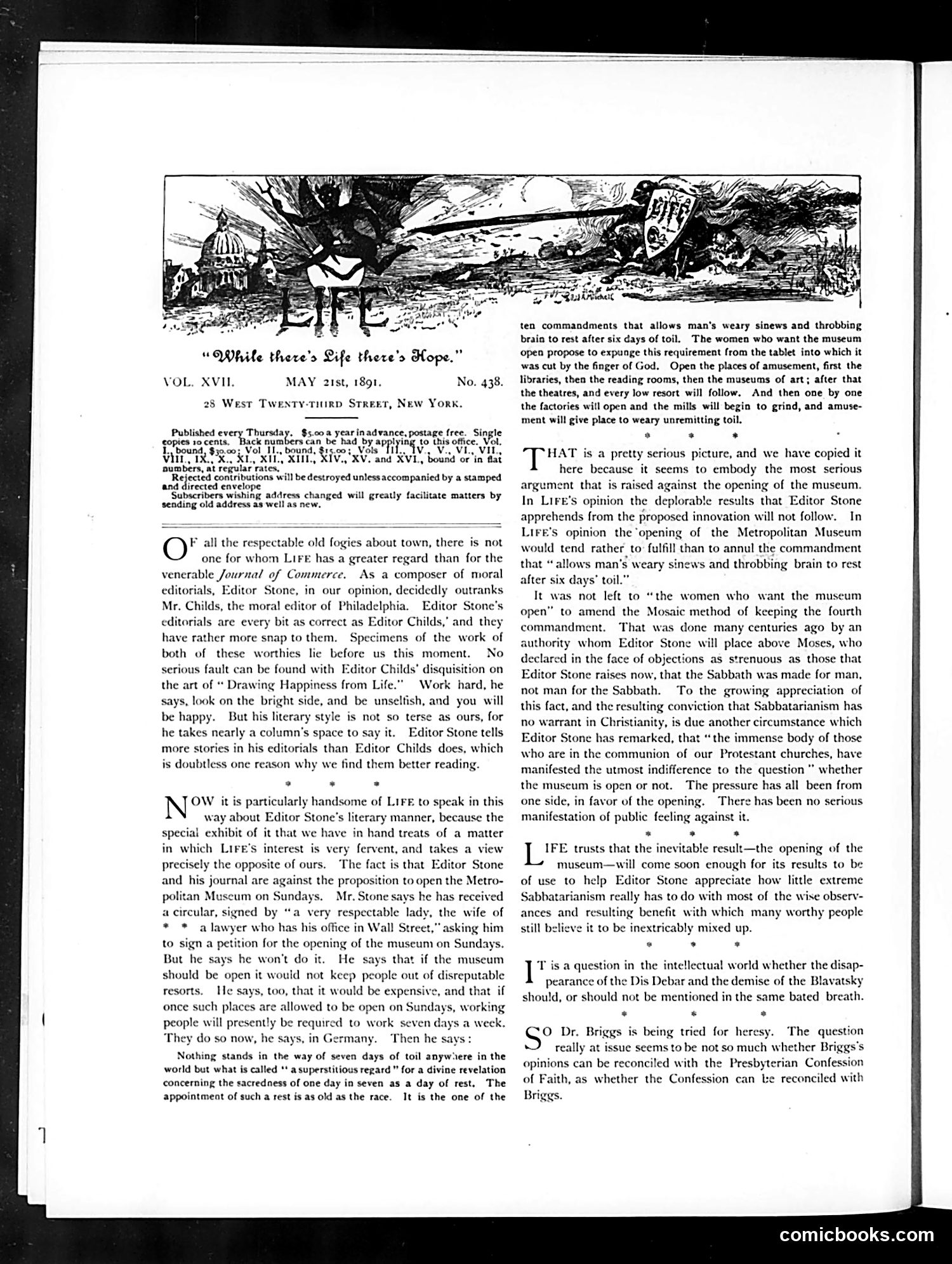
The masthead cartoon depicts a tree growing from an urban landscape with a classical dome (likely representing civic institutions), illustrating the magazine's title: "While there's Life there's Hope." The editorial content addresses a contemporary debate about opening the Metropolitan Museum on Sundays. Editor Stone opposes this, citing religious concerns about Sabbath observance. The text argues that allowing museums to open on Sundays violates the sacred nature of rest—a commandment given to allow workers respite from labor. The piece critiques both those wanting Sunday museum access and religious objections to it, discussing tensions between religious tradition, public welfare, and labor rights that characterized late 19th-century American social debates.
📄 Transcribed text from this page (OCR, searchable)
Machine-transcribed from the original scan — historical spelling and the odd misread are preserved.
“WMhile there's Life there's Hope.” VOL. XVII. 8 West Twenty-Tiirp STRE MAY 2st, 1891. No. 438. New York. Published ev: Thursday, $5.0oa year in advance, postage free. Single copies 10 cents. ck numbers can be had by applying to this office. Vol. 1, ‘bound, $30.00; Vol_II., bound, $15.00; Vols TIL 1V., V.. VI, VIL, VIL, IX. X.. XL, XID, XH, XIV.’ XV. and XVI, bound or ‘in flat umbers, at regular rates.” Rejected contributions will be destroyed unless accompanied by a stamped and directed envelope Subscribers wishing address changed will greatly facilitate matters by sending old address as well as new. F all the respectable old fogies about town, there is not one for whom LiFe has a greater regard than for the venerable Journal of Commerce. As a composer of moral editorials, Editor Stone, in our opinion, decidedly outranks Mr. Childs, the moral editor of Philadelphia. Editor Stone's editorials are every bit as correct as Editor Childs,’ and they have rather more snap to them. Specimens of the work of both of these worthies lie before us this moment. No serious fault can be found with Editor Childs’ disquisition on the art of * Drawing Happiness from Life.” Work hard, he says, look on the bright side, and be unselfish, and you will be happy. But his literary style is not so terse as ours, for he takes nearly a column’s space to say it. Editor Stone tells more stories in his editorials than Editor Childs does, which is doubtless one reason why we find them better reading. ° . * OW it is particularly handsome of LIFE to speak in this way about Editor Stone’s literary manner, because the special exhibit of it that we have in hand treats of a matter in which Lire’s interest is very fervent, and takes a view precisely the opposite of ours. The fact is that Editor Stone and his journal are against the proposition to open the Metro- politan Museum on Sundays. Mr. Stone says he has received a circular, signed by “a very respectable lady, the wife of * * a lawyer who has his office in Wall Street, ing him to sign a petition for the opening of the museum on Sundays. But he says he won't do it. He says that if the museum should be open it would not keep people out of disreputable resorts. He says, too, that it would be expensive, and that if once such places are allowed to be open on Sundays, working people will presently be required to work seven days a week. They do so now, he says, in Germany. Then he s Nothing stands in the way of seven days of toil anywiere in the world but what is called ** a superstitious regard" for a divine revelation concerning the sacredness of one day in seven as a day of rest. The appointment of such a rest is as old as the race. It is the one of the Pa ce ten commandments that allows man's weary sinews and throbbing brain to rest after six days of toil. The women who want the museum open propose to expunge this requirement from the tablet into which it was cut by the finger of God. Open the places of amusement, first the libraries, then the reading rooms, then the museums of art; after that the theatr d every low resort will follow. And then one by one the factories witl open and the mills will begin to grind, and amuse- ment will give place to weary unremitting toil. ° . . Ts is a pretty serious picture, and we have copied it here because it seems to embody the most serious argument that is raised against the opening of the museum. In Lire’s opinion the deplorable results that Editor Stone apprehends from the proposed innovation will not follow. In LiFe’s opinion the ‘opening of the Metropolitan Museum would tend rather to: fulfill than to annul the commandment that “allows man’s weary sinews and throbbing brain to rest after six days’ toil.” It was not left to “the women who want the museum open” to amend the Mosaic method of keeping the fourth commandment. That was done many centuries ago by an authority whom Editor Stone will place above Moses, who declared in the face of objections as strenuous as those that Editor Stone raises now, that the Sabbath was made for man, not man for the Sabbath. To the growing appreciation of this fact, and the resulting conviction that Sabbatarianism has no warrant in Christianity, is due another circumstance which Editor Stone has remarked, that “the immense body of those who are in the communion of our Protestant churches, have manifested the utmost indifference to the question ” whether the museum is open or not. The pressure has all been from one side, in favor of the opening. There h: manifestation of public feeling against it. . > . IFE trusts that the inevitable result—the opening of the museum—will come soon enough for its results to be of use to help Editor Stone appreciate how little extreme Sabbatarianism really has to do with most of the wise observ- ances and resulting benefit with which many worthy people still beli it to be inextricably mixed up. . . . as been no serious | ’ is a question in the intellectual world whether the disap- pearance of the Dis Debar and the demise of the Blavatsky should, or should not be mentioned in the same bated breath. . « . ~O Dr. Briggs is being tried for heresy. The question really at issue seems to be not so much whether Briggs opinions can be reconciled with the Presbyterian Confession of Faith, as whether the Confession can be reconciled with Briggs. comicbooks.com