
Life, 1891-05-21 · page 13 of 15
Life — May 21, 1891 — page 13: what you’re looking at
What you’re looking at
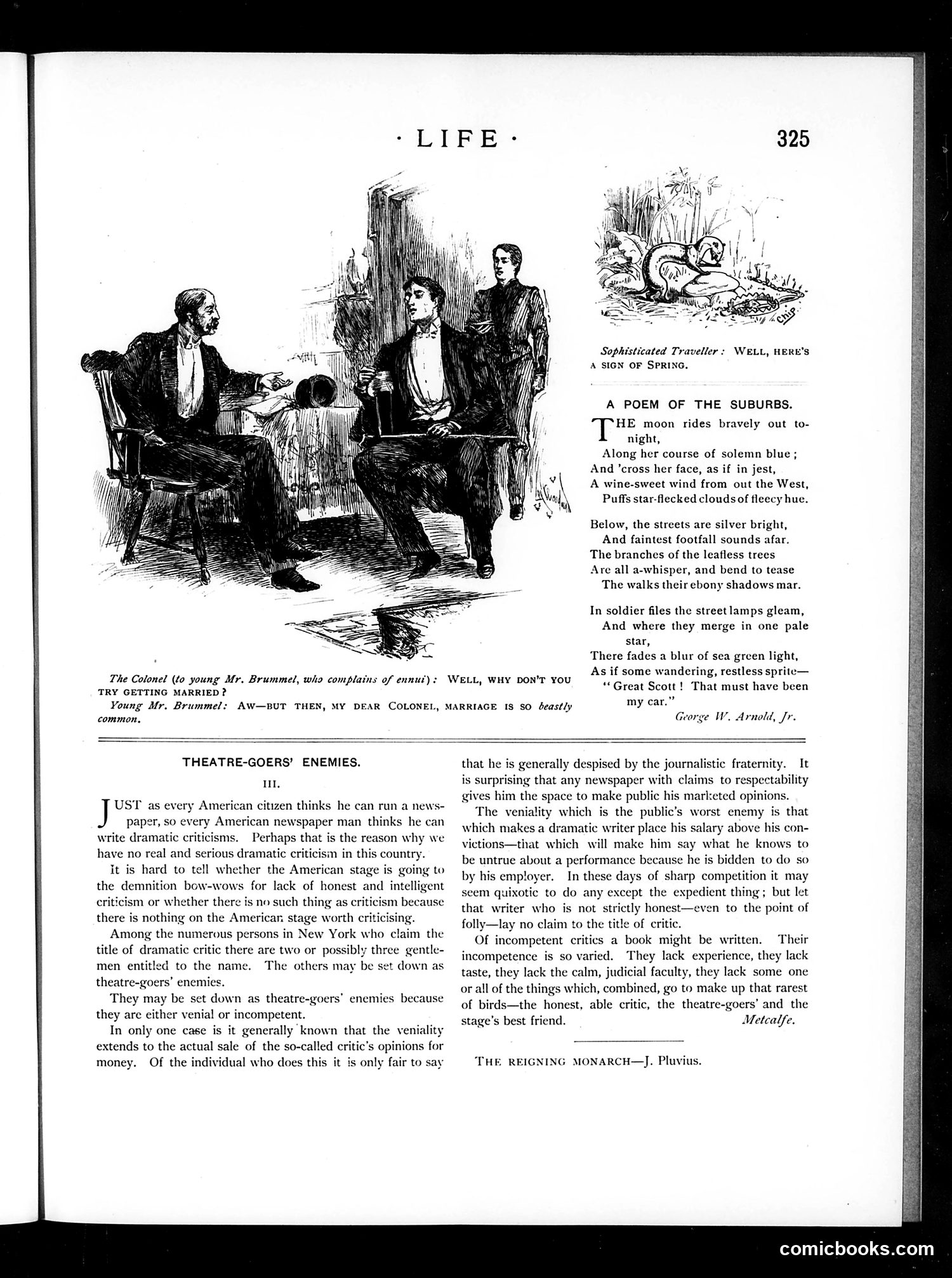
**Top Cartoon**: A Colonel counsels a bored young man (identified as "Mr. Brummel," referencing the famous Regency dandy) to cure his ennui by marrying. Brummel dismisses the idea as "beastly common"—satirizing upper-class pretension and the absurd complaints of wealthy idle men who reject practical solutions because they're beneath their social station. **Middle Section**: A humorous poem mocking suburban sentimentality. It romanticizes moonlit nights and quiet streets, then deflates itself with a punchline: the "wandering sprite" is actually the speaker's car—satirizing how modern intrusions (automobiles) interrupt pastoral reverie. **Main Article**: "Theatre-Goers' Enemies" criticizes New York drama critics. The piece argues most self-proclaimed critics are either dishonest (selling favorable reviews) or incompetent (lacking taste, experience, judgment). It distinguishes between mercenary critics and those who compromise integrity for employer demands, calling both enemies of theatre and audiences.
📄 Transcribed text from this page (OCR, searchable)
Machine-transcribed from the original scan — historical spelling and the odd misread are preserved.
The Colonel (to young Mr. Brummel, who complains of ennui): TRY GETTING MARRIED? Young Mr. Brummel: common, WELL, WHY DON’T YOU AW—BUT THEN, MY DEAR COLONEL, MARRIAGE IS SO beastly a3 Sophisticated Traveller: WELL, HERE'S : A SIGN OF SPRING. A POEM OF THE SUBURBS. HE moon rides bravely out to- night, Along her course of solemn blue; And ‘cross her face, as if in jest, A wine-sweet wind from out the West, Puffs star-flecked clouds of fleecy hue. Below, the streets are silver bright, And faintest footfall sounds afar. The branches of the leafless trees Are all a-whisper, and bend to tease The walks their ebony shadows mar. In soldier files the street lamps gleam, And where they merge in one pale star, ‘There fades a blur of sea green light, As if some wandering, restless sprite— “Great Scott! That must have been my car.” George W. Arnold, Jr. THEATRE-GOERS’ IIL, ENEMIES. UST as every American citizen thinks he can run a news- paper, so every American newspaper man thinks he can write dramatic criti s. Perhaps that is the reason why we have no real and serious dramatic criticism in this country. it is hard to tell whether the American stage is going to the demnition bow-wows for lack of honest and intelligent criticism or whether there is no such thing as criticism because there is nothing on the Americar. stage worth 1 Among the numerous persons in New York who claim the title of dramatic critic there are two or possibly three gentle- men entitled to the name, The others may be set down as theatre-goers’ enemies. They may be set down as theatre-goers’ enemies because they are either venial or incompetent. In only one case is it generally known that the veniality extends to the actual sale of the so-called critic’s opinions for money. Of the individual who does this it is only fair to say that he is generally despised by the journalistic fraternity. It is surprising that any newspaper with claims to respectability s him the space to make public his marketed opinions. The veniality which is the public’s worst enemy is that which makes a dramatic writer place his salary above his con- victions—that which will make him say what he knows to be untrue about a performance because he is bidden to do so by his employer. In these days of sharp competition it may seem quixotic to do any except the expedient thing; but let that writer who is not strictly honest—even to the point of folly—lay no claim to the title of critic. Of incompetent critics a book might be written. Their incompetence is so varied. They lack experience, they lack taste, they lack the calm, judicial faculty, they lack some one or all of the things which, combined, go to make up that rarest of birds—the honest, able critic, the theatre-goers’ and the stage’s best friend. Metcalfe. ‘THE REIGNING MONARCH—J. Pluvius. comicbooks.com