
A complete issue · 22 pages · 1891
Life — March 26, 1891
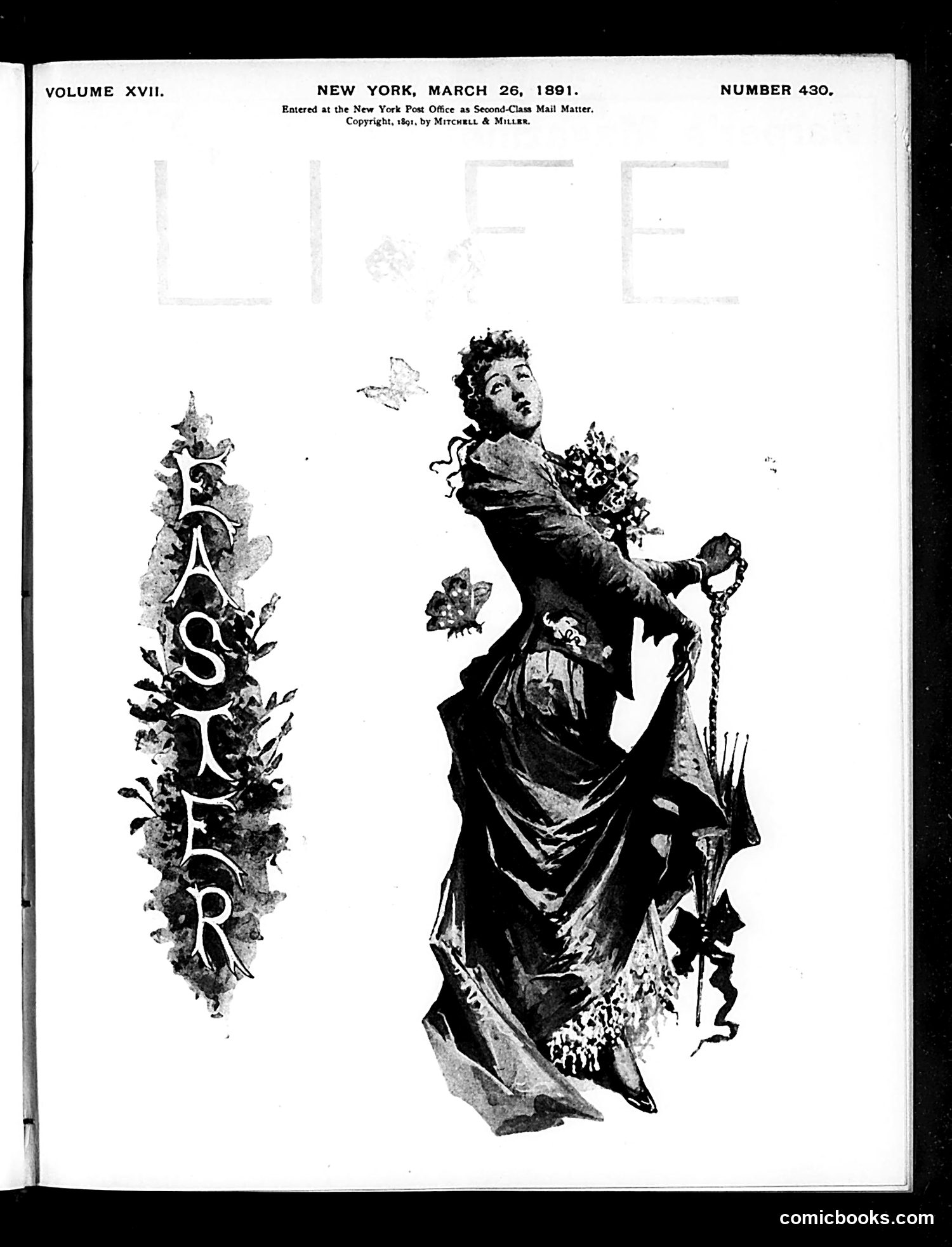
This page features an ornamental vertical design reading "LIFE" on the left and an illustration of a woman on the right. The woman is depicted in an exaggerated, theatrical pose wearing flowing draped clothing and holding flowers and what appears to be a decorative staff or wand. She gazes upward in an affected manner. The imagery appears to satirize theatrical or artistic pretension—likely mocking overly dramatic performances or affected aestheticism popular in the 1890s. The woman's exaggerated pose and costume suggest ridicule of artificially "artistic" behavior or perhaps specific theatrical trends of the era. Without additional context text on this page, the precise target remains unclear, though the satire targets someone or something considered fashionably but absurdly pretentious.
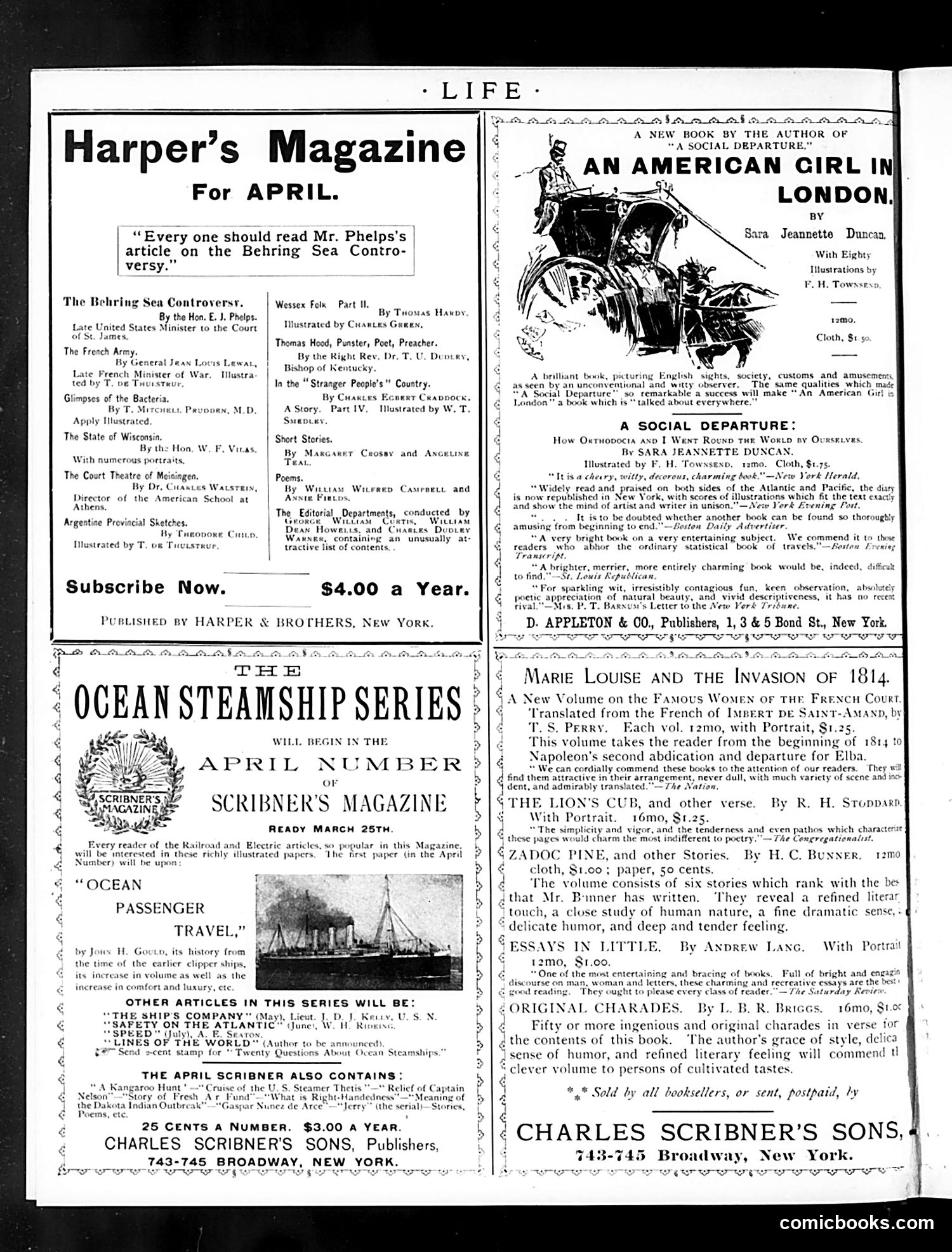
This page is primarily **advertising and book announcements** rather than political satire or comics. The left side advertises Harper's Magazine for April, highlighting an article by "the Hon. E. J. Phelps" on "The Behring Sea Controversy" — a diplomatic dispute (likely involving seal hunting rights in the Bering Sea between the U.S. and Britain). The right side promotes books, including "An American Girl in London" by Sara Jeannette Duncan with illustrations. Below that are advertisements for Scribner's Magazine and various published books. The only illustration is a modest sketch accompanying the book promotion—showing a woman in a carriage, presumably depicting a scene from Duncan's book about an American woman's experiences in London society. This is primarily a **publishing and subscription advertisement page**, not satirical commentary.
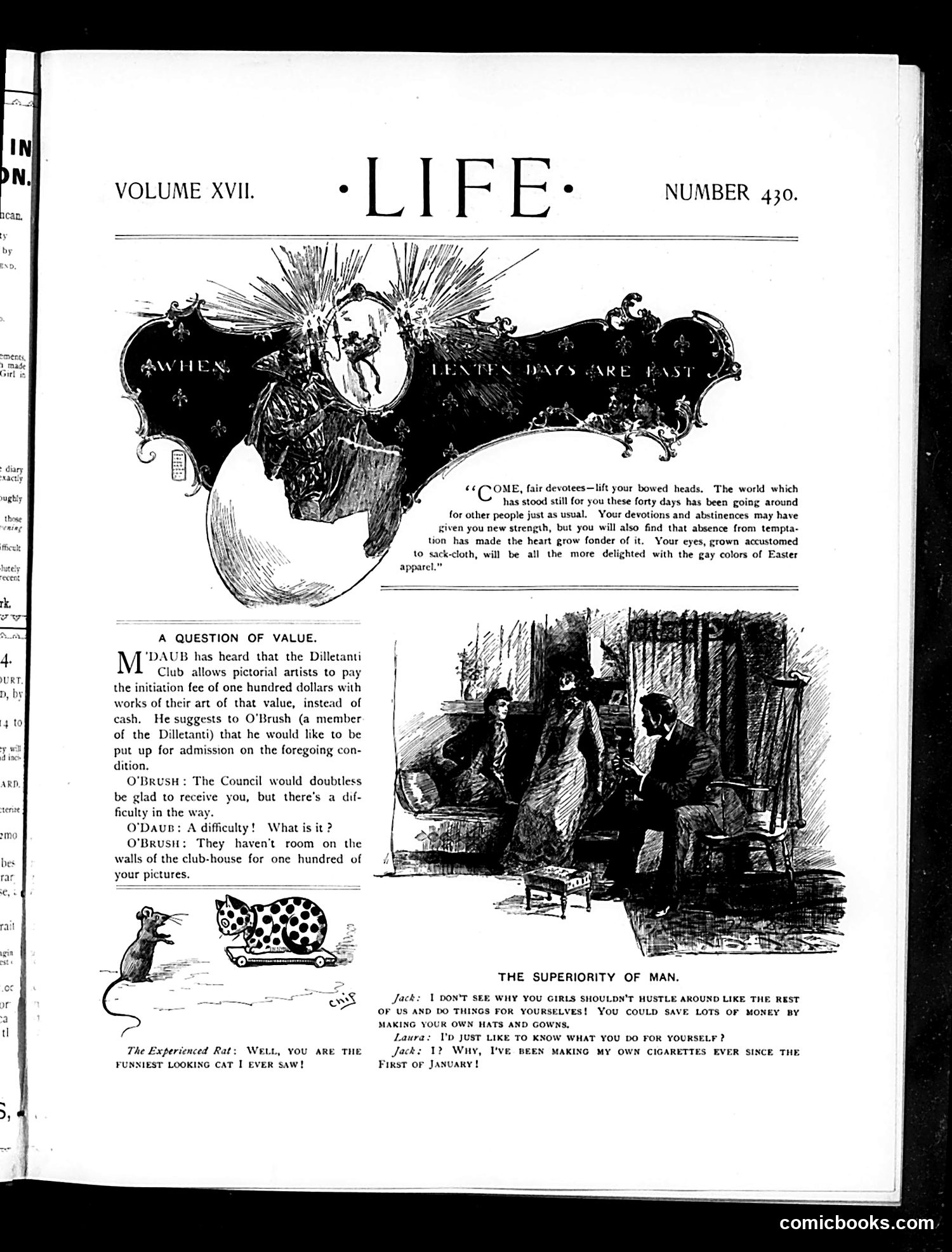
This page contains three satirical pieces: 1. **Top banner illustration**: "When Leaves Days Are Fast" — a pastoral Easter scene with religious overtones, accompanied by text about devotion and spiritual renewal during the holiday season. 2. **"A Question of Value"**: A dialogue between M'Daub and O'Brushi about the Dilettanti Club's policy allowing artists to pay membership fees with artwork rather than cash. O'Brushi jokes that the club simply lacks wall space for more paintings—satirizing both pretentious art clubs and struggling artists. 3. **"The Superiority of Man"**: A comic dialogue between Jack and Laura about self-sufficiency. Jack boasts of making his own cigarettes since January; Laura sarcastically suggests he could save money by making his own hats and gowns—mocking masculine claims of independence. The page uses humor to critique social pretension and gender dynamics.
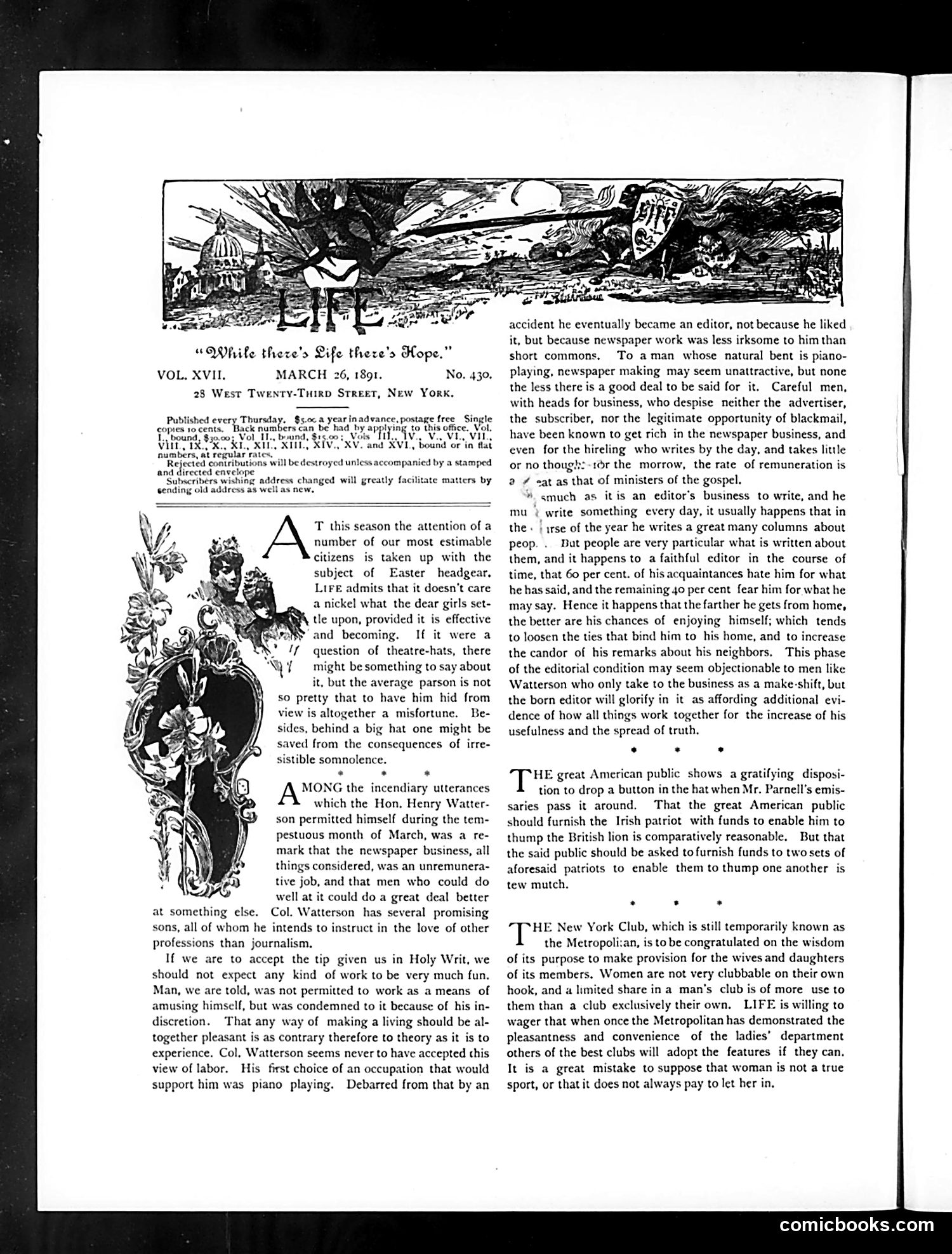
The main illustration depicts a woman in Victorian dress with elaborate Easter bonnets and flowers. The accompanying text discusses Easter headgear—specifically criticizing how impractical and expensive fashionable hats are. The satire targets wealthy society women's vanity and the fashion industry's influence. The text also contains editorial commentary on journalism and editors, discussing Col. Watterson (likely Henry Watterson, a prominent Louisville editor). It argues that newspaper work attracts men unsuited for it, and praises editors who maintain ethical standards despite pressure. A secondary note mentions the American public's disposition toward Irish patriot causes and the New York Club's policies regarding women members—satirizing gender exclusivity in elite clubs. The overall tone is typical 1891 Life magazine: mocking both fashion excess and social pretension.
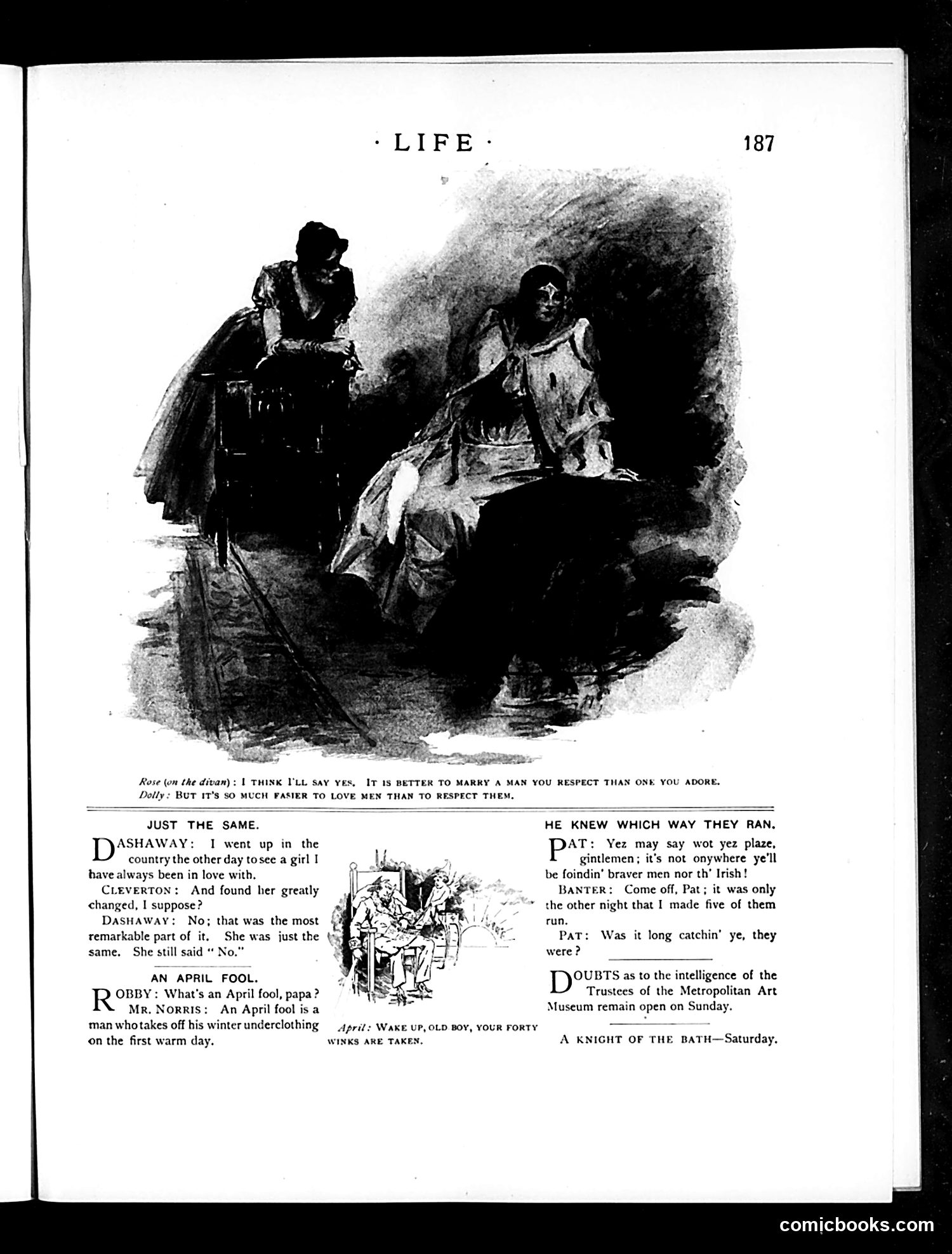
The top illustration depicts a dialogue about marriage, with a woman stating it's "better to marry a man you respect than one you adore." This appears to be social commentary on matrimonial expectations, contrasting respect-based versus passion-based marriages—typical satirical fare for early-20th-century Life magazine. The lower sections contain dialogue snippets labeled "Just the Same," "An April Fool," and "He Knew Which Way They Ran." These are brief humorous exchanges between characters (Dashaway, Cleverton, Robby, Mr. Norris, Pat, Hanter) discussing everyday situations—changed acquaintances, April foolery, and apparently military or adventurous exploits. The small vignette illustration shows figures in what appears to be a domestic or social scene. Without clearer identification of specific historical figures or events, the humor relies on period-appropriate social observation rather than topical satire.
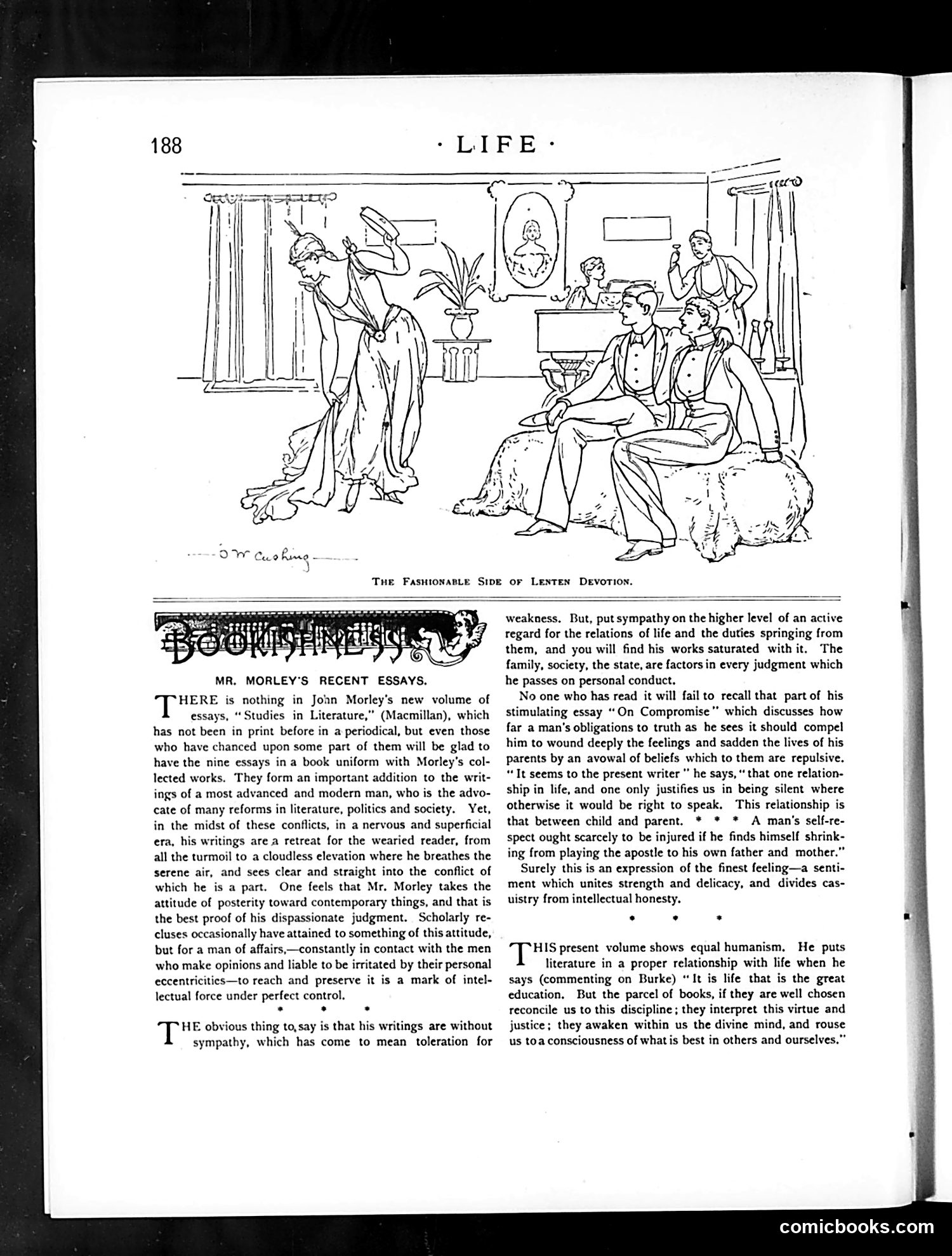
This cartoon satirizes wealthy society's approach to religious observance during Lent. The illustration shows fashionably-dressed people in an elegant parlor appearing to engage in devotional practice—one woman strikes a theatrical pose suggesting prayer or penitence. However, the scene's opulence (fine furniture, mirrors, potted plants) and the people's stylish attire undercut any genuine piety. The satire suggests these individuals treat Lenten devotion as a social performance or fashion statement rather than sincere spiritual commitment. The title's emphasis on "fashionable" and the theatrical body language mock the contradiction between outward religious display and the material comfort surrounding them. This reflects broader Progressive-era critiques of elite hypocrisy regarding moral and religious practice.
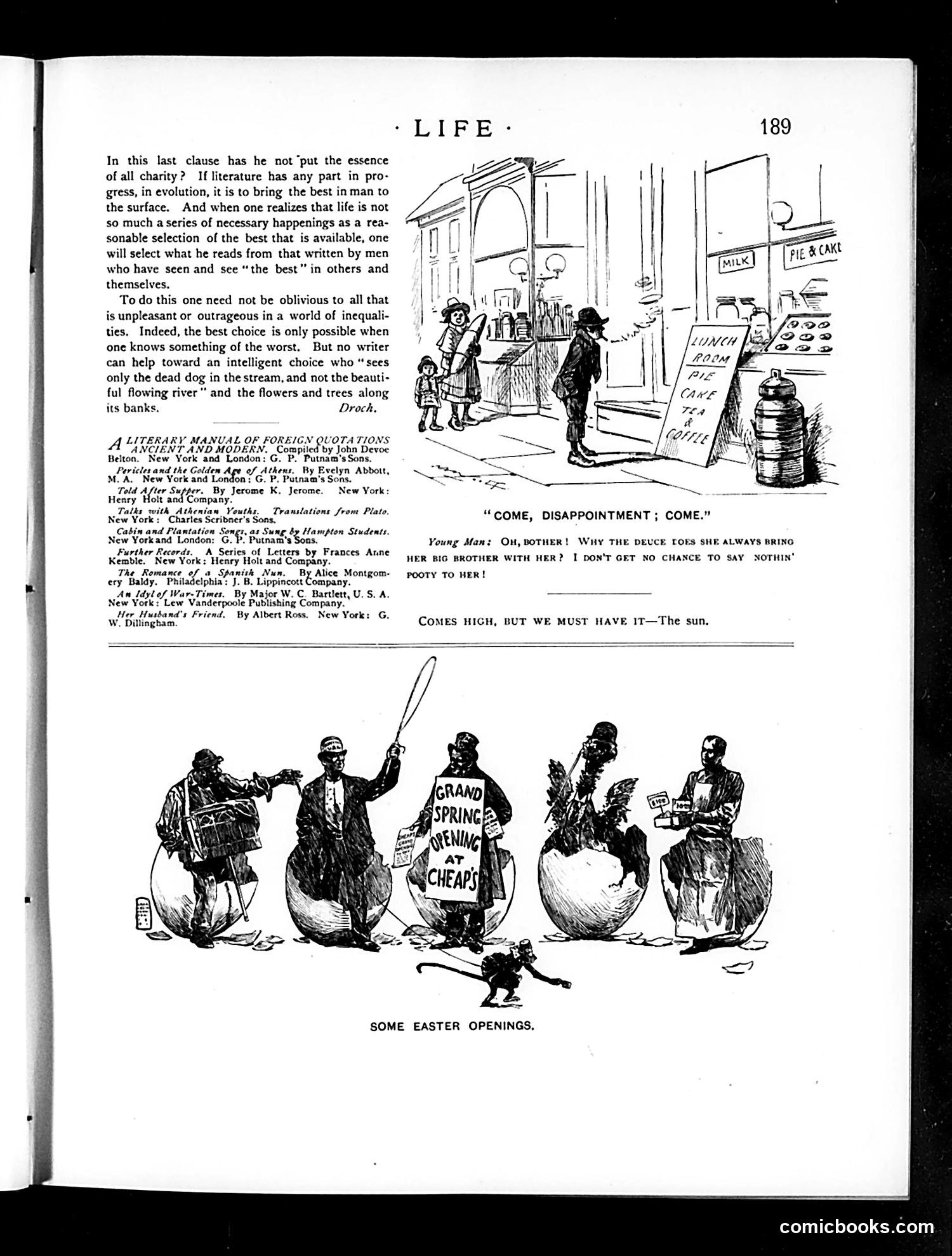
This page from *Life* magazine contains two cartoons satirizing consumer culture and retail commerce. **Top cartoon**: Shows a shop window where a young man complains about his sister always bringing her "big brother" along on outings, preventing him from spending time alone with her. The brother says "COMES HIGH, BUT WE MUST HAVE IT—The sun," suggesting the brother is an unwanted third wheel who costs money. **Bottom cartoon** ("Some Easter Openings"): Depicts five figures emerging from eggs like chicks, each representing different commercial enterprises—one holds a "Grand Spring Opening at Cheaps" sign. A rat scurries below. The satire mocks the proliferation of retail shops and commercial establishments that proliferate seasonally, particularly around Easter, treating them as parasitic or opportunistic business ventures. Both cartoons critique commercialism and consumer culture.
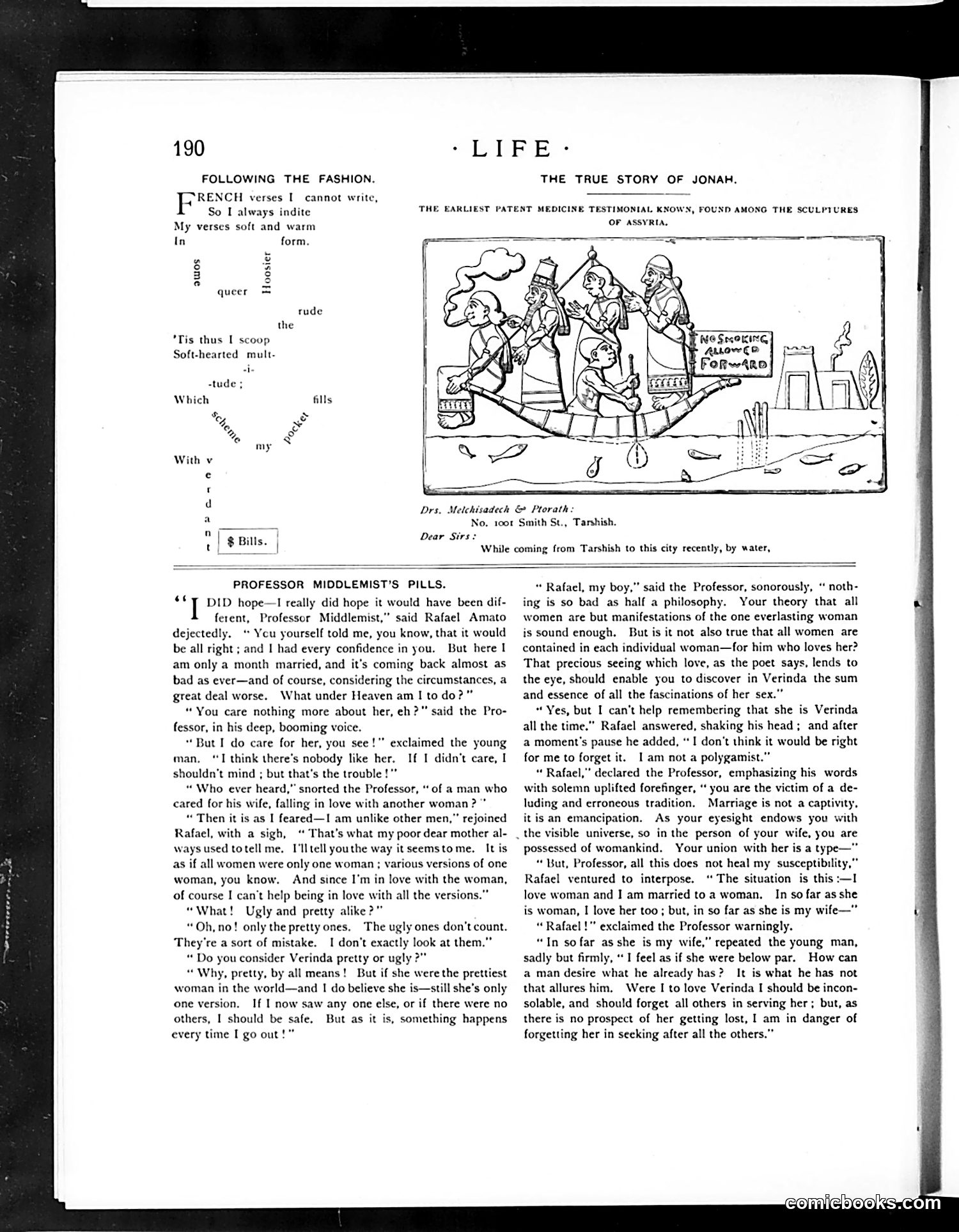
This page contains two unrelated items: **Left side:** "Following the Fashion" is a humorous poem about writing French verses, with awkward syntax arranged vertically to mock pretentious attempts at French poetry composition. **Right side:** "The True Story of Jonah" is a satirical cartoon-advertisement for "Professor Middlesmist's Pills." The illustration depicts Jonah and the whale in an absurdly modern style, with people in a boat and commercial signage. Below it, an extended dialogue between "Rafael Amato" and "Professor Middlesmist" parodies Victorian self-help advice, specifically mocking patent medicine testimonials and philosophy about love and relationships. The satire targets credulous consumers who bought questionable medicinal products backed by dubious "testimonials," a widespread American advertising practice. By packaging romantic philosophy as medical advice, Life ridicules both the pills themselves and the pseudointellectual language used to market them.
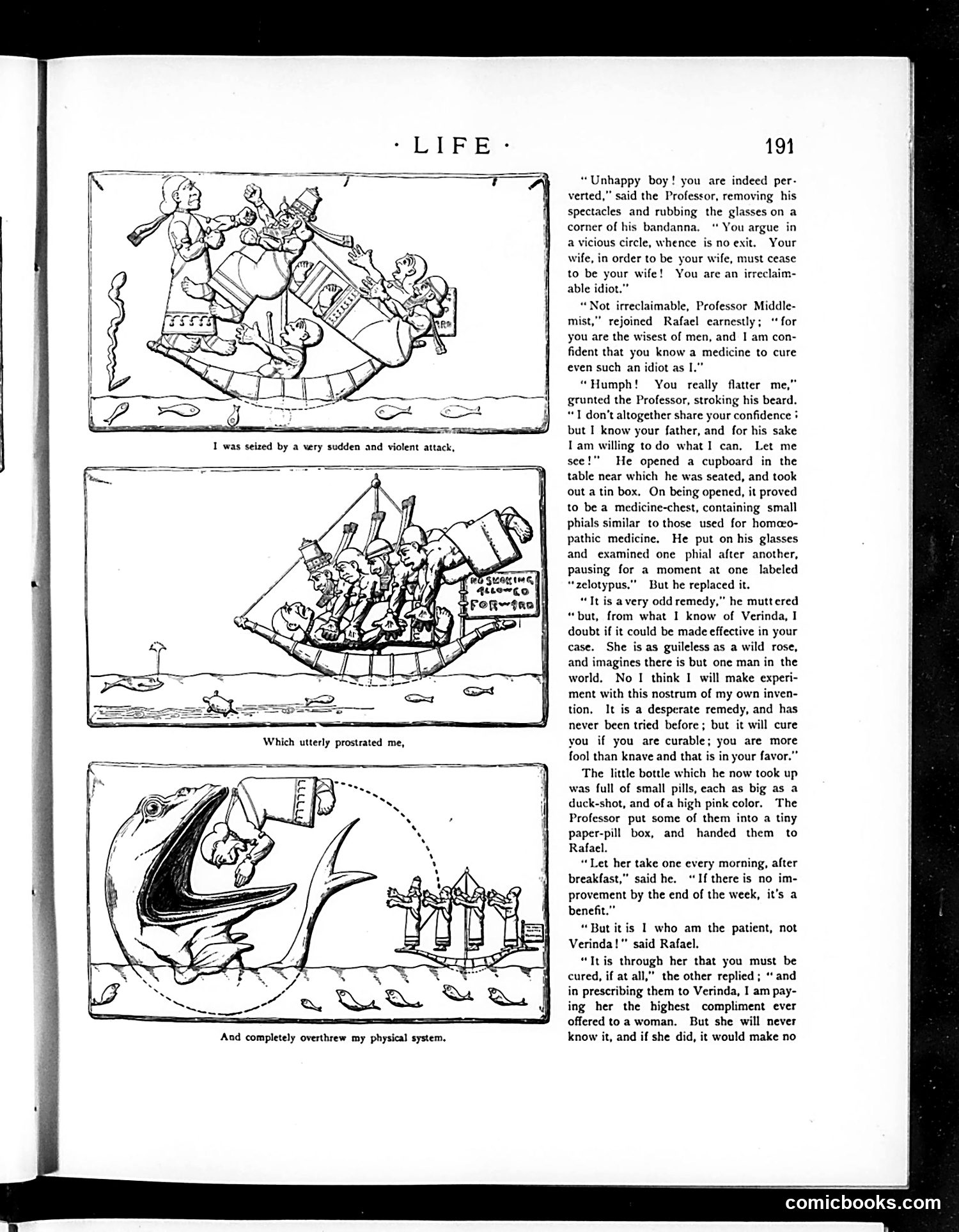
This page contains three satirical illustrations accompanying a narrative dialogue between Rafael and Professor Middlemist about treating an unnamed woman (Verinda) with experimental medicine. The cartoons depict Rafael being violently attacked—"seized by a very sudden and violent attack," "utterly prostrated," and having his "physical system" completely overthrown. The illustrations show fantastical, chaotic scenes of upheaval and distress. The satire appears to mock both homeopathic medicine (referenced explicitly in the text) and perhaps the desperation of medical practitioners. The joke centers on Rafael's suffering as a test subject for an unproven remedy the Professor believes will work on Verinda, playing on period anxieties about experimental treatments and medical authority.
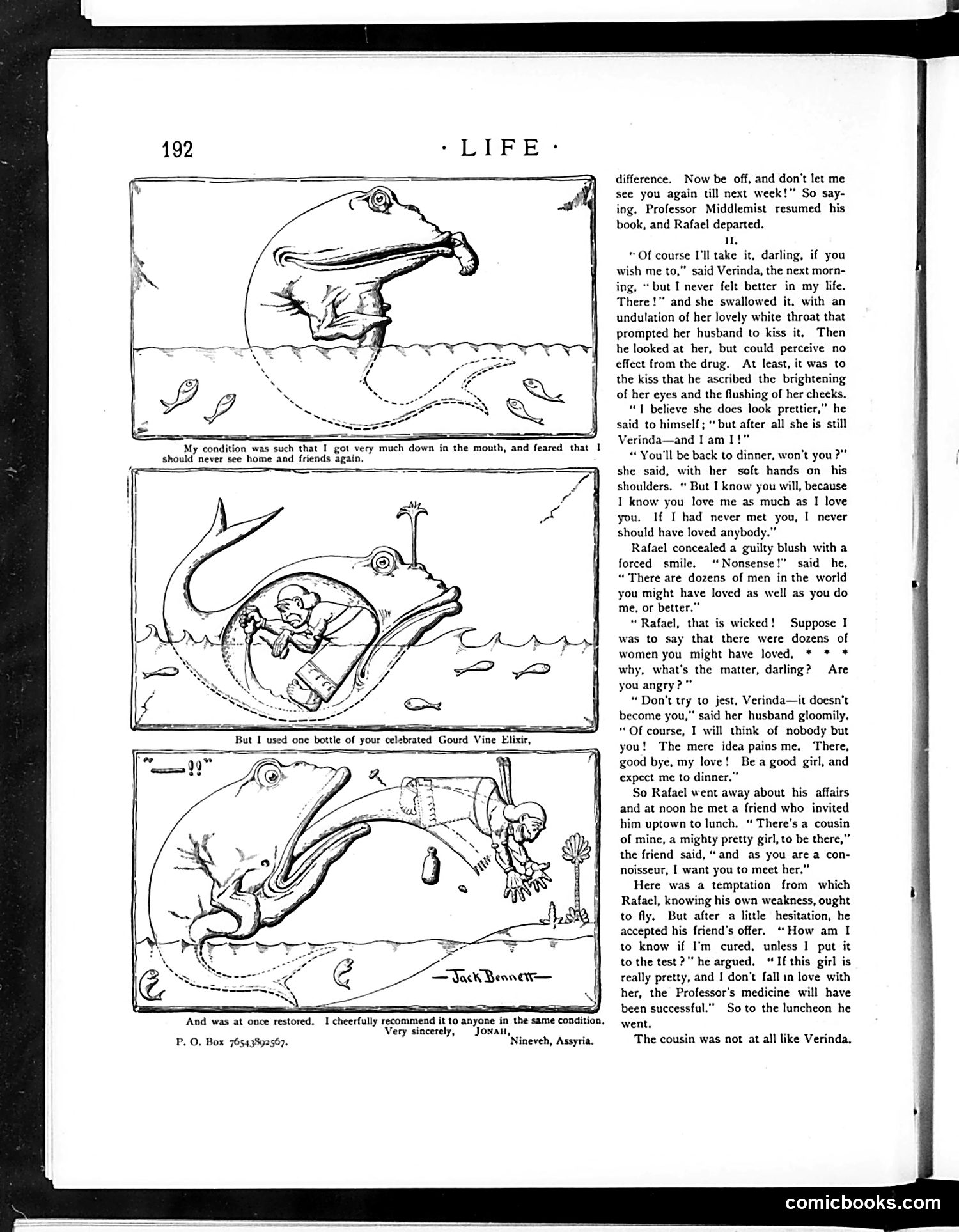
This page contains a three-panel comic strip by Jack Bannon (signed at bottom) depicting a frog that has been dramatically restored to health through "Gourd Vine Elixir," a patent medicine. The sequential narrative shows: the frog in poor condition; the frog after using the elixir, now cradling a human infant; and finally the frog fully restored and energized. The accompanying testimonial letter claims the writer was cured of a severe monthly ailment and now cheerfully recommends the product "to anyone in the same condition." This is **patent medicine advertising disguised as entertainment**—a common early 20th-century practice. The exaggerated before-and-after transformation satirizes the absurd medical claims these products made, while the comic format was designed to make the advertisement more memorable and shareable than straightforward ads.
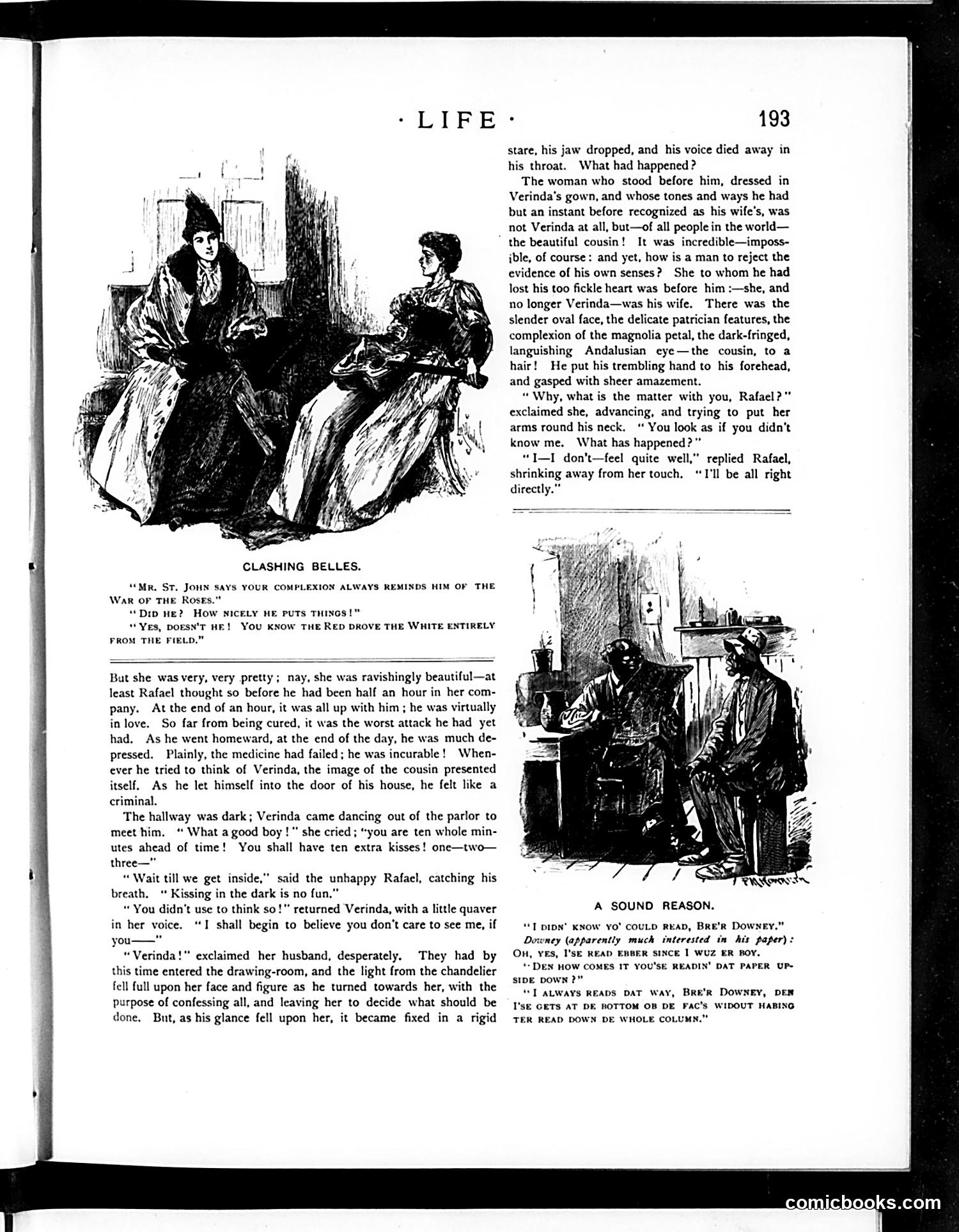
This page contains two narrative illustrations from a serialized short story rather than political satire. The top cartoon, titled "CLASHING BELLES," depicts a domestic drama where Rafael encounters his wife Verinda with her cousin. Rafael is emotionally devastated upon recognizing the cousin instead of his wife, triggering a crisis of identity and marital doubt. The bottom illustration, "A SOUND REASON," shows a humorous domestic exchange about newspaper reading habits, with dialogue about who reads the paper and how. The content is social comedy focused on domestic relationships and marital misunderstandings—typical of early-20th-century magazine fiction. There is no apparent political satire or historical reference requiring modern contextualization. This is simply a serialized story page with accompanying illustrations.
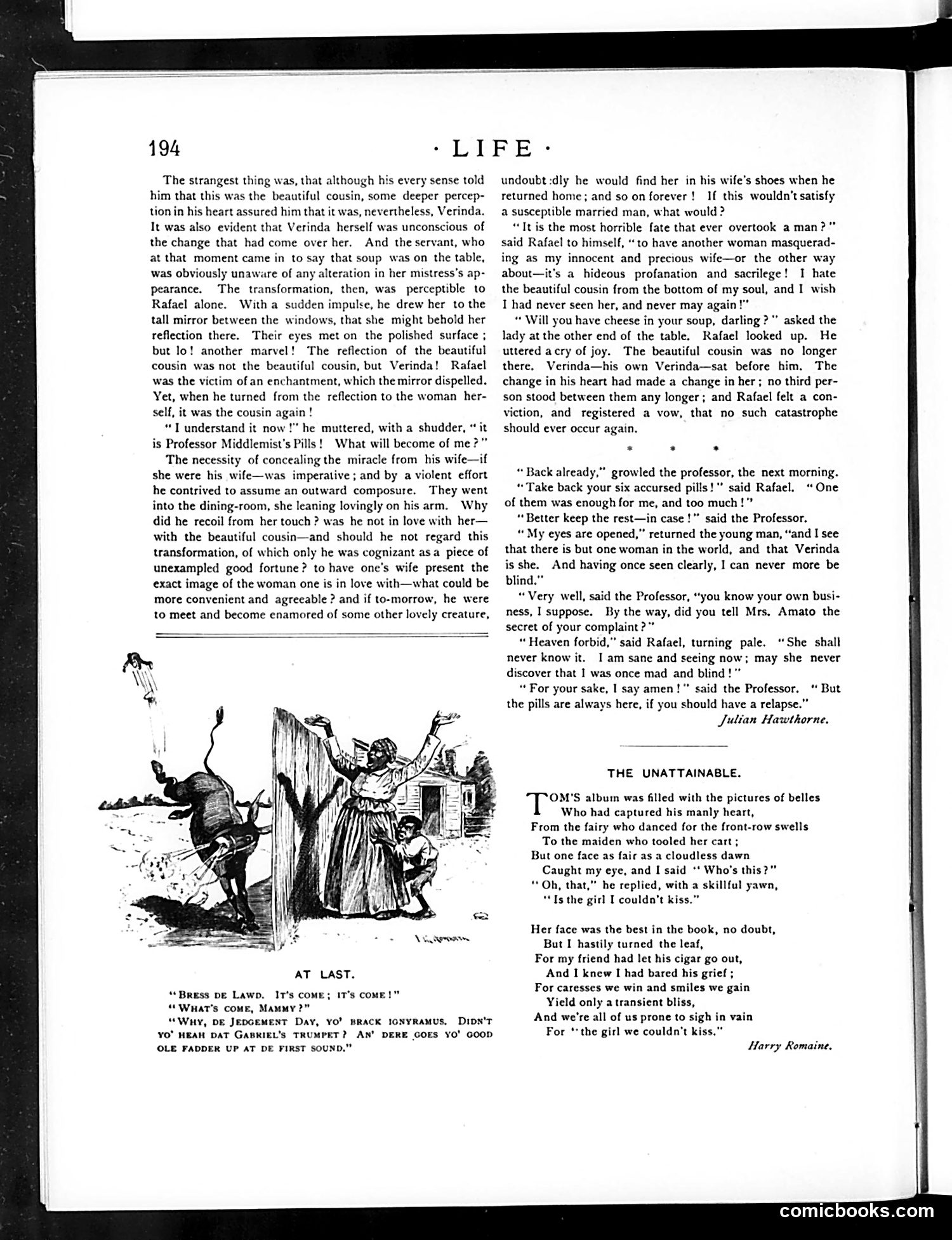
This page contains a serialized fiction story about Rafael, who uses "Professor Middlemist's Pills" that create a magical illusion—making his wife Verinda appear as her beautiful cousin. The satirical point: Rafael initially finds this convenient (he can admire another woman while his wife wears her "shoes"), but ultimately recognizes the horror of deception and recommits to authentic marriage. The small cartoon labeled "AT LAST" depicts a Black figure receiving news of Judgment Day—likely referencing period racial stereotypes through dialect humor and imagery. This represents the magazine's casual use of racist caricature common to early 20th-century American satire. The story's real satire targets masculine fickleness and the dangers of seeking idealized women rather than valuing one's actual spouse. The tale concludes with Rafael's moral awakening and destruction of the pills. The poems attributed to "Julian Hawthorne" and "Harry Romaine" provide literary commentary on romantic disillusionment.
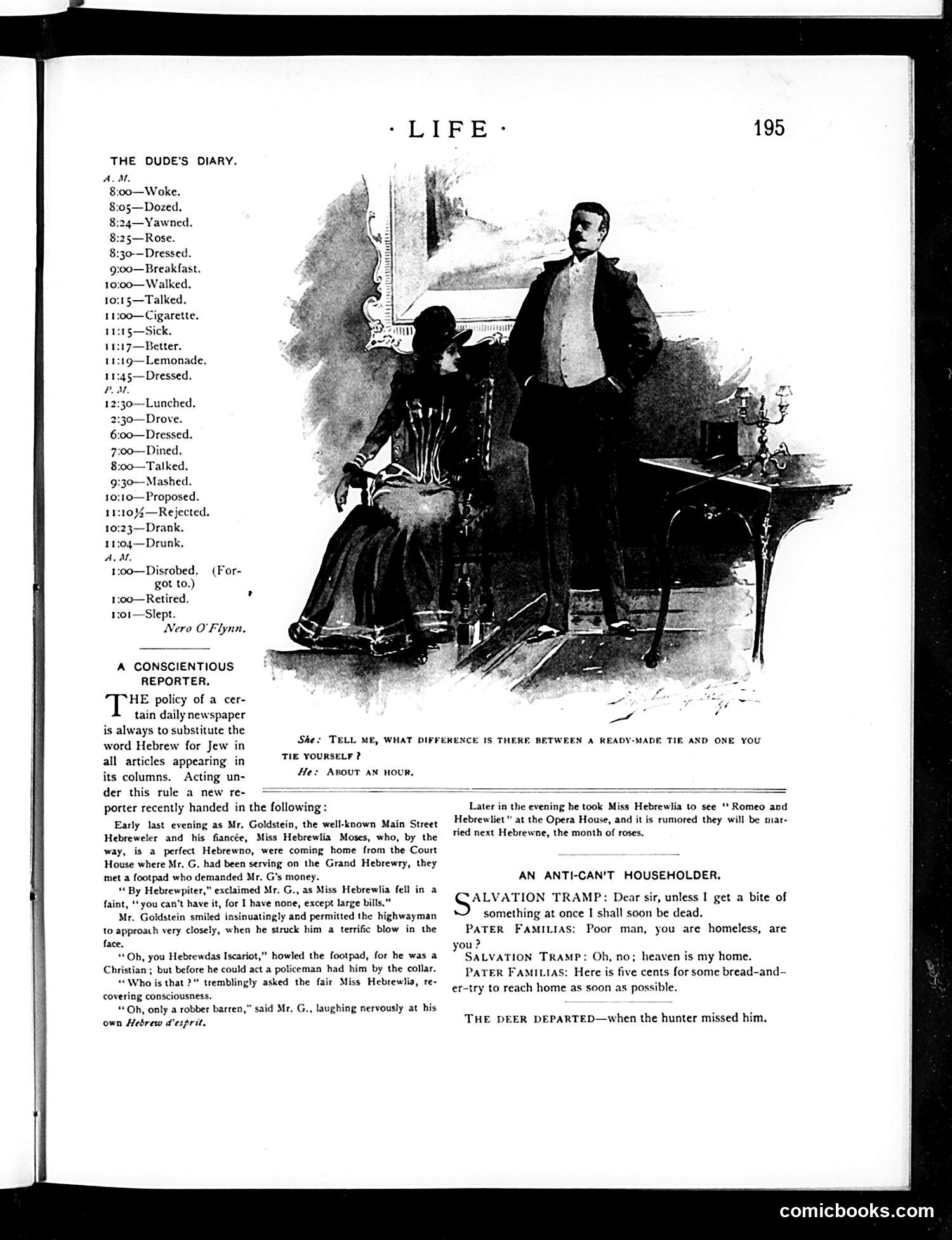
This page contains three separate satirical pieces: **"The Dude's Diary"** mocks an idle wealthy man whose day consists entirely of trivial activities (waking, dressing, smoking, talking) climaxing in a rejected marriage proposal and drunkenness—satirizing the purposeless leisure class. **"A Conscientious Reporter"** is sharper political satire. It lampoons a newspaper's policy of substituting "Hebrew" for "Jew" throughout all articles. By mechanically applying this rule to absurd effect—"Grand Hebrewry," "Hebrewliet," "Hebrewne"—the satire exposes how such editorial policies create ridiculous results and reveals the underlying prejudice and euphemism they mask. The joke's bite lies in showing how linguistic sanitization fails logically while perpetuating discrimination. **"An Anti-Can't Householder"** satirizes hypocrisy: a beggar claims his "home is heaven," allowing the householder to feel virtuous giving charity while dismissing actual homelessness. The illustration depicts the first piece, showing the dude with a woman at a piano.
The image shows a dilapidated house or building with overgrown ivy and vegetation, photographed at an angle. The accompanying text (partially visible) begins with "Here is where..." and mentions something about "a place of amusement" and references to "every part" and what appears to be discussion of conditions or decay. However, the OCR text provided only shows "comicbooks.com," which is a modern website identifier and clearly not the original magazine text. Without legible caption text, I cannot definitively identify what specific political, social, or satirical point this image makes or what figures it references. The deteriorated building could represent social decay, neglect, or critique of a specific institution, but **I cannot assert the exact meaning without readable accompanying text**. The source attribution and proper context are needed for accurate interpretation.
I can see this is a black and white image from what appears to be a historical publication, showing what looks like a sculptural or artistic relief with draped figures. However, the image quality and orientation make it difficult to discern specific details clearly. Without being able to read accompanying text or captions that would identify the figures, subjects, or satirical point, I cannot confidently explain what political or social commentary this represents. The OCR text only shows "comicbooks.com," which appears to be a watermark rather than page content. To properly analyze this as political satire, I would need: legible text identifying the subjects, clearer image resolution, and context about which Life magazine issue this appeared in. I cannot responsibly speculate about the specific figures or satirical intent without these details.
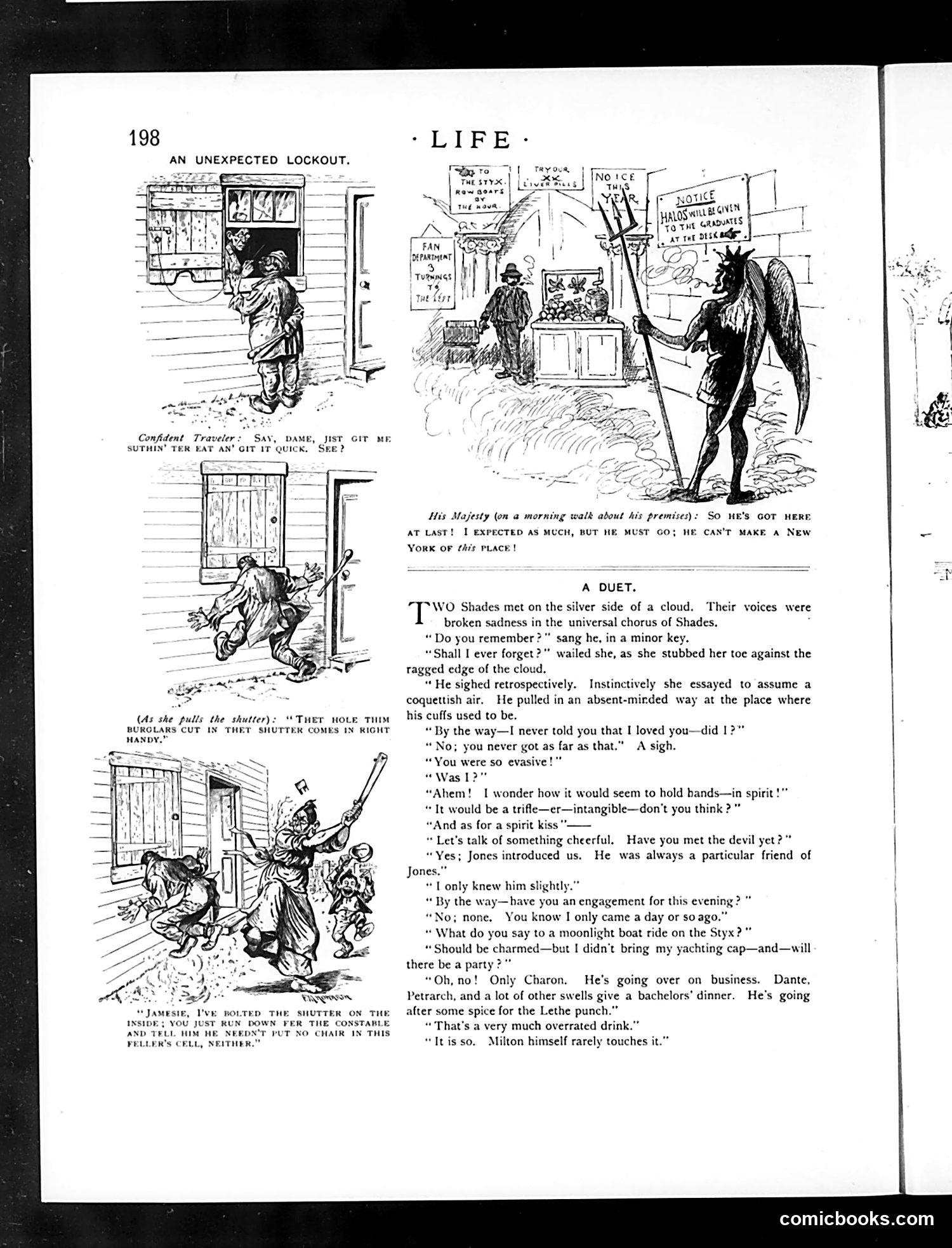
This page contains three separate humorous sketches satirizing early 20th-century social situations: **"An Unexpected Lockout"**: A confident hobo demands quick food from a homeowner ("dame"), but is rebuffed by the owner ("His Majesty"), who declares the vagrant "can't make a New York of this place"—suggesting fear that transients would disrupt orderly domestic life. **Burglar sketches**: Comic panels showing a burglar attempting break-ins, with captions about cutting shutters and pulling bolts—standard slapstick crime humor. **"A Duet"**: The longest piece satirizes overly sentimental romantic discourse. Two deceased spirits meet in the afterlife exchanging clichéd romantic laments and trivial small talk ("moonlight boat ride on the Styx"), mocking flowery Victorian sentiment and the banality of romantic conversation. References to classical figures (Charon, Dante, Petrarch, Milton) underscore the pretentiousness being ridiculed. The satire targets superficiality and affectation in social interaction across classes.
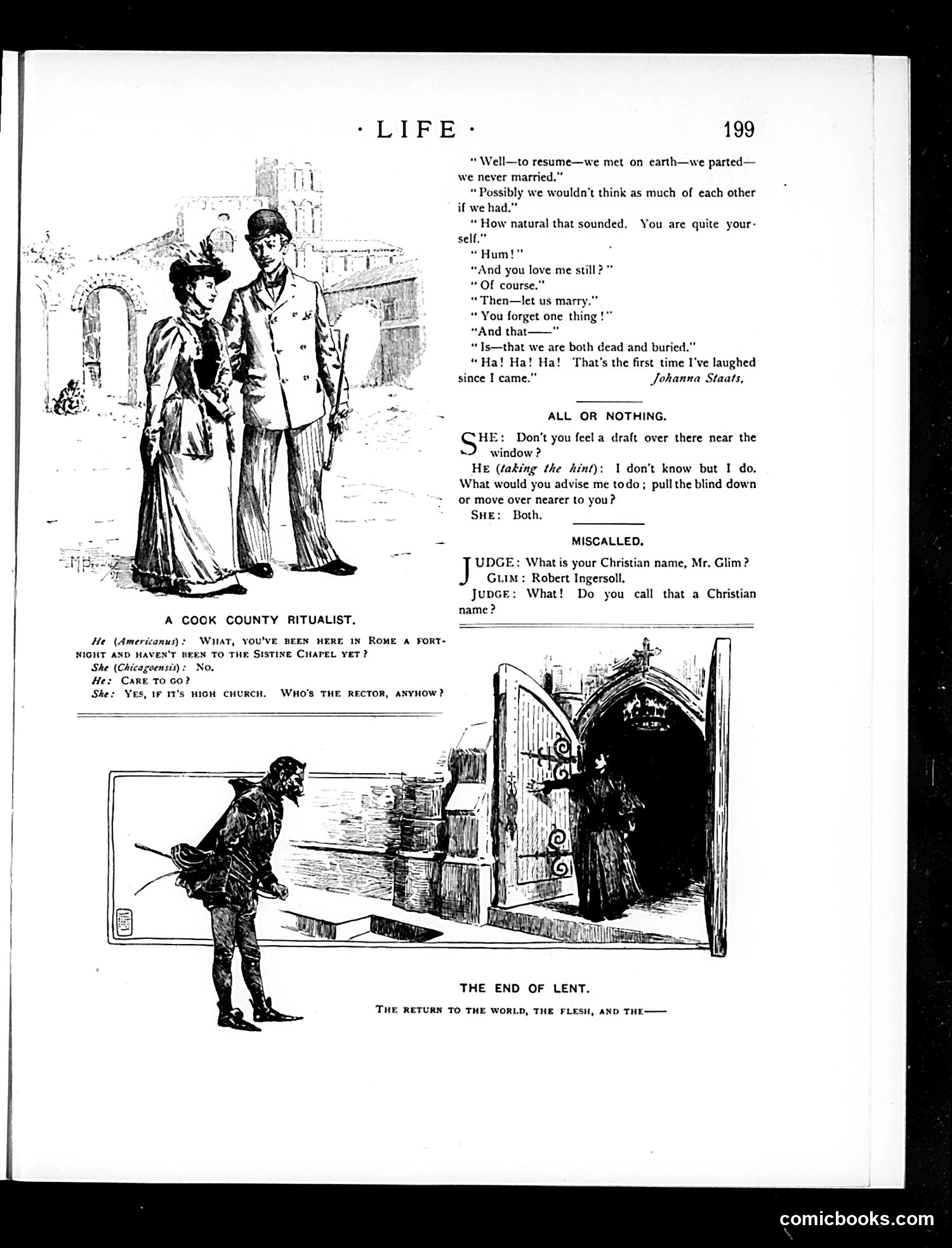
This page contains three unrelated satirical sketches typical of Life's humor: 1. **"All or Nothing"**: A flirtation joke where a man and woman discuss their afterlife romance, with the punchline that they're both dead—allowing them to be together without earthly complications. 2. **"Miscalled"**: A courtroom gag mocking Robert Ingersoll, a famous 19th-century American agnostic and freethinker. The judge ridicules his name "Robert Ingersoll" as unsuitable for someone called "Christian," satirizing both Ingersoll's atheism and formal naming conventions. 3. **"A Cook County Ritualist"**: Mocks a Chicagoan tourist in Rome who hasn't visited the Sistine Chapel but insists on doing so only if it's "high church" and wants to know the "rector"—confusing Catholic ritual with Protestant church hierarchy. The satire targets American religious ignorance abroad. 4. **"The End of Lent"**: An illustration suggesting the return to worldly pleasures after the Lenten season's abstinence.
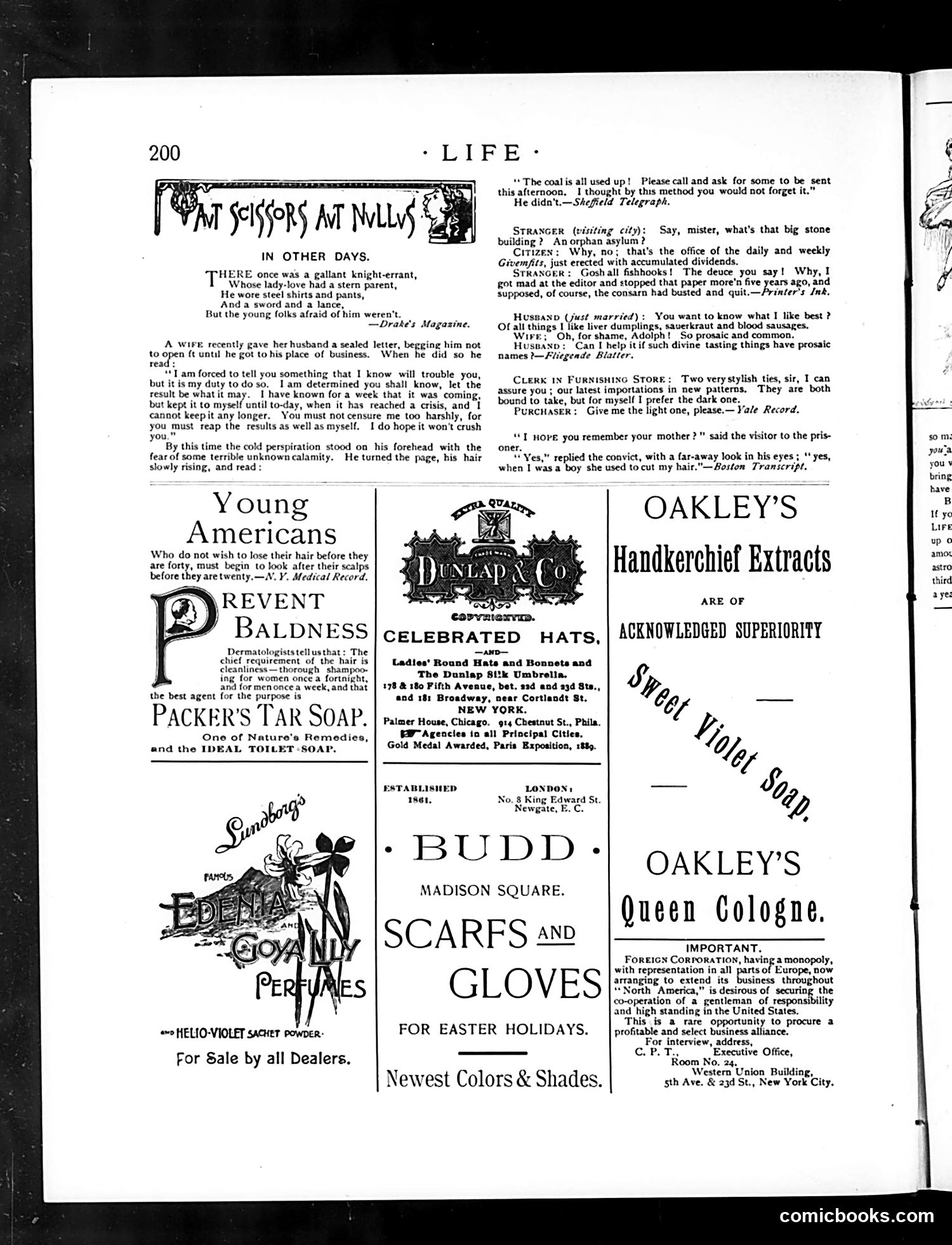
This page is primarily **advertisements and humorous anecdotes** rather than political satire. The page number indicates it's from *Life* magazine, circa late 19th century. **Main content:** - **"In Other Days"**: A romantic poem about a knight whose young lady isn't intimidated by him—gentle humor about courtship - **Humorous short pieces**: Domestic jokes including a wife's prank letter about coal running out, and a convict's memory of his mother cutting his hair - **Advertisements**: For baldness remedies (Packer's Tar Soap), Dunlap hats, Budd scarves/gloves, perfumes, and Oakley's handkerchiefs and cologne **The satire** (minimal here) includes mild workplace and marriage humor—a recurring *Life* feature mocking ordinary social situations. The anecdotes target absent-minded husbands and pompous clerks rather than political figures. This is essentially an **advertising-heavy magazine page** with light domestic humor typical of Victorian-era publications.
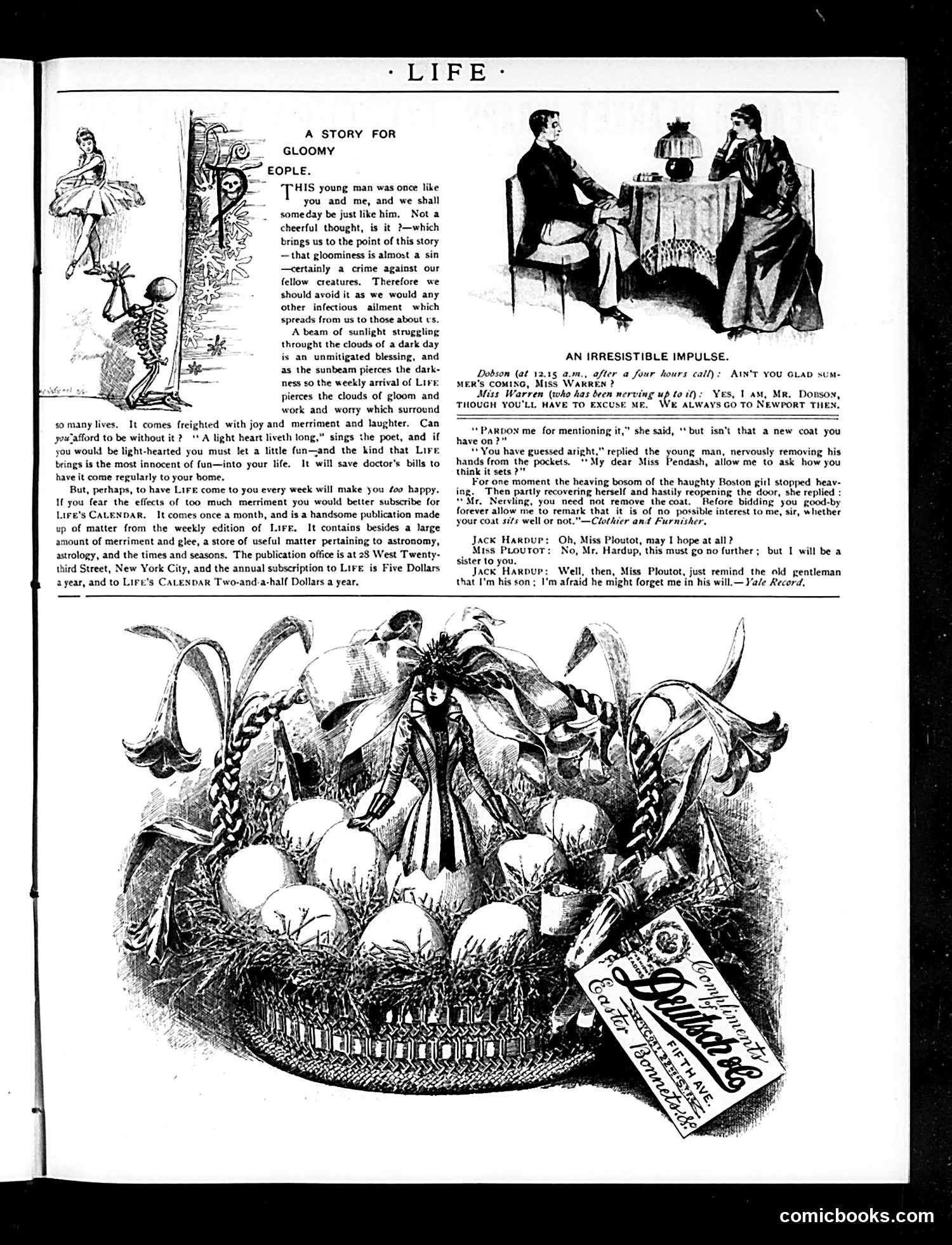
This page from *Life* magazine contains **two distinct pieces of satirical content**: ## Top Section: Advertisement/Editorial A self-promotional message claiming that *Life* magazine combats gloominess and melancholy by providing humor and merriment. It positions the publication as therapeutic—a "sunbeam" piercing clouds of worry. The magazine also advertised a monthly *Calendar* supplement with astronomy and seasonal information. ## Bottom Section: Two Comic Scenarios **"An Irresistible Impulse"**: A young man (Mr. Dobson) makes an extended late-night call on Miss Warren. When he nervously mentions her new coat and asks her opinion of his own, she sharply rebuffs him—implying his fidgeting suggests he's stolen the coat or is otherwise disreputable. The satire mocks awkward courtship etiquette and social anxiety. **The second dialogue** (attribution unclear from OCR) involves a young suitor (Jack Hardup) asking Miss Ploutot's permission to court her, then admitting he fears her father will forget him in his will—exposing his mercenary motives beneath romantic pretense. Both jokes target **courtship hypocrisy and masculine nervousness** around class and financial status.
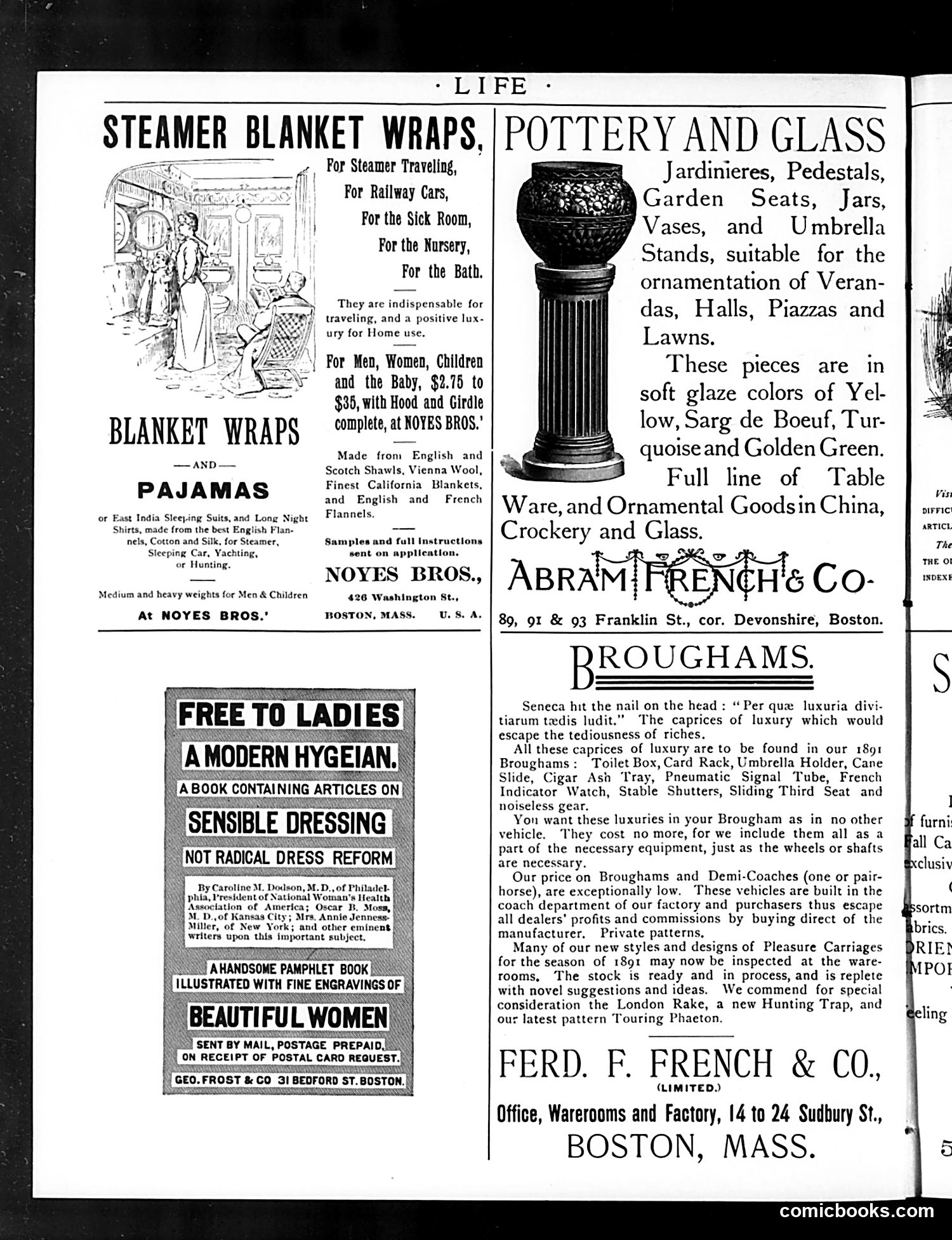
This is primarily an **advertising page**, not a satirical cartoon. It contains four commercial advertisements from 1891 Boston businesses: 1. **Noyes Bros.** (top left): Promotes steamer blanket wraps and pajamas for travel and home use, marketed to all family members. 2. **Abram French & Co.** (top right): Showcases decorative pottery and glassware—jardinieres, pedestals, vases—in fashionable soft-glaze colors for wealthy homeowners. 3. **Geo. Frost & Co.** (bottom left): Offers a free hygiene book on "sensible dressing" (not radical dress reform) for women, illustrated with engravings. 4. **Ferd. F. French & Co.** (bottom right): Advertises luxury broughams (carriages) with ornamental details—toilet boxes, card racks, umbrella holders—quoting Seneca on luxury escaping tedium. The ads target affluent readers and reflect late-19th-century consumer culture: travel accessories, home decoration, women's health literature, and luxury carriages.
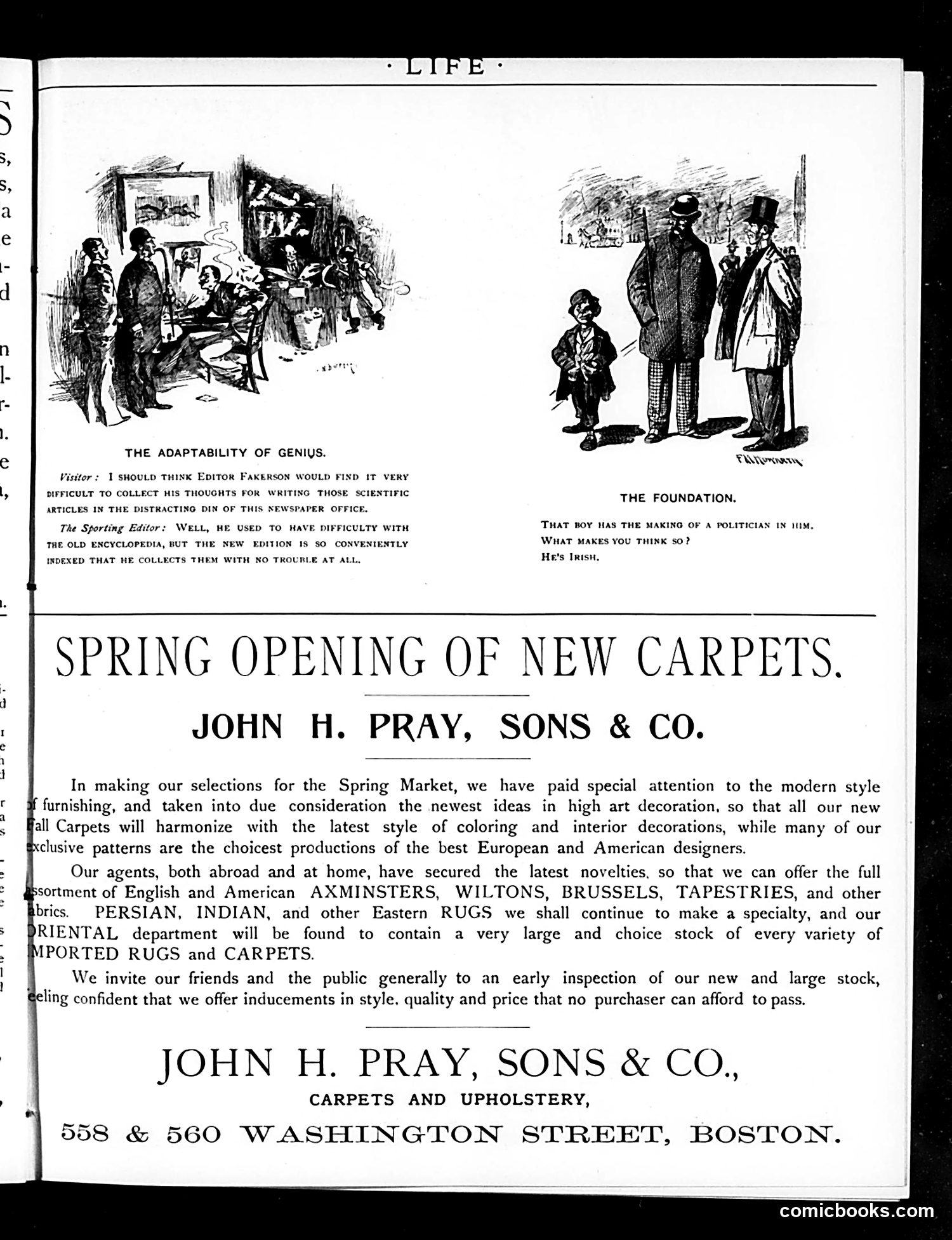
This page contains two satirical cartoons plus advertising: **"The Adaptability of Genius"** jokes about an editor named Fakerson who writes scientific articles in a noisy newspaper office. The punchline: he now uses a conveniently indexed encyclopedia instead of struggling with an old one—suggesting he's not truly composing original thought, just rearranging existing information. The satire mocks both editorial laziness and the pretense of "genius." **"The Foundation"** depicts a child described as having "the making of a politician" because he's Irish. This reflects period stereotypes about Irish-Americans in politics, particularly their association with urban machine politics and patronage systems. The joke assumes readers recognize this ethnic-political connection as obvious or self-evident. The remainder is a straightforward advertisement for John H. Pray, Sons & Co.'s spring carpet opening in Boston, emphasizing European and American designs and imported rugs.
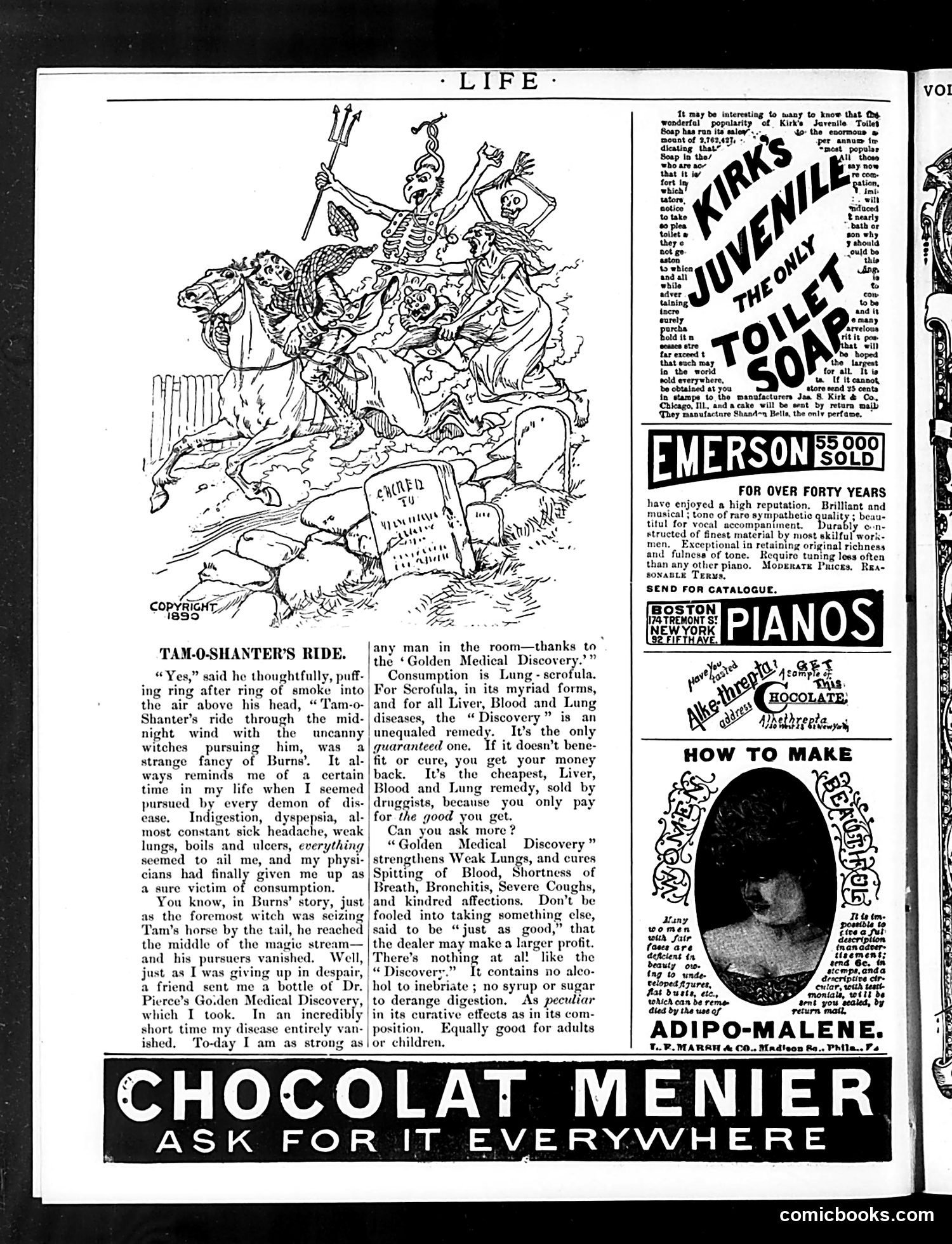
The page features a narrative advertisement disguised as editorial content—a common practice in early 20th-century magazines. The illustration depicts "Tam-o-Shanter's Ride," referencing Robert Burns' famous Scottish poem about a man pursued by witches. The text uses this literary parallel as a metaphor: a man describes being "pursued" by diseases (indigestion, dyspepsia, weak lungs, consumption) until rescued by Dr. Pierce's "Golden Medical Discovery" patent medicine. This is classic snake-oil marketing—the dramatic narrative creates emotional investment while making unverified health claims. The page is primarily **advertisements** for patent medicines, pianos, chocolate, and bust-enhancement cream, typical of Life magazine's era. These ads often made exaggerated medical claims before FDA regulations. The "Chocolat Menier" and "Adipo-Malene" ads similarly blend testimonial narrative with product promotion, reflecting an era when such unsubstantiated health claims were legally permitted. The satire (if any exists) is implicit—Life's readers would recognize these as advertisements, yet the format blurs editorial and commercial content.