
Life, 1891-03-26 · page 4 of 22
Life — March 26, 1891 — page 4: what you’re looking at
What you’re looking at
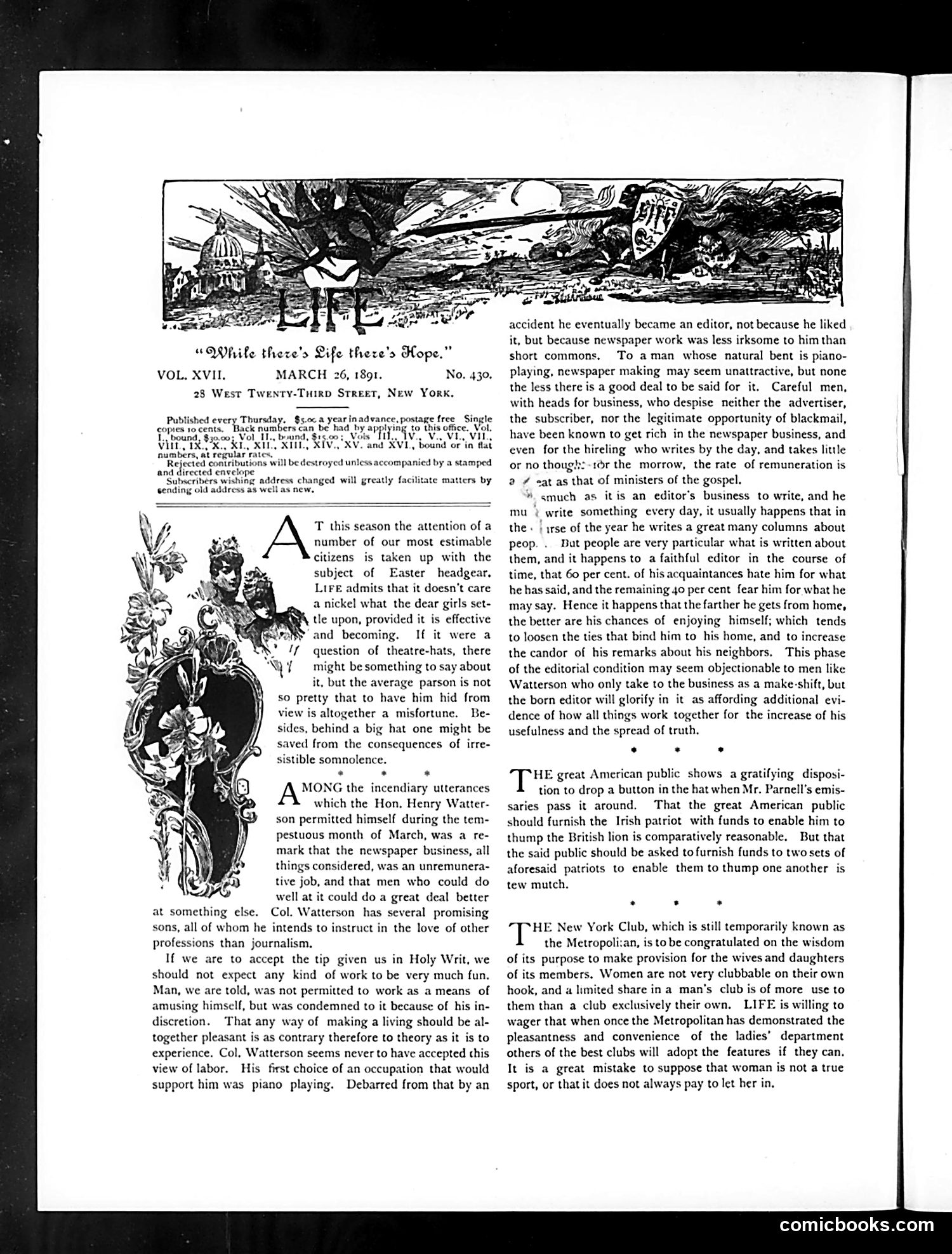
The main illustration depicts a woman in Victorian dress with elaborate Easter bonnets and flowers. The accompanying text discusses Easter headgear—specifically criticizing how impractical and expensive fashionable hats are. The satire targets wealthy society women's vanity and the fashion industry's influence. The text also contains editorial commentary on journalism and editors, discussing Col. Watterson (likely Henry Watterson, a prominent Louisville editor). It argues that newspaper work attracts men unsuited for it, and praises editors who maintain ethical standards despite pressure. A secondary note mentions the American public's disposition toward Irish patriot causes and the New York Club's policies regarding women members—satirizing gender exclusivity in elite clubs. The overall tone is typical 1891 Life magazine: mocking both fashion excess and social pretension.
📄 Transcribed text from this page (OCR, searchable)
Machine-transcribed from the original scan — historical spelling and the odd misread are preserved.
“Wife there's Life there's Hope.” VOL, XVII. MARCH 26, 1891. No. 430. 28 West Twenty-Tuirp Street, New York. Published every Thursday, $5.0: yearinadvance,postage free Single copies ro cents. Back numbers can be had by applying to this office, Vol I, bound, $39.00; Vol I., buund, $16.0 Ht. iV. V.VE. VIL, VHT, 1X. X.. XL, XU, XHIL, XIV.,"XV. and XVI, bound of in fat numbers, at regular rates, Rejected contributions will be destroyed unlessacco and directed env bscribers w mpanied by a stamped pe wg address changed will greatly facilitate matters by sending old address as T this season the attention of a number of our most estimable citizens is taken up with the subject of Easter headgear, LiFe admits that it doesn’t care a nickel what the dear girls set- tle upon, provided it is effective and becoming. If it were a question of theatre-hats, there might be something to say about it, but the average parson is not so pretty that to have him hid from view is altogether a misfortune. Be- sides, behind a big hat one might be saved from the consequences of irre- sistible somnolence. . . * MONG the incendiary utterances which the Hon, Henry Watter- son permitted himself during the tem- pestuous month of March, was a re- mark that the newspaper business, all things considered, was an unremunera- tive job, and that men who could do well at it could do a great deal better at something else. Col. Watterson has several promising sons, all of whom he intends to instruct in the love of other professions than journalism, If we are to accept the tip given us in Holy Writ, we should not expect any kind of work to be very much fun. Man, we are told, was not permitted to work as a means of amusing himself, but was condemned to it because of his in- discretion. That any way of making a living should b together pleasant is as contrary therefore to theory as it is to experience. Col, Watterson seems never to have accepted chis view of labor. His first choice of an occupation that would support him was piano playing. Debarred from that by an accident he eventually became an editor, not because he liked it, but because newspaper work was less irksome to him than short commons. To aman whose natural bent is piano- playing, newspaper making may seem unattractive, but none the less there is a good deal to be said for it. Careful men, with heads for business, who despise neither the advertiser, the subscriber, nor the legitimate opportunity of blackmail, have been known to get rich in the newspaper business, and even for the hireling who writes by the day, and takes little or no though: -1or the morrow, the rate of remuneration is a / eat as that of ministers of the gospel. » smuch as itis an editor's business to write, and he mu } write something every day, it usually happens that in the. + arse of the year he writes a great many columns about peop. . But people are very particular what is written about them, and it happens to a faithful editor in the course of time, that 60 per cent. of his acquaintances hate him for what he has said, and the remaining qo per cent fear him for what he may say. Hence it happens that the farther he gets from home, the better are his chances of enjoying himself; which tends to loosen the ties that bind him to his home, and to increase the candor of his remarks about his neighbors. This phase of the editorial condition may seem objectionable to men like Watterson who only take to the business as a make-shift, but the born editor will glorify in it as affording additional evi- dence of how all things work together for the increase of his usefulness and the spread of truth. . . ° HE great American public shows a gratifying disposi- tion to drop a button in the hat when Mr. Parnell’s emis- saries pass it around. That the great American public should furnish the Irish patriot with funds to enable him to thump the British lion is comparatively reasonable. But that the said public should be asked to furnish funds to two sets of aforesaid patriots to enable them to thump one another is tew mutch, . . * HE New York Club, which is still temporarily known as the Metropoli:an, is to be congratulated on the wisdom of its purpose to make provision for the wives and daughters of its members. Women are not very clubbable on their own hook, and a limited share ina man’s club is of more use to them than a club exclusively their own. LIFE is willing to wager that when once the Metropolitan has demonstrated the pleasantness and convenience of the ladies’ department others of the best clubs will adopt the features if they can, It is a great mistake to suppose that woman is not a true sport, or that it does not always pay to let her in, comicbooks.com