
Life, 1891-03-26 · page 6 of 22
Life — March 26, 1891 — page 6: what you’re looking at
What you’re looking at
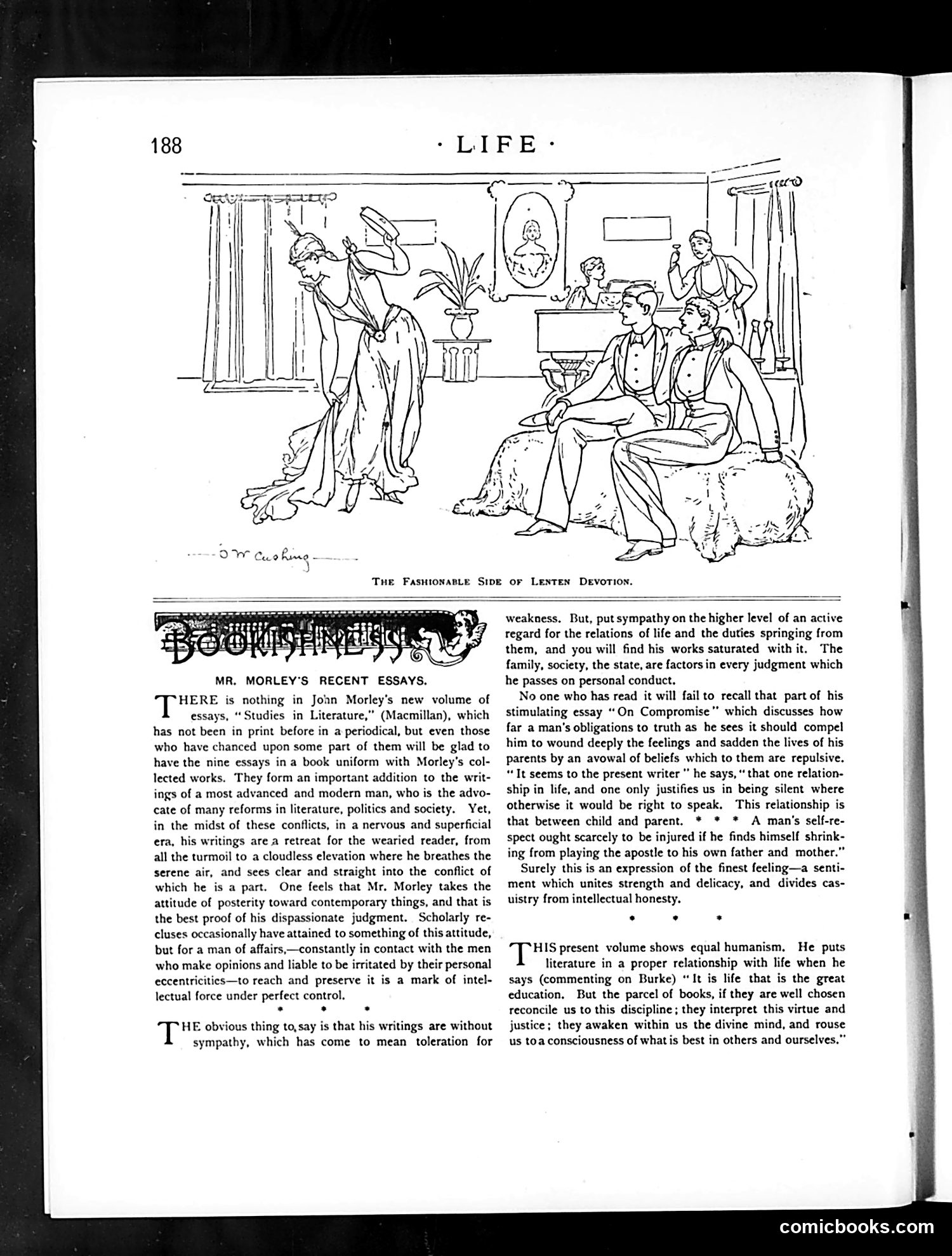
This cartoon satirizes wealthy society's approach to religious observance during Lent. The illustration shows fashionably-dressed people in an elegant parlor appearing to engage in devotional practice—one woman strikes a theatrical pose suggesting prayer or penitence. However, the scene's opulence (fine furniture, mirrors, potted plants) and the people's stylish attire undercut any genuine piety. The satire suggests these individuals treat Lenten devotion as a social performance or fashion statement rather than sincere spiritual commitment. The title's emphasis on "fashionable" and the theatrical body language mock the contradiction between outward religious display and the material comfort surrounding them. This reflects broader Progressive-era critiques of elite hypocrisy regarding moral and religious practice.
📄 Transcribed text from this page (OCR, searchable)
Machine-transcribed from the original scan — historical spelling and the odd misread are preserved.
MR. MORLEY’S RECENT ESSAYS. TT BERE is nothing in John Morley’s new volume of essays, ‘Studies in Literature,” (Macmillan), which has not been in print before in a periodical, but even those who have chanced upon some part of them will be glad to have the nine essays ina book uniform with Morley's col- lected works. They form an important addition to the writ- ings of a most advanced and modern man, who is the advo- cate of many reforms in literature, politics and society. Yet, in the midst of these conflicts, in a nervous and superficial era, his writings are a retreat for the wearied reader, from all the turmoil to a cloudless elevation where he breathes the serene air, and sees clear and straight into the conflict of which he is a part. One feels that Mr. Morley takes the attitude of posterity toward contemporary things, and that is the best proof of his dispassionate judgment. Scholarly re- cluses occasionally have attained to something of this attitude, but for a man of affairs,—constantly in contact with the men who make opinions and liable to be irritated by their personal eccentricities—to reach and preserve it is a mark of intel- lectual force under perfect control. . . . Te obvious thing to, say is that his writings are without sympathy, which has come to mean toleration for weakness. But, put sympathy on the higher level of an active regard for the relations of life and the duties springing from them, and you will find his works saturated with it. The family, society, the state, are factors in every judgment which he passes on personal conduct, No one who has read it will fail to recall that part of his stimulating essay ‘On Compromise” which discusses how far a man’s obligations to truth as he sees it should compel him to wound deeply the feelings and sadden the lives of his parents by an avowal of beliefs which to them are repulsive. “It seems to the present writer " he says, “ that one relation- ship in life, and one only justifies us in being silent where otherwise it would be right to speak. This relationship is that between child and parent. * * * A man’s self-re- spect ought scarcely to be injured if he finds himself shrink- ing from playing the apostle to his own father and mother.” Surely this is an expression of the finest feeling—a senti- ment which unites strength and delicacy, and divides cas- uistry from intellectual honesty. . ° * HIS present volume shows equal humanism. He puts literature in a proper relationship with life when he says (commenting on Burke) “It is life that is the great education, But the parcel of books, if they are well chosen reconcile us to this discipline ; they interpret this virtue and justice; they awaken within us the divine mind, and rouse us toa consciousness of what is best in others and ourselves.” comicbooks.com