
Life, 1891-03-26 · page 7 of 22
Life — March 26, 1891 — page 7: what you’re looking at
What you’re looking at
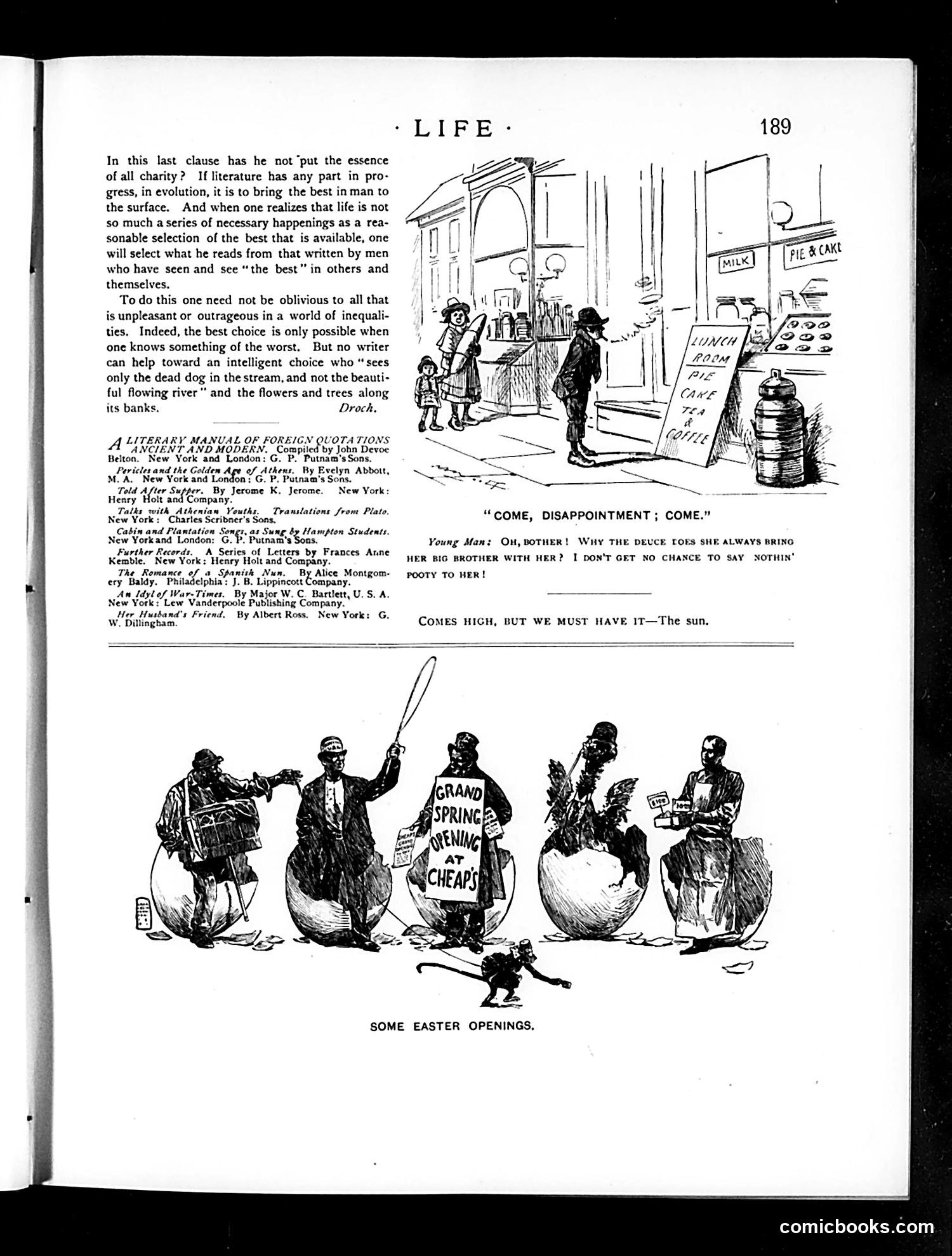
This page from *Life* magazine contains two cartoons satirizing consumer culture and retail commerce. **Top cartoon**: Shows a shop window where a young man complains about his sister always bringing her "big brother" along on outings, preventing him from spending time alone with her. The brother says "COMES HIGH, BUT WE MUST HAVE IT—The sun," suggesting the brother is an unwanted third wheel who costs money. **Bottom cartoon** ("Some Easter Openings"): Depicts five figures emerging from eggs like chicks, each representing different commercial enterprises—one holds a "Grand Spring Opening at Cheaps" sign. A rat scurries below. The satire mocks the proliferation of retail shops and commercial establishments that proliferate seasonally, particularly around Easter, treating them as parasitic or opportunistic business ventures. Both cartoons critique commercialism and consumer culture.
📄 Transcribed text from this page (OCR, searchable)
Machine-transcribed from the original scan — historical spelling and the odd misread are preserved.
In this last clause has he not ‘put the essence of all charity? If literature has any part in pro- gress, in evolution, it is to bring the best inman to the surface. And when one realizes that life is not so much a series of necessary happenings as a rea- sonable selection of the best that is available, one will select what he reads from that written by men who have seen and see “the best” in others and themselves, Todo this one need not be oblivious to all that is unpleasant or outrageous in a world of inequali- ties. Indeed, the best choice is only possible when one knows something of the worst. But no writer can help toward an intelligent choice who “sees only the dead dog in the stream, and not the beauti- ful flowing river’ and the flowers and trees along its banks, Droch, LITERARY MANUAL OF FOREIGN QUOTATIONS ANCIENT AND MODERN. Compiled by John Devoe Belton. New York and London: G. P. Putnam's Sons. Pericles and the Gelden Age of Athens, By Evelyn Abbott, M. A. New Yore and London? G. P, Putnag’s Sons. Told After Sutter By Jerome K. Jerome. New York: Henry Holt and Company. Talks with Athenian Youths. Translations from Plato. New York: Charles Scribner's Sons, Cabin and Plantation Songs, as Sung by Hampton Students. New Yorkand London: G.®. Putnam's Sons. Further Records. A Series of Letters by Frances Anne Kemble. New York: Henry Holt and Company. The Romance of a Spanith Nun. By Alice Montgom- ery Baldy. Philadelphia: J. B. Lippincott Company. An Idyl of War-Times. By Major W. C. Bartlett, U.S. A. New York: Lew Vanderpoole Publishing Company. Her Husband's Friend. By Albert Ross. New York: G. W. Dillingham. “COME, DISAPPOINTMENT ; COME.” Young Man: OM, BOTHER! WHY THE DEUCE TOES SHE ALWAYS BRING HER BIG BROTHER WITH HER? I DON'T GET NO CHANCE TO SAY NOTHIN’ POOTY TO HER! COMES HIGH, BUT WE MUST HAVE IT—The sun, SOME EASTER OPENINGS, comicbooks.com