
A complete issue · 14 pages · 1891
Life — February 26, 1891
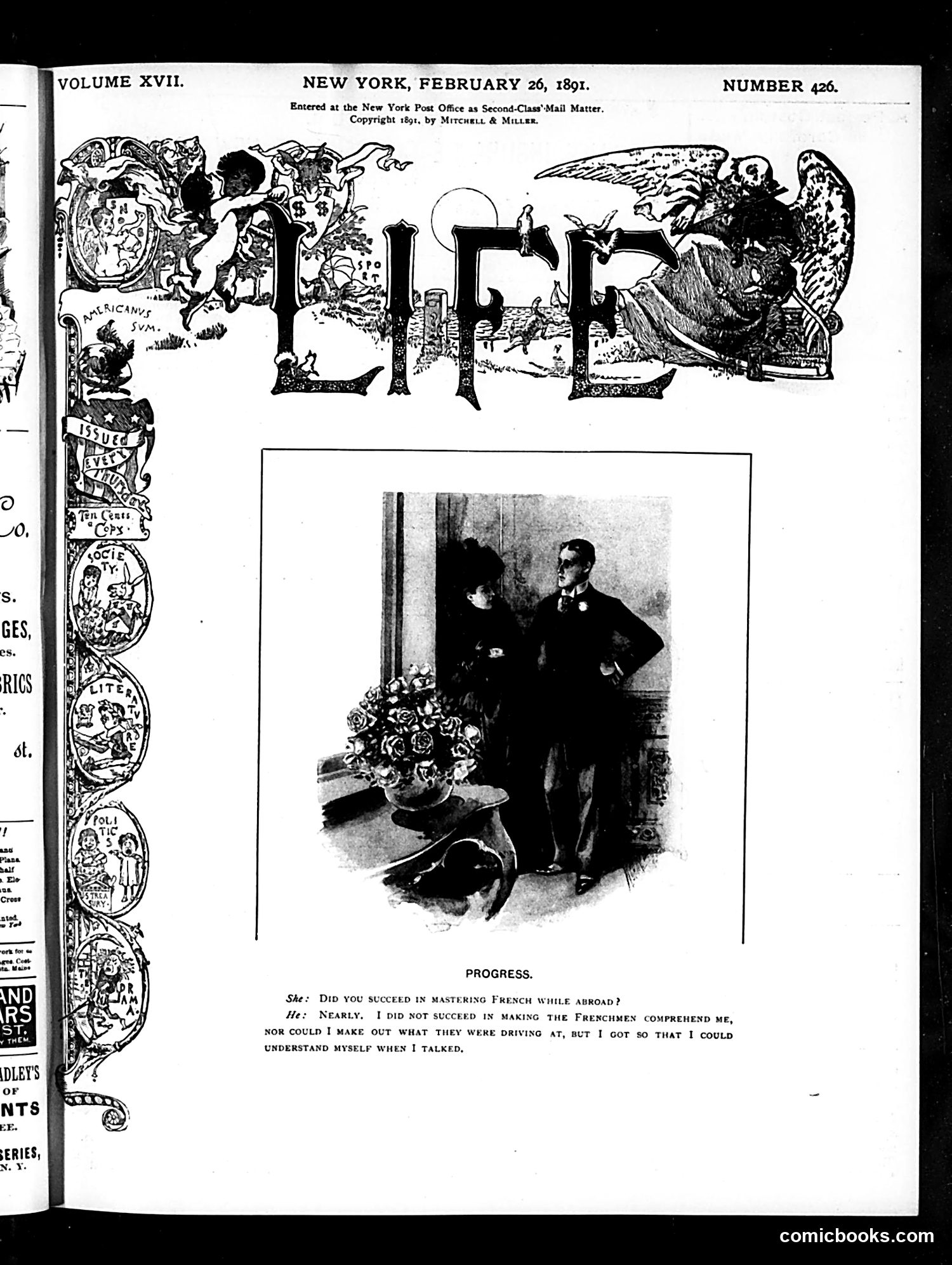
The cartoon illustrates a conversation between a man and woman examining a potted flower arrangement. The caption reads: "Did you succeed in mastering French while abroad?" He replies: "Nearly. I did not succeed in making the Frenchmen comprehend me, nor could I make out what they were driving at, but I got so that I could understand myself when I talked." **The satire targets** American tourists attempting to learn French abroad. The joke mocks both linguistic incompetence and the speaker's complacent self-satisfaction—he achieved nothing useful (communicating with actual French people), yet celebrates "progress" in merely understanding his own garbled French. It's a gentle jab at American provincialism and self-delusion regarding cultural advancement.
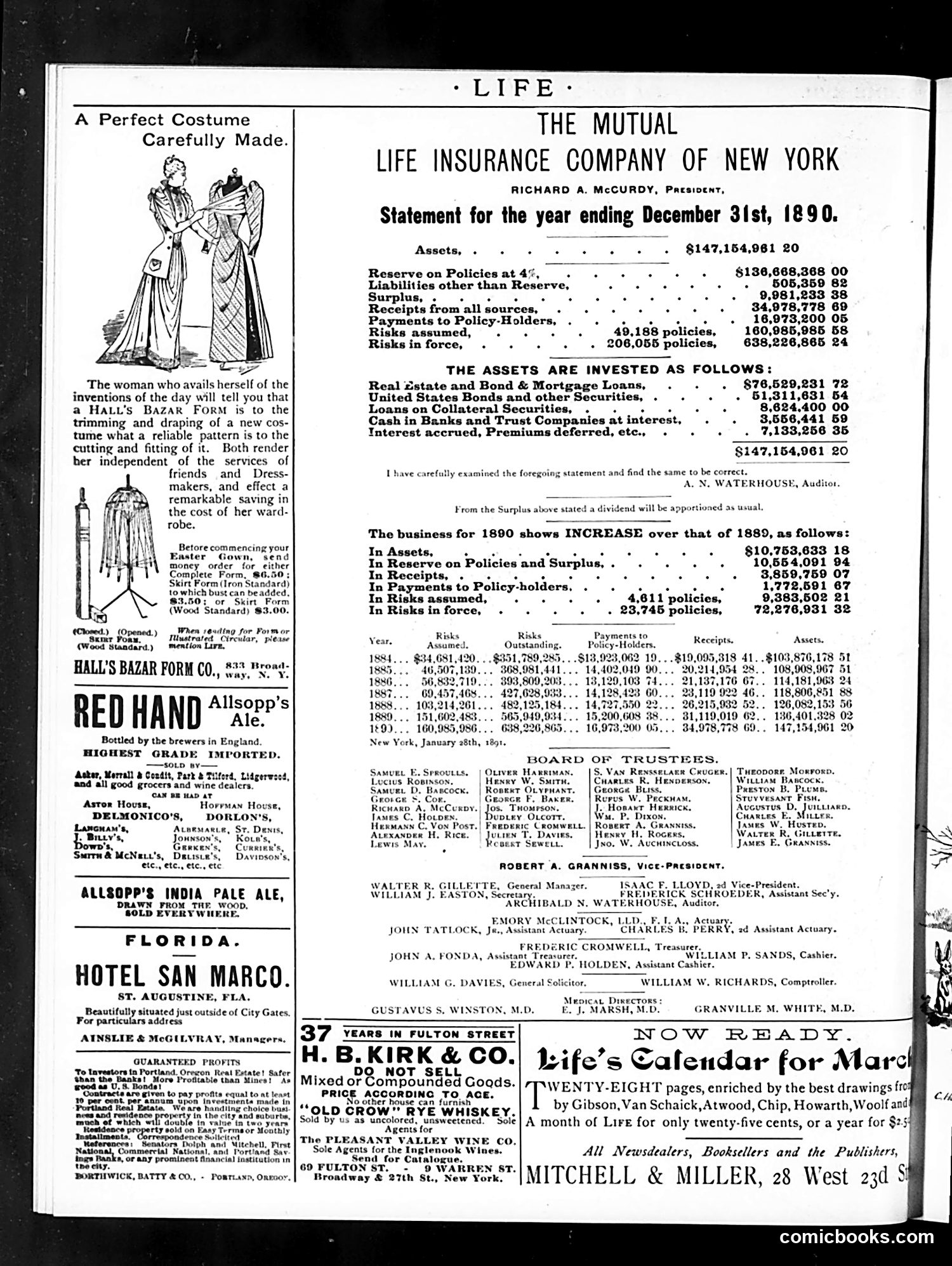
This page is primarily **advertising and corporate content**, not satire or political commentary. The left side features advertisements for Hall's Bazar Form Company (dress forms/mannequins), Red Hand Allsopp's Ale, Hotel San Marco in Florida, and Kerr & Co. The illustrated figures showing women in Victorian-era dress are **product advertisements**, not political cartoons—they demonstrate clothing construction and tailoring services available through mail order. The main content is a **financial statement** from the Mutual Life Insurance Company of New York for 1890, showing assets, reserves, and business metrics. Below that is a Board of Trustees listing and company officers. There is **no political satire or social commentary** visible on this page. It represents typical late-19th-century magazine layout combining advertisements with corporate/financial information.
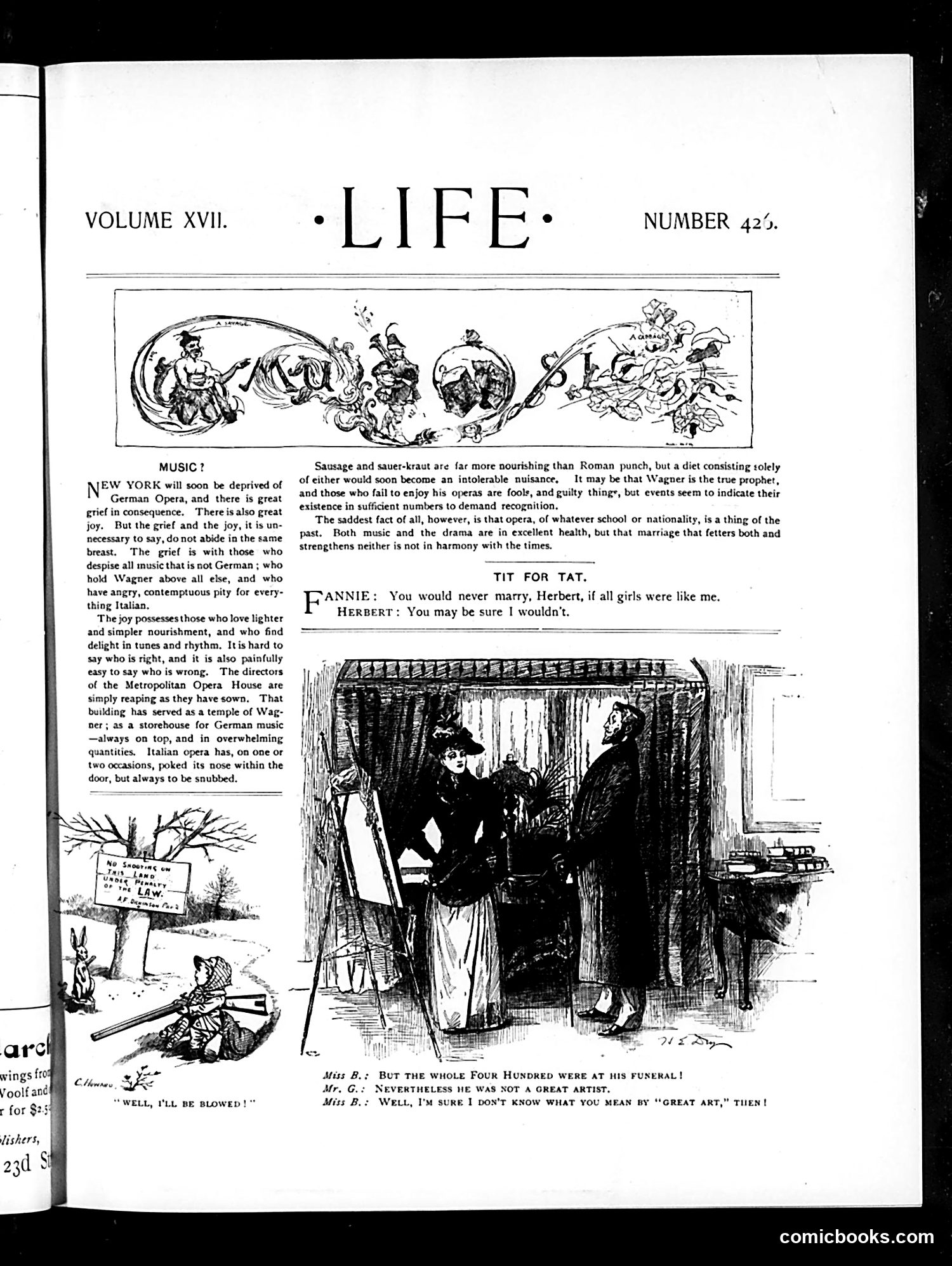
This page contains two distinct satirical pieces: **"Music!" section** critiques the impending closure of New York's German Opera house due to anti-German sentiment (likely WWI-era). The author argues opera's quality transcends nationality, defending German cultural contributions while acknowledging the emotional climate makes this defense difficult. **"Tit for Tat" cartoon** depicts a social scene where a woman (Fannie) and man (Herbert) exchange witty insults about marriage prospects. The accompanying illustration shows what appears to be a funeral scene with guests making sardonic comments about the deceased's artistic merit—a darkly humorous commentary on posthumous reputation and social hypocrisy regarding accomplishment and worth. Both pieces employ satire to critique contemporary attitudes and social pretension.
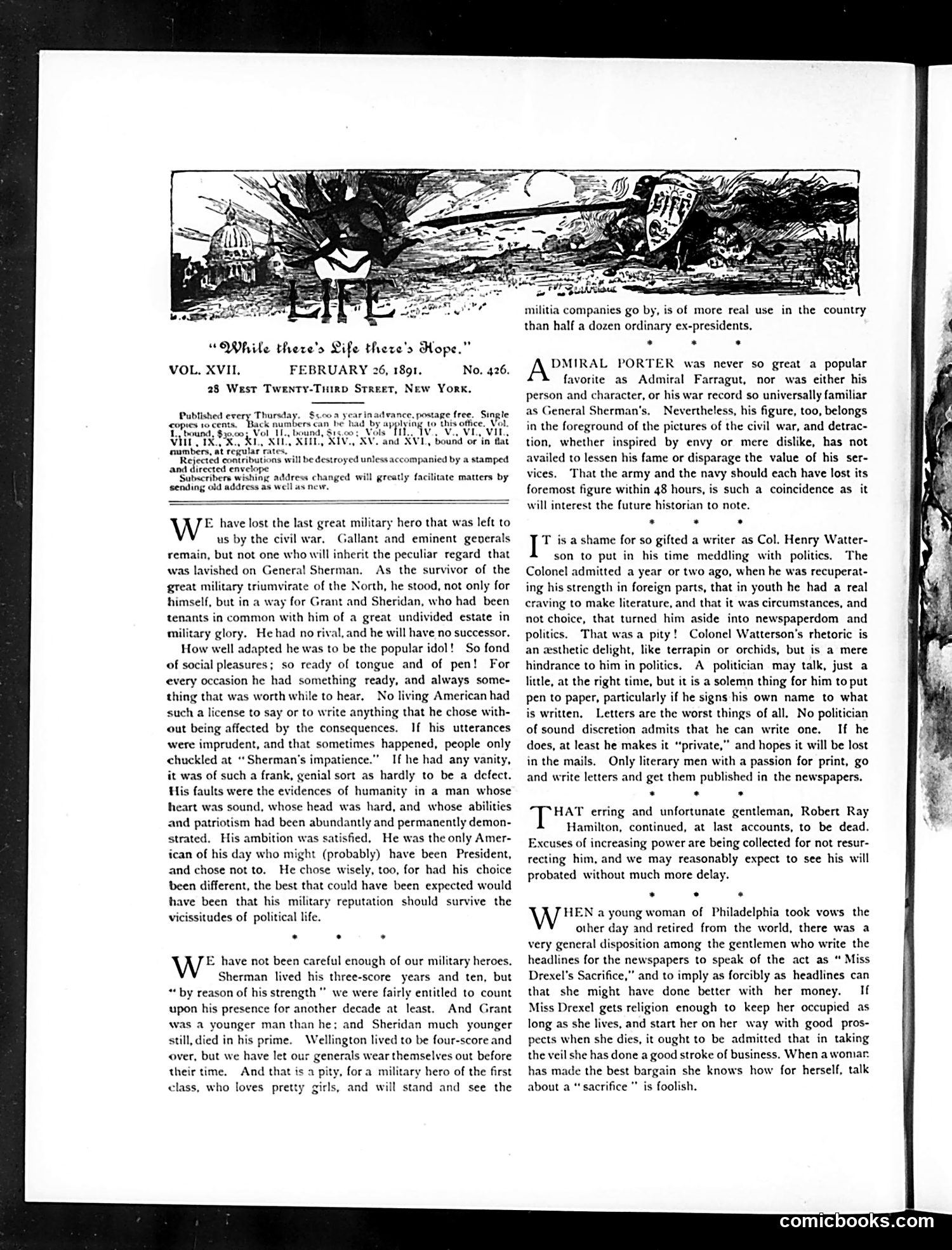
**The Cartoon:** The masthead illustration depicts a figure seated amid a desolate landscape with explosions and destruction. The caption reads "While there's Life there's Hope," apparently serving as Life's motto. **The Editorial Content:** The page's three essays address military and literary figures. The first discusses General Sherman as "the last great military hero" of the Civil War, praising his straightforward character. The second criticizes Colonel Henry Watterson for abandoning literary ambitions for politics—the author views this as a waste of talent. The third briefly mentions Robert Ray Hamilton's death and a Philadelphia woman named Miss Drexel who took religious vows, sarcastically suggesting her "sacrifice" represents good business sense. The writing reflects late-19th-century attitudes toward duty, public service, and gender roles.
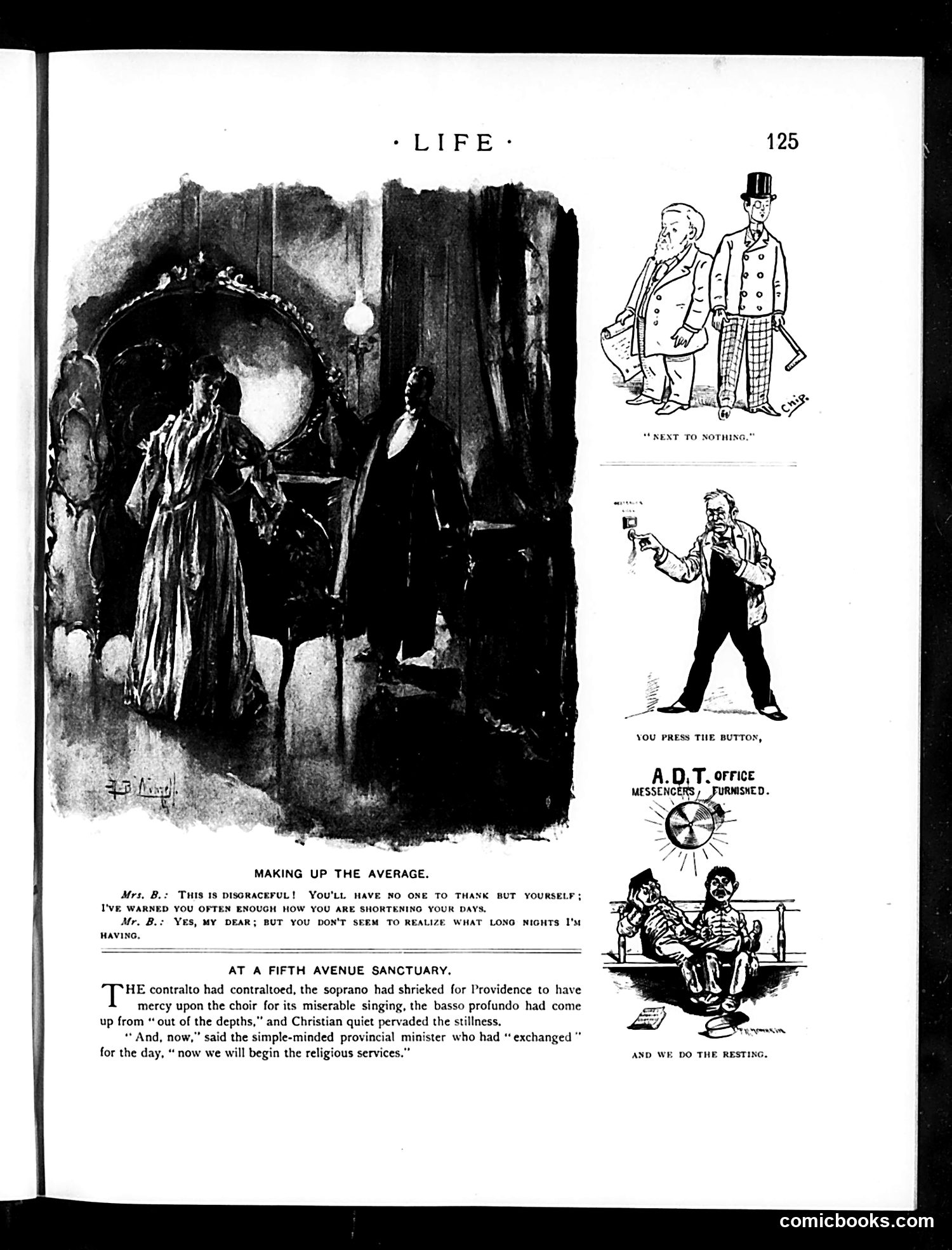
**Left cartoon ("Making Up the Average"):** A domestic dispute where a wife complains about her husband's long nights out. He dismisses her concerns, suggesting she should be grateful he's not doing worse. The satire mocks husbands who justify mediocre behavior by comparison—"at least I'm not the worst." **Right section:** Multiple small cartoons with office/workplace humor: - "Next to Nothing": Two men comparing salaries or assets - "You Press the Button": An A.D.T. (American District Telegraph) messenger service advertisement - "And We Do the Resting": Workers relaxing, likely satirizing automation's promised leisure **Bottom ("At a Fifth Avenue Sanctuary"):** A church scene where a choir performs poorly during services. The minister pragmatically moves forward despite the musical disaster—satire on institutional tolerance and lowered expectations.
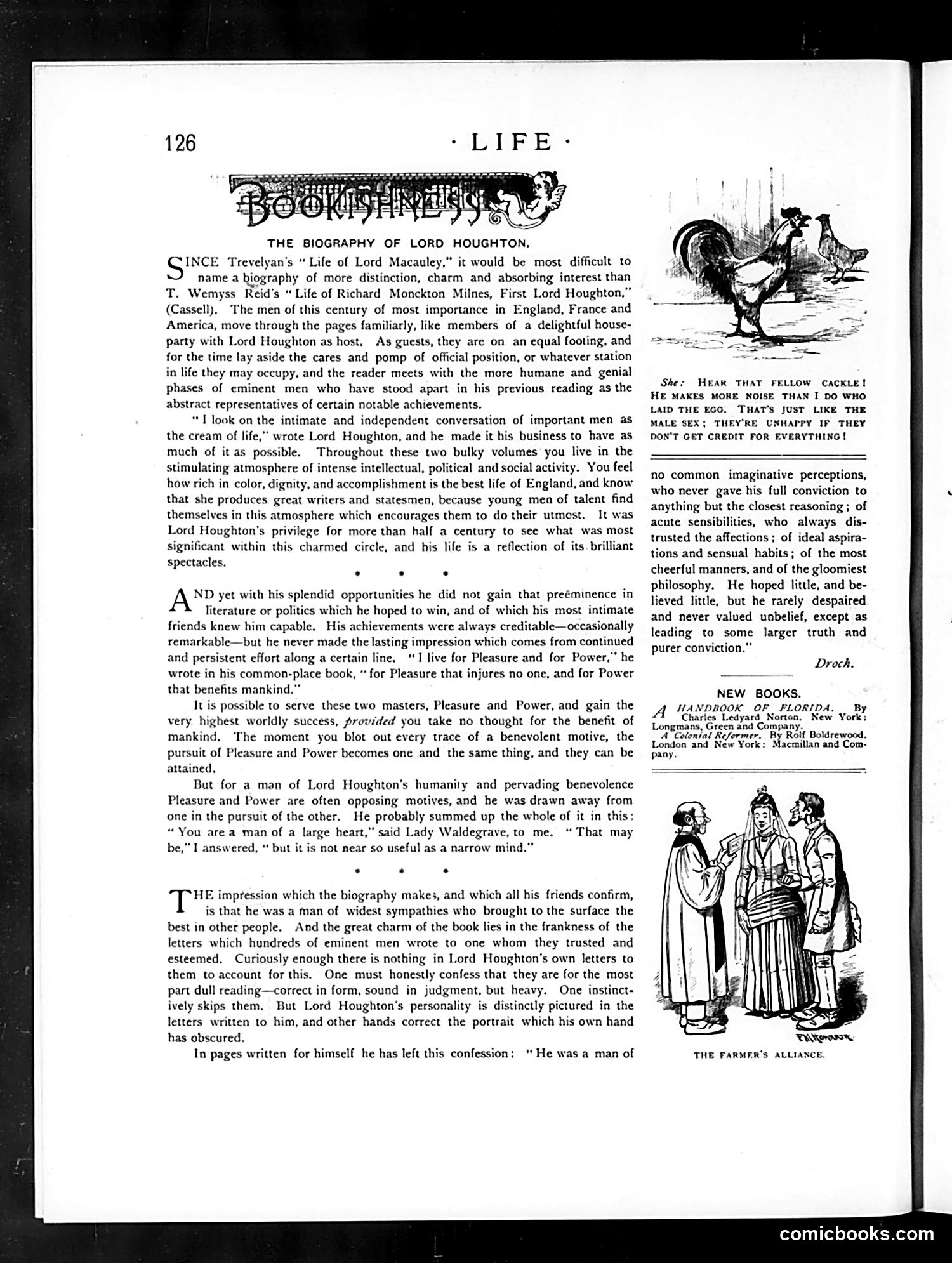
This page primarily contains a biographical essay about Lord Houghton by T. Wemyss Reid, praising his social influence and literary circle in 19th-century England. The essay emphasizes Houghton's ability to balance "Pleasure and Power" while maintaining humanitarianism. **The cartoons:** Two illustrations appear: one showing a rooster with accompanying text mocking male vanity ("He makes more noise than I do who laid the egg"), and another titled "The Farmer's Alliance" depicting three figures in period dress—likely representing rural/agricultural interests. These illustrations appear to be unrelated to the Houghton biography and instead serve as filler content. The page also advertises new books including "A Handbook of Florida" and "A Colonial Governor." The rooster cartoon is a straightforward gender-based joke about male boastfulness versus female reproductive contribution.
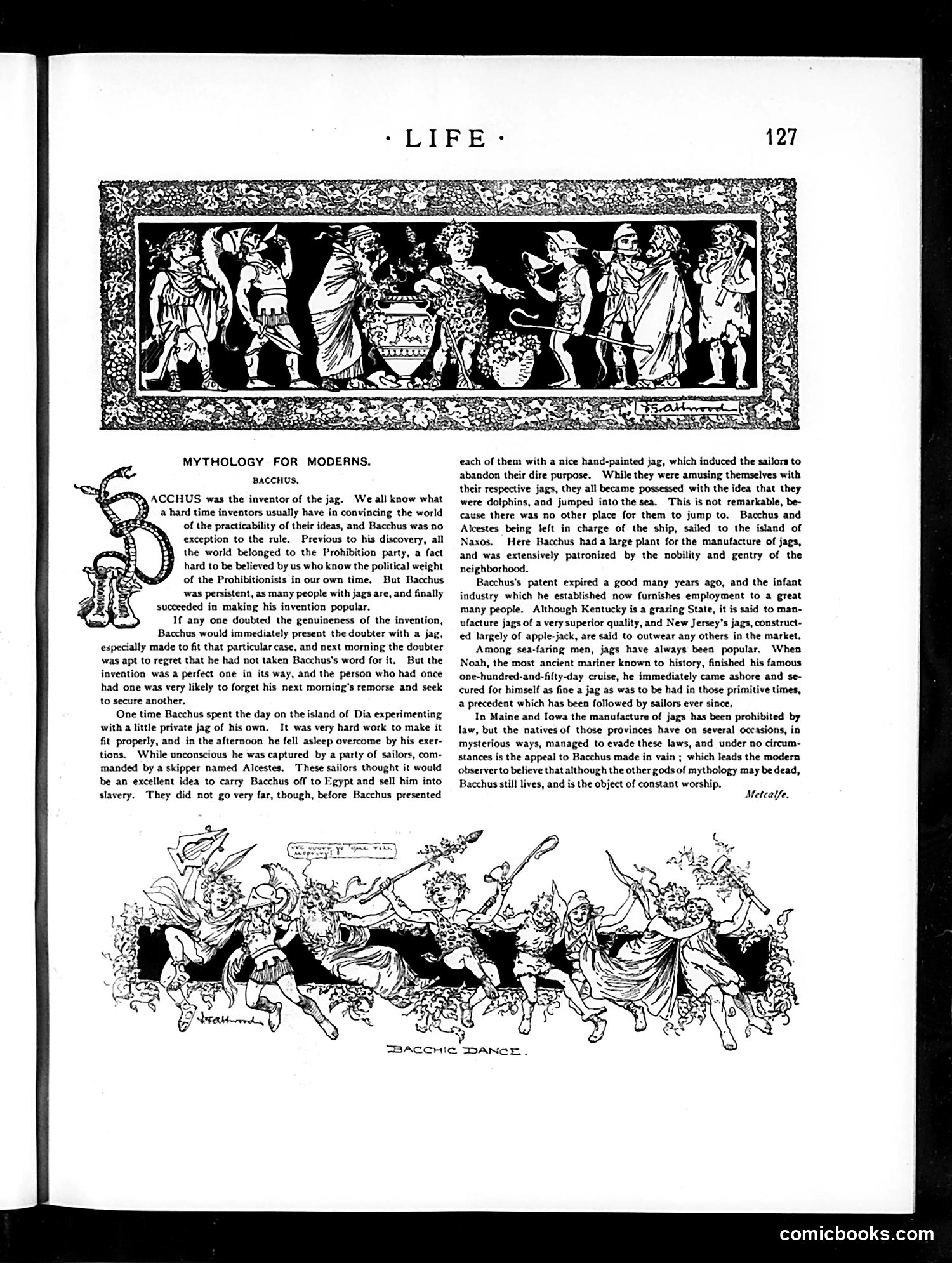
This satirical article reframes Bacchus, the Roman god of wine, as a modern industrialist. The top frieze shows classical figures; the lower illustration depicts a "Bacchic Dance" of revelry. The satire contrasts ancient mythology with contemporary American commerce. It celebrates Bacchus as the "inventor of the jag"—using slang for drunkenness—and credits him with establishing a profitable jug-manufacturing industry in Kentucky and New Jersey. The piece humorously suggests Bacchus pioneered consumer capitalism through alcohol production and marketing. This appears to be gentle satire about American industrialization and drinking culture, likely from the early 20th century. The tone treats profit-driven alcohol manufacturing as a quasi-religious enterprise worthy of mythological status.
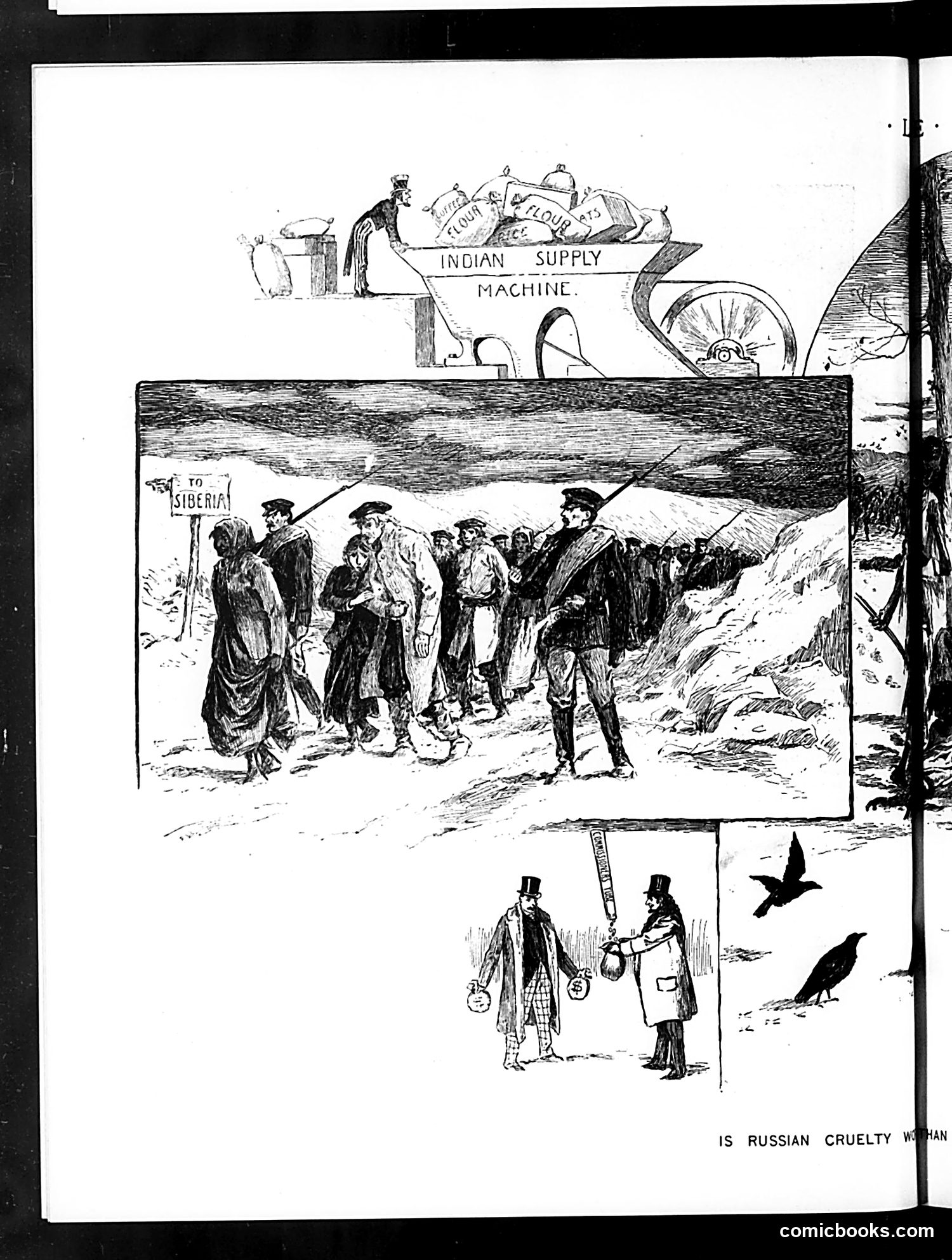
This page contains satirical commentary on Russian treatment of Siberia and indigenous populations. The top panel depicts an "Indian Supply Machine"—a grotesque mechanical device dispensing provisions to exiled or displaced peoples, suggesting Russia cynically managed suffering populations through minimal aid rather than humane policy. The large central scene shows starving or impoverished people gathered near a "TO SIBERIA" sign, illustrating forced exile to Siberian territories—a notorious Russian punishment practice. The bottom inset shows two figures exchanging what appears to be illicit goods, with birds (likely crows or ravens) nearby, symbolizing death or moral corruption. The caption reads "IS RUSSIAN CRUELTY W[HY]"—the text cuts off, but clearly indicts Russian imperial brutality toward exiled populations and indigenous peoples, a common critique in Western publications of this era.
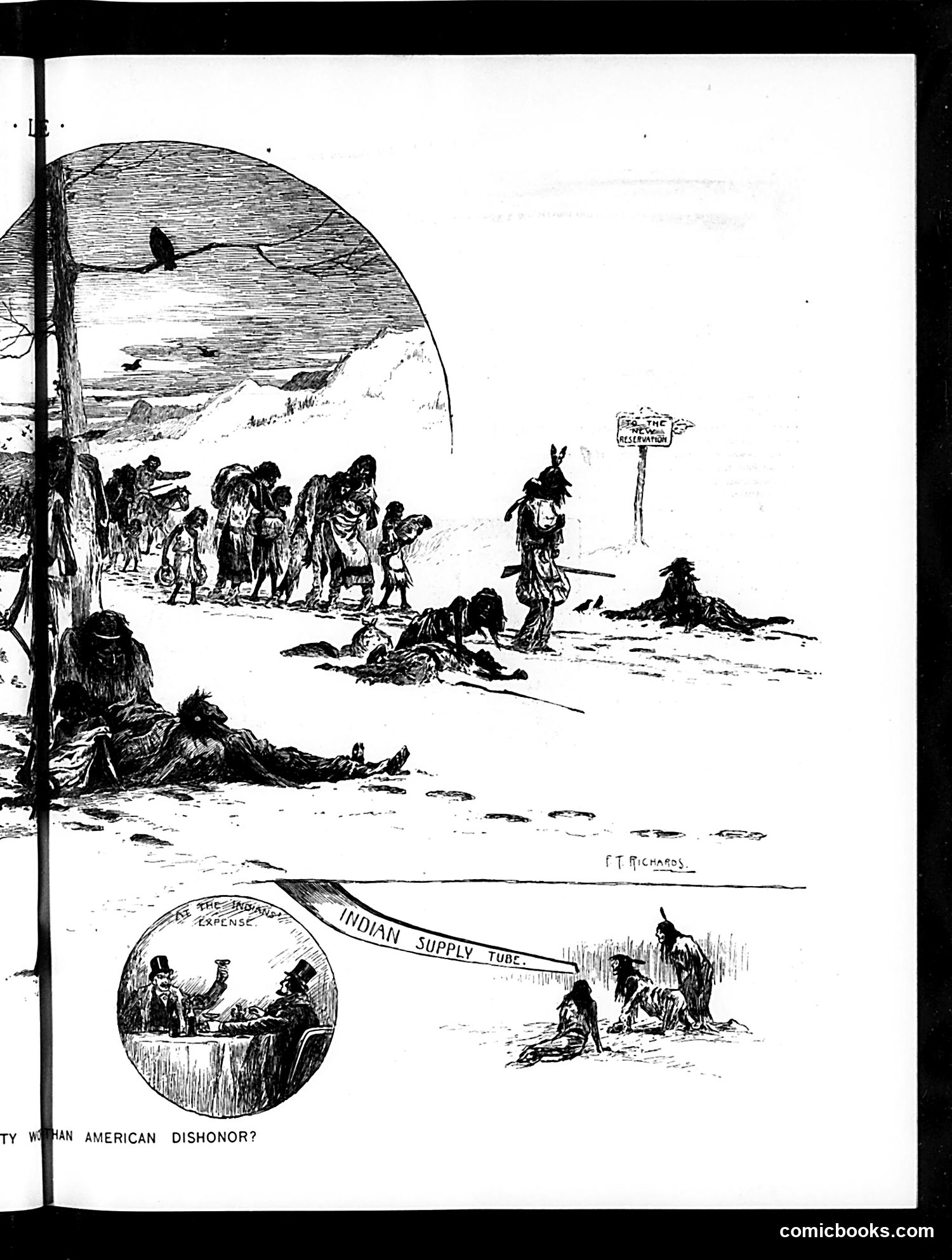
This appears to be a satirical cartoon criticizing American Indian policy, likely from the late 19th or early 20th century. The main image depicts Native Americans in distress near a body of water, with a sign reading "SAVE THE RESERVATION" visible. The inset circular panel labeled "AT THE INDIAN'S EXPENSE" shows two well-dressed men (likely government officials or politicians) dining comfortably, connected to the main scene via an "INDIAN SUPPLY TUBE"—a visual metaphor suggesting that resources meant for Native Americans were being diverted to benefit corrupt officials. The artist (F.T. Richards) is criticizing government mismanagement and embezzlement of Indian welfare funds, contrasting the poverty and death depicted above with the comfortable enrichment of those administering Indian affairs.
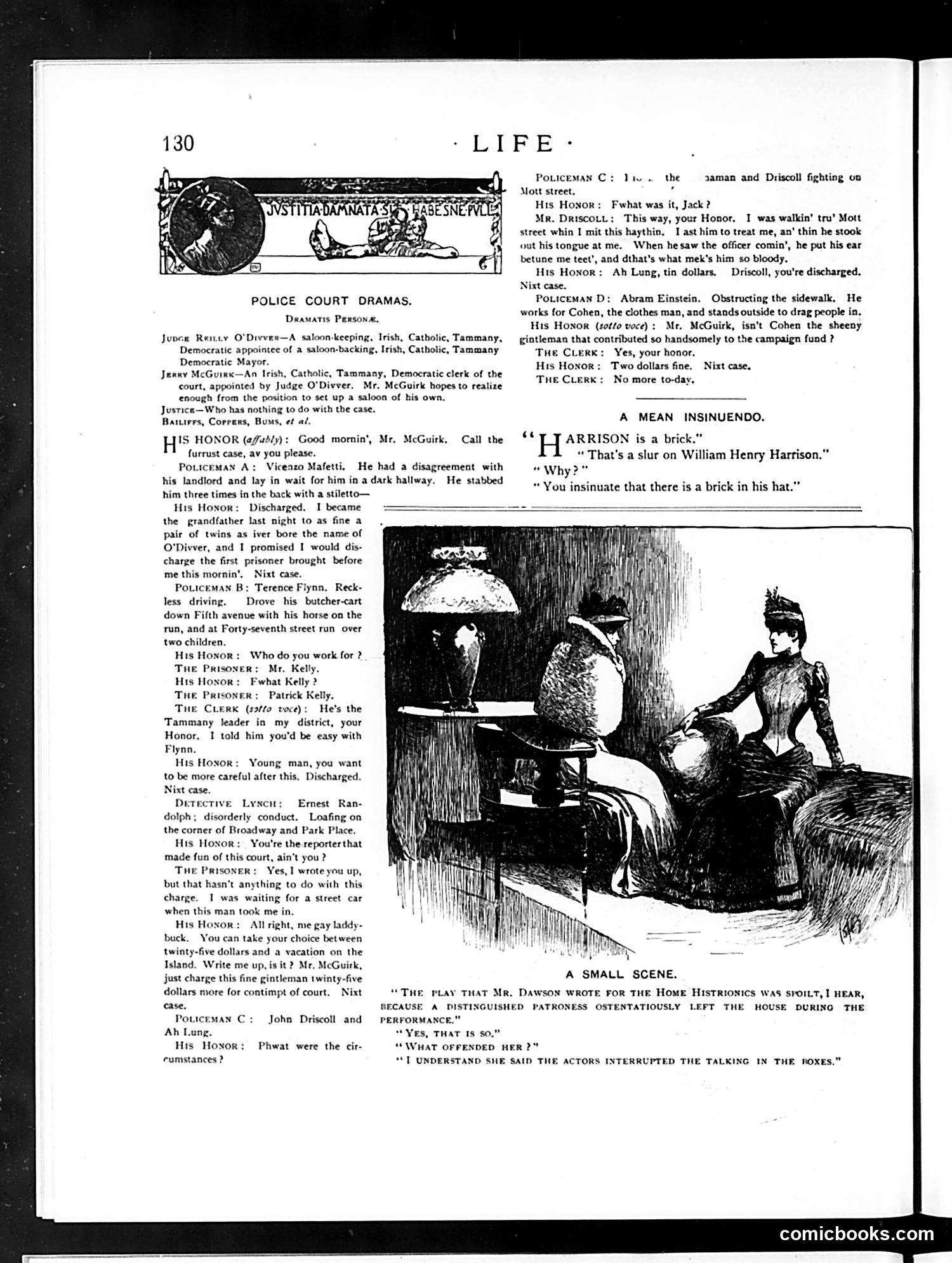
This page satirizes New York police court proceedings through fictional "Dramatis Personae" — humorous character sketches of typical courtroom figures. The left column presents stereotyped witnesses and defendants: an Irish bartender, a Democratic clerk, various policemen with ethnic markers, and a reporter. Each provides absurd testimony filled with malapropisms and Irish dialect humor common to period satire. The illustration shows a domestic scene, likely depicting one of these case scenarios. The accompanying caption mocks a theater performance interrupted by actors talking in the boxes — satirizing both theatrical pretension and audience disruption. The satire targets police court's apparent chaos, ethnic stereotyping of immigrants and working-class New Yorkers, and the casual way justice was administered. It's characteristic of *Life* magazine's mocking approach to urban institutions and immigrant populations.
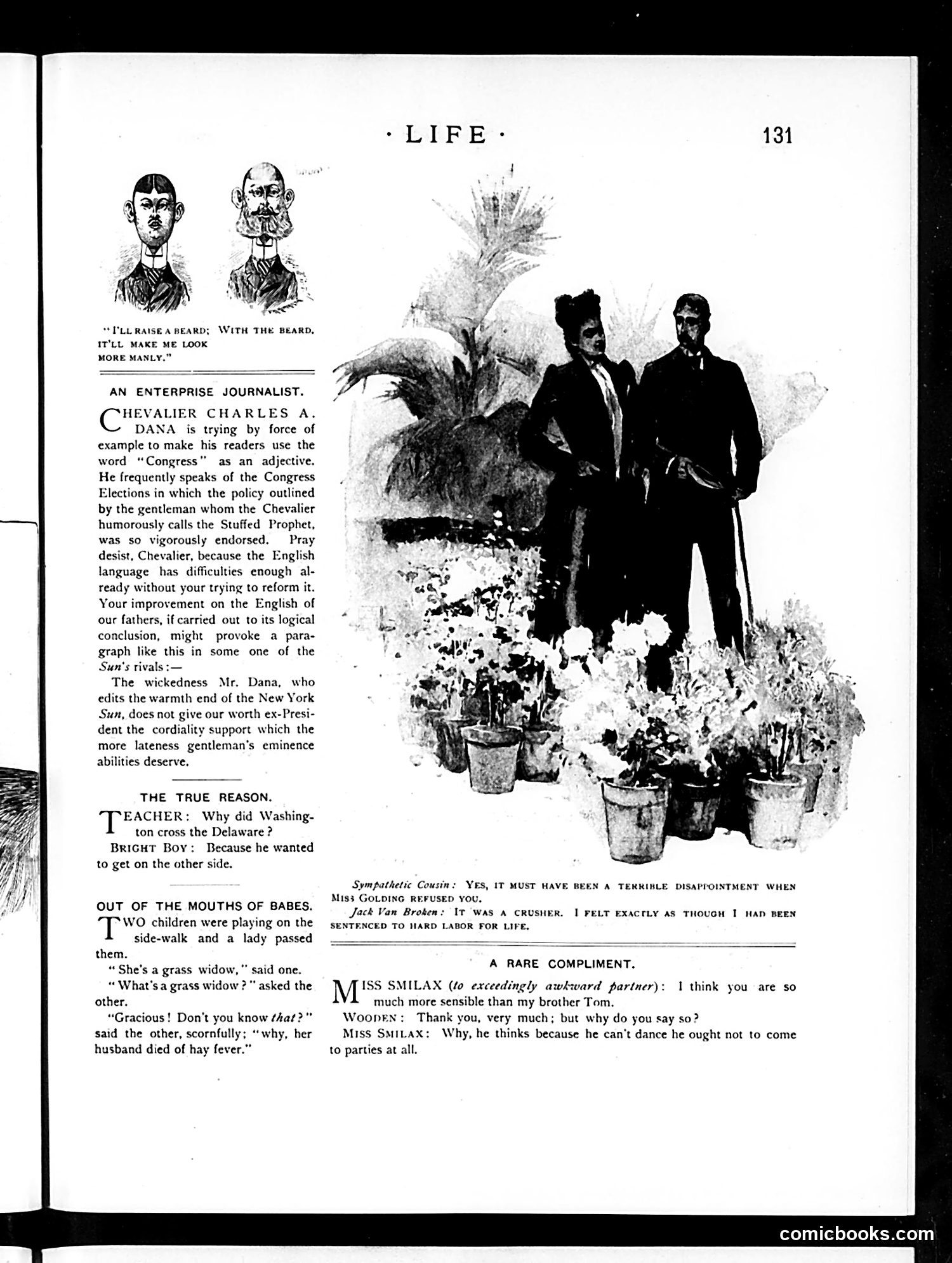
This page contains several satirical pieces typical of early Life magazine: **"An Enterprise Journalist"** criticizes Charles A. Dana, editor of the New York *Sun*, for misusing language—specifically trying to make "Congress" function as an adjective. The satire mocks Dana's editorial authority and his attempt to reform English usage. **"The True Reason"** is a brief joke about Washington crossing the Delaware, subverting the heroic narrative with a child's practical logic. **"Out of the Mouths of Babes"** plays on the phrase about children's unfiltered honesty, with children misunderstanding "grass widow" (a separated woman) as relating to actual grass and hay fever. **"A Rare Compliment"** jokes about social dancing and gender differences in judgment. The page exemplifies Life's focus on wordplay, social observation, and light mockery of American culture and public figures.
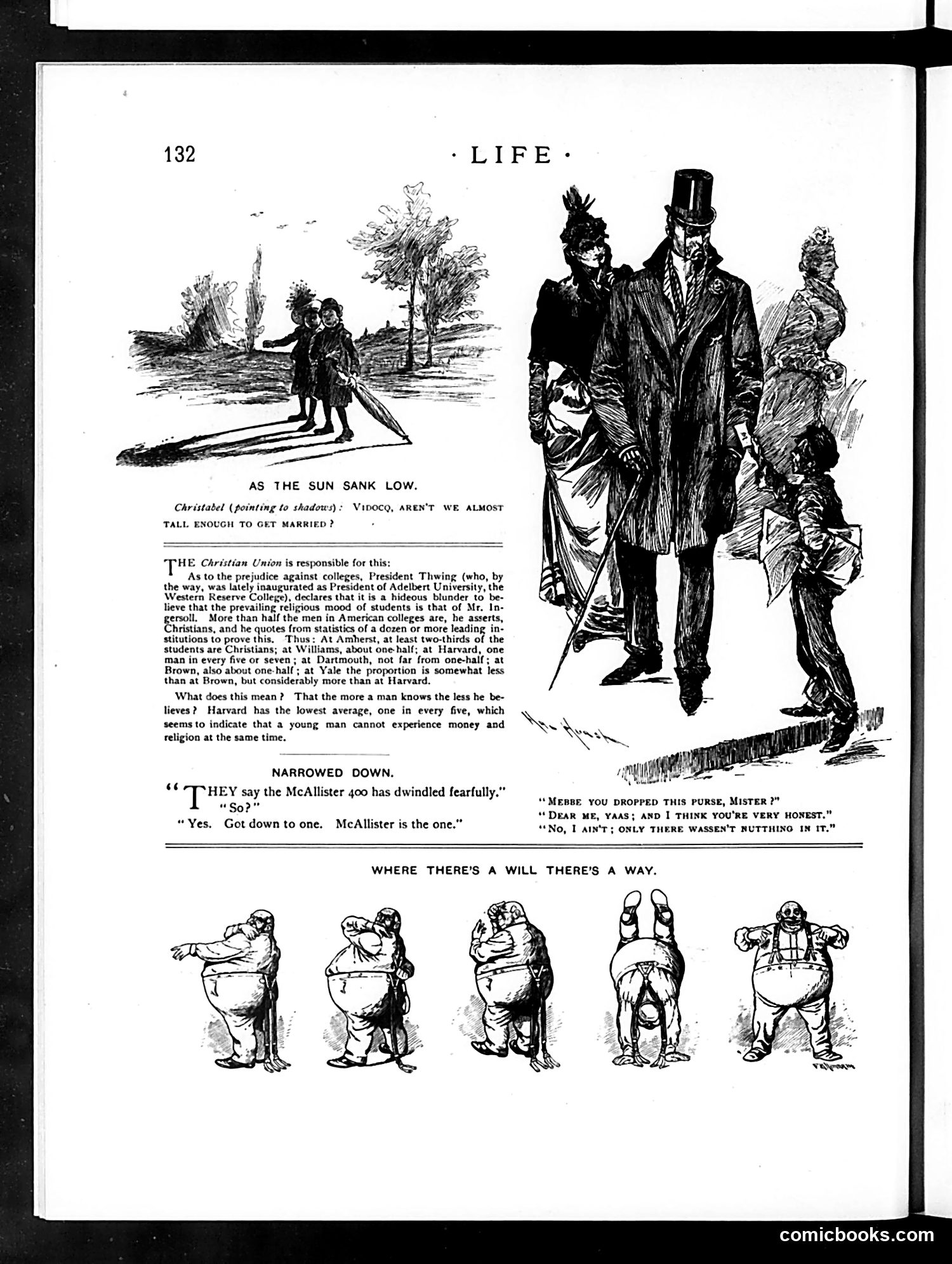
This page contains three separate satirical pieces from the Gilded Age: **"As the Sun Sank Low"** mocks the Christian Union's claim that most college students are religious believers. The text cites President Thwing's statistics showing varying percentages of Christian students across colleges—Harvard having the lowest (one in five to seven). The satire's point: the more educated a man becomes (Harvard being the most prestigious), the fewer believers there are, suggesting that higher learning and religious faith are incompatible. **"Narrowed Down"** references the "McAllister 400"—Ward McAllister's famous list of New York's social elite. The joke suggests this exclusive circle has dwindled to just one person. **"Where There's a Will There's a Way"** depicts five portly gentlemen in various contorted positions, apparently demonstrating flexibility or determination—the caption suggests finding solutions through persistence, though the specific reference is unclear. All pieces exemplify *Life* magazine's characteristic upper-class social criticism and gentle mockery of American institutions.
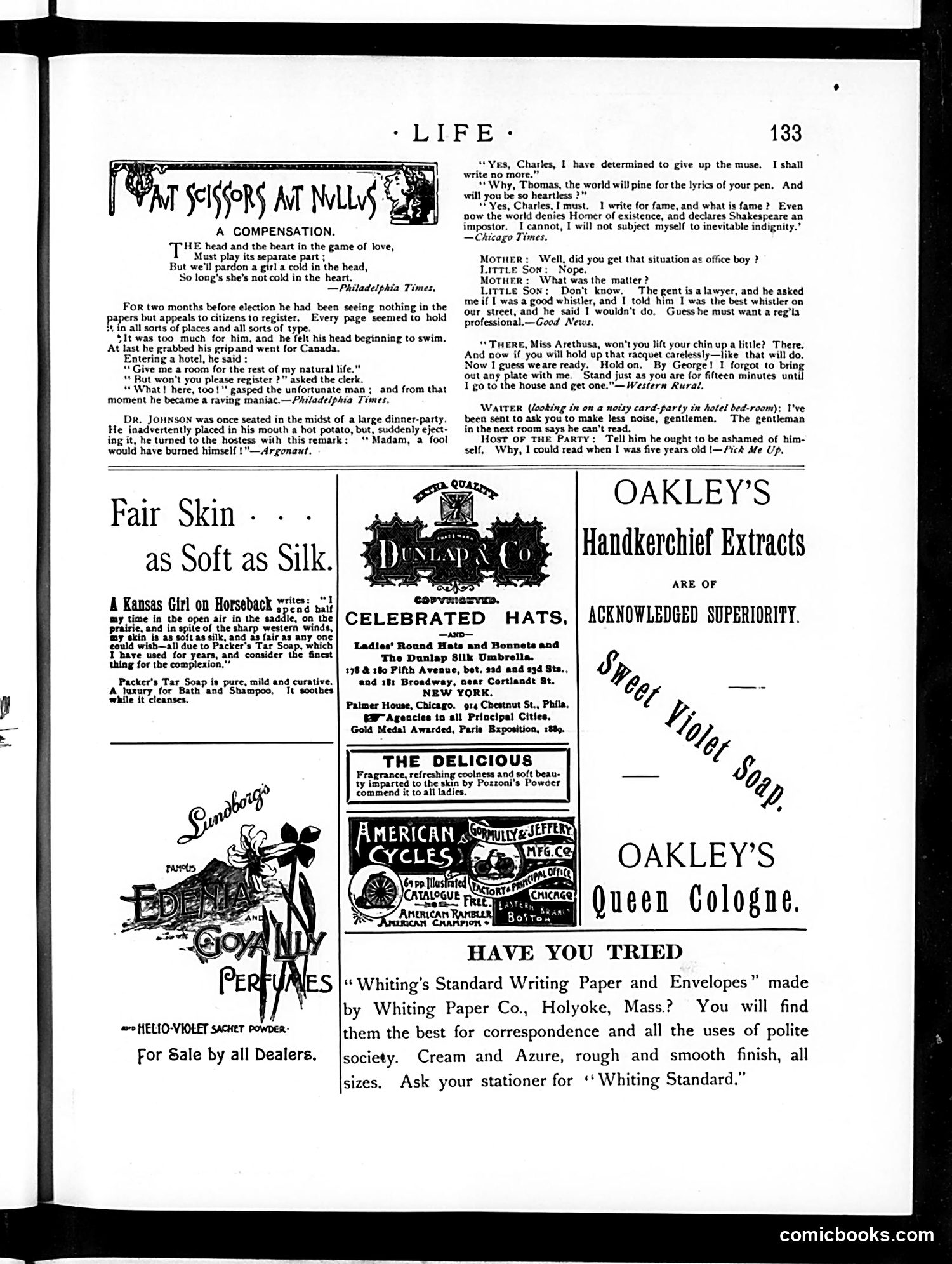
This page is primarily **advertising with interspersed humor snippets**, typical of Life's format. The cartoons/jokes satirize contemporary absurdities: 1. **"Registration" anecdote**: A man fleeing pre-election voter registration campaigns becomes so overwhelmed by constant registration appeals in newspapers that he flees to Canada—only to be asked to register at his hotel. The satire mocks the relentless civic registration push and suggests it drives people to madness. 2. **"Office boy" joke**: A lawyer rejects an applicant specifically because he's *too good* at whistling, implying that professional competence sometimes disqualifies candidates for entry-level work—a commentary on workplace absurdity. 3. **Card party noise complaint**: Guests ignore a noise complaint, with the host sarcastically questioning whether someone unable to read at age five should be ashamed—mocking upper-class entitlement. The remainder is period advertising for soaps, perfumes, hats, bicycles, and stationery, featuring common marketing claims about Kansas girls and "natural" beauty products.
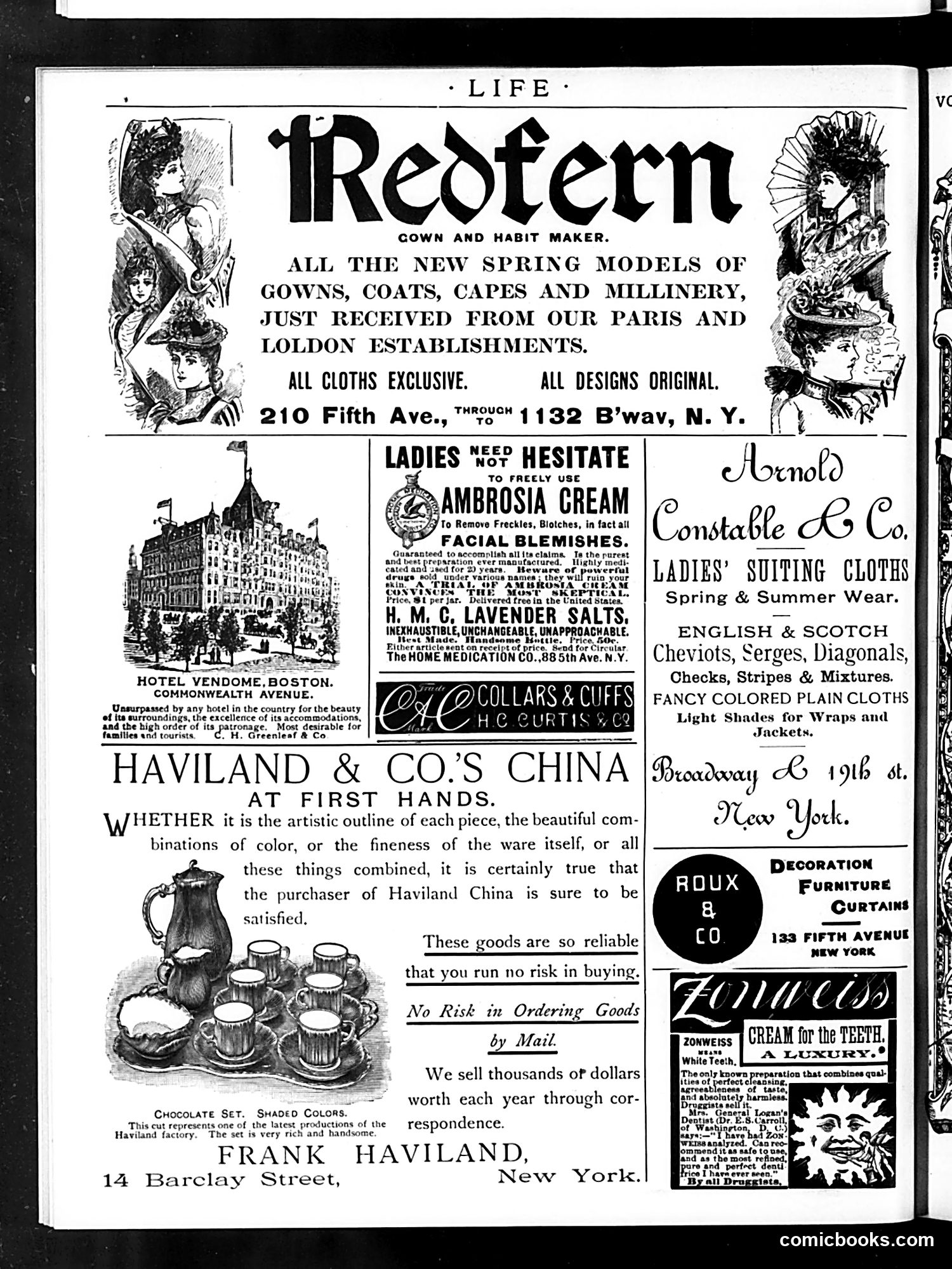
This is primarily a **commercial advertising page**, not a satirical cartoon page. It contains no political satire or social commentary. The page features luxury goods advertisements targeting affluent women of the early 20th century, including: - **Redfern**: A high-end gown and millinery shop advertising Paris and London fashions - **Ambrosia Cream**: A facial blemish treatment (note the period beauty concern about freckles and skin imperfections) - **Haviland China**: Fine porcelain sold by mail order - **Constable & Co.**: Women's clothing in English and Scottish fabrics - **Roux & Co.** and **Zonweiss**: Furnishings and tooth cream The Hotel Vendome advertisement emphasizes luxury travel accommodations. All ads stress exclusivity, quality imports, and mail-order convenience—reflecting the shopping habits and consumer aspirations of wealthy women of this era. **There is no cartoon or satirical content to analyze on this page.**