
Life, 1891-02-26 · page 4 of 14
Life — February 26, 1891 — page 4: what you’re looking at
What you’re looking at
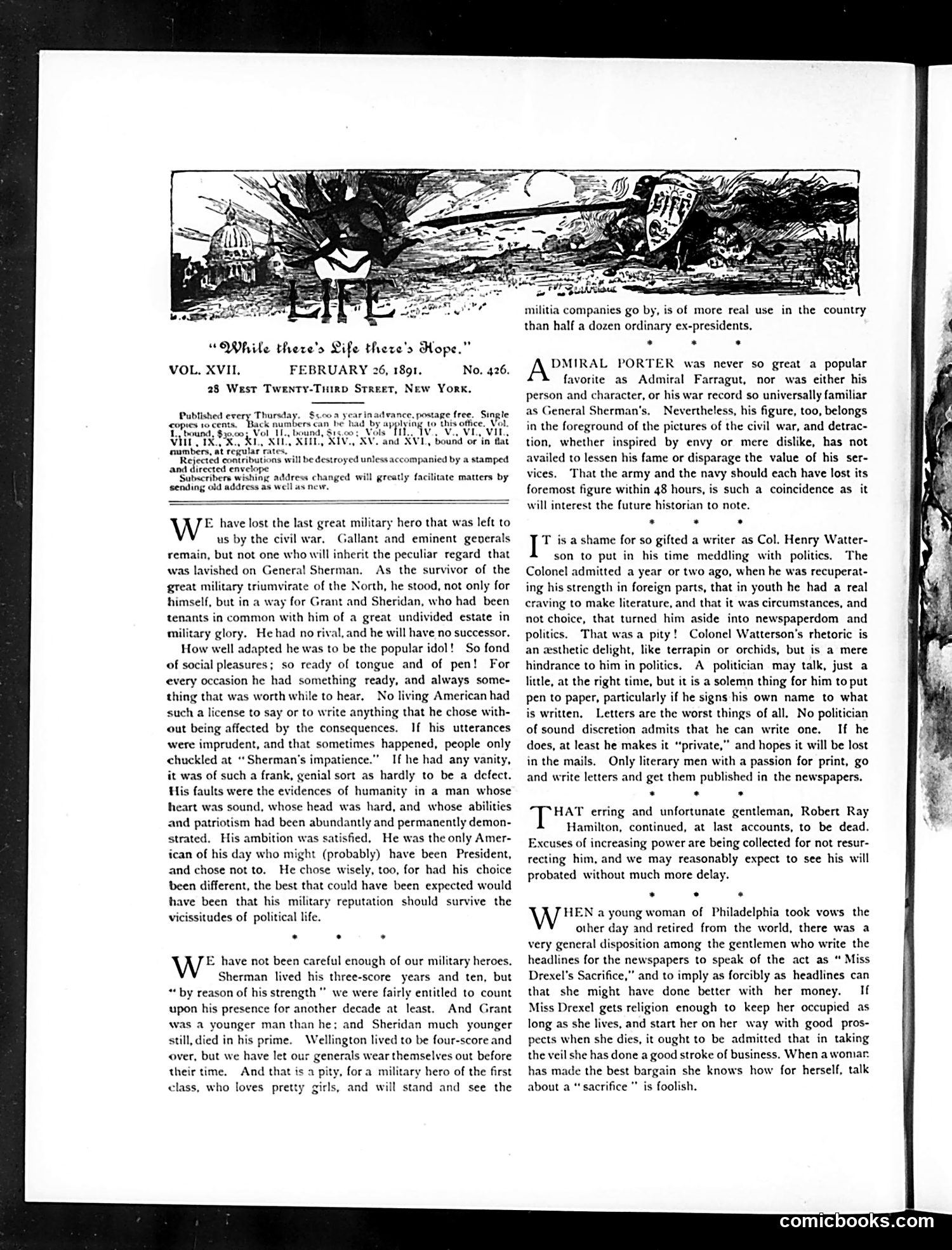
**The Cartoon:** The masthead illustration depicts a figure seated amid a desolate landscape with explosions and destruction. The caption reads "While there's Life there's Hope," apparently serving as Life's motto. **The Editorial Content:** The page's three essays address military and literary figures. The first discusses General Sherman as "the last great military hero" of the Civil War, praising his straightforward character. The second criticizes Colonel Henry Watterson for abandoning literary ambitions for politics—the author views this as a waste of talent. The third briefly mentions Robert Ray Hamilton's death and a Philadelphia woman named Miss Drexel who took religious vows, sarcastically suggesting her "sacrifice" represents good business sense. The writing reflects late-19th-century attitudes toward duty, public service, and gender roles.
📄 Transcribed text from this page (OCR, searchable)
Machine-transcribed from the original scan — historical spelling and the odd misread are preserved.
“Mhile there's Life there's Hope.” VOL. XVII. FEBRUARY 26, 1891. No. 426. 28 West Twenty-Tuirp Street, New York. nad vance, postage free. Single applying to this office, Vol Vos TH! Wve VIL. XV. and XVL, bound or ‘in tat Published every Tharstay. $5.0 copies ro cents. Back numbers can, 1., bound, $30.00; Vol H., bound, $1 : VEIL, IX. X., X12, XC XHIL, XIV, it regular rates Rejected contributik and directed envelope ‘Subscribers wishing address changed will greatly faci sending old address as well as new. 's will be destroyed unless accompanied by a stamped tate matters by W E have lost the last great military hero that was left to us by the civil war. Gallant and eminent geverals remain, but not one who will inherit the peculiar regard that was lavished on General Sherman. As the survivor of the great military triumvirate of the North, he stood, not only for himself, but in a way for Grant and Sheridan, who had been tenants in common with him of a great undivided estate in military glory. He had no rival, and he will have no successor. How well adapted he was to be the popular idol! So fond of social pleasures; so ready of tongue and of pen! For every occasion he had something ready, and always some- thing that was worth while to hear. No living American had such a license to say or to write anything that he chose with- out being affected by the consequences. If his utterances were imprudent, and that sometimes happened, people only chuckled at ‘Sherman's impatience.” If he had any vanity, it was of such a frank, genial sort as hardly to be a defect. His faults were the evidences of humanity in a man whose heart was sound, whose head was hard, and whose abilities and patriotism had been abundantly and permanently demon- strated. His ambition was satisfied. He was the only Amer- ican of his day who might (probably) have been President, and chose not to. He chose wisely, too, for had his choice been different, the best that could have been expected would have been that his military reputation should survive the vicissitudes of political life. . . . W* have not been careful enough of our military heroes. Sherman lived his three-score years and ten, but * by reason of his strength" we were fairly entitled to count upon his presence for another decade at least. And Grant was a younger man than he; and Sheridan much younger still, died in his prime. Wellington lived to be four-score and over, but we have let our generals wear themselves out before their time. And that is a pity, fora military hero of the first class, who loves pretty girls, and will stand and see the militia companies go by, is of more real use in the country than half a dozen ordinary ex-presidents. . * . DMIRAL PORTER was never so great a popular favorite as Admiral Farragut, nor was either his person and character, or his war record so universally familiar as General Sherman's, Nevertheless, his figure, too, belongs in the foreground of the pictures of the civil war, and detrac- tion, whether inspired by envy or mere dislike, has not availed to lessen his fame or disparage the value of his ser- vices. That the army and the navy should each have lost its foremost figure within 48 hours, is such a coincidence as it will interest the future historian to note. . . . T is ashame for so gifted a writer as Col. Henry Watter- son to put in his time meddling with politics. The Colonel admitted a year or two ago, when he was recuperat- ing his strength in foreign parts, that in youth he had a real craving to make literature, and that it was circumstances, and not choice, that turned him aside into newspaperdom and politics. That wasa pity! Colonel Watterson’s rhetoric is an wsthetic delight, like terrapin or orchids, but is a mere hindrance to him in politics, A politician may talk, just a little, at the right time, but it is a solemn thing for him to put pen to paper, particularly if he signs his own name to what is written, Letters are the worst things of all. No politician of sound discretion admits that he can write one, If he does, at least he makes it “private,” and hopes it will be lost in the mails. Only literary men with a passion for print, go and write letters and get them published in the newspapers. . . . HAT erring and unfortunate gentleman, Robert Ray Hamilton, continued, at last accounts, to be dead. Excuses of increasing power are being collected for not resur- recting him, and we may reasonably expect to see his will probated without much more delay. . . . WHE a young woman of Philadelphia took vows the other day and retired from the world, there was a very general disposition among the gentlemen who write the headlines for the newspapers to speak of the act as “ Miss Drexel’s Sacrifice,” and to imply as forcibly as headlines can that she might have done better with her money. If Miss Drexel gets religion enough to keep her occupied as long as she lives, and start her on her way with good pros- pects when she dies, it ought to be admitted that in taking the veil she has done a good stroke of business. When a womar: has made the best bargain she knows how for herself, talk about a “sacrifice " is foolish. comicbooks.com