
Life, 1891-02-26 · page 6 of 14
Life — February 26, 1891 — page 6: what you’re looking at
What you’re looking at
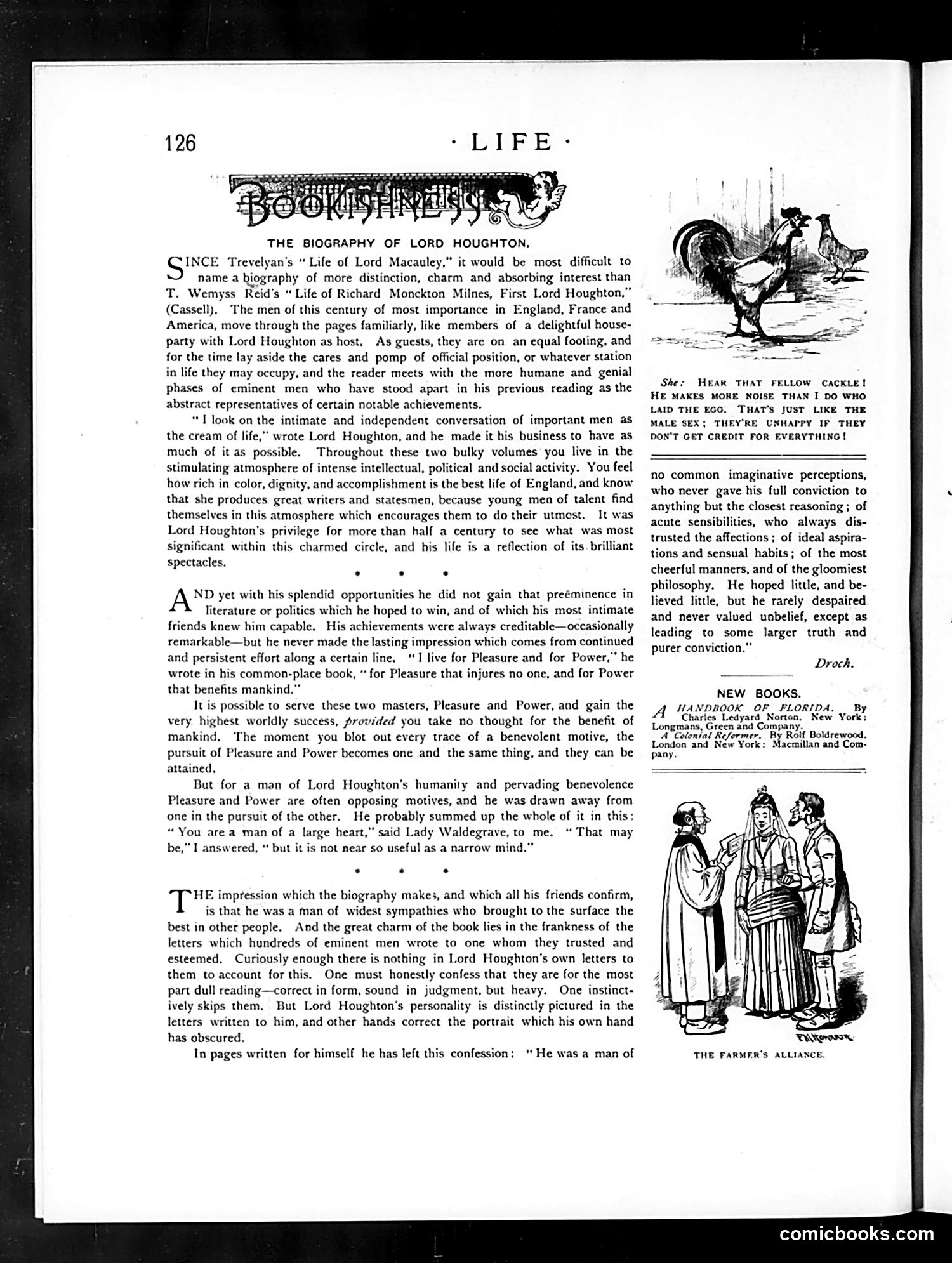
This page primarily contains a biographical essay about Lord Houghton by T. Wemyss Reid, praising his social influence and literary circle in 19th-century England. The essay emphasizes Houghton's ability to balance "Pleasure and Power" while maintaining humanitarianism. **The cartoons:** Two illustrations appear: one showing a rooster with accompanying text mocking male vanity ("He makes more noise than I do who laid the egg"), and another titled "The Farmer's Alliance" depicting three figures in period dress—likely representing rural/agricultural interests. These illustrations appear to be unrelated to the Houghton biography and instead serve as filler content. The page also advertises new books including "A Handbook of Florida" and "A Colonial Governor." The rooster cartoon is a straightforward gender-based joke about male boastfulness versus female reproductive contribution.
📄 Transcribed text from this page (OCR, searchable)
Machine-transcribed from the original scan — historical spelling and the odd misread are preserved.
THE BIOGRAPHY OF LORD HOUGHTON. INCE Trevelyan’s “ Life of Lord Macauley,” it would be most difficult to name a biography of more distinction, charm and absorbing interest than T. Wemyss Reid's “ Life of Richard Monckton Milnes, First Lord Houghton,” (Cassell). The men of this century of most importance in England, France and America, move through the pages familiarly, like members of a delightful house- party with Lord Houghton as host. As guests, they are on an equal footing, and for the time lay aside the cares and pomp of official position, or whatever station in life they may occupy, and the reader meets with the more humane and genial phases of eminent men who have stood apart in his previous reading as the abstract representatives of certain notable achievements. “TL look on the intimate and independent conversation of important men as the cream of life,” wrote Lord Houghton, and he made it his business to have as much of it as possible. Throughout these two bulky volumes you live in the stimulating atmosphere of intense intellectual, political and social activity. You feel how rich in color, dignity, and accomplishment is the best life of England, and know that she produces great writers and statesmen, because young men of talent find themselves in this atmosphere which encourages them to do their utmost. It was Lord Houghton’s privilege for more than half a century to see what was most significant within this charmed circle, and his life is a reflection of its. brilliant spectacles. . . . AX? yet with his splendid opportunities he did not gain that preéminence in literature or politics which he hoped to win, and of which his most intimate friends knew him capable. His achievements were always creditable—occasionally remarkable—but he never made the lasting impression which comes from continued and persistent effort along a certain line. ‘I live for Pleasure and for Power,” he wrote in his common-place book, “for Pleasure that injures no one, and for Power that benefits mankind.” It is possible to serve these two masters, Pleasure and Power, and gain the very highest worldly success, provided you take no thought for the benefit of mankind. The moment you blot out every trace of a benevolent motive, the pursuit of Pleasure and Power becomes one and the same thing, and they can be attained, But for a man of Lord Houghton’s humanity and pervading benevolence Pleasure and Power are often opposing motives, and he was drawn away from one in the pursuit of the other. He probably summed up the whole of it in this: “You are a man of a large heart,” said Lady Waldegrave, to me. “ That may be," I answered, “ but it is not near so useful as a narrow mind.” . . . HE impression which the biography makes, and which all his friends confirm, is that he was a man of widest sympathies who brought to the surface the best in other people. And the great charm of the book lies in the frankness of the letters which hundreds of eminent men wrote to one whom they trusted and esteemed. Curiously enough there is nothing in Lord Houghton’s own letters to them to account for this. One must honestly confess that they are for the most part dull reading—correct in form, sound in judgment, but heavy. One instinct- ively skips them. But Lord Houghton’s personality is distinctly pictured in the letters written to him, and other hands correct the portrait which his own hand has obscured. In pages written for himself he has left this confession: ‘He was a man of Ske: HEAK THAT FELLOW CACKLE! HE MAKES MORE NOISE THAN I DO WHO LAID THE EGG, THAT'S JUST LIKE THE MALE SEX; THEY'RE UNHAPPY IF THEY DON'T GET CREDIT FOR EVERYTHING! no common imaginative perceptions, who never gave his full conviction to anything but the closest reasoning; of acute sensibilities, who always dis- trusted the affections ; of ideal aspira- tions and sensual habits; of the most cheerful manners, and of the gloomiest philosophy. He hoped little, and be- lieved little, but he rarely despaired and never valued unbelief, except as leading to some larger truth and purer conviction.” Droch. NEW BOOKS. A YANDBOOK OF FLORIDA. | By Charles Ledyard Norton. New York: Longmans, Green and Company. A Colonial Reformer. By Rolf Boldrewood. London and New York: Macmillan and Com: pany. THE FARMER'S ALLIANCE. comicbooks.com