
A complete issue · 14 pages · 1891
Life — February 12, 1891
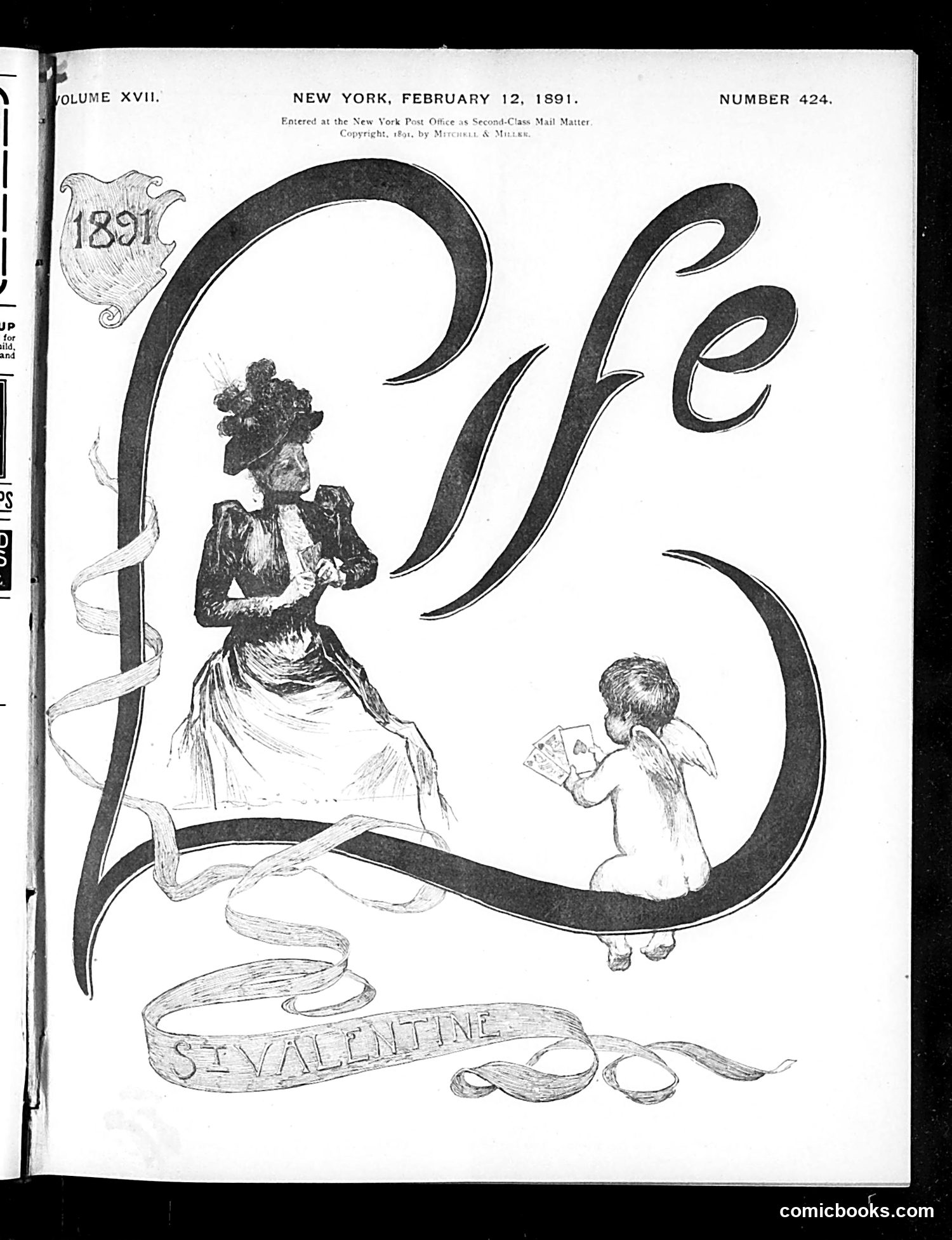
This is a Valentine's Day issue cover featuring a decorative art nouveau design. A fashionably dressed woman of the 1890s occupies the center, rendered in the era's characteristic "Gibson Girl" style with elaborate upswept hair and puffed sleeves. A cherub (Cupid) appears to her right holding a hand of playing cards—likely a visual pun suggesting romantic "chance" or "luck" in love. The banner reading "ST. VALENTINE" anchors the composition with scattered hearts and shell imagery below, reinforcing the romantic holiday theme. The large decorative letters frame the scene in the ornate typographic style typical of 1890s commercial illustration. This appears to be primarily a festive holiday cover rather than political satire, celebrating Valentine's Day with popular aesthetic conventions of the period.
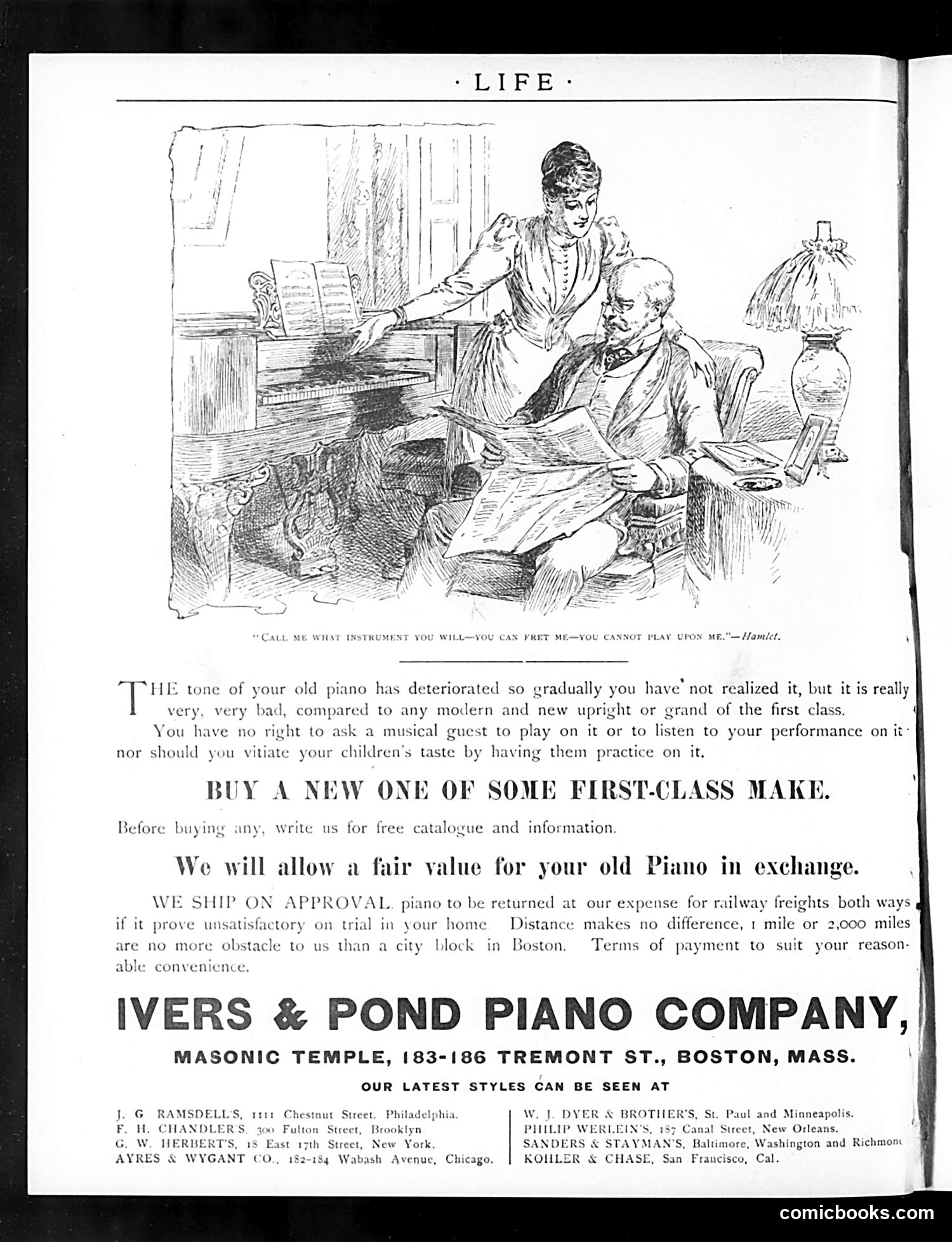
This page is primarily an **advertisement for Ivers & Pond pianos**, not satirical content. The illustration depicts a domestic scene where a woman stands beside a man seated at a piano, with sheet music visible. The quoted caption—"Call me what instrument you will—you can fret me, you cannot play upon me" (from Hamlet)—is a literary reference used as a sales hook. The ad argues that an old, deteriorated piano damages one's musical reputation and children's taste, urging readers to purchase a new "first-class" piano instead, offering trade-in value for old instruments. The "Hamlet" quote cleverly plays on musical terminology ("fret") while suggesting the piano itself cannot be manipulated or compromised—implying quality and reliability of Ivers & Pond's product.
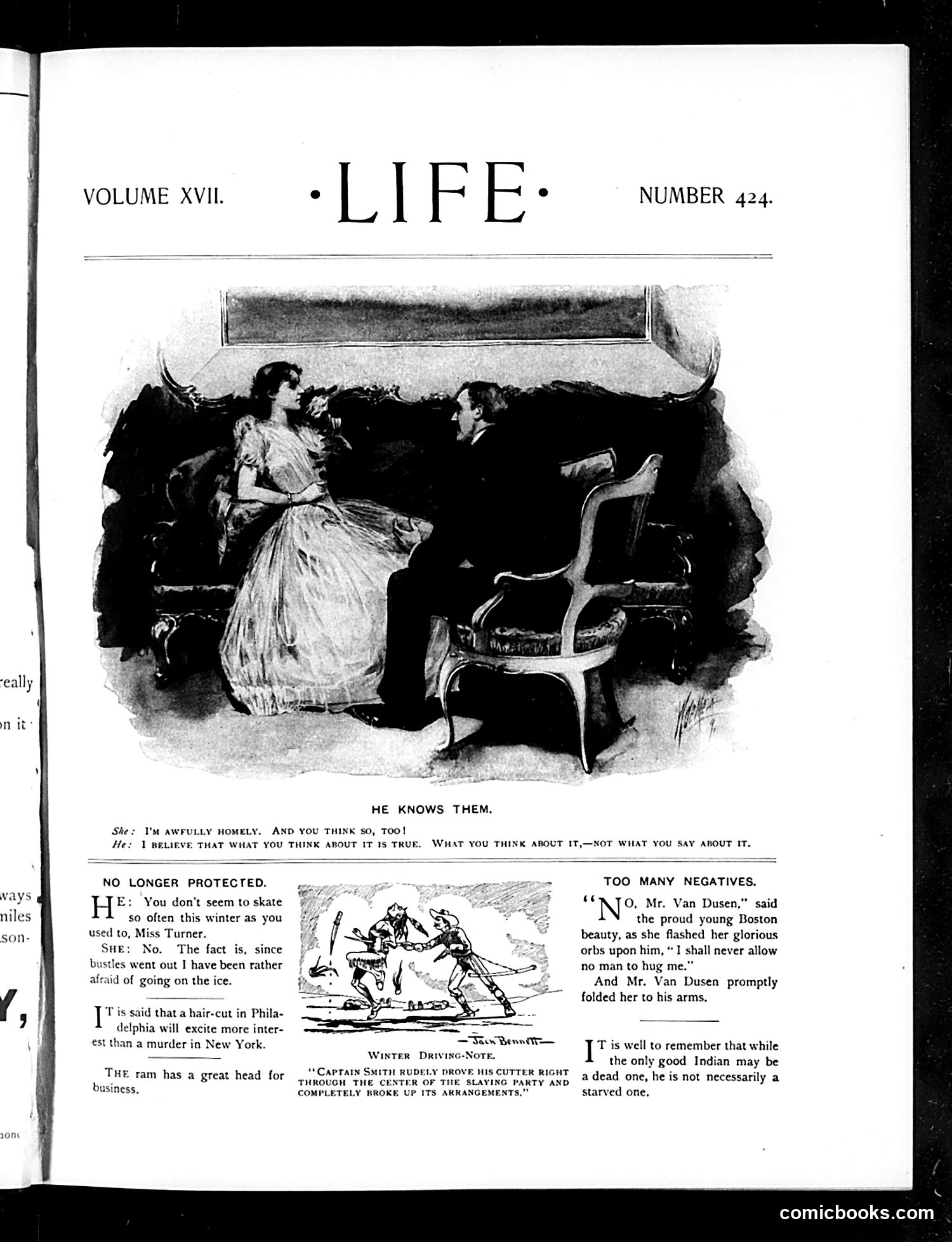
The main illustration depicts a domestic scene titled "He Knows Them," showing a woman and man in conversation on a sofa. The dialogue reveals social commentary: she confesses feeling "awfully homely," and he philosophically responds that thoughts—not words—define reality. Below are three brief humorous snippets: 1. **"No Longer Protected"**: A man no longer skates safely like he did with Miss Turner; now he's "rather afraid" due to increased dangers. 2. **"Winter Driving-Note"**: A cartoon showing someone's cutter breaking during winter activities—slapstick humor about seasonal mishaps. 3. **"Too Many Negatives"**: A woman (Miss Jeanson) rejects a man's (Mr. Van Dusen's) advances, asserting independence. The page reflects early-20th-century concerns about courtship, gender dynamics, and social propriety through gentle satirical humor.
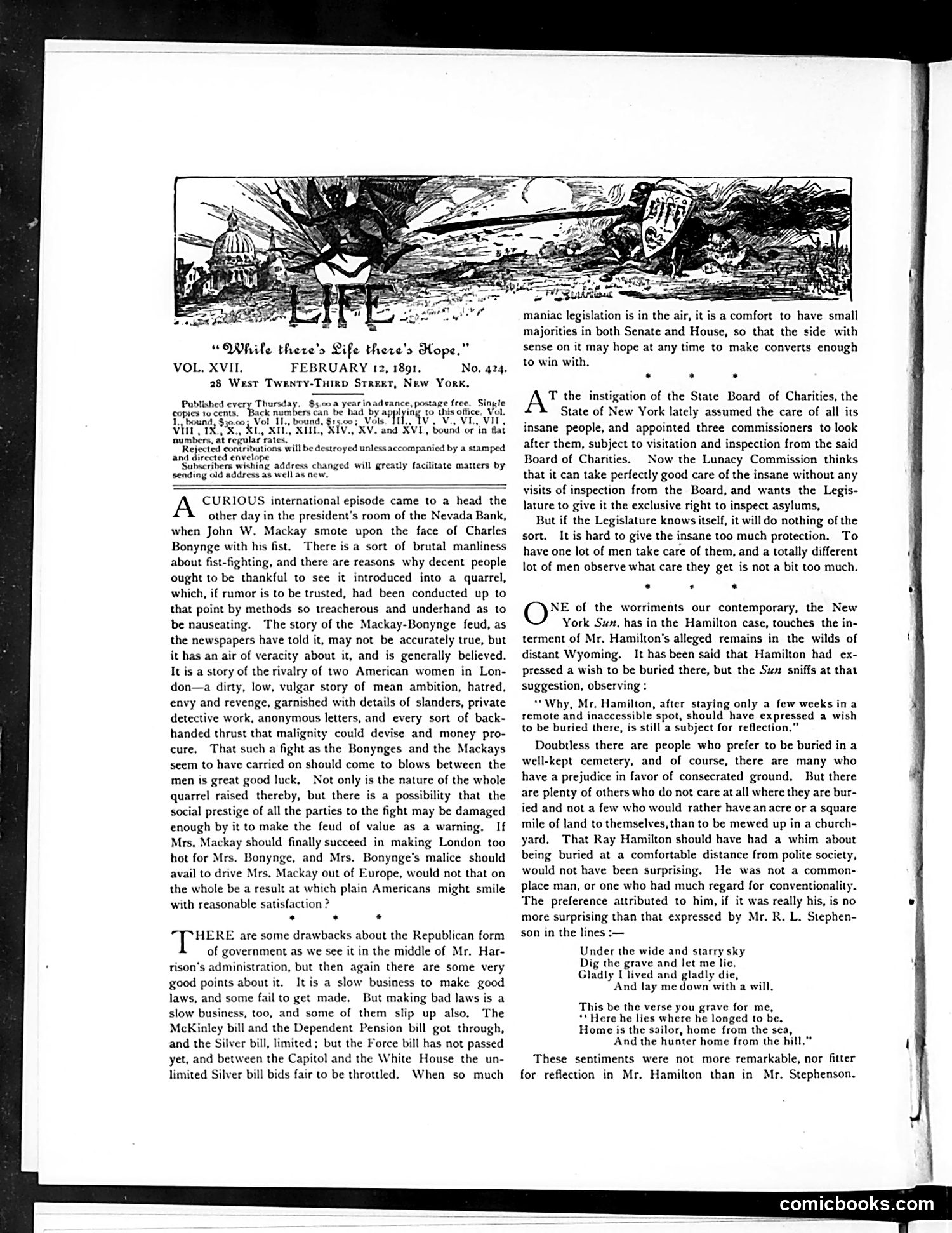
The page's header cartoon depicts a pastoral landscape with a large tree and a sign reading "LIFE," illustrating the magazine's title. The text discusses several political and social issues of the era: Republican governance, legislative challenges including the McKinley bill and Dependent Pension bill, and commentary on the "maniac legislation" currently under consideration. A notable anecdote describes an alleged altercation between John W. Mackay and Charles Boynge at the Nevada Bank involving disputes over women—a scandal employing period details of slander and social intrigue. The page also addresses treatment of the insane under New York State's Board of Charities, and discusses Ray Hamilton's burial preferences in Wyoming, touching on class attitudes toward proper burial grounds. The satirical tone critiques both government inefficiency and contemporary social pretensions.
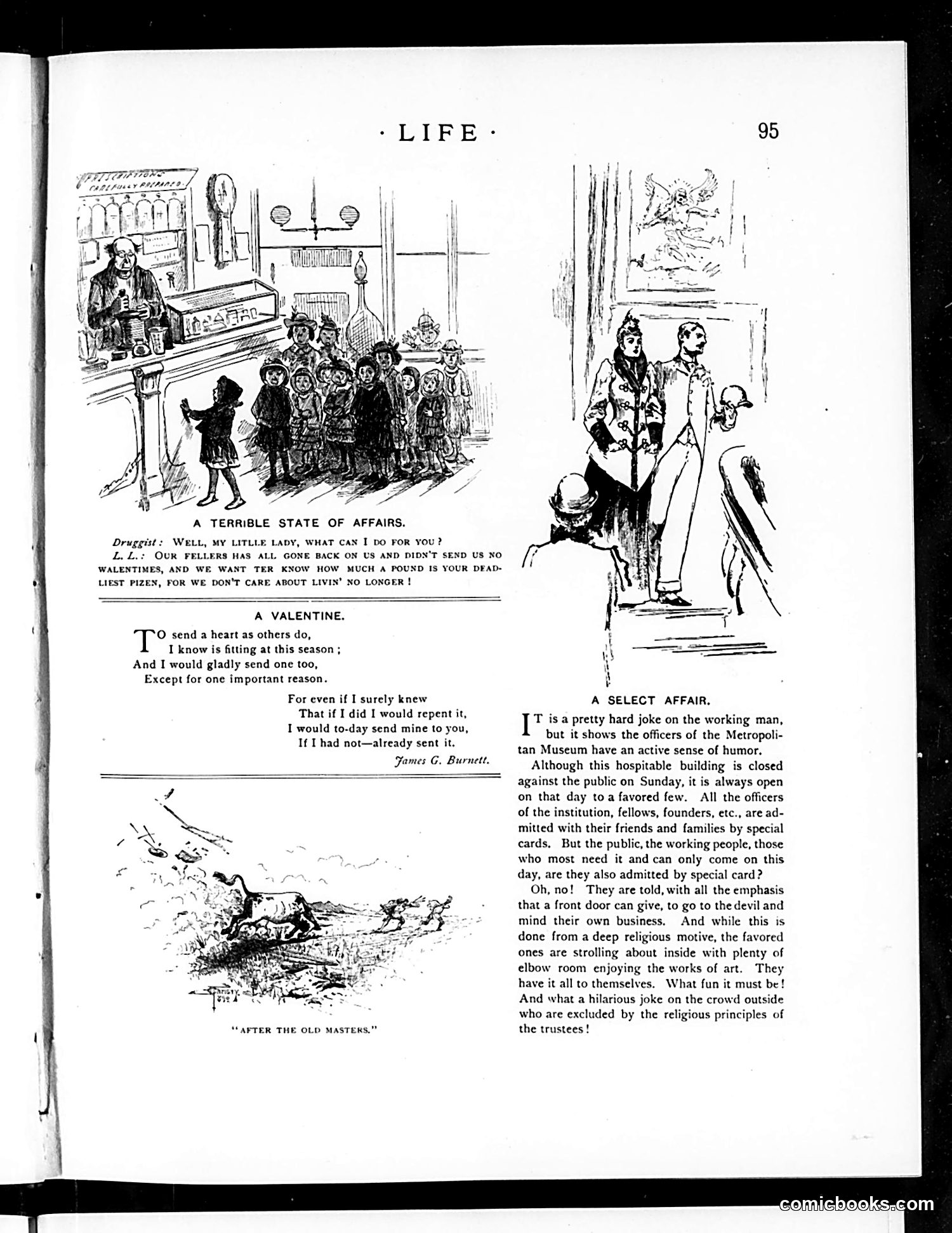
**"A Terrible State of Affairs"** (top left): A druggist at a counter addresses a young girl about missing Valentine's cards and money. The joke satirizes the commercialization of Valentine's Day—the concern is purely financial ("how much a pound is your dead-list fixed"), not romantic sentiment. **"A Valentine"** (center): A poem by James G. Burnett expressing reluctance to send a Valentine due to prior commitment. **"A Select Affair"** (right): This criticizes the Metropolitan Museum's Sunday hours policy. The satirist notes the irony that the museum is closed to the general public (working people who need it most) on Sundays but open only to privileged members—contradicting stated "religious principles" of the trustees who exclude the very people who deserve access.
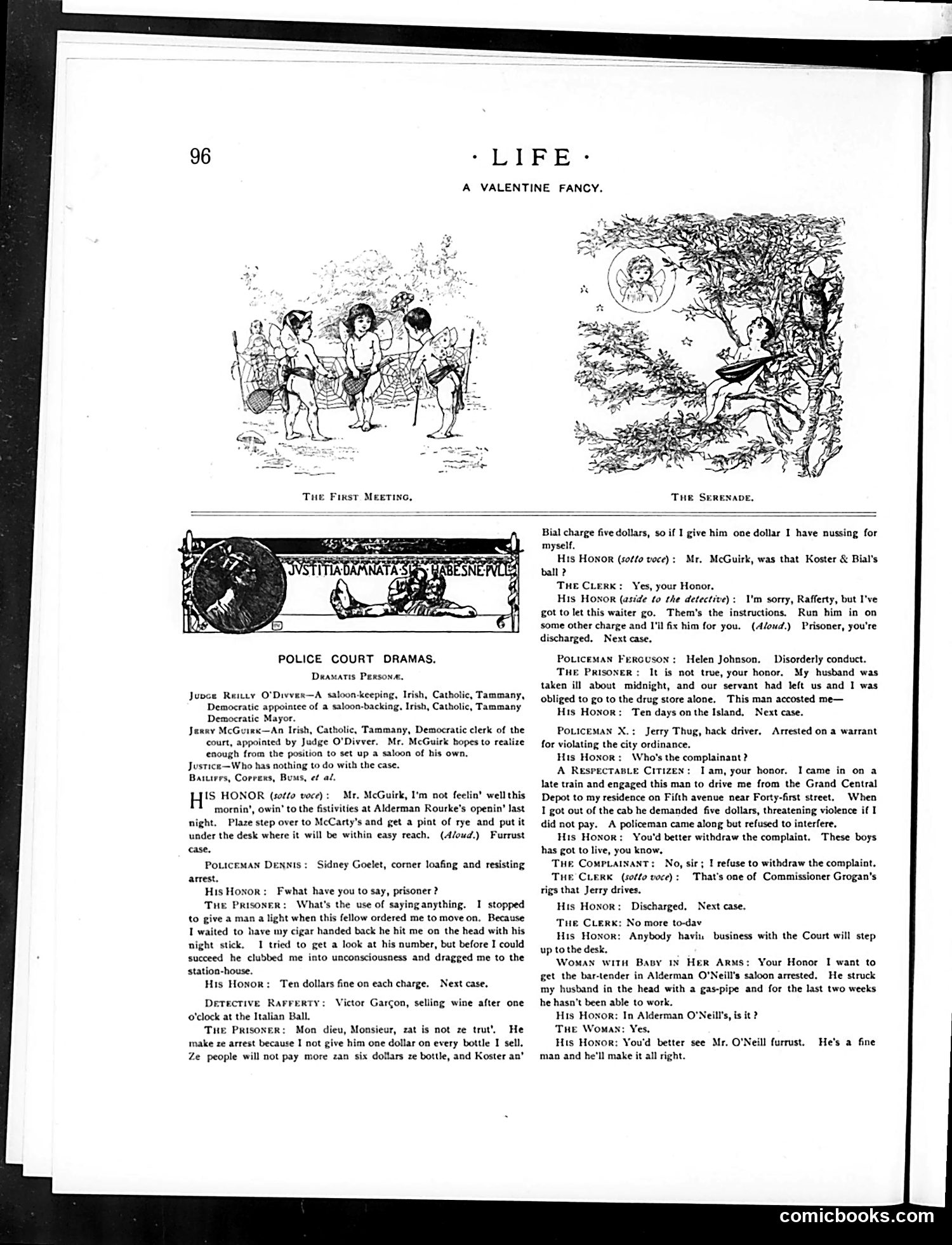
This page satirizes early 20th-century urban police court proceedings. The "Police Court Dramas" section mocks typical cases heard by Judge Reilly O'Dwyer, featuring minor offenses: a saloon-keeper's dispute over bottle charges, a cab driver arrested for traffic violations, and a domestic dispute where a woman accuses her husband of assault. The satire highlights how trivial many cases are—disputes over five-dollar charges, traffic infractions, complaints that get dismissed. The humor derives from the formal legal language applied to petty squabbles, and the judge's rapid dismissals ("Next case"), suggesting the court's inefficiency in handling such minor matters. The Valentine's Day framing suggests romance gone wrong drives many complaints.
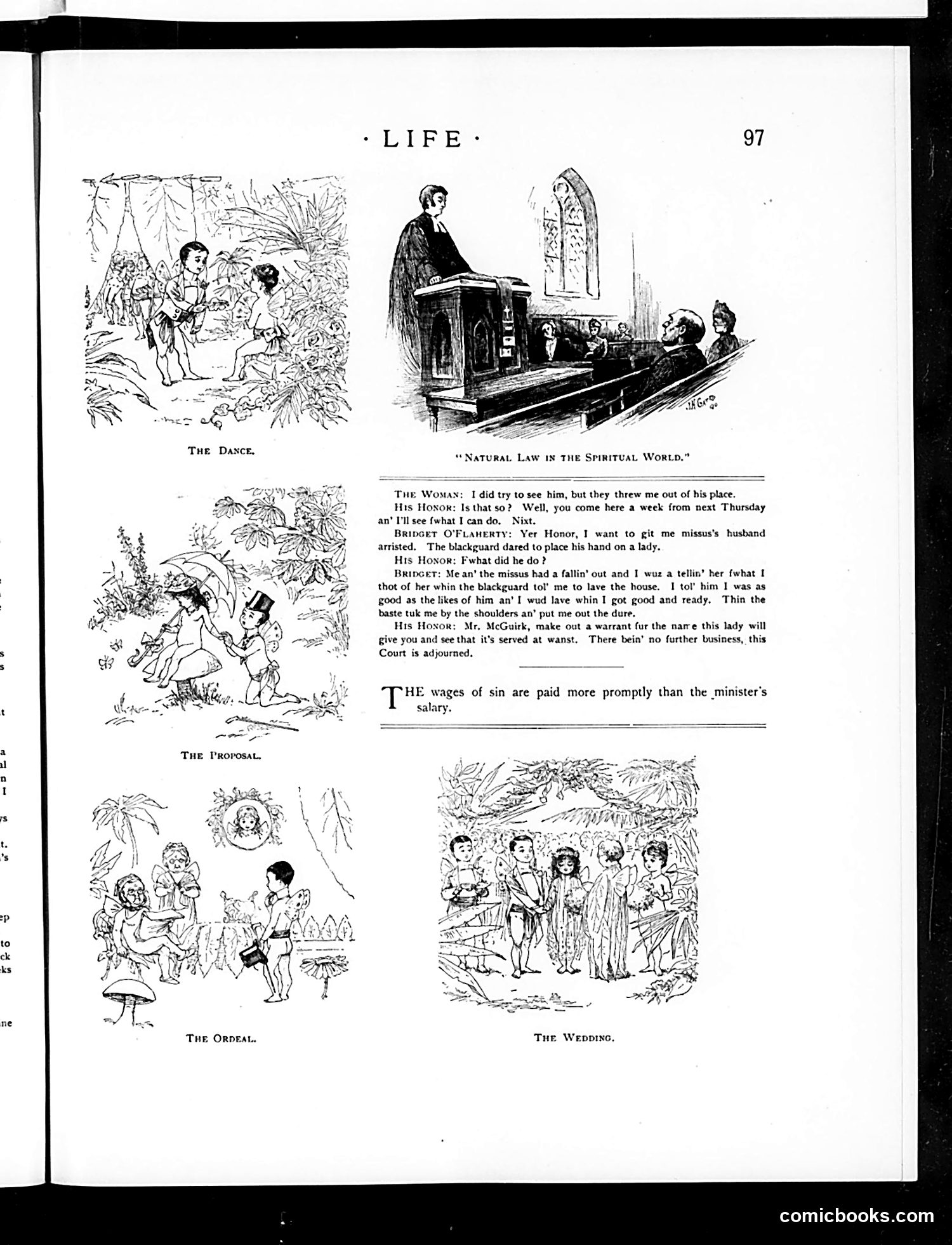
This page contains four satirical sketches with Victorian-era romantic and social themes: "The Dance," "The Proposal," "The Ordeal," and "The Wedding," depicting courtship rituals. The central text presents a dialogue between "The Woman," "His Honor," and "Bridget O'Flaherty" regarding a servant's husband who fell out and was injured. The Honor (likely a judge or magistrate) orders a warrant for the lady's name and arranges court dismissal. The aphorism—"The wages of sin are paid more promptly than the minister's salary"—satirizes religious hypocrisy and church financial struggles, a common Victorian critique. The accompanying sermon illustration labeled "Natural Law in the Spiritual World" shows clergy addressing a congregation in a church setting, likely mocking sermons about morality while social injustices persist.
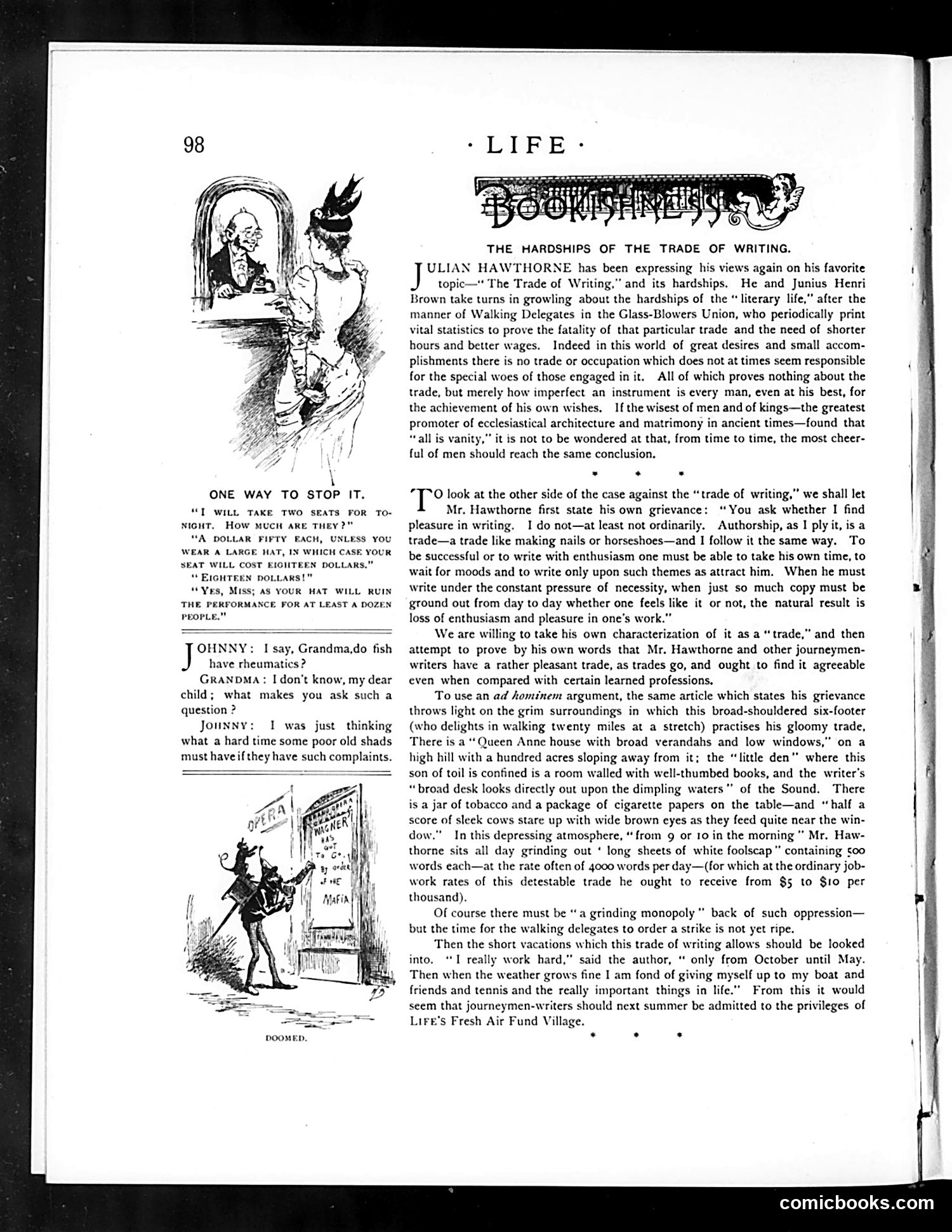
This satirical piece critiques the romantic notion of writing as a profession. Julian Hawthorne (son of Nathaniel Hawthorne) defends writing against claims it's not a "real trade" like nail-making or horseshoes. The cartoons mock writers' complaints: one shows a man at a desk refusing social invitations because he "must wait for moods," while another depicts a writer at a newspaper office labeled "DOOMED." The satire targets both sides—writers who romanticize their suffering and claim it's not a trade, and those who dismiss writing as easy leisure work. The underlying joke: writers want professional respect while refusing the discipline actual trades demand. The piece suggests writers should either commit fully or stop complaining.
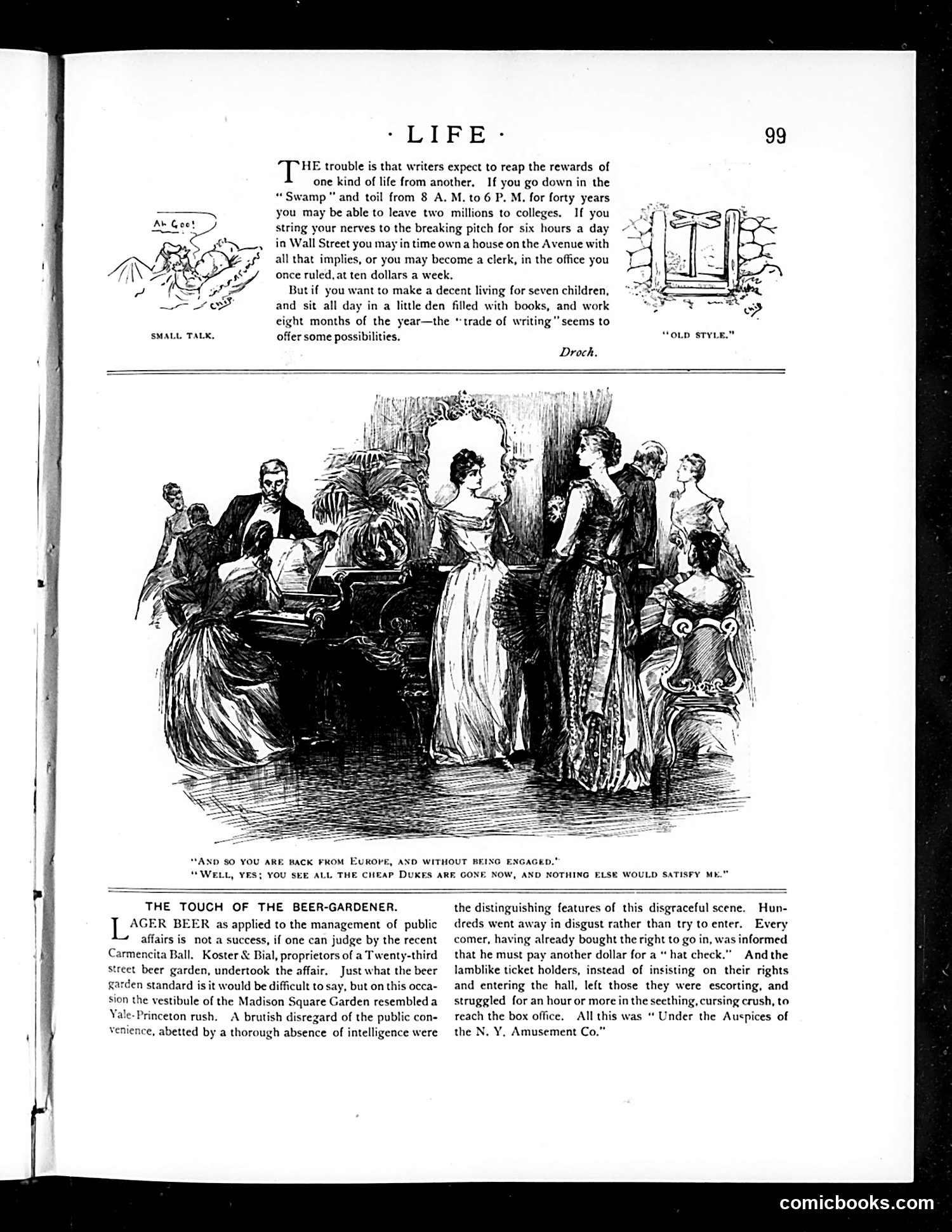
This page contains social satire about writers' career prospects and a satirical account of a beer-garden management scandal at Madison Square Garden. **Top section:** The text and small illustrations ("Small Talk" and "Old Style") discuss the economic struggle of professional writers. It contrasts the meager returns from serious literary work against other occupations, satirizing the romantic notion that writing offers financial security. **Main illustration and article:** "The Touch of the Beer-Gardener" critiques the mismanagement of the Madison Square Garden's beer concession. The scene depicts well-dressed patrons attempting to enter a social event, apparently being overcharged or harassed by ticket holders. The dialogue indicates frustration with inflated prices and poor service—satire directed at the proprietors' incompetence and profiteering in managing public entertainment.
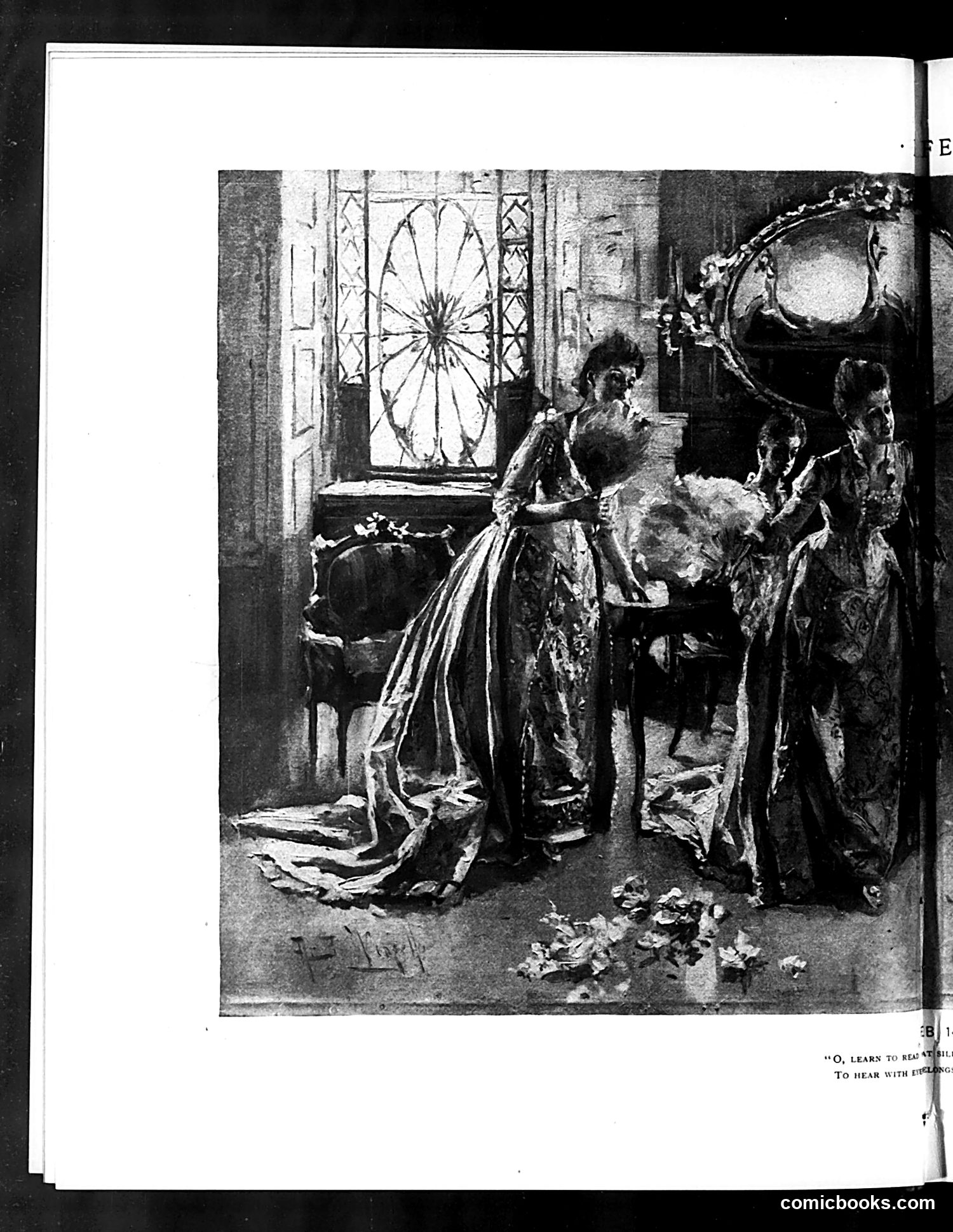
This appears to be an illustration from Life magazine depicting an elegant interior scene with several figures in ornate period dress gathered around a window. A woman in elaborate robes with a long train stands prominently, while other well-dressed figures observe her. The partially visible caption at bottom reads: "O, LEARN TO READ AT HIS! / TO HEAR WITH FEELING!" Without complete caption text or identifying labels, I cannot definitively state which specific political or social figures are being satirized. The scene suggests commentary on aristocratic pretension or affected cultural refinement, but the exact target of satire remains unclear from the visible information. The artistic style and clothing suggest this is likely from the late 19th or early 20th century.
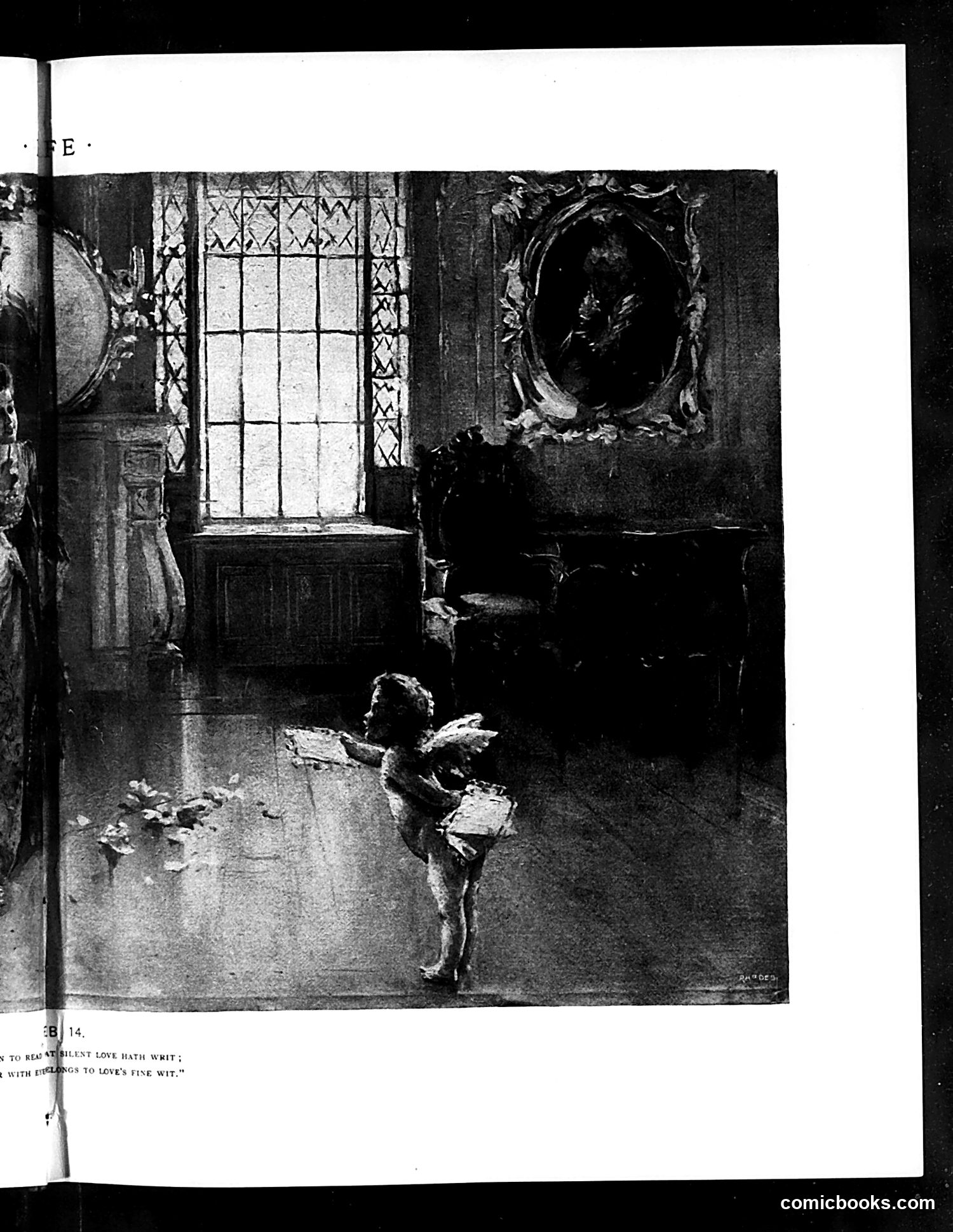
This appears to be a theatrical or literary illustration rather than a political cartoon. The black-and-white image shows an interior scene with a cherub or cupid figure in the center of an ornate room, near a window with leaded panes. A portrait hangs on the wall. The partial OCR text visible at bottom references "ELOQUENT LOVE HATH WRIT" and "LOVE'S FINE WIT," suggesting this illustrates a romantic or classical literary passage—possibly Shakespeare or similar period literature. Without complete caption text or publication date, I cannot definitively identify the specific work being illustrated or its satirical intent. The page appears to be from Life magazine's arts/literary section rather than its political commentary pages.
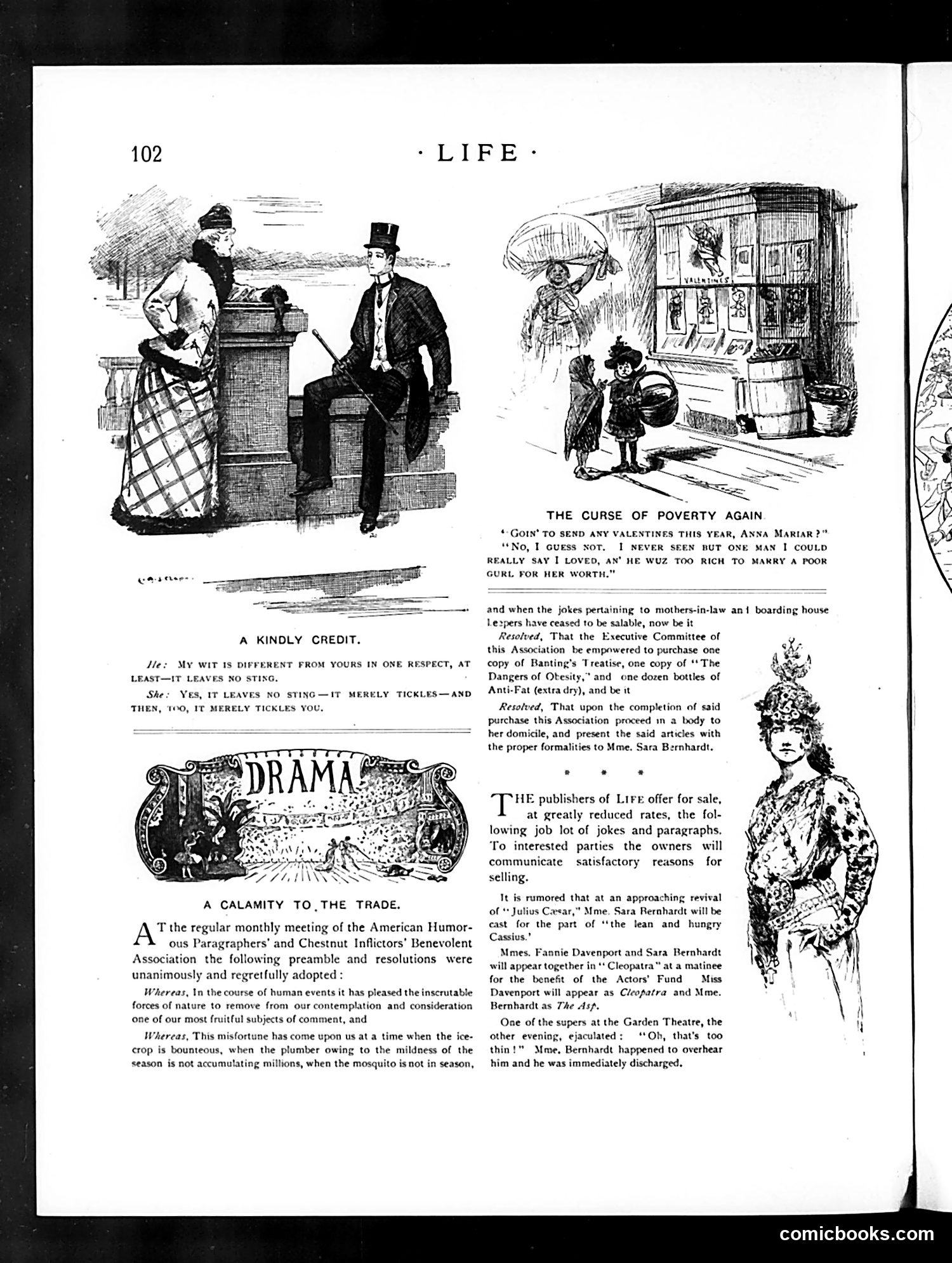
This page contains several interconnected jokes centered on **Sara Bernhardt**, the famous French actress. The satire works on two levels: **"A Calamity to the Trade"** mocks humorists and joke-writers who are running out of material. Their traditional targets (mothers-in-law, boarding house keepers, ice crop failures, plumbers) are no longer funny or newsworthy. As a solution, the "Humorists' Benevolent Association" proposes buying Bernhardt anti-fat treatises and bottles of "Anti-Fat (extra dry)"—a cutting joke about her weight. They'll present these "gifts" to her as a formal delegation. The subsequent quips pile on: she'll be cast as the "lean and hungry" Cassius (ironic); she'll play "The Asp" alongside Fannie Davenport's Cleopatra (implying she's snake-like); a theater extra who muttered "that's too thin!" was fired for the insult. **"The Curse of Poverty Again"** shows a poor woman refusing valentines because the one man she loved was too wealthy to marry beneath his station—a separate commentary on class divisions. The humor relies entirely on Bernhardt's celebrity status and assumptions about her appearance.
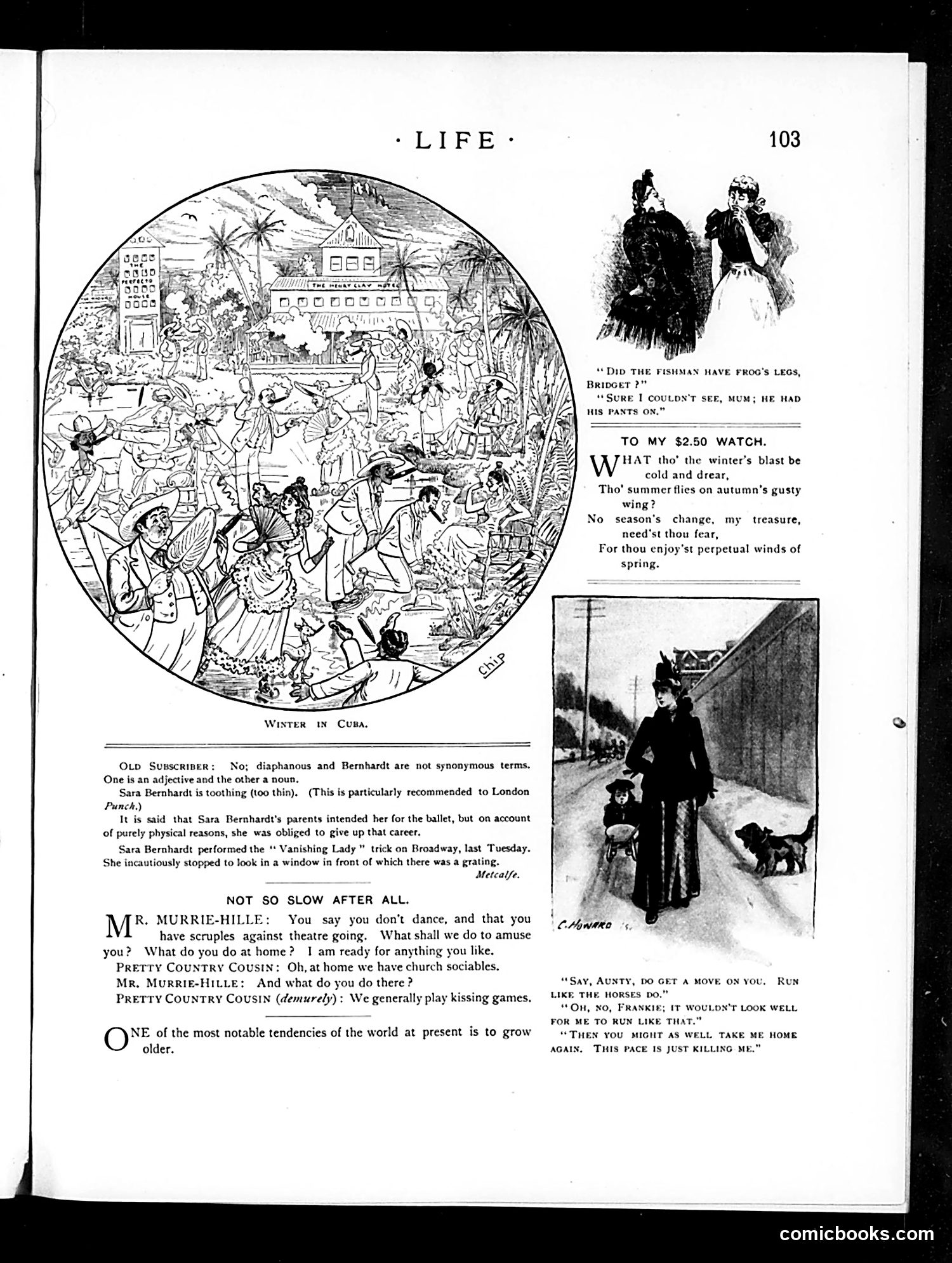
This page contains several satirical pieces typical of early 20th-century American humor: **"Winter in Cuba"** is a detailed circular illustration depicting tropical leisure activities—likely mocking wealthy Americans vacationing in Cuba during winter. **The dialogue exchanges** are comedic vignettes poking fun at social pretensions. One mock-serious "Old Subscriber" note criticizes Sara Bernhardt (the famous French actress), suggesting she's too thin, with a barbed reference to her attempted "Vanishing Lady" stage trick. **"Not So Slow After All"** presents a flirtation scene between a worldly gentleman and a naive "Pretty Country Cousin" who admits to only attending church socials with kissing games. The humor derives from her innocence contrasted with urban sophistication. **The final aphorism** ("One of the most notable tendencies...to grow older") is dry philosophical satire on aging. The page's overall tone reflects turn-of-the-century American magazine humor: mildly risqué, class-conscious, and gently mocking of both rural naiveté and urban affectation.
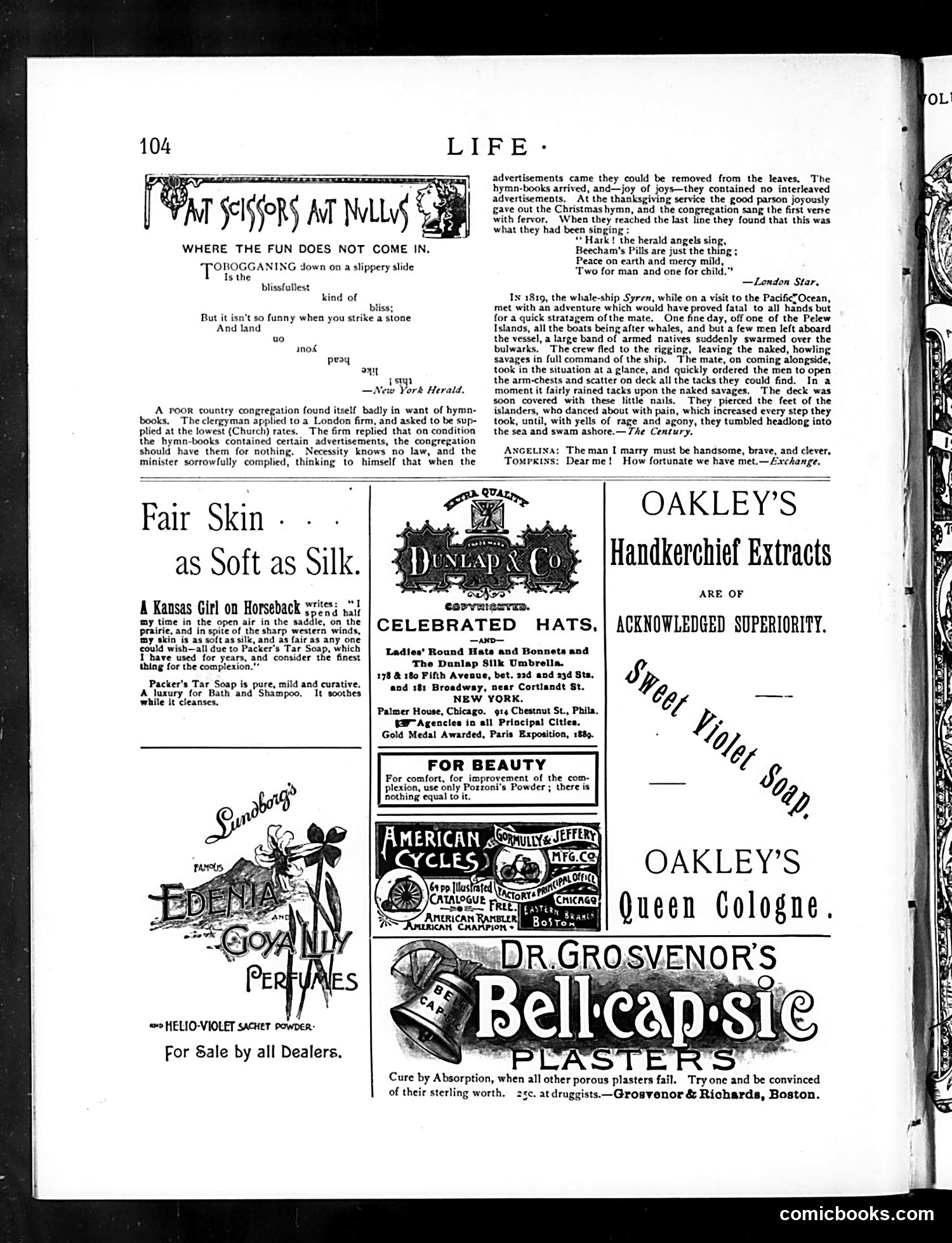
This page contains satirical anecdotes and period advertisements with no political cartoons. **The main content consists of humorous short pieces:** 1. **"At Scissors At Nullis"** — A joke about sledding that isn't funny when you hit a stone, illustrating how context changes enjoyment. 2. **The Hymn-Book Story** — Satire on commercialism and advertising's pervasiveness. A poor church receives free hymn-books on condition they contain ads. Ironically, when the congregation sings a Christmas hymn, the final line has been replaced with advertising copy ("Beecham's Pills are just the thing"). The joke critiques how advertisements infiltrate even sacred spaces and corrupt religious content. 3. **The Whale-Ship Anecdote** — A thrilling adventure story about a ship's crew using scattered tacks to repel invading natives. 4. **Angelina/Tompkins Exchange** — A brief comedic dialogue about courtship expectations. **The rest is advertising** for soaps, perfumes, hats, and patent medicines—typical of the era's magazine monetization.