
Life, 1891-02-12 · page 8 of 14
Life — February 12, 1891 — page 8: what you’re looking at
What you’re looking at
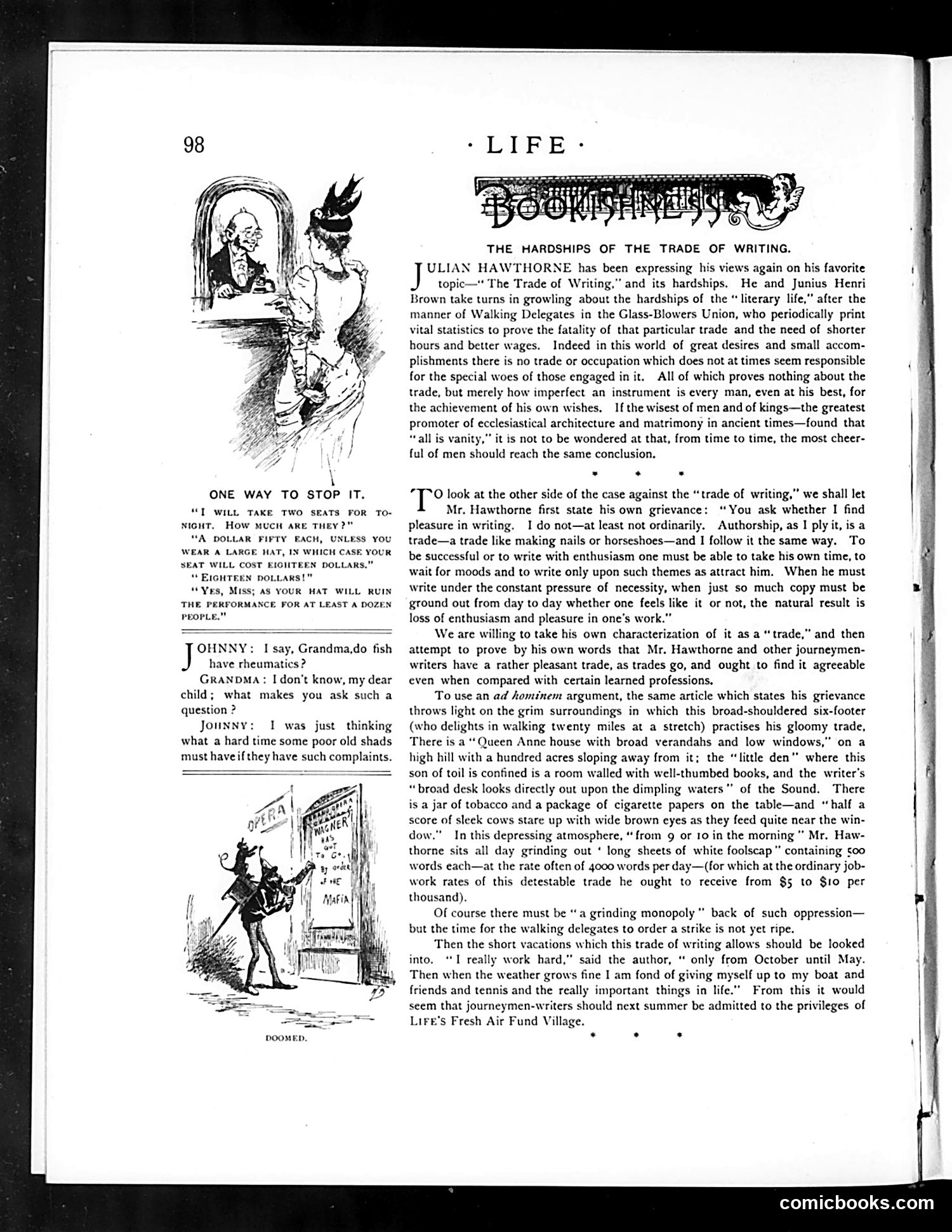
This satirical piece critiques the romantic notion of writing as a profession. Julian Hawthorne (son of Nathaniel Hawthorne) defends writing against claims it's not a "real trade" like nail-making or horseshoes. The cartoons mock writers' complaints: one shows a man at a desk refusing social invitations because he "must wait for moods," while another depicts a writer at a newspaper office labeled "DOOMED." The satire targets both sides—writers who romanticize their suffering and claim it's not a trade, and those who dismiss writing as easy leisure work. The underlying joke: writers want professional respect while refusing the discipline actual trades demand. The piece suggests writers should either commit fully or stop complaining.
📄 Transcribed text from this page (OCR, searchable)
Machine-transcribed from the original scan — historical spelling and the odd misread are preserved.
ONE WAY TO STOP IT. “1 WILL TAKE TWO SEATS FOR TO- Mtont. How uci are THEY? “A DOLLAR FIFTY EACH, U! you WEAR A LARGE HAT, IN WHICH CASE YOUR SEAT WILL COST EIGHTEEN DOLLARS.” “ EIGHTEEN DOLLAR: “Yes, Miss; AS YOUR HAT WILL RUIN THE PERFORMANCE FOR AT LEAST A DOZEN PEOPLE.” OHNNY: I say, Grandma,do fish have rheumatics? GRaNDMA: I don't know, my dear child; what makes you ask such a question ? Jounny: I was just thinking what a hard time some poor old shads must have if they have such complaints. DOOMED. THE HARDSHIPS OF THE TRADE OF WRITING. ULIAN HAWTHORNE has been expressing his views again on his favorite topic—* The Trade of Writing,” and its hardships. He and Junius Henri Brown take turns in growling about the hardships of the “ literary life,” after the manner of Walking Delegates in the Glass-Blowers Union, who periodically print vital statistics to prove the fatality of that particular trade and the need of shorter hours and better wages. Indeed in this world of great desires and small accom- plishments there is no trade or occupation which does not at times seem responsible for the special woes of those engaged in it. All of which proves nothing about the trade, but merely how imperfect an instrument is every man, even at his best, for the achievement of his own wishes. _ If the wisest of men and of kings—the greatest promoter of ecclesiastical architecture and matrimony in ancient times—found that “all is vanity,” it is not to be wondered at that, from time to time, the most cheer- ful of men should reach the same conclusion, * . . *T°O look at the other side of the case against the “trade of writing,” we shall let Mr, Hawthorne first state his own grievance: ‘You ask whether I find pleasure in writing. 1 do not—at least not ordinarily, Authorship, as I ply it, is a trade—a trade like making nails or horseshoes—and I follow it the same way. To be successful or to write with enthusiasm one must be able to take his own time, to wait for moods and to write only upon such themes as attract him. When he must write under the constant pressure of necessity, when just so much copy must be ground out from day to day whether one feels like it or not, the natural result is loss of enthusiasm and pleasure in one’s work.” We are willing to take his own characterization of it as a “trade,” and then attempt to prove by his own words that Mr. Hawthorne and other journeymen- writers have a rather pleasant trade, as trades go, and ought to find it agreeable even when compared with certain learned professions, To use an ad hominem argument, the same article which states his grievance throws light on the grim surroundings in which this broad-shouldered six-footer (who delights in walking twenty miles at a stretch) practises his gloomy trade, There is a ‘Queen Anne house with broad verandahs and low windows,” on a high hill with a hundred acres sloping away from it; the “little den" where this son of toil is confined is a room walled with well-thumbed books, and the writer's “broad desk looks directly out upon the dimpling waters’ of the Sound. There is a jar of tobacco and a package of cigarette papers on the table—and “half a score of sleek cows stare up with wide brown eyes as they feed quite near the wi dow.” In this depressing atmosphere, “from g or 10 in the morning " Mr, Haw- thorne sits all day grinding out ‘ long sheets of white foolscap" containing soo words each—at the rate often of 4000 words per day—(for which at the ordinary job- work rates of this detestable trade he ought to receive from $5 to $10 per thousand), Of course there must be ‘‘a grinding monopoly " back of such oppression— but the time for the walking delegates to order a strike is not yet ripe. Then the short vacations which this trade of writing allows should be looked into, ‘I really work hard," said the author, “ only from October until May. Then when the weather grows fine I am fond of giving myself up to my boat and friends and tennis and the really important things in life."" From this it would seem that journeymen-writers should next summer be admitted to the privileges of Lire’s Fresh Air Fund Village. . . . comicbooks.com