
Life, 1891-02-12 · page 4 of 14
Life — February 12, 1891 — page 4: what you’re looking at
What you’re looking at
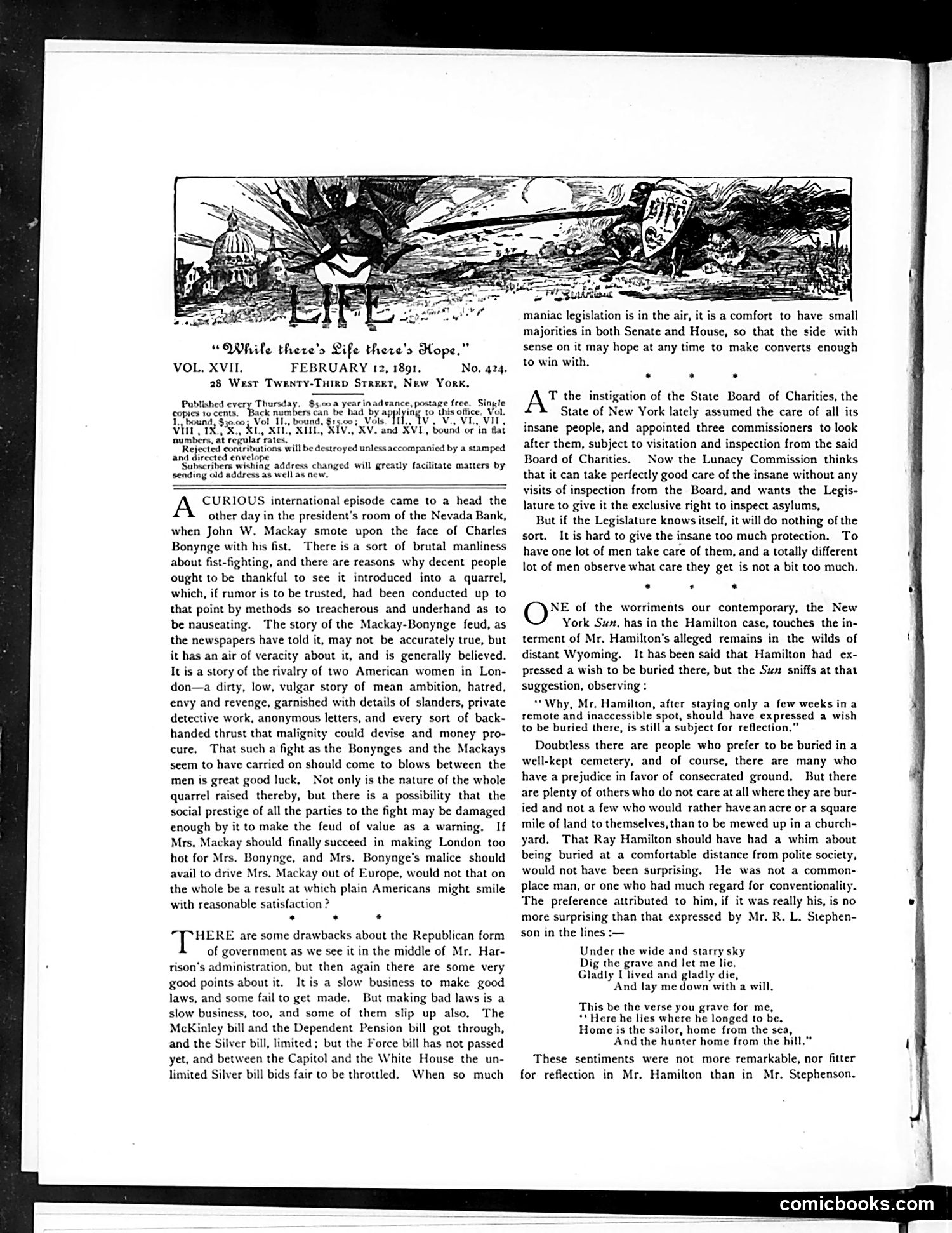
The page's header cartoon depicts a pastoral landscape with a large tree and a sign reading "LIFE," illustrating the magazine's title. The text discusses several political and social issues of the era: Republican governance, legislative challenges including the McKinley bill and Dependent Pension bill, and commentary on the "maniac legislation" currently under consideration. A notable anecdote describes an alleged altercation between John W. Mackay and Charles Boynge at the Nevada Bank involving disputes over women—a scandal employing period details of slander and social intrigue. The page also addresses treatment of the insane under New York State's Board of Charities, and discusses Ray Hamilton's burial preferences in Wyoming, touching on class attitudes toward proper burial grounds. The satirical tone critiques both government inefficiency and contemporary social pretensions.
📄 Transcribed text from this page (OCR, searchable)
Machine-transcribed from the original scan — historical spelling and the odd misread are preserved.
“While there's Life there's Hope.” VOL. XVII. FEBRUARY 12, 1891. No. 424. 28 West Twenty-Tuirp STREET, New York, Published eves Thursday. $5.00 a year in advance, postage free. Single gore: ro cents, ack numb Bers can be had Be ap yee to this of e. Ve ound, $30.05 Vol LI., bound, $15.00; Vols Vit, vin’ BLT XI, NIE NV? and XVI, bound or in ba numbers, at pai ‘rates. Rejected contributions will be destroyed unless accompanied by a stamped and directed enveloy ‘Subscribers wishing address changed will greatly facilitate matters by sending old address as well as new, CURIOUS international episode came to a head the other day in the president’s room of the Nevada Bank, when John W. Mackay smote upon the face of Charles Bonynge with his fist. There is a sort of brutal manliness about fist-fighting, and there are reasons why decent people ought to be thankful to see it introduced into a quarrel, which, if rumor is to be trusted, had been conducted up to that point by methods so treacherous and underhand as to be nauseating. The story of the Mackay-Bonynge feud, as the newspapers have told it, may not be accurately true, but it has an air of veracity about it, and is generally believed. Ic is a story of the rivalry of two American women in Lon- don—a dirty, low, vulgar story of mean ambition, hatred, envy and revenge, garnished with details of slanders, private detective work, anonymous letters, and every sort of back- handed thrust that malignity could devise and money pro- cure, That such a fight as the Bonynges and the Mackays seem to have carried on should come to blows between the men is great good luck. Not only is the nature of the whole quarrel raised thereby, but there is a possibility that the social prestige of all the parties to the fight may be damaged enough by it to make the feud of value as a warning. If Mrs, Mackay should finally succeed in making London too hot for Mrs. Bonynge, and Mrs. Bonynge’s malice should avail to drive Mrs. Mackay out of Europe, would not that on the whole be a result at which plain Americans might smile with reasonable satisfaction ? . . . HERE are some drawbacks about the Republican form of government as we see it in the middle of Mr. Har- rison’s administration, but then again there are some very good points about it. It is a slow business to make good laws, and some fail to get made. But making bad laws is a slow business, too, and some of them slip up also, The McKinley bill and the Dependent Pension bill got through, and the Silver bill, limited; but the Force bill has not passed yet, and between the Capitol and the White House the un- limited Silver bill bids fair to be throttled. When so much maniac legislation is in the air, it is a comfort to have small majorities in both Senate and House, so that the side with sense on it may hope at any time to make converts enough to win with. . * . T the instigation of the State Board of Charities, the State of New York lately assumed the care of all its insane people, and appointed three commissioners to look after them, subject to visitation and inspection from the said Board of Charities. Now the Lunacy Commission thinks that it can take perfectly good care of the insane without any visits of inspection from the Board, and wants the Legis- lature to give it the exclusive right to inspect asylums, But if the Legislature knows itself, it will do nothing of the sort. It is hard to give the insane too much protection. To have one lot of men take care of them, and a totally different lot of men observe what care they get is not a bit too much. O of the worriments our contemporary, the New York Sum, has in the Hamilton case, touches the in- terment of Mr. Hamilton's alleged remains in the wilds of distant Wyoming. It has been said that Hamilton had ex- pressed a wish to be buried there, but the Sw sniffs at that suggestion, observing : . * * ‘*Why, Mr. Hamilton, after staying only a few weeks ina remote and inaccessible spot, should have expressed a wish to be buried there, is still a subject for reflection.” Doubtless there are people who prefer to be buried in a well-kept cemetery, and of course, there are many who have a prejudice in favor of consecrated ground. But there are plenty of others who do not care at all where they are bur- ied and not a few who would rather have an acre or a square mile of land to themselves, than to be mewed up in a church- yard. That Ray Hamilton should have had a whim about being buried at a comfortable distance from polite society, would not have been surprising. He was not a common- place man, or one who had much regard for conventionality. The preference attributed to him, if it was really his, is no more surprising than that expressed by Mr. R. L. Stephen- son in the lines :-— Under the wide and starry sky Dig the grave and let me lic. Gladly I lived and gladly die, And lay me down with a will, This be the verse you grave for me, “Here he lies where he longed to be. Home is the sailor, home from the sea, And the hunter home from the hill.” These sentiments were not more remarkable, nor fitter for reflection in Mr. Hamilton than in Mr. Stephenson.