
A complete issue · 18 pages · 1891
Life — January 22, 1891
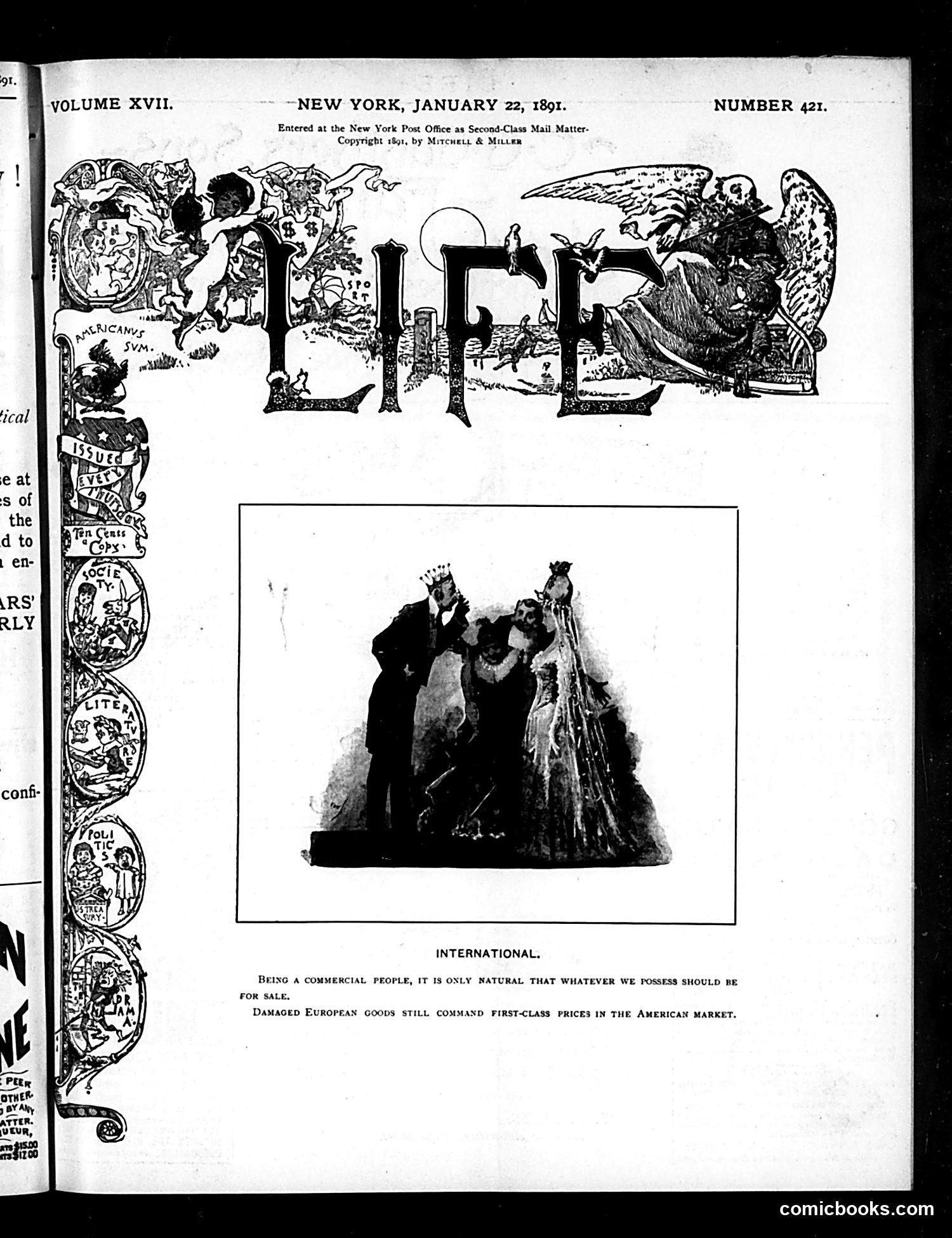
This satirical illustration critiques international commerce and trade practices. The caption reads: "Being a commercial people, it is only natural that whatever we possess should be for sale. Damaged European goods still command first-class prices in the American market." The image depicts what appears to be European merchants or traders presenting goods—likely damaged merchandise—to American buyers. The satire targets American consumers' perceived eagerness to purchase inferior European products at premium prices, despite their damaged condition. This reflects late-19th-century tensions over foreign imports competing with American goods and the irony that Americans valued European brands even when inferior. The joke critiques both American materialism and the shrewd exploitation by European sellers.
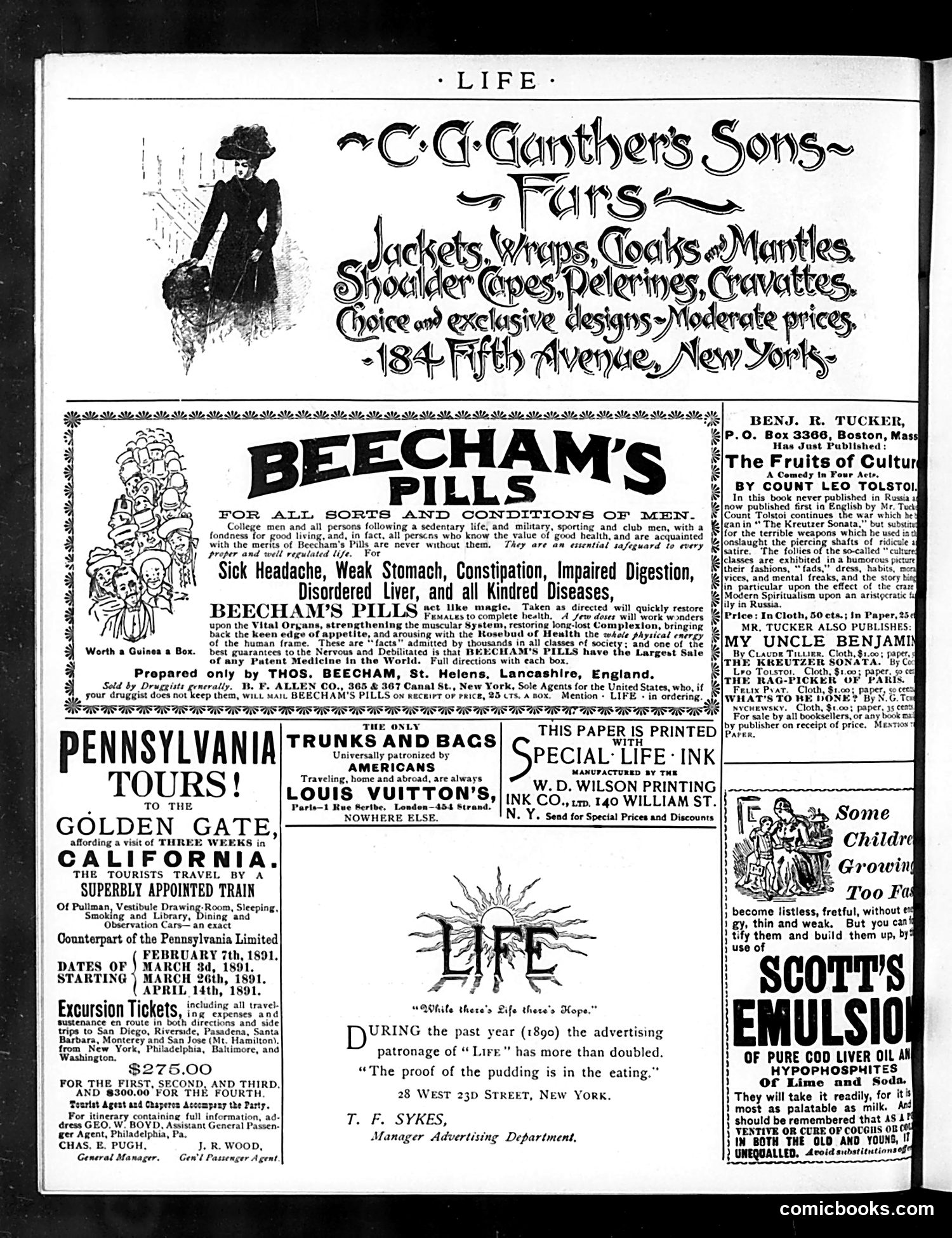
This page is primarily **advertising**, not political satire. It contains multiple commercial advertisements typical of late 19th-century magazines: 1. **C.G. Ganthers Sons** - women's outerwear advertisement featuring an illustrated woman in Victorian dress 2. **Beecham's Pills** - patent medicine ad promising cures for various ailments 3. **Pennsylvania Tours** - travel advertisements for California trips via the Pennsylvania Limited train 4. **Louis Vuitton** - luggage advertisement 5. **Scott's Emulsion** - cod liver oil supplement ad The only editorial content is a brief notice from **Life's advertising department** at page center, stating their advertising patronage has "more than doubled" and quoting "the proof of the pudding is in the eating." There are no political cartoons or satirical commentary visible on this page—it's a standard advertising section from a turn-of-the-century magazine.
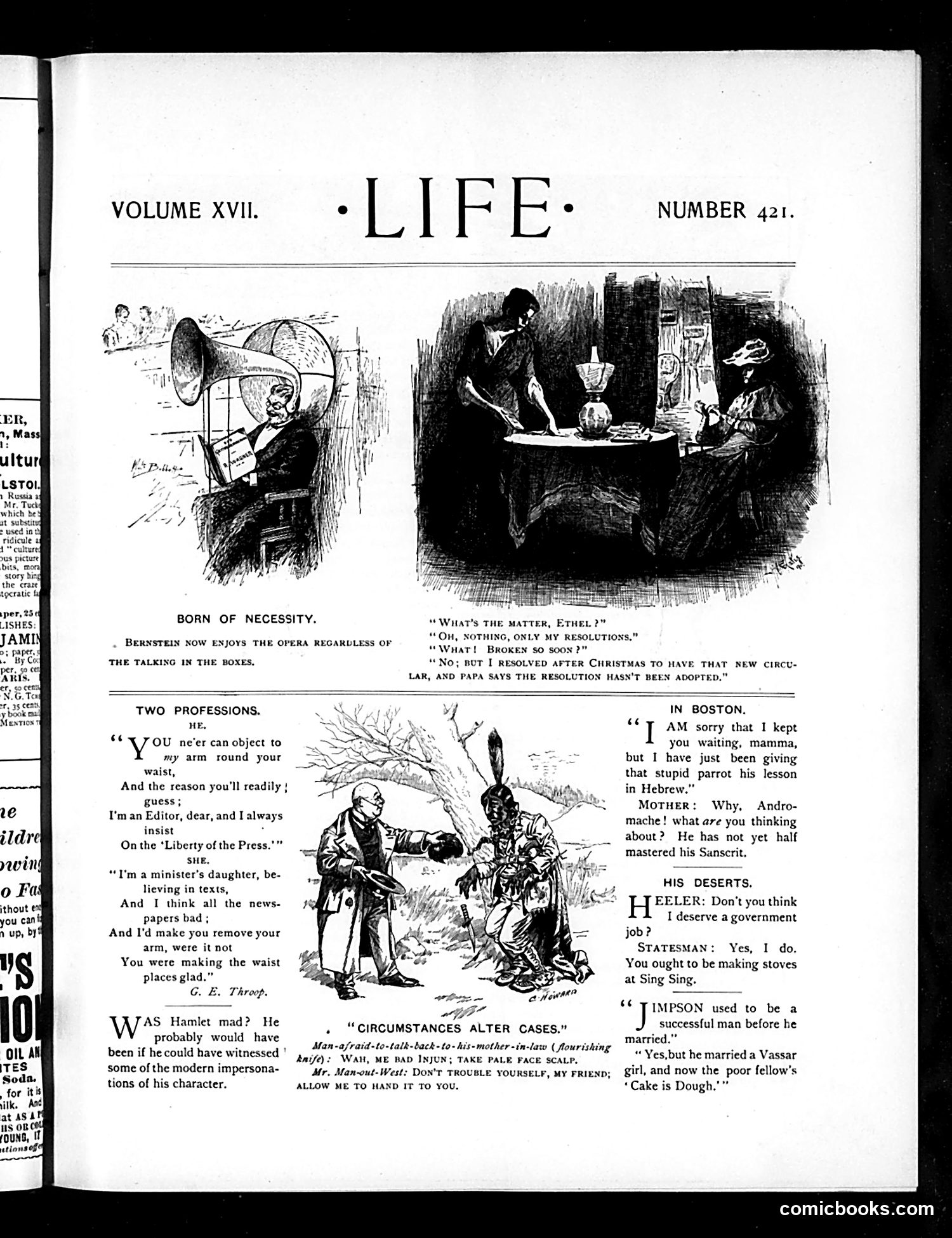
This page contains several satirical humor pieces typical of early 20th-century Life magazine: **"Born of Necessity"** mocks the opera's survival despite technical problems with sound systems in theaters—Bernstein apparently conducts regardless of auditory failures. **"Two Professions"** presents a dialogue between an editor defending press freedom and a minister's daughter who objects to his writing about "Liberty of the Press," suggesting tension between journalistic independence and social propriety. **"Circumstances Alter Cases"** shows a dialogue between figures discussing professional choices and marriage—one character notes that someone "used to be a successful bachelor" before marrying, implying loss of status through matrimony. **"In Boston"** and **"His Deserts"** contain brief domestic and professional humor exchanges typical of the magazine's style, focusing on everyday situations rather than specific political events.
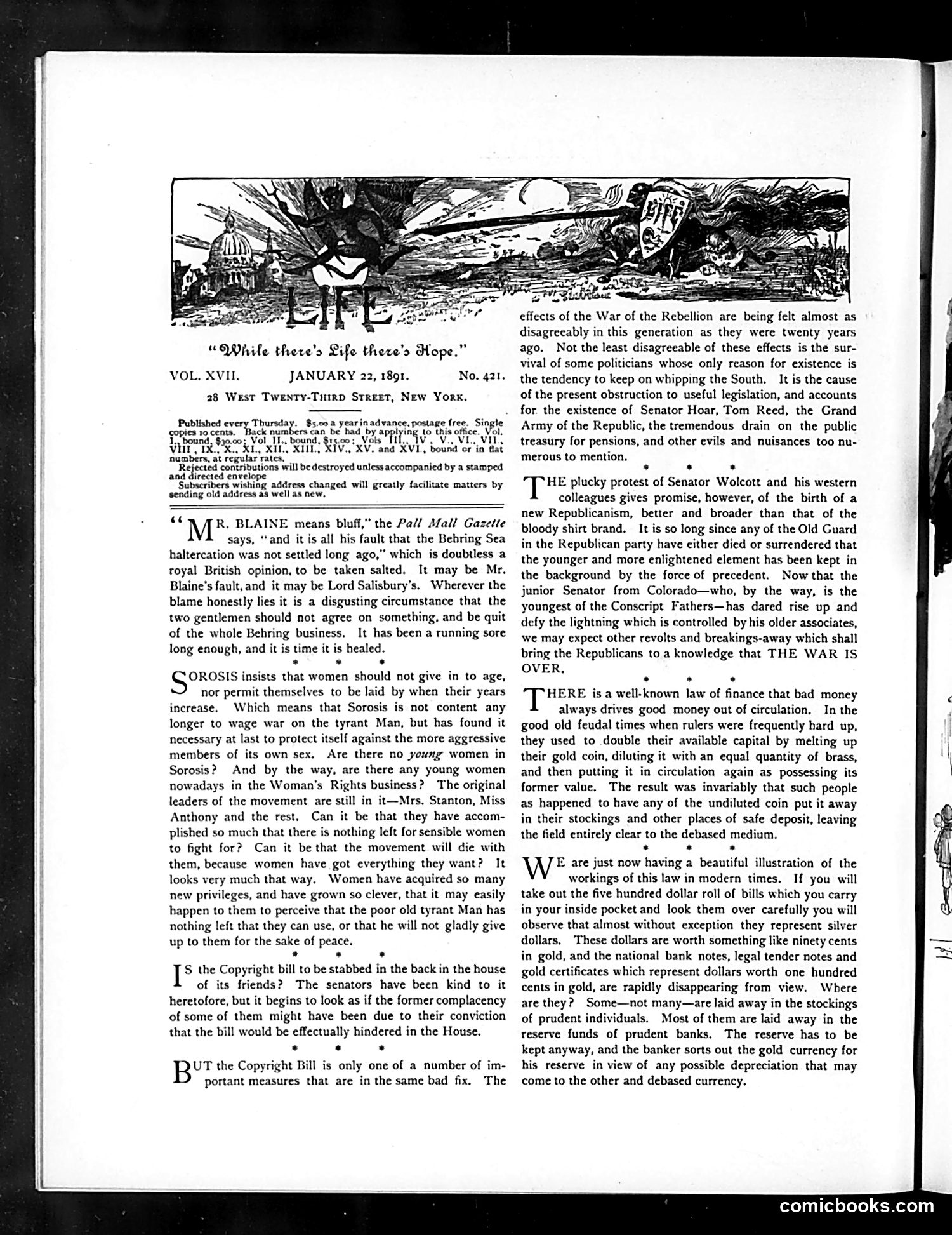
The masthead cartoon shows a nighttime landscape with a gnarled tree and moon—its meaning unclear without additional context. The text discusses several political matters: 1. **Mr. Blaine and the Behring Sea dispute**: A reference to Secretary of State James G. Blaine's handling of a British-American disagreement over seal hunting rights in the Behring Sea, apparently criticized as mishandled diplomacy. 2. **Senator Wolcott's protest**: Praised as promising new Republican leadership, representing "enlightened" younger party members challenging older associates. 3. **Currency and inflation**: The magazine satirizes the disappearance of gold and silver coins from circulation, replaced by paper currency and bank notes—a concern during the 1891 economic period. The satire critiques both foreign policy blunders and monetary policy anxieties of the era.
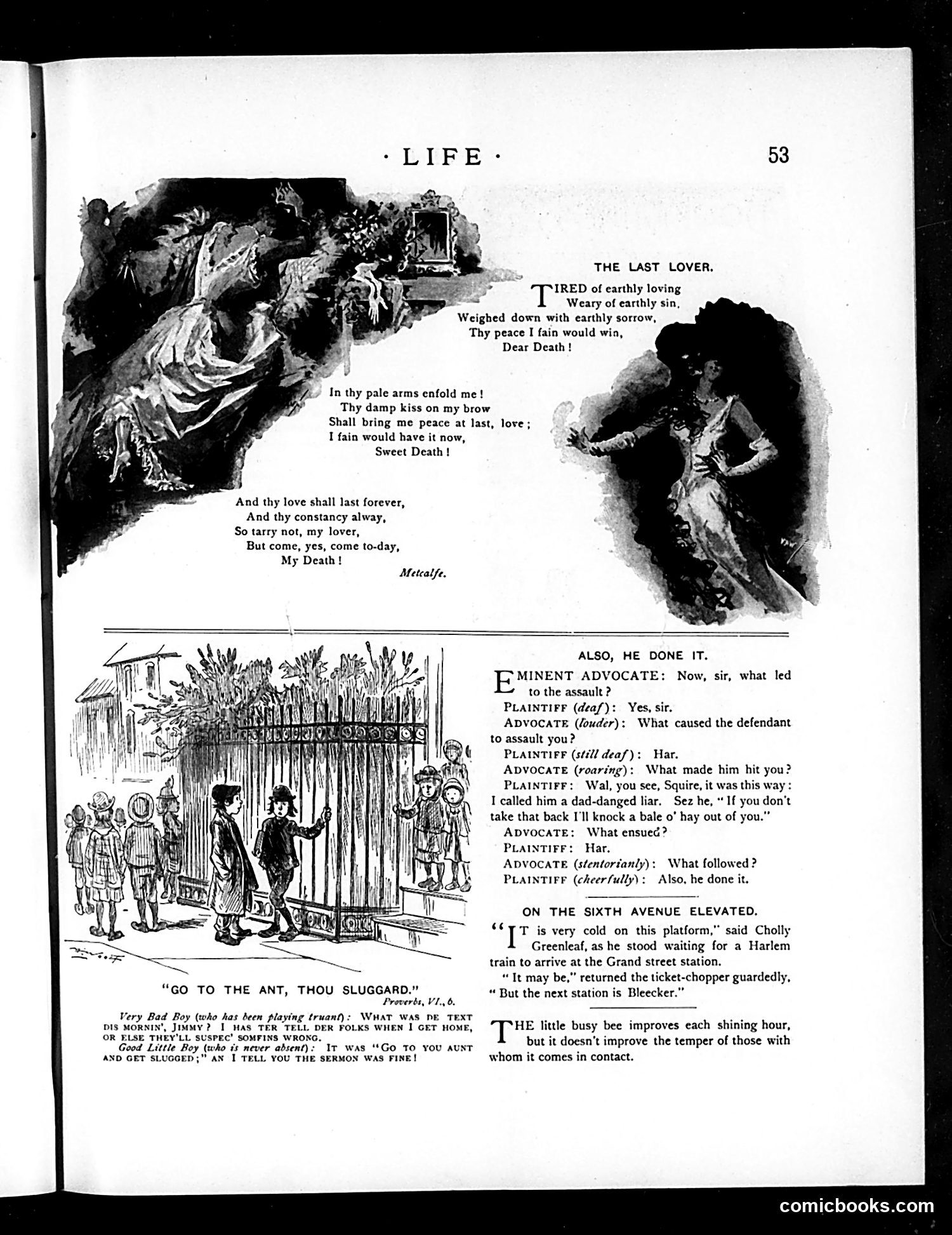
This page contains three distinct satirical pieces: 1. **"The Last Lover"** - A romantic poem attributed to Metcalfe, illustrated with dramatic imagery of Death as a skeletal figure embracing a weary lover, mocking Victorian sentimentality about romantic death. 2. **"Also, He Done It"** - A courtroom dialogue satirizing legal proceedings. A plaintiff with a "dischanged liar" is questioned about an assault. The humor lies in the plaintiff's evasive answers ("Har") and the absurd escalation—the defendant supposedly told him to return something or "I'll knock a bale o' hay out of you." 3. **"On the Sixth Avenue Elevated"** and **"Go to the Ant, Thou Sluggard"** - Brief urban observations mocking New York City life and human nature's irritability, with an accompanying illustration of people at a train platform. The overall tone is cynical, mocking human folly, legal systems, and urban manners.
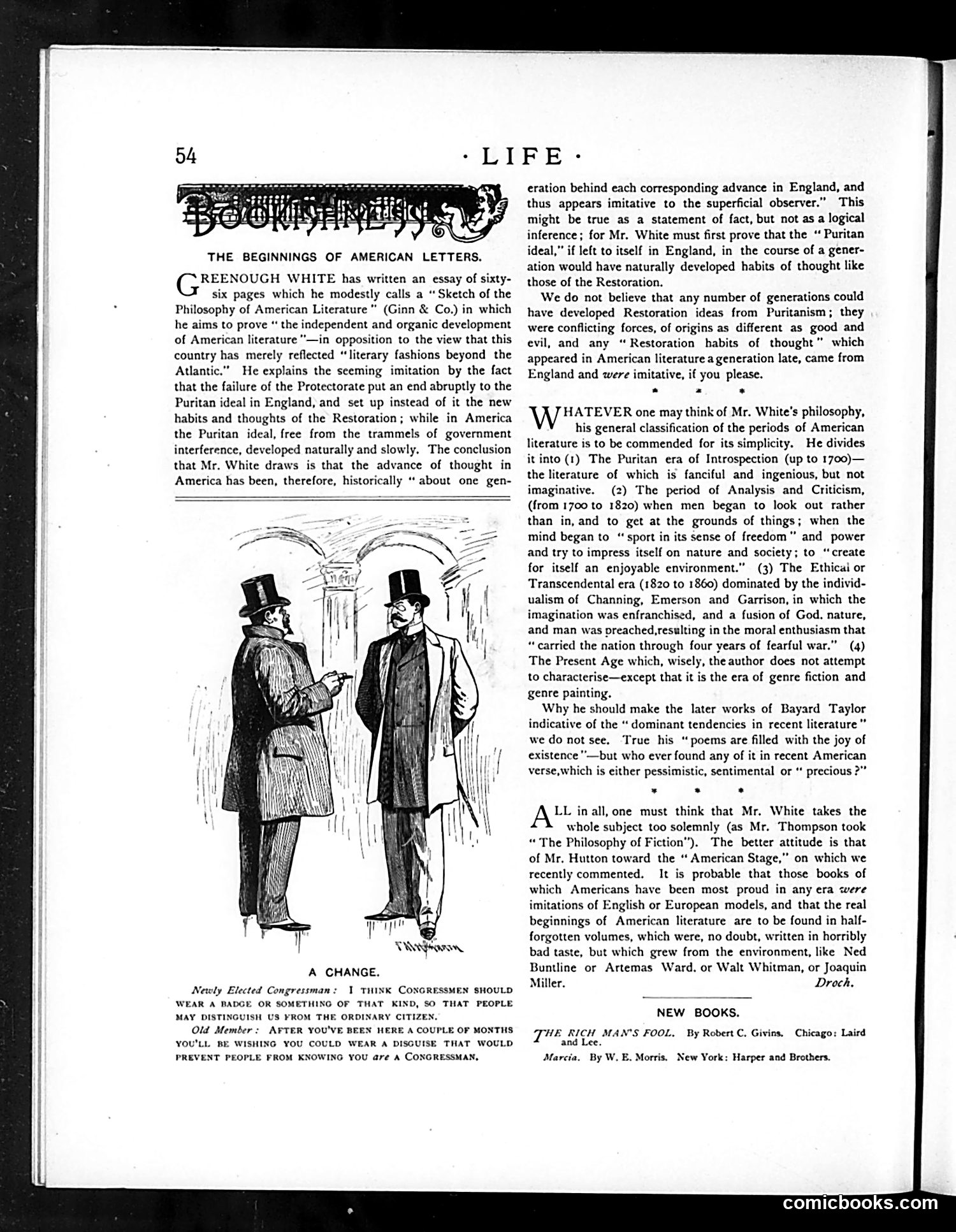
The cartoon titled "A Change" depicts two gentlemen in formal 19th-century attire (top hats and overcoats) in conversation. The caption is a dialogue between a "Newly Elected Congressman" and an "Old Member," discussing how the new congressman should wear a disguise to distinguish himself from ordinary citizens, as people can no longer tell congressmen apart from regular people. This is satire on congressional mediocrity and the undistinguished nature of elected representatives. The joke suggests that congressmen have become so ordinary and unremarkable that they're visually indistinguishable from the general public—implying they lack the dignity, gravitas, or distinctive character voters might expect from their representatives. The cartoon reflects 19th-century cynicism about political leadership.
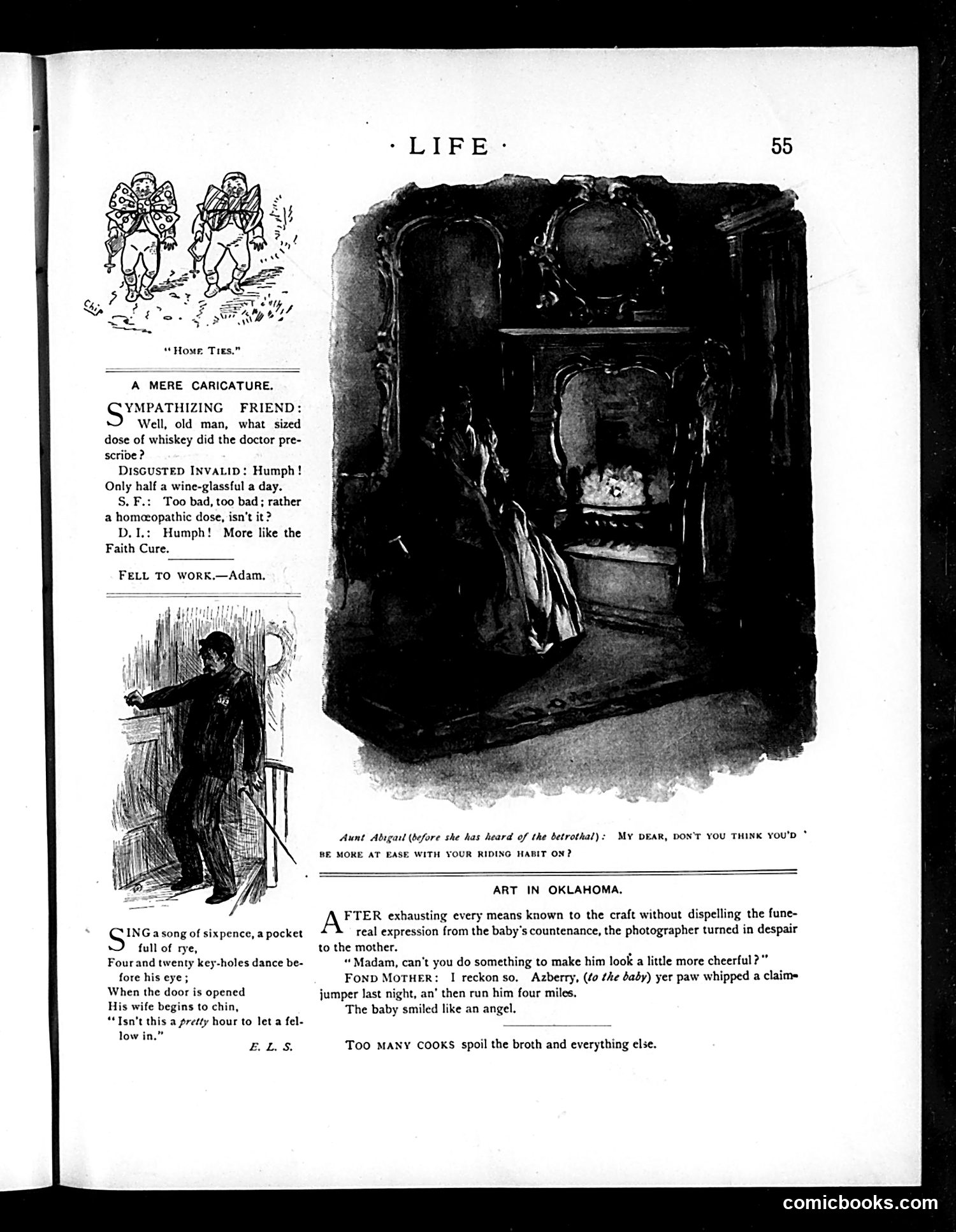
This page contains three distinct satirical pieces: 1. **"Home Ties"** (top left): A simple caricature joke about domestic life, showing two rotund figures. 2. **"A Mere Caricature"** (center): A dialogue mocking homeopathic medicine, where a doctor prescribes only a "wine-glassful a day" for an invalid patient—essentially useless treatment. The satire targets ineffective medical practices popular in that era. 3. **"Art in Oklahoma"** (bottom): This piece ridicules both incompetent photographers and overprotective mothers. A photographer cannot make an unhappy baby smile for a portrait, so the "fond mother" suggests the baby's paw (likely a dog) was whipped to make it smile—implying both animal cruelty and absurd parenting. The caption "Too many cooks spoil the broth" suggests meddlesome interference ruins results. The page satirizes medical quackery, amateur artistry, and misguided parenting.
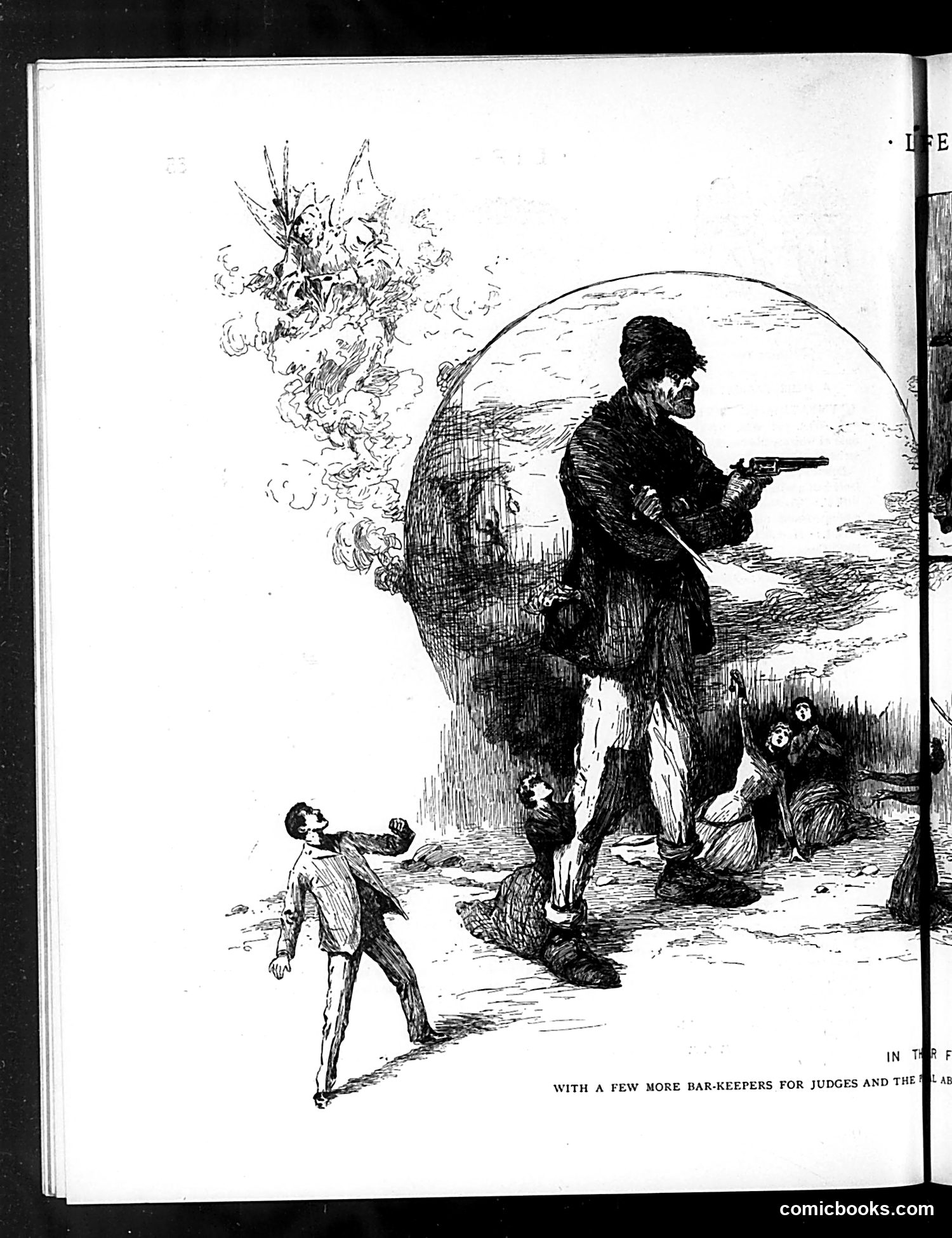
This political cartoon satirizes the American legal system, specifically judicial corruption. The image shows a giant figure (likely representing a judge or legal authority) wielding a pistol while standing over a smaller, prostrate man. To the side are what appear to be animals (possibly representing corrupt officials or "bar-keepers"). The partial caption reads: "WITH A FEW MORE BAR-KEEPERS FOR JUDGES AND THE..." suggesting the cartoon critiques the appointment of unqualified or ethically questionable individuals to judicial positions. The term "bar-keeper" is used mockingly, implying judges lack proper credentials or integrity. The smaller figure's vulnerable position emphasizes how ordinary citizens face an unjust, weaponized legal system controlled by corrupt authority figures. This reflects Progressive-era concerns about judicial reform and accountability.
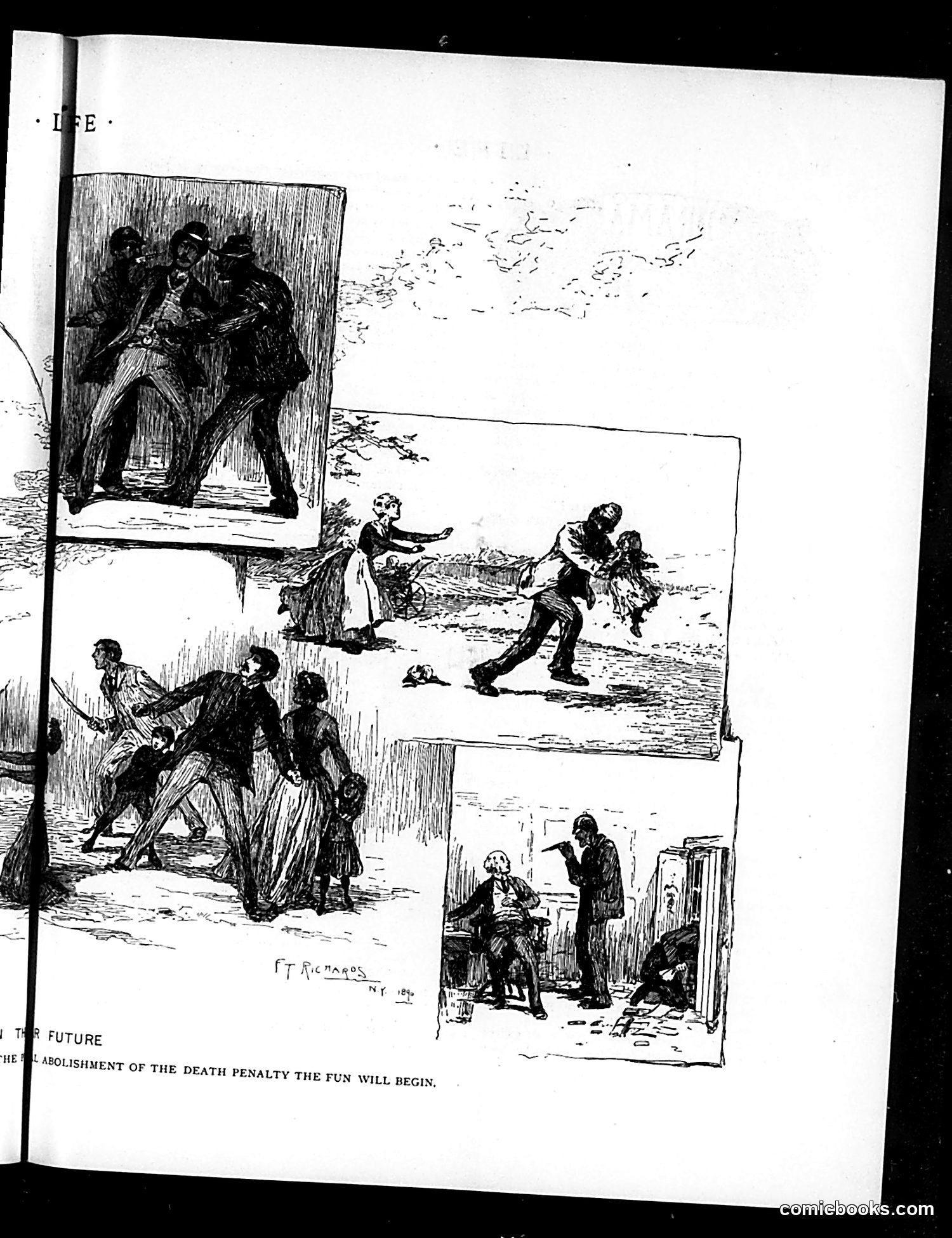
This page features three sequential cartoon panels by F.T. Richards (signed lower left), satirizing the potential consequences of abolishing capital punishment. The caption reads: "THE FUTURE — THE ABOLISHMENT OF THE DEATH PENALTY THE FUN WILL BEGIN." The cartoons depict escalating criminal violence: the top panel shows violent assault indoors; the middle panel shows a crime scene outdoors with a woman and onlookers; the bottom panel shows interrogation or imprisonment of suspects. The satirical argument is that eliminating execution as punishment would encourage criminals, leading to increased violent crime. This reflects early-to-mid 20th century debates about criminal justice reform, where opponents of abolishing capital punishment warned it would result in lawlessness and public danger.
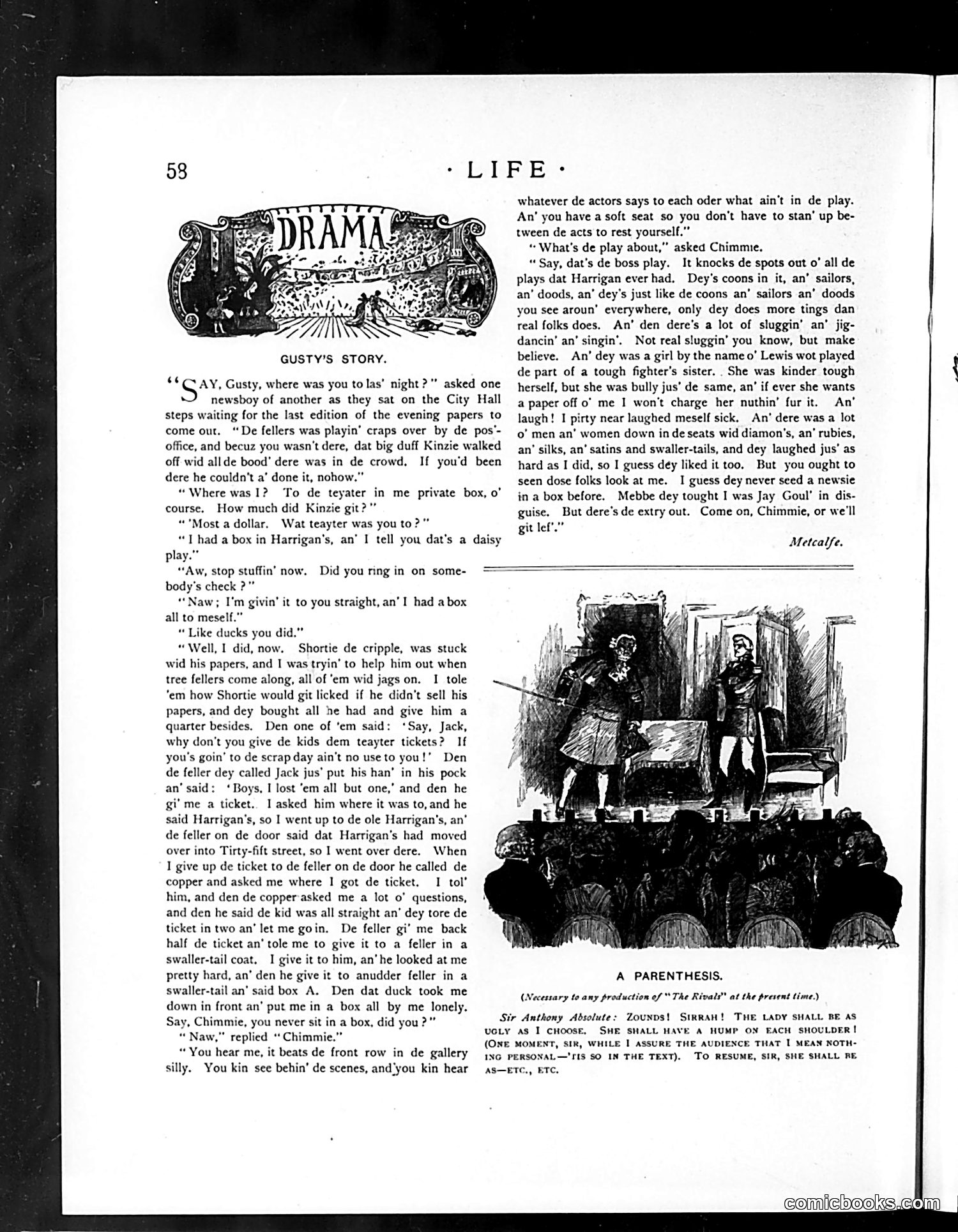
This page contains a dramatic story about theater life, specifically vaudeville performance. The narrative describes a newsboy named Gusty recounting his experience at a City Hall theater showing craps (a dice game) during an evening performance. The story involves working-class characters and theatrical lingo of the era, depicting the casual, often crude behavior of theater-goers and backstage personnel. References to "Harrigan" likely allude to Harrigan and Hart, famous 19th-century vaudeville performers known for comedic Irish-American sketches. The illustration shows a theatrical scene with multiple figures in what appears to be a box or balcony setting, typical of vaudeville theater representation. The text exemplifies Life magazine's satirical documentation of popular entertainment culture and working-class urban life.
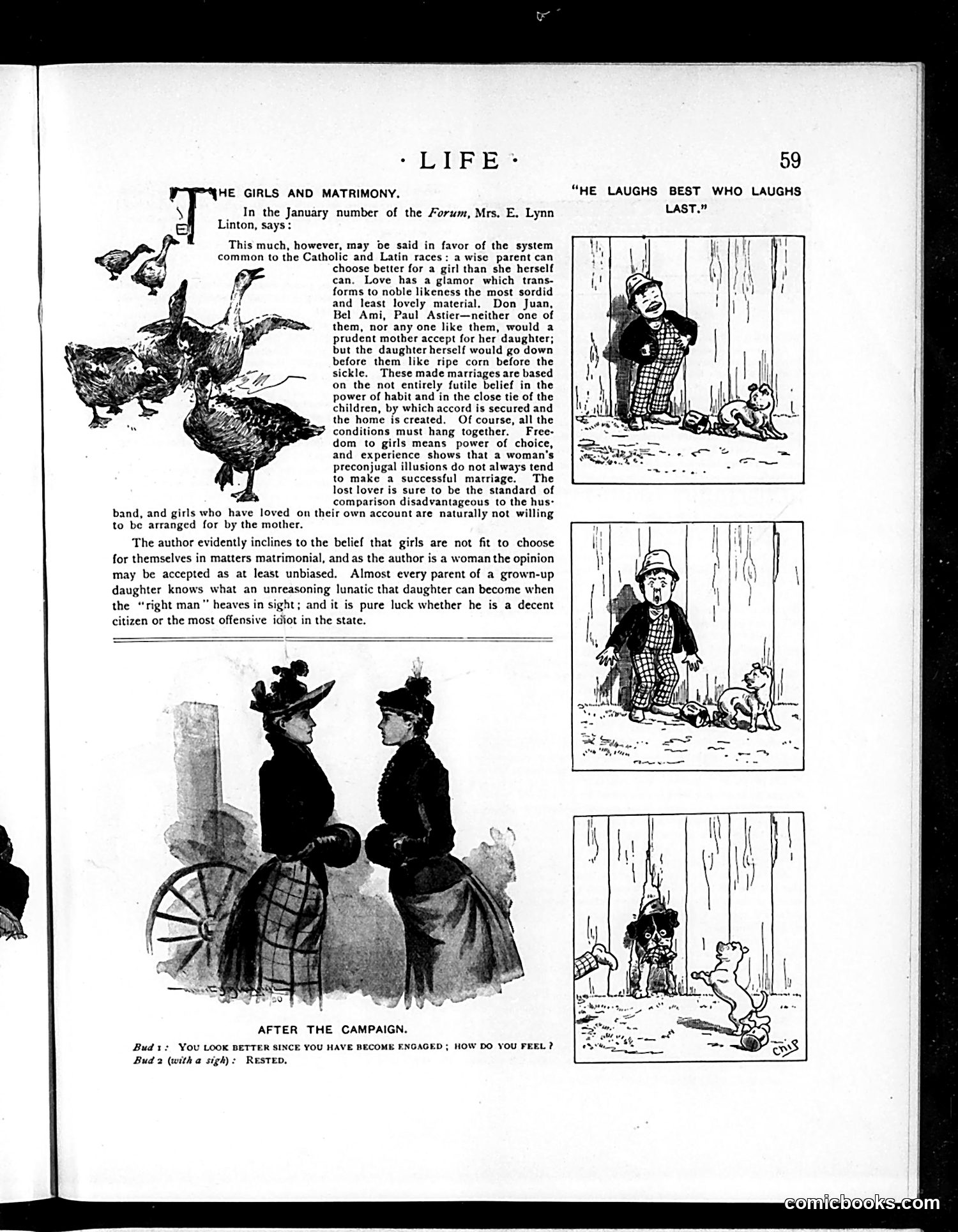
This page satirizes attitudes about girls choosing marriage partners. The top section presents a letter from Mrs. E. Lynn Linton arguing that girls lack judgment in selecting husbands and should rely on parental guidance rather than romantic love. The author counters that even prudent mothers sometimes choose poorly for their daughters. The cartoon "After the Campaign" depicts two fashionably dressed women in conversation, with the caption joking that one looks better since becoming engaged—because she's finally "rested" from the exhausting social effort of courtship. The three small comic panels on the right show a woman in domestic situations, illustrating the humorous "realities" of married life versus romantic expectations. The satire mocks both courtship rituals and marriage itself.
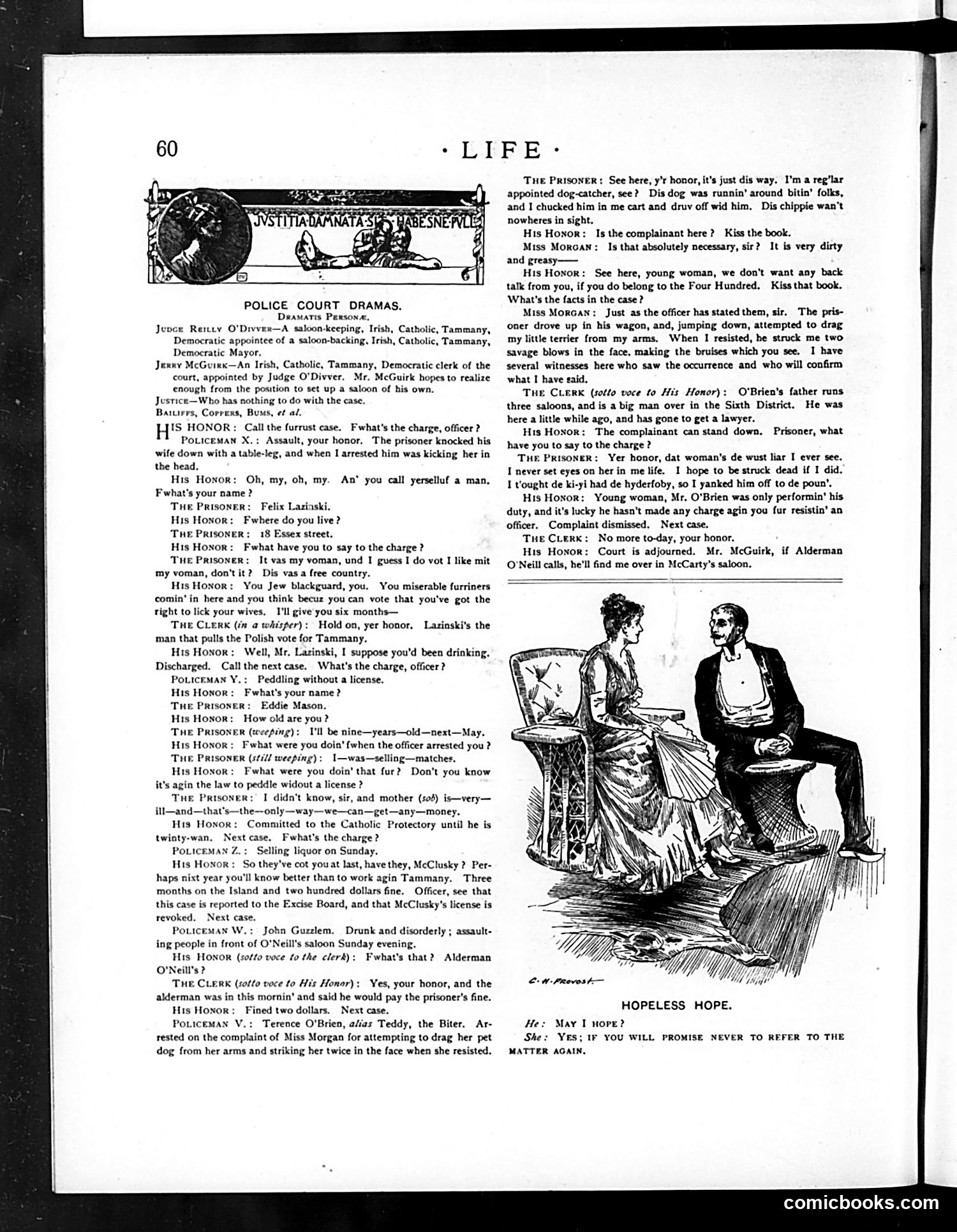
This satirical sketch mocks New York's corrupt municipal court system under Tammany Hall, the Democratic political machine. Judge "Reily O'Divver" and clerk "Janey McGuirk"—transparently Irish Catholic names—are portrayed as appointees chosen for political loyalty rather than legal competence, with the clerk hoping to profit enough to open his own saloon. The satire exposes blatant double standards: A Jewish immigrant (Lazinski) brutally assaults his wife but gets discharged once the judge learns he controls Polish votes for Tammany. A destitute nine-year-old boy selling matches to support his sick mother faces commitment to an institution. A saloon owner (McClusky) opposing Tammany gets three months and a fine, while a drunk assaulting people at an alderman's saloon ("O'Neill's") gets only two dollars—the alderman covers it. The point: Tammany justice is entirely transactional, rewarding political allies while punishing the powerless and poor. "Justice" itself is literally irrelevant to these proceedings.
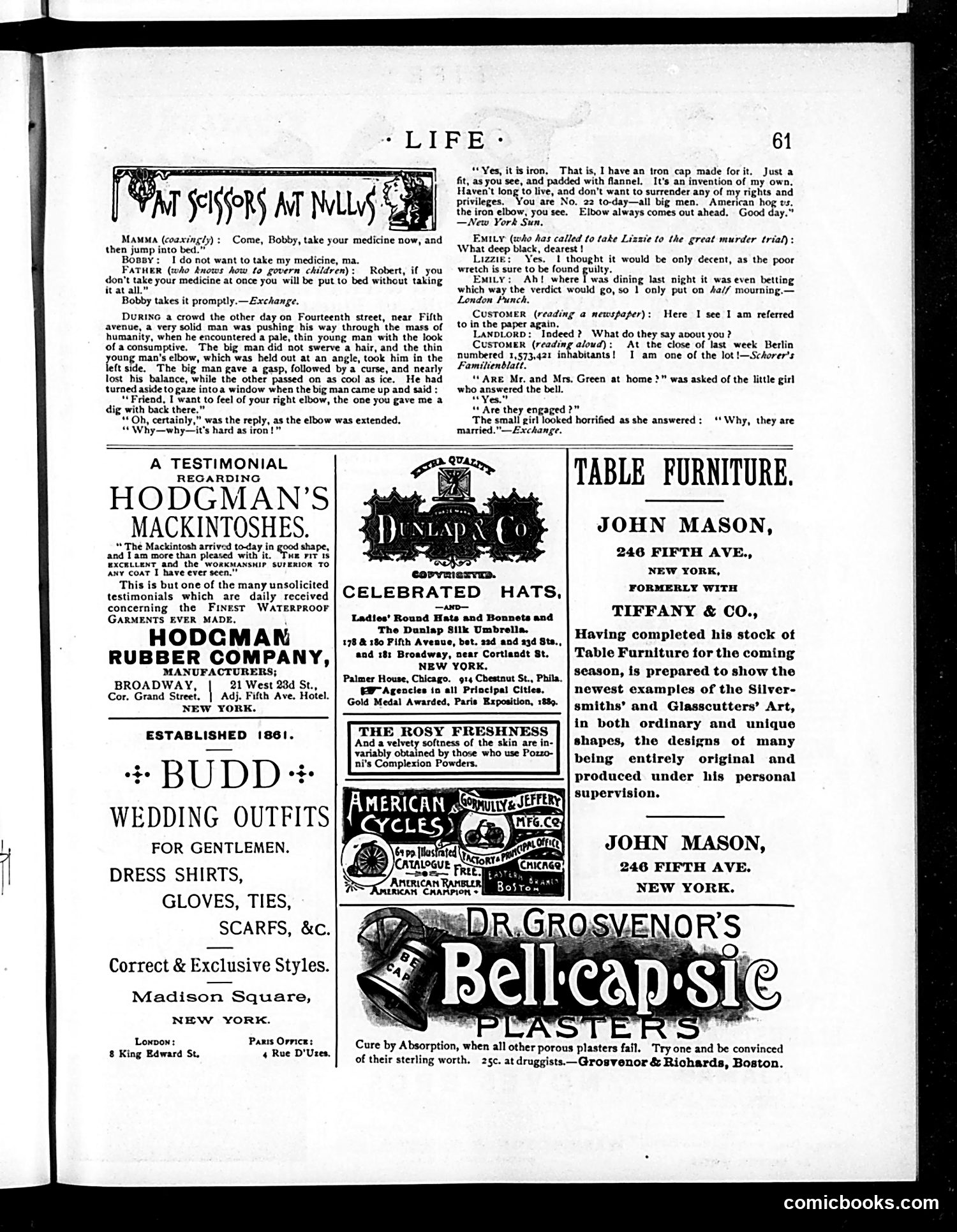
This page contains three humorous anecdotes rather than political cartoons. The main satire concerns urban manners and identity: **"I want to feel your right elbow"**: A working-class man with an iron-reinforced elbow (created to protect himself during daily collisions in crowded streets) explains to a wealthy man he just jostled that he's been bumped by 21 other "big men" that day. The joke mocks American capitalist aggression—the ruthless elbowing through crowds symbolizes competitive, selfish behavior. His armor is both literal protection and social commentary on urban brutality. The other anecdotes concern social embarrassment (a woman wearing mourning to a murder trial without knowing the verdict) and naïveté (a child horrified to learn engaged people get married). The page is otherwise filled with period advertisements for rubber coats, table furniture, wedding attire, and medical products—typical of *Life* magazine's advertising-heavy layout from this era.
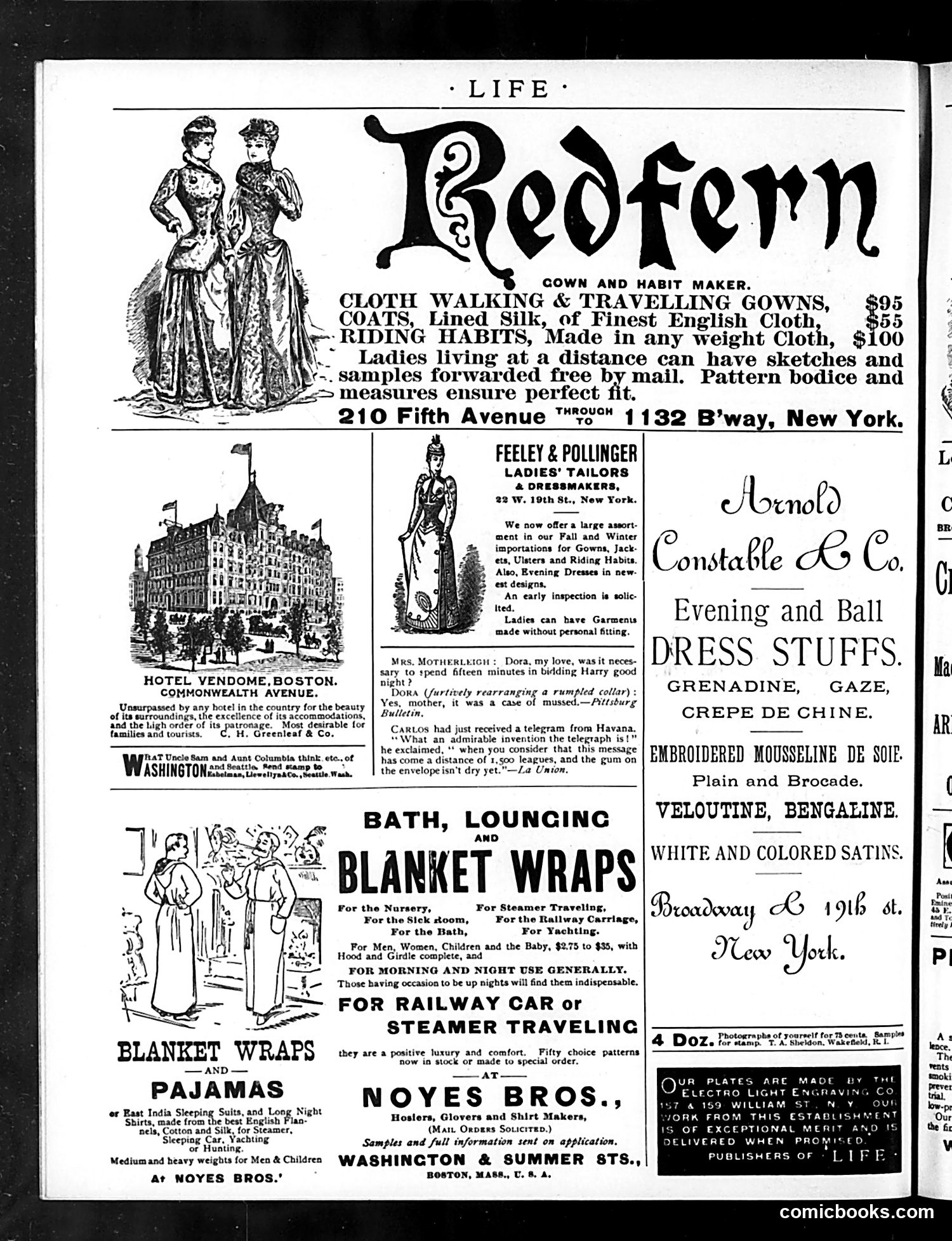
This page is primarily **advertising**, not satirical content. It consists of commercial notices for late 19th/early 20th-century fashion, hotels, and services. The only actual humor content appears to be two brief **jokes**: 1. **"Mrs. Motherleigh" joke**: A mother questions her daughter Dora about spending fifteen minutes saying goodnight to "Harry." Dora's reply—"it was a case of mussed"—is a pun on "missed" versus the rumpled collar she's "rearranging," implying romantic physical contact disguised as a verbal farewell. The humor relies on Victorian-era anxiety about courtship propriety. 2. **Cartos telegram joke**: A man receives a message from Havana and marvels that the telegraph works across 1,500 leagues—yet notices the envelope's gum still isn't dry, suggesting the marvel of modern technology is undermined by mundane reality. Both jokes reflect period concerns about technology, propriety, and social expectations, but neither constitutes significant political satire.
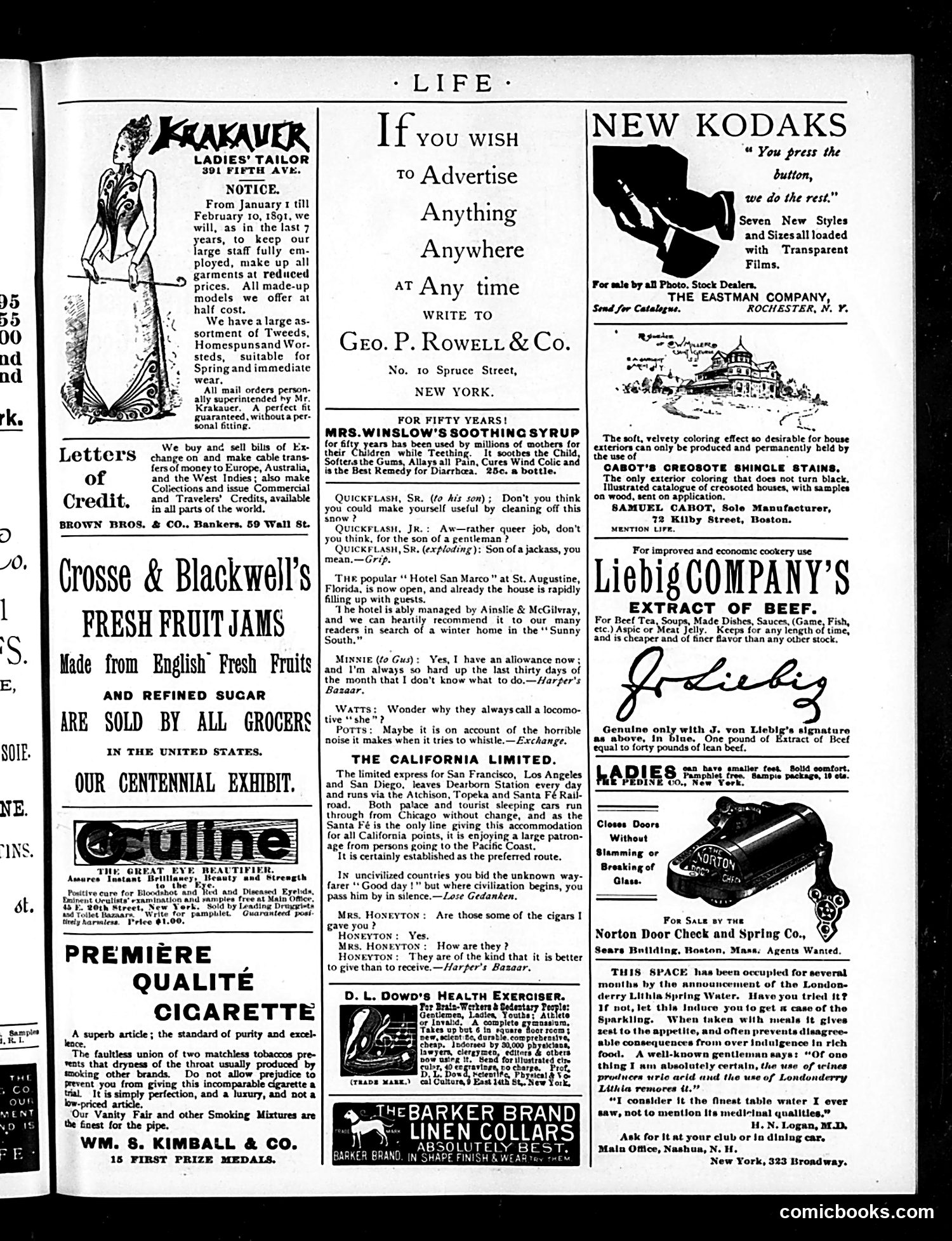
This is primarily an **advertising page** from Life magazine (circa 1891, based on the Mrs. Winslow's Soothing Syrup reference and date notices). The page contains **three brief humorous items**: 1. **"Quickflash" dialogue**: A father asks his son to shovel snow; the son protests it's beneath a gentleman. The father responds by calling him "son of a jackass"—satirizing pretentious youth who avoid manual labor. 2. **Minnie and Gus**: A woman admits she gets an allowance but squanders it within weeks, then doesn't know what to do—poking fun at financial irresponsibility. 3. **Honeyton/Potts exchange**: A joke about a whistling noise—text cuts off, unclear full meaning. These are light social satire typical of Life's humor: mocking class pretension, poor financial management, and genteel behavior. The majority of the page is commercial advertising for products (cigarettes, jams, sewing, eyedrops, hotels, railroads), reflecting how magazines funded themselves in the 1890s.
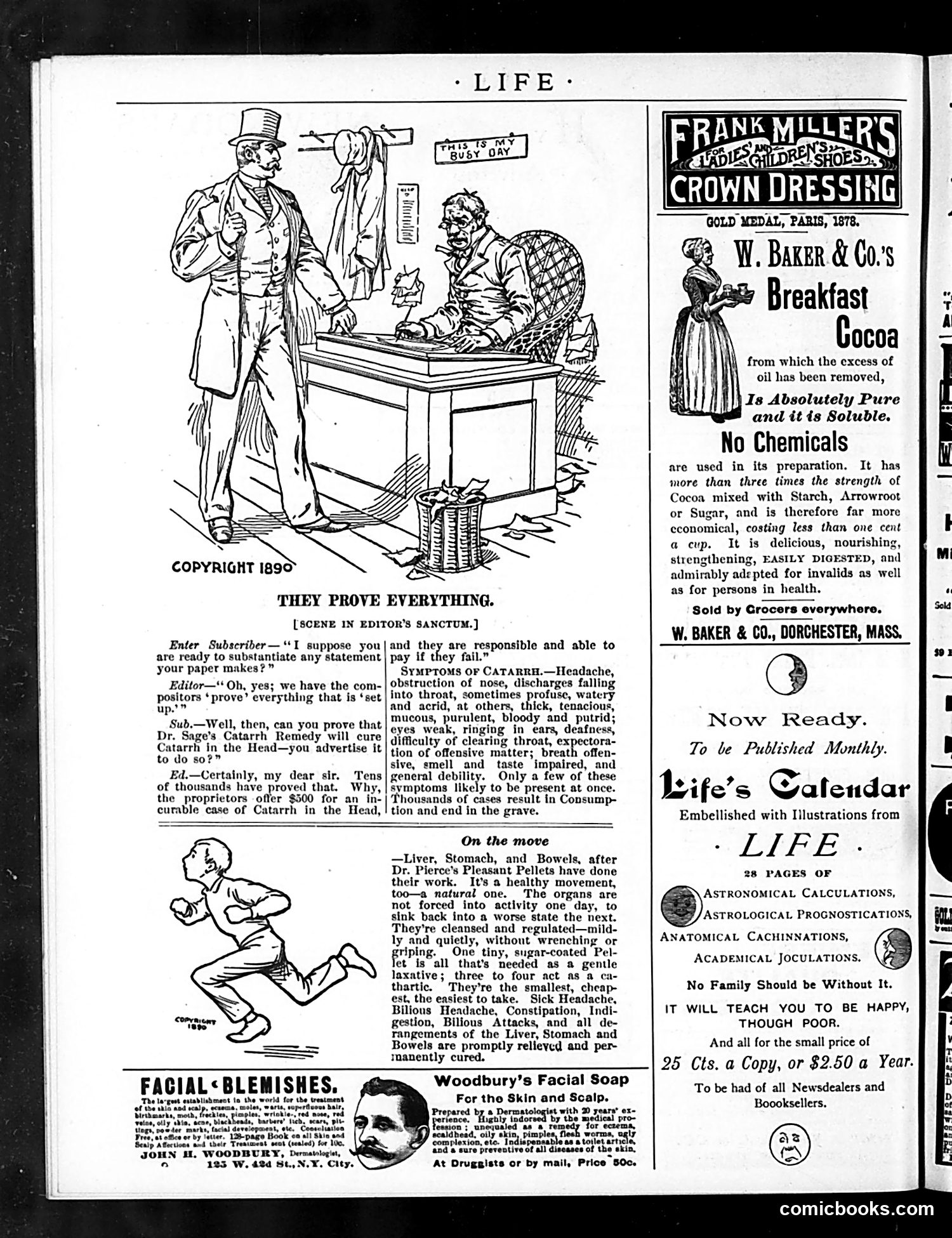
The main cartoon satirizes advertising claims through wordplay. An **Editor** (representing *Life* magazine) jokes with a **Subscriber** by deliberately misunderstanding "prove"—conflating the printing term (compositors "prove" typeset pages for accuracy) with substantiating advertising claims. The Editor boasts they "prove" everything, then confidently claims they can verify that "Dr. Sage's Catarrh Remedy" cures catarrh because thousands claim it works and the proprietor offers $500 for uncurable cases. The satire targets deceptive patent-medicine advertising rampant in the 1890s. By having the editor conflate printing proofs with actual proof, *Life* mocks how magazines sold questionable health products through false authority. The detailed symptom list and threat of consumption (tuberculosis) underscore how seriously people took such remedies—and how exploitative such ads were. The surrounding advertisements (Woodbury's Soap, Dr. Pierce's Pellets, Baker's Cocoa) exemplify the dubious products filling contemporary magazines.
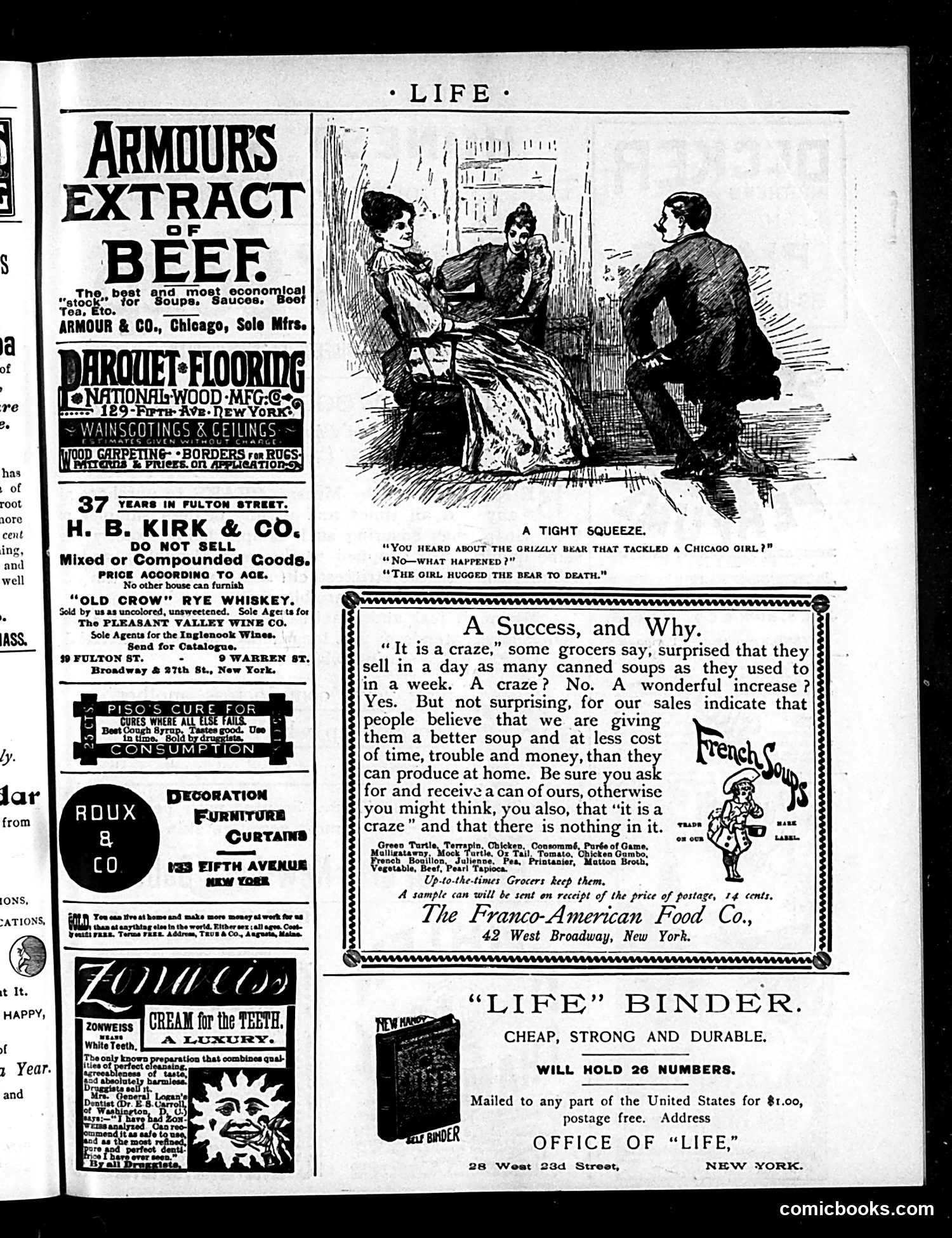
This page combines advertisements with one satirical cartoon titled "A Tight Squeeze." **The Cartoon:** The sketch depicts a woman in Victorian dress physically embracing a man while a second man watches in apparent shock. The caption references a "grizzly bear that tackled a Chicago girl," with the punchline that "the girl hugged the bear to death." **The Satire:** This appears to mock the "New Woman" of the 1890s-1900s era—a figure who challenged Victorian gender norms by being assertive and physically forward. The humor derives from gender role inversion: rather than the traditional scenario of a woman needing rescue from danger, this woman is so strong and aggressive that *she* poses the threat. It's satirizing anxieties about changing female independence and behavior. **The Advertisements:** The rest of the page features typical period product ads (beef extract, whiskey, furniture, canned soup, tooth cream, and magazine binders)—representative of Life's commercial content alongside its satirical editorial material.
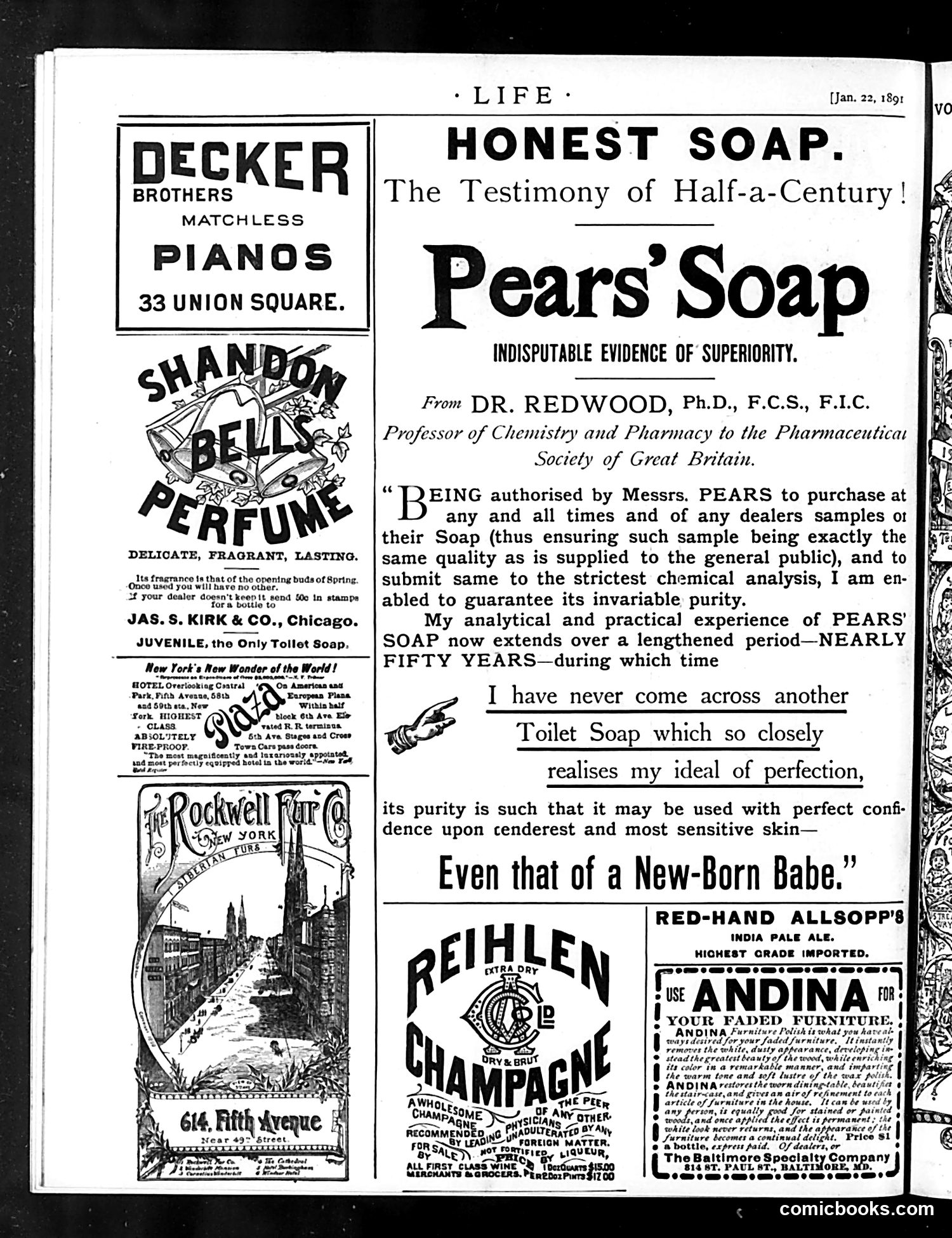
This page is primarily **advertising**, not satire or political commentary. It contains multiple Victorian-era product advertisements: The dominant feature is a testimonial for **Pears' Soap**, featuring an endorsement from Dr. Redwood, a legitimate British chemistry professor, claiming nearly fifty years of experience verifying the soap's purity. The advertisement emphasizes the product's gentleness—safe even for newborn babies' skin—reflecting Victorian concerns about hygiene and product quality. Surrounding ads include: - **Decker Brothers pianos** (Union Square) - **Shandon Bell perfume** (Chicago) - **Rockwell Fur Company** (New York) - **Reihlen Champagne** - **Andina furniture polish** and other products The page's satire lies not in overt mockery but in the *excessive earnestness* of these advertisements and their appeals to authority and pseudoscientific legitimacy—typical of late-Victorian marketing that Life magazine's satirical readership would recognize as overwrought.