
Life, 1891-01-22 · page 4 of 18
Life — January 22, 1891 — page 4: what you’re looking at
What you’re looking at
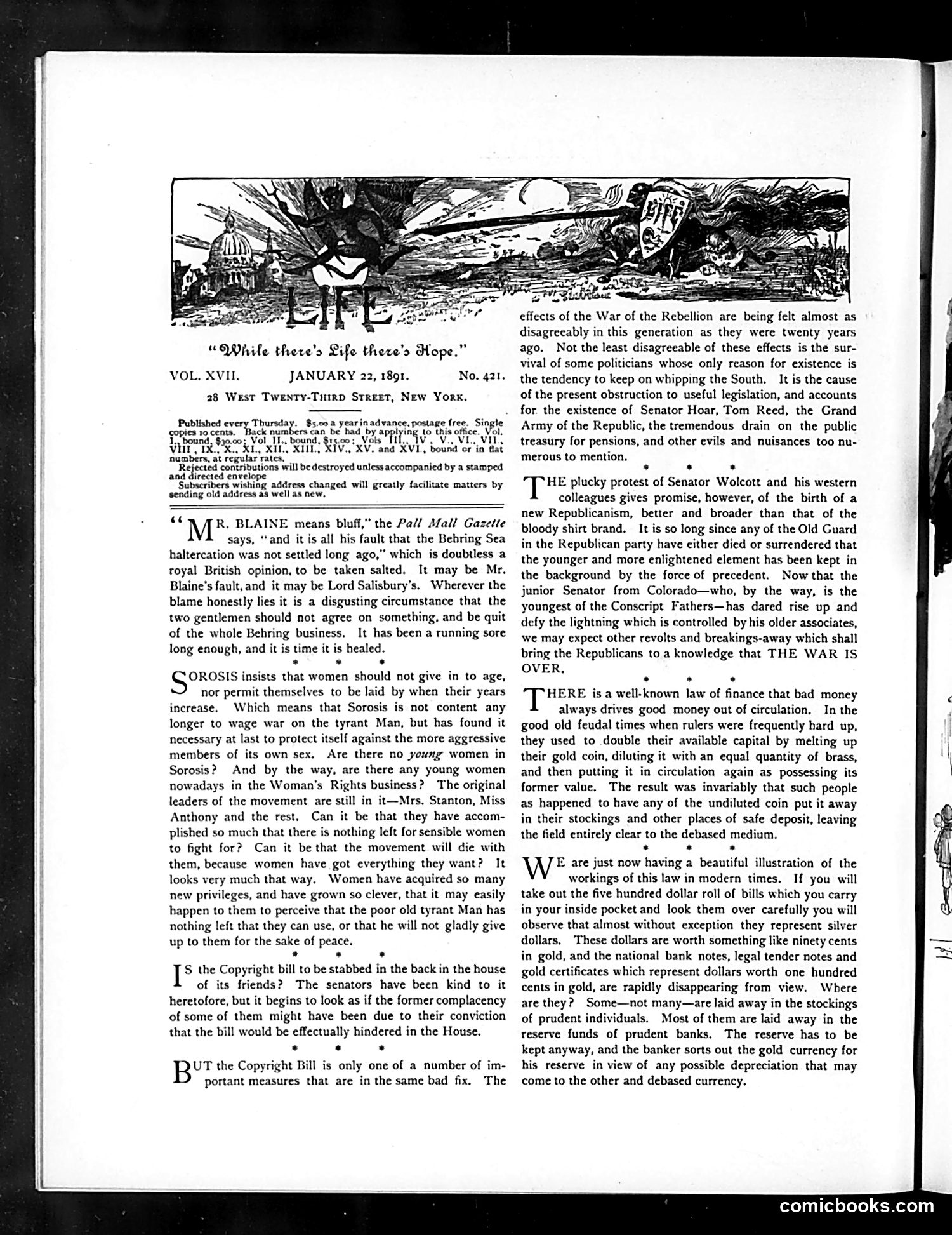
The masthead cartoon shows a nighttime landscape with a gnarled tree and moon—its meaning unclear without additional context. The text discusses several political matters: 1. **Mr. Blaine and the Behring Sea dispute**: A reference to Secretary of State James G. Blaine's handling of a British-American disagreement over seal hunting rights in the Behring Sea, apparently criticized as mishandled diplomacy. 2. **Senator Wolcott's protest**: Praised as promising new Republican leadership, representing "enlightened" younger party members challenging older associates. 3. **Currency and inflation**: The magazine satirizes the disappearance of gold and silver coins from circulation, replaced by paper currency and bank notes—a concern during the 1891 economic period. The satire critiques both foreign policy blunders and monetary policy anxieties of the era.
📄 Transcribed text from this page (OCR, searchable)
Machine-transcribed from the original scan — historical spelling and the odd misread are preserved.
“While there's Life there's Hope.” VOL. XVII. JANUARY 22, 1891. No. 421. 28 West Twenty-Tuirp Street, New York, Published syery] Thursda‘ 5.00 a year inad vance, postage free. Single re ro.cents Ha ck per lh can be had Py Pp ng to this office. en nd, $39.0} yo I}., bound, Saye Vols Moe Vg VEL vine XID, XML, XIV., XV. and XVI, mare at XXL, ‘rates. Rejected contributions will be destroyed unless accompanied by a stamped and directed enve! Subscribers wishing address changed will greatly facilitate matters by sending old address as well as new, bound or’in flat AINE means bluff,” the Pall Mall Gazette and it is all his fault that the Bebring Sea haltercation was not settled long ago,” which is doubtless a royal British opinion, to be taken salted. It may be Mr. Blaine’s fault, and it may be Lord Salisbury’s. Wherever the blame honestly lies it is a disgusting circumstance that the two gentlemen should not agree on something, and be quit of the whole Behring business. It has been a running sore long enough, and it is time it is healed. * * . OROSIS insists that women should not give in to age, nor permit themselves to be laid by when their years increase. Which means that Sorosis is not content any longer to wage war on the tyrant Man, but has found it necessary at last to protect itself against the more aggressive members of its own sex. Are there no young women in Sorosis? And by the way, are there any young women nowadays in the Woman's Rights business? The original leaders of the movement are still in it—Mrs. Stanton, Miss Anthony and the rest. Can it be that they have accom- plished so much that there is nothing left for sensible women to fight for? Can it be that the movement will die with them, because women have got everything they want? It looks very much that way. Women have acquired so many new privileges, and have grown so clever, that it may easily happen to them to perceive that the poor old tyrant Man has nothing left that they can use, or that he will not gladly give up to them for the sake of peace. . . . Is the Copyright bill to be stabbed in the back in the house of its friends? The senators have been kind to it heretofore, but it begins to look as if the former complacency of some of them might have been due to their conviction that the bill would be effectually hindered in the House. . . . UT the Copyright Bill is only one of a number of im- portant measures that are in the same bad fix. The effects of the War of the Rebellion are being felt almost as disagreeably in this generation as they were twenty years ago. Not the least disagreeable of these effects is the sur- vival of some politicians whose only reason for existence is the tendency to keep on whipping the South. It is the cause of the present obstruction to useful legislation, and accounts for. the existence of Senator Hoar, Tom Reed, the Grand Army of the Republic, the tremendous drain on the public treasury for pensions, and other evils and nuisances too nu- merous to mention. . * * Tt plucky protest of Senator Wolcott and his western colleagues gives promise, however, of the birth of a new Republicanism, better and broader than that of the bloody shirt brand. It is so long since any of the Old Guard in the Republican party have either died or surrendered that the younger and more enlightened element has been kept in the background by the force of precedent. Now that the junior Senator from Colorado—who, by the way, is the youngest of the Conscript Fathers—has dared rise up and defy the lightning which is controlled by his older associates, we may expect other revolts and breakings-away which shall bring the Republicans to a knowledge that THE WAR IS OVER. . . . “T MERE is a well-known law of finance that bad money always drives good money out of circulation. In the good old feudal times when rulers were frequently hard up, they used to double their available capital by melting up their gold coin, diluting it with an equal quantity of brass, and then putting it in circulation again as possessing its former value, The result was invariably that such people as happened to have any of the undiluted coin put it away in their stockings and other places of safe deposit, leaving the field entirely clear to the debased medium. . . . E are just now having a beautiful illustration of the workings of this law in modern times. If you will take out the five hundred dollar roll of bills which you carry in your inside pocket and look them over carefully you will observe that almost without exception they represent silver dollars. These dollars are worth something like ninety cents in gold, and the national bank notes, legal tender notes and gold certificates which represent dollars worth one hundred cents in gold, are rapidly disappearing from view. Where are they? Some—not many—are laid away in the stockings of prudent individuals. Most of them are laid away in the reserve funds of prudent banks. The reserve has to be kept anyway, and the banker sorts out the gold currency for his reserve in view of any possible depreciation that may come to the other and debased currency. comicbooks.com