
Life, 1891-01-22 · page 6 of 18
Life — January 22, 1891 — page 6: what you’re looking at
What you’re looking at
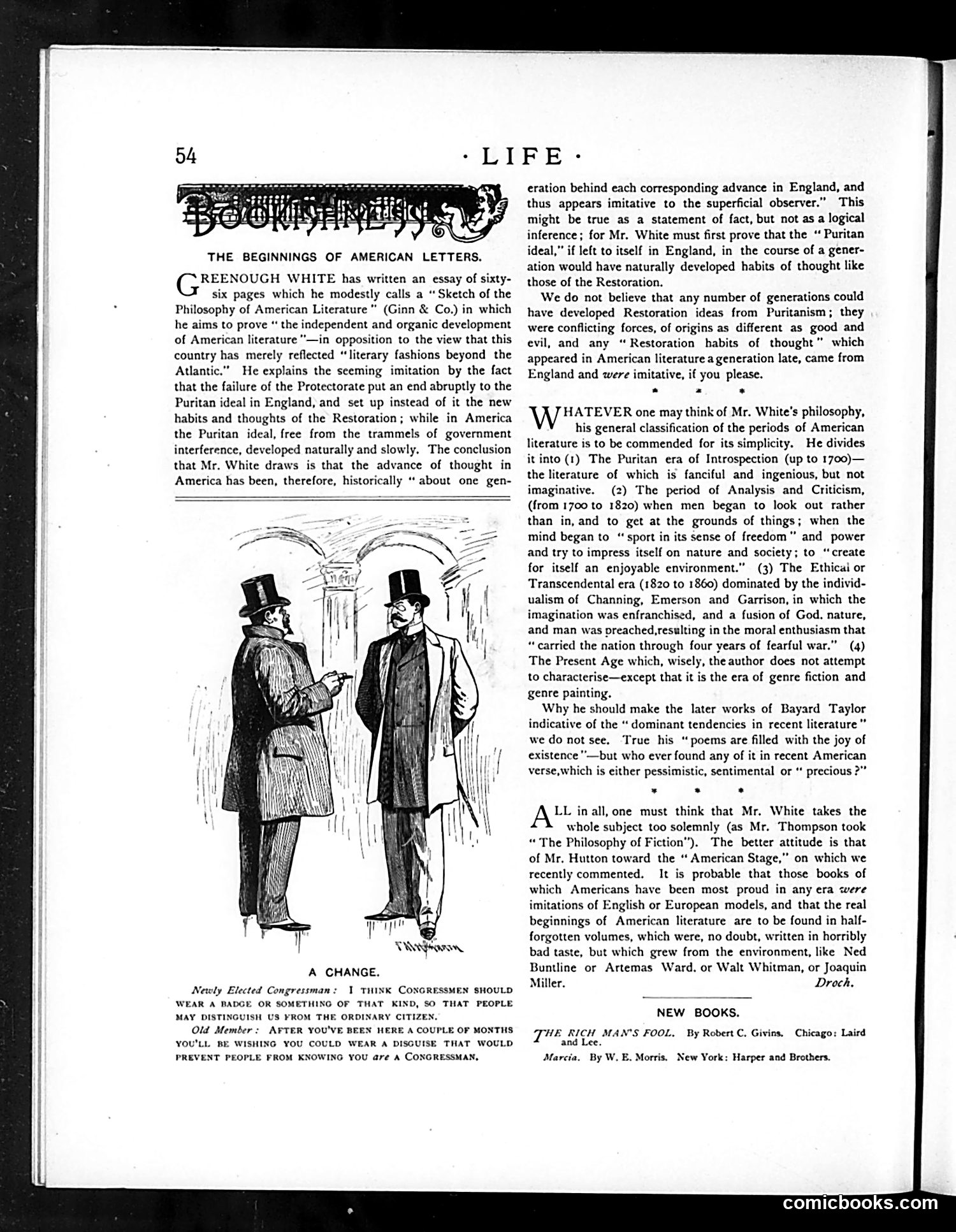
The cartoon titled "A Change" depicts two gentlemen in formal 19th-century attire (top hats and overcoats) in conversation. The caption is a dialogue between a "Newly Elected Congressman" and an "Old Member," discussing how the new congressman should wear a disguise to distinguish himself from ordinary citizens, as people can no longer tell congressmen apart from regular people. This is satire on congressional mediocrity and the undistinguished nature of elected representatives. The joke suggests that congressmen have become so ordinary and unremarkable that they're visually indistinguishable from the general public—implying they lack the dignity, gravitas, or distinctive character voters might expect from their representatives. The cartoon reflects 19th-century cynicism about political leadership.
📄 Transcribed text from this page (OCR, searchable)
Machine-transcribed from the original scan — historical spelling and the odd misread are preserved.
- LIFE: THE BEGINNINGS OF AMERICAN LETTERS. REENOUGH WHITE has written an essay of sixty- six pages which he modestly calls a “ Sketch of the Philosophy of American Literature" (Ginn & Co.) in which he aims to prove “ the independent and organic development of American literature "—in opposition to the view that this country has merely reflected “literary fashions beyond the Atlantic.” He explains the seeming imitation by the fact that the failure of the Protectorate put an end abruptly to the Puritan ideal in England, and set up instead of it the new habits and thoughts of the Restoration; while in America the Puritan ideal, free from the trammels of government interference, developed naturally and slowly. The conclusion that Mr. White draws is that the advance of thought in America has been, therefore, historically ‘* about one gen- 1 ni RN A CHANGE, Newly Elected Congressman: 1 TWINK CONGRESSMEN SHOULD WEAR A BADGE OR SOMETHING OF THAT KIND, 80 THAT PEOPLE MAY DISTINGUISH US ¥ROM THE ORDINARY CITIZEN, Old Member: AFTER YOU'VE BEEN HERE A COUPLE OF MONTHS YOU'LL BE WISHING YOU COULD WEAR A DISGUISE THAT WOULD PREVENT PEOPLE FROM KNOWING YOU are A CONGRESSMAN, eration behind each corresponding advance in England, and thus appears imitative to the superficial observer.” This might be true as a statement of fact, but not as a logical inference; for Mr. White must first prove that the “ Puritan ideal,” if left to itself in England, in the course of a gener- ation would have naturally developed habits of thought like those of the Restoration. We do not believe that any number of generations could have developed Restoration ideas from Puritanism; they were conflicting forces, of origins as different as good and evil, and any “Restoration habits of thought” which appeared in American literature a generation late, came from England and were imitative, if you please. « = . VBA TENER one may think of Mr. White's philosophy, his general classification of the periods of American literature is to be commended for its simplicity. He divides it into (1) The Puritan era of Introspection (up to 1700)— the literature of which is fanciful and ingenious, but not imaginative. (2) The period of Analysis and Criticism, (from 1700 to 1820) when men began to look out rather than in, and to get at the grounds of things; when the mind began to “sport in its sense of freedom" and power and try to impress itself on nature and society; to “create for itself an enjoyable environment.” (3) The Ethicai or Transcendental era (1820 to 1860) dominated by the individ- ualism of Channing, Emerson and Garrison, in which the imagination was enfranchised, and a fusion of God, nature, and man was preached,resulting in the moral enthusiasm that “carried the nation through four years of fearful war.” (4) The Present Age which, wisely, the author does not attempt to characterise—except that it is the era of genre fiction and genre painting. Why he should make the later works of Bayard Taylor indicative of the “ dominant tendencies in recent literature” we do not see. True his “poems are filled with the joy of existence "—but who ever found any of it in recent American verse,which is either pessimistic, sentimental or “ precious ?” * . . LL in all, one must think that Mr. White takes the whole subject too solemnly (as Mr. Thompson took “ The Philosophy of Fiction”). The better attitude is that of Mr. Hutton toward the “ American Stage,” on which we recently commented. It is probable that those books of which Americans have been most proud in any era were imitations of English or European models, and that the real beginnings of American literature are to be found in half- forgotten volumes, which were, no doubt, written in horribly bad taste, but which grew from the environment, like Ned Buntline or Artemas Ward. or Walt Whitman, or Joaquin Miller, Droch, NEW BOOKS. THE RICH MAN'S FOOL, By Robert C, Givins, Chicago: Laird and Lee. Marcia, By W.E. Morris, New York: Harper and Brothers. comicbooks.com