
A complete issue · 20 pages · 1891
Life — January 8, 1891
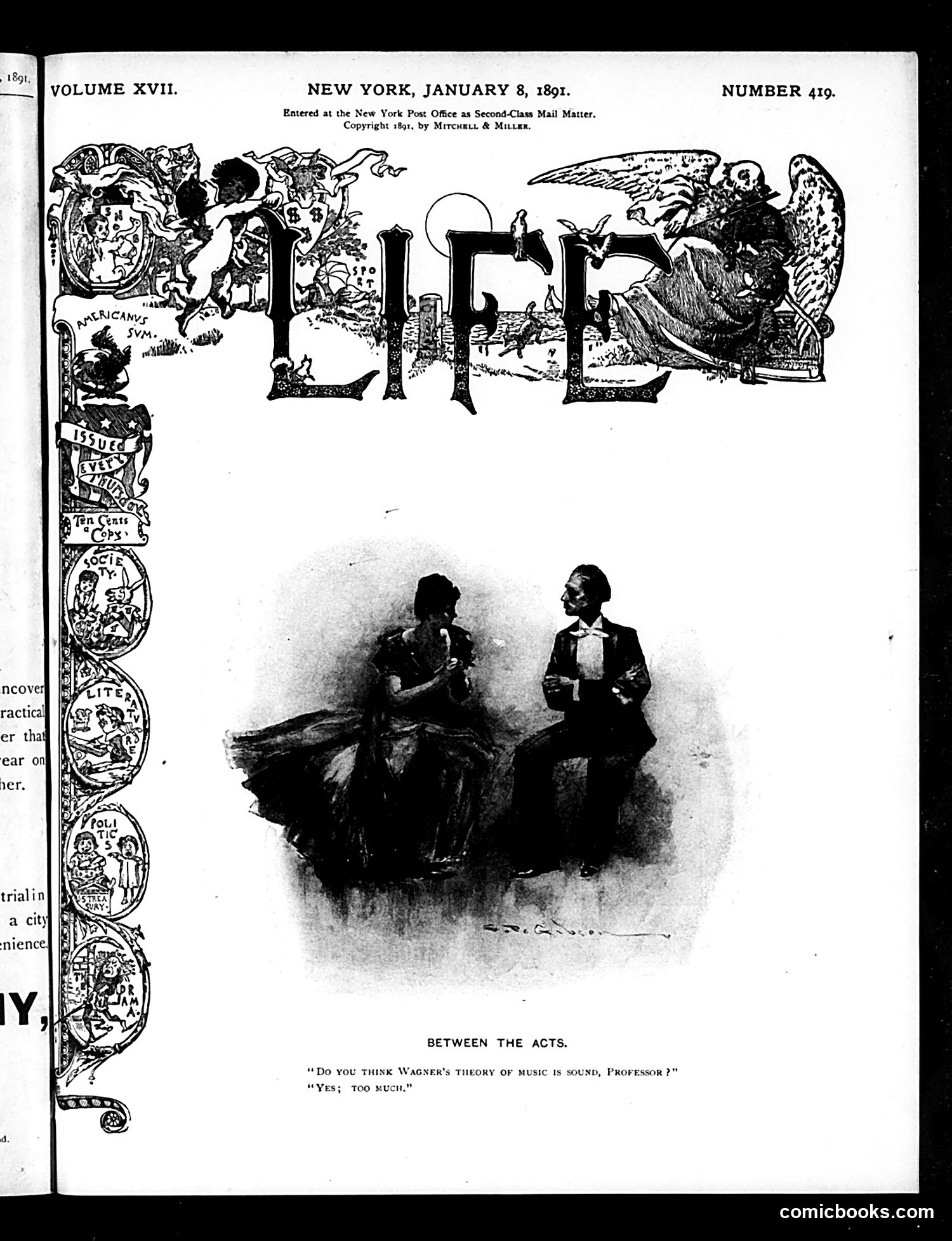
This satirical cartoon depicts two men in conversation during a theater intermission. The caption reads: "Do you think Wagner's theory of music is sound, Professor?" with the response "Yes; too much." The joke targets Richard Wagner, the famous German composer whose elaborate theories about music and opera were fashionable among intellectual circles in the 1890s. The humor lies in the pun on "sound"—meaning both acoustically pleasant AND logically coherent. The Professor's reply "Yes; too much" suggests Wagner's music is excessively loud or his theories overly complex and pretentious. This mocks the affectation of discussing Wagner's philosophical ideas as a marker of cultural sophistication among the theater-going elite.
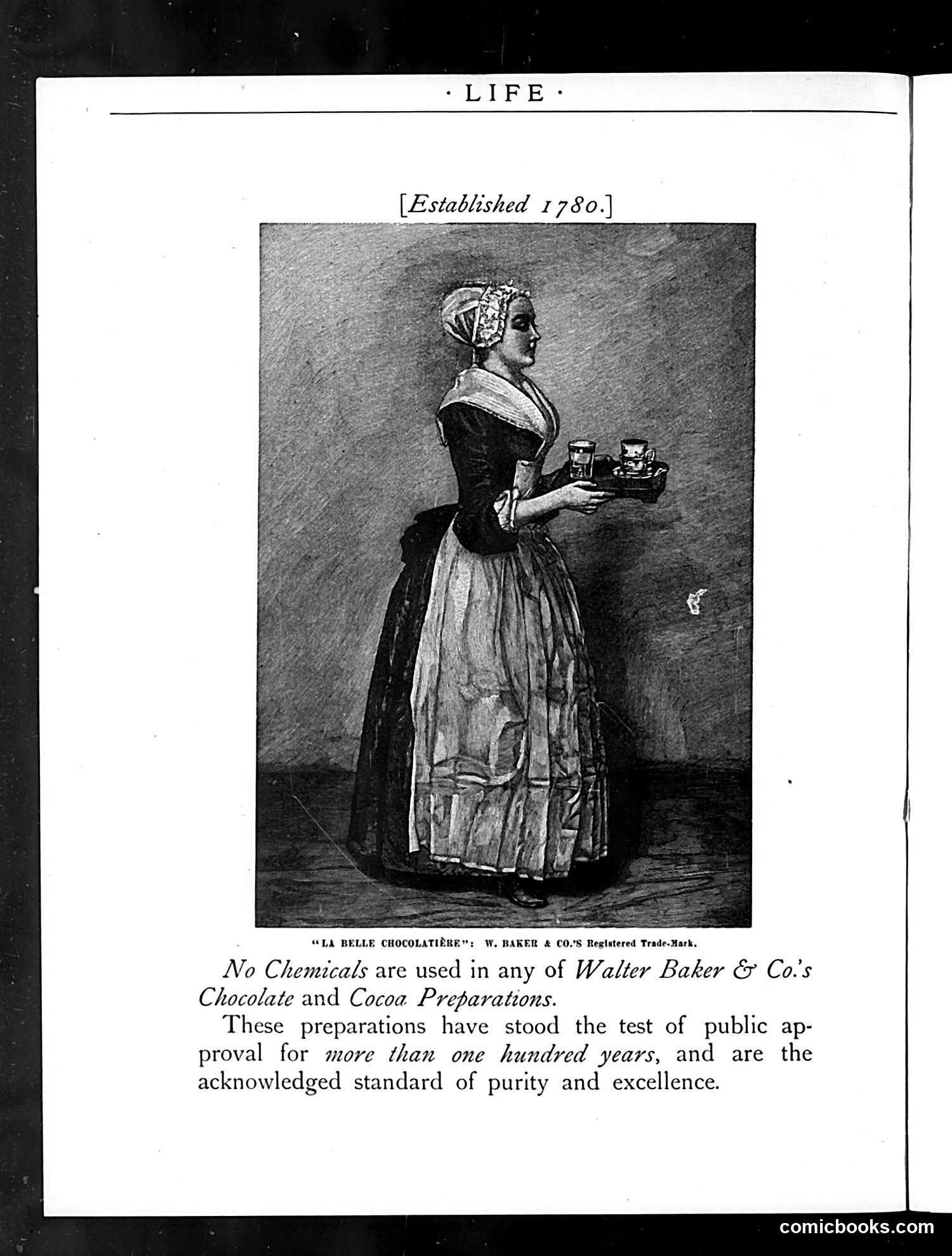
This page is primarily **advertising, not satire or political commentary**. It features an illustration titled "La Belle Chocolatière" (The Beautiful Chocolate Girl), a famous 18th-century painting, used to promote Walter Baker & Co.'s chocolate and cocoa products. The company established in 1780 uses the elegant historical image to suggest sophistication and tradition. The advertisement's text emphasizes that no chemicals are used in their preparations and claims their products have maintained public approval for "more than one hundred years," positioning them as a trusted standard of quality. This represents typical **early-20th-century commercial advertising** strategy: borrowing cultural prestige (the famous artwork) to market consumer goods to middle and upper-class readers of *Life* magazine.
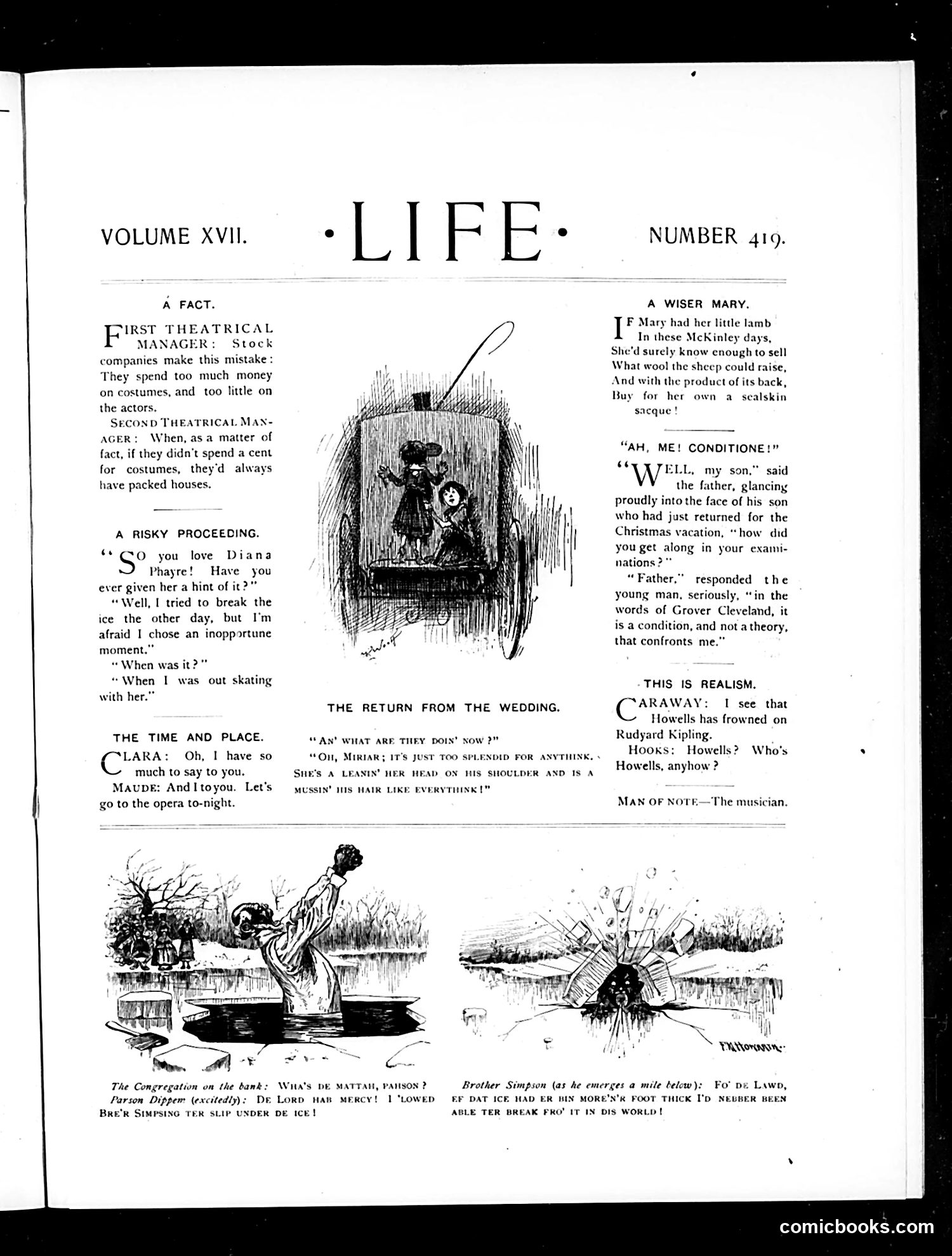
This page contains theatrical humor and satirical sketches rather than political commentary. The main items include: **"A Fact"** — jokes about theatrical managers' spending priorities: one spends too much on costumes, another too little on actors. **"A Risky Proceeding"** — dialogue about breaking ice while skating with Diana Phayre (apparently an actress). **"A Wiser Mary"** — a poem about a girl in the McKinley era who could sell wool and buy a sealskin instead of keeping a lamb. **"Ah, Me! Conditione!"** — a father-son conversation about exam performance and conditions versus theory. **Illustrations** depict humorous winter scenes: people falling through ice and emerging from water. The humor is domestic and physical rather than politically targeted.
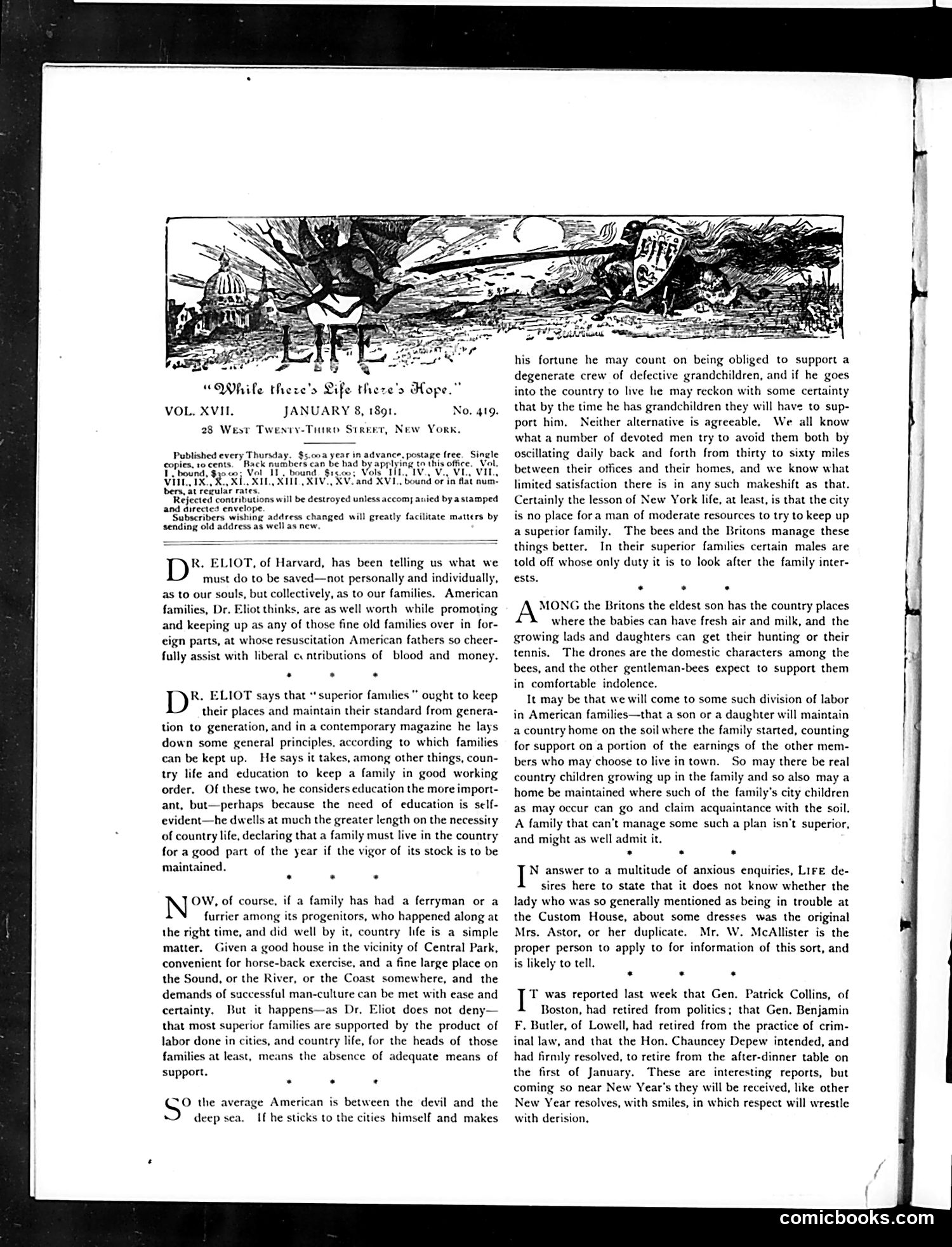
The page contains editorial commentary rather than cartoons. The text discusses Dr. Eliot of Harvard, who advocated that "superior families" should maintain their social standing by sending sons to work in the country and daughters to live in rural estates—essentially keeping the upper classes separated from urban life. The satire critiques this elitist position, arguing that American families of moderate means cannot afford such luxuries. The author points out that while country estates might suit the wealthy, most Americans must live in cities for economic necessity, making Eliot's prescription impractical and somewhat absurd for average families. The piece represents early 20th-century debate about class, urbanization, and education in America.
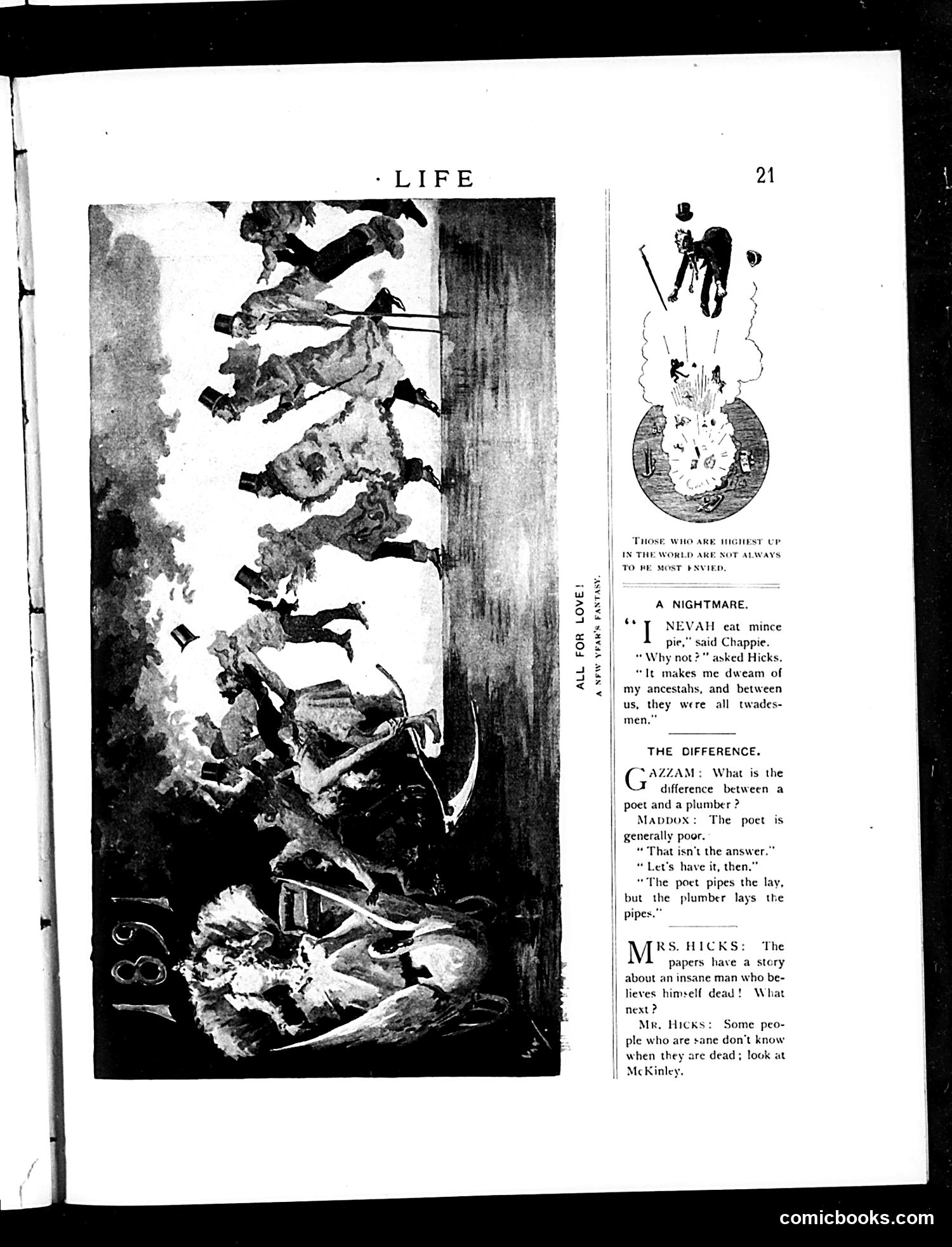
The large left illustration appears to be a satirical political cartoon showing multiple figures stacked vertically—likely representing a social or political hierarchy or pecking order ("ALL FOR LOVE"). The image is oriented sideways, suggesting the subjects are tumbling or in chaos. The right side contains brief humorous dialogue pieces: - **"A Nightmare"**: Chappie and Hicks joke about eating mince pie and ancestral twadesmen - **"The Difference"**: Gazzam and Maddox debate poets versus plumbers (the poet is poor; the plumber lays pipes) - **"Mrs. Hicks"**: References an insane man who believes himself dead, contrasting with McKinley These are light satirical jokes about class distinctions, profession, and sanity—typical of LIFE's humorous social commentary circa early 1900s.
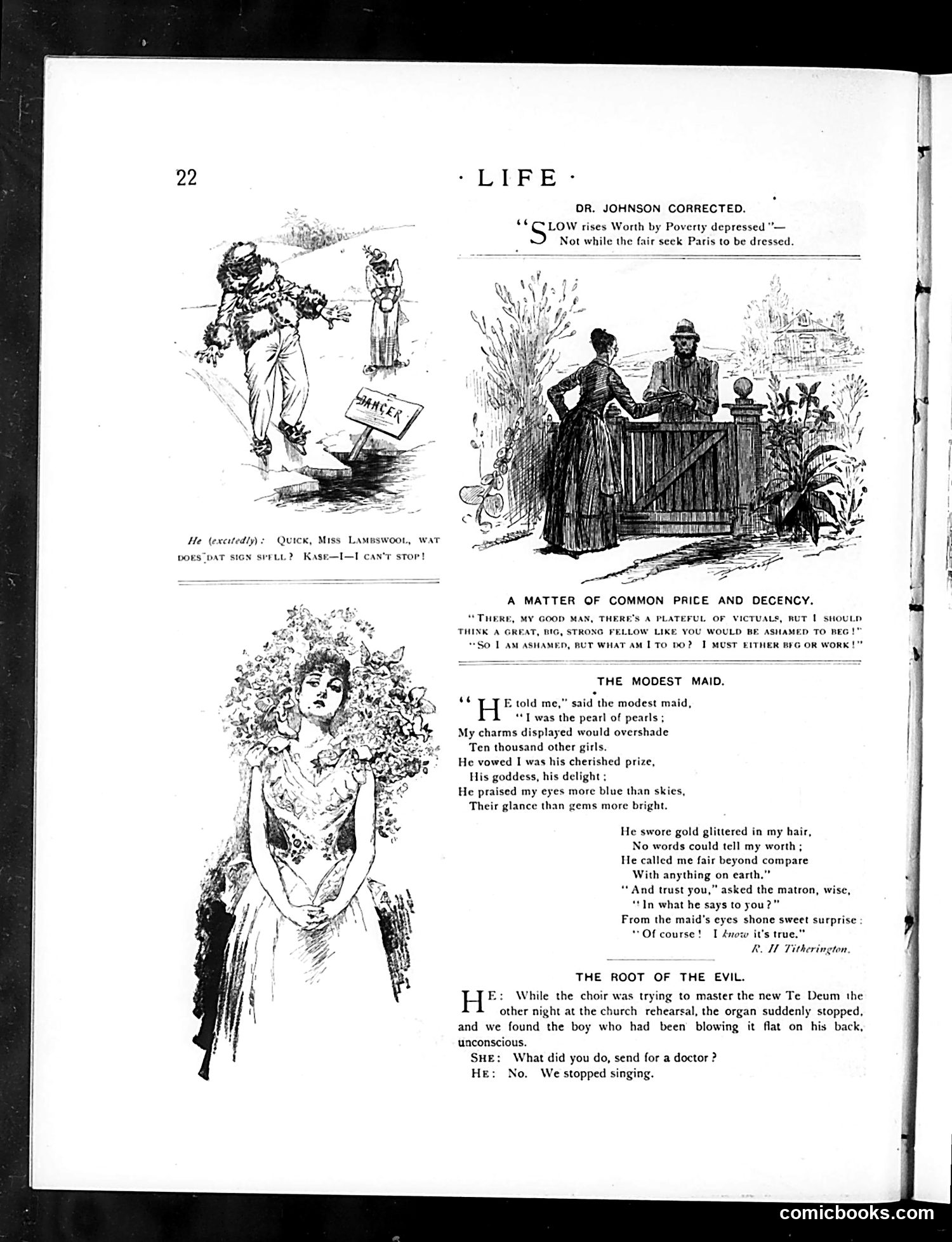
**"Dr. Johnson Corrected"** (top left): A satirical cartoon showing a disheveled man being corrected about Samuel Johnson's famous quote on poverty. The joke plays on the classical reference—the man misquotes Johnson's observation that poverty doesn't prevent seeking fashionable dress. **"A Matter of Common Price and Decency"** (top right): Depicts a woman rejecting a suitor's proposal, emphasizing her standards and independence—typical Victorian-era humor about courtship and female agency. **"The Modest Maid"** (center): A poem by K.H. Tilkrington about a woman whose suitor extravagantly praises her beauty and charm, ending with her matter-of-fact response that she believes him. The humor lies in the contrast between his flowery declarations and her practical acceptance. **"The Root of the Evil"** (bottom): A brief anecdote about a church choir incident, relying on understated humor typical of early 20th-century Life magazine.
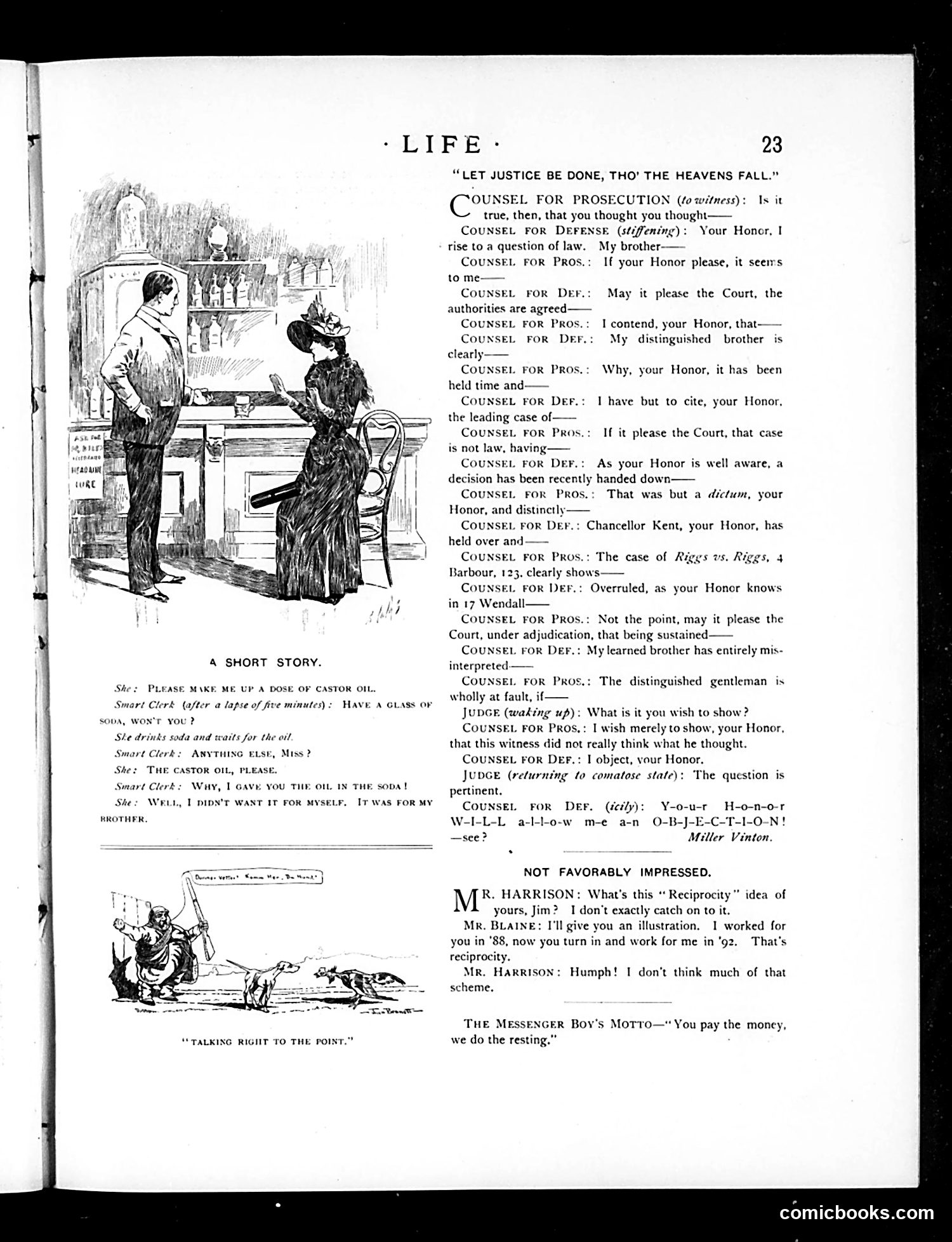
The page contains three distinct satirical pieces: **Top illustration**: A courtroom scene satirizing legal proceedings. The dialogue shows opposing counsel debating precedent—one cites "Riggs vs. Riggs" while another references Chancellor Kent's holdings. The satire targets how lawyers use obscure cases and technicalities to obstruct justice, with one counsel deliberately distorting testimony. The caption "Let Justice Be Done, Tho' the Heavens Fall" ironically undercuts the depicted legal maneuvering. **"A Short Story"**: A joke about a woman ordering castor oil at a soda fountain, mishearing the clerk's suggestion to add something "else," resulting in unintended consequences. **"Not Favorably Impressed"**: A brief dialogue between Mr. Harrison and Mr. Blaine about "reciprocity"—likely referencing 1880s-90s trade policy debates. Blaine's claim that reciprocal work arrangements benefit both parties is dismissed as a poor scheme.
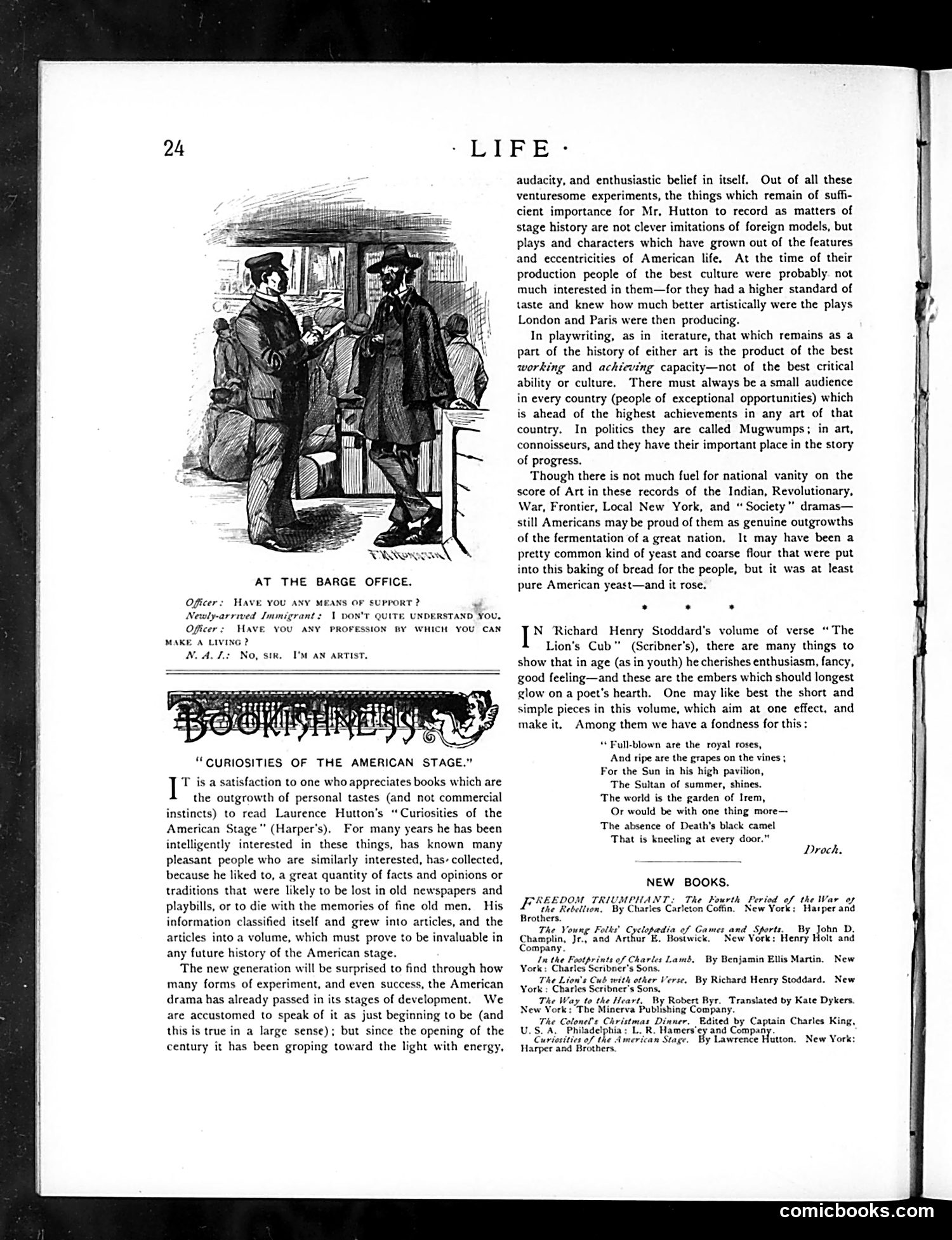
This cartoon satirizes immigration processing at the Barge Office (Ellis Island's predecessor). The officer questions a "newly-arrived immigrant" about means of support, while the immigrant claims to be an artist who can support himself. The satire targets a common American anxiety: that immigrants arriving with few resources might become public burdens. The joke appears to be the immigrant's implausible claim—declaring oneself an "artist" as proof of financial viability was likely seen as evasive or absurd by readers who viewed artists as economically marginal. The accompanying text discusses American theater's development, suggesting broader themes about what counts as "legitimate" American contribution versus mere survival or subsistence.
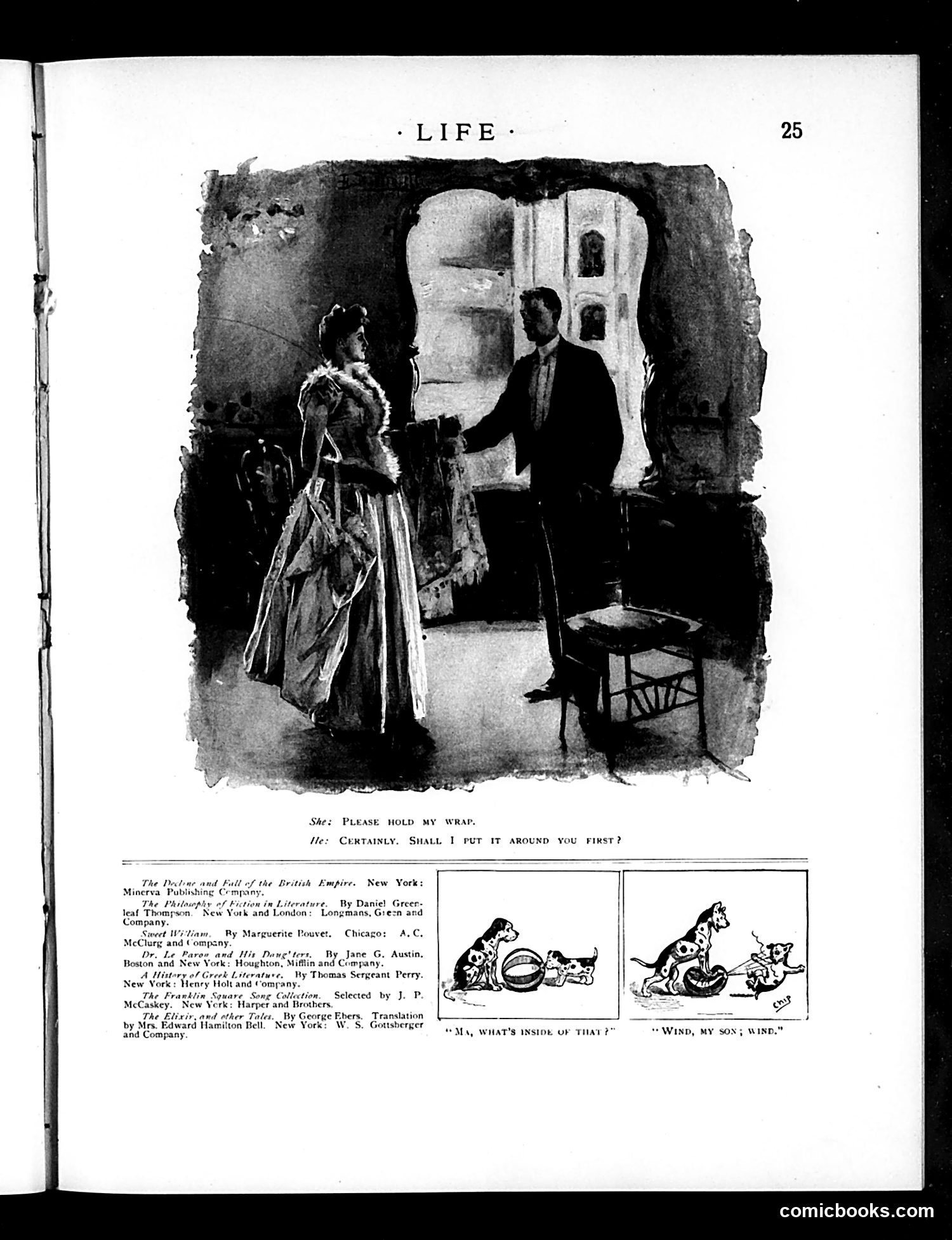
This page from *Life* magazine features a domestic comedy scene. The main illustration shows a woman asking a man to hold her wrap, with his response: "Certainly. Shall I put it around you first?" The humor derives from deliberate misunderstanding—the woman's request is ambiguous, and the man feigns confusion to make an innuendo-laden joke about putting the wrap "around" her (implying physical closeness or intimacy) rather than simply holding it. The two small cartoon vignettes below ("Ma, what's inside that?" and "Wind, my son, wine") appear to be separate jokes, likely playing on homophones or double meanings. The page also includes book advertisements for titles on British Empire, Victorian literature, and other works, typical of *Life*'s mixed editorial and advertising content.
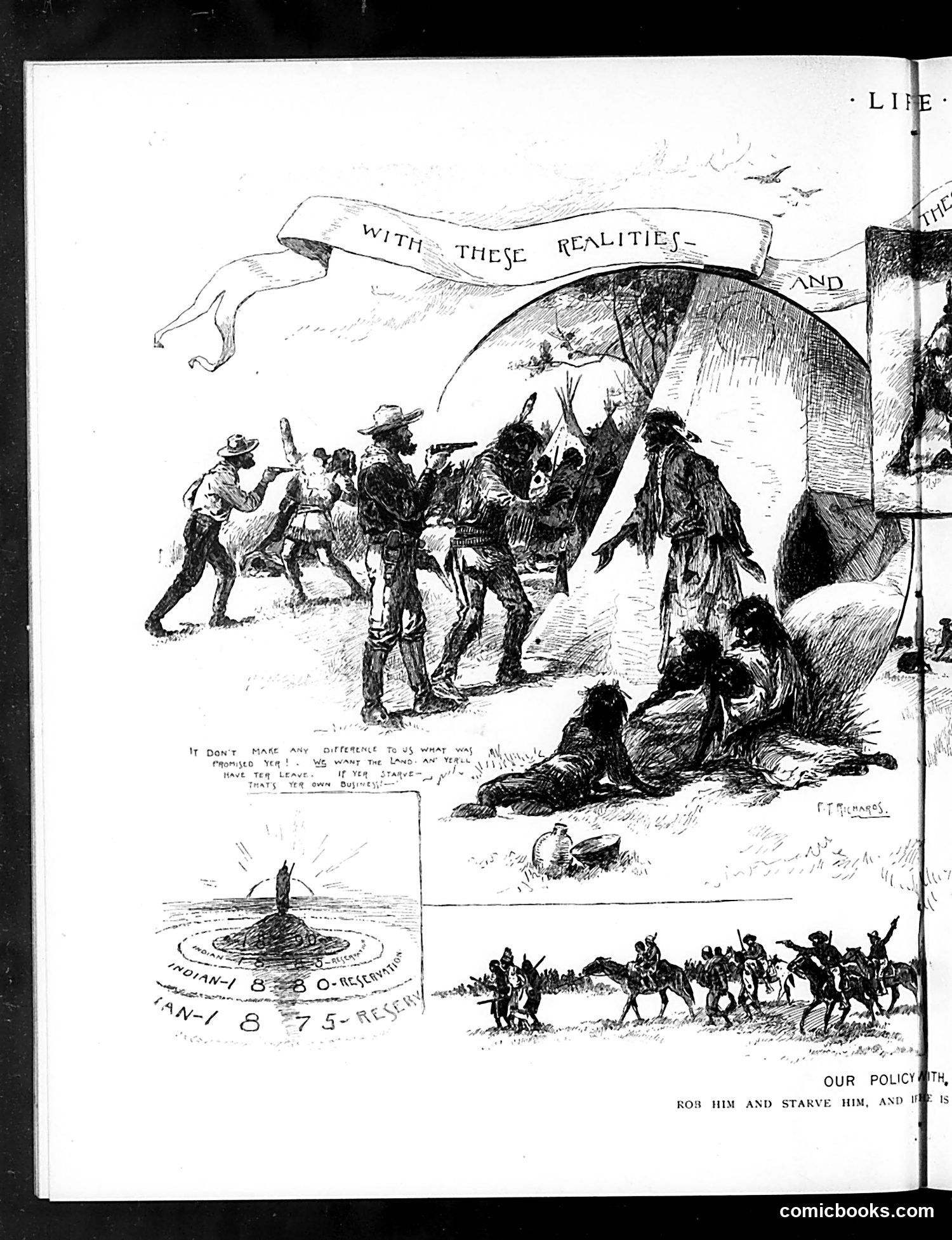
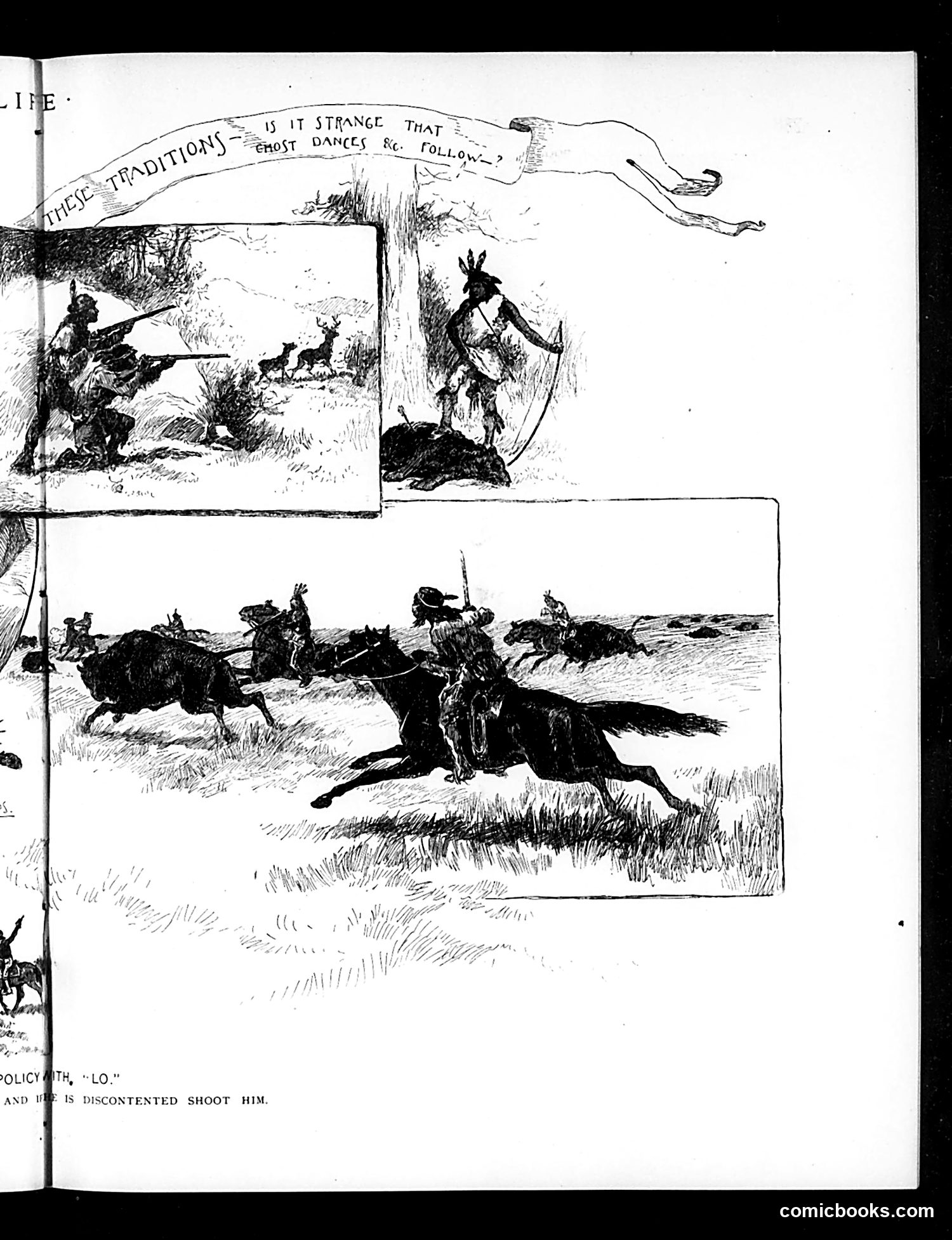
This satirical cartoon critiques American Indian policy, likely from the early 20th century. The banner reads "WITH THESE REALITIES," suggesting the government makes promises it doesn't keep. The main scene shows soldiers or officials confronting Native Americans, with text stating the government promised "the land as years have passed, if yes staggers—" and "that's the gain, business!"—indicating broken land-treaty promises. The small inset labeled "INDIAN-1870-RECEIPTS" and "INDIAN-1875-RECEIPTS" appears to mock minimal compensation or resources given to Native peoples. The bottom panel shows cavalry pursuing Native Americans on horseback, illustrating military enforcement of these failed policies. The cartoon's point: the U.S. government cynically exploited and displaced Native Americans while claiming benevolent intentions, profiting while tribes starved.
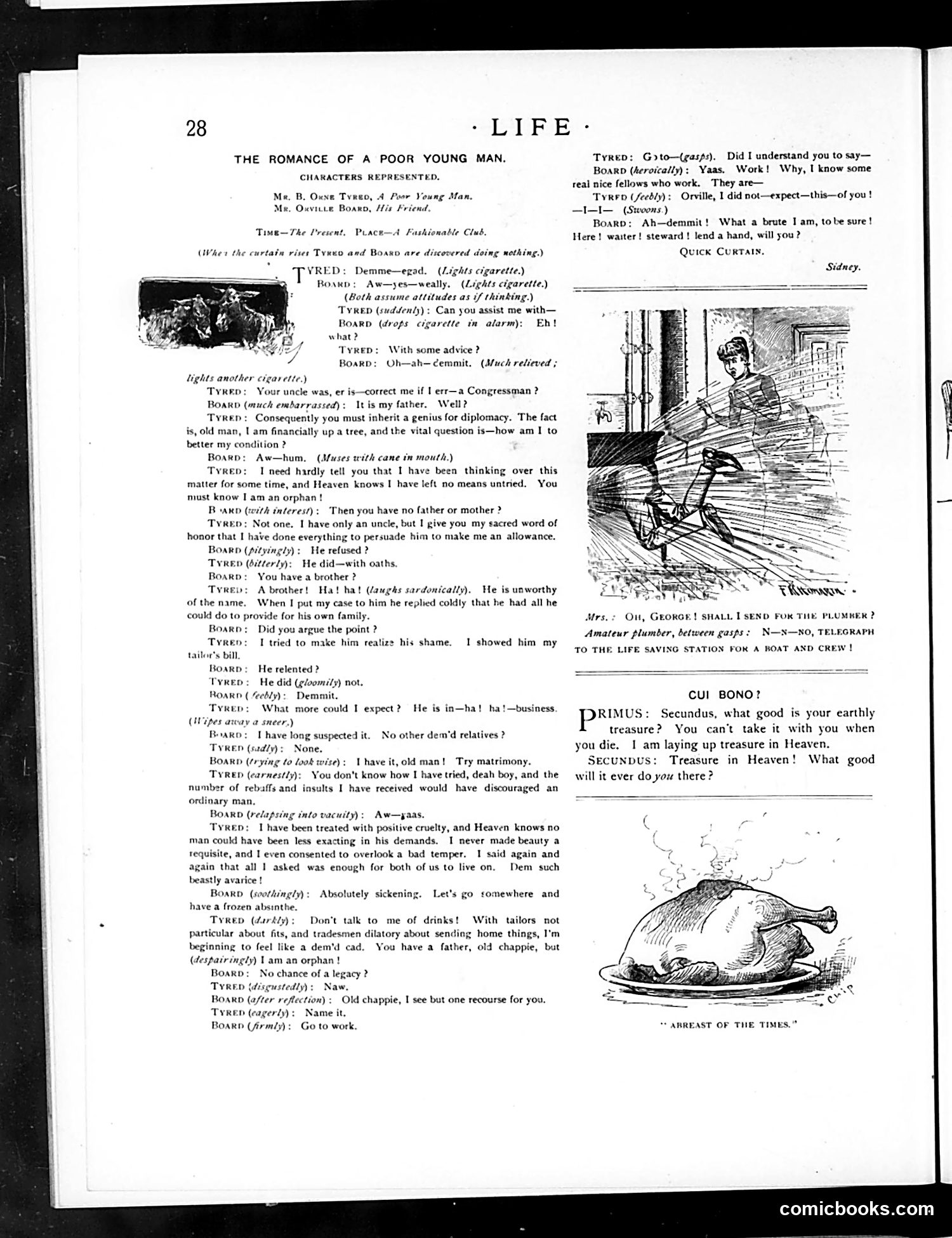
This page presents a comedic playlet mocking the leisured upper class. Two idle wealthy men—Tyred and Board—lounge at a fashionable club smoking and doing nothing. When Tyred asks Board for advice about his financial troubles (unpaid tailor bills, no inheritance, failed marriage prospects), Board's solution is devastatingly simple: "Go to work." The satire targets the genteel poor—men of social standing too proud for labor but too broke to maintain appearances. Their affected speech ("demme," "deah boy"), constant cigarette lighting, and paralyzed indecision while creditors circle exemplify a class dependent on family money or advantageous marriages rather than employment. The punchline—that work is unthinkable, almost insulting—exposes the absurdity of this lifestyle. The accompanying sketches (a man signaling for a plumber, a roasted turkey) provide comic relief but reinforce themes of desperation and class anxiety.
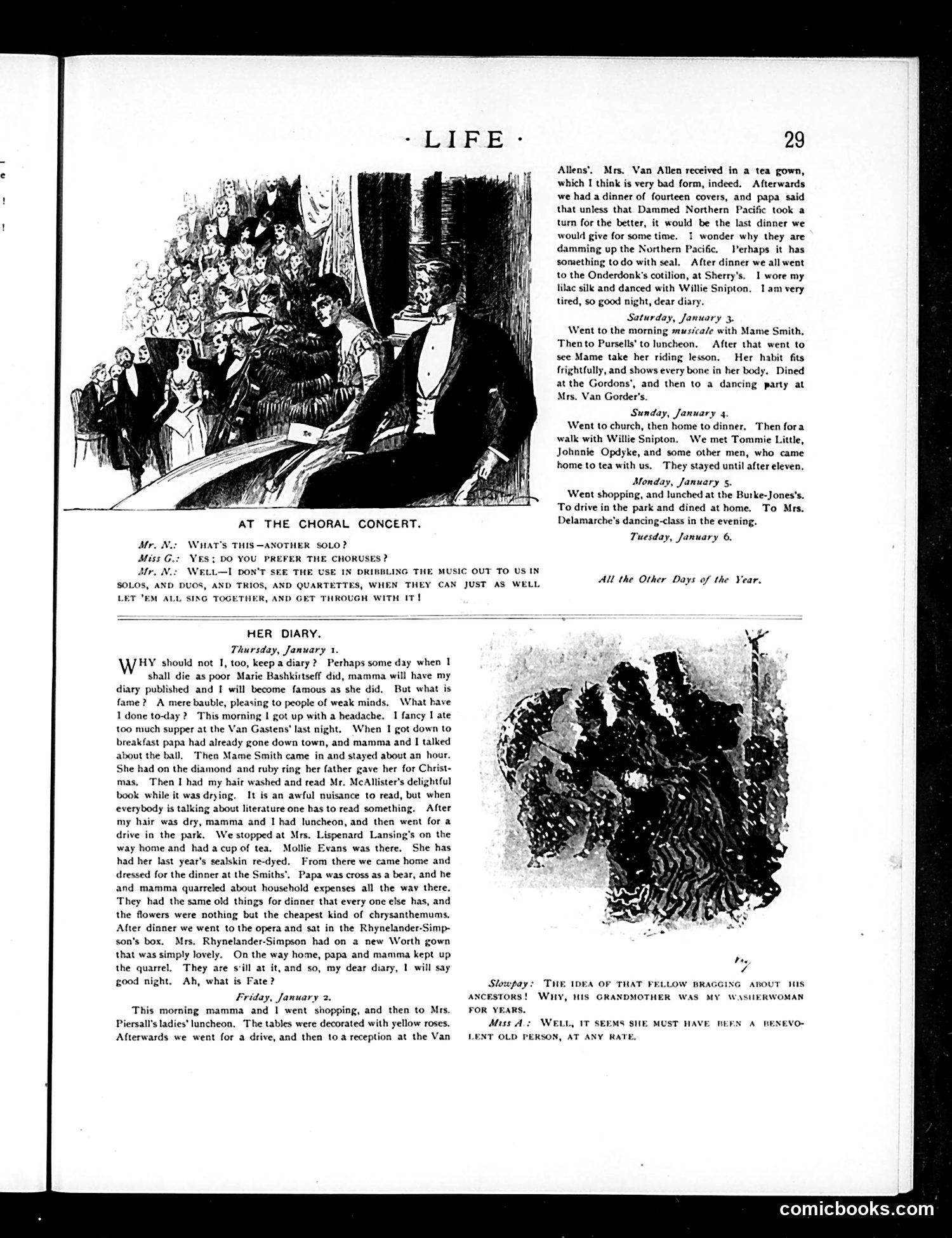
This page satirizes the superficial social world of wealthy New York society circa early 1900s through two separate pieces: **"Her Diary"** mocks the self-absorbed, privileged young socialite keeping a detailed record of trivial social activities—tea gowns, musicales, dancing classes, park drives. The satire lies in her pretension (comparing herself to Marie Bashkirtseff, a famous diarist) while documenting only meaningless social engagements. References to "the Northern Pacific" and her father's financial worries hint at real-world economic concerns intruding on their leisure. **"At the Choral Concert"** presents a brief dialogue mocking concert-goers who prefer choruses over solos—suggesting audiences lack appreciation for serious music, preferring group performances to individual artistry. **The bottom exchange** satirizes social climbing and class pretense: a man boasts about his ancestry, but a woman reveals his grandmother was her washerwoman, deflating his claims to aristocratic standing. The second woman's charitable response ("benevolent old person") gently mocks both the pretension and the condescending pity of the wealthy toward servants. The overall message critiques superficiality, class anxiety, and hollow social conventions among the wealthy elite.
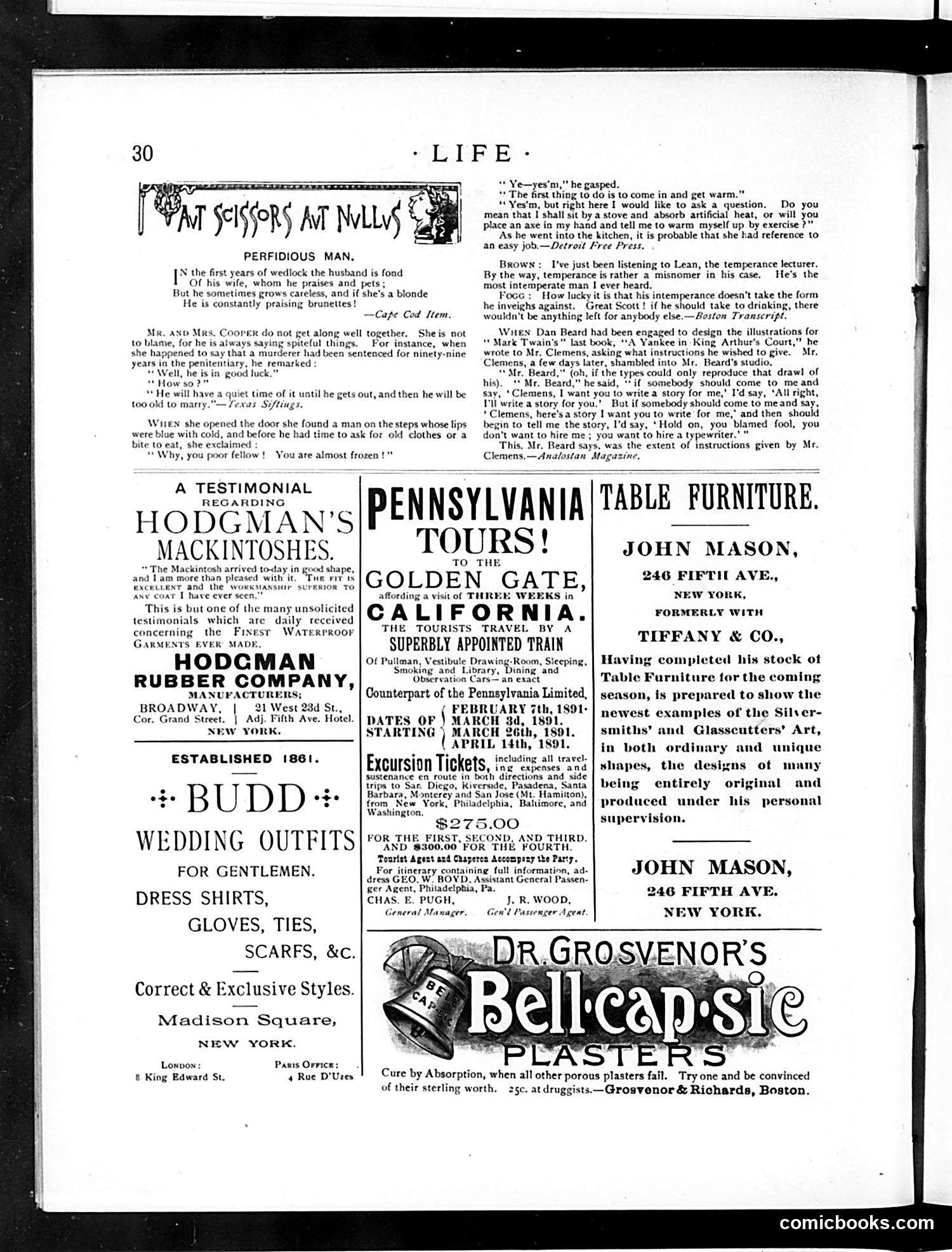
This page consists primarily of **humorous anecdotes and advertisements** rather than political cartoons. The comic content includes brief, cynical jokes about marriage and human nature: The opening piece, "Perfidious Man," satirizes husbands who neglect wives after marriage, particularly the trope of praising brunettes while married to blondes—a commentary on male infidelity and fickleness. Several brief jokes follow mocking misers, temperance lecturers, and marital dynamics. Notably, there's an anecdote about author Mark Twain (via Dan Beard) refusing to accept story assignments, preferring to write independently—a jab at creative control and artistic pride. The page is dominated by **Victorian-era advertisements** for rubber coats, wedding attire, furniture, and excursion tours to California. These reveal contemporary consumer culture and leisure interests. The overall tone reflects *Life* magazine's satirical approach: cynical humor about domestic life, marriage, and human foibles, typical of 1890s American satire.
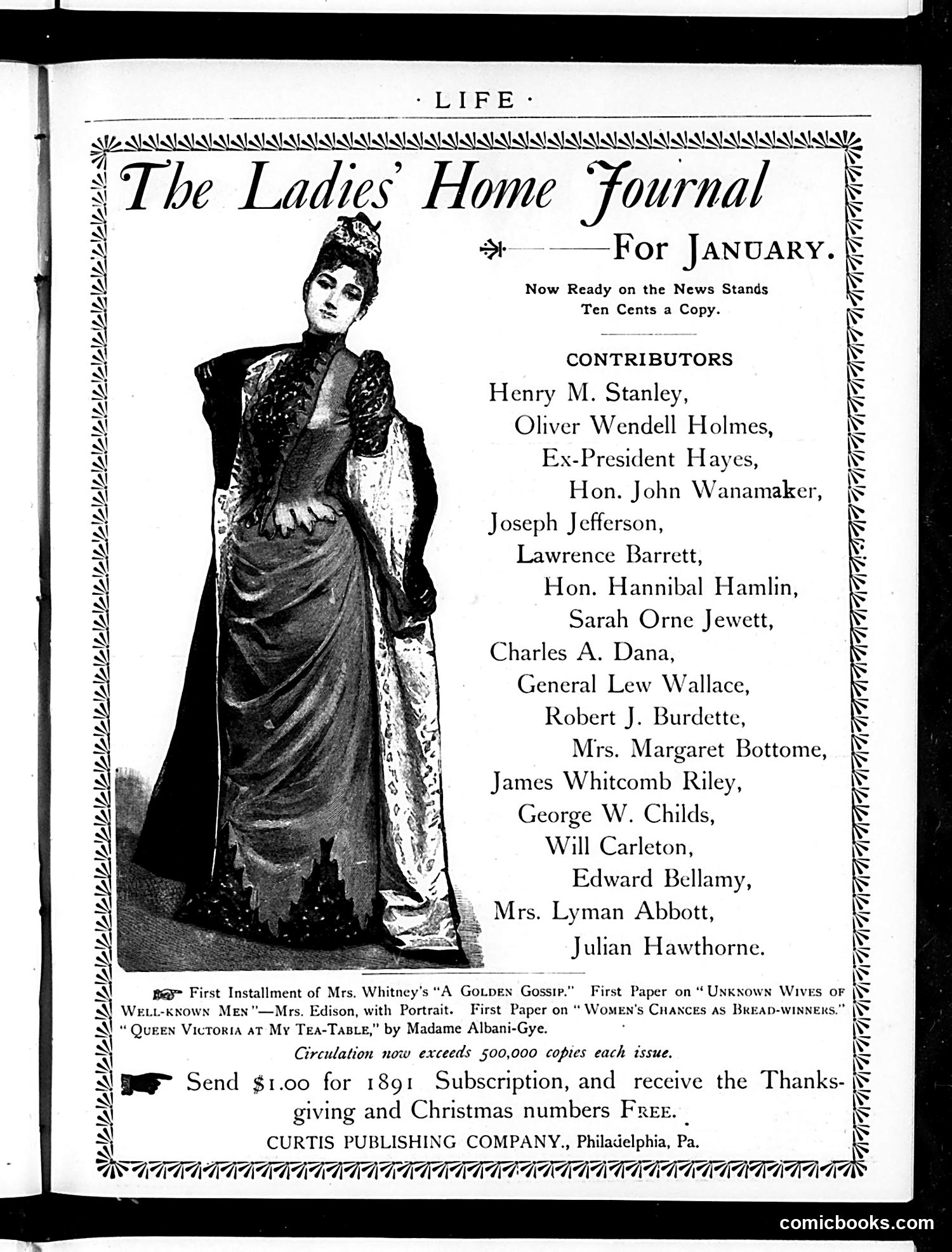
This is a **title page/advertisement** for *The Ladies' Home Journal*, not a political cartoon. It promotes the January issue, priced at ten cents, published by Curtis Publishing Company in Philadelphia. The page lists prominent **contributors** including literary figures (Oliver Wendell Holmes, James Whitcomb Riley), politicians (Ex-President Hayes, General Lew Wallace), and explorers (Henry M. Stanley). The featured illustration shows a fashionably dressed woman in 1890s attire with an elaborate hat and cape. Key content advertised includes serialized stories like "A Golden Gossip" and articles on "Women's Chances as Bread-winners"—reflecting contemporary interest in women's economic roles. A feature on Mrs. Edison (wife of inventor Thomas Edison) showcases the magazine's appeal to middle-class readers curious about prominent families. The claimed circulation of 500,000 copies indicates this was a major mass-market publication. The $1.00 annual subscription offer (with free holiday issues) positioned it as affordable domestic reading material for American households.
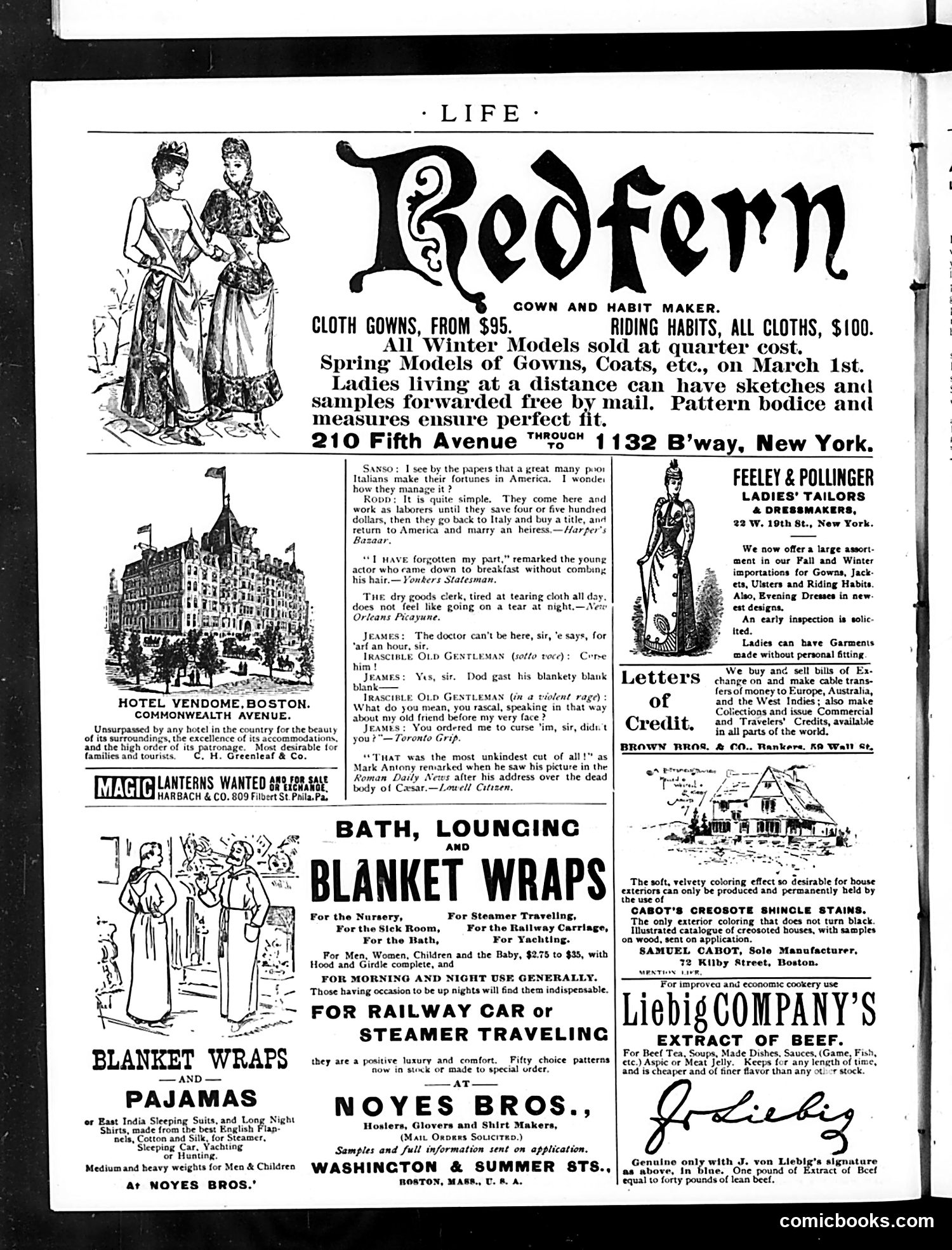
This page is primarily **advertising**, not satirical content. It features high-end merchants targeting wealthy late-19th century American consumers: Redfern (women's couture), Hotel Vendome (Boston luxury hotel), and various specialty retailers. The few **short jokes** included are typical period humor: - An Italian immigrant becomes wealthy by working as a laborer, saving money, buying a title back in Italy, then returning to marry an American heiress—satirizing both immigrant ambition and the American upper class's willingness to purchase European nobility. - A dry goods clerk making a pun about "going on a tear." - A servant misunderstanding his employer's sarcastic curse. These jokes reflect contemporary anxieties about **class mobility** and **transatlantic social climbing** but contain no political commentary. The page primarily documents consumer goods, prices, and services available to affluent readers in this era.
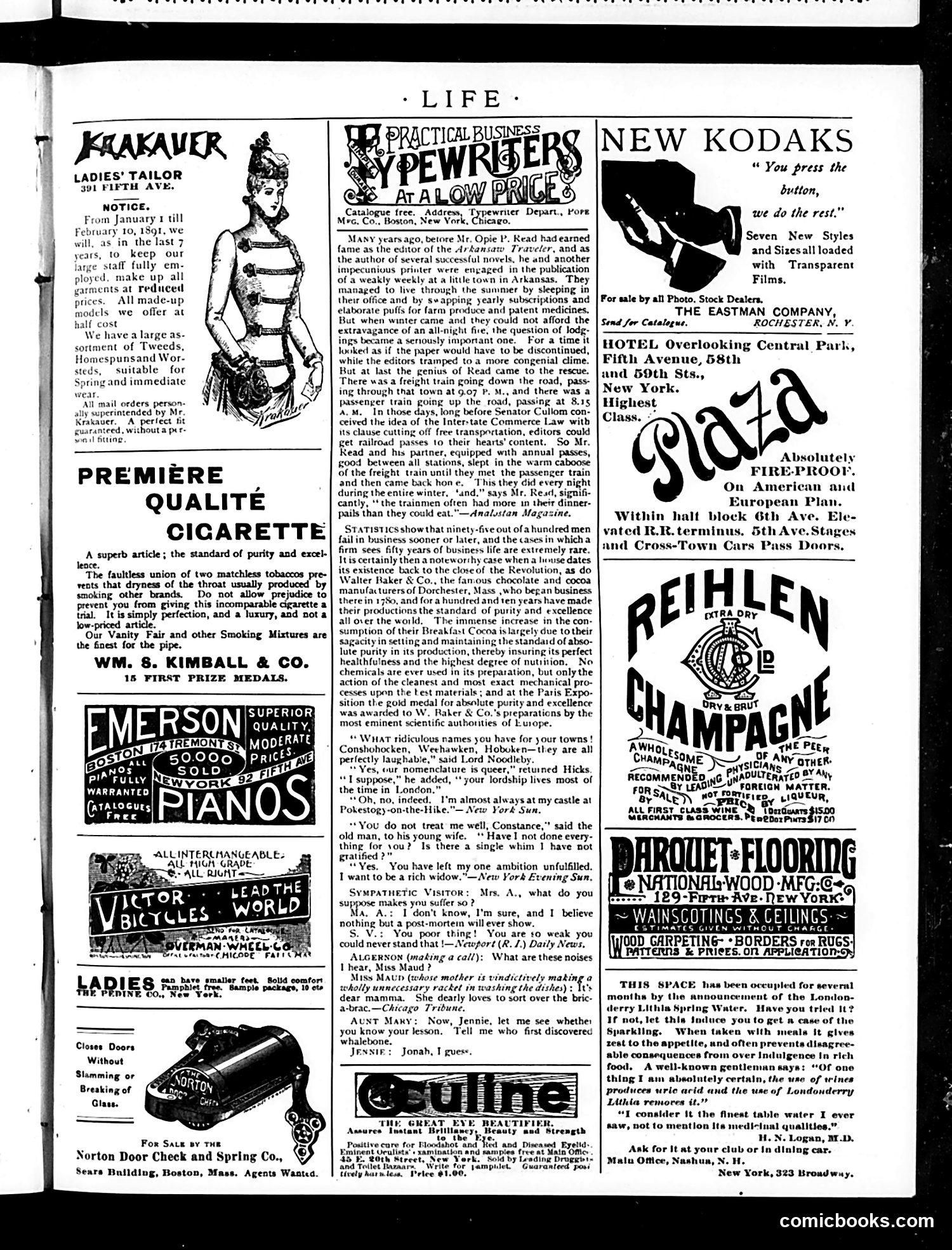
This is primarily an **advertising page** with minimal editorial cartooning. The main content consists of commercial advertisements for ladies' tailoring, cigarettes, pianos, door hardware, and other products typical of 1891. The only cartoon-like element visible is labeled "VICTOR BICYCLES" at the bottom left—a small illustrated advertisement showing a bicycle, not political satire. The page includes a narrative article about **Opie P. Read**, editor of the *Arkansas Traveler*, describing how he and a fellow printer survived an Arkansas winter by sleeping on freight trains with railroad passes—trading between a night freight train (departing 9:07 PM) and a morning passenger train (arriving 8:15 AM). The anecdote humorously notes trainmen had better meals from these arrangements than they could afford otherwise. The remaining space features **Walter Baker & Co.** cocoa advertisement, celebrating the company's 110-year history since the Revolution. This is **not a satirical or political page**—it's a commercial issue showcasing period advertising and light human-interest stories.
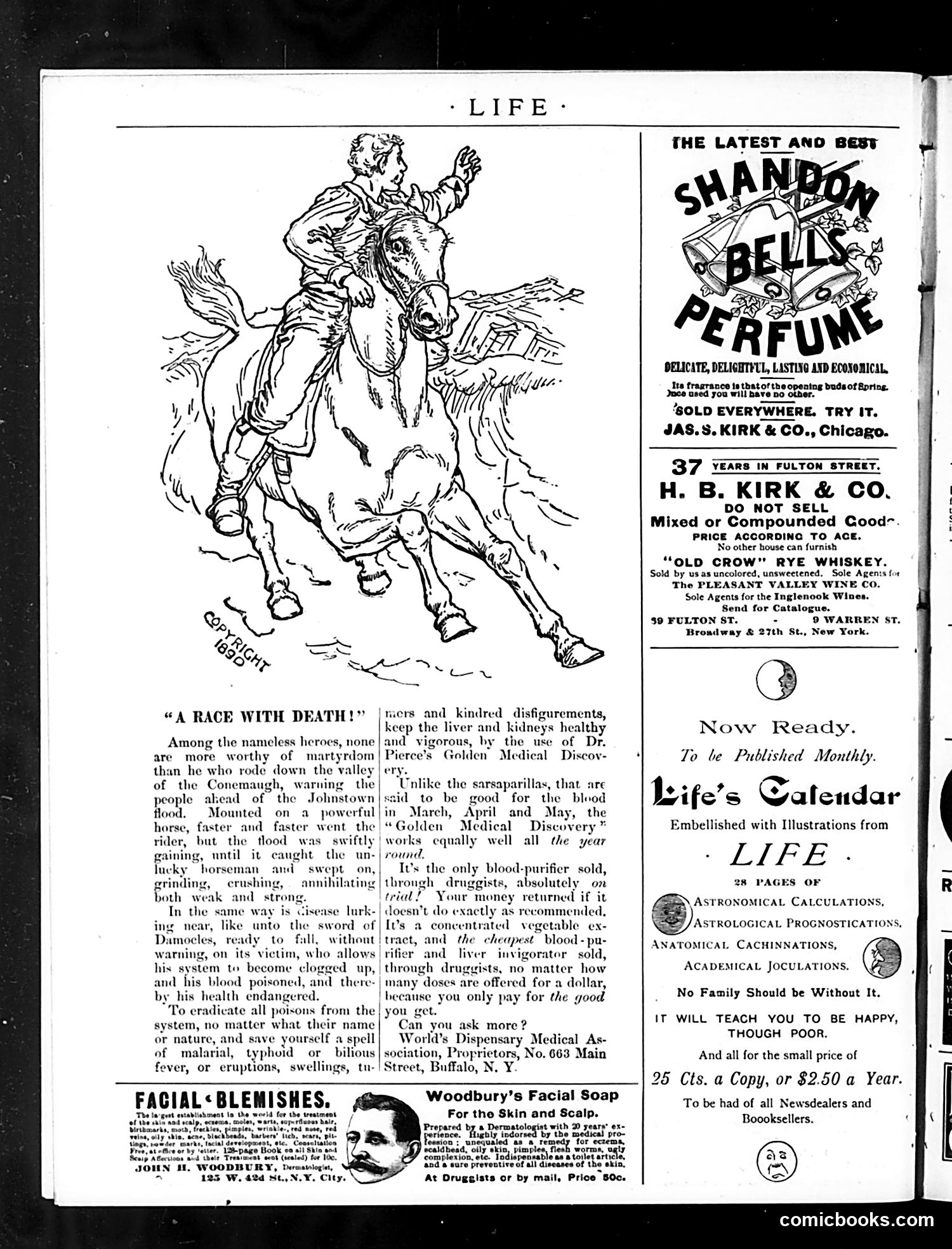
This page's main illustration depicts a dramatic horseman racing ahead of a flood, referencing the **1889 Johnstown Flood** in Pennsylvania—a catastrophic disaster that killed over 2,000 people. The image celebrates an unnamed hero who allegedly rode through the valley warning residents of the approaching floodwaters. However, the illustration serves as a metaphor for the accompanying advertisement for **Dr. Pierce's Golden Medical Discovery**. The text compares disease ("poisons") racing through the body to the flood pursuing the horseman—both threaten death unless one acts swiftly. The medicine is marketed as the life-saving escape, the solution to outrun illness. This is typical 19th-century patent medicine advertising that exploited current events and fear to sell dubious remedies. The page also includes advertisements for perfume, facial soap, and whiskey—standard commercial content. The juxtaposition uses contemporary tragedy to create urgency around health concerns, a common sales tactic of the era.
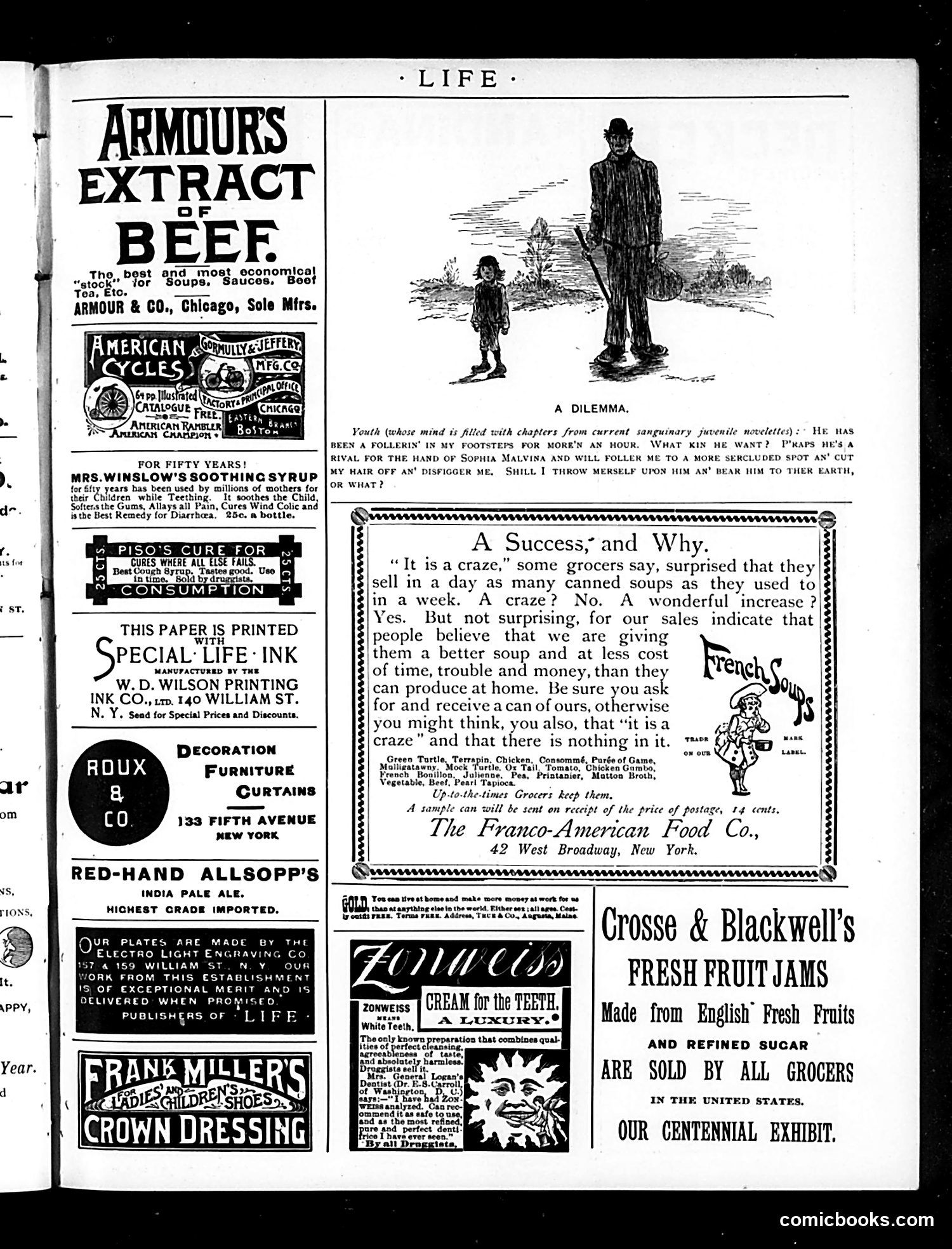
This single-panel cartoon satirizes the conventions of contemporary "sanguinary juvenile novelettes" (violent adventure stories for young readers). A boy, having apparently internalized melodramatic fiction tropes, encounters a smaller rival and contemplates dramatic violence—threatening to throw himself upon his pursuer and "bear him to their earth." His internal monologue reveals he's imagining scenarios from pulp literature: romantic rivalry over "Sophia Malvina," secret confrontations, etc. The joke targets both the overwrought romanticism and violence in cheap adventure fiction aimed at youth, and young readers' literal-minded absorption of these narratives. The boy's grandiose internal speech contrasts absurdly with the mundane reality (likely just another boy following him). This reflects Progressive-era anxieties about "penny dreadfuls" and sensational literature corrupting youth—a common satirical target in Life magazine during this period.
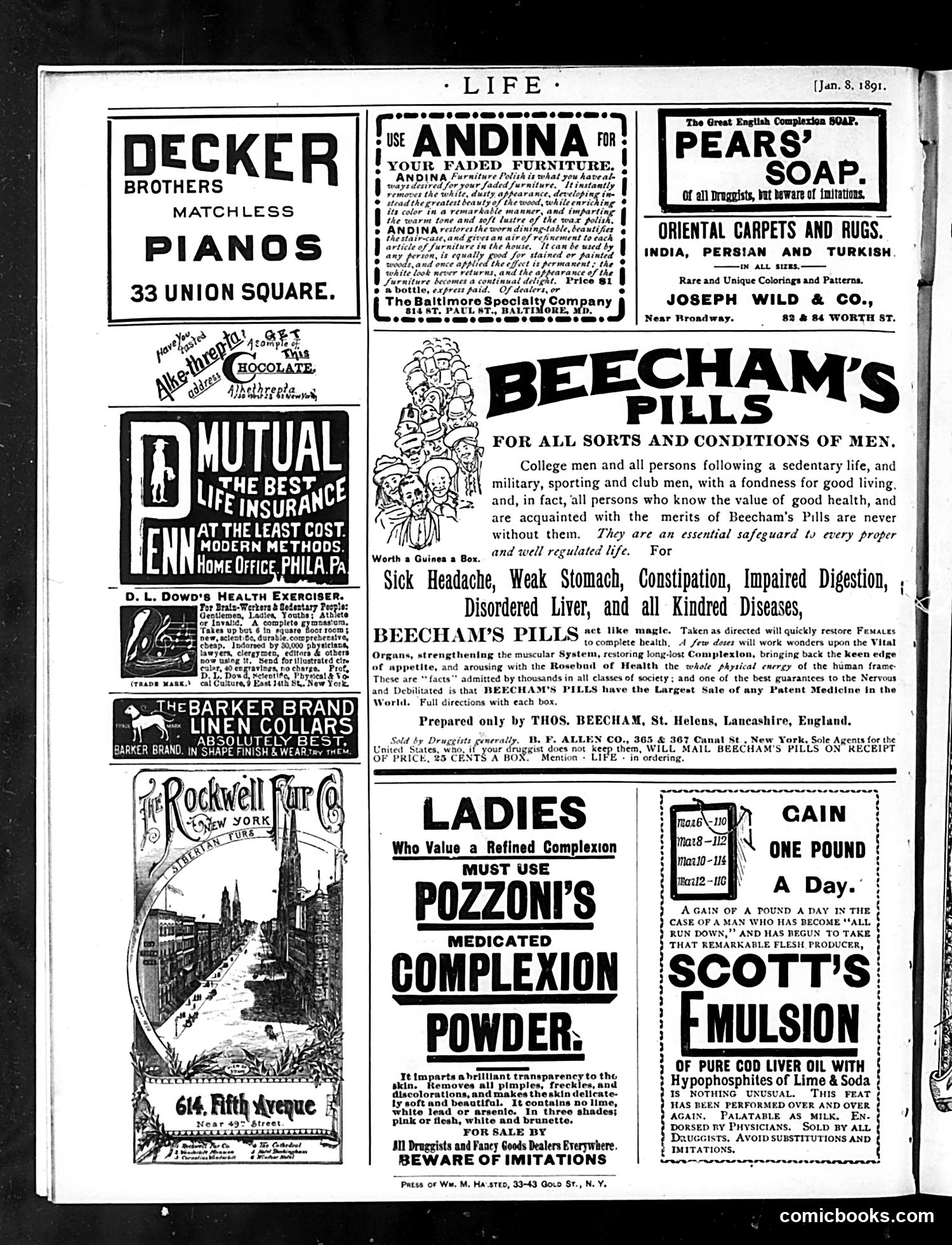
This is primarily an **advertising page** with no political cartoons or satirical content. It consists entirely of commercial advertisements typical of the 1890s. The ads reveal what health and beauty concerns preoccupied Americans of this era: **patent medicines** (Beecham's Pills for digestion and general ailments, Scott's Emulsion for weight gain), **complexion products** (Pozzoni's Medicated Powder, Pears' Soap), and **furniture polish** (Andina). Several ads explicitly warn "beware of imitations," suggesting widespread counterfeiting of popular products. Notable is the medical pseudoscience: Beecham's Pills claimed to cure everything from headaches to liver disease; Scott's Emulsion promised one pound daily weight gain. The targeting is segmented—Beecham's addresses "college men" and "sedentary" workers; Pozzoni's targets women concerned with complexion. The page documents 1890s consumer culture and the largely unregulated patent medicine industry that would eventually inspire FDA regulation.