
Life, 1891-01-08 · page 8 of 20
Life — January 8, 1891 — page 8: what you’re looking at
What you’re looking at
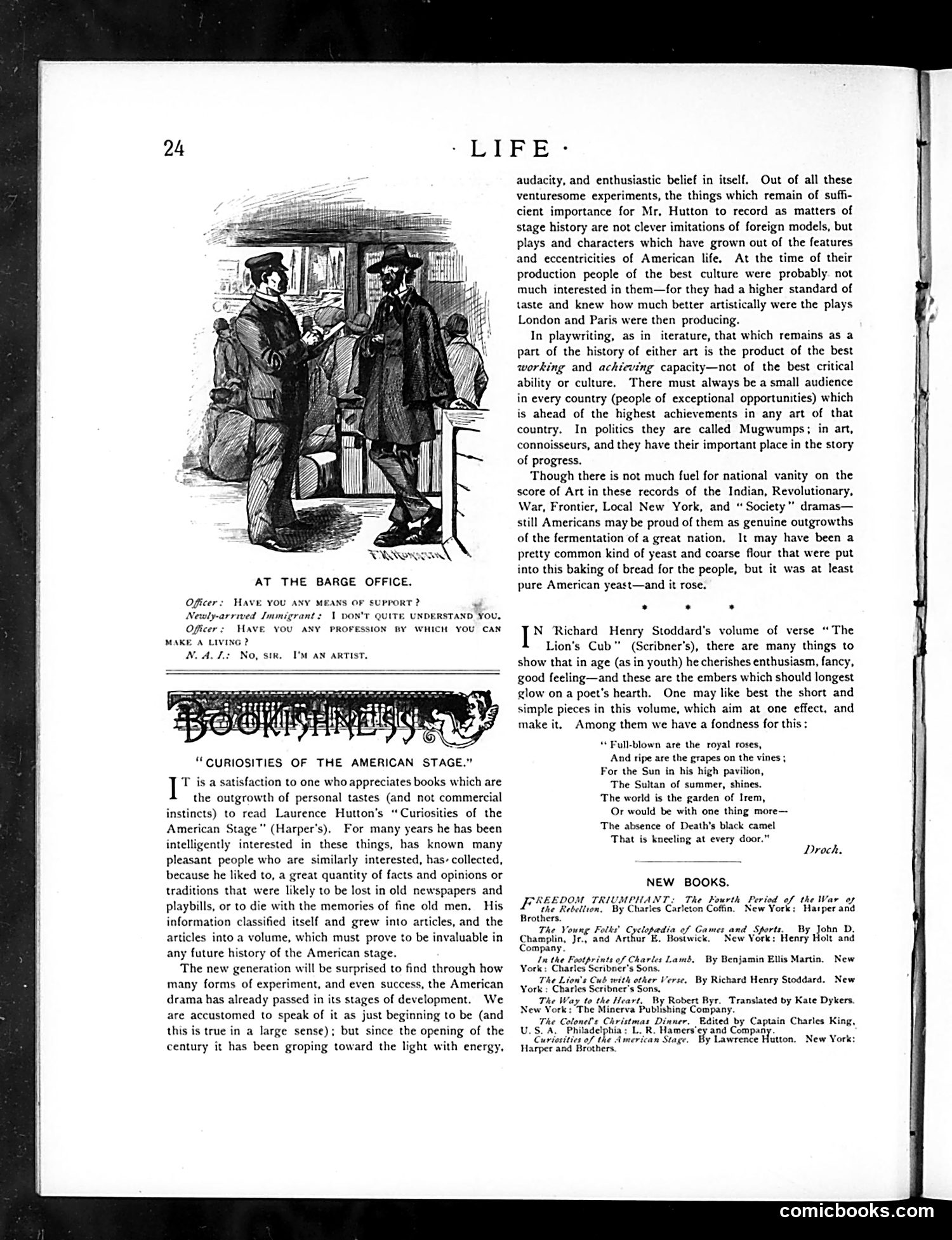
This cartoon satirizes immigration processing at the Barge Office (Ellis Island's predecessor). The officer questions a "newly-arrived immigrant" about means of support, while the immigrant claims to be an artist who can support himself. The satire targets a common American anxiety: that immigrants arriving with few resources might become public burdens. The joke appears to be the immigrant's implausible claim—declaring oneself an "artist" as proof of financial viability was likely seen as evasive or absurd by readers who viewed artists as economically marginal. The accompanying text discusses American theater's development, suggesting broader themes about what counts as "legitimate" American contribution versus mere survival or subsistence.
📄 Transcribed text from this page (OCR, searchable)
Machine-transcribed from the original scan — historical spelling and the odd misread are preserved.
> LIFE: VWs AT THE BARGE OFFICE. HAVE YOU ANY MEANS OF SUPPORT? ¥ I be QUITE ERSTAND YOU, Officer : Newly-arrived Immigrant : Officer : cA LIVE : sik, I'M AN ARTIST. “CURIOSITIES OF THE AMERICAN STAGE.” J T isa satisfaction to one who appreciates books which are the outgrowth of personal tastes (and not commercial instincts) to read Laurence Hutton’s “Curiosities of the American Stage" (Harper's). For many years he has been intelligently interested in these things, has known many pleasant people who are similarly interested, has: collected, because he liked to, a great quantity of facts and opinions or traditions that were likely to be lost in old newspapers and playbills, or to die with the memories of fine old men. His information classified itself and grew into articles, and the articles into a volume, which must prove to be invaluable in any future history of the American stage. The new generation will be surprised to find through how many forms of experiment, and even success, the American drama has already passed in its stages of development. We are accustomed to speak of it as just beginning to be (and this is true in a large sense); but since the opening of the century it has been groping toward the light with energy, audacity, and enthusiastic belief in itself. Out of all these venturesome experiments, the things which remain of suffi- cient importance for Mr, Hutton to record as matters of stage history are not clever imitations of foreign models, but plays and characters which have grown out of the features and eccentricities of American life. At the time of their production people of the best culture were probably. not much interested in them—for they had a higher standard of taste and knew how much better artistically were the plays London and Paris were then producing. In playwriting, as in iterature, that which remains as a part of the history of either art is the product of the best working and achieving capacity—not of the best critical ability or culture. There must always be a small audience in every country (people of exceptional opportunities) which is ahead of the highest achievements in any art of that country. In politics they are called Mugwumps; in art, connoisseurs, and they have their important place in the story of progress. Though there is not much fuel for national vanity on the score of Artin these records of the Indian, Revolutionary, War, Frontier, Local New York, and “ Society" dramas— still Americans may be proud of them as genuine outgrowths of the fermentation of a great nation. It may have been a pretty common kind of yeast and coarse flour that were put into this baking of bread for the people, but it was at least pure American yeast—and it rose. . . . N Richard Henry Stoddard’s volume of verse “The Lion's Cub” (Scribner's), there are many things to show that in age (as in youth) he cherishes enthusiasm, fancy, good feeling—and these are the embers which should longest glow on a poet's hearth. One may like best the short and simple pieces in this volume, which aim at one effect, and make it. Among them we have a fondness for this: * Full-blown are the royal roses, And ripe are the grapes on the vines ; For the Sun in his high pavilion, The Sultan of summer, shines. ‘The world is the garden of Irem, Or would be with one thing more— The absence of Death's black camel That is kneeling at every door.” Droch. NEW BOOKS. FREEDOM TRIUMPHANT: The Fourth Period of the War oy the Rebellion, By Charles Carleton Coffin. New York: Harper and Brothers. The Young Folks’ Cyctopadia of Gamer and Sports. By John D. Champlin, Jr., and Arthur E. Bostwick. New York: Henry Ho and Company: In the Footprints of Charles Lamb, York: Charles Scribner's Sons. The Lion's Cub with other Verse, By Richard Henry Stoddard. York : Charles Scribner's Sons, fo the Heart, By Robert Byr. Translated by Kate Dykers. he Minerva Publishing Company. The Colonel's Christmas Dinner. Edited by Captain Charles King, U.S.A. Philadephia: L..R. Hamers'ey and Company. Curiosities of the American Stage. By Lawrence Hutton. New York: Harper and Brothers By Benjamin Ellis Martin, New New comicbooks.com