
Life, 1891-01-08 · page 4 of 20
Life — January 8, 1891 — page 4: what you’re looking at
What you’re looking at
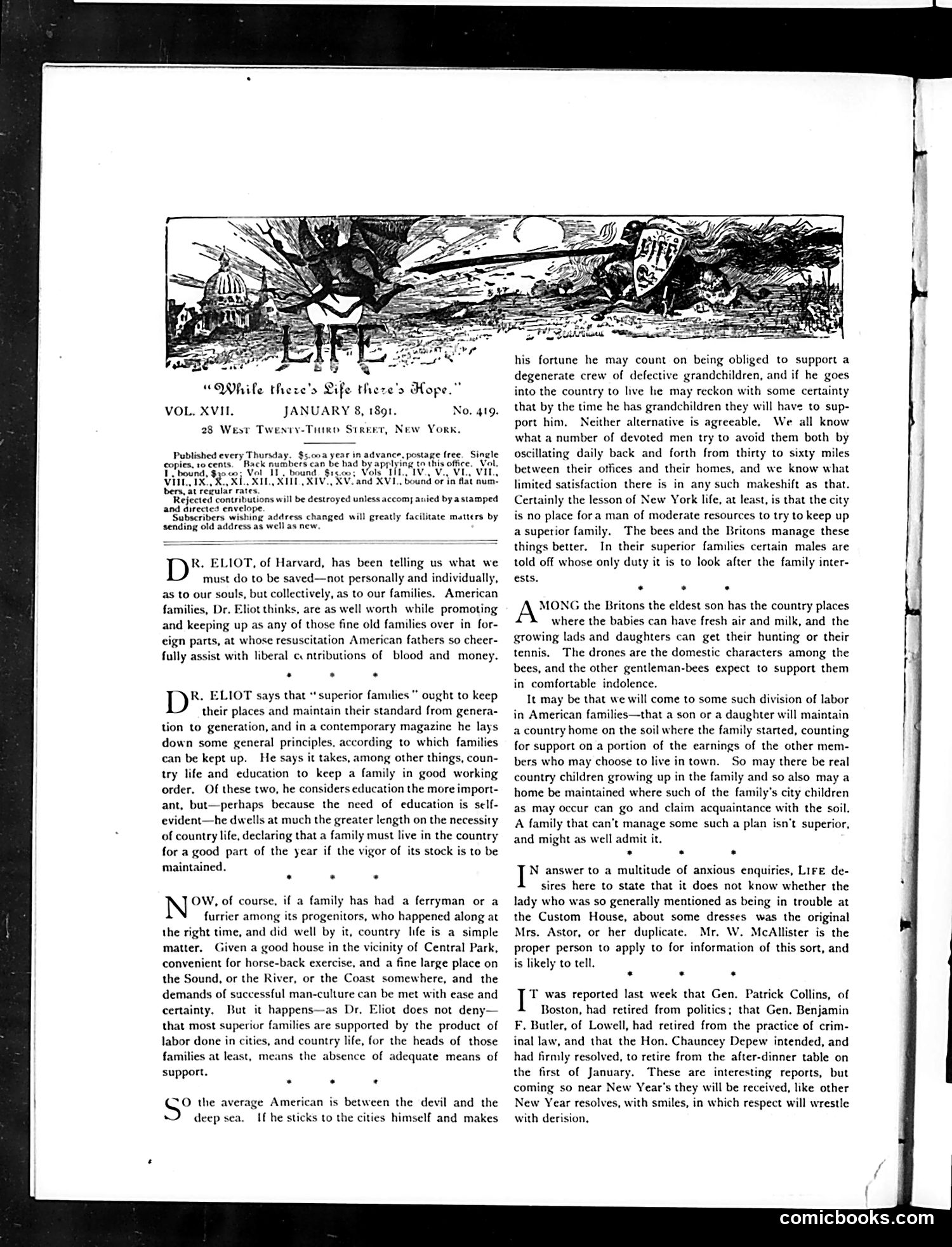
The page contains editorial commentary rather than cartoons. The text discusses Dr. Eliot of Harvard, who advocated that "superior families" should maintain their social standing by sending sons to work in the country and daughters to live in rural estates—essentially keeping the upper classes separated from urban life. The satire critiques this elitist position, arguing that American families of moderate means cannot afford such luxuries. The author points out that while country estates might suit the wealthy, most Americans must live in cities for economic necessity, making Eliot's prescription impractical and somewhat absurd for average families. The piece represents early 20th-century debate about class, urbanization, and education in America.
📄 Transcribed text from this page (OCR, searchable)
Machine-transcribed from the original scan — historical spelling and the odd misread are preserved.
“Mhile there's Life there's VOL. XVII. JANUARY 8, 1891. 28 West Twenty-Titrp Street, New York. $s.coa year in advance, postage free. Single 's can be had by applying to this office. Vol. bound $rs.00; Vols TIL. IV.. V.. VE. V Vill. 1X, X., XL. XIL, NUL, XIV., XVeand XVI, bound or ia flat nu bers, at regular rates. Rejected contributions will be destroyed unless accomy anied bya stamped and airectes envelope. ‘Subscribers wishing address changed will greatly facilitate matters by sending old address as well as new. Published every Thursday copies, ro cents, Back num 1. bound, $30.c0; Vol IL R. ELIOT, of Harvard, has been telling us what we must do to be saved—not personally and individually, ‘as to our souls, but collectively, as to our families. American families, Dr, Eliot thinks, are as well worth while promoting and keeping up as any of those fine old families over in for- cign parts, at whose resuscitation American fathers so cheer- fully assist with liberal c ntributions of blood and money. R. ELIOT says that “superior families ” ought to keep their places and maintain their standard from genera- tion to generation, and in a contemporary magazine he lays down some general principles, according to which families can be kept up. He says it takes, among other things, coun- try life and education to keep a family in good working order. Of these two, he considers education the more import- ant, but—perhaps because the need of education is self- evident—he dwells at much the greater length on the necessity of country life, declaring that a family must live in the country for a good part of the year if the vigor of its stock is to be maintained. . . . OW, of course, if a family has had a ferryman or a furrier among its progenitors, who happened along at the right time, and did well by it, country Ife is a simple matter. Given a good house in the vicinity of Central Park, convenient for horse-back exercise, and a fine large place on the Sound, or the River, or the Coast somewhere, and the demands of successful man-culture can be met with ease and certainty. But it happens—as Dr. Eliot does not deny— that most superior families are supported by the product of labor done in cities, and country life, for the heads of those families at least, means the absence of adequate means of support. . . . >O the average American is between the devil and the deep sea. If he sticks to the cities himself and makes his fortune he may count on being obliged to support a degenerate crew of defective grandchildren, and if he goes into the country to live he may reckon with some certainty that by the time he has grandchildren they will have to sup- port him. Neither alternative is agreeable. We all know what a number of devoted men try to avoid them both by oscillating daily back and forth from thirty to sixty miles between their offices and their homes, and we know what limited satisfaction there is in any such makeshift as that. Certainly the lesson of New York life, at least, is that the city is no place fora man of moderate resources to try to keep up a superior family. The bees and the Britons manage these things better. In their superior families certain males are told off whose only duty it is to look after the family inter- ests. MONG the Britons the eldest son has the country places where the babies can have fresh air and milk, and the growing lads and daughters can get their hunting or their tennis, The drones are the domestic characters among the bees, and the other gentleman-bees expect to support them in comfortable indolence. It may be that we will come to some such division of labor in American families—that a son or a daughter will maintain a country home on the soil where the family started, counting for support on a portion of the earnings of the other mem- bers who may choose to live in town. So may there be real country children growing up in the family and so also may a home be maintained where such of the family’s city children as may occur can go and claim acquaintance with the soil. A family that can’t manage some such a plan isn’t superior, and might as well admit it. 1 answer to a multitude of anxious enquiries, LiFe de- sires here to state that it does not know whether the lady who was so generally mentioned as being in trouble at the Custom House, about some dresses was the original Mrs. Astor, or her duplicate. Mr. W. McAllister is the proper person to apply to for information of this sort, and is likely to tell. . . . T was reported last week that Gen. Patrick Collins, of Boston, had retired from politics; that Gen. Benjamin F. Butler, of Lowell, had retired from the practice of crim- inal law, and that the Hon, Chauncey Depew intended, and had firmly resolved, to retire from the after-dinner table on the first of January. These are interesting reports, but coming so near New Year's they will be received, like other New Year resolves, with smiles, in which respect will wrestle with derision, comicbooks.com