
A complete issue · 14 pages · 1890
Life — December 18, 1890
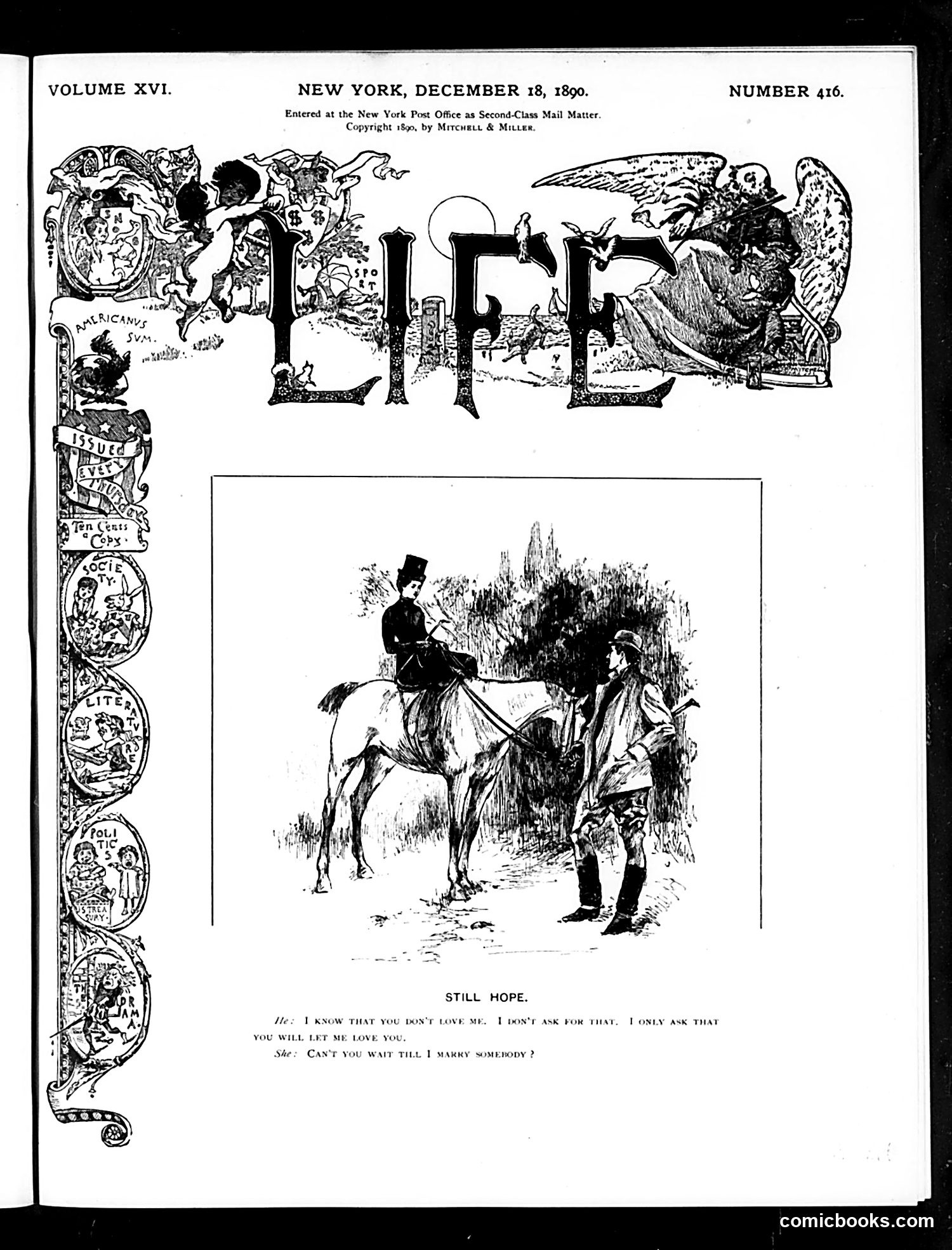
This cartoon depicts a romantic scene between a man on horseback and a woman on foot. The title and dialogue suggest a courtship narrative: the man says he knows she doesn't love him and doesn't ask for that—he only asks she'll let him love her. The woman responds by asking if he can't wait until she marries somebody else. The satire appears to target persistent male romantic pursuit despite clear rejection. The "still hope" title is ironic: the man clings to optimism despite the woman's obvious disinterest and her suggestion she'll marry another. This likely comments on Victorian courtship conventions and male presumption in romantic matters, though the specific individuals being caricatured remain unclear from the image alone.
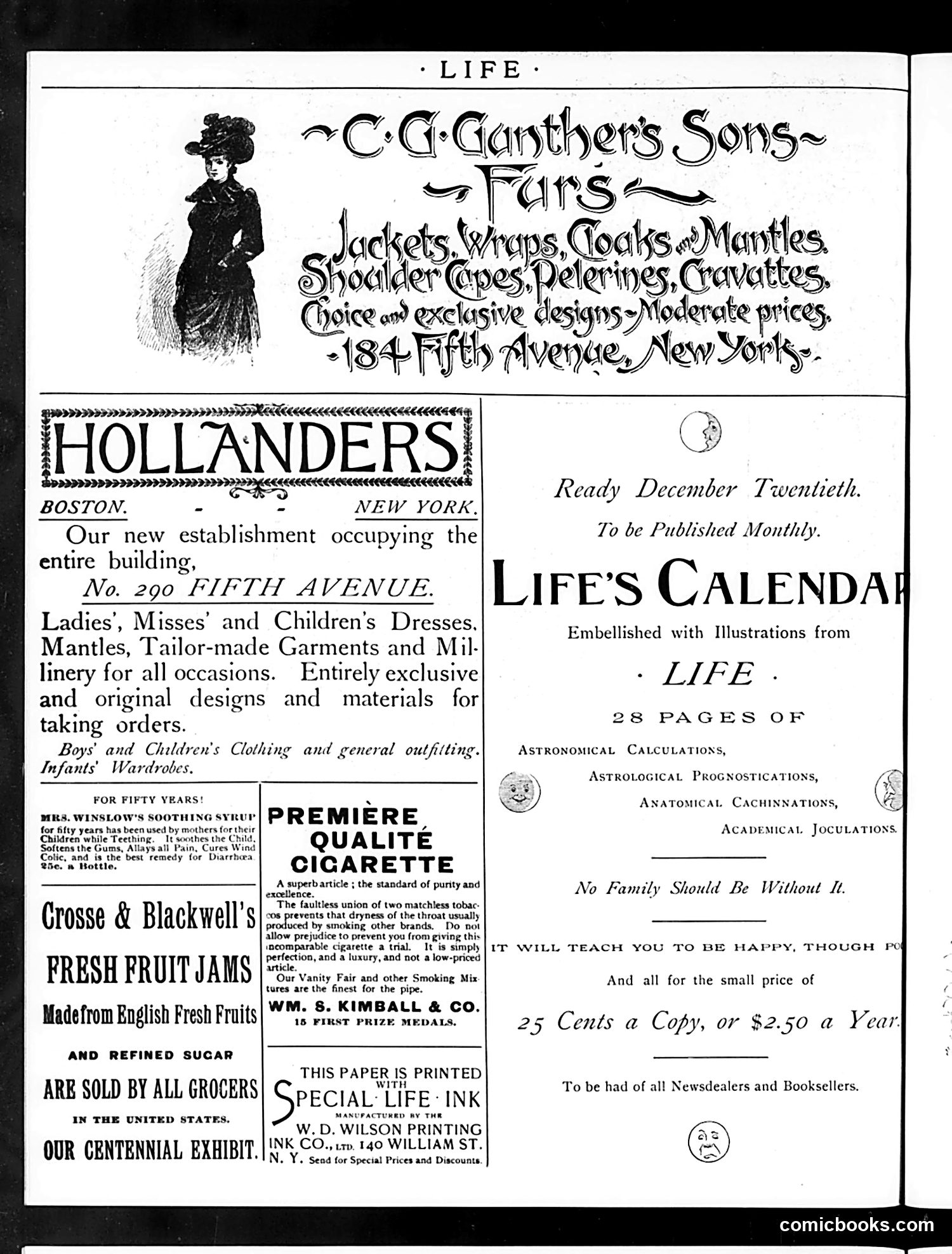
This page is **primarily advertising** with no political cartoons or satirical content visible. The advertisements promote: - **C.G. Gunthers Sons**: A New York fashion retailer offering coats, wraps, jackets, and cloaks at "184 Fifth Avenue" - **Hollanders**: A Boston/New York clothing store at "No. 290 Fifth Avenue" - **Mrs. Winslow's Soothing Syrup**: A patent medicine marketed for teething infants - **Crosse & Blackwell's Fresh Fruit Jams**: English preserves sold by grocers - **Première Qualité Cigarettes**: Tobacco products - **Life's Calendar**: A forthcoming monthly publication with astrological content The sole illustration is a fashionable woman in dark clothing, typical of period fashion advertising. The page represents late-19th or early-20th century commercial print culture rather than satirical commentary.
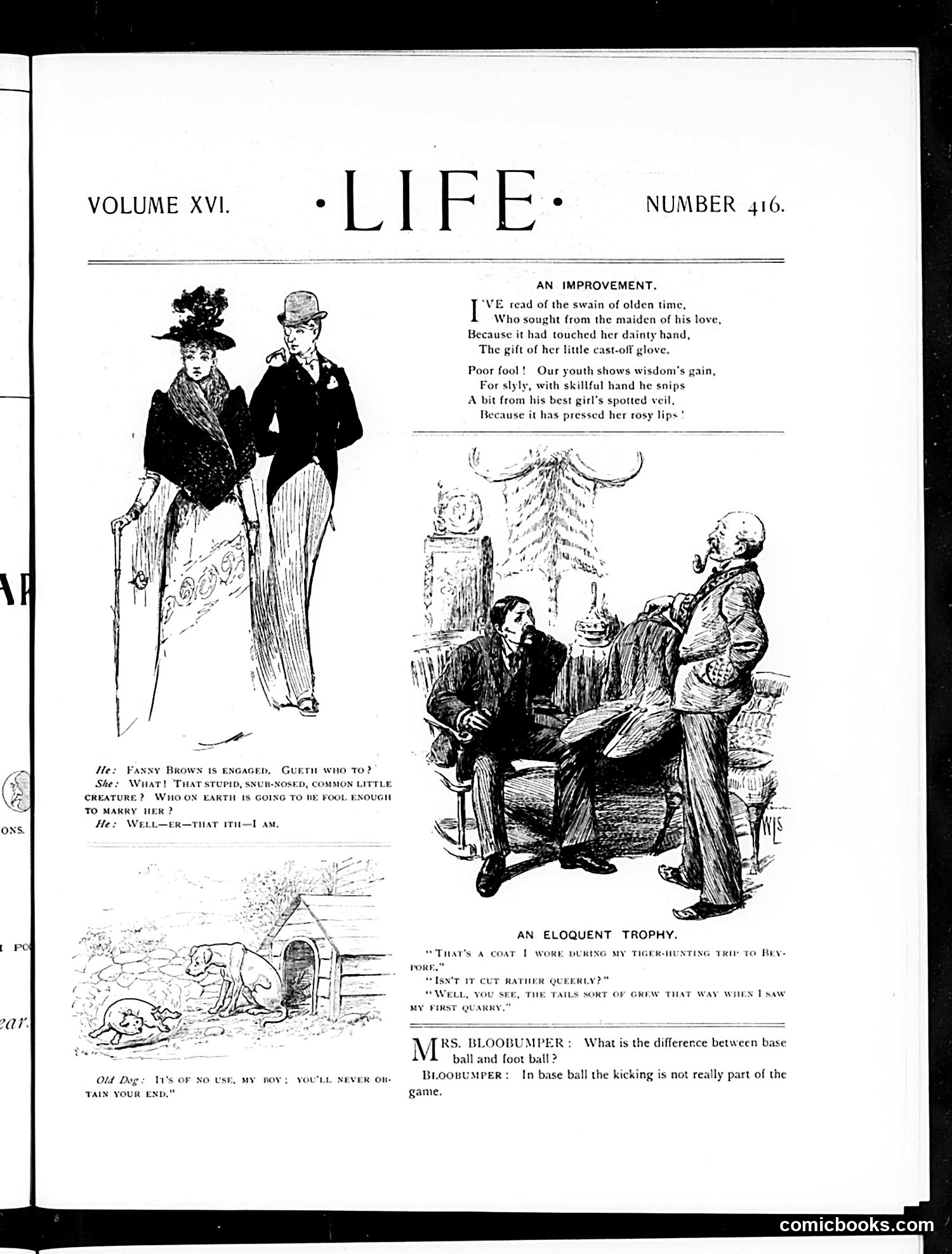
This page contains three separate humorous sketches typical of Life's satirical format: 1. **"An Improvement"**: A poem mocking a young man who stole his sweetheart's cast-off glove from her hand, suggesting he lacks genuine romantic skill. 2. **"An Eloquent Trophy"**: Gentlemen discuss a coat worn during tiger-hunting, with one noting the tail holes "grew that way" when first seeing the quarry—satirizing hunters who exaggerate their exploits. 3. **"Old Dog"**: A brief joke about a dog's uselessness, with the caption suggesting the dog will "never obtain your end." 4. **"Mrs. Bloodbumper"**: A Q&A about the difference between base ball and foot ball, where Bloodbumper pedantically notes that in base ball, "the kicking is not really part of the game." The page exemplifies Life's format: lighthearted social satire targeting pretension, hunting boasts, and pedantic behavior.
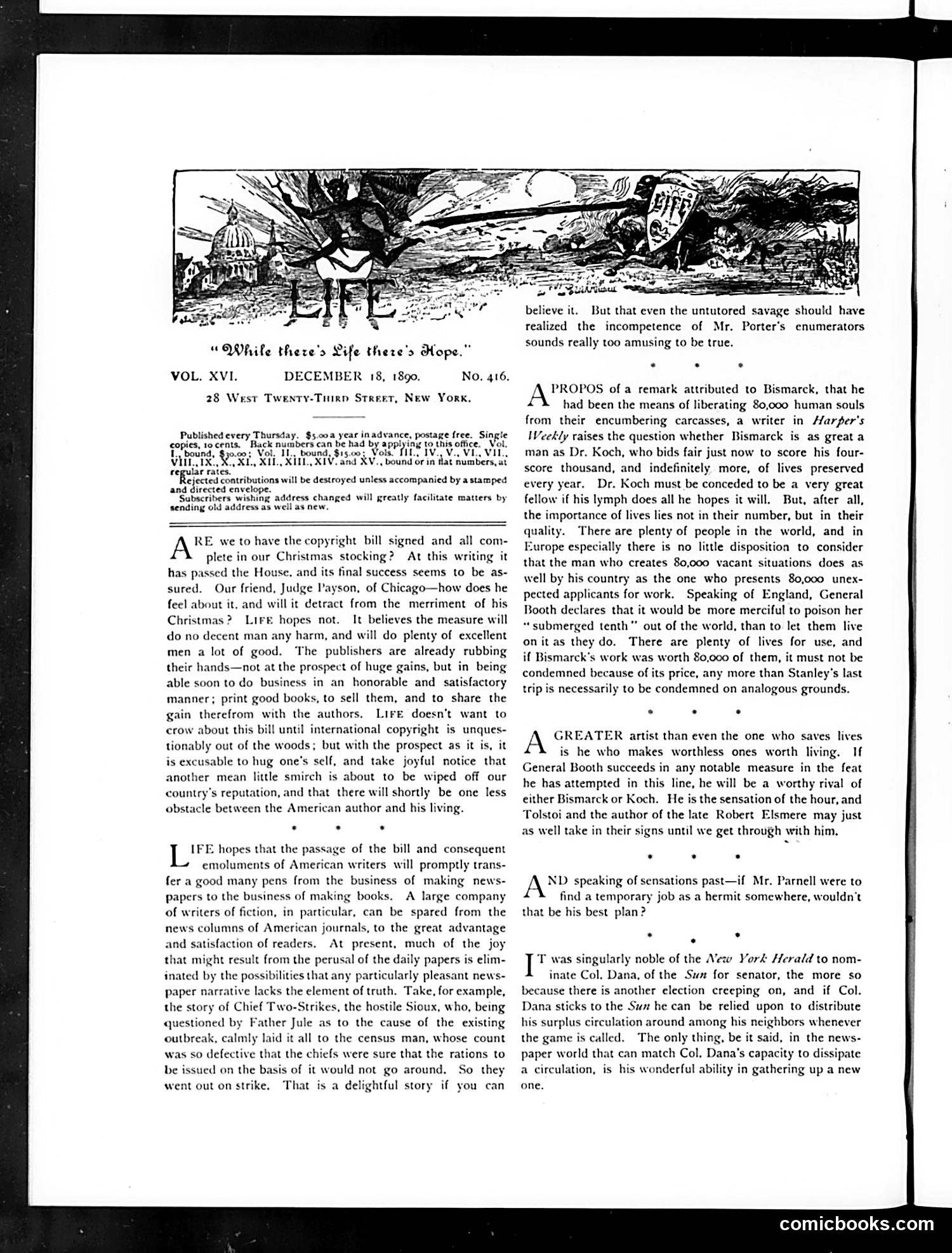
**The Cartoon:** The heading "While there's Life there's Hope" accompanies an illustration showing a figure seated in a barren landscape with European landmarks (dome, possibly St. Paul's Cathedral) visible. The image appears surreal or dreamlike, though its specific satirical target is unclear from the visual alone. **The Articles:** The page's text discusses copyright legislation, American publishing, and contemporary figures including Bismarck, Dr. Koch (the bacteriologist), General Booth (Salvation Army founder), and references to Tolstoy. The commentary critiques these figures' legacies and accomplishments. **Overall:** This appears to be a editorial/opinion page mixing visual and written satire on politics, literature, and public figures of 1890, though the specific cartoon's meaning requires additional context.
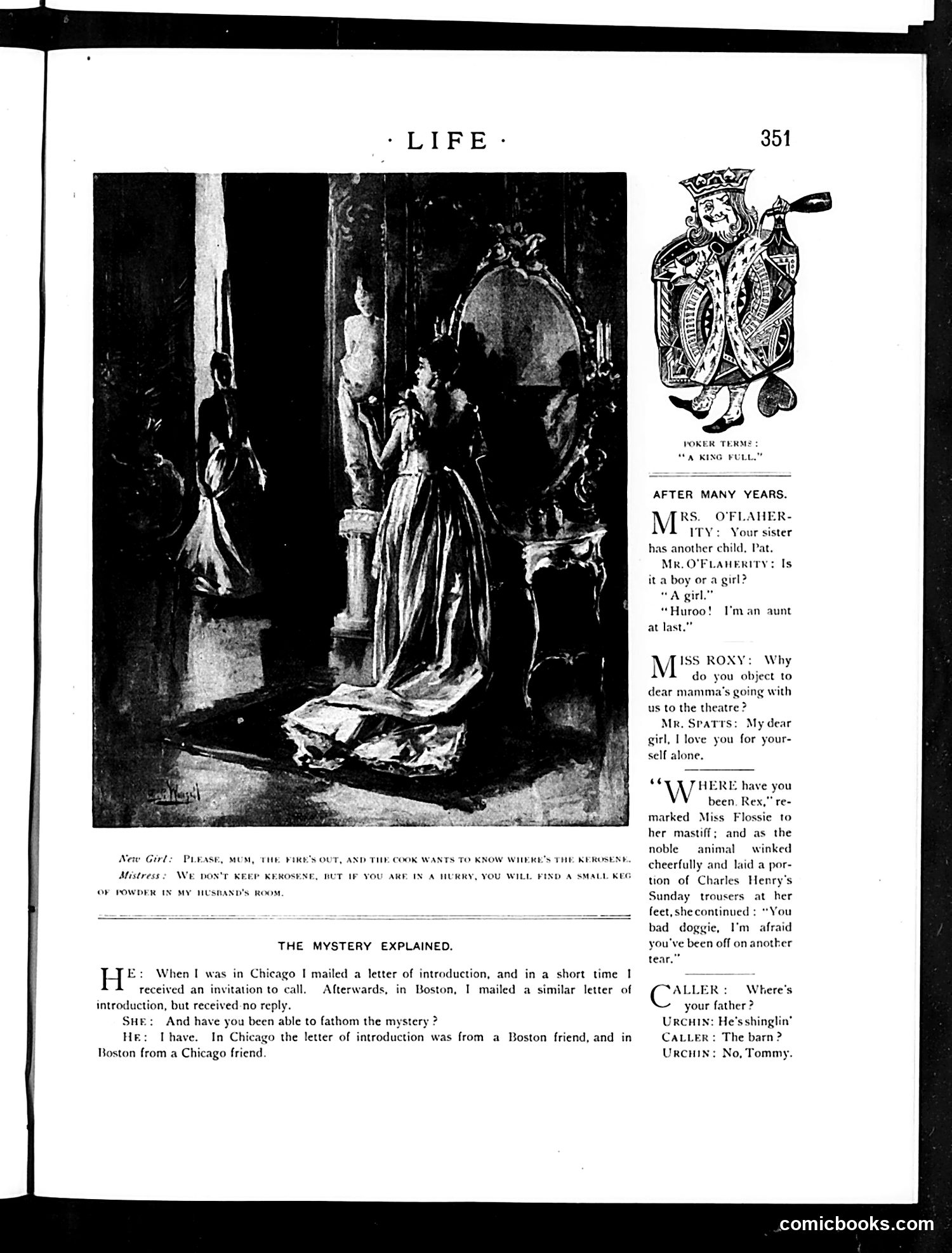
This page contains two distinct pieces: **Upper illustration**: A theatrical scene showing a woman in elaborate period dress in what appears to be a palace interior. The caption references a domestic conversation about kerosene, suggesting this is a humorous juxtaposition of high theatrical drama with mundane household concerns—a common Life magazine satire tactic mocking the gap between art and everyday reality. **Lower section titled "The Mystery Explained"**: A dialogue explaining how letters of introduction from friends in one city secured social access in another city. This appears to satirize the social convention of relying on personal connections and referrals for entry into respectable society—poking fun at how arbitrary and circular these networking practices were. The poker card illustration is decorative.
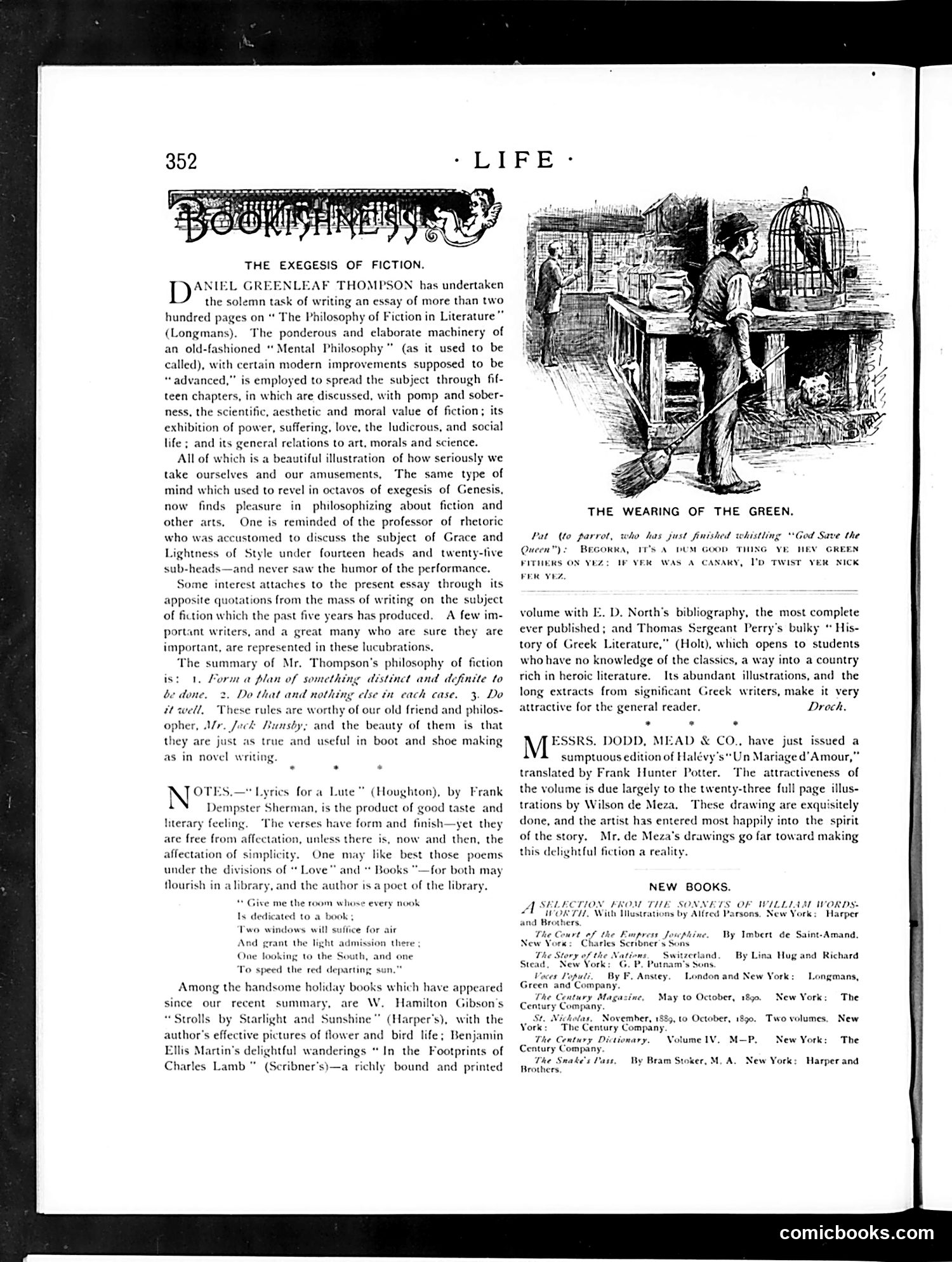
This illustration depicts a domestic scene with a caption referencing an Irish song ("God Save the Queen"). The image shows a woman at a writing desk while a man stands nearby, with a birdcage visible in the background. The caption's punchline appears to involve wordplay around "wearing the green"—an Irish nationalist expression—twisted into a domestic/marital joke about a canary. The humor likely plays on tensions between Irish identity and British authority (the "God Save the Queen" reference), translating political meaning into absurdist domestic comedy. Without additional historical context about specific 1890s events or personalities, the precise satirical target remains unclear, though the joke seems to mock both Irish sensibilities and Victorian domestic life through punning.
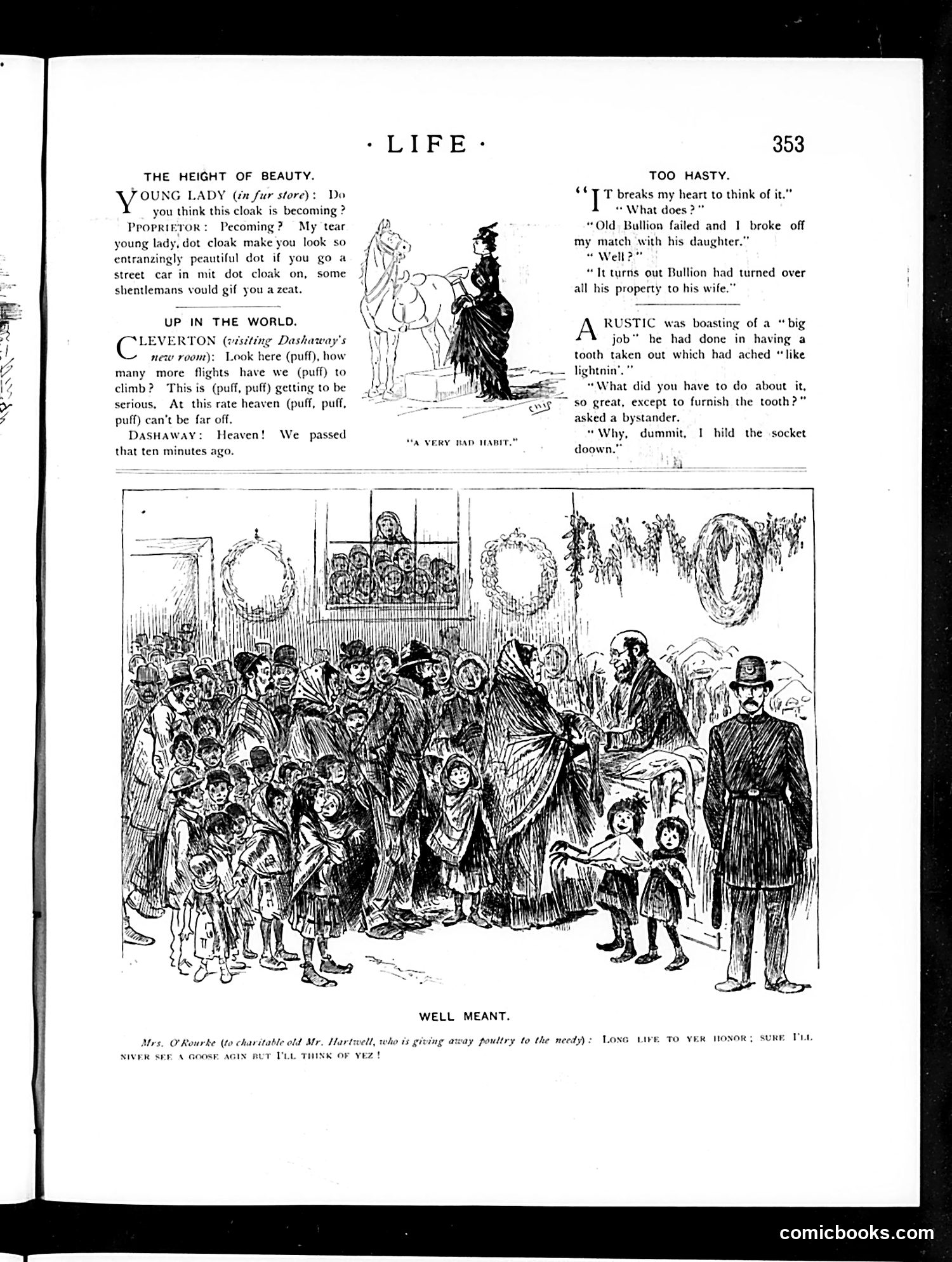
This page contains four unrelated satirical pieces typical of Life's humor format: 1. **"The Height of Beauty"**: A joke about a cloak's fashionable length, suggesting women's clothing was absurdly long. 2. **"Up in the World"**: A pun about Dashaway (likely a racehorse) and repeated references to "puff"—satirizing exaggerated claims about accomplishments. 3. **"Too Hasty"**: A brief anecdote mocking Old Bullion's hasty financial decisions, suggesting recklessness in business dealings. 4. **"A Very Bad Habit"**: A dentist joke about extracting teeth and holding "the socket down." The large illustration titled **"Well Meant"** depicts a charitable distribution of poultry to poor women and children, with a caption about Mrs. O'Rourke and "long life to yer honor"—likely satirizing charity as performative or condescending social theater.
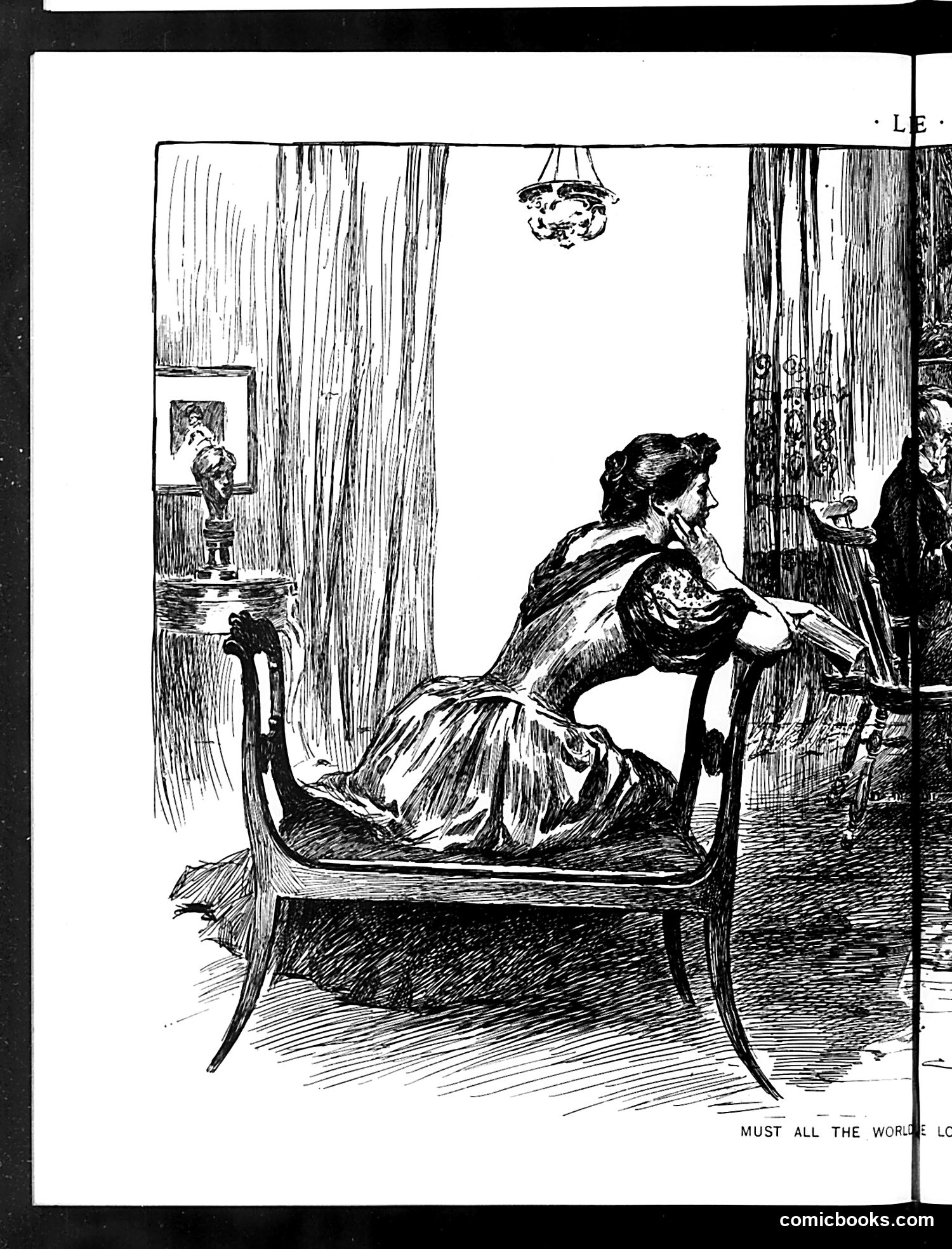
This appears to be a satirical cartoon depicting a woman reclining luxuriously on a chaise lounge in an elegant interior setting, attended by what seems to be a servant or companion. The incomplete caption at bottom reads "MUST ALL THE WORLD LO[VE]..." The satire likely critiques either: - **Feminine idleness or leisure culture** among wealthy women of the era - **Vanity and self-absorption** of high society - **Class disparity** between the relaxed woman and her attendants The hanging bust sculpture and ornate furnishings emphasize affluence and aesthetic pretension. Without the complete caption, the precise satirical target remains unclear, but the composition suggests commentary on upper-class women's perceived frivolousness or disconnect from broader social concerns—a common theme in early 20th-century satirical publications.
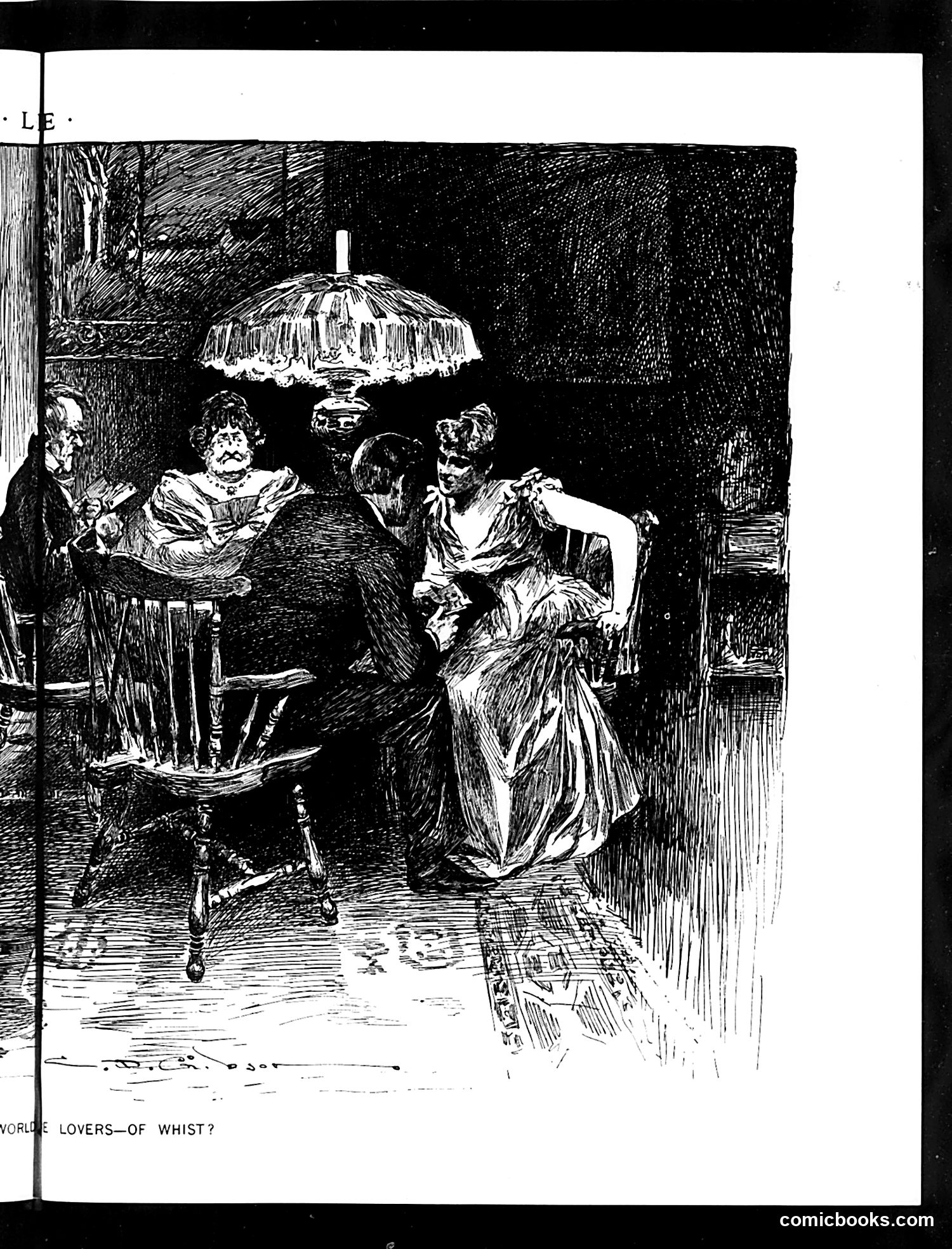
This is a satirical illustration captioned "WORLD OF LOVERS—OF WHIST?" showing an indoor social scene with well-dressed figures gathered around a table beneath a hanging lamp. The composition suggests a parlor gathering, likely from the late 19th or early 20th century based on the clothing and artistic style. The caption's question—"lovers of whist?"—appears to be the satire's point. Whist was a popular card game of the era. The joke likely mocks the pretense of Victorian social gatherings: the figures appear posed in romantic or flirtatious postures, but the caption suggests their real interest is the card game, not love or courtship. This deflates the romantic atmosphere the scene initially suggests, revealing that practical entertainment (gambling or gaming) motivated these supposedly romantic encounters.
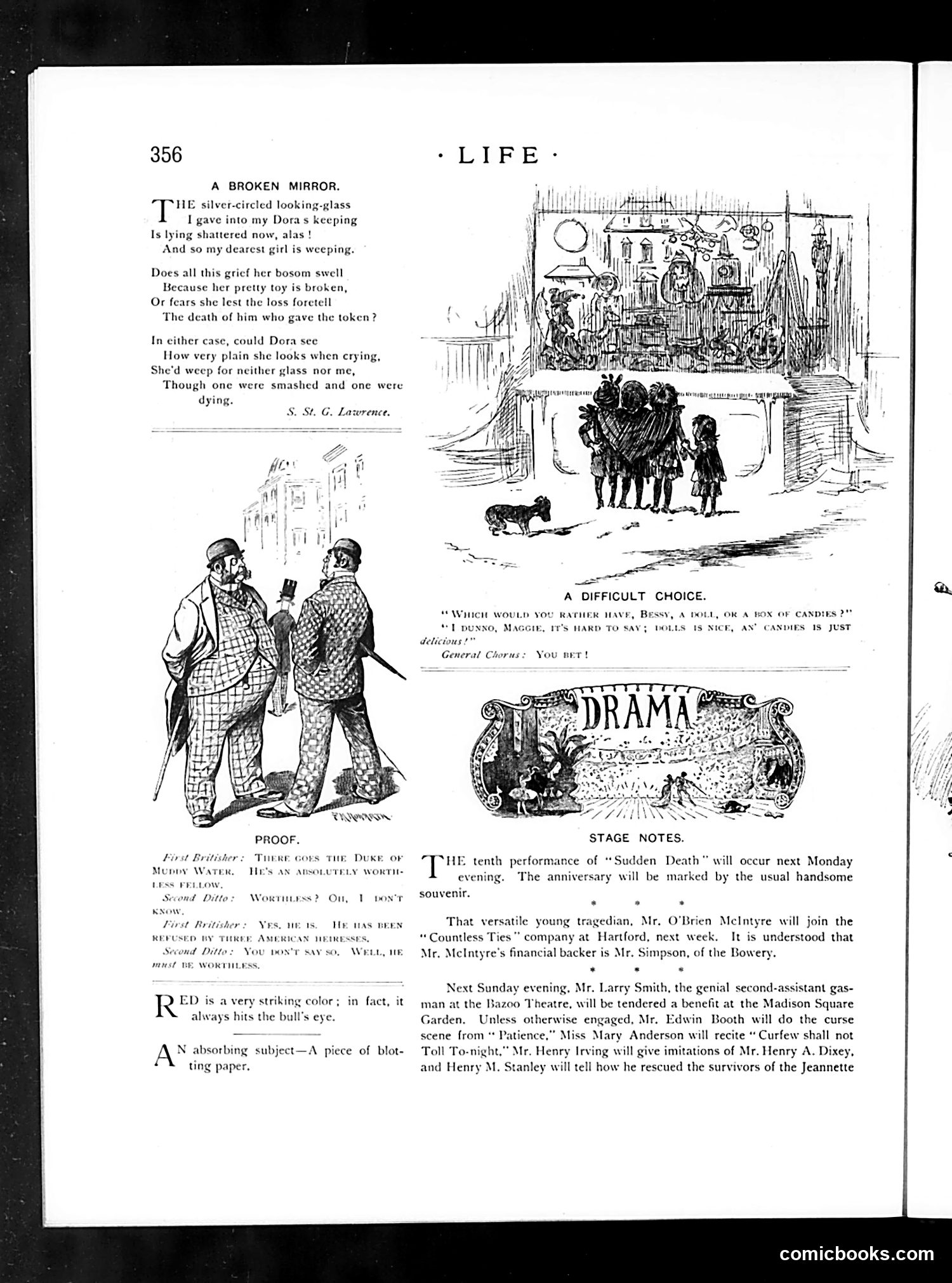
**"A Broken Mirror"** is a sentimental poem by S.S.G. Lawrence about a girl weeping over a shattered looking-glass, questioning whether her grief stems from losing a toy or learning of someone's death. **"A Difficult Choice"** is a brief joke showing figures debating preferences between "a doll, or a box of candies," with the punchline "Dolls is nice, an' candies is just delicious." **"Proof"** presents two gentlemen discussing whether someone (possibly a public figure) is "absolutely worthless" or not, using sarcastic dialogue about American heirlooms. The **Drama section** announces theatrical performances and cast changes, including mentions of actors like Mr. O'Brien McIntyre and performances at various theaters. The page represents typical Life magazine content: light humor, sentimental verse, and entertainment news.
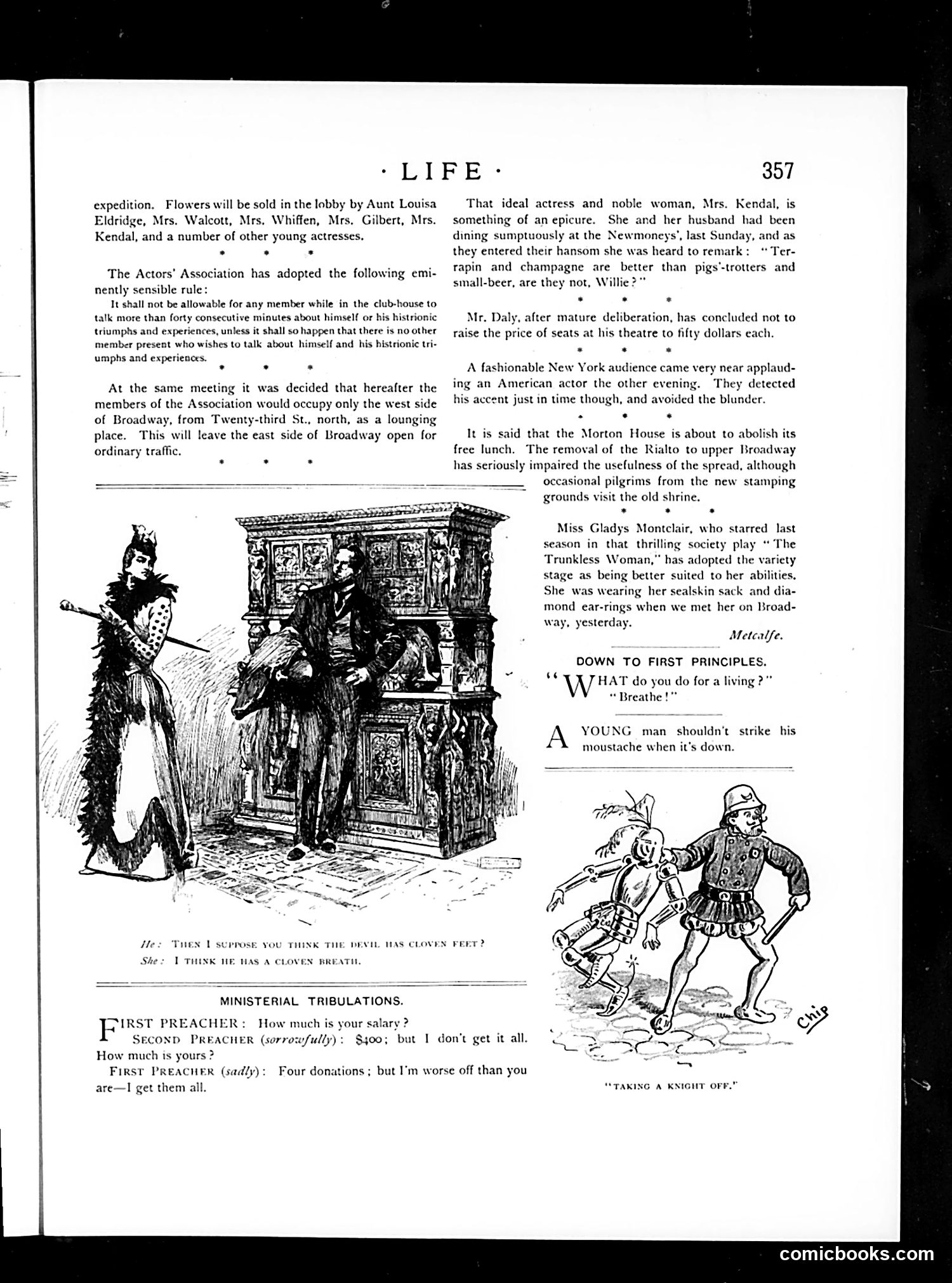
This page contains theatrical gossip and light humor rather than political satire. The main cartoon shows two figures discussing someone with "cloven feet"—a reference to the Devil. The joke plays on the phrase "cloven breath" (bad breath) as a misheard alternative. Below that, "Ministerial Tribulations" depicts two preachers discussing meager salaries and donations, with one ironically noting he's "worse off" despite receiving $100. The humor targets clergy financial struggles. The right page includes "Taking a Knight Off," a visual pun showing a figure removing armor from a chess knight piece, exploiting the homophone between the chess piece and a medieval warrior. The theatrical items reference Broadway actors and society figures of the era, discussing performances and social gatherings among the theater world's elite.
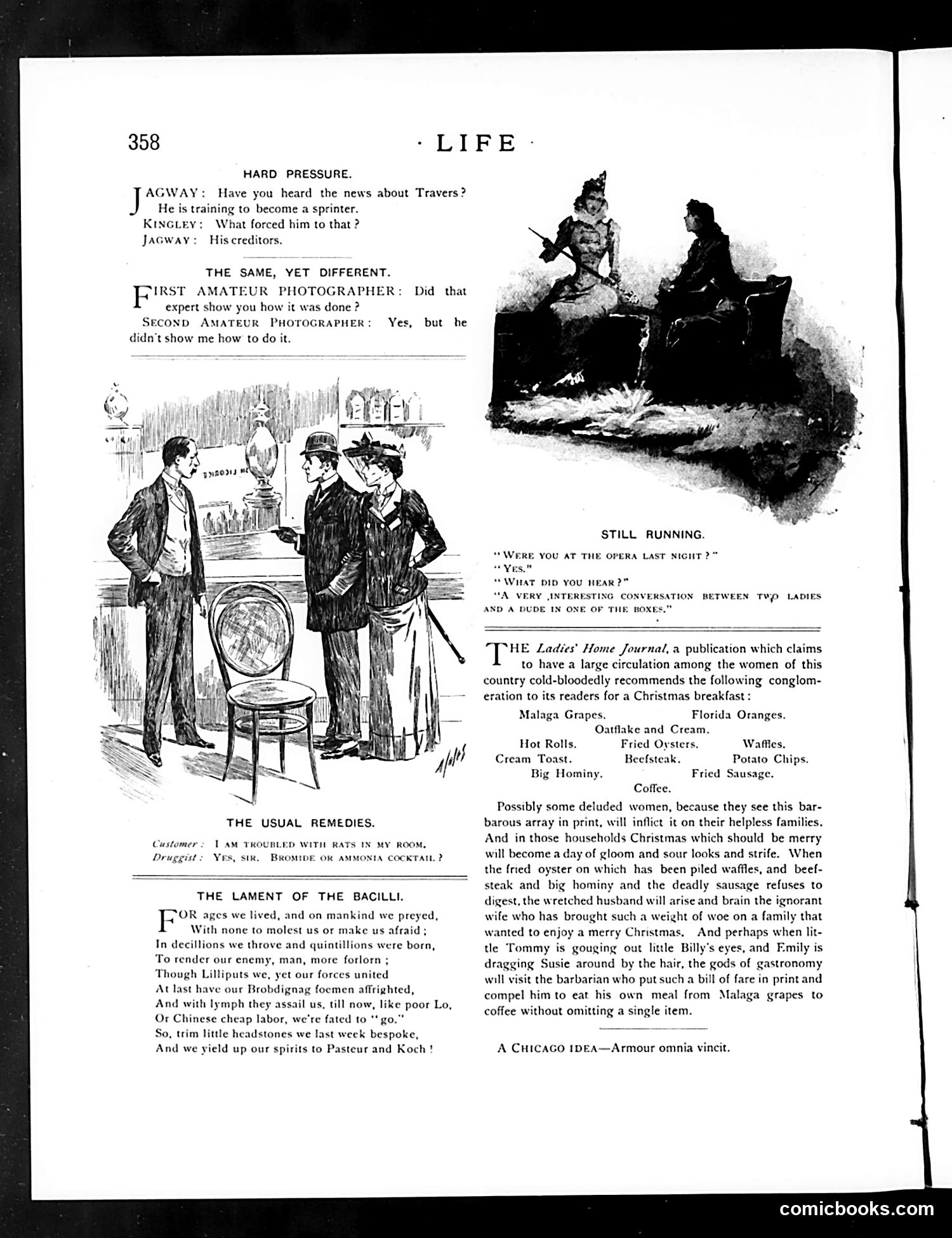
This page contains several short humorous sketches typical of *Life* magazine's satirical format: **"Hard Pressure"**: A joke about a man named Travers becoming a sprinter—forced by his creditors chasing him. The humor relies on the pun that financial pressure literally makes him run. **"The Same, Yet Different"**: An amateur photographer learns technique from an expert but can't actually execute it—mocking the gap between instruction and ability. **"Still Running"**: Women at the opera were too busy gossiping to hear the actual performance, satirizing society ladies' superficiality. **Main Satire**: The lengthy attack on *Ladies' Home Journal* for recommending an absurdly excessive Christmas breakfast menu (fried oysters, waffles, beefsteak, sausage, etc. together). *Life* sarcastically predicts this indigestible combination will cause family misery—husbands raging, children fighting—rather than Christmas cheer. This mocks both the magazine's impractical advice and wealthy excess. **"Bacilli Lament"**: Bacteria mourn their defeat by modern medicine (Pasteur and Koch), comparing themselves to exploited groups facing extinction.
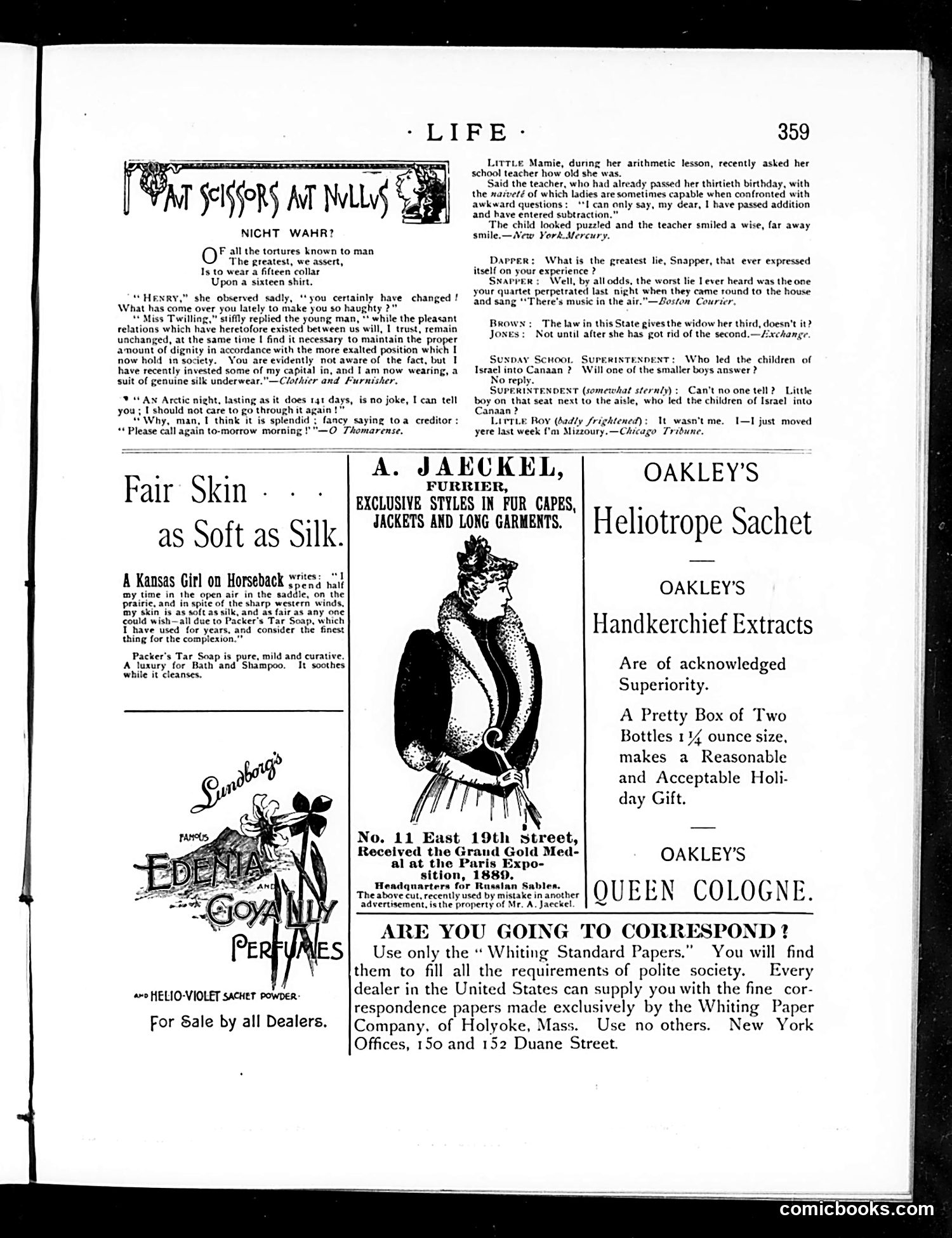
This page contains **humorous short jokes and advertisements** rather than political cartoons. The humor relies on wordplay and social observations: **"Nicht Wahr?" section:** A teacher, asked her age, claims she's "passed addition and entered subtraction"—a math pun about aging and her reluctance to state her actual years. The humor plays on vanity about women's ages. **Other jokes** include: - A man complaining about wearing a 15-inch collar on a 16-inch shirt (minor discomfort humor) - A young man's pompous explanation that wearing silk underwear has made him more dignified - Crude jokes about marriage, widows, and infidelity **The cartoons** are minimal; the page is dominated by **period advertisements** for Packer's Tar Soap, Edenia Goand Perfumes, J. Jaeckel furs, Oakley's products, and Whiting stationery. The content reflects early 20th-century magazine humor: genteel but sometimes risqué, focused on social manners, marriage, and personal appearance. Nothing requires historical context beyond understanding early 1900s American social attitudes.
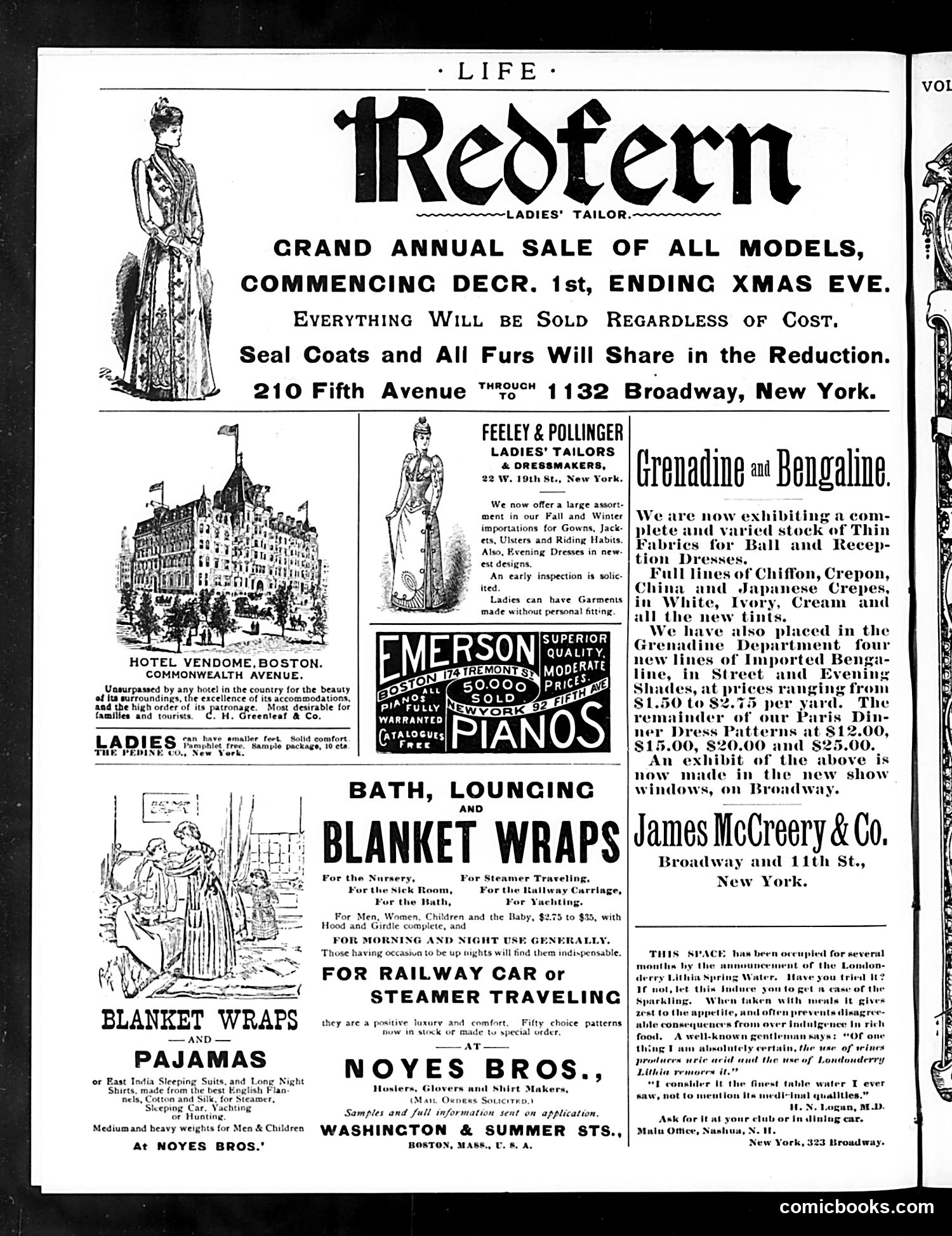
This is predominantly an **advertising page**, not a satirical cartoon. It contains no political commentary or social satire requiring historical context. The page features turn-of-the-century **department store and specialty shop advertisements** for New York and Boston retailers, including: - **Redfern** (ladies' tailor) announcing a holiday sale - **Emerson Pianos** - **Noyes Bros.** (blanket wraps and pajamas for travel and lounging) - **James McCreery & Co.** (fabric and dress patterns) - **Feeley & Pollinger** (dressmakers) The advertisements reflect **period consumer culture**: luxury items like seal coats, imported fabrics (grenadine, bengaline, chiffon), and travel accessories marketed to affluent women. The illustrations show fashionable women in elaborate dresses typical of the 1890s-1900s era. There is no satirical content to decode—this is a straightforward commercial section of *Life* magazine.