
Life, 1890-12-18 · page 6 of 14
Life — December 18, 1890 — page 6: what you’re looking at
What you’re looking at
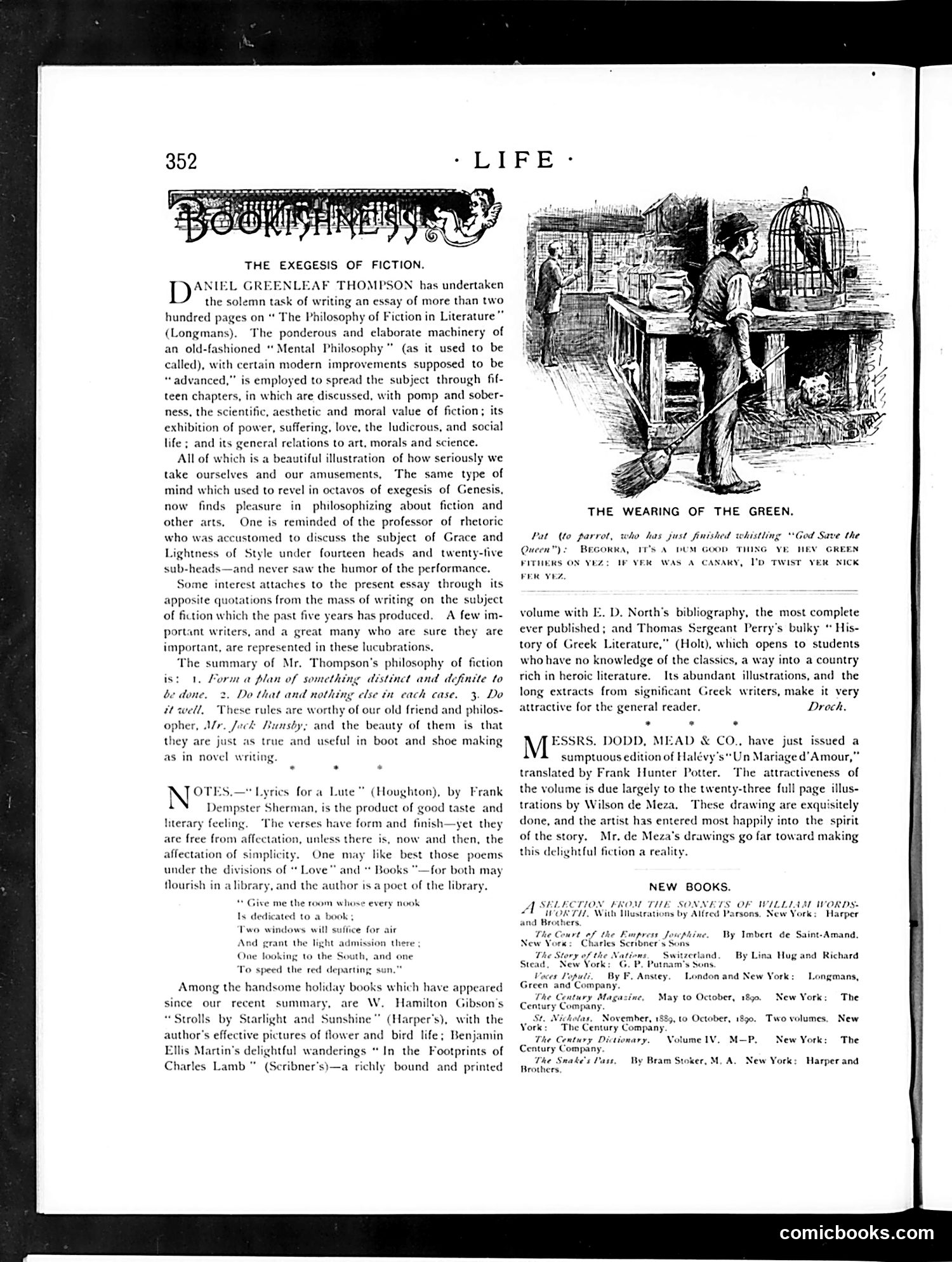
This illustration depicts a domestic scene with a caption referencing an Irish song ("God Save the Queen"). The image shows a woman at a writing desk while a man stands nearby, with a birdcage visible in the background. The caption's punchline appears to involve wordplay around "wearing the green"—an Irish nationalist expression—twisted into a domestic/marital joke about a canary. The humor likely plays on tensions between Irish identity and British authority (the "God Save the Queen" reference), translating political meaning into absurdist domestic comedy. Without additional historical context about specific 1890s events or personalities, the precise satirical target remains unclear, though the joke seems to mock both Irish sensibilities and Victorian domestic life through punning.
📄 Transcribed text from this page (OCR, searchable)
Machine-transcribed from the original scan — historical spelling and the odd misread are preserved.
THE EXEGESIS OF FICTION [)*Se GREENLEAF THOMPSON has undertaken the solemn task of writing an essay of more than two hundred pages on “ The Philosophy of Fiction in Literature” (Longmans). The ponderous and elaborate machinery of an old-fashioned " Mental Philosophy" (as it used to be called), with certain modern improvements supposed to be “advanced,” is employed to spread the subject through fif- teen chapters, in which are discussed, with pomp and sober- ness, the scientific, aesthetic and moral value of fiction; its exhibition of power, suffering, love, the ludicrous, and social life ; and its general relations to art, morals and science. All of which is a beautiful illustration of how seriously we take ourselves and our amusements, The same type of mind which used to revel in octavos of exegesis of Genesis, now finds pleasure in philosophizing about fiction and other arts. One is reminded of the professor of rhetoric who was accustomed to discuss the subject of Grace and Lightness of Style under fourteen heads and twenty-five sub-heads—and never saw the humor of the performance. me interest attaches to the present essay through its apposite quotations from the mass of writing on the subject A few im- portant writers, and a great many who are sure they are of fiction which the past five years has produced. important, are represented in these lucubrations. The summary of Mr. Thompson's philosophy of fiction is: 1. Forma plan of something distinct and definite to be done. Do that and nothing else in each case. 3. Do it well, These rules are worthy of our old friend and philos- opher, Wr. Jock Bunsby; and the beauty of them is that they are just as true and useful in boot and shoe making as in novel writing. Nots— Lyrics for a Lute” (Houghton), by Frank L Dempster Sherman, is the product of good taste and Inerary feeling. ‘The verses have form and finish—yet they are free from affectation, unless there is, now and then, the affectation of simplicity. One may like best those poems Love” and * Books “—for both may flourish in a library, and the author isa poct of the library. under the divisions of * * Give me the room whose every nook Is d Two windows will dicated to a book ; ice for air ant the light admission th ng to the South, and one To speed the red departing sun.” Among the handsome holiday books which have a our are W. Hamilton arlight and Sunshine” (Harper's), ppeared Gibson's “ Strolls by with the author's effective pictures of flower and bird life; Benjamin Ellis Martin's delightful wanderings “In the Footprints of Charles Lamb ” (Scribner’s)—a richly bound and printed since recent summary, THE WEARING OF THE GREEN. Pat (to parrot, who has just finished whistling “God Save the Queen): BEGORKA, THING YE NEV GREEN FITHERS ON VEZ: 1's A PUM Goop IF YER WAS A CANARY, I'D TWIST YER NICK FER VEZ, volume with E. D. North’s bibliography, the most complete ever published; and Thomas Sergeant Perry's bulky * His- tory of Greek Literature,” (Holt), which opens to students who have no knowledge of the classic: y into a country rich in heroic literature. Its abundant illustrations, and the long extracts from significant Greek writers, make it very attractive for the general reader. Droch, . . . M ISSRS. DODD, MEAD sumptuous edition of Halé translated by Frank Hunter Potter. the volume is due largely to the twenty-three full page illus itely done, and the artist has entered most happily into the spirit of the story, Mr, de Meza’s drawings go far toward making this delightful fiction a reality. CO., have just issued a d'Amour,” The attractiveness of 's"Un Mariag trations by Wilson de Meza, These drawing are exqu NEW BOOKS. 4 SELECTION FKOM THE EO WORTH, With nd Brothers. The Court of the Eu New York: Charles Scribner's S« The Story of the Nations. Sw New York: G. P, Putr vpuli. By F. Anstey. nd Company. The Century Magazine, Century Company. St. Nicholas. November, 1 York: The Century Company The Century Dictionary. Century Company. he Snake's Pass. Brothers, WILLIAM WORDS. Harper SONNETS OF ns by Alfred Parsons. New York: By Imbert de Saint-Amand, By Lina Hug and Richard London and New York: Longmans, May to October, 1890. New York: The to October, 1850. Two volumes. New ume IV. M—P. New York: The Hy Bram Stoker, M.A. New York: Harper and comicbooks.com