
Life, 1890-12-18 · page 4 of 14
Life — December 18, 1890 — page 4: what you’re looking at
What you’re looking at
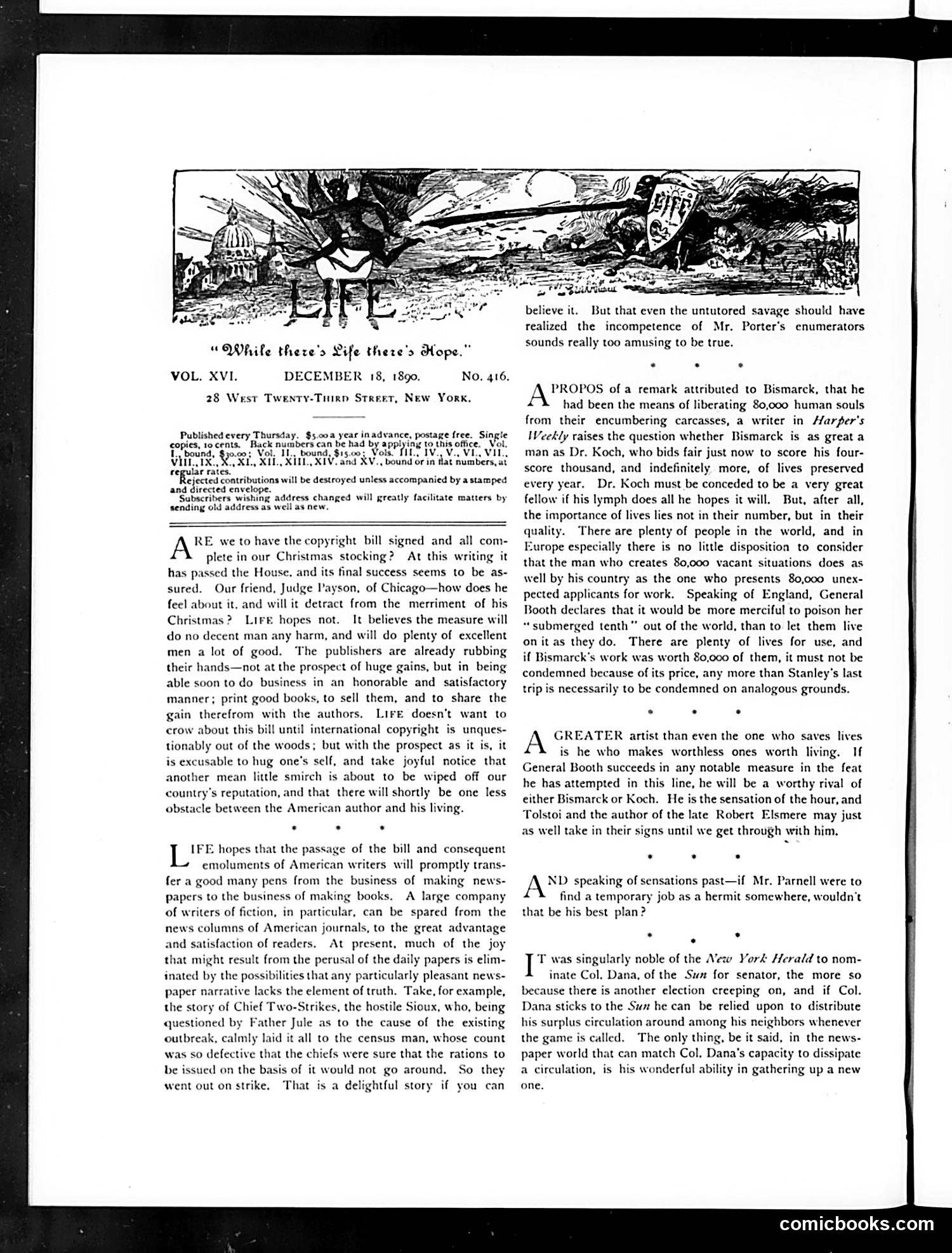
**The Cartoon:** The heading "While there's Life there's Hope" accompanies an illustration showing a figure seated in a barren landscape with European landmarks (dome, possibly St. Paul's Cathedral) visible. The image appears surreal or dreamlike, though its specific satirical target is unclear from the visual alone. **The Articles:** The page's text discusses copyright legislation, American publishing, and contemporary figures including Bismarck, Dr. Koch (the bacteriologist), General Booth (Salvation Army founder), and references to Tolstoy. The commentary critiques these figures' legacies and accomplishments. **Overall:** This appears to be a editorial/opinion page mixing visual and written satire on politics, literature, and public figures of 1890, though the specific cartoon's meaning requires additional context.
📄 Transcribed text from this page (OCR, searchable)
Machine-transcribed from the original scan — historical spelling and the odd misread are preserved.
“WMhile there's Life there's Hope.” VOL. XVI. DECEMBER 18, 1899. No. 416. 28 West Twenty-Tuirp Street, New York. Published every Thursday. $5.00 year in advance, postage free. Single copies, ro cents. " Back numbers can be had by applying to this office, Vol, IL, bound, $15.00; Vols. ML, IV. V.. Vi. VIL, bound, 00; Vol. .XIIL, XIVland XV., bound 6r in flat humbers, at | VHLIX X.. x0, X regular rates. ejected contribtions will be destroyed unless accompanied by astamped and rected envelope. Subscribers wishing address changed will greatly facilitate matters by sending old address as well as new. RE we to have the copyright bill signed and all com- plete in our Christmas stocking? At this writing it has passed the House, and its final success seems to be as- sured. Our friend, Judge Payson, of Chicago—how does he feel about it, and will it detract from the merriment of his Christmas ? Lire hopes not. It believes the measure will do no decent man any harm, and will do plenty of excellent men a lot of good. The publishers are already rubbing their hands—not at the prospect of huge gains, but in being able soon to do business in an honorable and satisfactory manner; print good books, to sell them, and to share the gain therefrom with the authors. Lire doesn't want to crow about this bill until international copyright is unques- tionably out of the woods; but with the prospect as it is, it is excusable to hug one's self, and take joyful notice that another mean little smirch is about to be wiped off our country’s reputation, and that there will shortly be one less obstacle between the American author and his living. L' hopes that the passage of the bill and consequent emoluments of American writers will promptly trans- fer a good many pens from the business of making news- papers to the business of making books. A large company of writers of fiction, in particular, can be spared from the news columns of American journals, to the great advantage and satisfaction of readers. At present, much of the joy that might result from the perusal of the daily papers is elim- inated by the possibilities that any particularly pleasant news- paper narrative lacks the element of truth. Take, for example, the story of Chief Two-Strikes, the hostile Sioux, who, being questioned by Father Jule as to the cause of the existing outbreak, calmly laid it all to the census man, whose count was so defective that the chiefs were sure that the rations to be issued on the basis of it would not go around. So they went out on strike, That is a delightful story if you can believe it. realized the incompetence of Mr. Porter sounds really too amusing to be true. But that even the untutored savage should have "s enumerators ArRobos of a remark attributed to Bismarck, that he had been the means of liberating 80,000 human souls from their encumbering carcasses, a writer in Harper's Veekly raises the question whether Bismarck is as great a man as Dr. Koch, who bids fair just now to score his four- score thousand, and indefinitely more, of lives preserved every year. Dr. Koch must be conceded to be a very great fellow if his lymph does all he hopes it will. But, after all, the importance of lives lies not in their number, but in their quality. There are plenty of people in the world, and in Europe especially there is no little disposition to consider that the man who creates 80,000 vacant situations does as well by his country as the one who presents 80,000 unex- pected applicants for work. Speaking of England, General Booth declares that it would be more merciful to poison her “ submerged tenth” out of the world, than to let them live on it as they do. There are plenty of lives for use, and if Bismarck’s work was worth 80,000 of them, it must not be condemned because of its price, any more than Stanley's last trip is necessarily to be condemned on analogous grounds. . . . GREATER artist than even the one who saves lives is he who makes worthless ones worth living. If General Booth succeeds in any notable measure in the feat he has attempted in this line, he will be a worthy rival of either Bismarck or Koch. He is the sensation of the hour, and Tolstoi and the author of the late Robert Elsmere may just as well take in their signs until we get through with him. . . . ND speaking of sensations past—if Mr. Parnell were to find a temporary job as a hermit somewhere, wouldn't that be his best plan? T was singularly noble of the New York Herald to nom- inate Col. Dana, of the Sz for senator, the more so because there is another election creeping on, and if Col. Dana sticks to the Suz he can be relied upon to distribute his surplus circulation around among his neighbors whenever the game is called. The only thing, be it said, in the news- paper world that can match Col, Dana's capacity to dissipate a circulation, is his wonderful ability in gathering up a new one. comicbooks.com