
A complete issue · 16 pages · 1890
Life — July 3, 1890
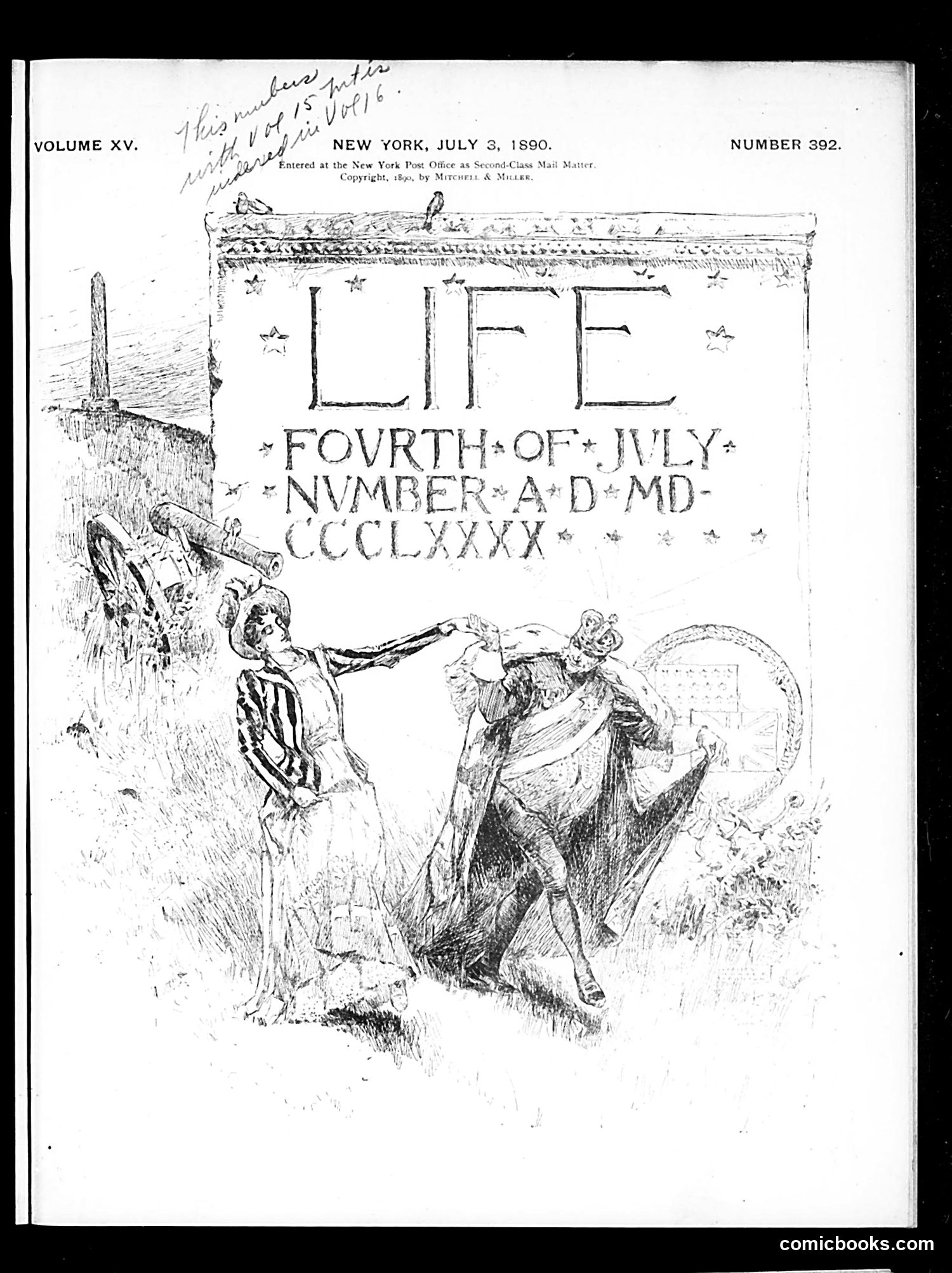
This is a **Fourth of July cover** for Life magazine (Volume XV, Number 392), dated July 3, 1890. The cover features an allegorical illustration with two female figures in classical dress against a patriotic background. One figure appears to be Lady Liberty or Columbia (the female personification of America), gesturing toward what appears to be a large shield or circular emblem on the right. The Roman numeral date "MDCCCXC" (1890) reinforces the patriotic theme. The artistic style—classical female figures and patriotic symbolism—was typical of late 19th-century American illustrations celebrating Independence Day. Without additional interior content visible, the specific satirical point remains unclear, though such covers typically commented on contemporary political or social issues of that moment.
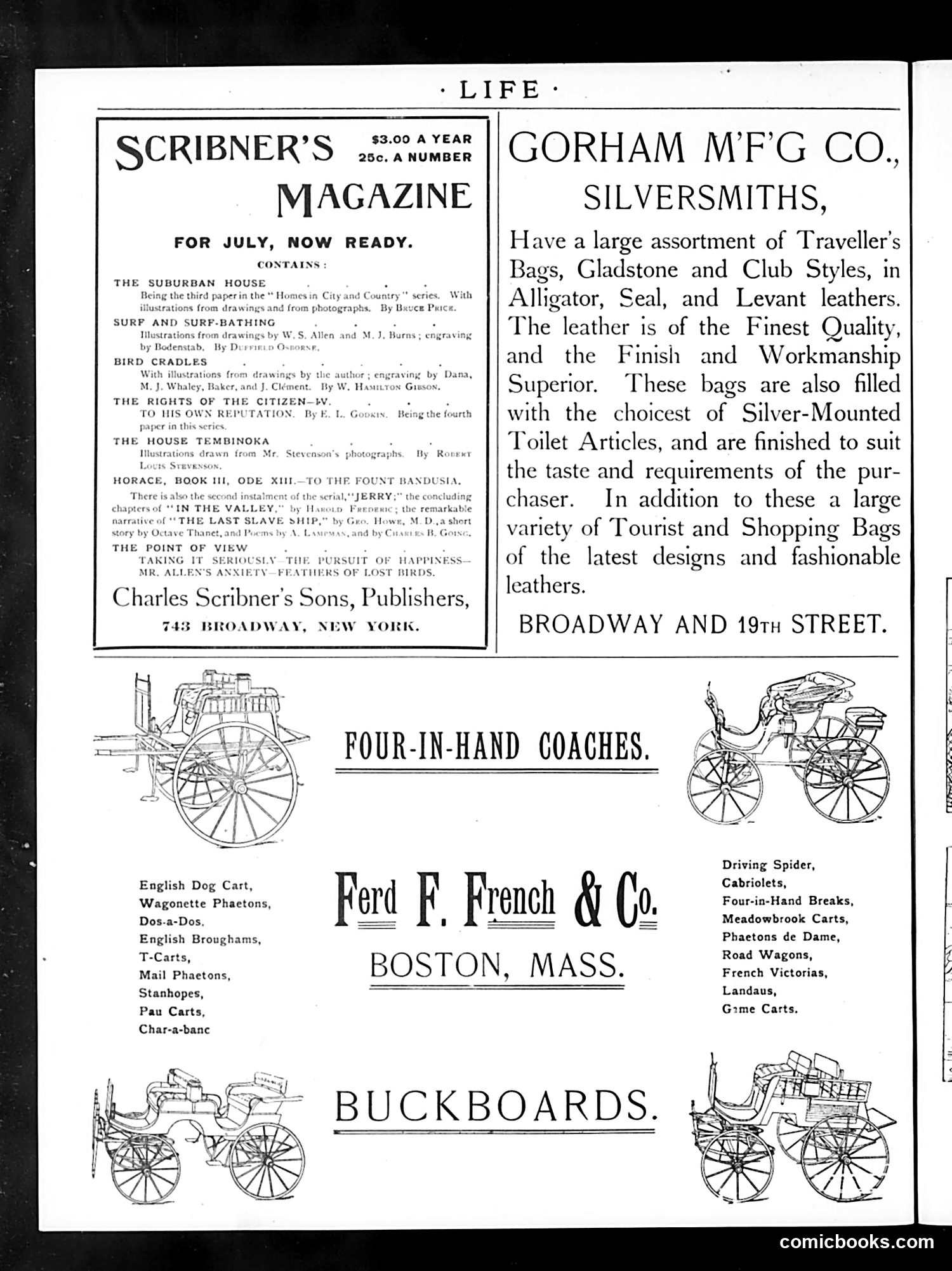
This page is primarily **advertising content**, not political satire or commentary. It contains four distinct advertisements: 1. **Scribner's Magazine** (top left) — promoting July issue with articles on suburban houses, surfing, bird-watching, and citizenship rights. 2. **Gorham Mfg Co.** (top right) — advertising luxury leather travel bags and silver-mounted toilet articles for affluent travelers. 3. **Ferd F. French & Co.** (center) — showcasing various horse-drawn carriages and coaches, including phaetons, broughams, and victorias. 4. **Buckboards** section (bottom) — continuing the carriage advertisement. The page reflects early 20th-century consumer culture targeting wealthy readers, featuring luxury goods and services typical of *Life* magazine's affluent audience.
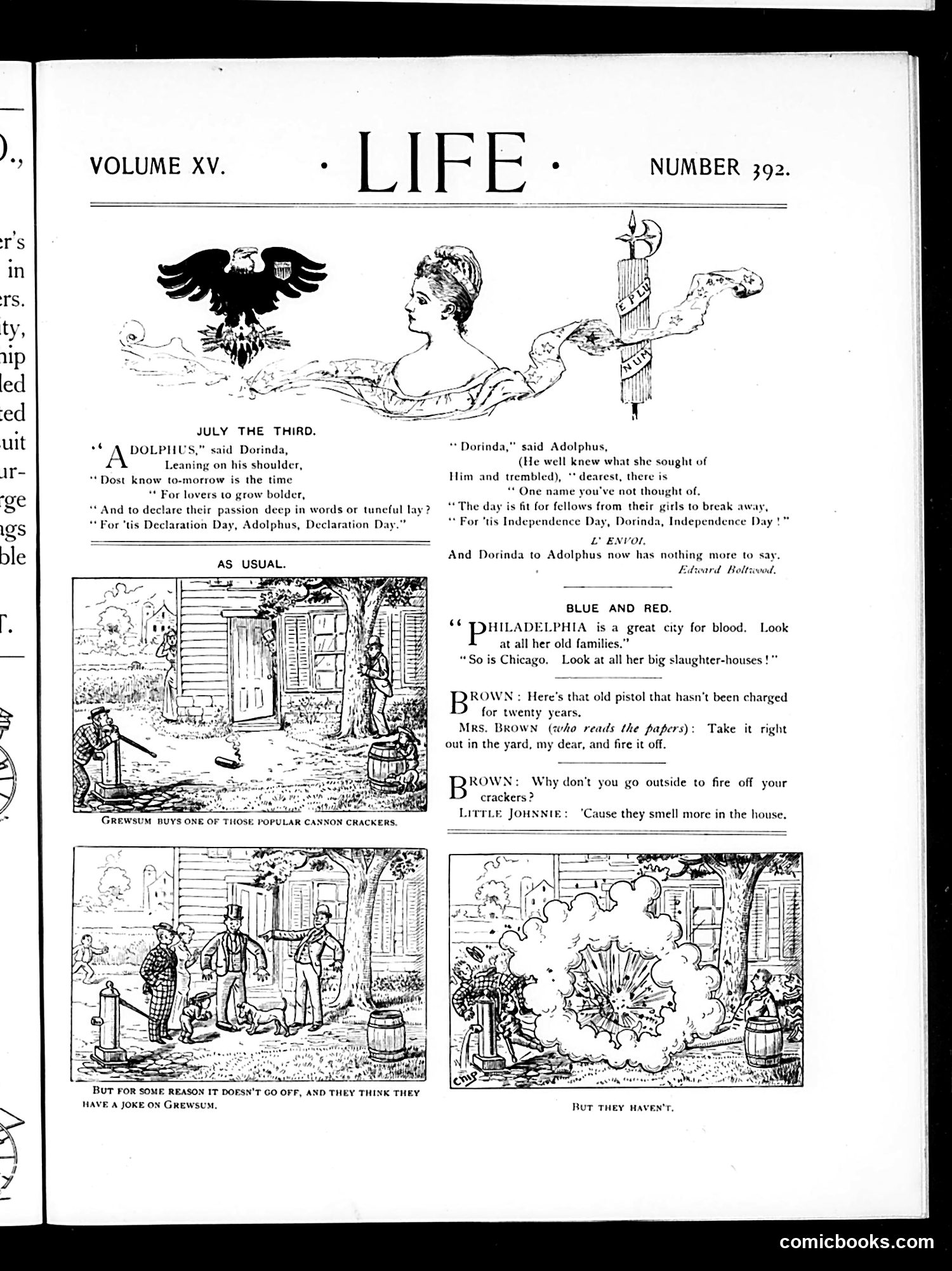
This page contains two distinct pieces: **"July the Third"** (top): A poetic dialogue between Adolphus and Dorinda about Declaration Day, with romantic/patriotic overtones typical of Life's literary humor. **"Blue and Red"** (bottom): A four-panel comic strip about a firecracker prank. The joke centers on Little Johnnie, who places a cannon cracker in the house rather than outside because "they smell more in the house." When it explodes indoors, the adults are angry but can't joke about it with Grewsum (possibly the neighbor), suggesting the prank's consequences prevent the usual lighthearted banter. This is genteel, family-oriented humor about July Fourth celebrations common to the era. The overall theme reflects pre-Independence Day festivities and domestic comedy.
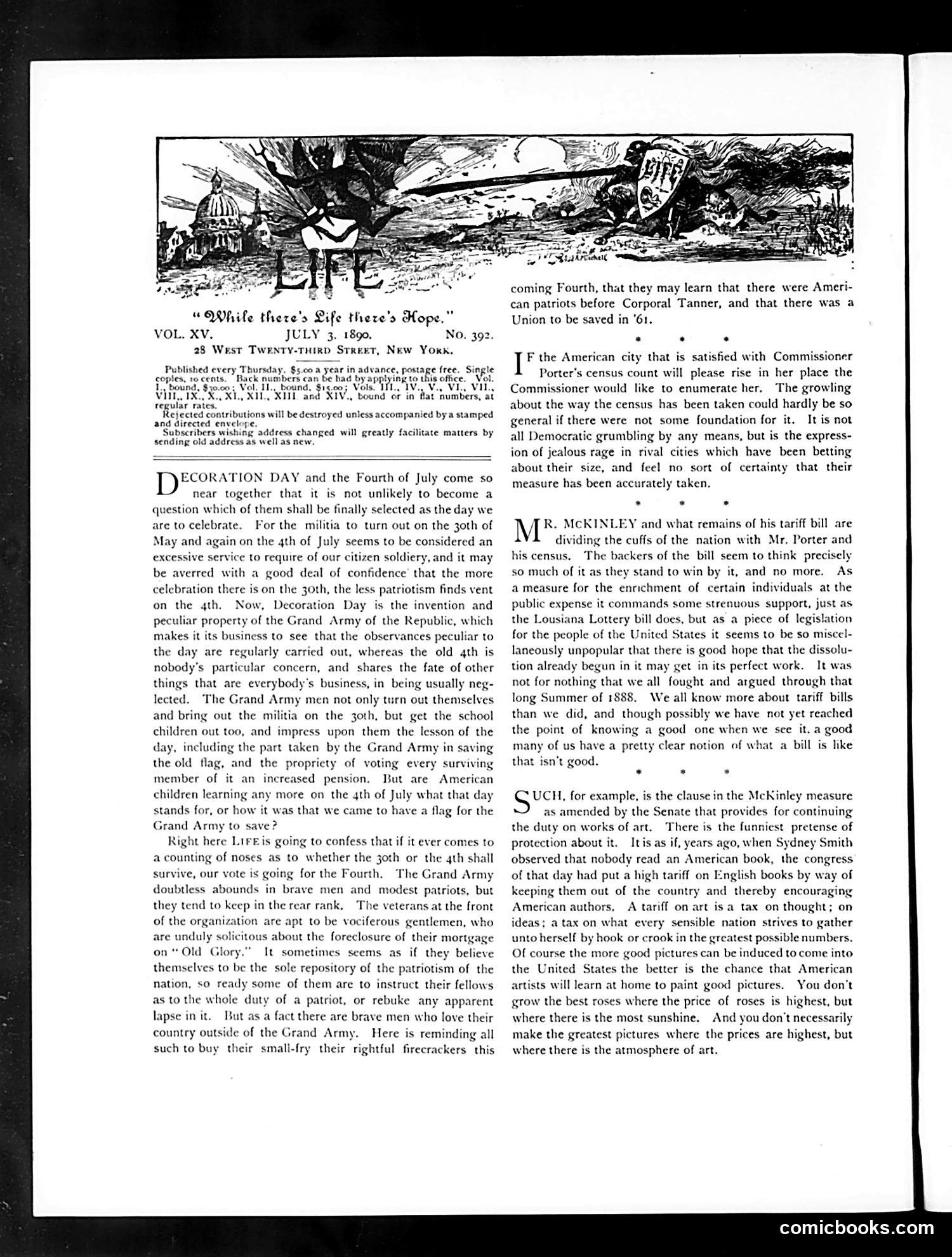
The masthead illustration depicts "Life" as a personified female figure amid apocalyptic imagery—suggesting satirical commentary on contemporary American chaos. The text discusses Decoration Day and Fourth of July celebrations, but focuses primarily on **political conflict over tariffs and the census**. It references: - **Commissioner Porter's census count**, which Democratic readers apparently dispute - **McKinley's tariff bill**, which the author criticizes as enriching specific individuals at public expense - A clause protecting tariffs on artwork, which the author mocks as benefiting wealthy collectors while discouraging American artists The piece argues that protective tariffs harm rather than help American interests, comparing them unfavorably to the Louisiana Lottery—both presented as corrupt schemes benefiting elites while deceiving the public.
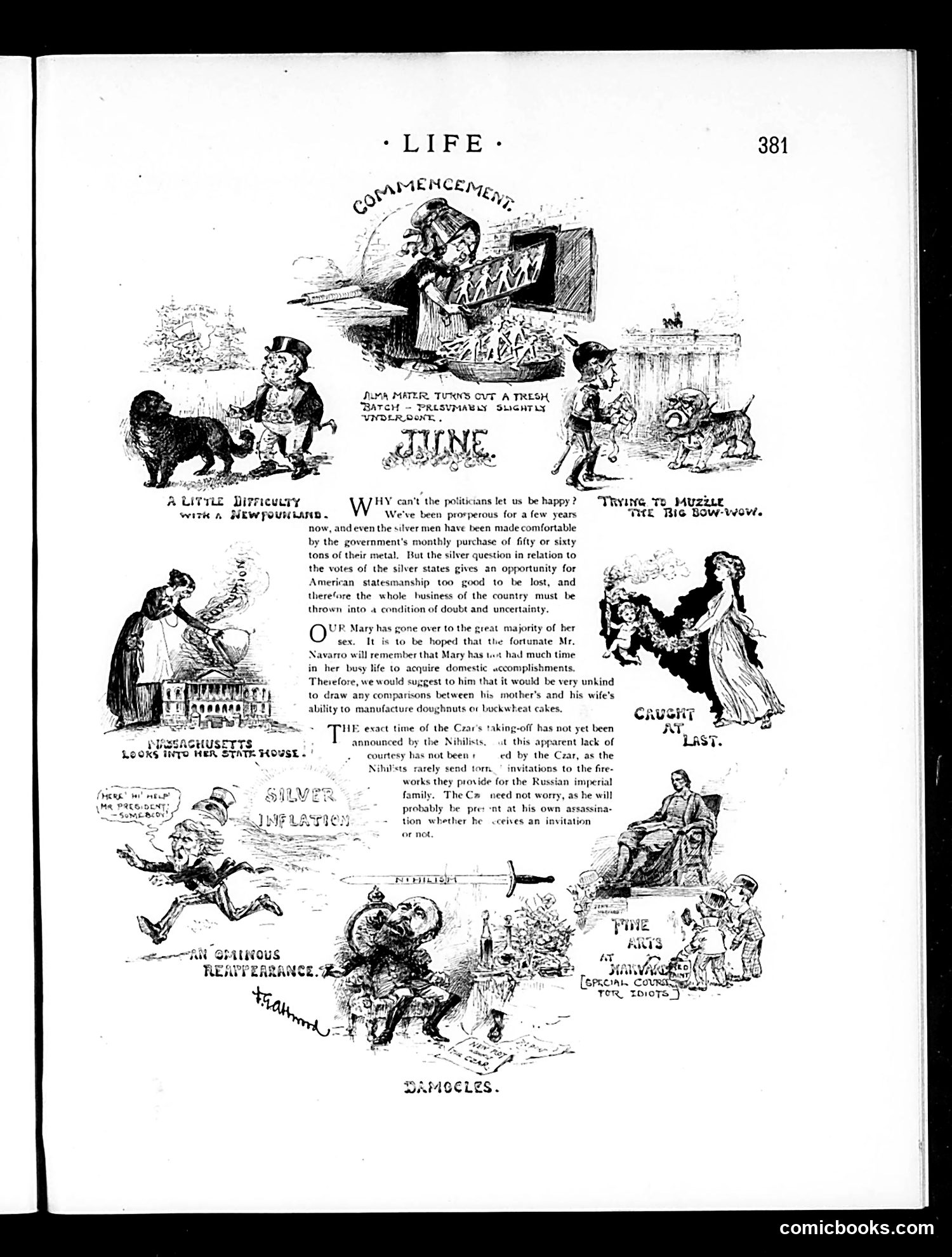
This page contains multiple satirical cartoons addressing early 20th-century American political issues: **"Commencement"** (top): Shows a figure launching something labeled "June," satirizing graduation season's chaos. **Silver/Currency Issues**: The central text discusses silver coinage policy and "the silver question," suggesting debate over monetary policy affecting "silver states." Politicians are mocked for being "prosperous for a few years" due to government silver purchases. **Russian References**: Cartoons about "Massachusetts Looks Into Her State House" and "Czar" mention appear to reference Russian political situations, possibly the Russian imperial family. **Domestic Humor**: Smaller cartoons satirize everyday American life—doughnuts, bakery products, and family situations. The overall tone mocks politicians' indifference to serious policy while ordinary citizens struggle with economic uncertainty caused by monetary debates.
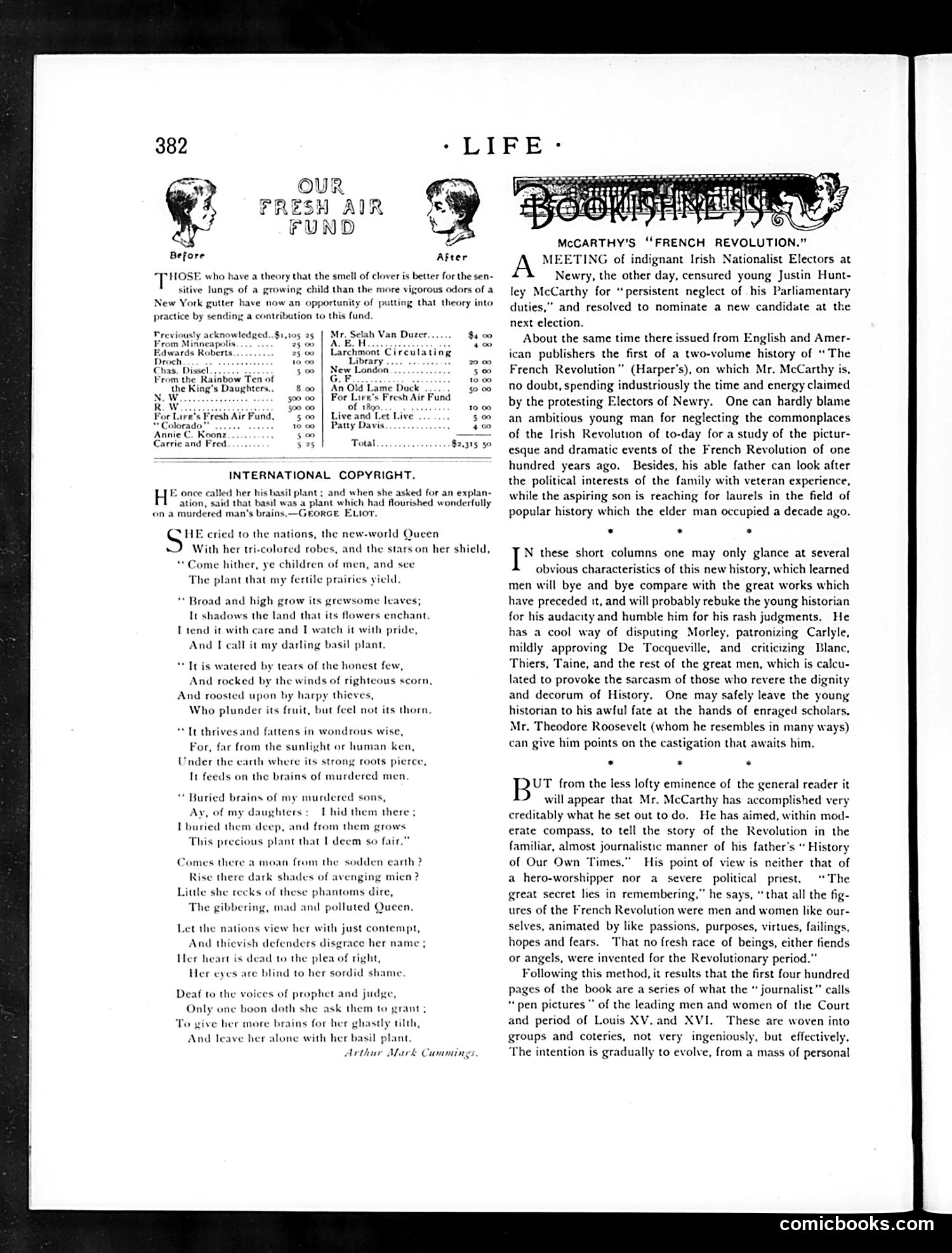
**The "Fresh Air Fund" Cartoon (top left):** This shows a before-and-after comparison of a child's health. The "Fresh Air Fund" was a real charitable program sending sickly urban children to the countryside for healthier air. The cartoon satirizes this by suggesting the fund works—the child appears healthier after exposure to fresh air. This is straightforward advocacy rather than political satire. **"Scottish Lass" and "McCarthy's French Revolution" (right):** The text discusses McCarthy's new two-volume history of the French Revolution, noting Irish Nationalist Electors at Newry protested his neglect of Parliamentary duties. The commentary appears critical of McCarthy prioritizing historical writing over political responsibilities, a common tension between intellectual and civic duties.
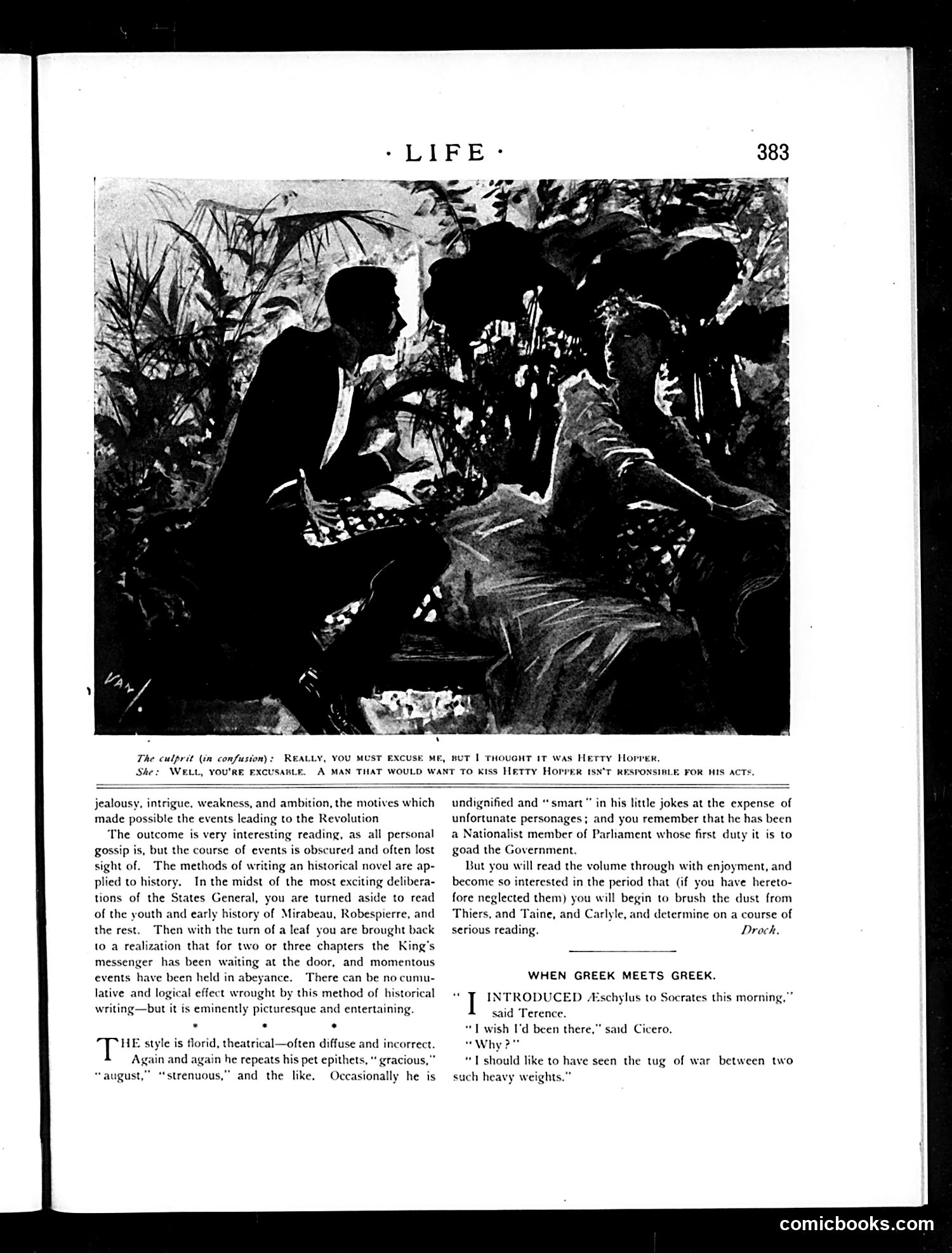
The page contains a dramatic scene illustration captioned about "Hetty Hopper" and an apology. The image shows silhouetted figures in what appears to be a tense social encounter, with the caption indicating someone is being excused for mistaking another person's identity—specifically confusing them with "Hetty Hopper." Below the illustration, the text discusses the literary style of a historical novel, critiquing its theatrical and diffuse nature while praising its entertainment value. The bottom section, titled "When Greek Meets Greek," features a dialogue between Terence and Cicero about introducing Aeschylus to Socrates and witnessing conflict between intellectual heavyweights. Without additional context about "Hetty Hopper" or the specific novel being reviewed, the precise satirical target remains unclear, though the page appears to blend theatrical criticism with classical wit.
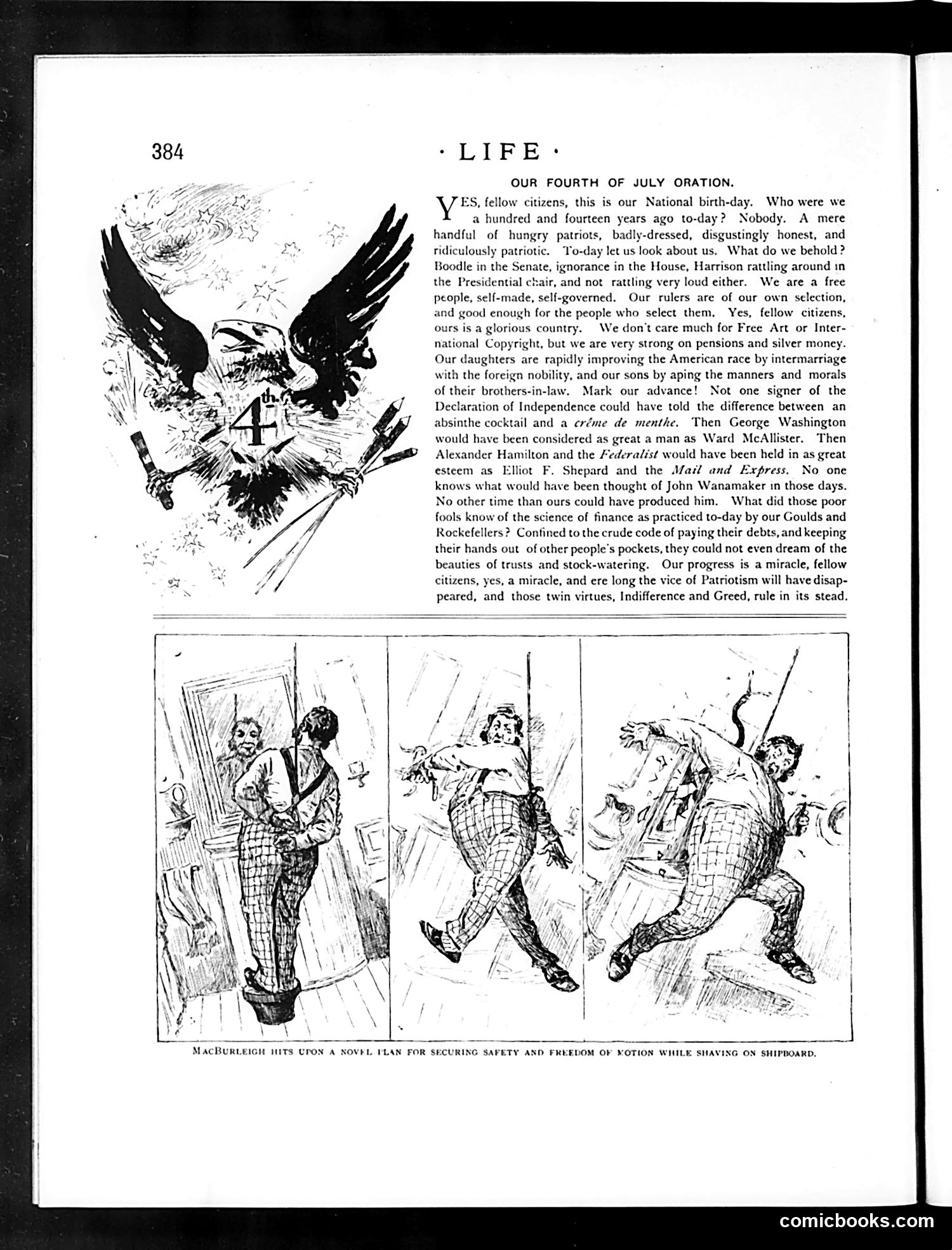
This page presents a satirical Fourth of July speech mocking American politics and society. The text criticizes contemporary leaders ("hoodie in the Senate, ignorance in the House"), attacks wealthy industrialists (Goulds and Rockefellers), and mocks the privileged classes who intermarry with foreign nobility while their sons adopt aristocratic manners. The three-panel cartoon below depicts MacBurleigh executing a "novel plan for securing safety and freedom of motion while shaving on shipboard"—a physical comedy routine showing a man attempting to shave while the ship rocks, with increasingly absurd results. The overall message satirizes American pretension, corruption, and the gap between democratic ideals and actual behavior among the wealthy elite.
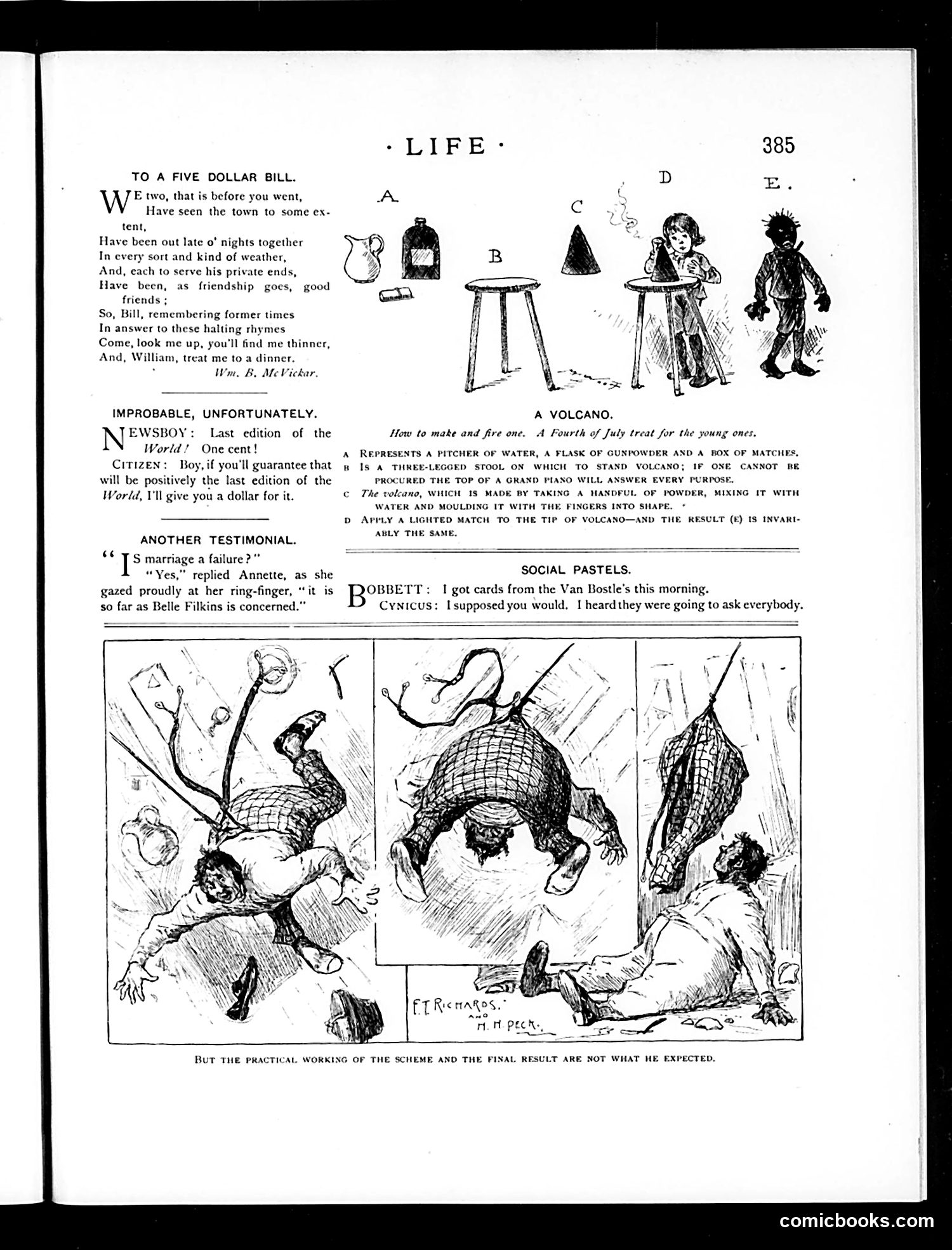
This page contains several humorous pieces typical of early Life magazine: **"To a Five Dollar Bill"** is a poem about friendship and financial hardship, apparently referencing someone named Bill who's fallen on difficult times. **"Improbable, Unfortunately"** jokes about a newsboy selling the last edition of the *World* newspaper for one cent, with a citizen's skeptical response about its actual value. **"A Volcano"** is a DIY craft instruction—instructions for children to create a homemade volcano using household items (pitcher, gunpowder, matches, piano top) as a Fourth of July activity. **"Social Pastels"** features a comic strip showing characters in various physical predicaments involving nets or hammocks, drawn by F. Richardson and H. Peck, with the caption noting the scheme's results differed from expectations. The page exemplifies Life's mix of satirical commentary, practical humor, and illustrated jokes.
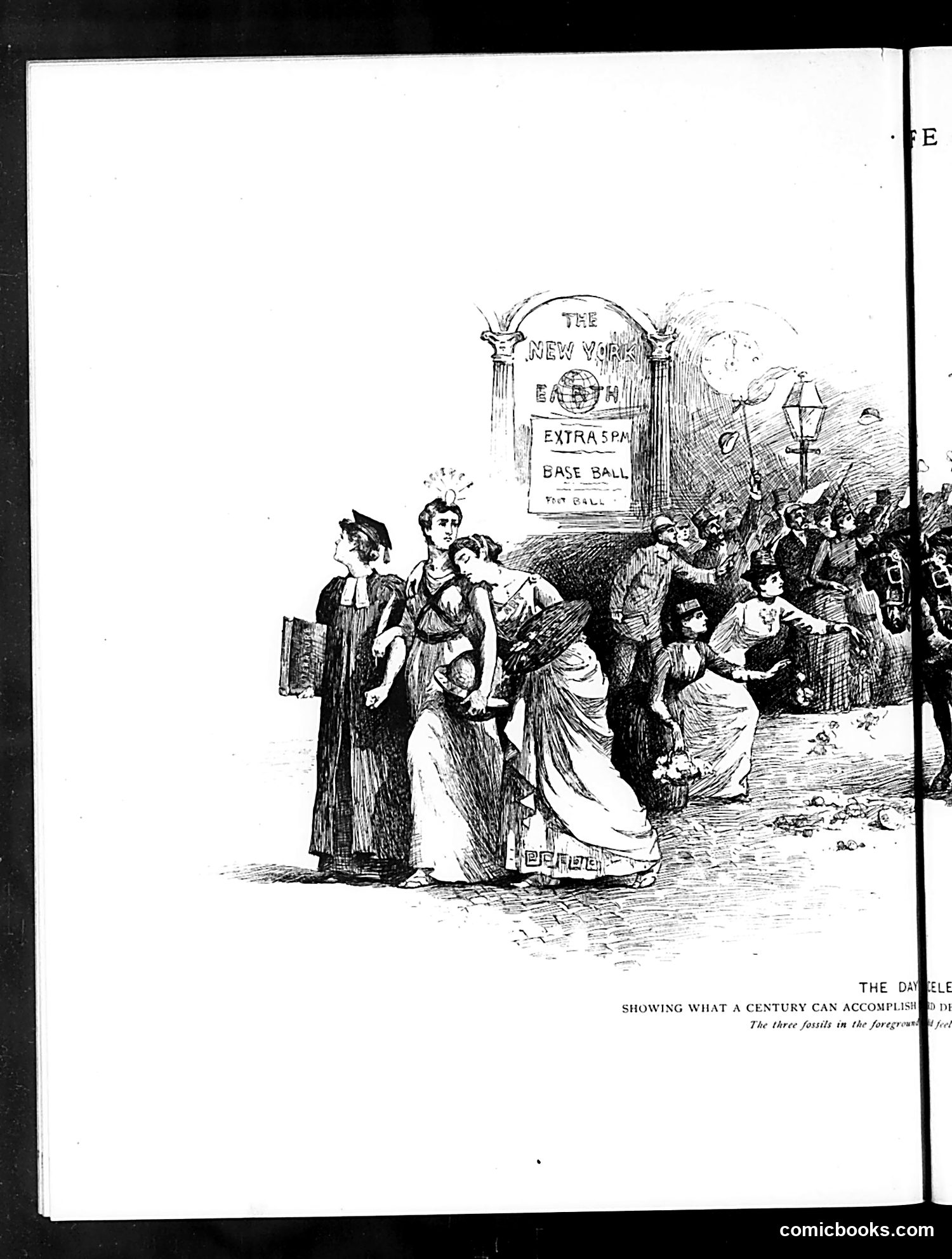
This satirical cartoon depicts three fashionably dressed women gazing at a sign advertising "The New York Extra Spa Base Ball" to a crowd gathered behind them. The caption reads "Showing What a Century Can Accomplish" with a subtitle referencing "The three fossils in the foreground." The satire appears to mock women's changing social roles and interests in early 20th-century America. The "three fossils" (older or traditional women) are portrayed as shocked or bewildered by the emergence of baseball as a public spectacle that now attracts crowds—suggesting that women's passive domesticity is being displaced by modern, active participation in popular entertainment and sports culture. The cartoon uses their stunned expressions to ridicule resistance to these social changes.
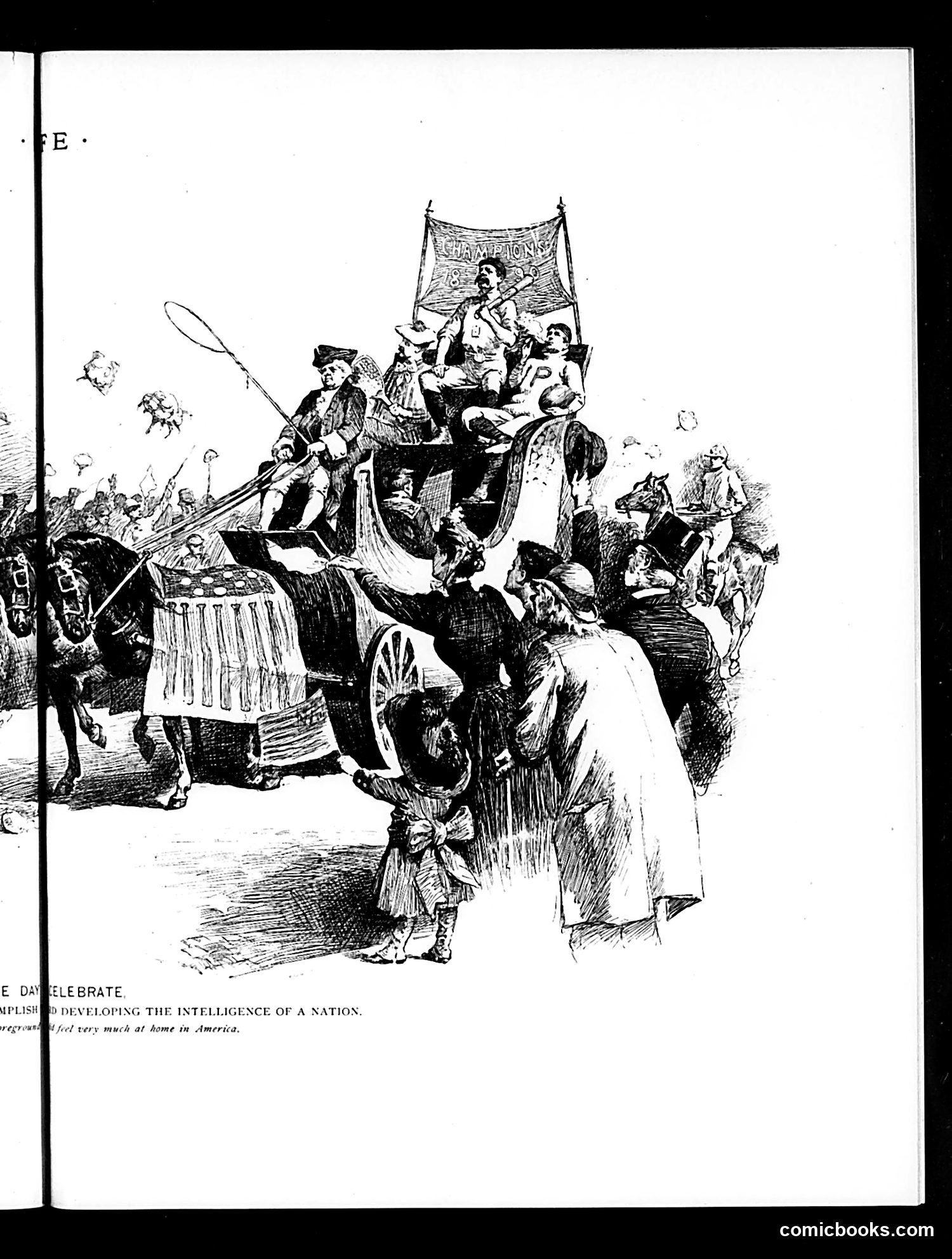
This satirical illustration critiques American education and national development. The visible text references "developing the intelligence of a nation" and mentions "school very much at home in America." The cartoon depicts an ornate, elaborate educational "vessel" or chariot—heavily decorated with classical imagery and pulled by horses—surrounded by crowds. The satire appears to target the pretentiousness or ineffectiveness of American educational institutions of the era. The contrast between the grand, elaborate apparatus and the ordinary people observing it suggests criticism of how schools present themselves versus their actual utility. The phrase "at home in America" implies commentary on whether such elaborate European-influenced educational models genuinely serve American needs, or whether they're poorly adapted imports. This likely reflects late 19th-century debates about education reform and what form American schooling should take.
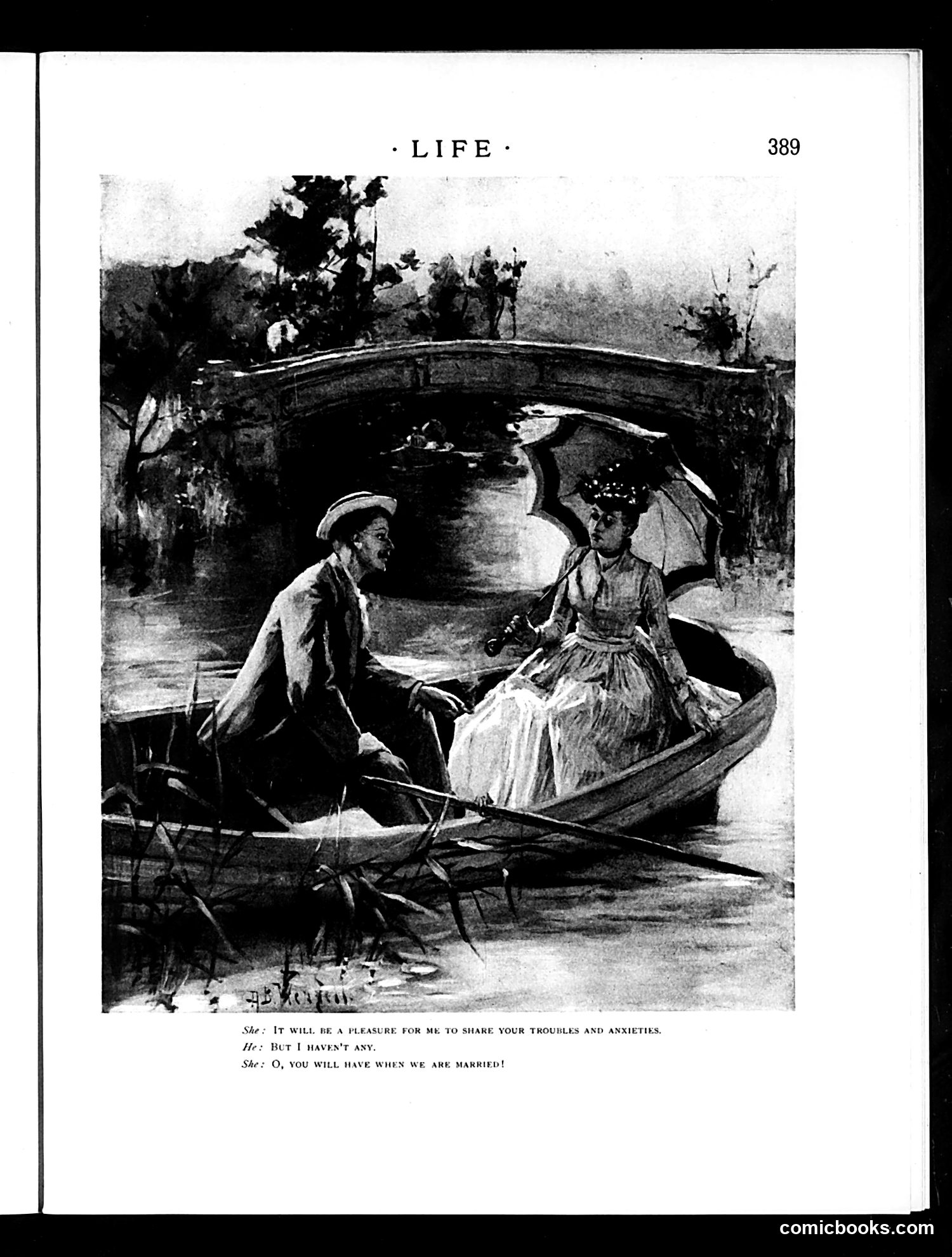
This is a romantic cartoon depicting a couple in a rowboat beneath an arched bridge. The humor plays on traditional anxieties about marriage. The woman offers to share the man's troubles and worries, presenting marriage as a compassionate partnership. He responds that he currently has none. Her final line—"O, you will have when we are married!"—delivers the punchline: marriage itself will create the very troubles she promises to help him bear. This reflects early 20th-century satirical commentary on matrimony, suggesting that marriage inevitably brings financial burdens, domestic complications, and various anxieties. It's a cynical but affectionate jab at the institution, treating matrimonial stress as an expected, almost humorous consequence of wedded life.
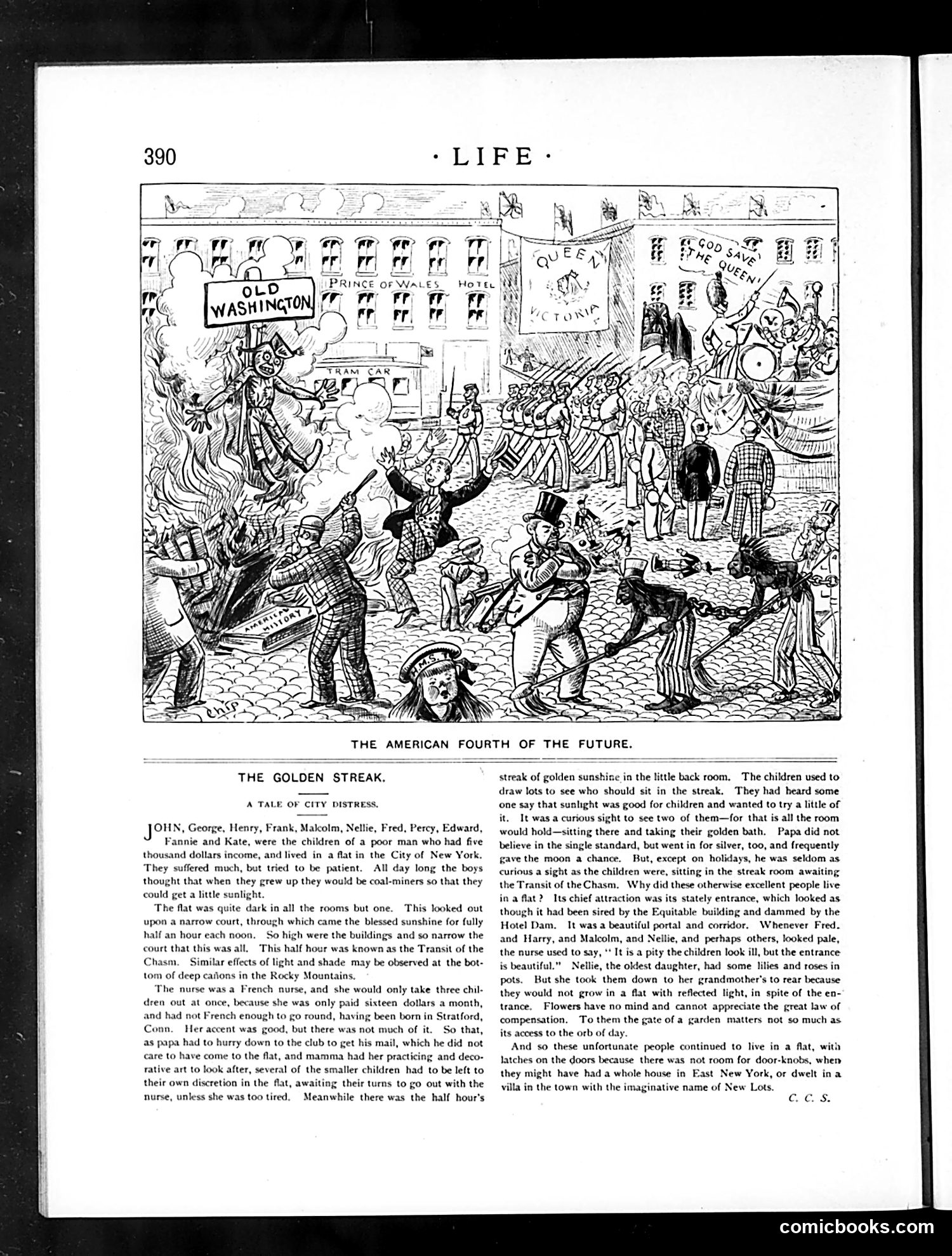
This is satirical social commentary on urban poverty and housing inequality in early 20th-century New York City. A family with a modest $5,000 annual income lives in a cramped, dark apartment despite being able to afford better housing elsewhere (like homes in East New York or New Lots). The satire mocks their priorities: they maintain the flat primarily for its "stately entrance"—valuing appearances over their children's wellbeing. The children literally compete by lottery for a few minutes daily of the only sunlight penetrating their dim flat during the "Transit of the Chasm"—a half-hour when sun reaches their narrow courtyard. The top cartoon illustrates the contrast between their "golden" dream (shown as a chaotic, joyful celebration in a bright future America) and their actual "golden streak" of sunlight—a meager, rationed substitute for real prosperity. The piece criticizes urban class pretension: prioritizing decorative "entrance" over actual living conditions and children's health.
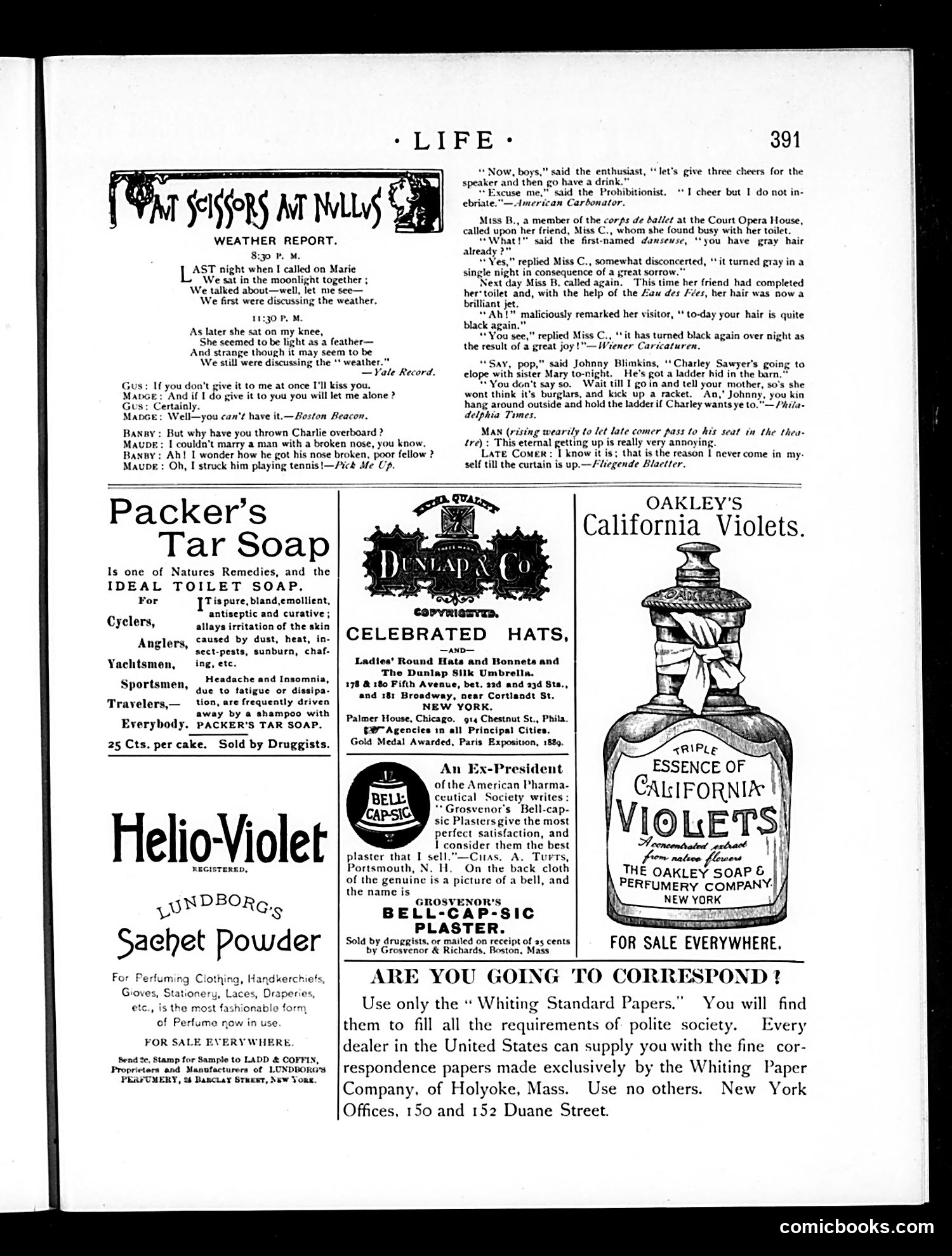
This page contains short humorous anecdotes typical of Life magazine's satirical format, alongside period advertisements. The main cartoon narrative concerns **Prohibition**, a contentious social issue of the era. A speaker advocates for Prohibition (abstaining from alcohol), and an enthusiast proposes celebratory cheers followed by drinking. A Prohibitionist objects, wanting to cheer but refusing to "inebriate." The joke targets the apparent hypocrisy or absurdity of the Prohibitionist position—celebrating while denying oneself the social convention of toasting with drink. Other brief comedic pieces mock romantic pretense, feminine vanity, and awkward social situations (late theater arrivals, romantic negotiations). The advertisements promote patent medicines and beauty products typical of the 1890s: Packer's Tar Soap, Helio-Violet powder, and California Violets essence—products now recognized as largely ineffective or containing harmful ingredients. The Dunlap hat advertisement and Bell-Cap-Sic Plaster also appear. The page is primarily advertising-driven with satirical humor interspersed throughout.
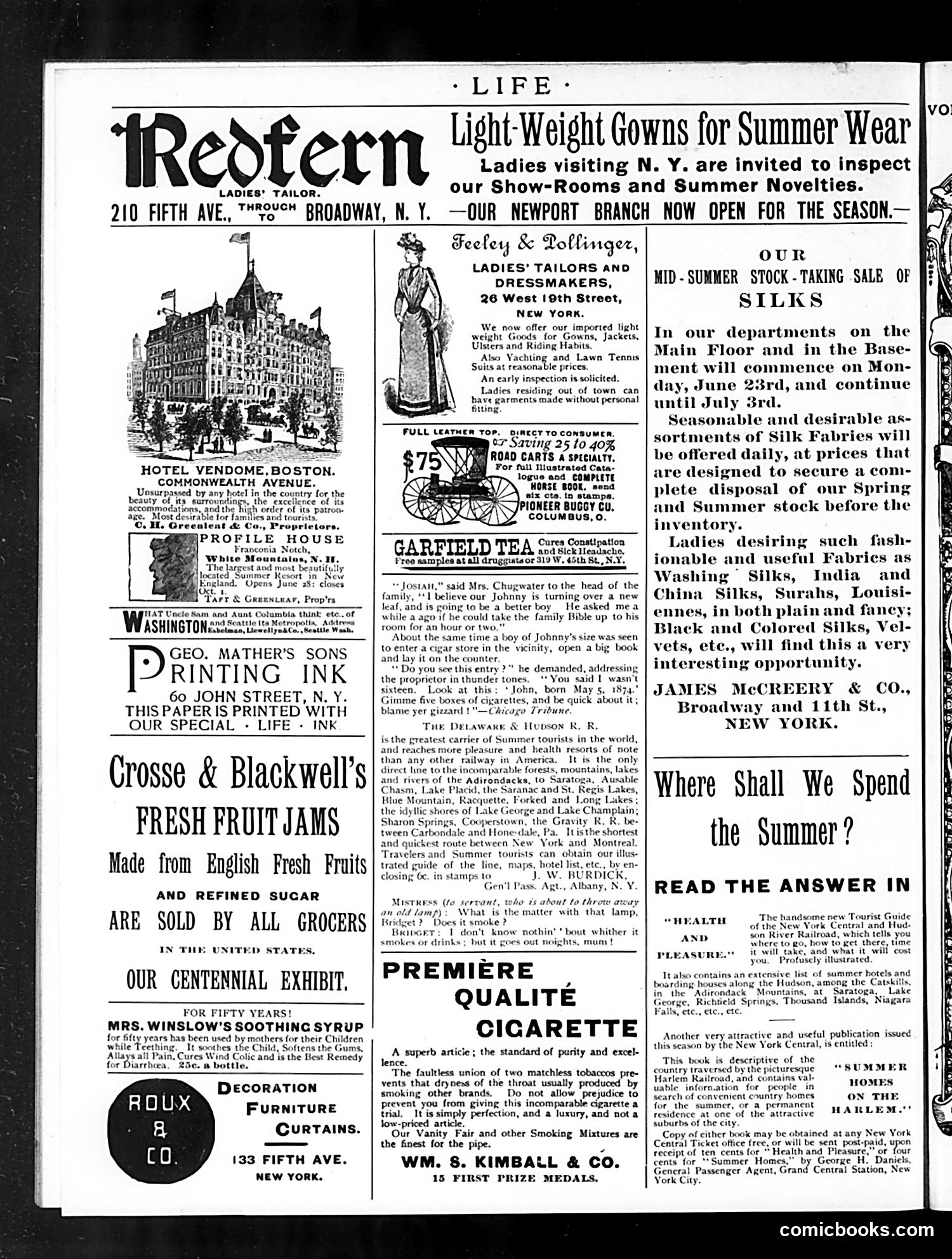
This page is primarily **advertising**, not political satire. It contains commercial promotions for luxury goods and services targeting affluent readers—including high-end fashion (Redfern tailors), hotels (Hotel Vendome), jams, furniture, and cigarettes. The only humor content appears to be two brief **comic anecdotes** in small text: 1. A story about "Johnny" who uses a Bible passage proving his birth date to convince a cigar store clerk to sell him cigarettes—a joke about a clever boy's dishonesty. 2. A servant misunderstanding her mistress's question about whether an old lamp "smokes," replying it "goes out nights." These are mild, domestic humor pieces common to the era, with no political significance. The page reflects Gilded Age consumer culture, advertising imported goods and resort travel to wealthy urbanites, particularly women visiting New York City for shopping and summer leisure.