
Life, 1890-07-03 · page 7 of 16
Life — July 3, 1890 — page 7: what you’re looking at
What you’re looking at
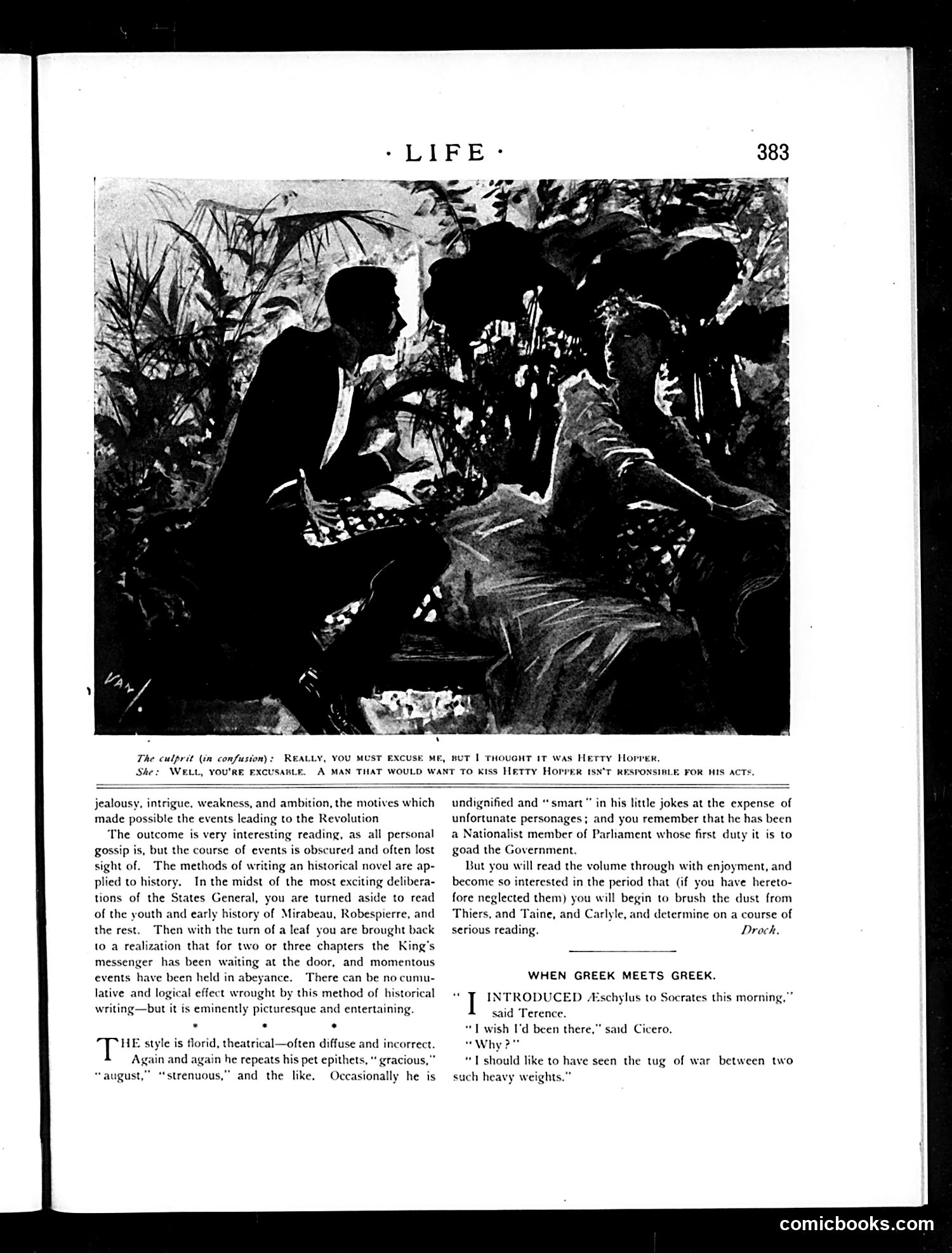
The page contains a dramatic scene illustration captioned about "Hetty Hopper" and an apology. The image shows silhouetted figures in what appears to be a tense social encounter, with the caption indicating someone is being excused for mistaking another person's identity—specifically confusing them with "Hetty Hopper." Below the illustration, the text discusses the literary style of a historical novel, critiquing its theatrical and diffuse nature while praising its entertainment value. The bottom section, titled "When Greek Meets Greek," features a dialogue between Terence and Cicero about introducing Aeschylus to Socrates and witnessing conflict between intellectual heavyweights. Without additional context about "Hetty Hopper" or the specific novel being reviewed, the precise satirical target remains unclear, though the page appears to blend theatrical criticism with classical wit.
📄 Transcribed text from this page (OCR, searchable)
Machine-transcribed from the original scan — historical spelling and the odd misread are preserved.
The culprit (in confusion): REALLY, YOU MUST EXCUSE ME, HUT I THOUGHT IT Was Hetty Horrer. She: WELL, YOU'RE EXCUSAHLE. A MAN THAT WOULD WANT TO KISS HETTY HOPPER ISN'T RESPONSIBLE FOR HIS ACTS. jealousy, intrigue, weakness, and ambition, the motives which made possible the events leading to the Revolution ‘The outcome is very interesting reading, as all personal gossip is, but the course of events is obscured and often lost sight of. The methods of writing an historical novel are ap- plied to history. In the midst of the most exciting delibera- tions of the States General, you are turned aside to read of the youth and early history of Mirabeau, Robespierre, and the rest. Then with the turn of a leaf you are brought back to a realization that for two or three chapters the King’s messenger has been waiting at the door, and momentous events have been held in abeyance. There can be no cumu- lative and logical effect wrought by this method of historical writing—but it is eminently picturesque and entertaining. . * . HE style is florid, theatrical—often diffuse and incorrect. Again and again he repeats his pet epithets, “ gracious,” “august,” “strenuous,” and the like, Occasionally he is undignified and “ smart” in his little jokes at the expense of unfortunate personages; and you remember that he has been a Nationalist member of Parliament whose first duty it is to goad the Government. But you will read the volume through with enjoyment, and become so interested in the period that (if you have hereto- fore neglected them) you will begin to brush the dust from Thiers, and Taine, and Carlyle, and determine on a course of serious reading. Droch. WHEN GREEK MEETS GREEK. “ I INTRODUCED Aischylus to Socrates this morning,” said Terence, “TL wish I'd been there,” said Cicero. “Why?” “TL should like to have seen the tug of war between two such heavy weights.” comicbooks.com