
Life, 1890-07-03 · page 4 of 16
Life — July 3, 1890 — page 4: what you’re looking at
What you’re looking at
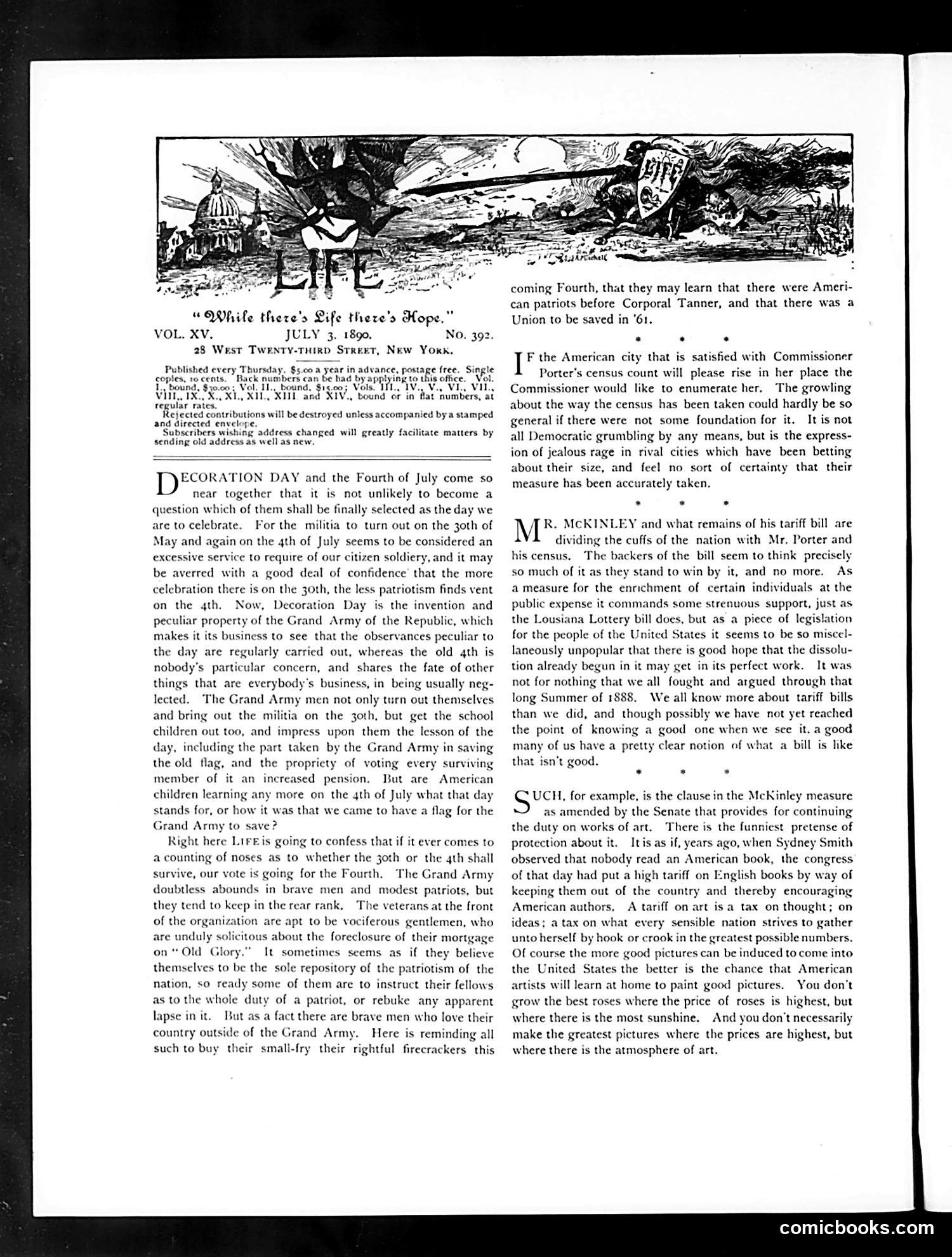
The masthead illustration depicts "Life" as a personified female figure amid apocalyptic imagery—suggesting satirical commentary on contemporary American chaos. The text discusses Decoration Day and Fourth of July celebrations, but focuses primarily on **political conflict over tariffs and the census**. It references: - **Commissioner Porter's census count**, which Democratic readers apparently dispute - **McKinley's tariff bill**, which the author criticizes as enriching specific individuals at public expense - A clause protecting tariffs on artwork, which the author mocks as benefiting wealthy collectors while discouraging American artists The piece argues that protective tariffs harm rather than help American interests, comparing them unfavorably to the Louisiana Lottery—both presented as corrupt schemes benefiting elites while deceiving the public.
📄 Transcribed text from this page (OCR, searchable)
Machine-transcribed from the original scan — historical spelling and the odd misread are preserved.
“WMhile there's VOL. XV. Life there's Hope.” JULY 3. 1890, No, 392. 28 West Twenty-THirp Street, New York. $5.00 a year in advance, postage free. Single y applying to this office. Vol. Vois Ut, WV. Vw Vin, VIL, bound of in fat numbers, at Published every Thursds coples, to cents. Back n 1. bound, regular rates. Rejected contributions will be destroyed unless accompanied by a stamped and directed envelope. Subscribers wishing address changed will greatly facilitate matters by sending old address as well as new. CORATION DAY and the Fourth of July come so near together that it is not unlikely to become a question which of them shall be finally selected as the day we are to celebrate. For the militia to turn out on the 3oth of May and again on the 4th of July seems to be considered an excessive service to require of our citizen soldiery, and it may be averred with a good deal of confidence’ that the more celebration there is on the 30th, the less patriotism finds vent on the 4th. Now, Decoration Day is the invention and peculiar property of the Grand Army of the Republic, which makes it its business to see that the observances peculiar to the day are regularly carried out, whereas the old qth is nobody's particular concern, and shares the fate of other things that are everybodys business, in being usually neg- The Grand Army men not only turn out themselves and bring out the militia on the 30th, but get the school children out too, and impress upon them the lesson of the day, including the part taken by the Grand Army in saving the old flag, and the propriety of voting every surviving member of it an increased pension, But are American children learning any more on the 4th of July what that day stands for, or how it was that we came to have a flag for the Grand Army to save? lected. Right here LiFEis going to confess that if it ever comes to a counting of noses as to whether the 3oth or the 4th shall survive, our vote is going for the Fourth. The Grand Army doubtless abounds in brave men and modest patriots, but they tend to keep in the rear rank, of the organization © veterans at the front € apt to be vociferous gentlemen, who are unduly solicitous about the foreclosure of their mortga on" Old Glory.” It sometimes seems as if they believe themselves to be the sole repository of the patriotism of the nation, so ready some of them are to instruct their fellows as tothe whole duty of a patriot, or rebuke any apparent lapse in it, But as a fact there are brave men who love their country outside of the Grand Army. Here is reminding all such to buy their small-fry their rightful firecrackers this coming Fourth, that they may learn that there were Ameri- can patriots before Corporal Tanner, and that there was a Union to be saved in ‘61. . . . [IF the American city that is satisfied with Commissioner Porter's census count will please rise in her place the Commissioner would like to enumerate her. The growling about the way the census has been taken could hardly be so general if there were not some foundation for it. It is not all Democratic grumbling by any means, but is the express- ion of jealous rage in rival cities which have been betting about their size, and feel no sort of certainty that their measure has been accurately taken. M . . . R. MCKINLEY and what remains of his tariff bill are dividing the cuffs of the nation with Mr. Porter and his census. The backers of the bill seem to think precisely so much of it as they stand to win by it, and no more. As a measure for the enrichment of certain individuals at the public expense it commands some strenuous support, just as the Lousiana Lottery bill does, but as a piece of legislation for the people of the United States it seems to be so miscel- laneously unpopular that there is good hope that the dissolu- tion already begun in it may get in its perfect work. It was not for nothing that we all fought and argued through that long Summer of 1888. We all know more about tariff bills than we did, and though possibly we have not yet reached the point of knowing a good one when we sce it. a good many of us have a pretty clear notion of what a bill is like that isn’t good. . * * UCH, for example, is the clause in the McKinley measure as amended by the Senate that provides for continuing the duty on works of art. There is the funn pretense of protection about it. Itis as if, years ago, when Sydney Smith observed that nobody read an American book, the congr of that day had put a high tariff on English books by way of keeping them out of the country and thereby encouraging American authors, A tariff on art isa tax on thought; on ideas; a tax on what every sensible nation strives to gather unto herself by hook or crook in the greatest possible numbers. Of course the more good pictures can be induced to come into the United States the better is the chance that American artists will learn at home to paint good pictures. You don’t grow the best roses where the price of roses is highest, but where there is the most sunshine, And you don't necessarily make the greatest pictures where the prices are highest, but where there is the atmosphere of art. comicbooks.com