
Life, 1890-07-03 · page 6 of 16
Life — July 3, 1890 — page 6: what you’re looking at
What you’re looking at
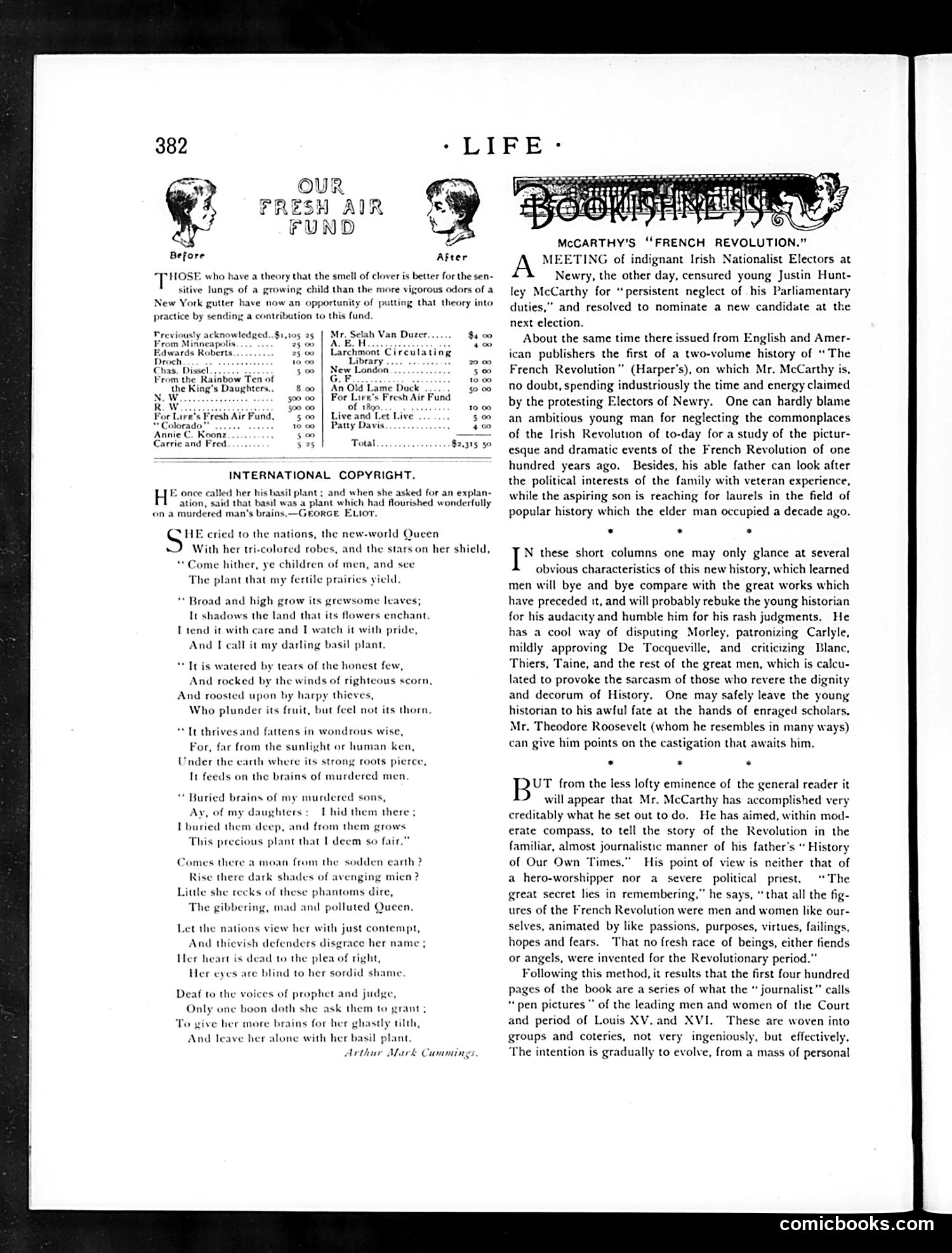
**The "Fresh Air Fund" Cartoon (top left):** This shows a before-and-after comparison of a child's health. The "Fresh Air Fund" was a real charitable program sending sickly urban children to the countryside for healthier air. The cartoon satirizes this by suggesting the fund works—the child appears healthier after exposure to fresh air. This is straightforward advocacy rather than political satire. **"Scottish Lass" and "McCarthy's French Revolution" (right):** The text discusses McCarthy's new two-volume history of the French Revolution, noting Irish Nationalist Electors at Newry protested his neglect of Parliamentary duties. The commentary appears critical of McCarthy prioritizing historical writing over political responsibilities, a common tension between intellectual and civic duties.
📄 Transcribed text from this page (OCR, searchable)
Machine-transcribed from the original scan — historical spelling and the odd misread are preserved.
OUR FRESH AIR FUND Before After HOSE who have a theory that the smell of clover is better for the sen- sitive lungs of a growing child than the more vigorous odors of a New York gutter have now an opportunity of putting that theory into practice by sending a contribution to this fund. Previously acknowledged..$1,105 25 | Mr, Selah Van Durer. fom Minneapolis ago | AEH... e wards Roberts, 25 oo | Larchmont Circulating Droch Siaatesse 10 00 Library .... : Chas. Dissel . 3 | New London From the Rainbow Ten of G.F. the King’s Daughters... An O NeW ise For of 1299 es 30 | Liveand Let Live . 10 eo | Patty Davis Carrie and Fred 5 25 $400 400 $00 Laie Duck $0 00 *s Fresh Air Fund 8 00 00 00 10 5 00 $00 Total... $2,315 50 INTERNATIONAL COPYRIGHT. HE once called her his basil plant; and when she asked for an explan- ation, said that basil was a plant which had flourished wonderfully on a murdered man’s brains, —Georce ELtor. > HE cried to the nations, the new-world Queen With her tri-colored robes, and the stars on her shield, "Come hither, ye children of men, and sce The plant that my fertile prairies yield * Broad and high grow its grewsome leaves; It shadows the land that its flowers enchant Ttend it with care and T wateh it with pride, And I call it my darling basil plant. * Tt is watered by tears of the honest few, And rocked by the winds of righteous scorn, And roosted upon by harpy thieves, Who plunder its fruit, but feel not its thorn “Tt thrives and fattens in wondrous wise, For, far from the sunlight or human ken, Under the earth where its strong roots pierce, It feeds on the brains of murdered men. * Buried brains of my murdered sons, Ay, of my daughters I hid them there ; T buried them deep, and from them grows This precious plant that | deem so fair,” Comes there a moan from the sodden earth ? Rise there dark shades of avenging mien? Little she recks of these phantoms dire, The gibbering, mad and polluted Queen. Let the nations view her with just contempt, And thievish defenders disgrace her name ; Her heart is dead to the plea of right, Her eyes are blind to her sordid shame. Deaf to the voices of prophet and judge, Only one boon doth she ask them to grant; To give her more brains for her ghastly tilth, And leave her alone with her basil pl Arthur Mark Cummings. McCARTHY’S ‘‘FRENCH REVOLUTION.” MEETING of indignant Irish Nationalist Electors at Newry, the other day, censured young Justin Hunt- ley McCarthy for “persistent neglect of his Parliamentary duties,” and resolved to nominate a new candidate at the next election. About the same time there issued from English and Amer- ican publishers the first of a two-volume history of “The French Revolution” (Harper's), on which Mr. McCarthy is, no doubt, spending industriously the time and energy claimed by the protesting Electors of Newry. One can hardly blame an ambitious young man for neglecting the commonplaces of the Irish Revolution of to-day for a study of the pictur- esque and dramatic events of the French Revolution of one hundred years ago. Besides, his able father can look after the political interests of the family with veteran experience, while the aspiring son is reaching for laurels in the field of popular history which the elder man occupied a decade ago, I these short columns one may only glance at several obvious characteristics of this new history, which learned men will bye and bye compare with the great works which have preceded 1t, and will probably rebuke the young historian for his audacity and humble him for his rash judgments. He has a cool way of disputing Morley, patronizing Carlyle, mildly approving De Tocqueville, and criticizing Blanc, Thiers, Taine, and the rest of the great men, which is calcu- lated to provoke the sarcasm of those who revere the dignity and decorum of History. One may safely leave the young historian to his awful fate at the hands of enraged scholars, Mr. Theodore Roosevelt (whom he resembles in many ways) can give him points on the castigation that awaits him. . * . ] UT from the less lofty eminence of the general reader it will appear that Mr. McCarthy has accomplished very creditably what he set out todo. He has aimed, within mod- erate compass, to tell the story of the Revolution in the familiar, almost journalistic manner of his father’s “ History of Our Own Times.” His point of view is neither that of a hero-worshipper nor a severe political priest. “The great secret lies in remembering,” he says, “that all the fig- ures of the French Revolution were men and women like our- selves, animated by like passions, purposes, virtues, failings, hopes and fears. That no fresh race of beings, either fiends or angels, were invented for the Revolutionary period.” Following this method, it results that the first four hundred pages of the book are a series of what the “ journalist” calls “pen pictures ” of the leading men and women of the Court and period of Louis XV. and XVI. These are woven into groups and coteries, not very ingeniously, but effectively. ‘The intention is gradually to evolve, from a mass of personal comicbooks.com