
A complete issue · 16 pages · 1890
Life — January 30, 1890
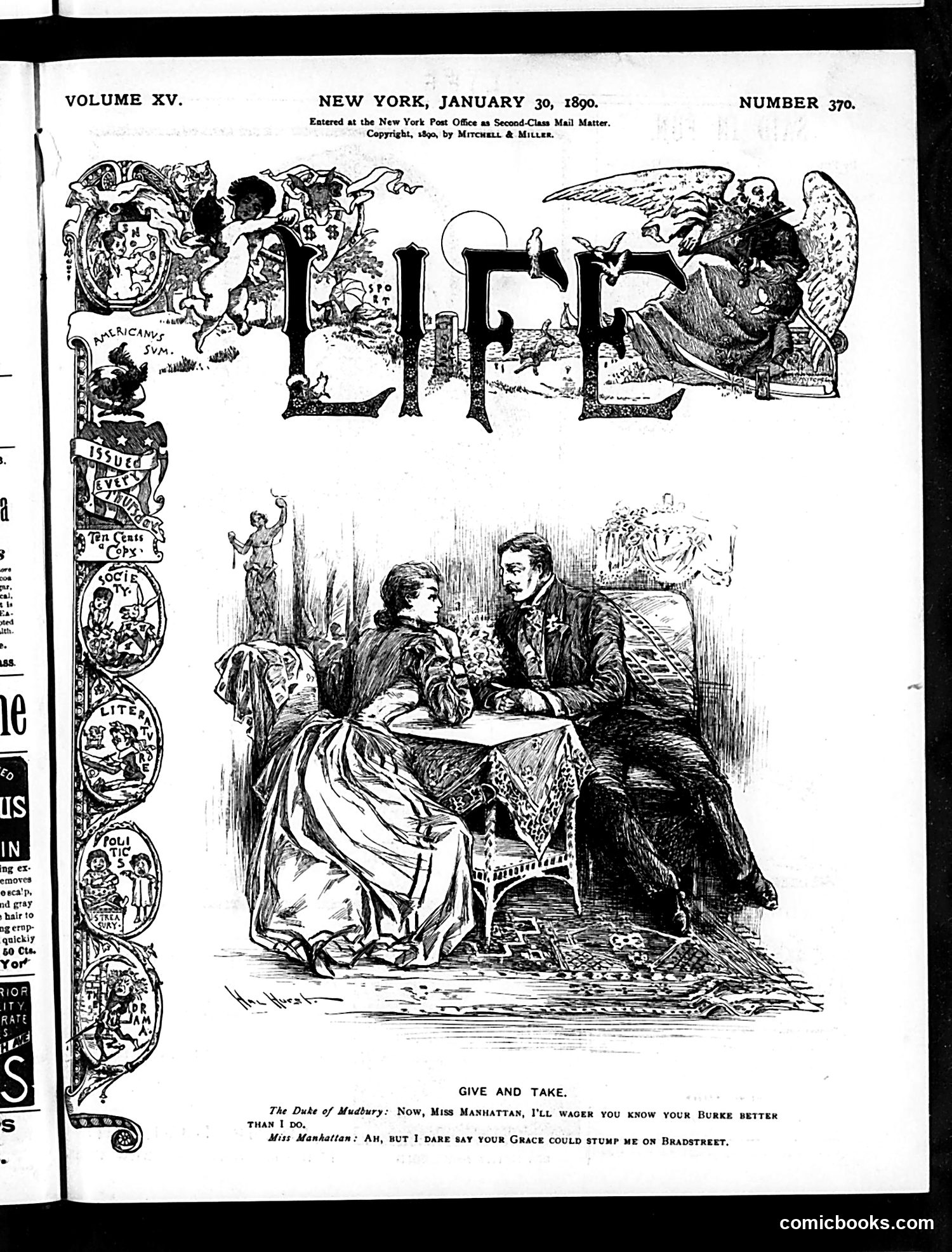
This cartoon satirizes social class dynamics in 1890s New York. A well-dressed man (appearing to represent upper-class society) sits with a woman identified as "Miss Manhattan." The Duke of Medbury offers to "wager" Miss Manhattan knows Burke better than he does—Burke likely referring to Burke's Peerage, a guide to aristocratic lineage. Miss Manhattan's retort suggests that despite the Duke's noble credentials, his Grace couldn't "stump" her on Broadway—implying New York's commercial culture and street knowledge rival European aristocratic pretension. The satire mocks both the snobbish European nobleman and the brash American socialite, suggesting American wealth and urban sophistication challenge Old World aristocratic superiority.
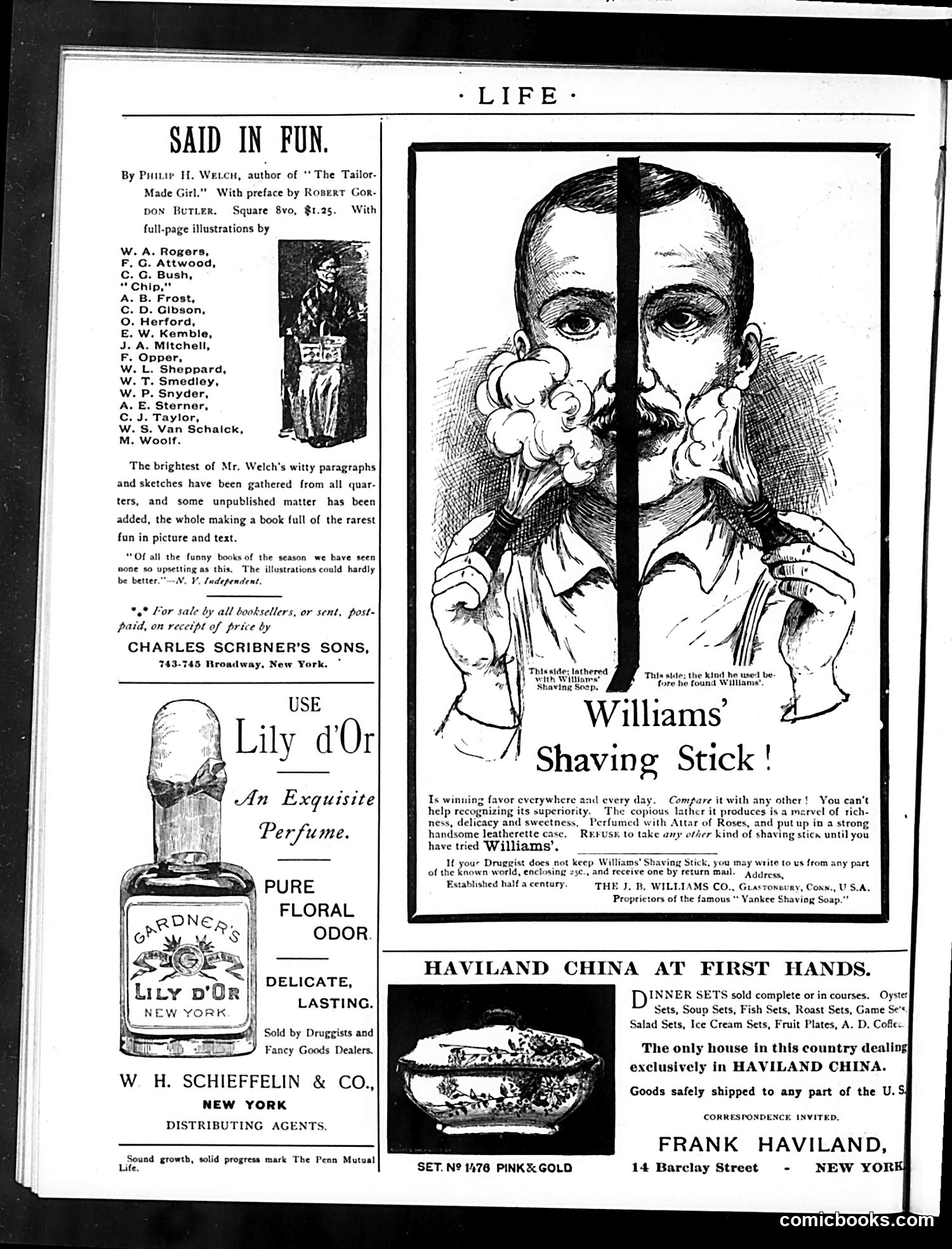
This page is primarily **advertising**, not editorial content. The main cartoon depicts a split face—one side clean-shaven, the other with heavy stubble—advertising **Williams' Shaving Stick**. The advertisement emphasizes the product's superiority by claiming it wins "favor everywhere and every day" and comparing it favorably to competitors. The top left advertises **"Said in Fun,"** a humor book by Philip H. Welch with illustrations by various artists, published by Charles Scribner's Sons. Below that, **Lily d'Or perfume** by Gardner's is promoted as having "pure floral odor." The bottom right advertises **Haviland China** dinnerware sets sold exclusively by Frank Haviland in New York. No political satire is present; this is straightforward commercial advertising from the early 20th century.
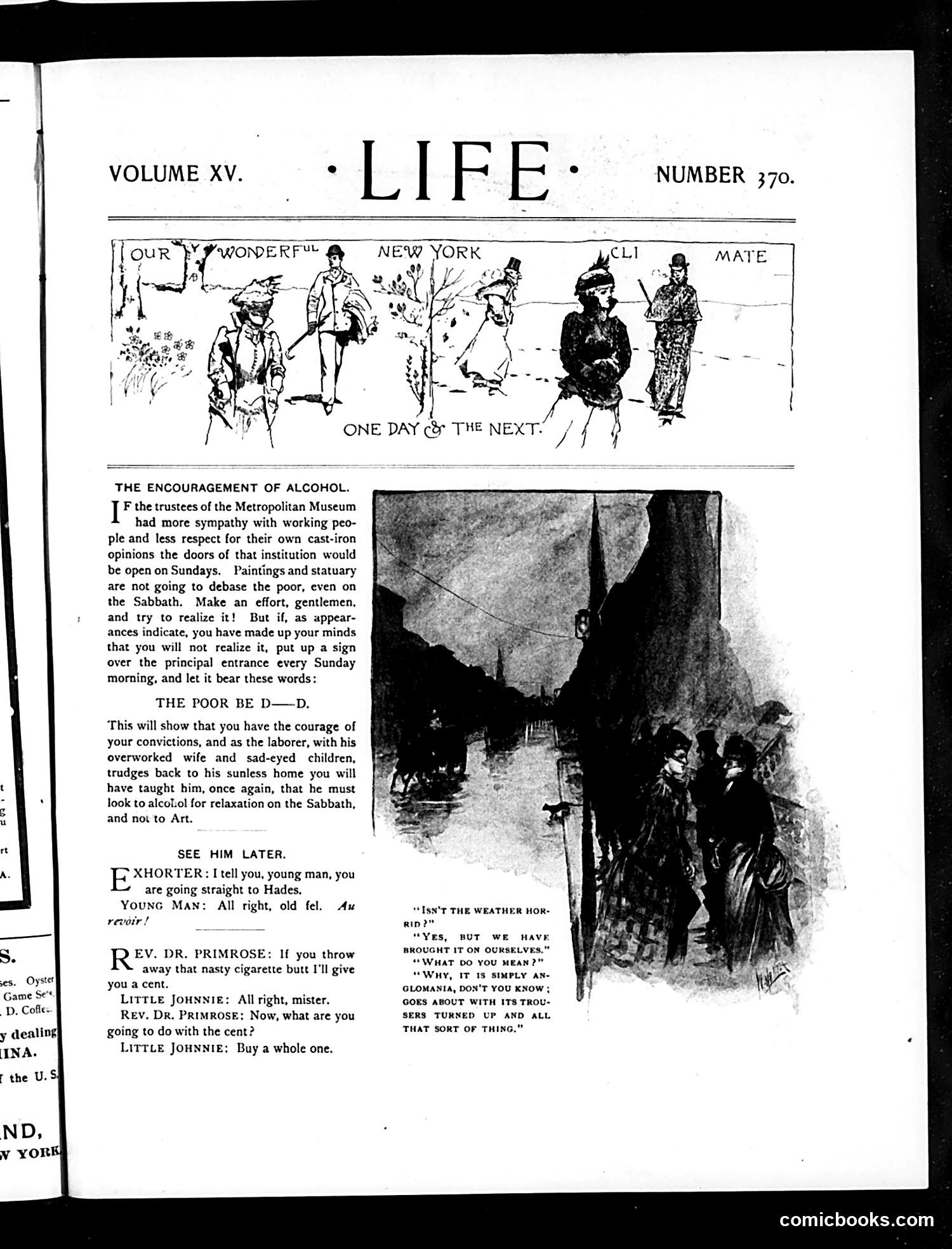
**Top Cartoon:** "Our Wonderful New York Cli-Mate One Day & The Next" depicts the dramatic weather shifts New Yorkers experienced—showing people in summer clothes one day, winter coats the next. This is straightforward satire about unpredictable climate. **Main Article:** "The Encouragement of Alcohol" criticizes the Metropolitan Museum's proposed Sunday openings, arguing that instead of appreciating art, working-class visitors will seek alcohol for "relaxation." The piece sarcastically suggests posting "THE POOR BE D—D" to discourage them. **Dialogue Section:** A conversation between an Exhorter, Young Man, Rev. Dr. Primrose, and Little Johnnie satirizes temperance advocates' hypocritical moralizing while themselves engaging in casual vice—the reverend offers cigarettes while condemning alcohol. The overall theme: class-based hypocrisy regarding moral reform.
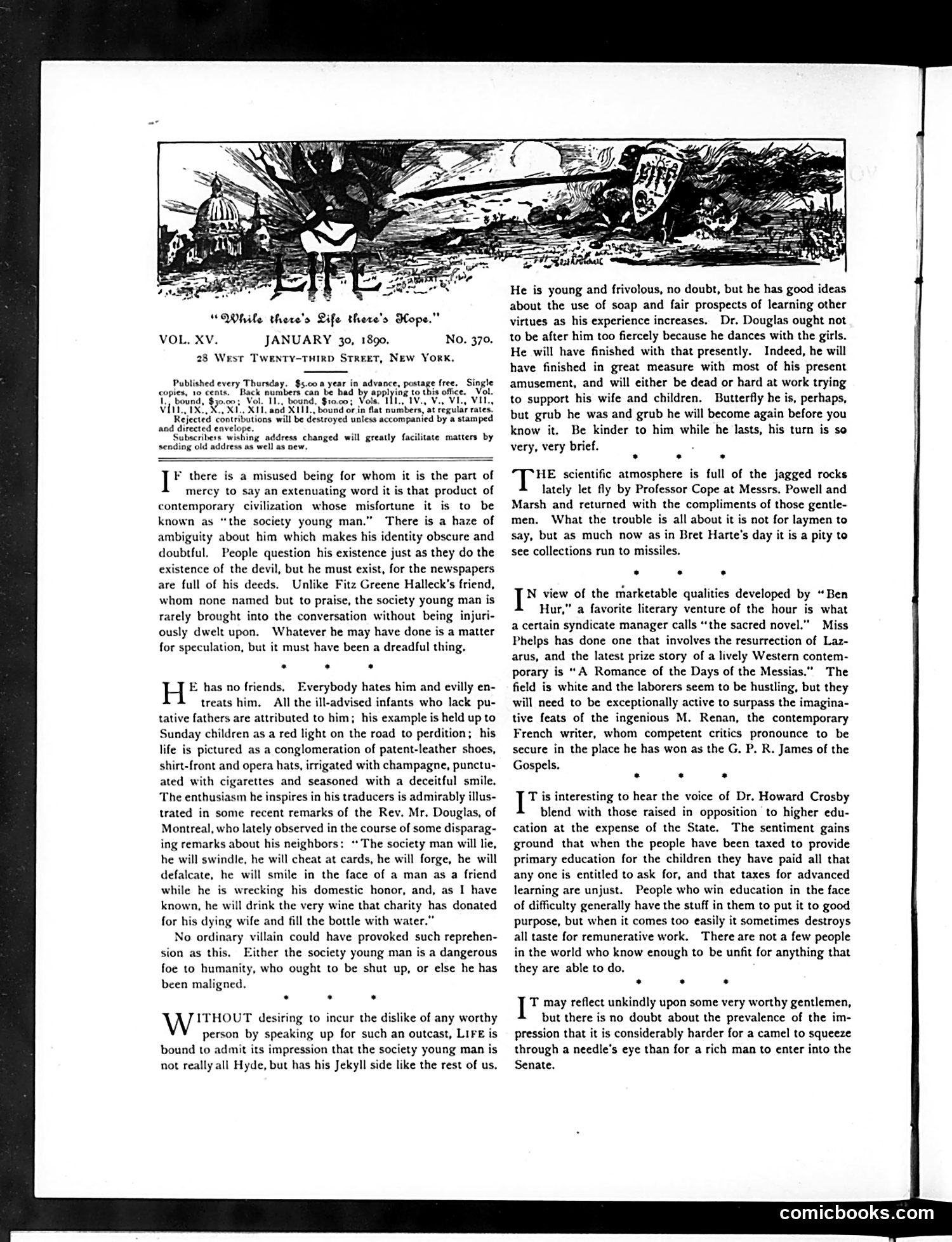
The cartoon at the top ("While there's Life there's Hope") depicts a skeletal Death figure hovering over a cityscape with a domed building (likely the U.S. Capitol). The imagery suggests mortality threatening civilization or government. The text below discusses a "society young man"—apparently a wealthy, dissolute figure criticized for moral failings. The passage references his dancing with girls, lack of ambition, and poor character, contrasting his superficial charm with his actual worthlessness. The editorial critiques social pretense and questions whether such individuals deserve society's acceptance. There's also commentary on educational debates and political figures like Dr. Howard Crosby regarding public spending on schools. The satire targets Gilded Age excess and the moral bankruptcy of privileged youth.
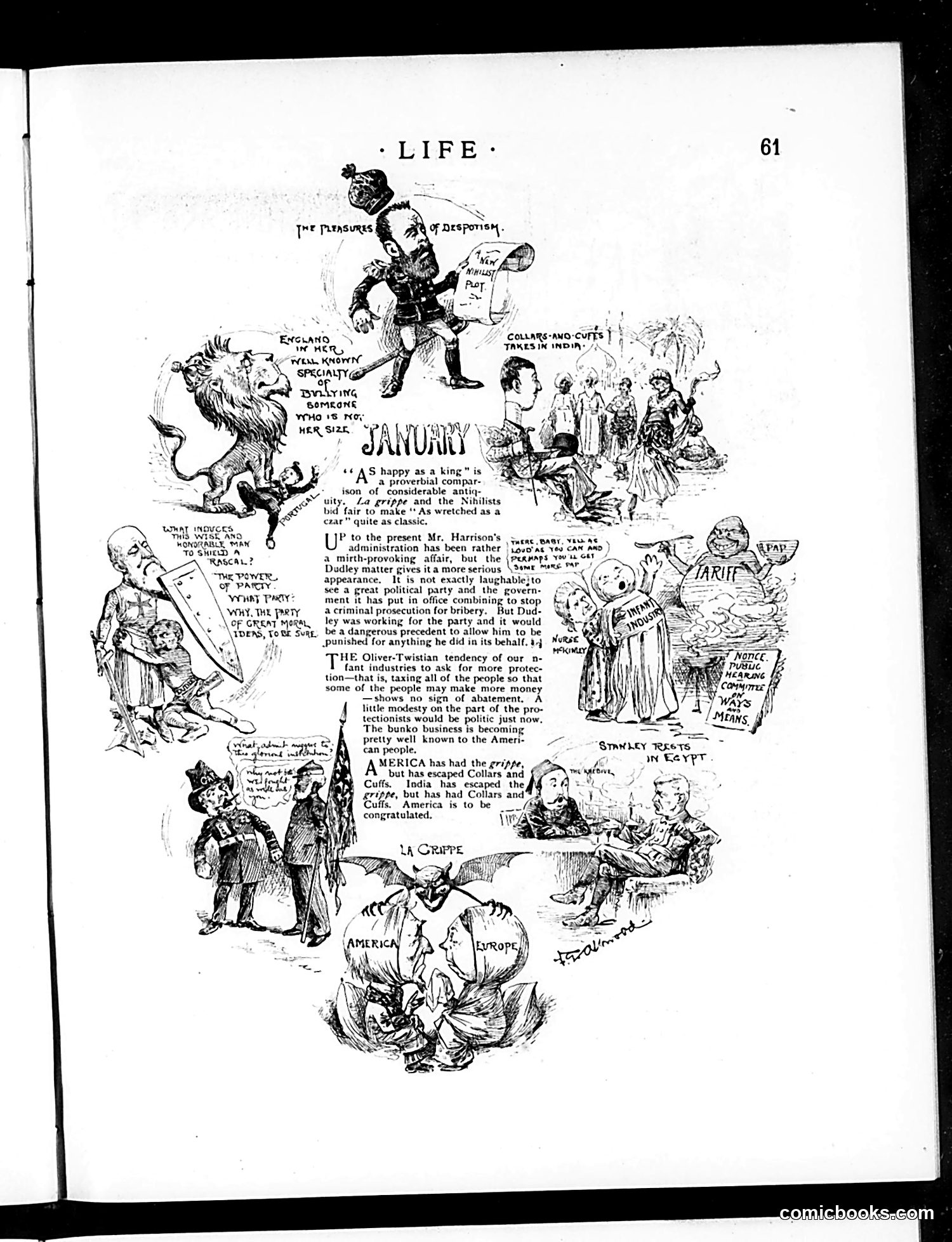
This page satirizes early 1900s American politics and international affairs through multiple cartoons. The central section titled "January" critiques the Harrison administration's policies, particularly regarding tariffs and industrial monopolies. The "Grippe" cartoon compares America and Europe, suggesting America has escaped economic illness ("Collars and Cuffs") while Europe continues suffering. References to "Collars and Cuffs" likely denote specific trade goods or industries. "Stanley Rents in Egypt" appears to reference colonial/imperial expansion themes common to the period. The cartoons employ anthropomorphized figures and allegorical characters (lions, symbolic figures) typical of Life's satirical style, targeting government economic policy, monopolistic business practices, and protectionist tariffs with sharp visual wit.
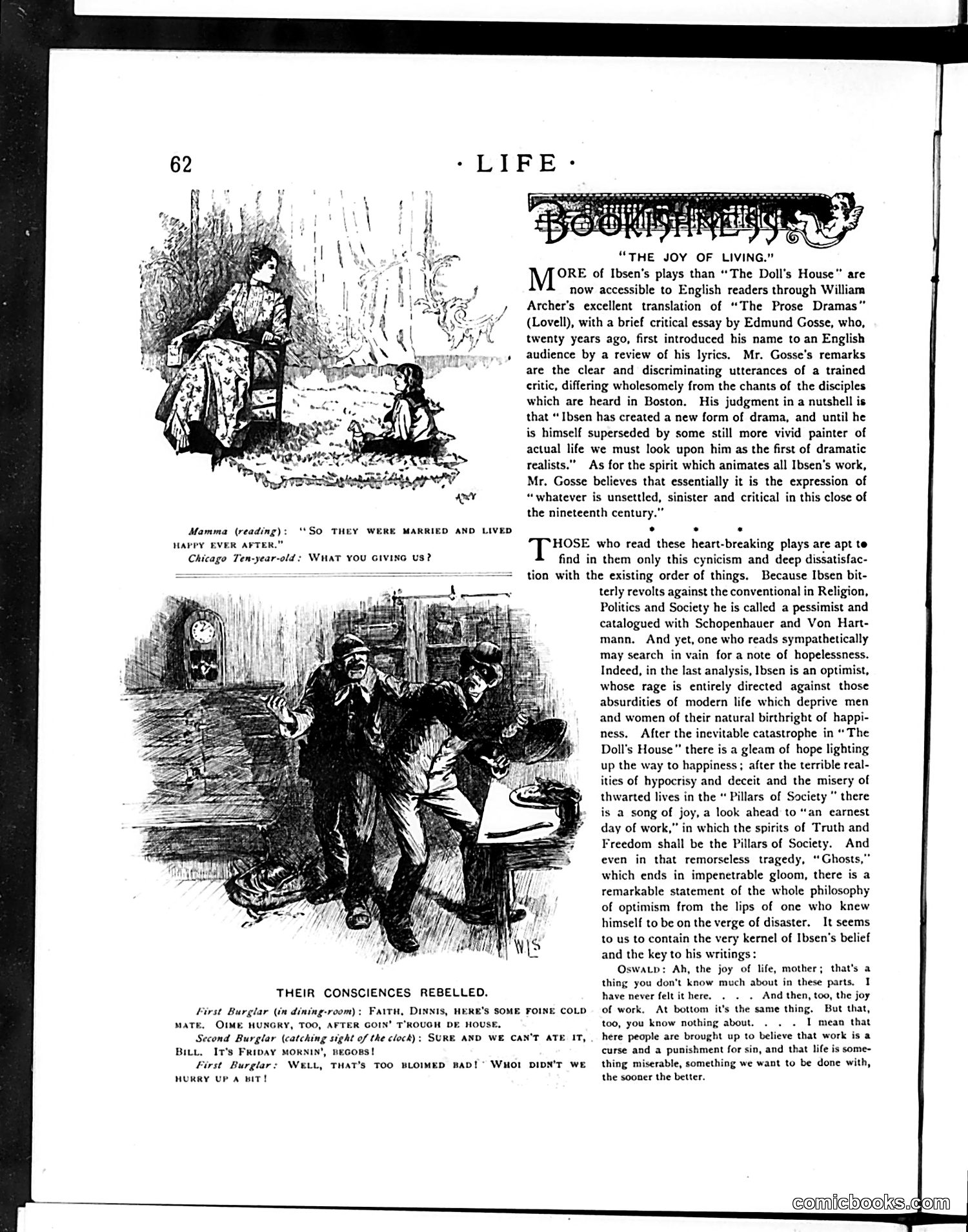
This page discusses Henrik Ibsen's plays, particularly "The Doll's House," newly available in English translation through William Archer. The two illustrations are scenes from the play, not political cartoons. The top image shows a domestic interior scene; the bottom depicts what appears to be characters in conversation, labeled "Their Consciences Rebelled." The text argues that Ibsen's work expresses dissatisfaction with conventional society—challenging Religion, Politics, and Social institutions. However, the article contends that beneath Ibsen's pessimism lies optimism: his critique targets society's absurdities to ultimately promote human happiness and freedom. The quoted dialogue at the bottom appears to be from the play itself, illustrating working-class characters discussing poverty and labor.
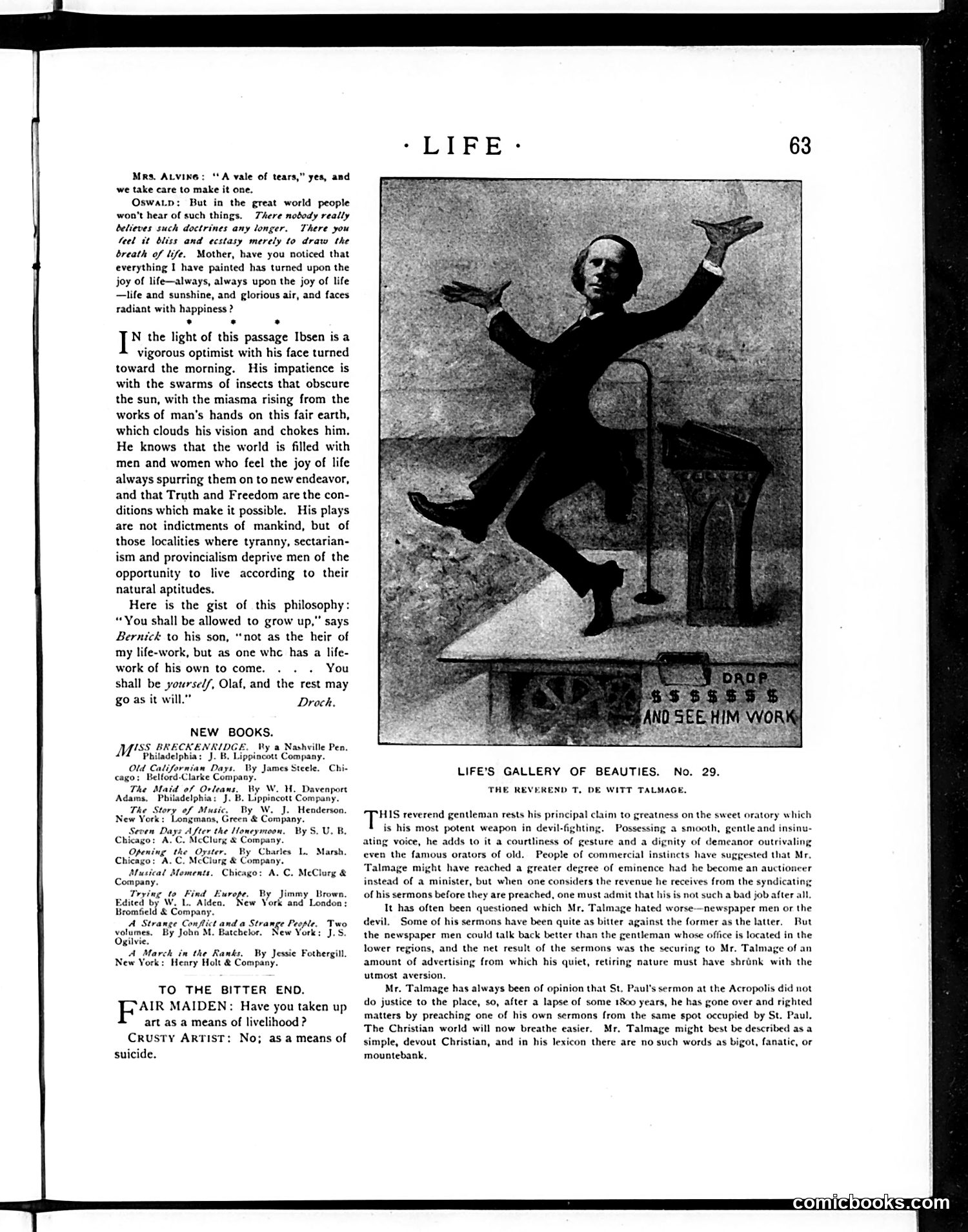
The main image shows a silhouetted figure in dramatic pose with text reading "AND SEE HIM WORK" - this is "Life's Gallery of Beauties, No. 29" featuring Reverend T. De Witt Talmage. The accompanying text praises Talmage as a powerful orator and preacher, describing his "smooth, potent insinuating voice" and "courtliness of gesture." However, the satire is subtle: the text notes that Talmage's prominence comes partly from newspaper publicity rather than purely from merit, and mentions his recent decision to preach from St. Paul's pulpit—suggesting his fame may exceed his actual substance. The small dialogue at bottom ("TO THE BITTER END") mocks an artist for claiming art as a "means of livelihood," sarcastically suggesting it's actually "a means of suicide."
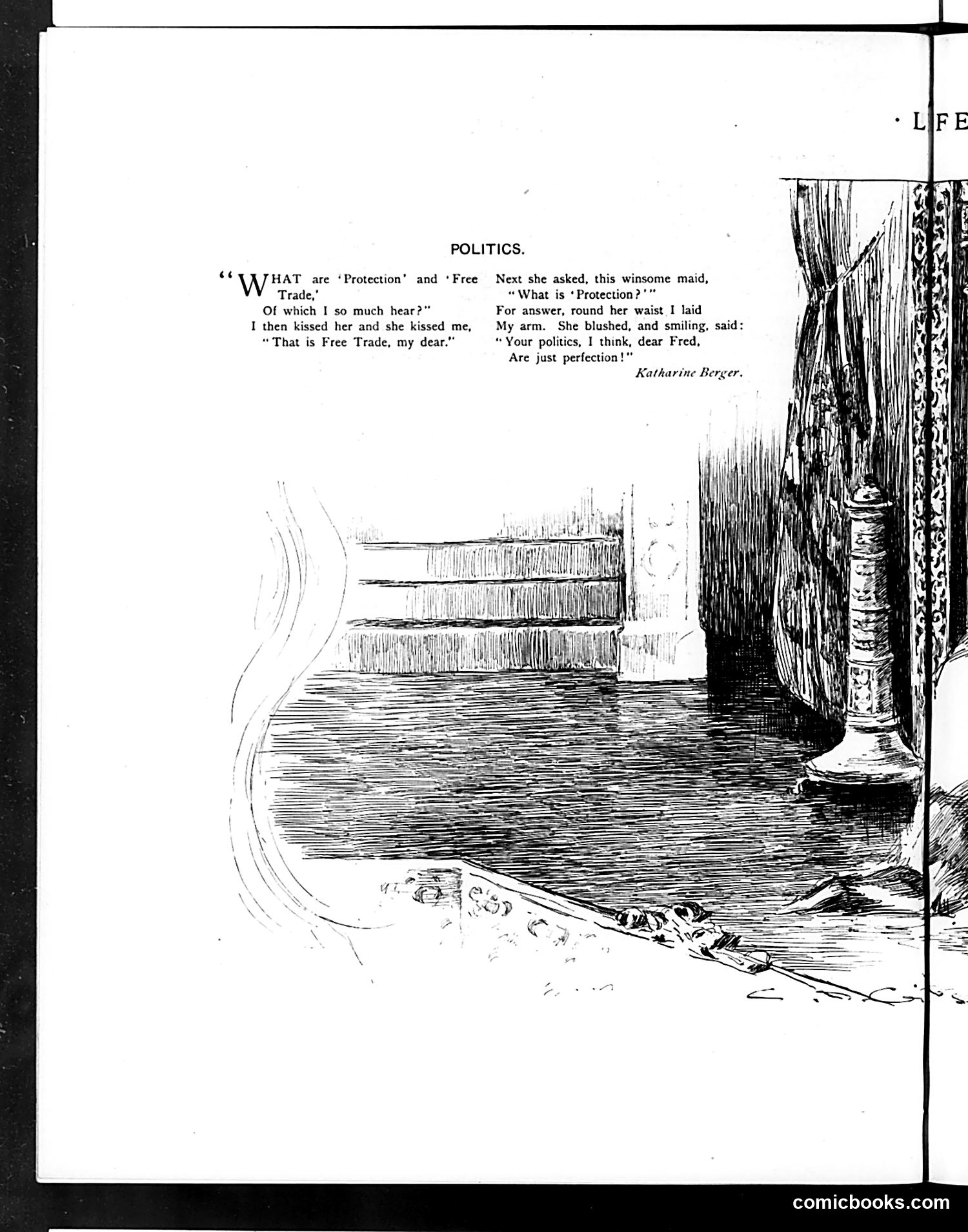
This satirical piece uses a domestic romantic scene to mock contemporary political debates over "Protection" and "Free Trade"—major economic policy disputes of the late 19th/early 20th century. A man asks his companion what "Protection" and "Free Trade" mean. Rather than explaining complex economics, she responds by putting her arm around his waist and calling his politics "just perfection"—avoiding substantive discussion entirely. The joke satirizes how political arguments were often reduced to empty sentiment and flattery rather than genuine debate. The intimate setting suggests that personal charm and affection substituted for actual policy understanding, mocking both the superficiality of political discourse and perhaps contemporary gender dynamics around women's participation in political conversation.
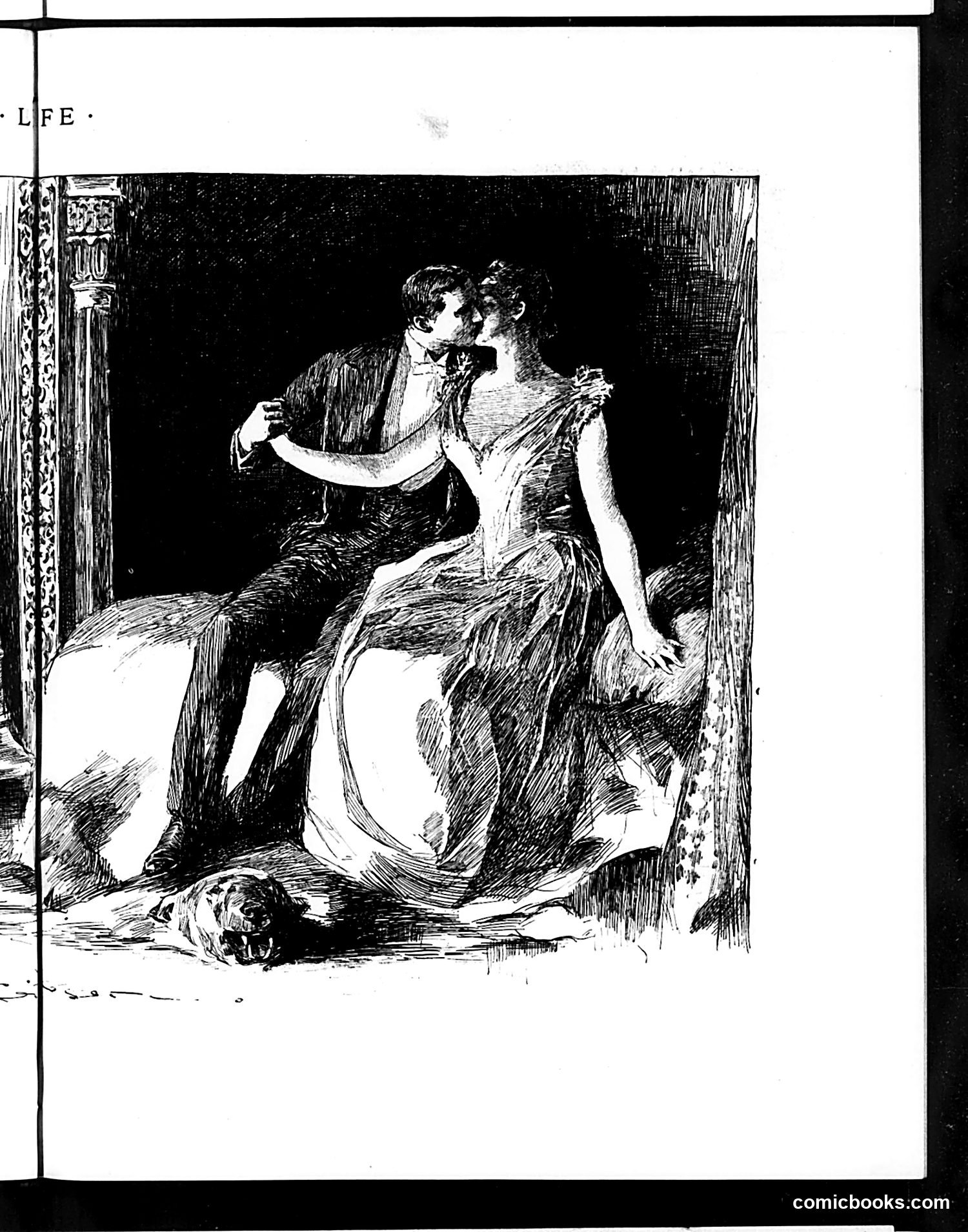
This illustration from *Life* magazine depicts a romantic/intimate scene between a well-dressed man in formal attire and a woman in an elegant gown, with a small dog visible at their feet. The page header reads "LIFE," identifying this as the satirical magazine. Without additional OCR text visible or caption information, the specific satirical point is unclear from the image alone. However, given *Life*'s focus on social satire, this likely comments on contemporary courtship, class dynamics, or romantic conventions of the era. The formal setting and clothing suggest commentary on upper-class behavior or romance. The precise historical reference, intended figures, and satirical message cannot be reliably determined without accompanying caption text or dated context.
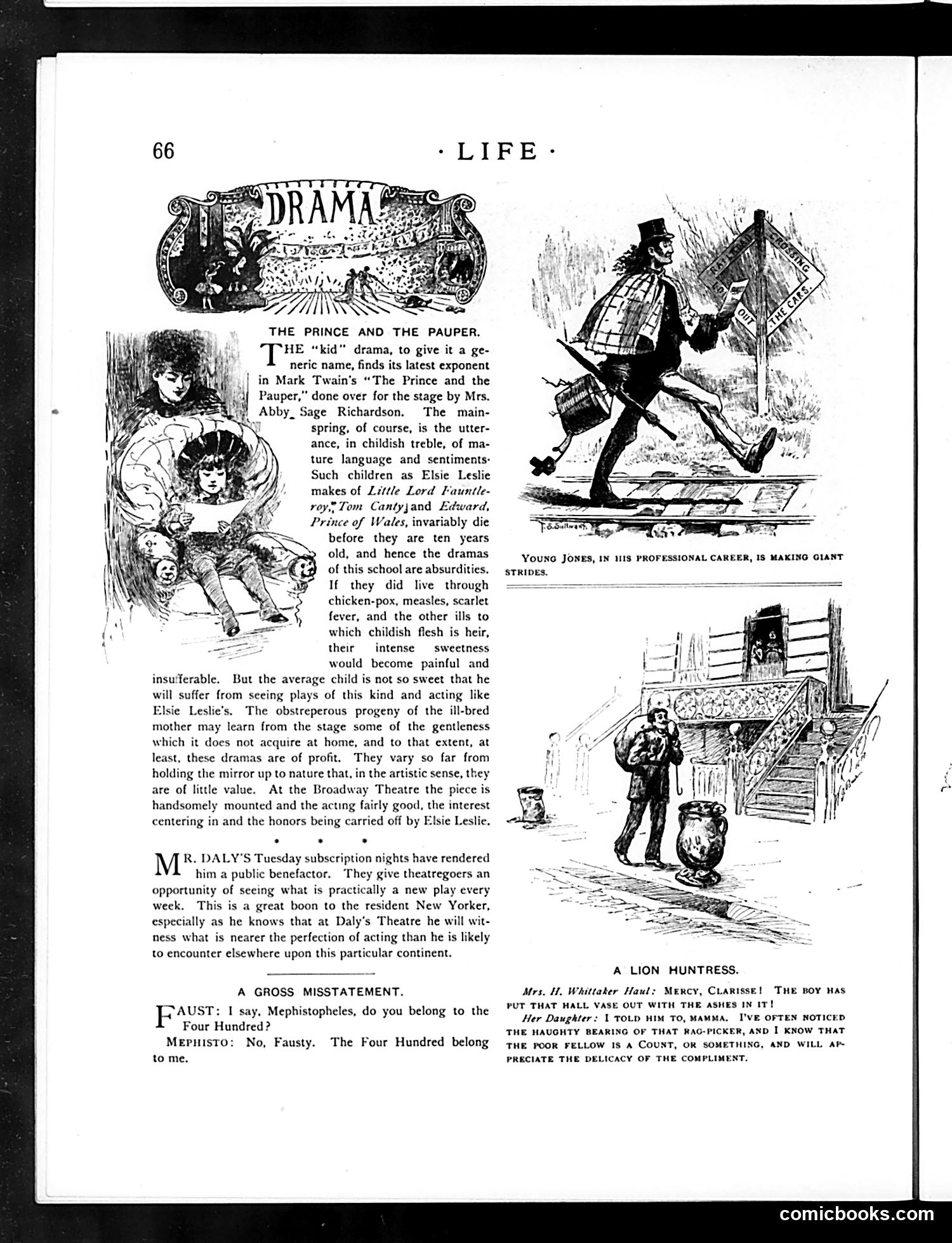
This page critiques theatrical productions marketed to children. The main article, "The Prince and the Pauper," discusses Mark Twain's play staged by Mrs. Abby Sage Richardson, criticizing how child actors perform material with "mature language and sentiments" inappropriate for their age. The author argues such "kid dramas" are absurdities—children die before age ten in the plot, making the sweet innocence unbearable. The illustrations show theatrical scenes, including one labeled "Young Jones, in his professional career, is making giant strides." Below is a brief comedic exchange ("A Gross Misstatement") between Faust and Mephisto about belonging to "The Four Hundred"—a reference to New York's elite social class. The final caption "A Lion Huntress" appears unrelated to the main text.
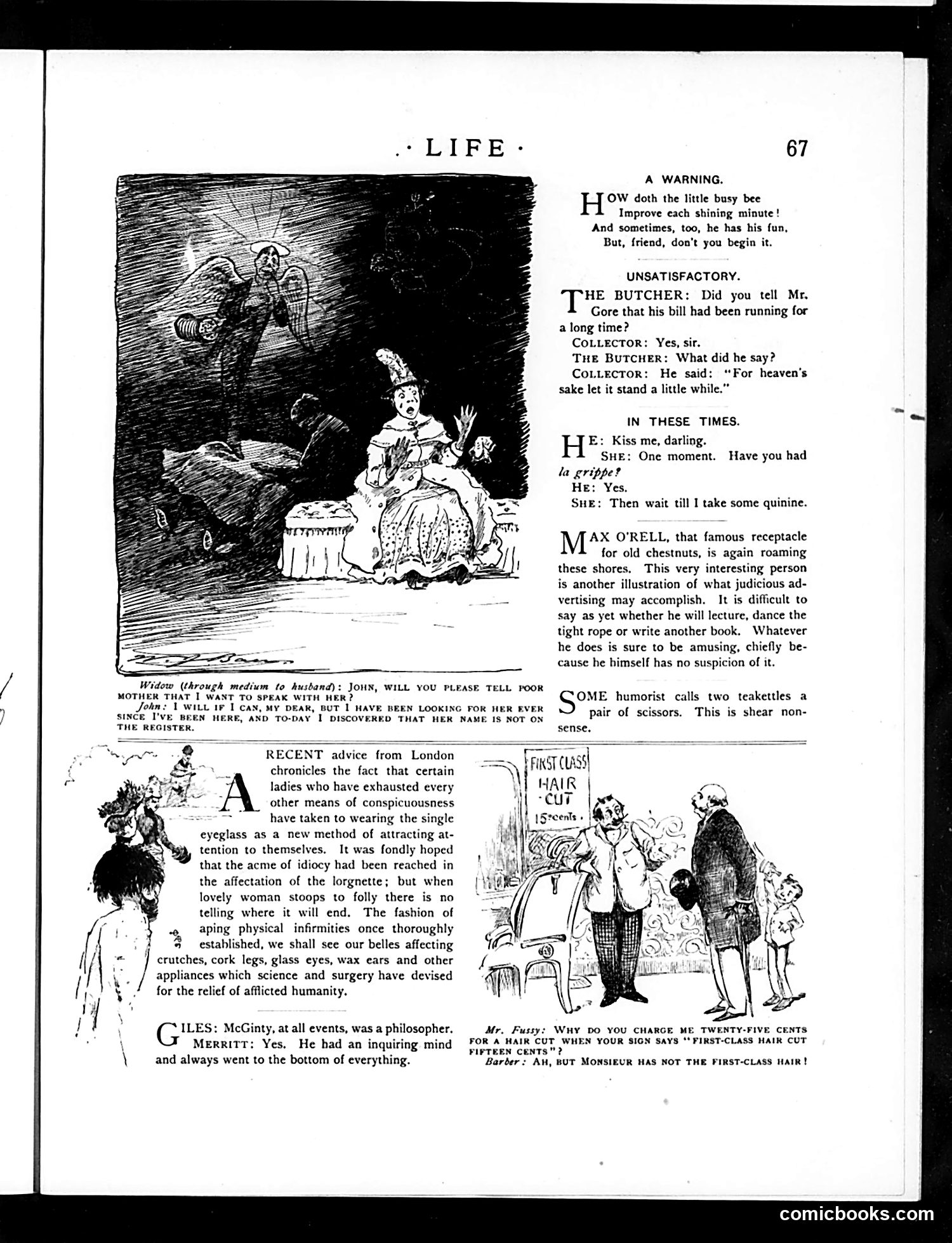
This page contains several satirical sketches and humorous short pieces typical of early Life magazine: **"A Warning"** mocks the busy bee's industriousness—advice not to emulate constant work. **"Unsatisfactory"** and **"In These Times"** are brief comic dialogues poking fun at mundane domestic situations and romance. **The main illustration** depicts a widow (labeled) speaking with John, apparently about a poor relative—likely satirizing family obligation and financial responsibility among the wealthy. **The lower section** mocks fashion trends, specifically women wearing eyeglasses as affectation rather than necessity—skewering the pretentiousness of conspicuous consumption and artificial attractiveness. **The final cartoon** jokes about a barber charging more than advertised, playing on the gap between signs and actual service quality. The overall tone is gentle social satire aimed at middle and upper-class absurdities and pretensions.
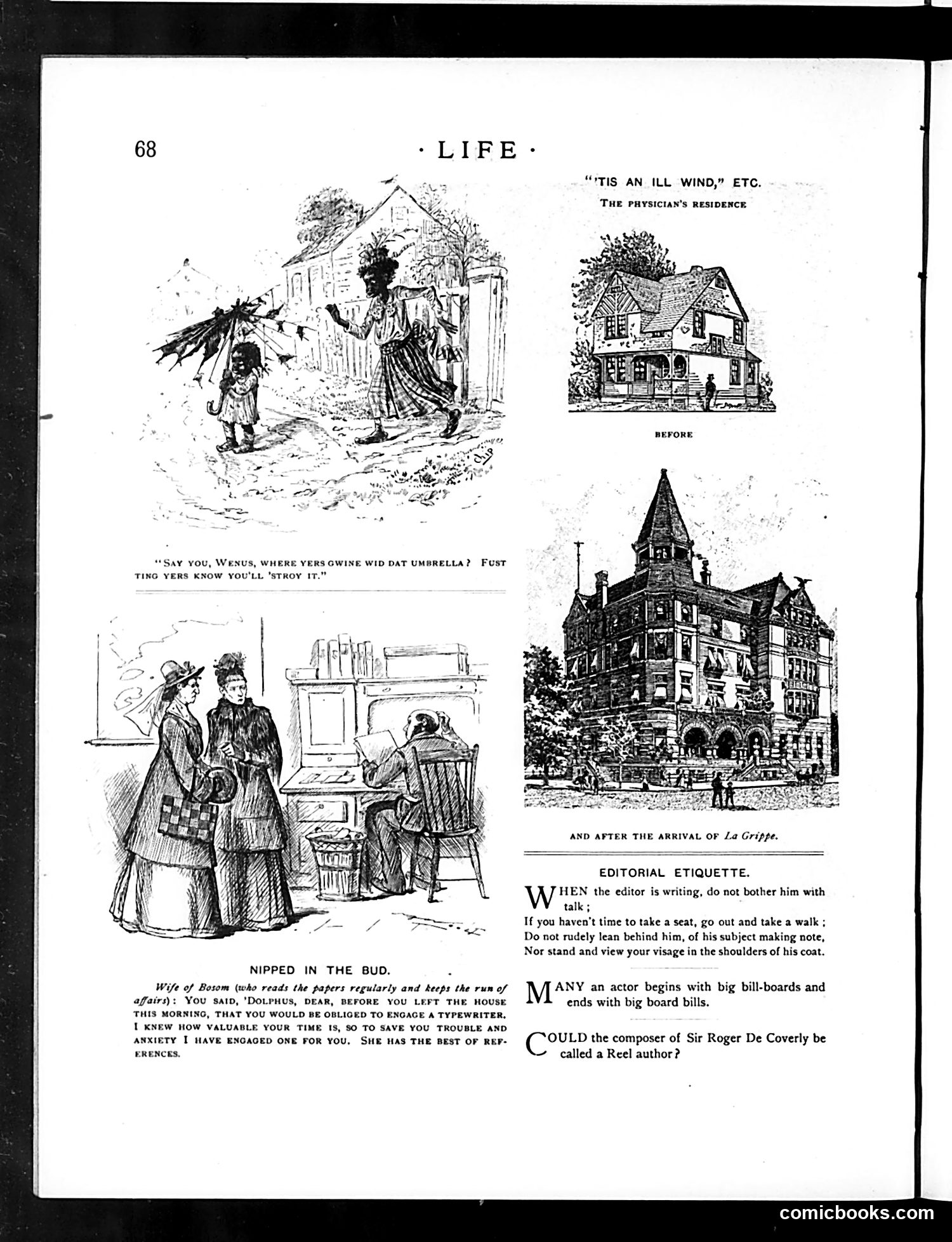
This page contains three separate satirical pieces: 1. **"Say You, Venus..."** (top left): A dialect-heavy joke about an African American character and an umbrella, using period stereotypes in speech patterns. 2. **"Nipped in the Bud"** (middle): A domestic comedy where a well-meaning wife, trying to help her busy husband "Dolphus," pre-emptively hires a female typewriter operator (secretary) for him. The satire targets both the wife's presumption and the anxiety about women entering the workplace as office workers—a relatively new phenomenon. 3. **"'Tis an Ill Wind"** (right): Shows architectural transformation of "the Physician's Residence" from a modest house to an impressive Victorian mansion, satirizing how disaster (illness/crisis) brings professional prosperity to doctors. The **Editorial Etiquette** section offers humorous office conduct rules, while the final quips mock theatrical economics and make a pun on "Sir Roger De Coverly" (a dance/tune).
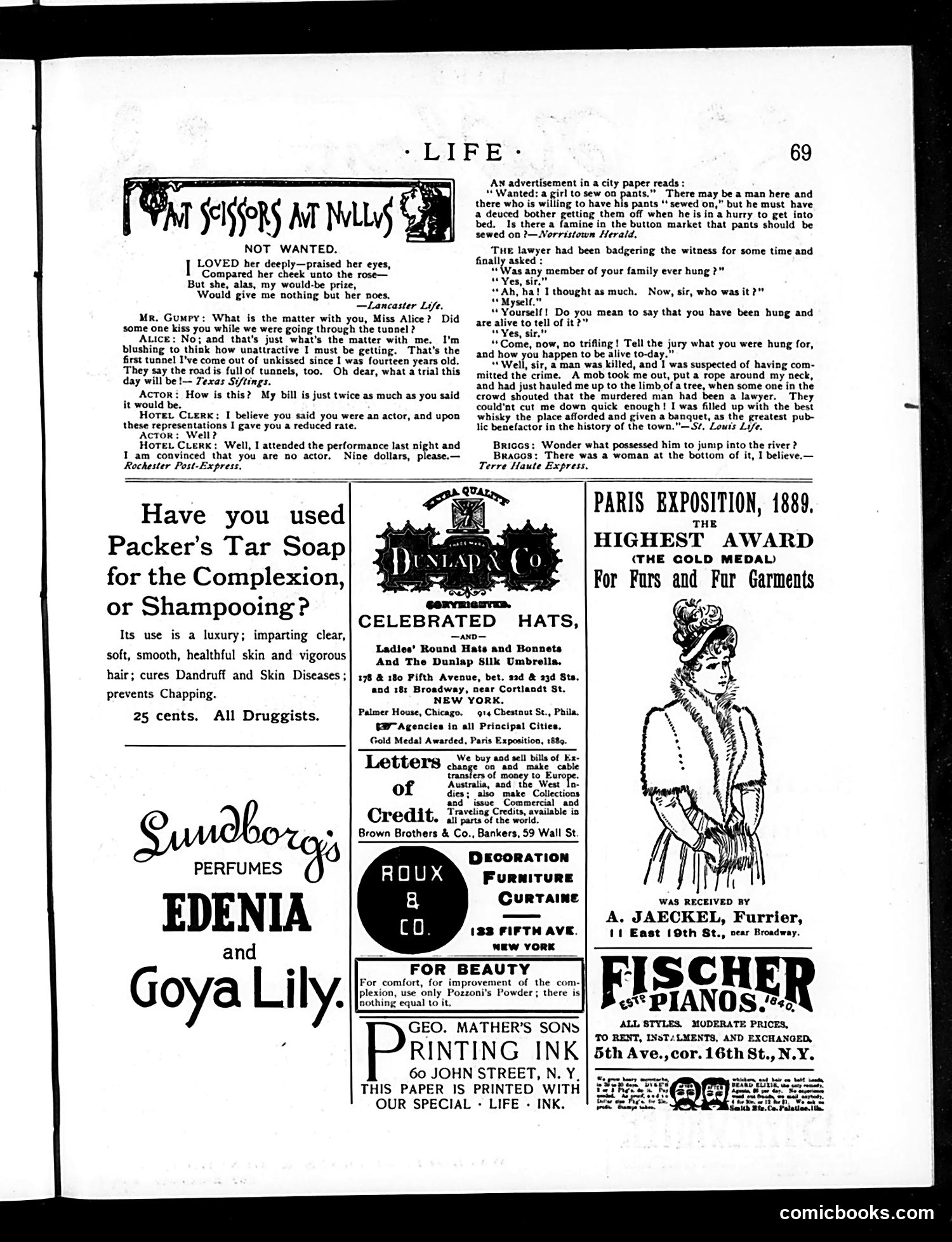
This page is primarily **advertisements and short humorous anecdotes** rather than political cartoons. The title "Barbers at Mills—Not Wanted" refers to a brief joke about a man comparing romantic rejection to being kissed in railway tunnels (a flirting custom of the era). The three main humor pieces mock: 1. **A woman's vanity** about missing unwanted kisses in tunnels 2. **An actor's poor performance**, where a hotel clerk refuses to honor a reduced rate after attending his show 3. **A lawyer-killing mob**, where would-be lynchers release their victim upon learning he allegedly killed a lawyer—satirizing anti-lawyer sentiment The final joke references **suicide by drowning**, with dark humor about a woman being "at the bottom of it." These represent typical **late-1800s Life magazine satire**: bawdy, anti-female, anti-lawyer, and casually violent. The page is otherwise filled with contemporary advertisements for soaps, perfumes, hats, and pianos—standard magazine content of the period.
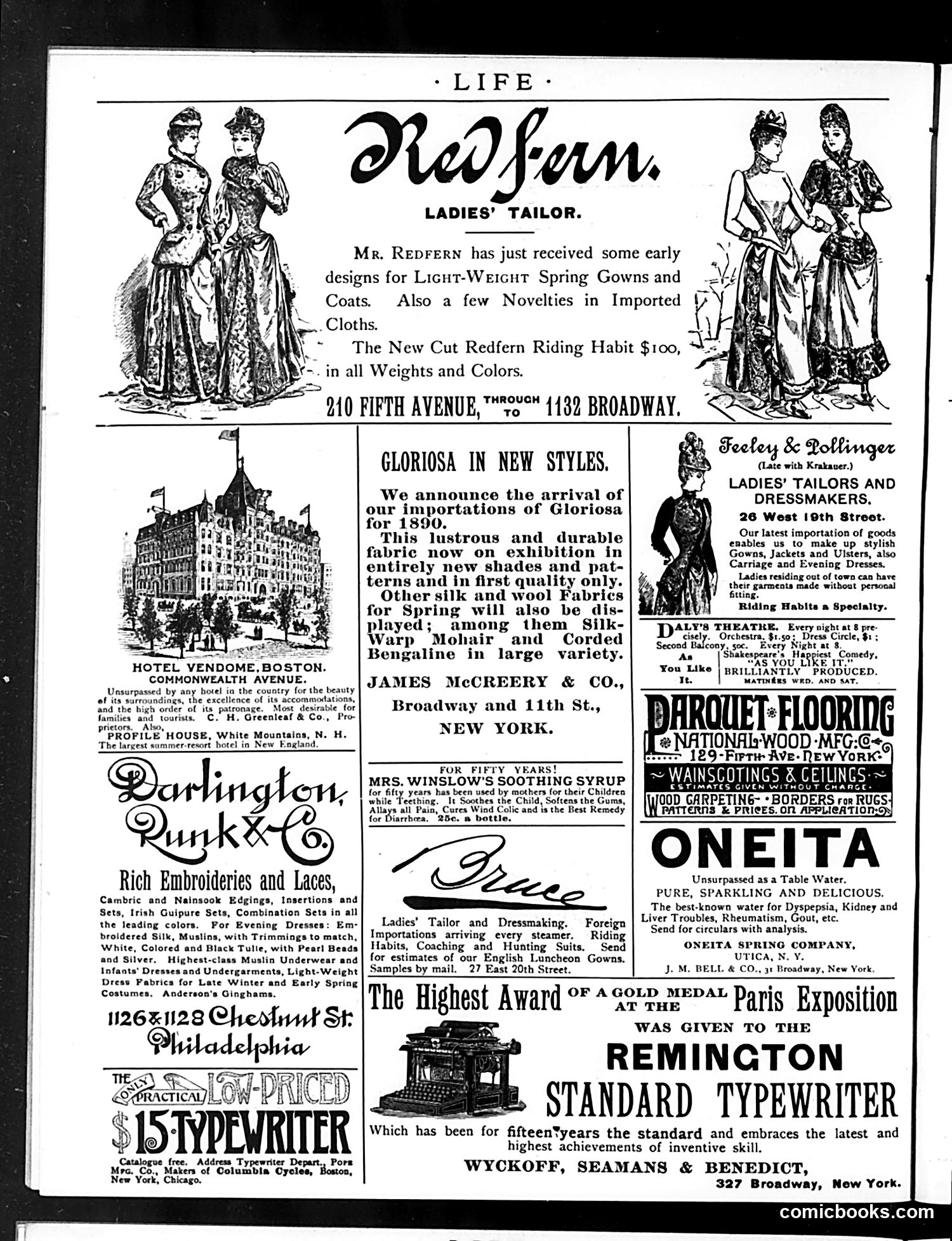
This is primarily a **advertisements page**, not a political cartoon. It showcases luxury goods and services from the 1890s era, targeting wealthy Americans. **Key advertisers include:** - **Red Fern** (ladies' tailor): High-end riding habits ($100—expensive for the era) and spring fashions - **Darlington, Runk & Co.** (Philadelphia): Fine embroideries and laces for evening wear - **James McCreery & Co.**: Imported fabrics like Gloriosa silk - **Mrs. Winslow's Soothing Syrup**: A patent medicine (now known to contain morphine) marketed to mothers for teething babies - **Remington Standard Typewriter**: Highlighted as award-winning **The social context**: These ads reflect Gilded Age consumerism—targeting affluent women interested in fashionable clothing and domestic products. The typewriter ad notably positions the machine as prestigious technology. Mrs. Winslow's Syrup's casual marketing of what we'd recognize as a dangerous narcotic shows period attitudes toward medicine and children's health.
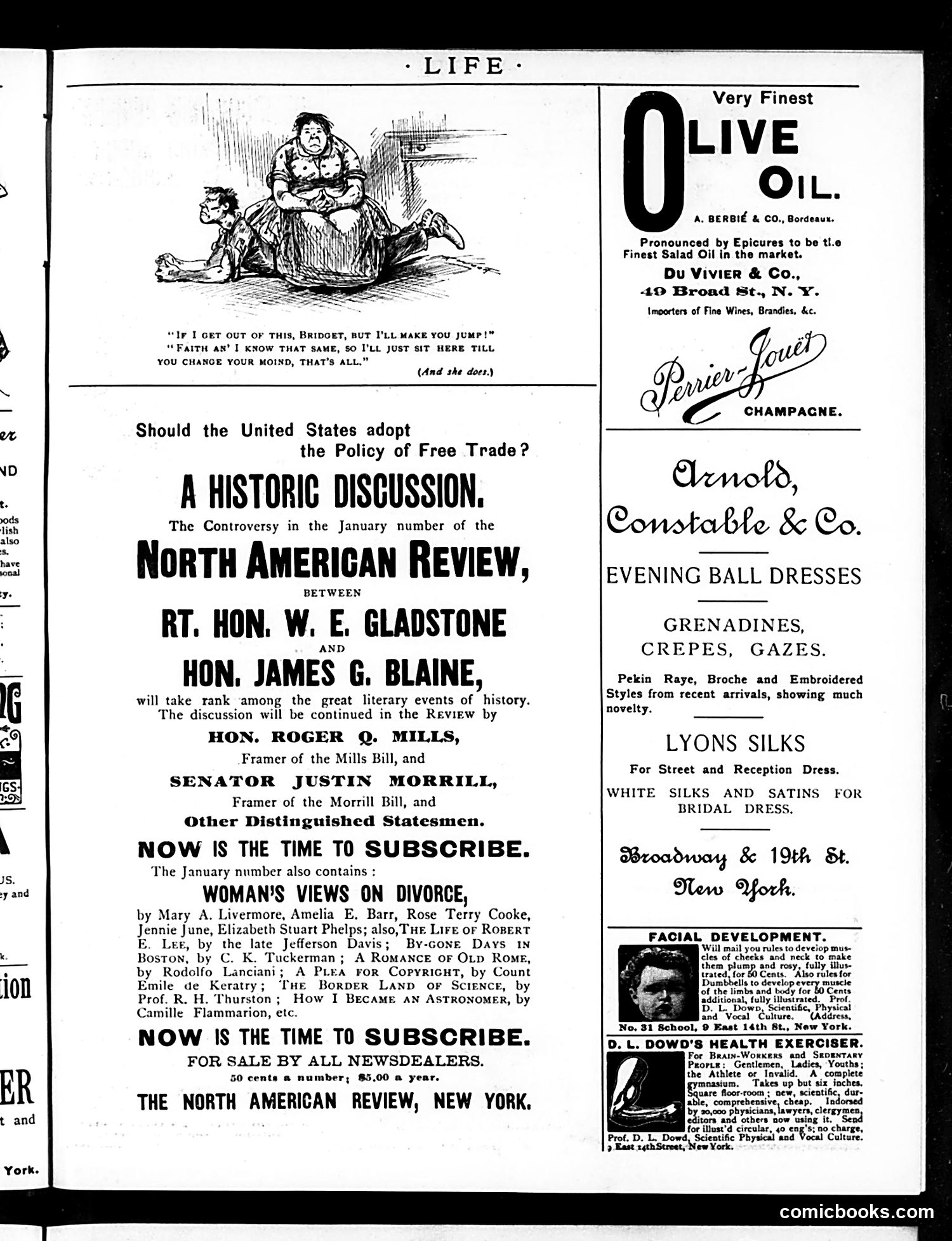
This page combines political content with period advertising. The main cartoon depicts an Irish domestic servant ("Bridget") in a standoff with her employer. The employer threatens to make her "jump" if she leaves, but Bridget refuses to budge, saying she knows "that same" (his threat) and will simply wait until he changes his mind. The joke satirizes the power dynamics between Irish immigrant servants and American employers—Bridget's passive resistance subverts the expected hierarchy, suggesting working-class immigrant women had leverage through indispensability. The bulk of the page advertises the *North American Review's* January issue, promoting a major free-trade debate between British politician W.E. Gladstone and American congressman James G. Blaine—framed as historically significant. The right column contains typical period luxury advertisements: French olive oil, champagne, silk dress fabrics, and dubious "health exercisers" promising physical development.
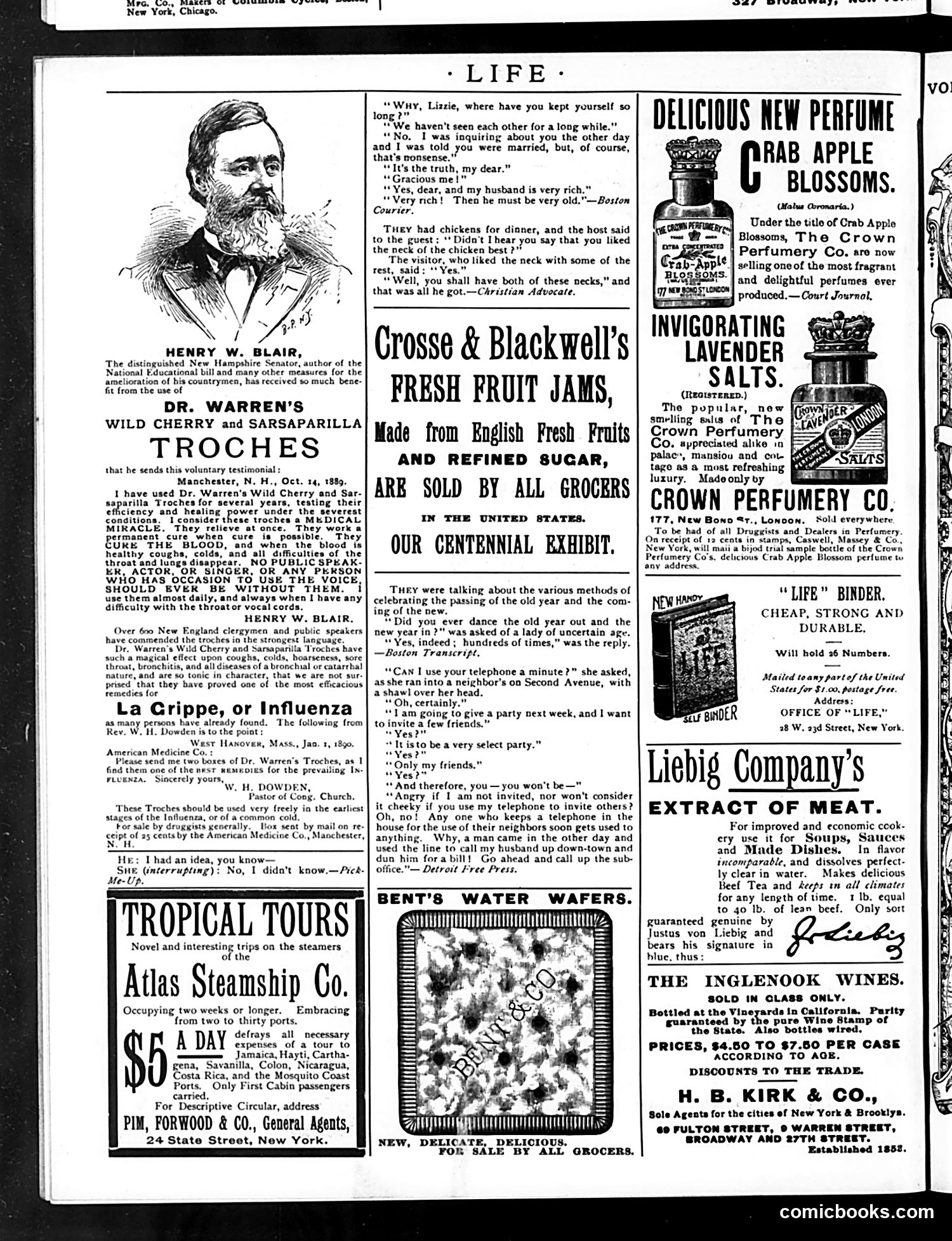
This page is primarily **advertising** with minimal editorial content. The main elements are: **Advertisement Focus:** - Dr. Warren's Wild Cherry and Sarsaparilla Troches (throat lozenges), endorsed by New Hampshire Senator Henry W. Blair as a "medical miracle" for speakers and singers - Crosse & Blackwell's jam - Atlas Steamship tropical tours - Liebig Company meat extract - Various other patent medicines and products **Humor Content:** Three brief jokes appear: 1. A woman claims to be married to a rich man; her friend assumes he must be old (satire on marrying for wealth) 2. A host offers a guest both chicken necks instead of the preferred single neck (wordplay on stinginess) 3. A woman claims to have danced in the old year hundreds of times despite appearing elderly (joke about vanity/age) **Historical Context:** This reflects the 1889-1890 era when Life magazine mixed advertising with light satirical humor. The endorsement format and unregulated medical claims were typical of the period before FDA oversight. The ads target middle and upper-class readers.