
Life, 1890-01-30 · page 6 of 16
Life — January 30, 1890 — page 6: what you’re looking at
What you’re looking at
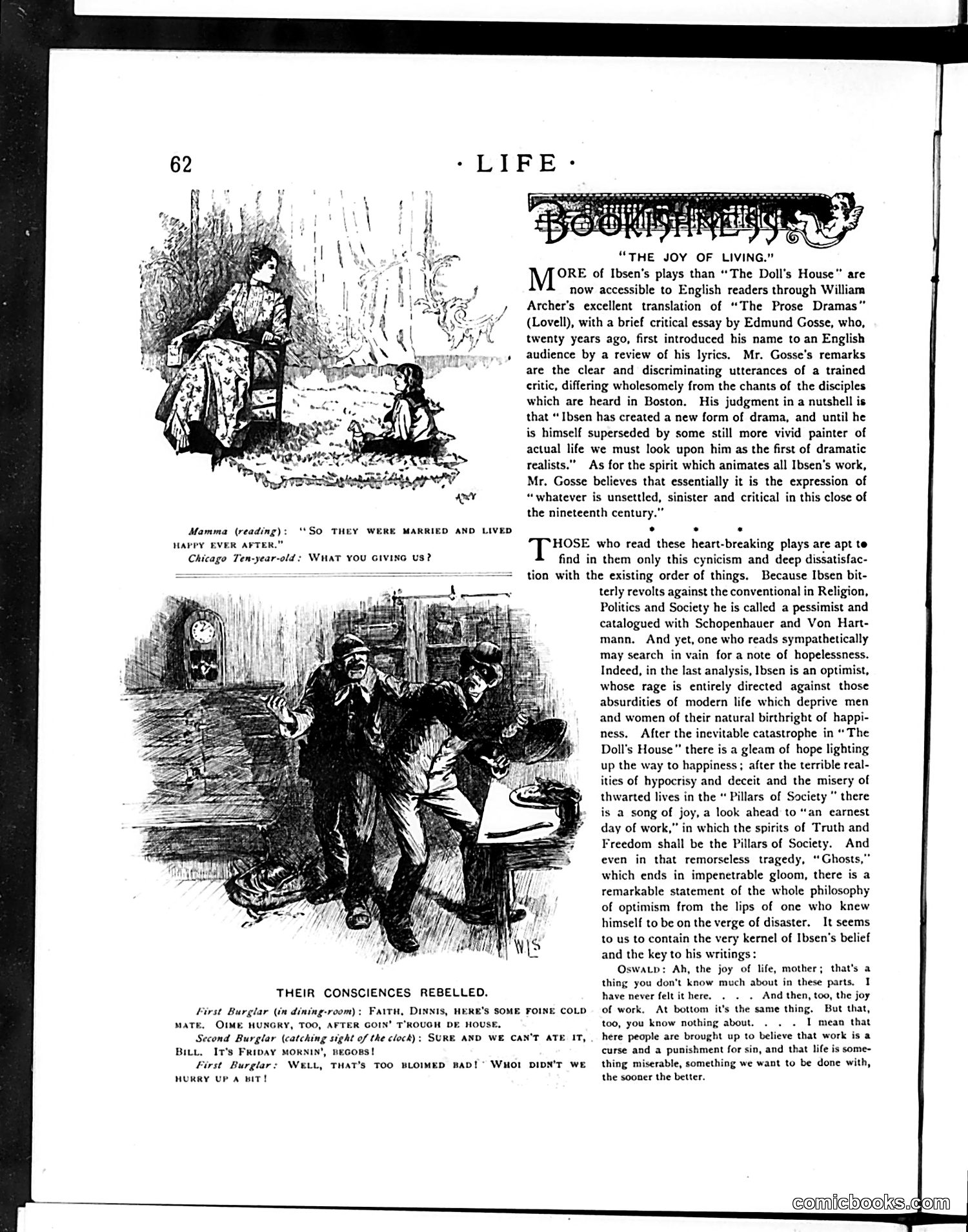
This page discusses Henrik Ibsen's plays, particularly "The Doll's House," newly available in English translation through William Archer. The two illustrations are scenes from the play, not political cartoons. The top image shows a domestic interior scene; the bottom depicts what appears to be characters in conversation, labeled "Their Consciences Rebelled." The text argues that Ibsen's work expresses dissatisfaction with conventional society—challenging Religion, Politics, and Social institutions. However, the article contends that beneath Ibsen's pessimism lies optimism: his critique targets society's absurdities to ultimately promote human happiness and freedom. The quoted dialogue at the bottom appears to be from the play itself, illustrating working-class characters discussing poverty and labor.
📄 Transcribed text from this page (OCR, searchable)
Machine-transcribed from the original scan — historical spelling and the odd misread are preserved.
“THE JOY OF LIVING.” M°% of Ibsen's plays than “The Doll's House” are now accessible to English readers through William Archer's excellent translation of “The Prose Dramas” (Lovell), with a brief critical essay by Edmund Gosse, who, twenty years ago, first introduced his name to an English audience by a review of his lyrics. Mr. Gosse’s remarks are the clear and discriminating utterances of a trained critic, differing wholesomely from the chants of the disciples which are heard in Boston. His judgment in a nutshell is that “Ibsen has created a new form of drama, and until he is himself superseded by some still more vivid painter of actual life we must look upon him as the first of dramatic realists.” As for the spirit which animates all Ibsen's work, Mr. Gosse believes that essentially it is the expression of “whatever is unsettled, sinister and critical in this close of the nineteenth century.” . . . MAPPY EVER AFTER. HOSE who read these heart-breaking plays are apt te Chicago Ten-year-old: WHAT YOU GIVING US? find in them only this cynicism and deep dissatisfac- tion with the existing order of things. Because Ibsen bit- terly revolts against the conventional in Religion, Politics and Society he is called a pessimist and catalogued with Schopenhauer and Von Hart- mann. And yet, one who reads sympathetically may search in vain for a note of hopelessness. Indeed, in the last analysis, Ibsen is an optimist, whose rage is entirely directed against those absurdities of modern life which deprive men and women of their natural birthright of happi- ness. After the inevitable catastrophe in “The Doll's House” there is a gleam of hope lighting up the way to happiness ; after the terrible real- ities of hypocrisy and deceit and the misery of thwarted lives in the “Pillars of Society” there is a song of joy, a look ahead to “an earnest day of work,” in which the spirits of Truth and Freedom shall be the Pillars of Society. And even in that remorseless tragedy, “Ghosts,” which ends in impenetrable gloom, there is a remarkable statement of the whole philosophy of optimism from the lips of one who knew himself to be on the verge of disaster. It seems to us to contain the very kernel of Ibsen's belief and the key to his writings: Oswatp: Ah, the joy of life, mother; that's a thing you don't know much about in these parts, I THEIR CONSCIENCES REBELLED. have never felt it here. . . . And then, too, the joy First Burglar (in dining-room): Fatu, DINNIS, HERE'S SOME FOINE COLD of work. At bottom it's the same thing. But that, MATE, OIME HUNGRY, TOO, AFTER GOIN’ T'ROUGH DE HOUSE. too, you know nothing about. . . . I mean that Second Burglar (catching sight of the clock): SURE AND WE CAN'T ATE IT, . here people are brought up to believe that work is a Bitt, It's Fripay Mornin’, BEGORS! curse and a punishment for sin, and that life is some- First Burglar: Wett, THAT’s TOO BLOIMED BAD!’ Wuol DIDN'T we thing miserable, something we want to be done with, HURRY UPA BIT! the sooner the better. comichooks.gom