
Life, 1890-01-30 · page 4 of 16
Life — January 30, 1890 — page 4: what you’re looking at
What you’re looking at
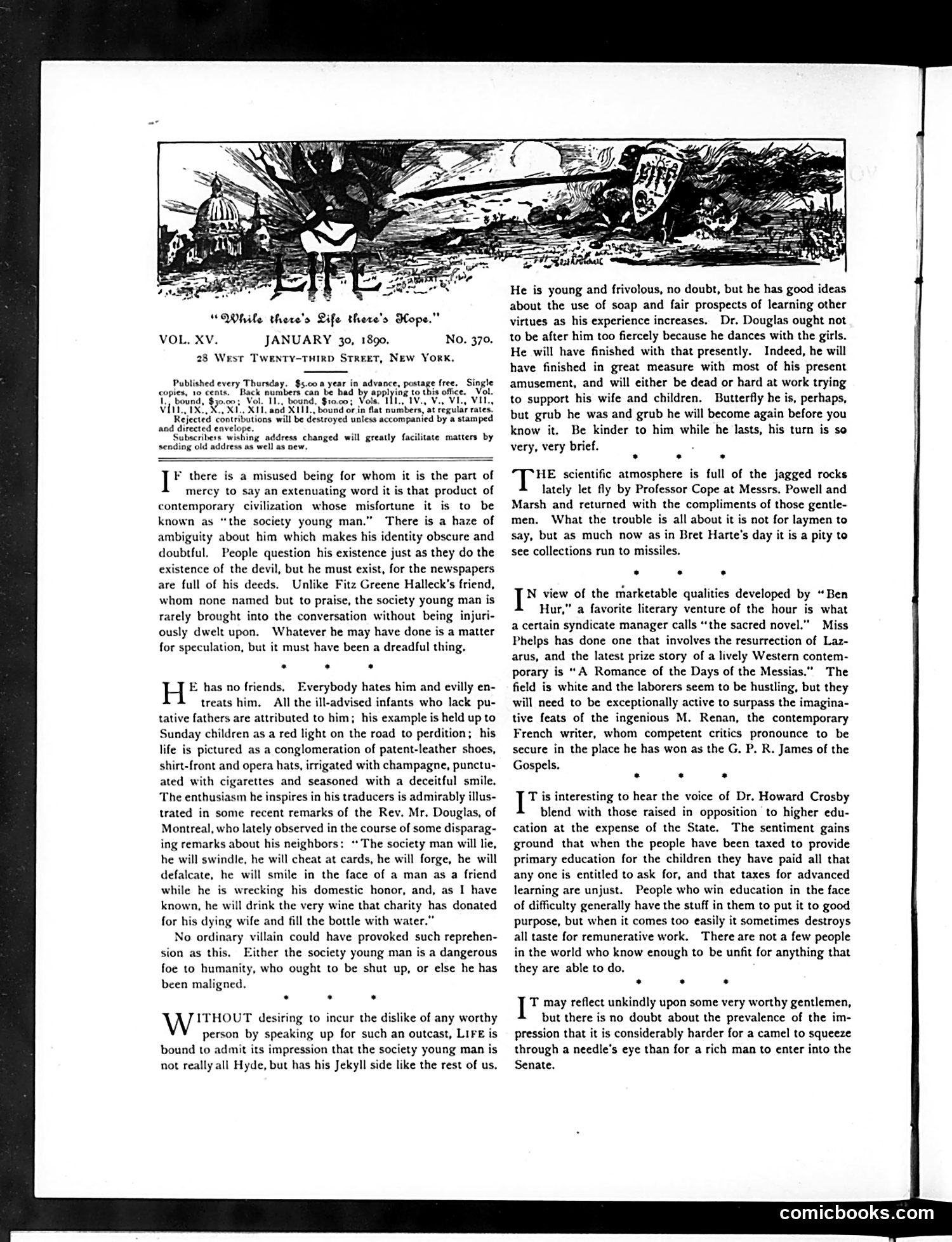
The cartoon at the top ("While there's Life there's Hope") depicts a skeletal Death figure hovering over a cityscape with a domed building (likely the U.S. Capitol). The imagery suggests mortality threatening civilization or government. The text below discusses a "society young man"—apparently a wealthy, dissolute figure criticized for moral failings. The passage references his dancing with girls, lack of ambition, and poor character, contrasting his superficial charm with his actual worthlessness. The editorial critiques social pretense and questions whether such individuals deserve society's acceptance. There's also commentary on educational debates and political figures like Dr. Howard Crosby regarding public spending on schools. The satire targets Gilded Age excess and the moral bankruptcy of privileged youth.
📄 Transcribed text from this page (OCR, searchable)
Machine-transcribed from the original scan — historical spelling and the odd misread are preserved.
“OMNite there's Life there's Hope.” VOL. XV. JANUARY 30, 1890, No. 370. 23 West Twenty-THIRD STREET, NEW York. Published every Thursday. $5.00 a year in advance, postage free. Si copies, 10 cents. Back numbers can be had by applying to this office. $30.00; Vol. I1., bound, $10.00; Vols. iti Iv., V.. VE, Vv X.. XI. XI. aod XI. bound of in flat numbers, 1 regular rates. ions will be destroyed unless accompani Rejected contr by a stamped and directed envelope. Subscribers wishing address changed will greatly facilitate matters by sending old address as well as new. F there is a misused being for whom it is the part of mercy to say an extenuating word it is that product of contemporary civilization whose misfortune it is to be known as “the society young man.” There is a haze of ambiguity about him which makes his identity obscure and doubtful. People question his existence just as they do the existence of the devil, but he must exist, for the newspapers are full of his deeds. Unlike Fitz Greene Halleck's friend, whom none named but to praise, the society young man is rarely brought into the conversation without being injuri- ously dwelt upon. Whatever he may have done is a matter for speculation, but it must have been a dreadful thing. . . . E has no friends. Everybody hates him and evilly en- treats him. All the ill-advised infants who lack pu- tative fathers are attributed to him; his example is held up to Sunday children as a red light on the road to perdition; his life is pictured as a conglomeration of patent-leather shoes, shirt-front and opera hats, irrigated with champagne, punctu- ated with cigarettes and seasoned with a deceitful smile. ‘The enthusiasm he inspires in his traducers is admirably illus- trated in some recent remarks of the Rev. Mr. Douglas, of Montreal, who lately observed in the course of some disparag- ing remarks about his neighbors: “The society man will lie, he will swindle, he will cheat at cards, he will forge, he will defalcate, he will smile in the face of a man as a friend while he is wrecking his domestic honor, and, as I have known, he will drink the very wine that charity has donated for his dying wife and fill the bottle with water.” No ordinary villain could have provoked such reprehen- sion as th Either the society young man is a dangerous foe to humanity, who ought to be shut up, or else he has been maligned. . . . W ITHOUT desiring to incur the dislike of any worthy person by speaking up for such an outcast, LIFE is bound to admit its impression that the society young man is not really all Hyde, but has his Jekyll side like the rest of us. He is young and frivolous, no doubt, but he has good ideas about the use of soap and fair prospects of learning other virtues as his experience increases. Dr. Douglas ought not to be after him too fiercely because he dances with the girls. He will have finished with that presently. Indeed, he will have finished in great measure with most of his present amusement, and will either be dead or hard at work trying to support his wife and children. Butterfly he is, perhaps, but grub he was and grub he will become again before you know it. Be kinder to him while he lasts, his turn is so very, very brief. . . . HE scientific atmosphere is full of the jagged rocks lately let fly by Professor Cope at Messrs. Powell and Marsh and returned with the compliments of those gentle- men. What the trouble is all about it is not for laymen to say, but as much now as in Bret Harte’s day it is a pity to see collections run to missiles. . . . N view of the marketable qualities developed by “Ben Hur,” a favorite literary venture of the hour is what a certain syndicate manager calls “the sacred novel.” Miss Phelps has done one that involves the resurrection of Laz- arus, and the latest prize story of a lively Western contem- porary is “A Romance of the Days of the Messias.” The field is white and the laborers seem to be hustling, but they will need to be exceptionally active to surpass the imagina- tive feats of the ingenious M. Renan, the contemporary French writer, whom competent critics pronounce to be secure in the place he has won as the G. P. R. James of the Gospels. . . . T is interesting to hear the voice of Dr. Howard Crosby blend with those raised in opposition to higher edu- cation at the expense of the State. The sentiment gains ground that when the people have been taxed to provide primary education for the children they have paid all that any one is entitled to ask for, and that taxes for advanced learning are unjust. People who win education in the face of difficulty generally have the stuff in them to put it to good purpose, but when it comes too easily it sometimes destroys all taste for remunerative work. There are not a few people in the world who know enough to be unfit for anything that they are able to do. . . . T may reflect unkindly upon some very worthy gentlemen, but there is no doubt about the prevalence of the im- pression that it is considerably harder for a camel to squeeze through a needle’s eye than for a rich man to enter into the Senate. comicbooks.com