
Life, 1890-01-30 · page 7 of 16
Life — January 30, 1890 — page 7: what you’re looking at
What you’re looking at
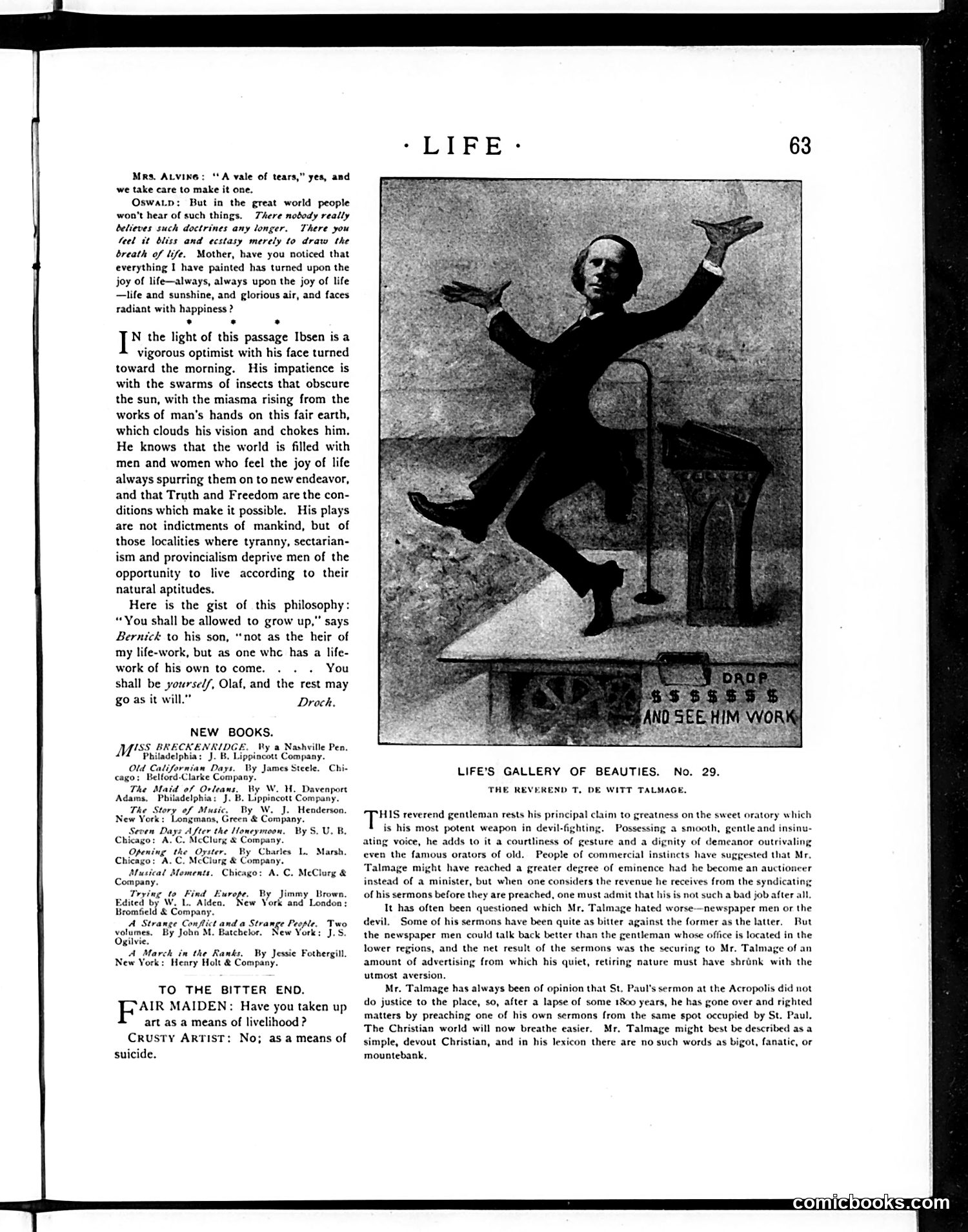
The main image shows a silhouetted figure in dramatic pose with text reading "AND SEE HIM WORK" - this is "Life's Gallery of Beauties, No. 29" featuring Reverend T. De Witt Talmage. The accompanying text praises Talmage as a powerful orator and preacher, describing his "smooth, potent insinuating voice" and "courtliness of gesture." However, the satire is subtle: the text notes that Talmage's prominence comes partly from newspaper publicity rather than purely from merit, and mentions his recent decision to preach from St. Paul's pulpit—suggesting his fame may exceed his actual substance. The small dialogue at bottom ("TO THE BITTER END") mocks an artist for claiming art as a "means of livelihood," sarcastically suggesting it's actually "a means of suicide."
📄 Transcribed text from this page (OCR, searchable)
Machine-transcribed from the original scan — historical spelling and the odd misread are preserved.
MRS. ALVING: ‘A vale of tears,” yes, and we take care to make it one, Oswatp: But in the great world people won't hear of such things. There nobody really believes such doctrines any longer. There you feck it bliss and ecstasy merely to draw the breath of life. Mother, have you noticed that everything I have painted has turned upon the joy of life—always, always upon the joy of life —life and sunshine, and glorious air, and faces radiant with happiness? . . ey the light of this passage Ibsen is a vigorous optimist with his face turned toward the morning. His impatience is with the swarms of insects that obscure the sun, with the miasma rising from the works of man's hands on this fair earth, which clouds his vision and chokes him. He knows that the world is filled with men and women who feel the joy of life always spurring them on to new endeavor, and that Truth and Freedom are the con- ditions which make it possible. His plays are not indictments of mankind, but of those localities where tyranny, sectarian- ism and provincialism deprive men of the opportunity to live according to their natural aptitudes. Here is the gist of this philosophy: “You shall be allowed to grow up,” says Bernick to his son, “not as the heir of my life-work, but as one whc has a life- work of his own to come. . . . You shall be yoursed/, Olaf, and the rest may go as it will.” Drock. NEW BOOKS. c. Ry a Nashville Pen. Philadelphia: J.B. Lippincott Company. Old Californian Days, By James Steele, Chi- cago: Belford-Clarke Company. The Maid of Orleans. Wy W. VW. Davenport Adams. Philadelphia: J. B. Lippincott Company. The Story of Music. By W. J. Henderson. New York: Longmans, Green & Company. ‘even Daye After the Honeymoon, By S. U. B. Chicago: A.C. McClurg & Company. Opening the Oyster, By Charles L. Chicago: A.C. McClurg & Company. Musical Moments, Chicago: A. C, McClurg & Company. Ke gd fo Find Europe. By Jimmy Brown. Edited by W. L. Aldea, New York and London: Tiromield & Gorspanys A Strange Conflict and a Strange People. Two volumes, By Joho M. Batchelor, New York: J.S. Ogilvie. A March in the Ranks. By Jessie Fothergill. New York: Henry Holt & Company, Marsh. TO THE BITTER END. AIR MAIDEN: Have you taken up art as a means of livelihood ? Crusty ARTIST: No; asa means of suicide. LIFE’S GALLERY OF BEAUTIES. No. 29. THE REVEREND T, DE WITT TALMAGE. T" IS reverend gentleman rests his principal claim to greatness on the sweet oratory which is his most potent weapon in devil-fighting. Possessing a smooth, gentle and insinu- ating voice, he adds to it a courtliness of gesture and a dignity of demeanor outrivaling even the famous orators of old. People of commercial instincts have suggested that Mr. Talmage might have reached a greater degree of eminence had he become an auctioncer instead of a minister, but when one considers the revenue he receives from the syndicating. of his sermons before they are preached, one must admit that his is not such a bad job after all. It has often been questioned which Mr. Talmage hated worse—newspaper men or the devil. Some of his sermons have been quite as bitter against the former as the latter. But the newspaper men could talk back better than the gentleman whose office is located in the lower regions, and the net result of the sermons was the securing to Mr. Talmage of an amount of advertising from which his quiet, retiring nature must have sbrank with the utmost aversion. Mr. Talmage has always been of opinion that St, Paul's sermon at the Acropolis did not do justice to the place, so, after a lapse of some 1800 years, he has gone over and righted matters by preaching one of his own sermons from the same spot occupied by St. Paul. The Christian world will now breathe easier. Mr. Talmage might best be described as a simple, devout Christian, and in his lexicon there are no such words as bigot, fanatic, or mountebank.