
A complete issue · 18 pages · 1890
Life — January 9, 1890
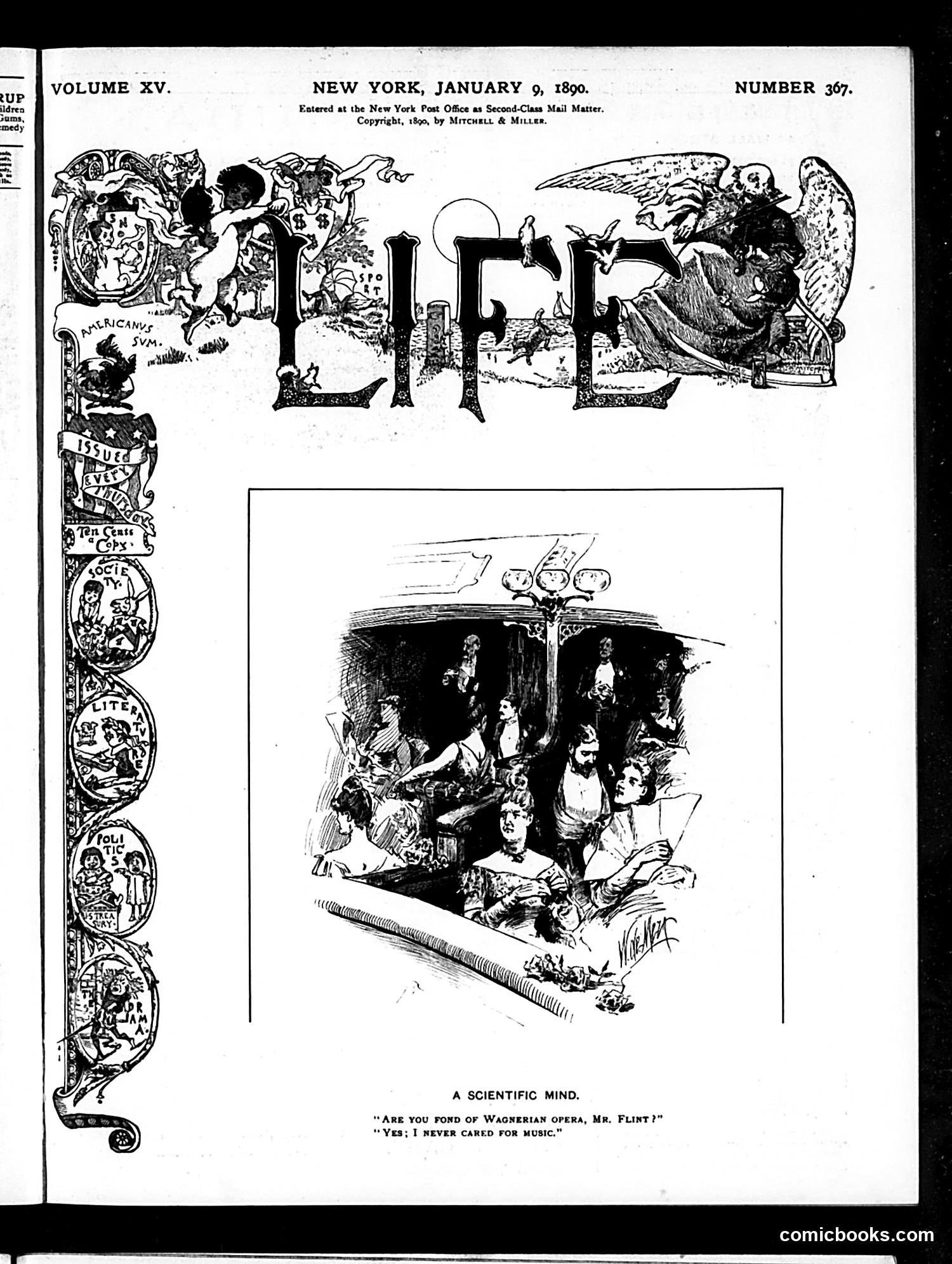
The cartoon satirizes a man named Mr. Flint (identified in the caption) who claims to have a "scientific mind" while riding in what appears to be a crowded, uncomfortable streetcar or public transport vehicle filled with passengers. The joke hinges on the caption's contradiction: when asked if he's fond of Wagnerian opera, Flint responds "Yes; I never cared for music." This is absurd—Wagner's operas are famous for their musical complexity. The satire suggests Flint pretends to intellectual sophistication (claiming to enjoy challenging modern opera) while simultaneously admitting he dislikes music itself, exposing his pretense and lack of genuine appreciation for the arts despite his claimed "scientific" sensibilities.
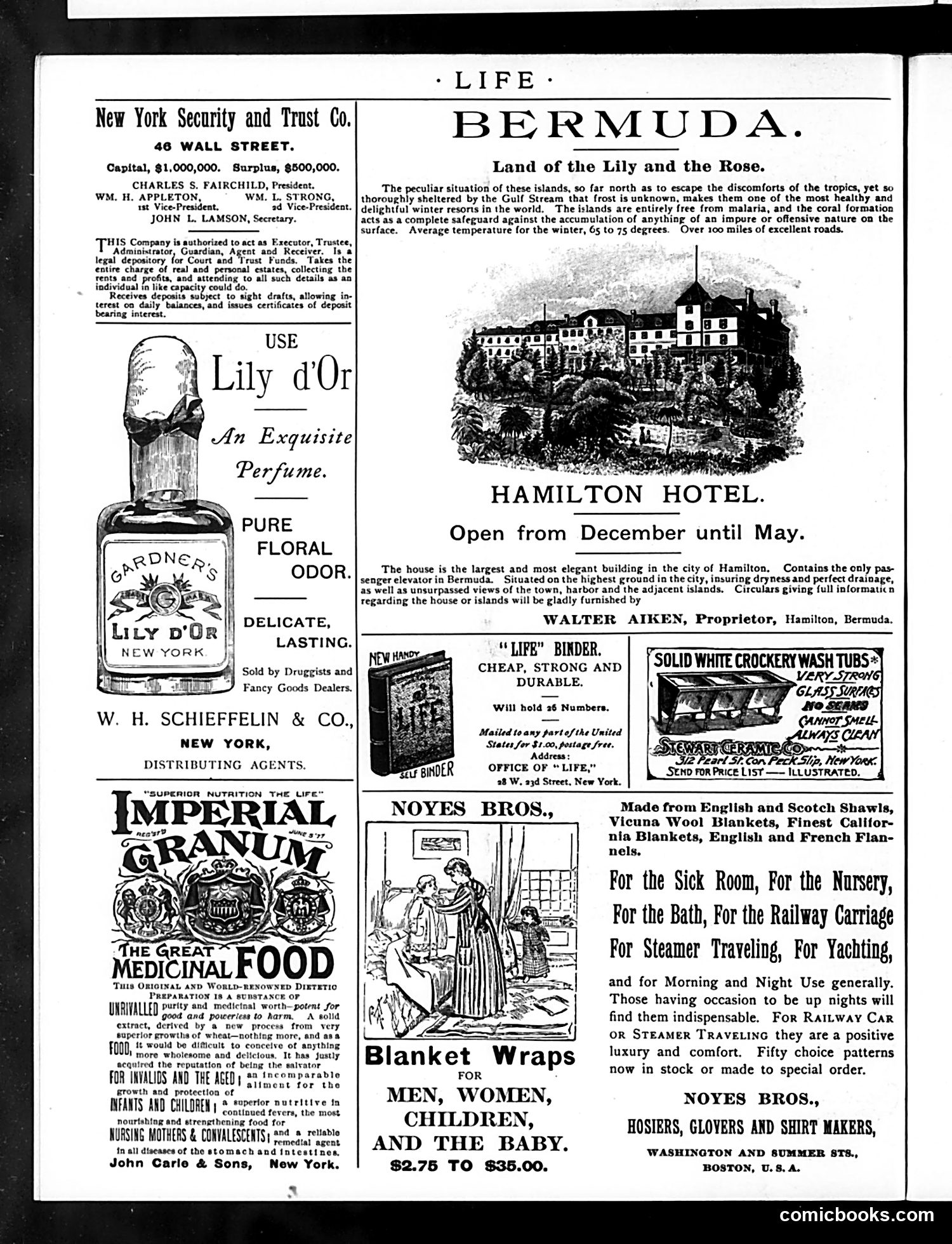
This page is **primarily advertisements**, not political cartoons or satire. The main content includes: - A New York Security and Trust Company bank advertisement - "Lily d'Or" perfume ad by W.H. Schieffelin & Co. - Imperial Granum food product advertisement - Hamilton Hotel tourism ad for Bermuda - "Life" brand binder and grocery wash tubs ads - Noyes Bros. blanket wraps advertisement The only illustration with narrative content shows a domestic scene (appears to be from a Noyes Bros. advertisement) depicting someone at a window, but it's commercial rather than satirical. This page reflects late-19th/early-20th-century *Life* magazine's business model: advertising revenue subsidized satirical content elsewhere in the publication.
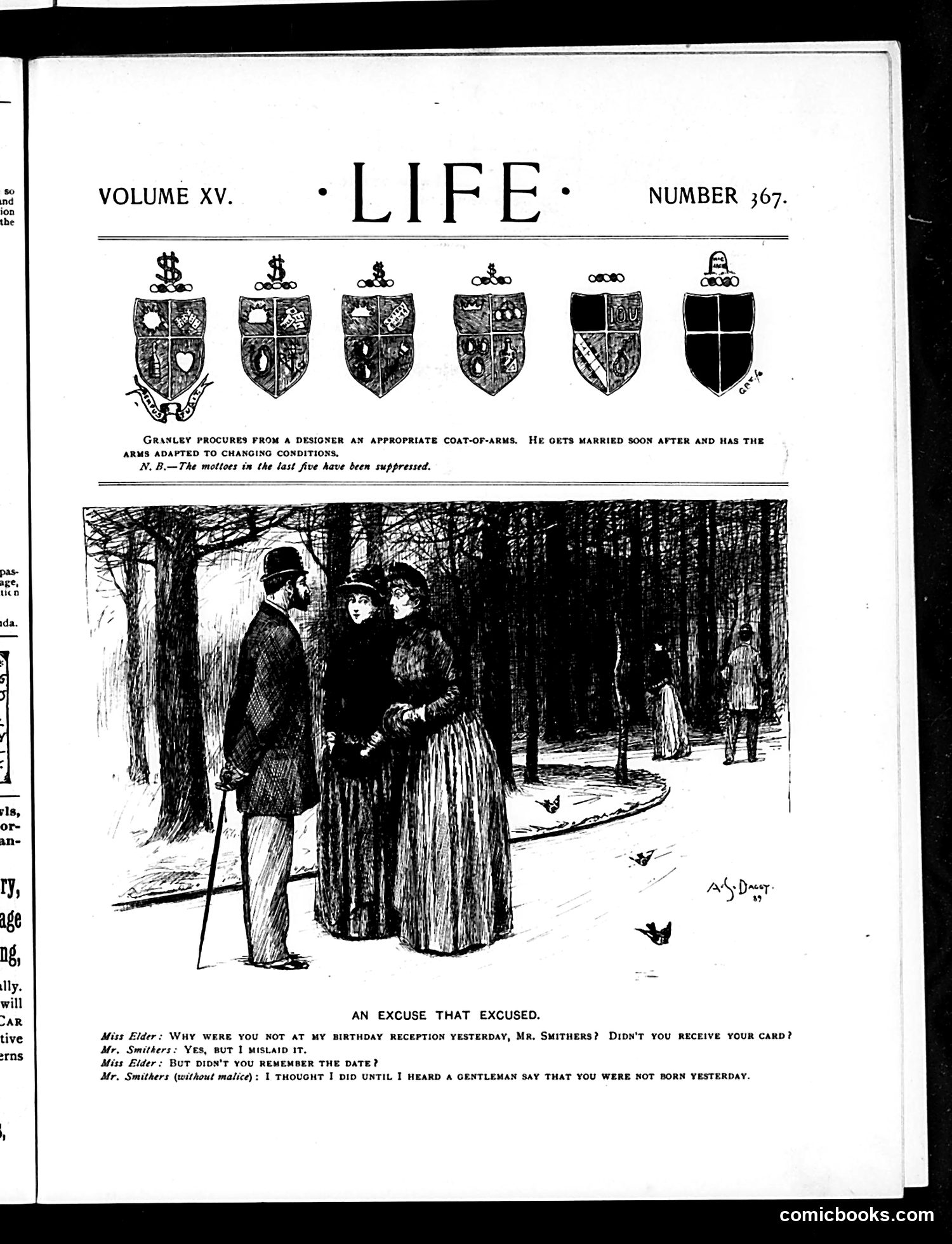
This cartoon satirizes a social embarrassment of the Edwardian era. Mr. Smithers missed Miss Elder's birthday reception, claiming he'd misplaid the invitation card. When confronted, he offers an increasingly implausible excuse: he thought he wasn't born yesterday—implying he wouldn't forget such an important date. The humor lies in the transparent absurdity of his excuse-making. His claim that "a gentleman" told him Smithers wasn't born yesterday is circular logic meant to deflect responsibility, yet it obviously fails. The title "An Excuse That Excused" is ironic—his excuse accomplishes nothing and likely worsens his social standing with Miss Elder, whose skeptical expression suggests she's not fooled. The cartoon mocks weak excuses and social pretension.
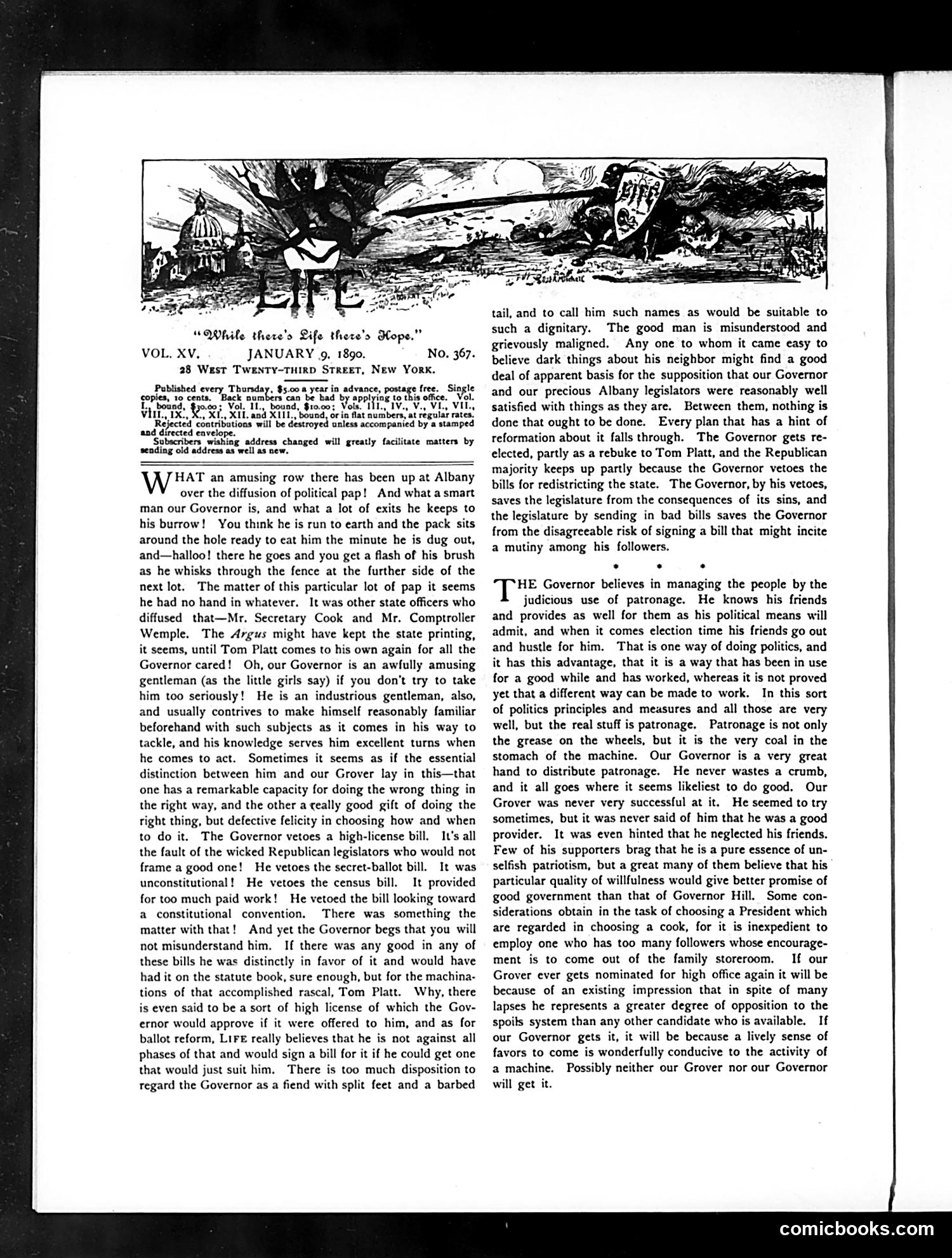
**The Cartoon ("While there's Life there's Hope")** The illustration depicts a chaotic Albany political scene with figures fighting over state governance. The satire targets Governor David B. Hill and Republican legislators engaged in bitter disputes over bills and redistricting. **Key References:** - **Governor Hill** (likely the central figure): Criticized for using vetoes strategically against Republican bills, then claiming credit when circumstances favor him - **Tom Platt**: A Republican leader mentioned as the target of Hill's political maneuvering - The "secret-ballot bill" and redistricting disputes reflect actual 1890 New York political conflicts **The Satire:** The piece mocks Hill's pragmatic use of patronage and political tactics—managing the public through favors rather than principles. The cartoon suggests Albany politics involves calculated maneuvering where both parties game the system, regardless of good governance.
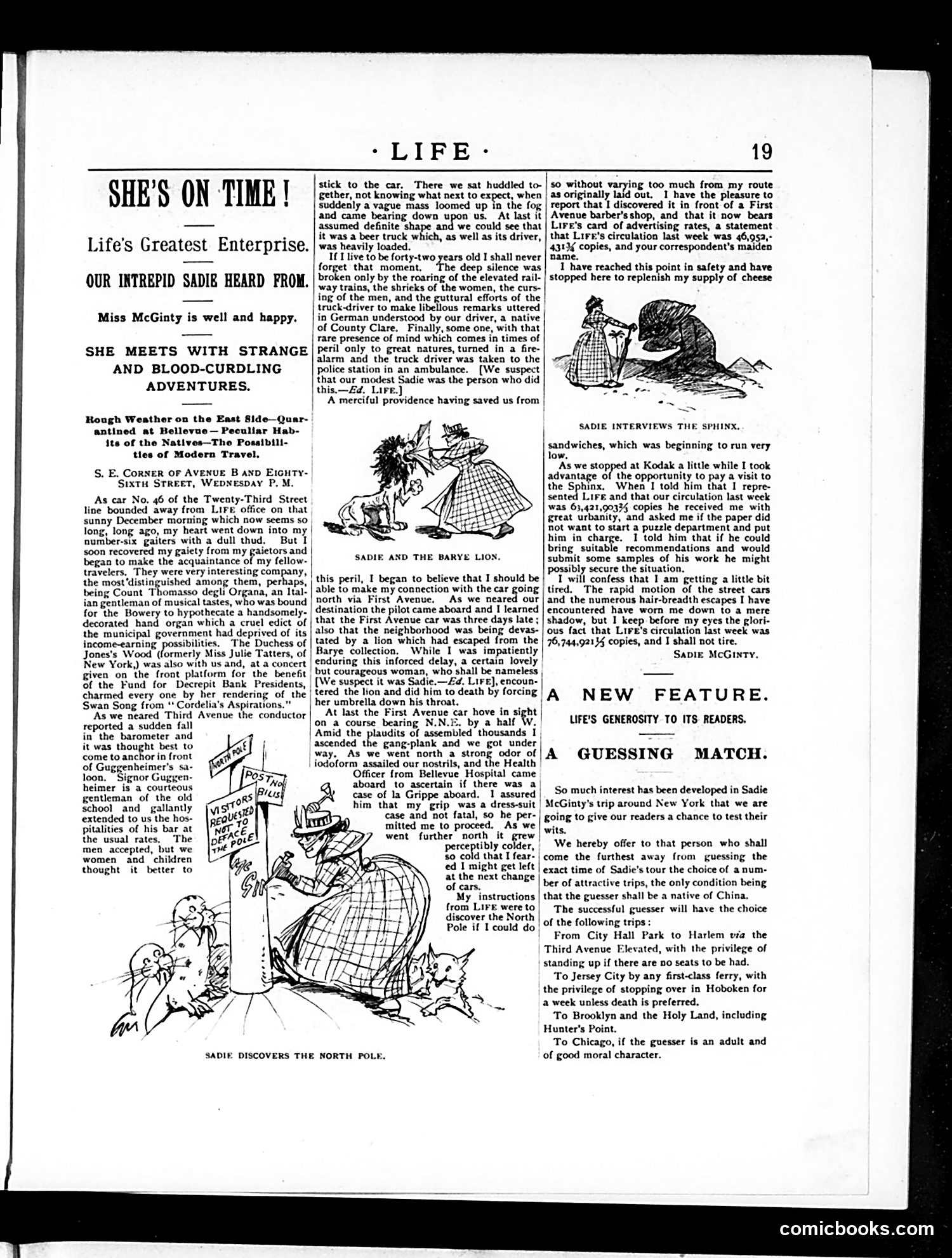
This page features a serialized adventure story about "Sadie McGinty," described as Life's "Greatest Enterprise." The main narrative recounts Sadie's travels, including encounters with fog, a beer truck, and various urban hazards. The accompanying cartoons illustrate her misadventures—one shows her interviewing the Sphinx, another depicts her "discovering the North Pole" (humorously, amid city streets with fire hydrants). Below is a "Guessing Match" contest offering readers prizes for correctly predicting Sadie's tour destinations, including possibilities like "City Hall Park to Harlem," "Brooklyn and the Holy Land," or "Chicago." The satire mocks both sensational travel journalism and audience gullibility—treating mundane urban navigation as exotic adventure.
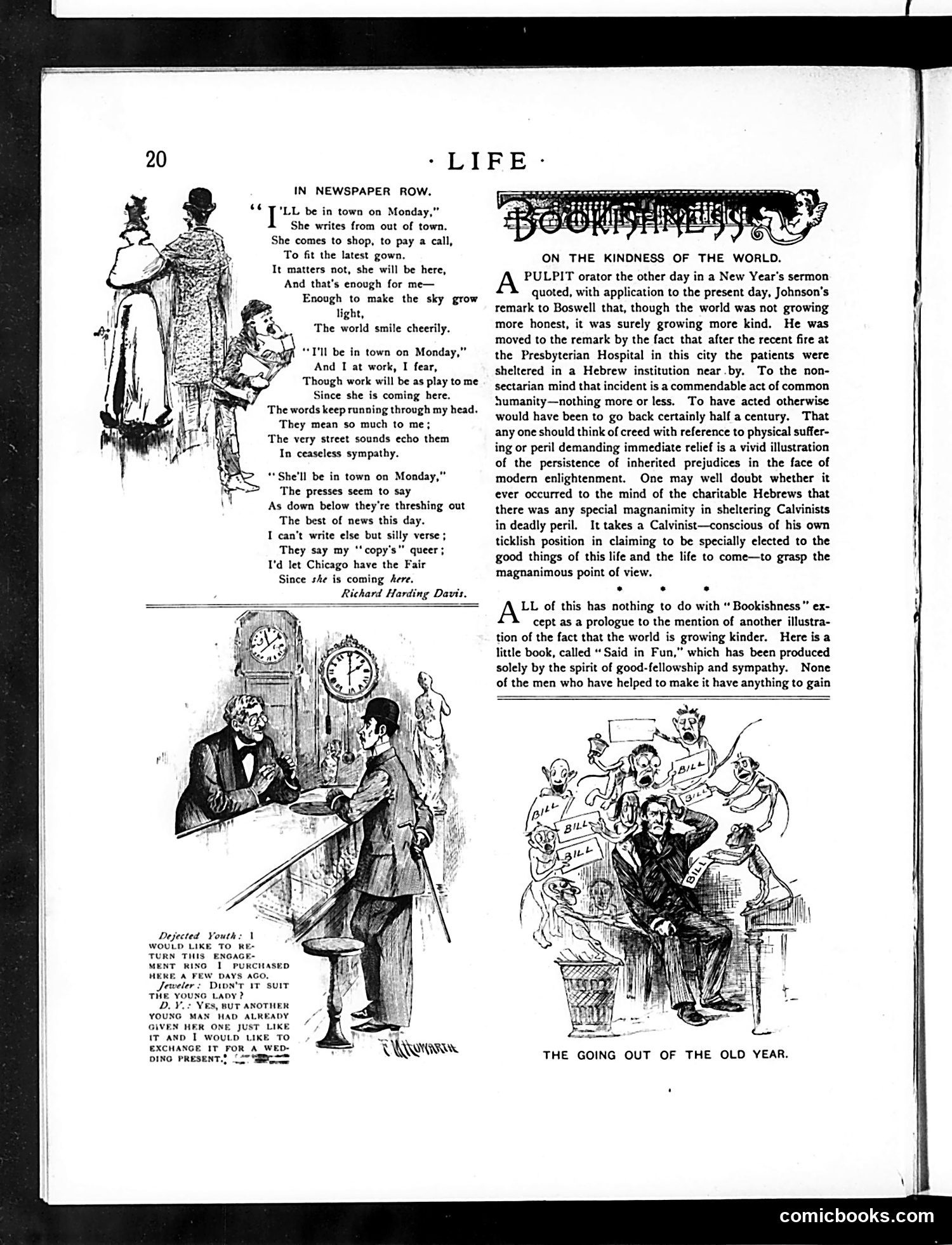
This page contains two distinct cartoons addressing social issues: **"In Newspaper Row"** (top left): A poem by Richard Harding Davis about a woman visiting the city on Mondays, depicting her as a source of distraction to working men. The satire targets workplace distraction and perhaps gender dynamics in early 20th-century offices. **"Rejected Youth"** (center): Shows a young man at what appears to be a ticket counter, rejected in an engagement. The caption indicates he's trying to exchange an engagement ring, having already given one to another young woman. This satirizes romantic fickleness and commitment issues. **"The Going Out of the Old Year"** (right): Depicts bills literally attacking or overwhelming a man—personified bills labeled "BILL" surround him, satirizing year-end financial obligations and debt anxiety common to the period. All three address early 1900s social and economic anxieties through humor.
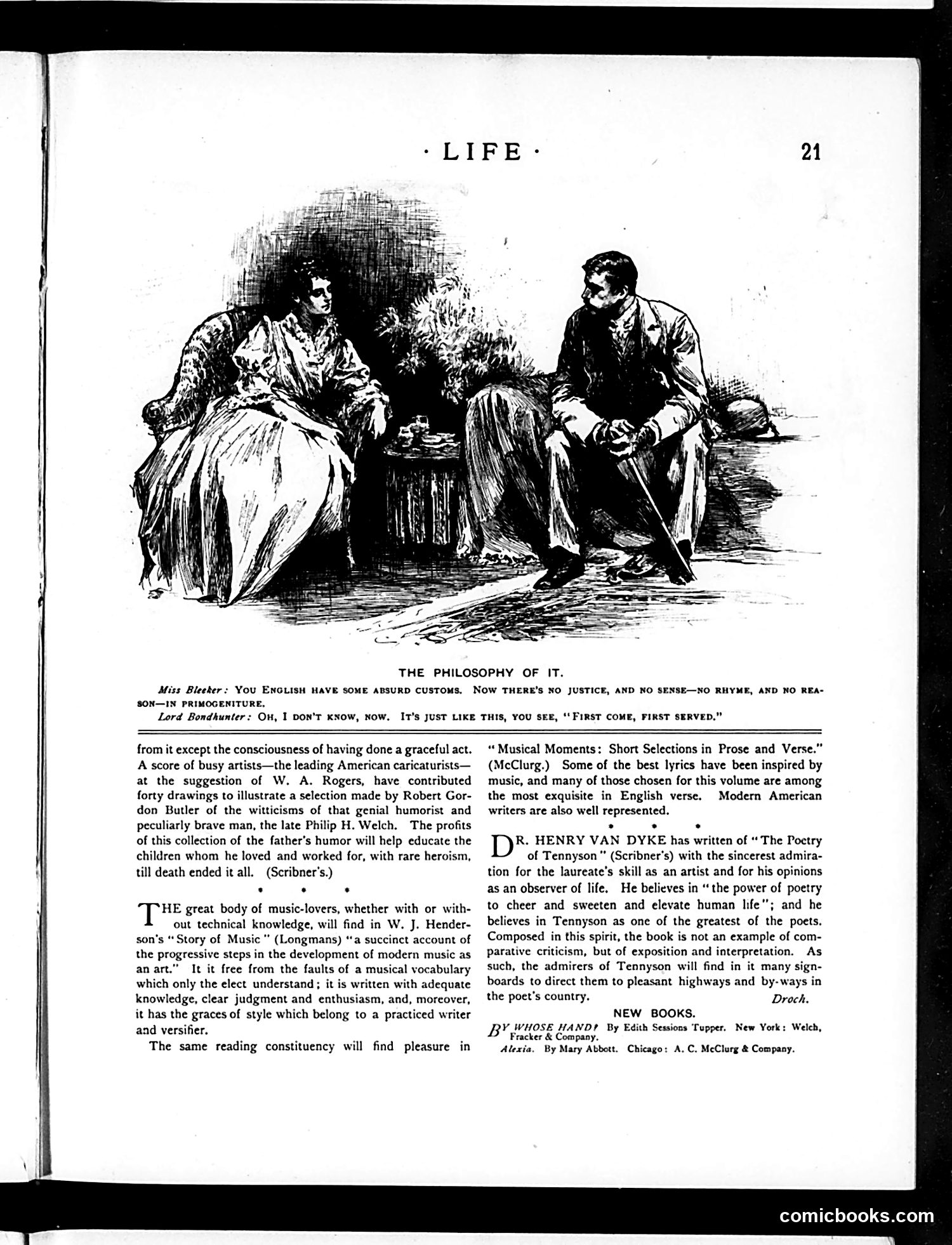
This cartoon satirizes British class pretension and dinner etiquette. A well-dressed English woman instructs a man (labeled "Lord Bombardier") about English customs, specifically the rule "first come, first served"—though she notes there's "no justice, and no sense—no rhyme, and no reason—in primogeniture" (the aristocratic inheritance system favoring eldest sons). The satire is **ironic**: she claims English society has no special rules or favoritism, yet primogeniture itself was the ultimate expression of arbitrary class privilege. The joke highlights the hypocrisy of British aristocrats who boasted of orderly customs while maintaining rigid hierarchical systems that contradicted their stated principles. The cartoon likely appeals to American readers skeptical of British class claims.
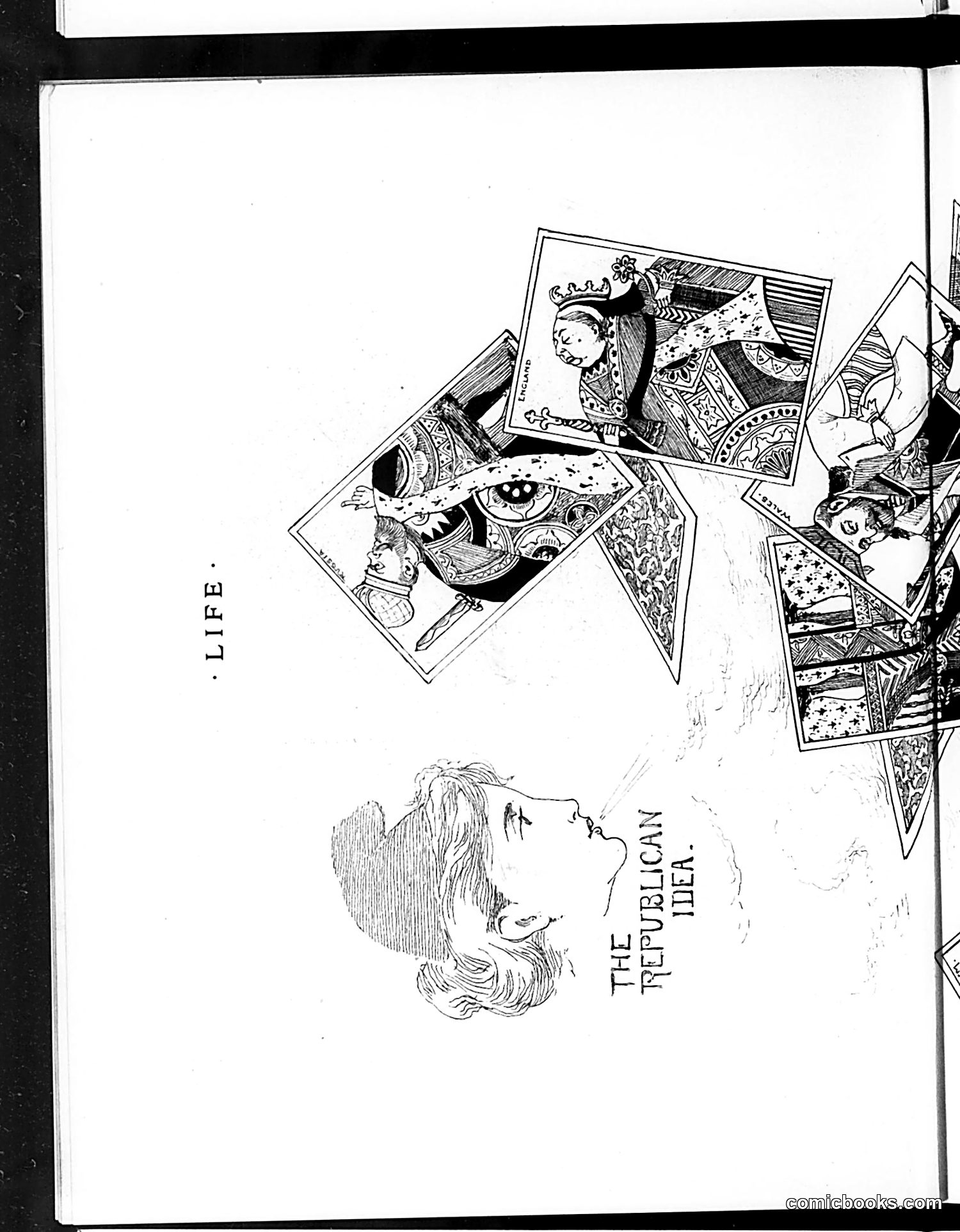
This appears to be a title page from *Life* magazine featuring two illustrated elements: **Top illustration:** Playing cards arranged in a fan, depicting what appears to be royalty or nobility figures in elaborate dress with ornate patterns and crowns. **Bottom illustration:** A profile sketch of a face labeled "THE REPUBLICAN IDEA!" The juxtaposition suggests political satire contrasting European aristocratic imagery (represented by the ornate playing cards showing crowned figures) with American republicanism. The satirical point appears to be commentary on Republican ideals or leadership of the period, likely criticizing either the pretentious nature of Republican politicians or their perceived distance from democratic principles. Without more specific historical dating or context, the exact political targets remain unclear, though the contrast between aristocratic excess and republican values is evident.
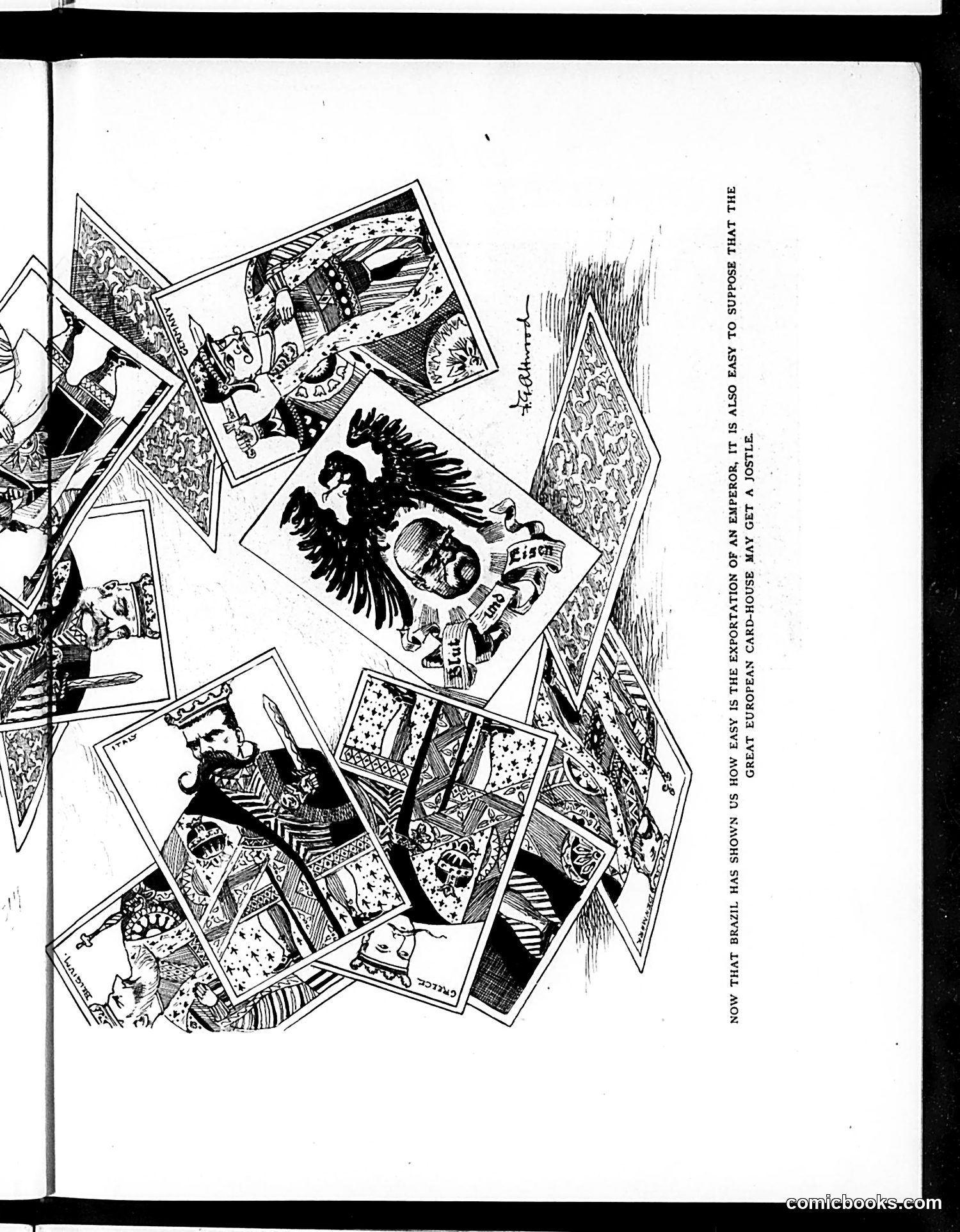
This appears to be a satirical illustration showing various playing cards and figures arranged in a scattered composition. The caption indicates the cartoon critiques how "Brazil has shown us how easy it is to exonerate an emperor; it is also easy to disgrace may get a whistle." The image uses playing cards as metaphors, likely representing political figures or factions in a game of power. The prominent eagle symbol (appearing on one card) suggests references to imperial or national authority. The scattered arrangement suggests chaos or disorder in Brazilian politics—possibly commenting on Brazil's transition from empire to republic in the late 19th century. The satire appears to mock the ease with which political power and reputation can shift based on public perception or political maneuvering, using card-game imagery to suggest political outcomes are somewhat arbitrary or subject to chance.
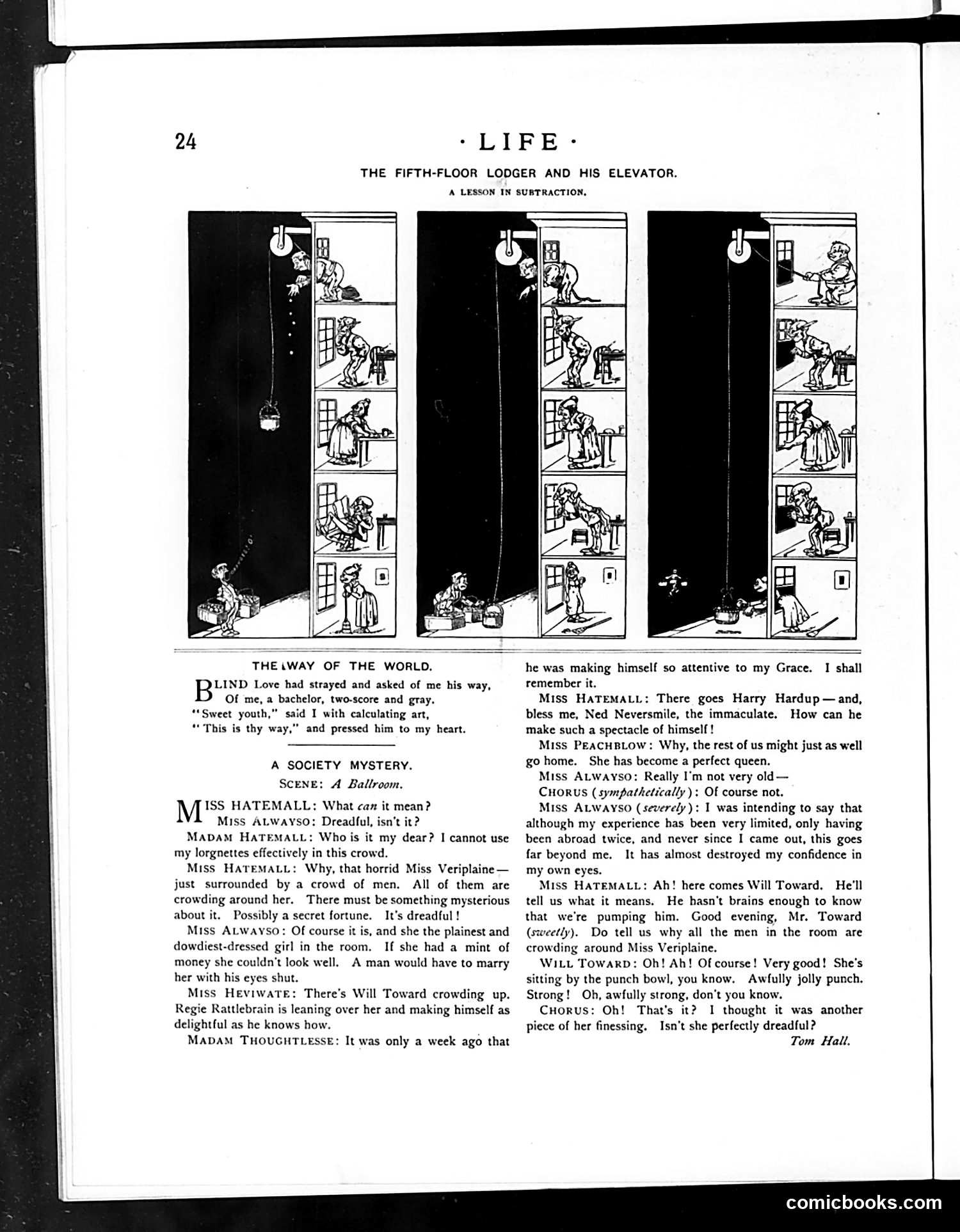
This is a visual comic strip showing a man using an elevator shaft as a pulley system to lower a basket—apparently a humorous solution to avoiding stairs. The three panels show the elevator's operation at different floor levels. Below, "A Society Mystery" depicts upper-class women gossiping about a mysterious man (Will Toward) who's become socially prominent by paying attention to an unfashionable woman (Miss Verplaine). The satire mocks society's superficiality: women are puzzled why he'd court her unless there's hidden wealth or scandal, unable to imagine genuine kindness as motivation. It critiques the materialistic and status-obsessed nature of high society, where romantic interest must have mercenary or sensational explanations.
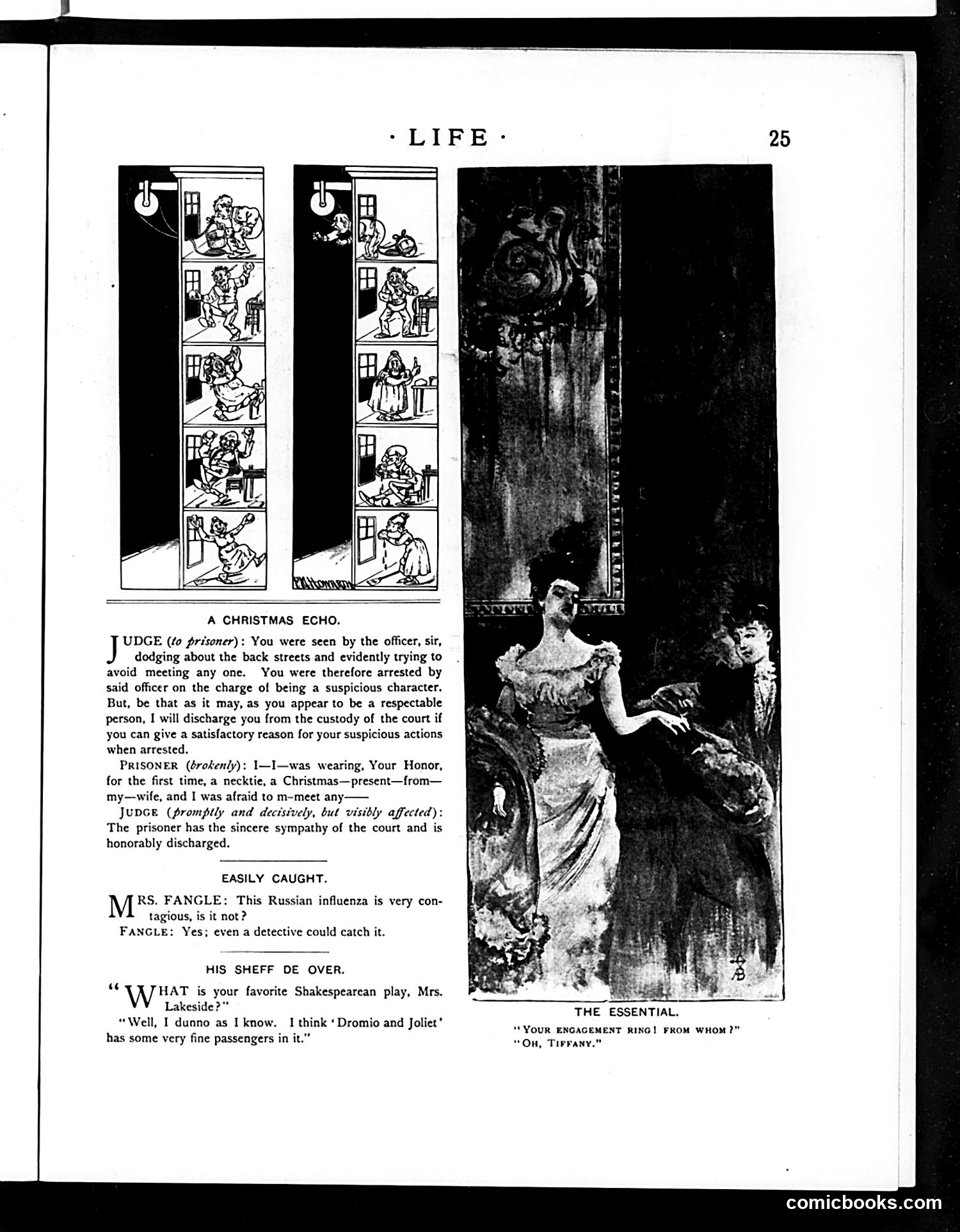
**"A Christmas Echo"** (top left): A two-panel comic strip showing a prisoner before a judge. The joke hinges on the prisoner receiving leniency after claiming he was wearing a necktie—a Christmas gift from his wife—when arrested for suspicious behavior. The judge, moved by this explanation of respectability, discharges him. The satire appears to mock both judicial sentimentality and the absurdity that a necktie alone signals good character. **"Easily Caught"** (middle): A brief exchange where Mrs. Fangle jokes that "Russian influenza" is contagious, and Fangle quips that even a detective could catch it—a pun playing on "catch" as both literal infection and detective work. **"His Sheff De Over"** (bottom): Mrs. Lakeside misidentifies Shakespeare's "Romeo and Juliet" as "Dromio and Joliet," apparently confusing character names while praising its "fine passengers."
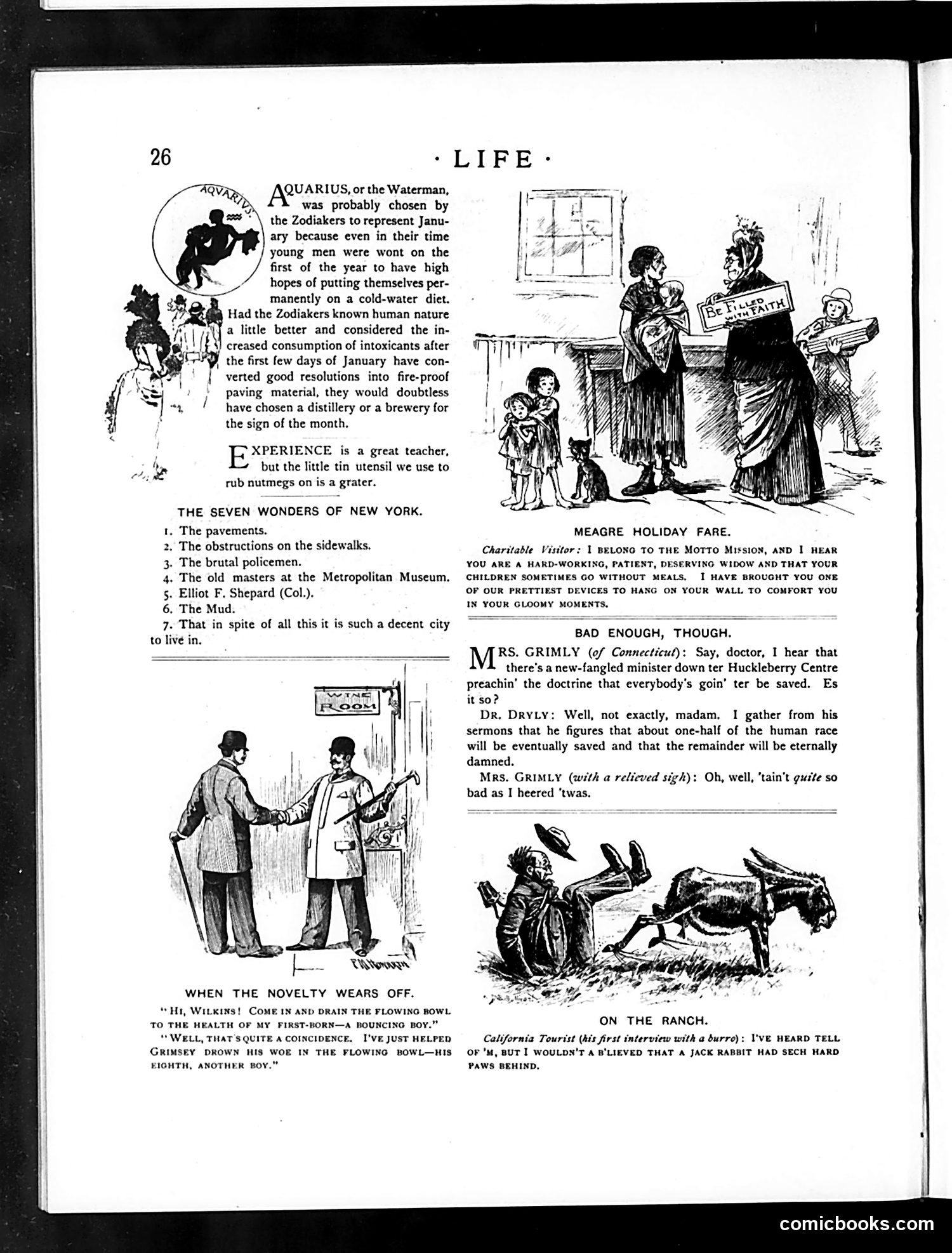
This page satirizes American society through several cartoons: **January/New Year's Resolutions**: The Aquarius section mocks the annual tradition of cold-water diets and sobriety pledges, noting that increased drinking in early January proves such resolutions fail immediately. **"When the Novelty Wears Off"**: Two men celebrate their newborns by getting drunk—one says he's helping a friend ("Grimsey") drown sorrows over his *eighth* boy, creating dark comedy about excessive drinking and unwanted pregnancies. **"Meagre Holiday Fare"**: A charity visitor patronizes a poor widow, offering a decorative motto for her wall instead of actual food—satirizing ineffectual charitable gestures that prioritize appearance over material aid. **"Bad Enough, Though"**: Rural Mrs. Grimly discusses salvation doctrine with a doctor, relieved that "only half" humanity faces damnation—dark humor about provincial religious anxieties. The page collectively targets hypocrisy, ineffectual charity, and human weakness across class lines.
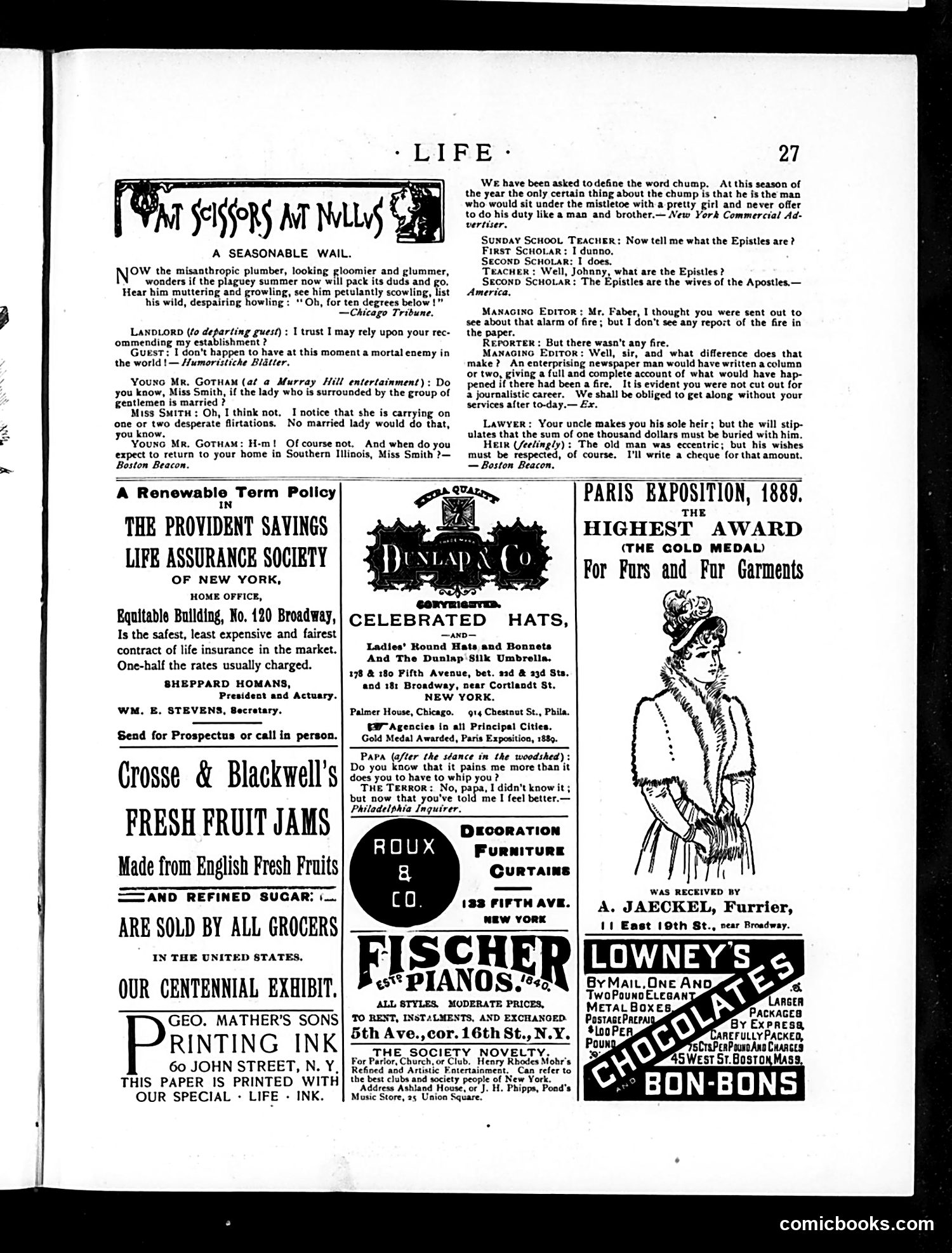
This page contains brief satirical jokes typical of 1880s-90s American humor magazines, plus period advertisements. **The Jokes:** - A plumber complains about summer heat - A landlord hopes guests will recommend his establishment (only if they have no enemies) - A young man asks if a flirtatious woman is married - A definition of "chump": a man who won't kiss a woman under mistletoe - A Sunday school child mishears "Epistles" as "wives of Apostles" - A newspaper editor demands a reporter fabricate details about a fire that didn't happen—satirizing sensationalist journalism - A man inherits money on condition he bury $1,000 with his eccentric uncle **The Context:** These are mild, domestic humor pieces reflecting late Victorian social conventions and mores. The journalism joke mocks yellow journalism practices of the era. The other jokes rely on misunderstandings, social awkwardness, and marital/courtship themes common to the period. The page is primarily **advertisements** for life insurance, hats, pianos, and food products—typical revenue for magazines of this era.
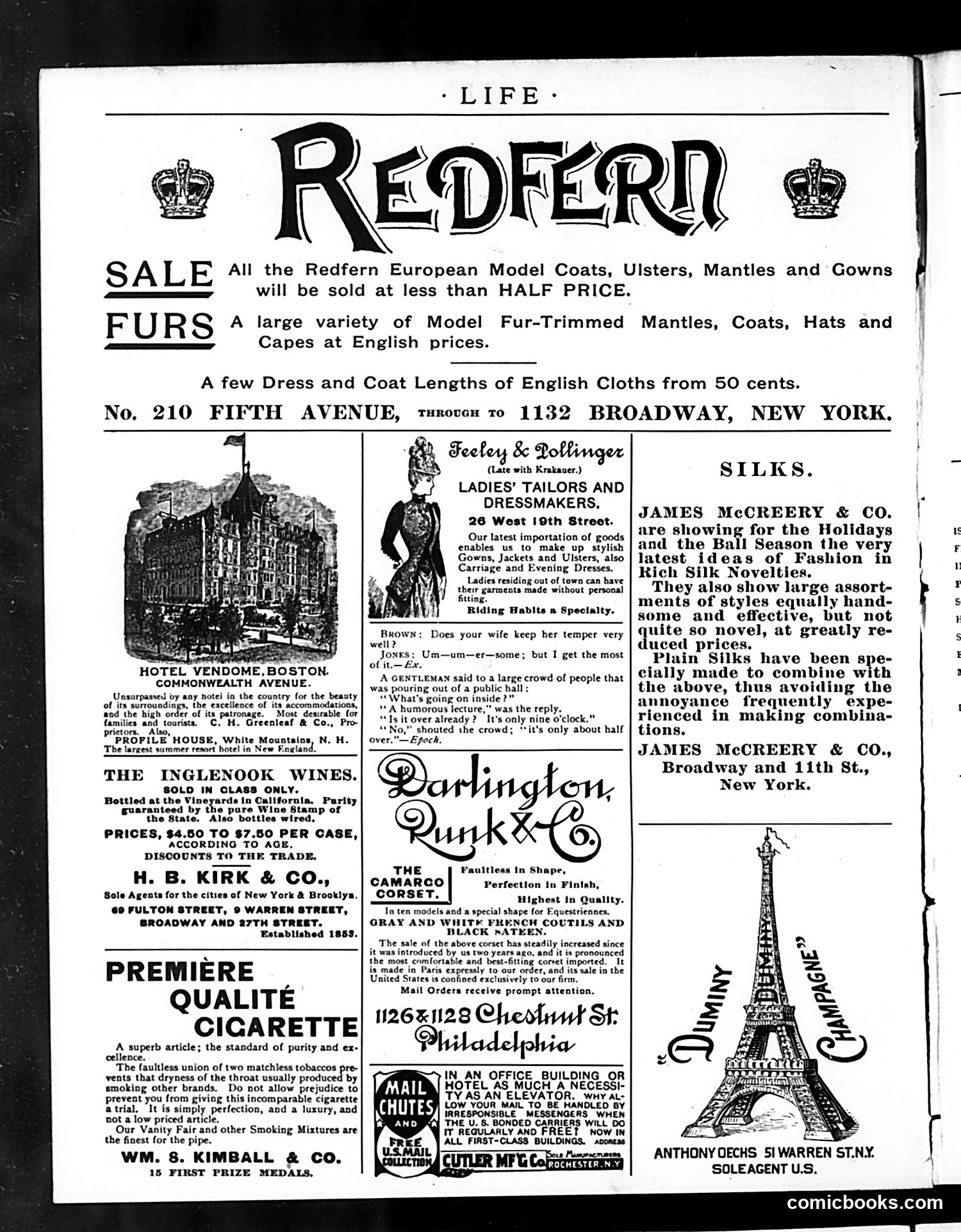
This is primarily an **advertising page** from Life magazine, not a satirical cartoon page. The advertisements showcase high-end goods for affluent Americans, likely from the 1880s-1890s based on styling and prices. The one **humorous item** is a brief joke about a "humorous lecture" where a gentleman asks if it's over at 9 p.m., and the crowd responds "it's only about half over"—a joke about tediously long lectures. The advertisements themselves reflect period concerns: **women's fashion** (Redfern coats, dressmakers, corsets), **wine and cigars** (luxury goods), and **business services** (mail carriers). The *Camargo Corset* ad notably emphasizes a "special shape for Equestriennes," reflecting women's athletic interests. The page demonstrates how Life functioned partly as a commercial vehicle for wealthy consumers, advertising European imports and luxury items at premium prices.
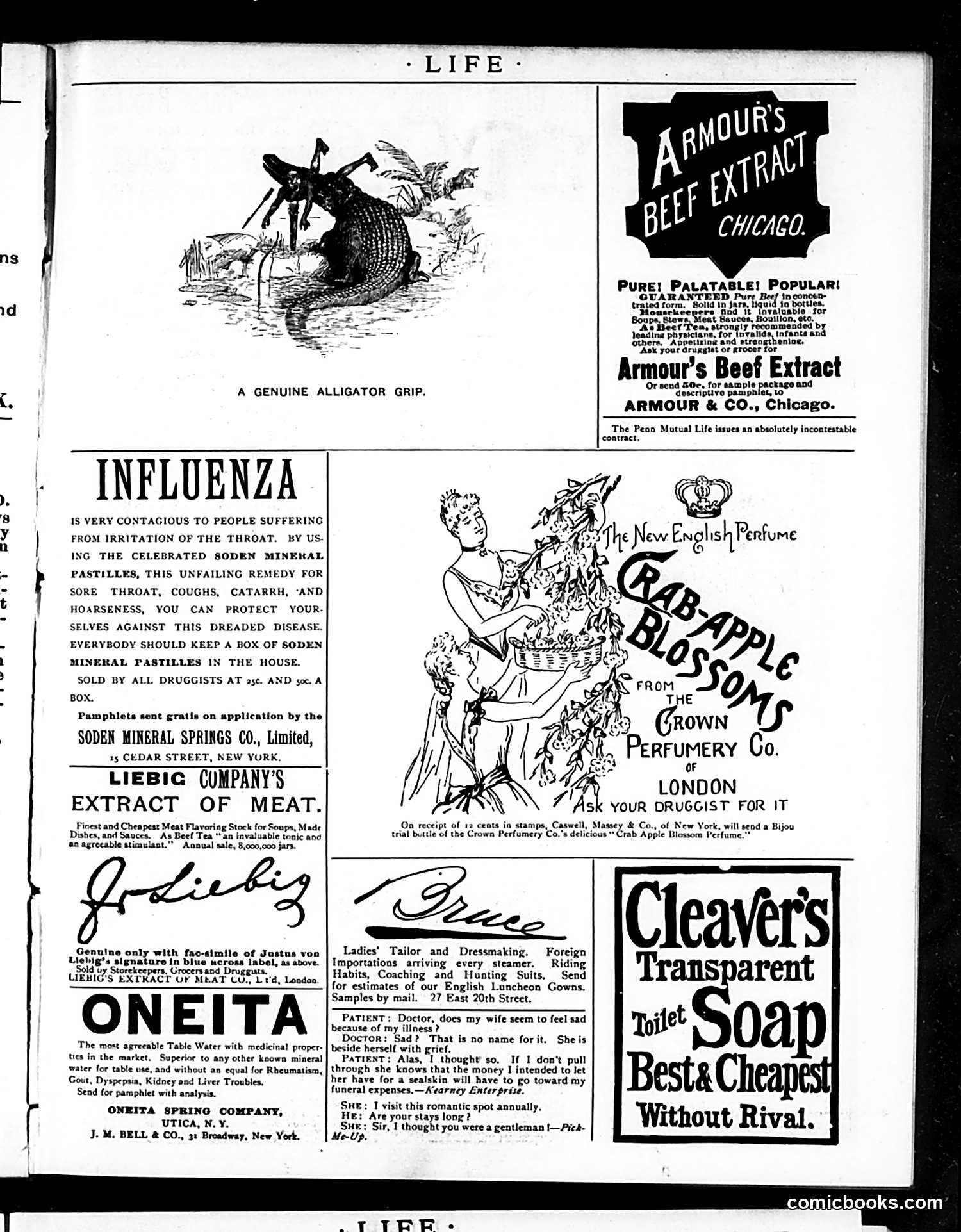
This is primarily an **advertising page** from Life magazine, not a political cartoon. The page contains multiple product advertisements typical of early 20th-century media. The one visual joke is "A Genuine Alligator Grip" — a cartoon showing an alligator gripping a mosquito, likely illustrating the aggressive effectiveness of whatever product it promotes (the accompanying text is unclear from the OCR). The two brief jokes at bottom are unrelated social humor: one mocks a husband worried his wife's grief over his potential death stems from losing money for a fur coat; the other is mild flirtation humor about visiting a "romantic spot." Most of the page advertises patent medicines (influenza pastilles, beef extract, mineral water), perfume, tailoring services, and insurance — reflecting the era's reliance on dubious medicinal products and the advertising conventions of early 1900s publications. Nothing here is overtly political; it's simply a snapshot of period commercial culture.
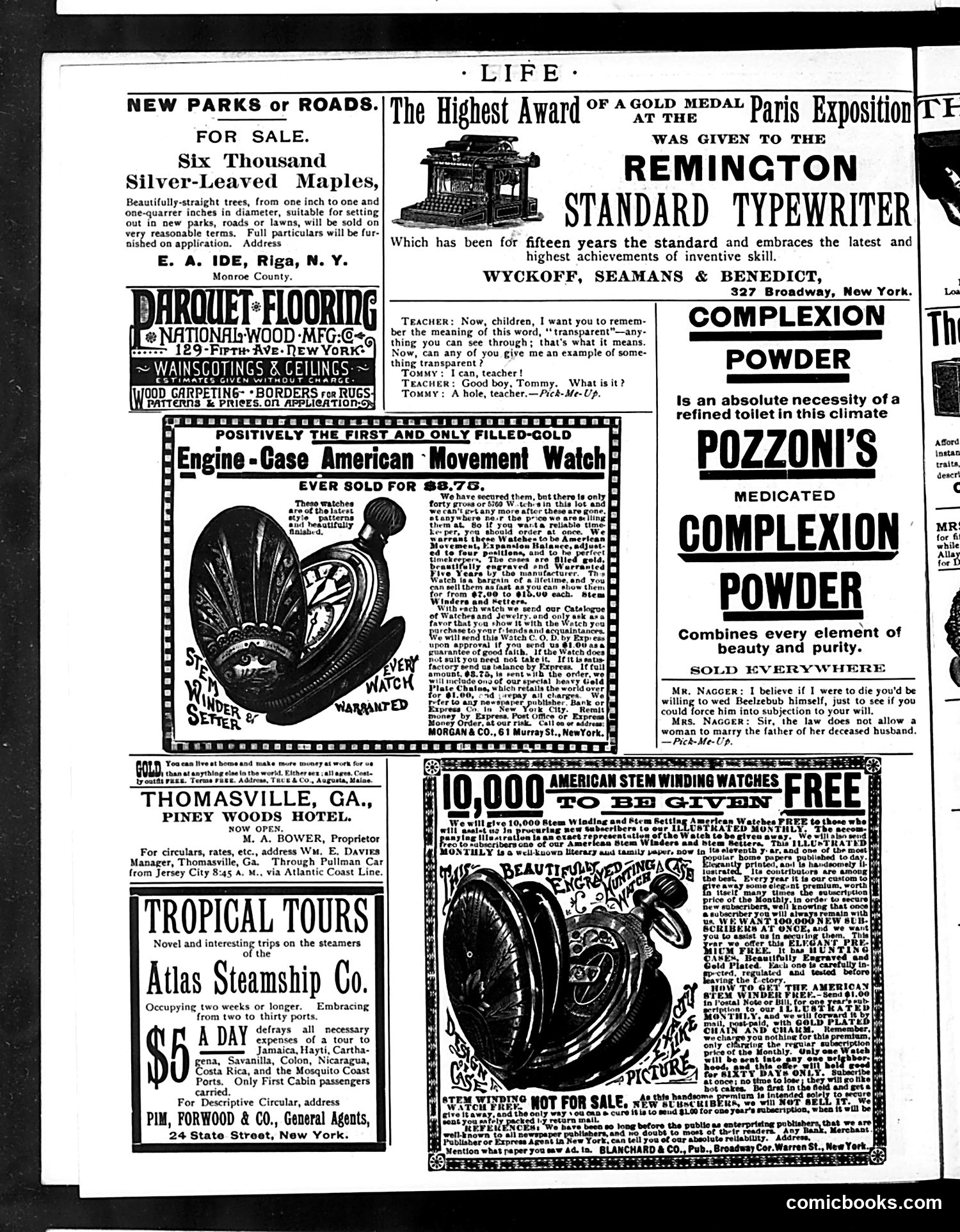
This is primarily an **advertising page** from Life magazine, not a political cartoon. The page contains various classified advertisements and product promotions typical of late 19th/early 20th-century publications. Notable content includes: **Products advertised:** The Remington Standard Typewriter (awarded a gold medal at the Paris Exposition), Pozzoni's Medicated Complexion Powder, an "Engine-Case American Movement Watch" sold for $8.75, and tropical tour packages. **Humorous content:** Two brief comedy pieces—a classroom joke about a child defining "transparent" as "a hole, teacher," and a marital joke about remarriage to the devil. These represent typical period humor from the "Pick-Me-Up" publication. **Travel/hospitality ads:** Hotels in Thomasville, Georgia, and Caribbean steamship tours. The page reflects turn-of-the-century advertising conventions and light humor rather than political satire. The Remington typewriter ad's Paris Exposition medal references international competition in industrial innovation.
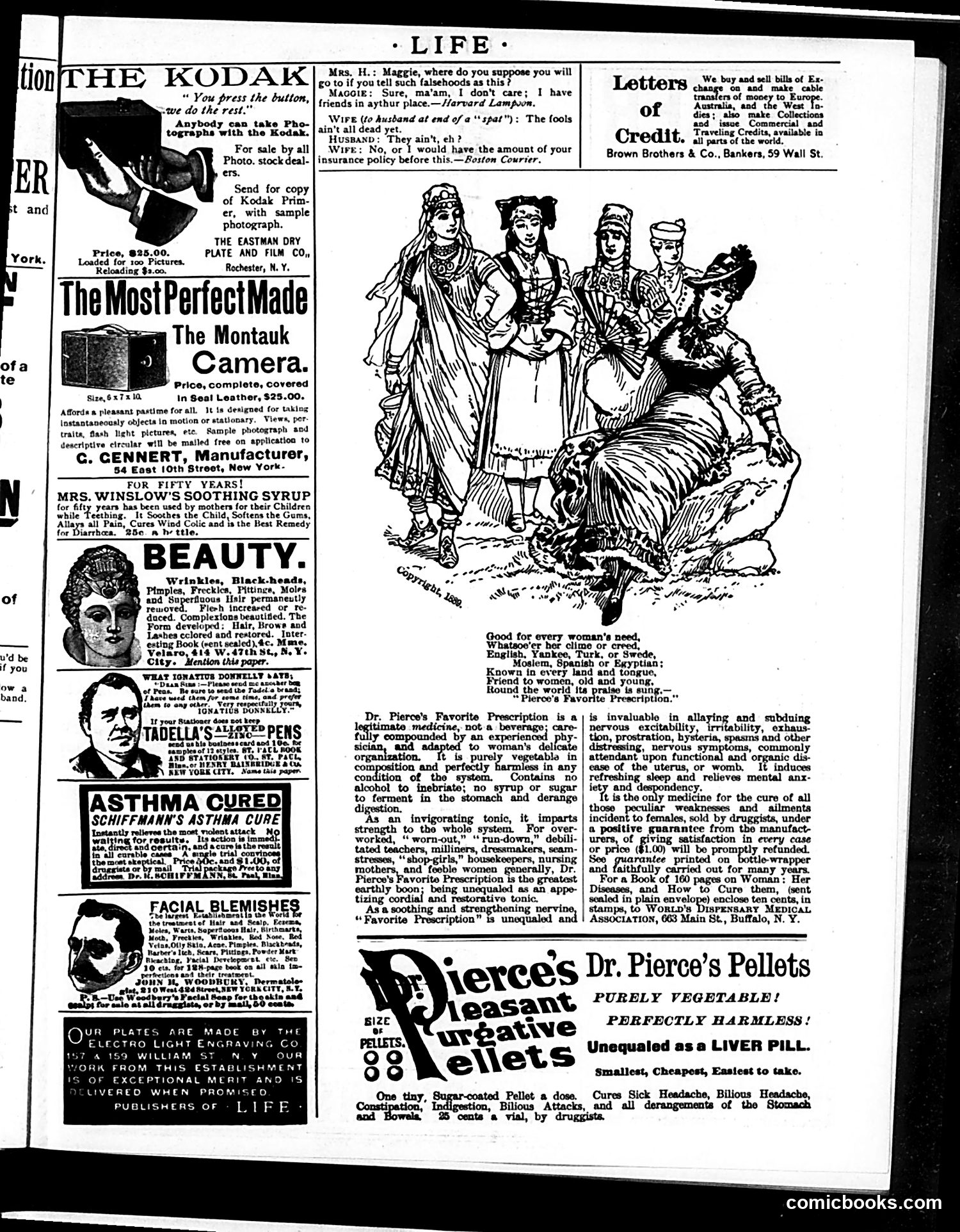
This page is primarily **advertising**, typical of late 19th-century American magazines. The advertisements showcase products marketed to women and the general public: Kodak and Montauk cameras (representing the new photography craze), Mrs. Winslow's Soothing Syrup (a common patent medicine for infants), beauty treatments promising to remove facial blemishes, and Dr. Pierce's Favorite Prescription (a heavily marketed "women's tonic" claiming to cure various female ailments). The small humorous items in the "Letters of Credit" section are brief jokes: one about a child asking where liars go, another about a husband and wife arguing (she threatens him with knowledge of his insurance policy). These are light domestic humor typical of the era. The Dr. Pierce's advertisement is notably verbose, making sweeping medical claims about treating "nervous excitability" and "female complaints"—reflecting the era's pseudoscientific approach to women's health and the prevalence of unregulated patent medicines.
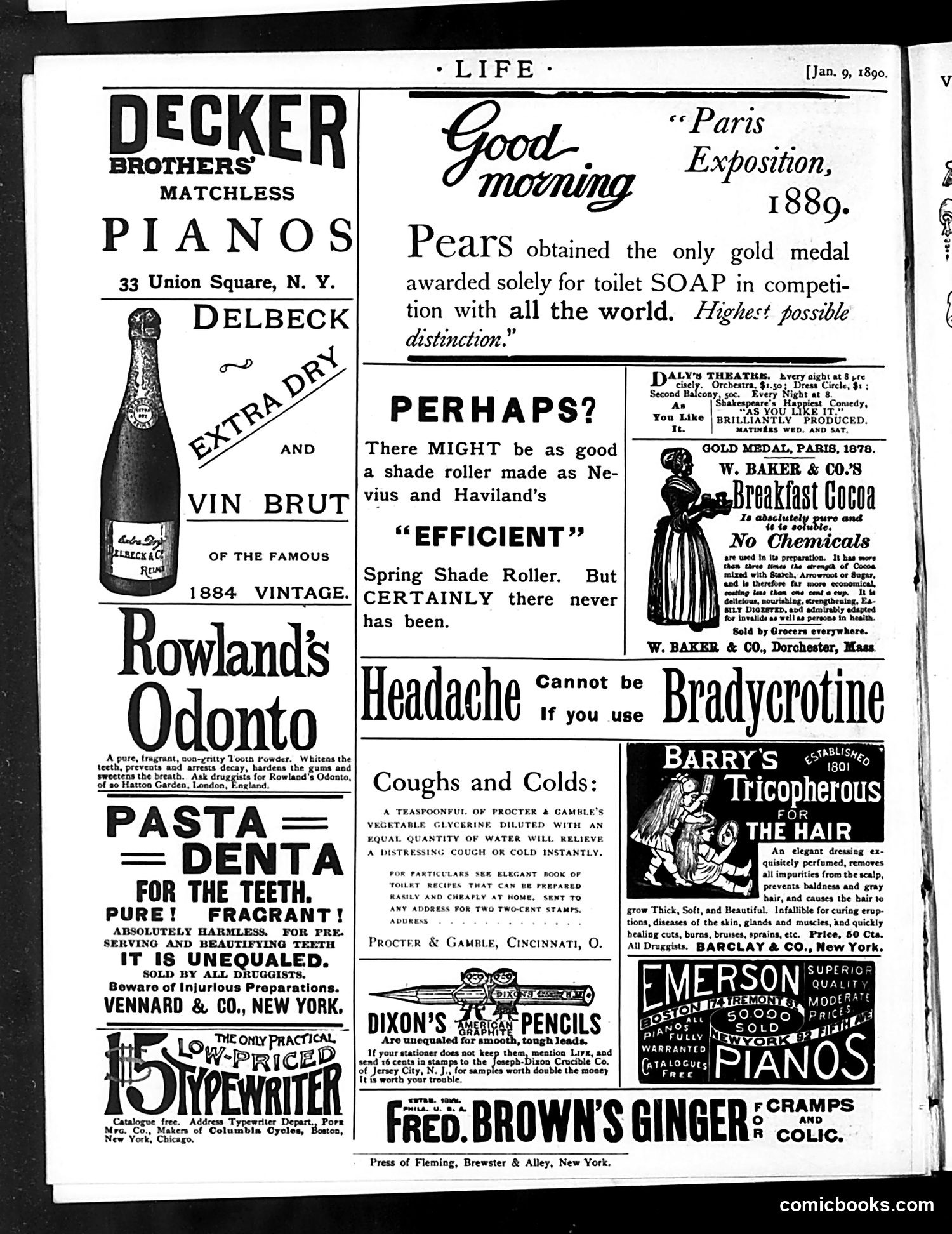
This is primarily an **advertising page** with no political cartoons or satire. The page consists entirely of commercial advertisements typical of 1890s American magazines. Notable ads include: - **Pears Soap**: Claims the only gold medal for toilet soap at the 1889 Paris Exposition - **Decker Brothers Pianos**: Musical instrument advertisement - **Rowland's Odonto**: Tooth powder claiming to whiten teeth and sweeten breath - **Pasta Denta**: Toothpaste marketed as "pure" and "fragrant" - **Fred. Brown's Ginger**: Patent medicine for cramps and colic - **Barry's Tricopherous**: Hair dressing product - **Dixon's Pencils** and **Emerson Pianos**: Additional consumer goods The advertisements reflect 1890s commercial culture, with patent medicines and personal care products heavily marketed with exaggerated health claims. No satirical content or political commentary is present on this page.