
Life, 1890-01-09 · page 6 of 18
Life — January 9, 1890 — page 6: what you’re looking at
What you’re looking at
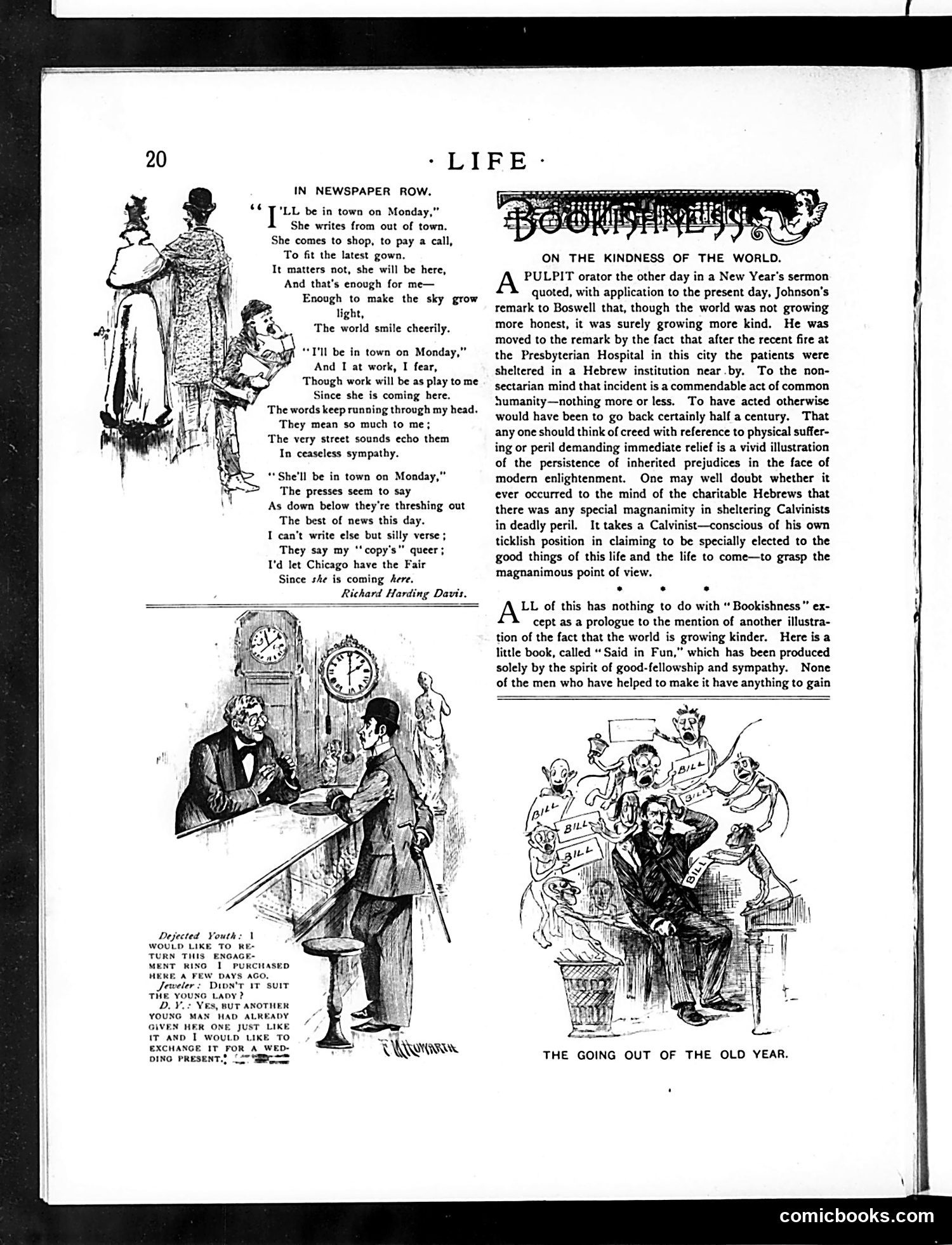
This page contains two distinct cartoons addressing social issues: **"In Newspaper Row"** (top left): A poem by Richard Harding Davis about a woman visiting the city on Mondays, depicting her as a source of distraction to working men. The satire targets workplace distraction and perhaps gender dynamics in early 20th-century offices. **"Rejected Youth"** (center): Shows a young man at what appears to be a ticket counter, rejected in an engagement. The caption indicates he's trying to exchange an engagement ring, having already given one to another young woman. This satirizes romantic fickleness and commitment issues. **"The Going Out of the Old Year"** (right): Depicts bills literally attacking or overwhelming a man—personified bills labeled "BILL" surround him, satirizing year-end financial obligations and debt anxiety common to the period. All three address early 1900s social and economic anxieties through humor.
📄 Transcribed text from this page (OCR, searchable)
Machine-transcribed from the original scan — historical spelling and the odd misread are preserved.
IN NEWSPAPER ROW. $e | es be in town on Monday,” She writes from out of town. She comes to shop, to pay a call, To fit the latest gown. It matters not, she will be here, And that’s enough for me— Enough to make the sky grow light, The world smile cheerily. “T'll be in town on Monday,” And I at work, I fear, Though work will be as play tome Since she is coming here. ‘The words keep running through my head. They mean so much to me; The very street sounds echo them In ceaseless sympathy. ** She'll be in town on Monday,” The presses seem to say As down below they're threshing out The best of news this day. I can’t write else but silly verse ; They say my ‘‘copy'’s” queer; I'd let Chicago have the Fair Since she is coming ere. Richard Harding Davis. Dejected Youth: WOULD LIKE TO TURN THIS ENGAGE- PURCHASED ADY? BUT ANOTHER MAD ALREADY” ea GIVEN HER ONE JUST LIKE , a IT AND T WOULD LIKE TO wT. EXCHANGE IT FOR A_WED- NS DING PRESENTS SBC ON THE KINDNESS OF THE WORLD. A PULPIT orator the other day in a New Year's sermon quoted, with application to the present day, Johnson's remark to Boswell that, though the world was not growing more honest, it was surely growing more kind. He was moved to the remark by the fact that after the recent fire at the Presbyterian Hospital in this city the patients were sheltered in a Hebrew institution near.by. To the non- sectarian mind that incident is a commendable act of common ‘umanity—nothing more or less. To have acted otherwise would have been to go back certainly half a century. That any one should think of creed with reference to physical suffer- ing or peril demanding immediate relief is a vivid illustration of the persistence of inherited prejudices in the face of modern enlightenment. One may well doubt whether it ever occurred to the mind of the charitable Hebrews that there was any special magnanimity in sheltering Calvinists in deadly peril. It takes a Calvinist—conscious of his own ticklish position in claiming to be specially elected to the good things of this life and the life to come—to grasp the magnanimous point of view. . . . LL of this has nothing to do with “ Bookishness” ex- cept as a prologue to the mention of another illustra- tion of the fact that the world is growing kinder. Here isa little book, called “Said in Fun,” which has been produced solely by the spirit of good-fellowship and sympathy. None of the men who have helped to make it have anything to gain THE GOING OUT OF THE OLD YEAR. comicbooks.com