
Life, 1890-01-09 · page 7 of 18
Life — January 9, 1890 — page 7: what you’re looking at
What you’re looking at
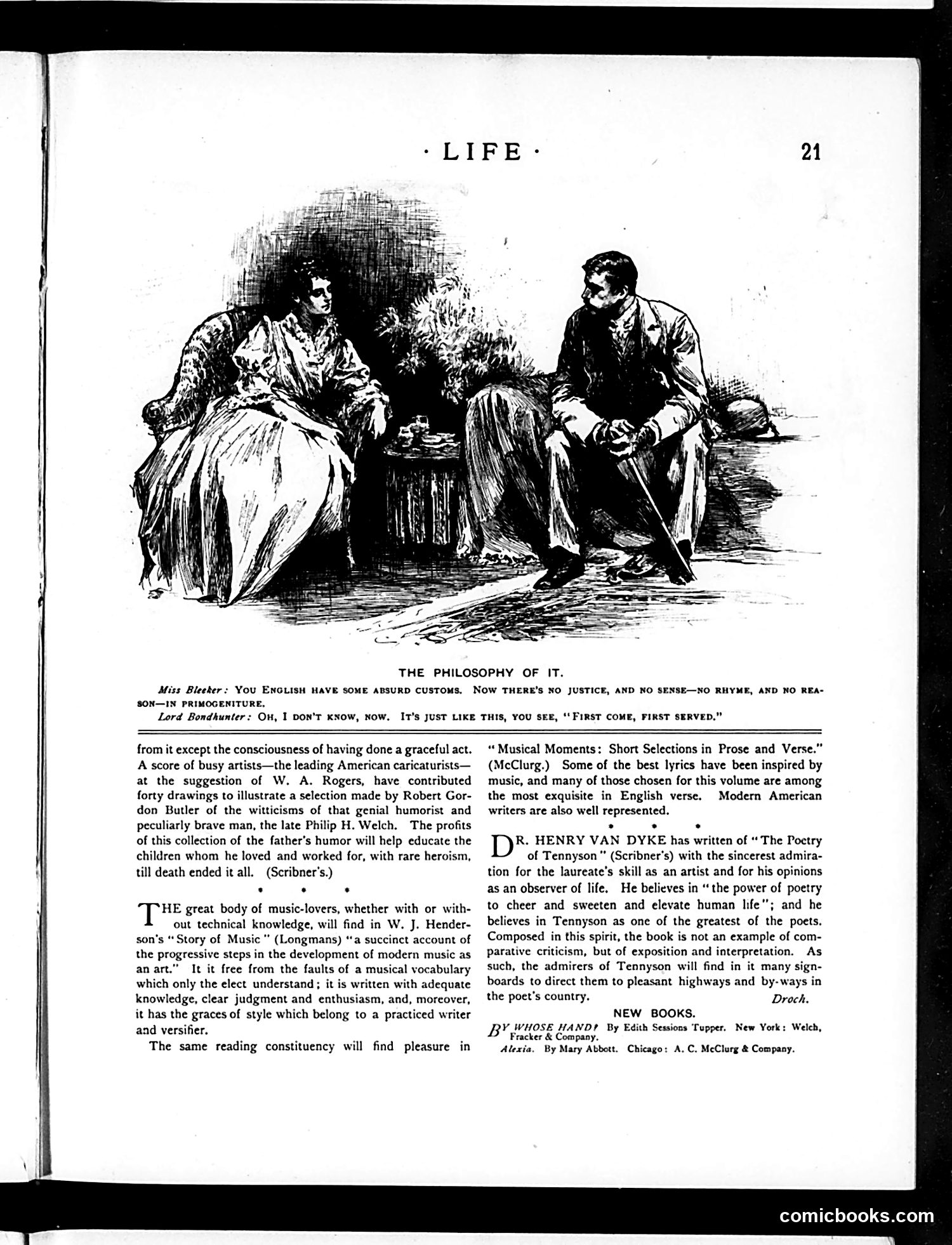
This cartoon satirizes British class pretension and dinner etiquette. A well-dressed English woman instructs a man (labeled "Lord Bombardier") about English customs, specifically the rule "first come, first served"—though she notes there's "no justice, and no sense—no rhyme, and no reason—in primogeniture" (the aristocratic inheritance system favoring eldest sons). The satire is **ironic**: she claims English society has no special rules or favoritism, yet primogeniture itself was the ultimate expression of arbitrary class privilege. The joke highlights the hypocrisy of British aristocrats who boasted of orderly customs while maintaining rigid hierarchical systems that contradicted their stated principles. The cartoon likely appeals to American readers skeptical of British class claims.
📄 Transcribed text from this page (OCR, searchable)
Machine-transcribed from the original scan — historical spelling and the odd misread are preserved.
THE PHILOSOPHY OF IT. Miss Bleeker: YOU ENGLISH HAVE SOME ABSURD CUSTOMS. NOW THERE'S NO JUSTICE, AND NO SENSE—NO RHYME, AND NO REA- SON—IN PRIMOGENITURE, Lord Bondhunter: Ou, 1 von't KNow, Now. It’s JUST LIKE THIS, YOU SEE, ‘‘ FIRST COME, FIRST SERVED,” from it except the consciousness of having done a graceful act. A score of busy artists—the leading American caricaturists— at the suggestion of W. A. Rogers, have contributed forty drawings to illustrate a selection made by Robert Gor- don Butler of the witticisms of that genial humorist and peculiarly brave man, the late Philip H. Welch. The profits of this collection of the father's humor will help educate the children whom he loved and worked for, with rare heroism, till death ended it all. (Scribner’s.) HE great body of music-lovers, whether with or with- out technical knowledge, will find in W. J. Hender- son's “Story of Music ” (Longmans) ‘a succinct account of the progressive steps in the development of modern music as anart.” It it free from the faults of a musical vocabulary which only the elect understand ; it is written with adequate knowledge, clear judgment and enthusiasm, and, moreover, it has the graces of style which belong to a practiced writer and versifier. The same reading constituency will find pleasure in “Musical Moments: Short Selections in Prose and Verse.” (McClurg.) Some of the best lyrics have been inspired by music, and many of those chosen for this volume are among the most exquisite in English verse. Modern American writers are also well represented. . . . R. HENRY VAN DYKE has written of “ The Poetry of Tennyson" (Scribner's) with the sincerest admira- tion for the laureate’s skill as an artist and for his opinions as an observer of life. He believes in “the power of poetry to cheer and sweeten and elevate human life”; and he believes in Tennyson as one of the greatest of the poets. Composed in this spirit, the book is not an example of com- parative criticism, but of exposition and interpretation. As such, the admirers of Tennyson will find in it many sign- boards to direct them to pleasant highways and by-ways in the poet's country, Droch. NEW BOOKS. BY WHOSE HAND? By Edith Sessions Tupper. Fracker & Company, By Mary Abbott. New York: Welch, Alexia. Chicago: A. C. McClurg & Company. comicbooks.com