
A complete issue · 18 pages · 1889
Life — December 5, 1889
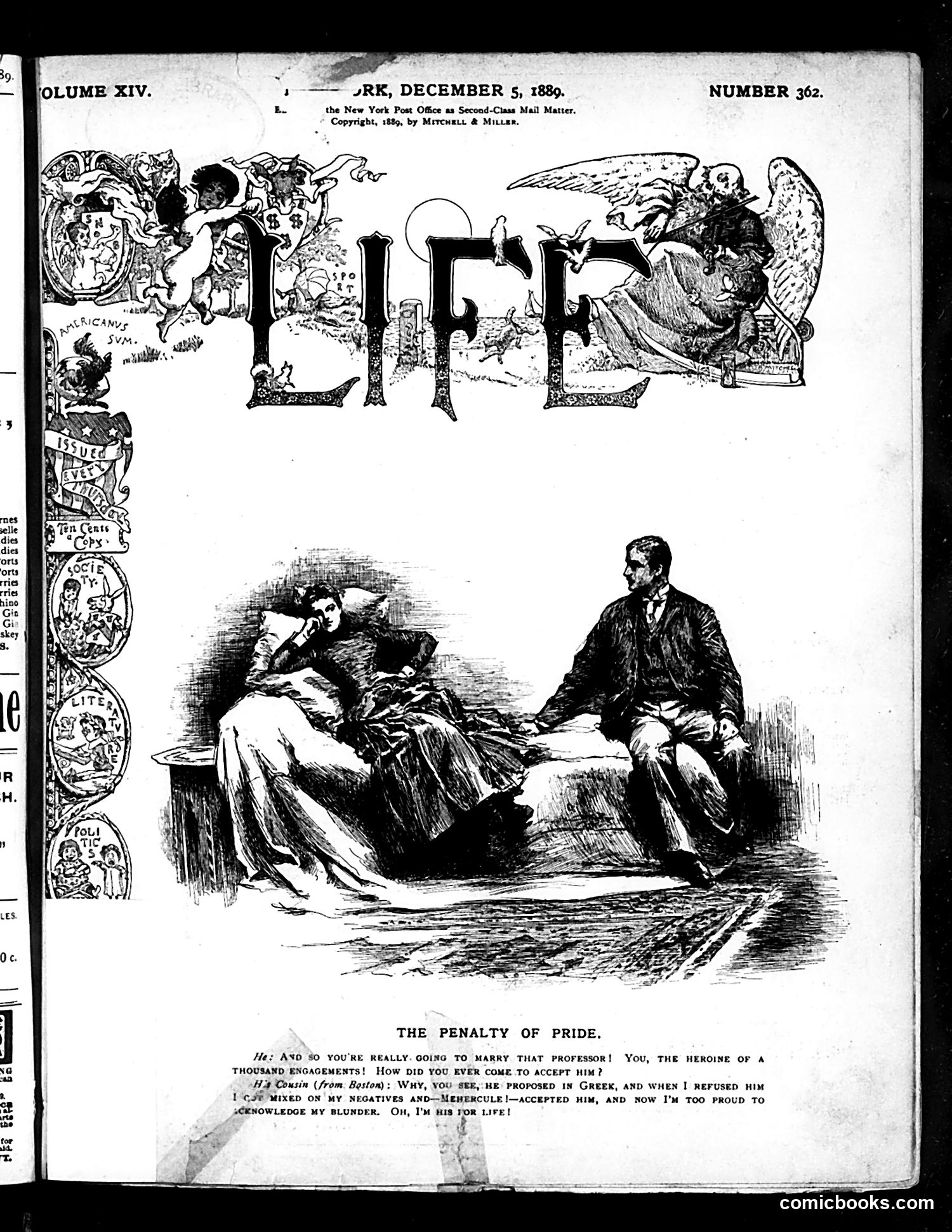
This satirical illustration depicts a domestic confrontation between a woman and man, titled "The Penalty of Pride." The woman, seated and emotionally distressed, accuses the man of marrying her under false pretenses. According to the dialogue, she rejected his initial proposal in Greek (suggesting he was a professor), then he proposed in English, which she accepted—only to later discover she'd made a terrible mistake. The caption emphasizes her current regret: she's now bound to him for life despite her initial rejection. The cartoon satirizes pride and poor judgment in marriage decisions, suggesting the woman's linguistic confusion or the man's deceptive courtship led to her unfortunate union. It's social commentary on Victorian-era marriage consequences and female vulnerability in matrimonial contracts.
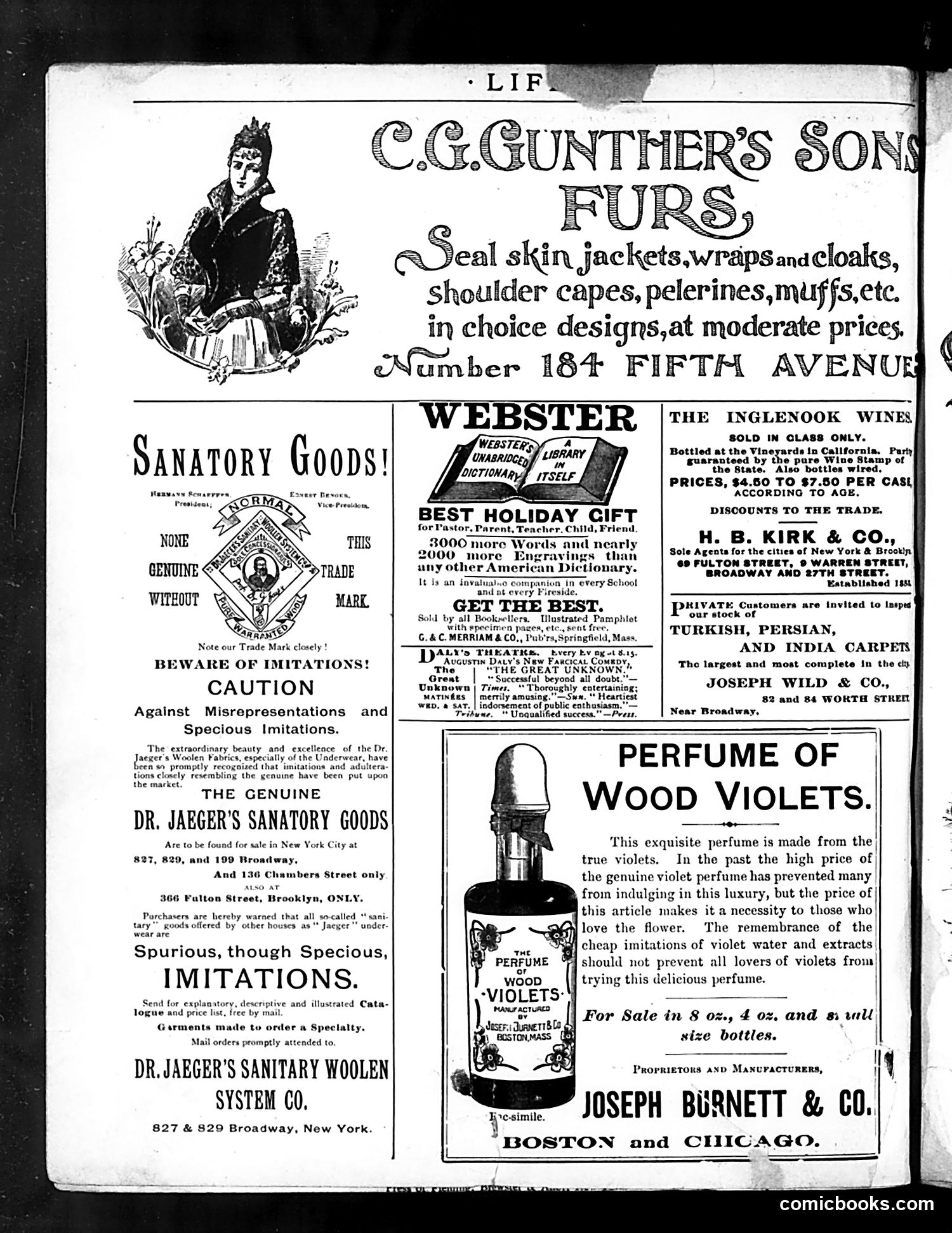
This page is **primarily advertisements** from what appears to be a late 19th-century issue of Life magazine. The visible ads include: - **C.G. Gunther's Sons Furs** (top): fur garments at "moderate prices" - **Dr. Jaeger's Sanitary Goods** (left): woolen undergarments, with warnings against counterfeit "Jaeger" products sold by competitors - **Webster's Unabridged Dictionary** (center): promoted as a superior reference work - **The Inglenook Wines** (right): California wine sold by H.B. Kirk & Co. - **Perfume of Wood Violets** (bottom right): Joseph Burnett & Co.'s fragrance product **No political cartoons or satirical content is visible** on this page. It appears to be a standard advertising section typical of late-Victorian-era magazines, showcasing consumer goods and services.
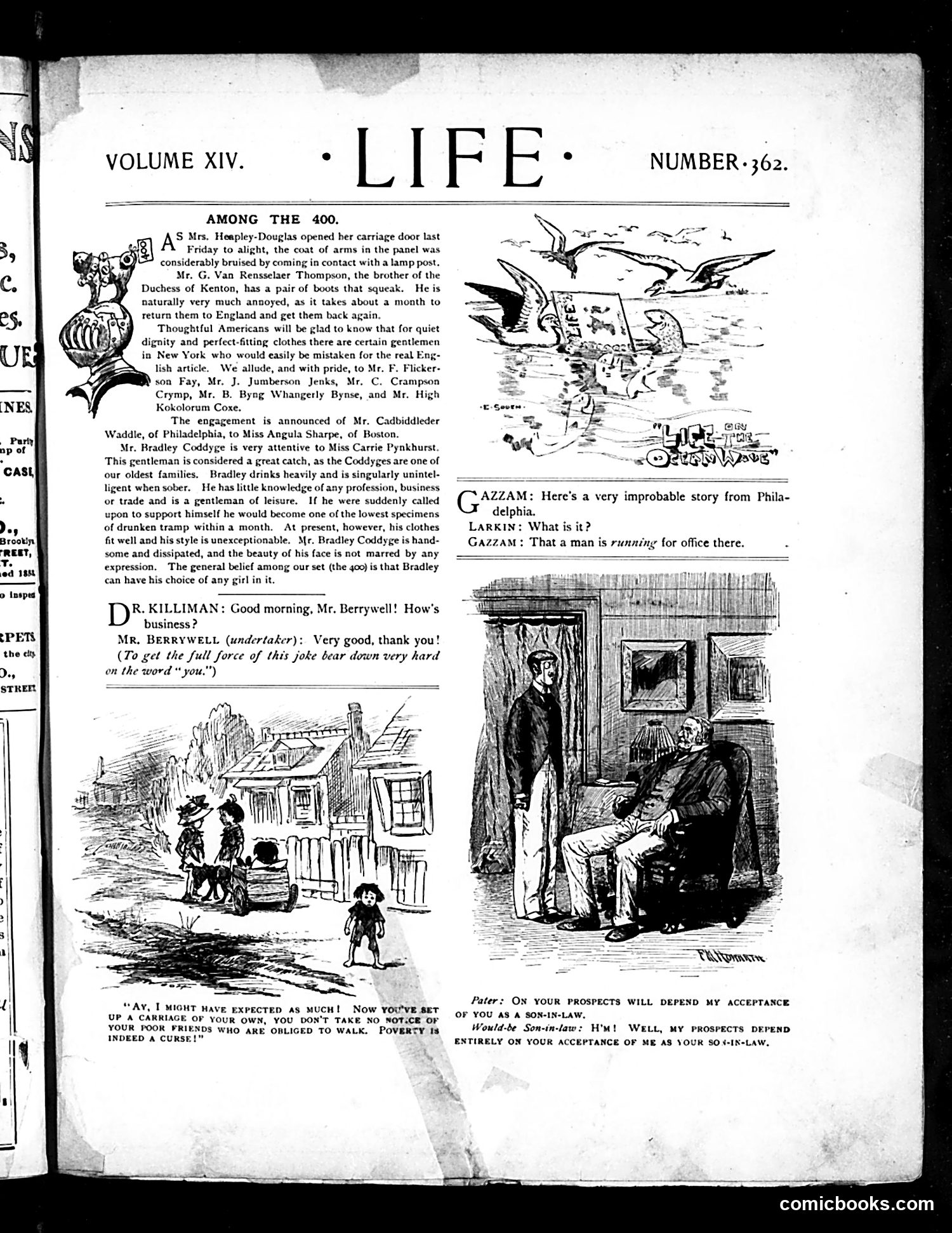
This page contains three separate satirical pieces: **"Among the 400"** mocks New York high society, noting that wealthy gentleman Bradley Coddyge has "squeak" boots and wears them despite their noise—humorous because such affectation contradicts upper-class dignity. **The illustrated joke** about Dr. Killman and Mr. Berrywell appears to reference someone "running for office" while dealing with a carriage accident—likely contemporary political commentary, though the specific reference is unclear. **The final cartoon** depicts a father-son confrontation about prospects and acceptance, playing on class anxieties about social advancement through marriage. The overall theme critiques Gilded Age wealth, pretension, and status-seeking among the American elite—standard satire for Life's audience.
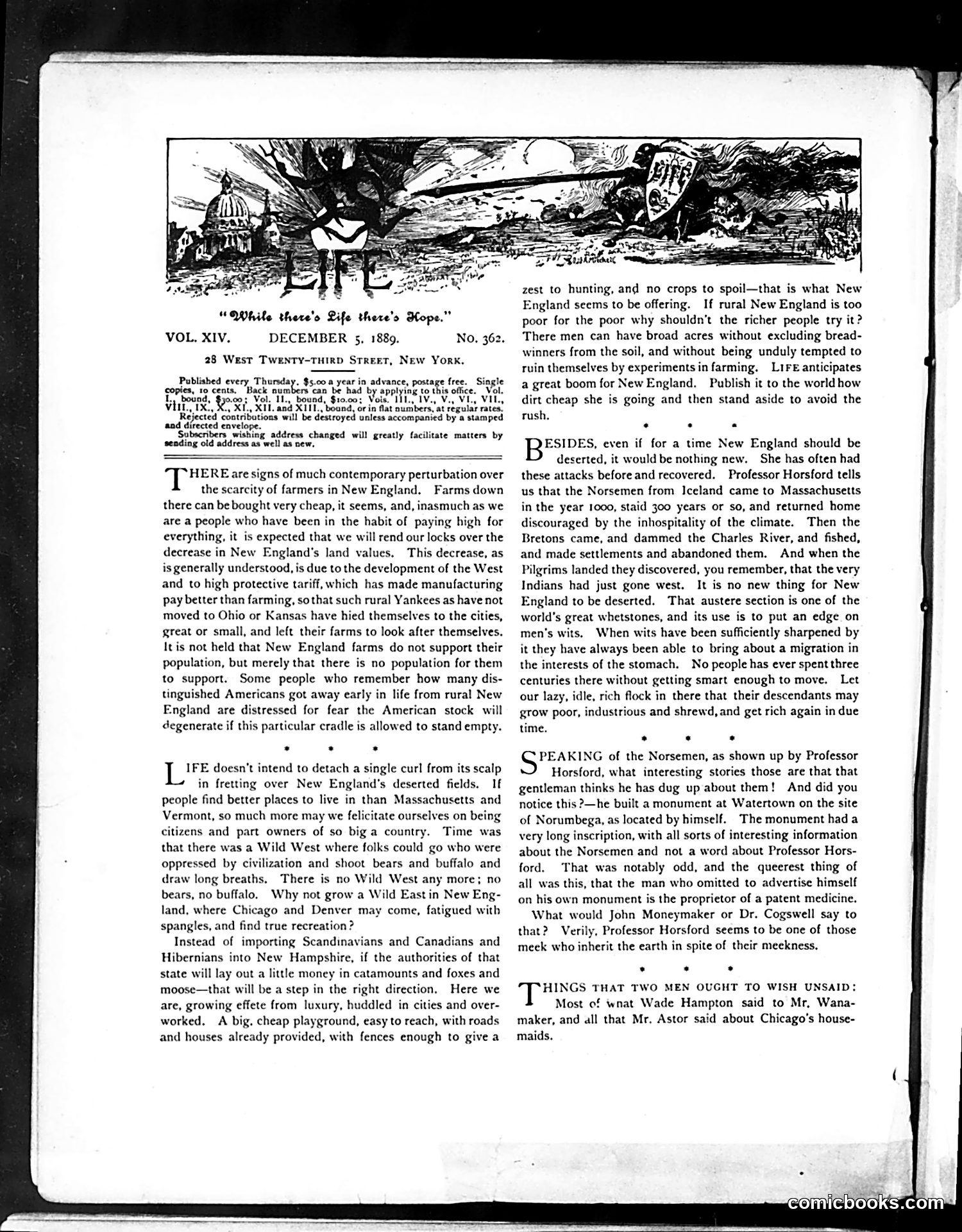
**The Cartoon:** The header illustration titled "While there's Life there's Skops" appears to show allegorical figures in a landscape—likely personifications of themes discussed in the article below. **The Content:** The main article discusses New England's agricultural decline and depopulation. It argues that rural New England farms are being abandoned as people migrate westward or to cities, causing property values to collapse. The author proposes solutions: instead of farming, New England should develop recreational hunting grounds and estates for wealthy buyers. **The Satire:** The piece critiques both rural decay and wealthy indifference. It sardonically suggests that rather than revitalize farming communities, the solution is to convert struggling farmland into playgrounds for the rich—essentially abandoning ordinary people's livelihoods.
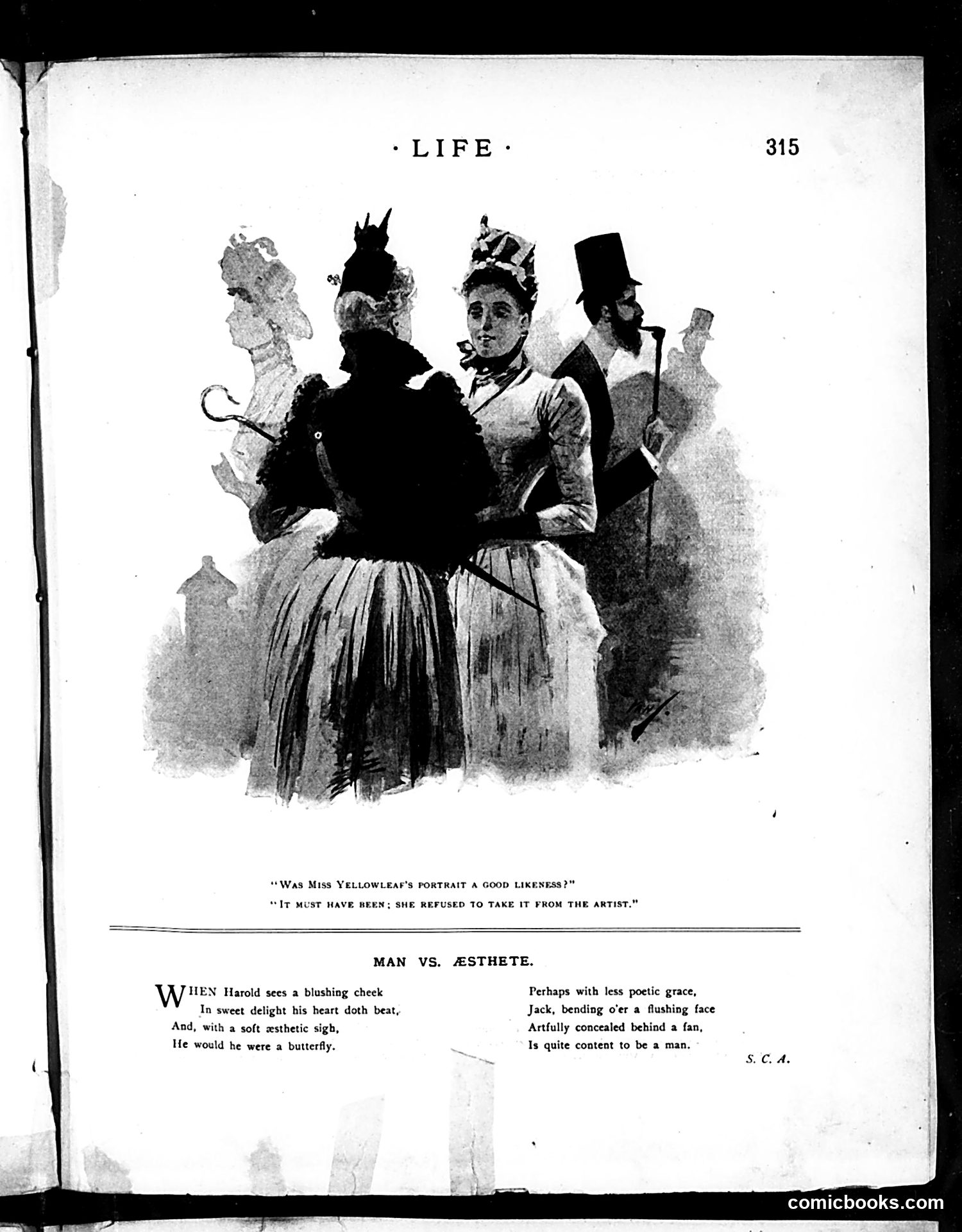
This page features a satirical cartoon about portraiture and artistic standards. The caption questions whether an artist's portrait of "Miss Yellowleaf" is a good likeness, with the punchline that she refused to accept it from the artist. The accompanying poem, "Man vs. Æsthete," contrasts two male responses to feminine beauty. One man (Harold) becomes poetic and aesthetic upon seeing a woman's blush, imagining himself as a butterfly. The other (Jack) pragmatically conceals his reaction behind a fan, content simply to be a man. The satire mocks both excessive aestheticism and artistic pretension—suggesting that concern with beauty, grace, and artistic representation can be ridiculous compared to straightforward masculine practicality.
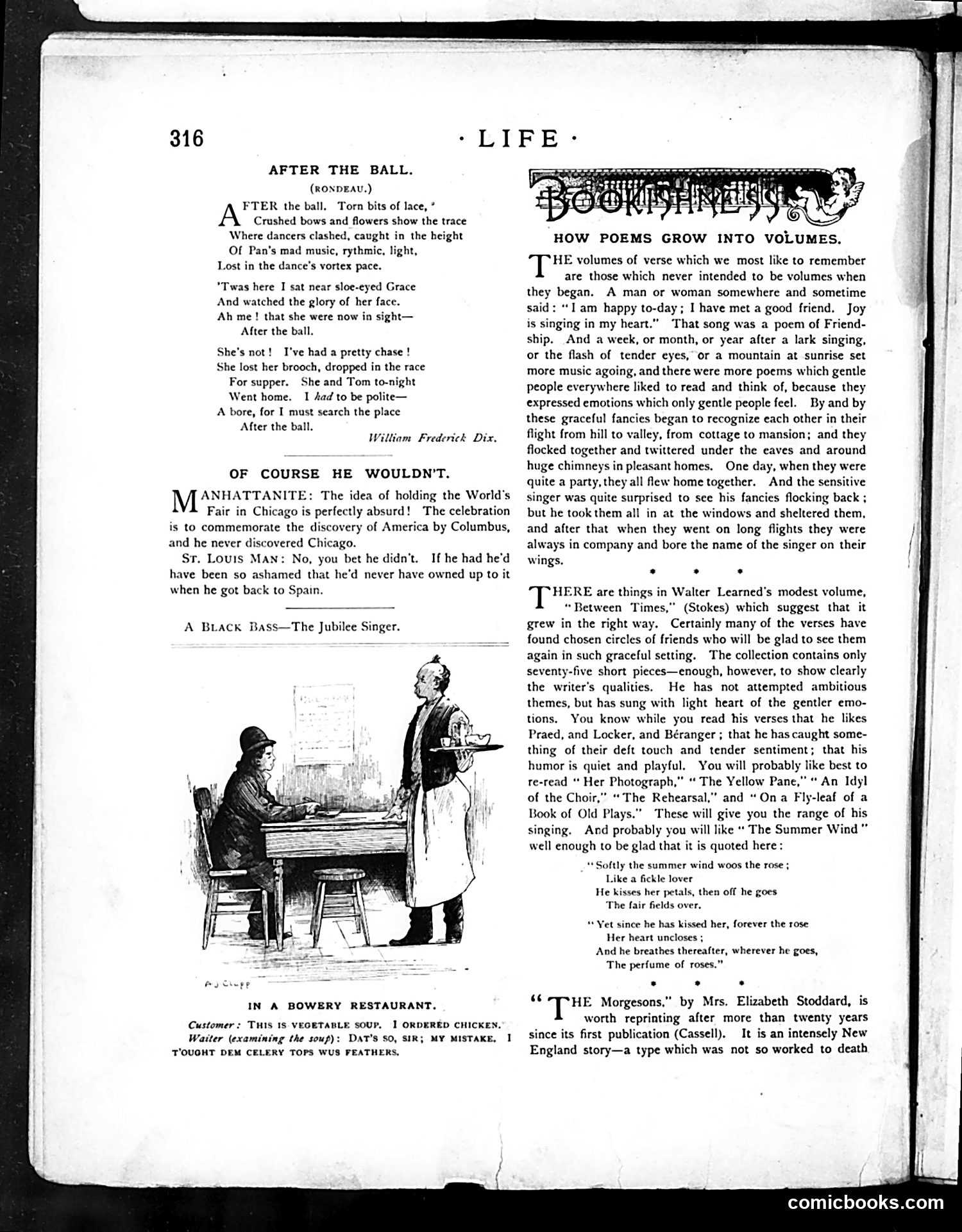
This page contains literary reviews and social humor rather than political cartoons. The main cartoon titled "A BLACK BASS—The Jubilee Singer" depicts a waiter serving a seated customer in what appears to be a restaurant setting. The accompanying caption reads: "Customer: This is vegetable soup. I ordered chicken. Waiter (examining the soup): Dat's so, sir; my mistake. I thought dem celery tops wus feathers." The joke relies on racial dialect humor common to the era, portraying the waiter as ignorant and clumsy—confusing vegetable matter for poultry feathers. This reflects period stereotypes about Black service workers. The page's other content focuses on book reviews, including discussions of Walter Learned's poetry volume "Between Times" and Elizabeth Stoddard's "The Morgessons."
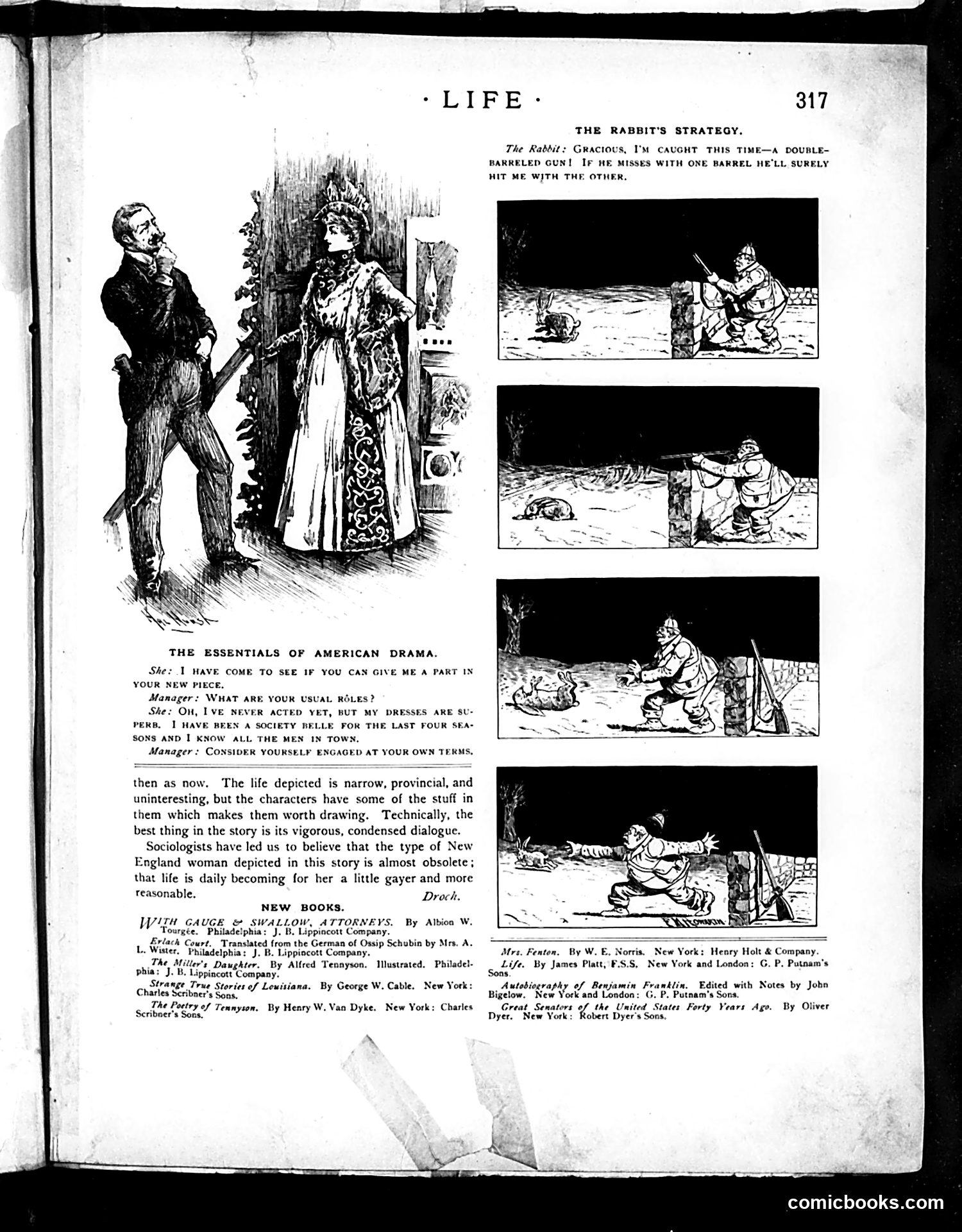
The left cartoon satirizes theatrical casting. A man pitches a play to an elaborately dressed woman (likely an actress or theater manager), claiming she needn't have acted before—he knows "all the best people in town" who can fill roles. This mocks how American theater relied on social connections and nepotism rather than talent or experience. The right panel, "The Rabbit's Strategy," shows a hunter with a double-barreled gun facing a clever rabbit. The rabbit's monologue explains his tactic: if one barrel misfires, the other will surely hit. The four sequential panels illustrate this hunting scenario, using the rabbit as a metaphor for strategic thinking under pressure in dangerous situations.
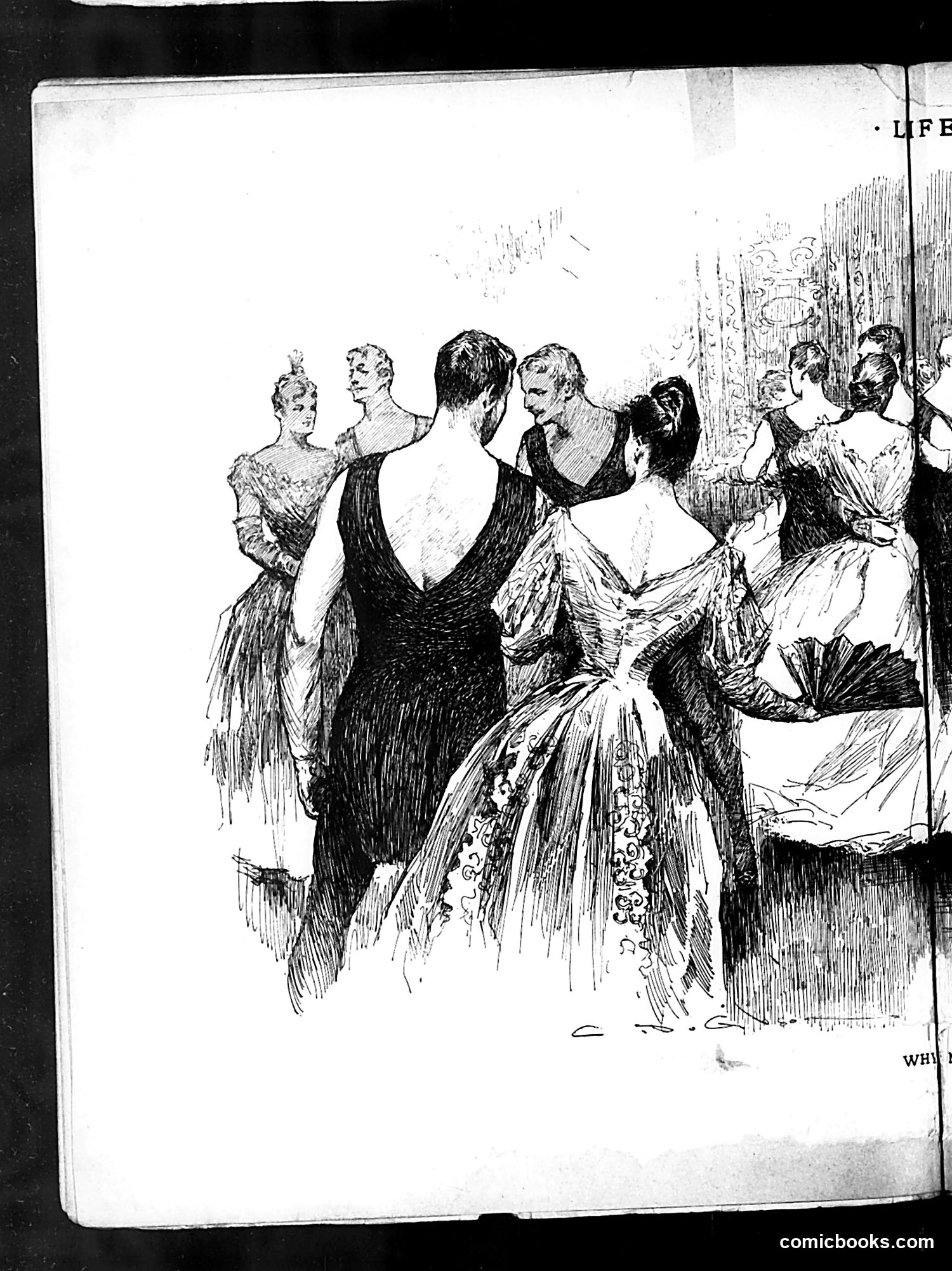
This is a sketch from *Life* magazine showing what appears to be a formal social gathering or ball. A central male figure in dark formal wear (tuxedo) is shown interacting with multiple women in elaborate evening gowns. The women are depicted in fashionable dress typical of late 19th or early 20th century high society. The satire likely concerns social dynamics at upper-class events—possibly mocking courtship rituals, the behavior of eligible bachelors surrounded by marriageable women, or social pretension. The women's focused attention on the central figure suggests commentary on matrimonial pursuit or the marriage market among the wealthy. However, without visible text identifying specific figures or providing a caption, the precise satirical target remains unclear.
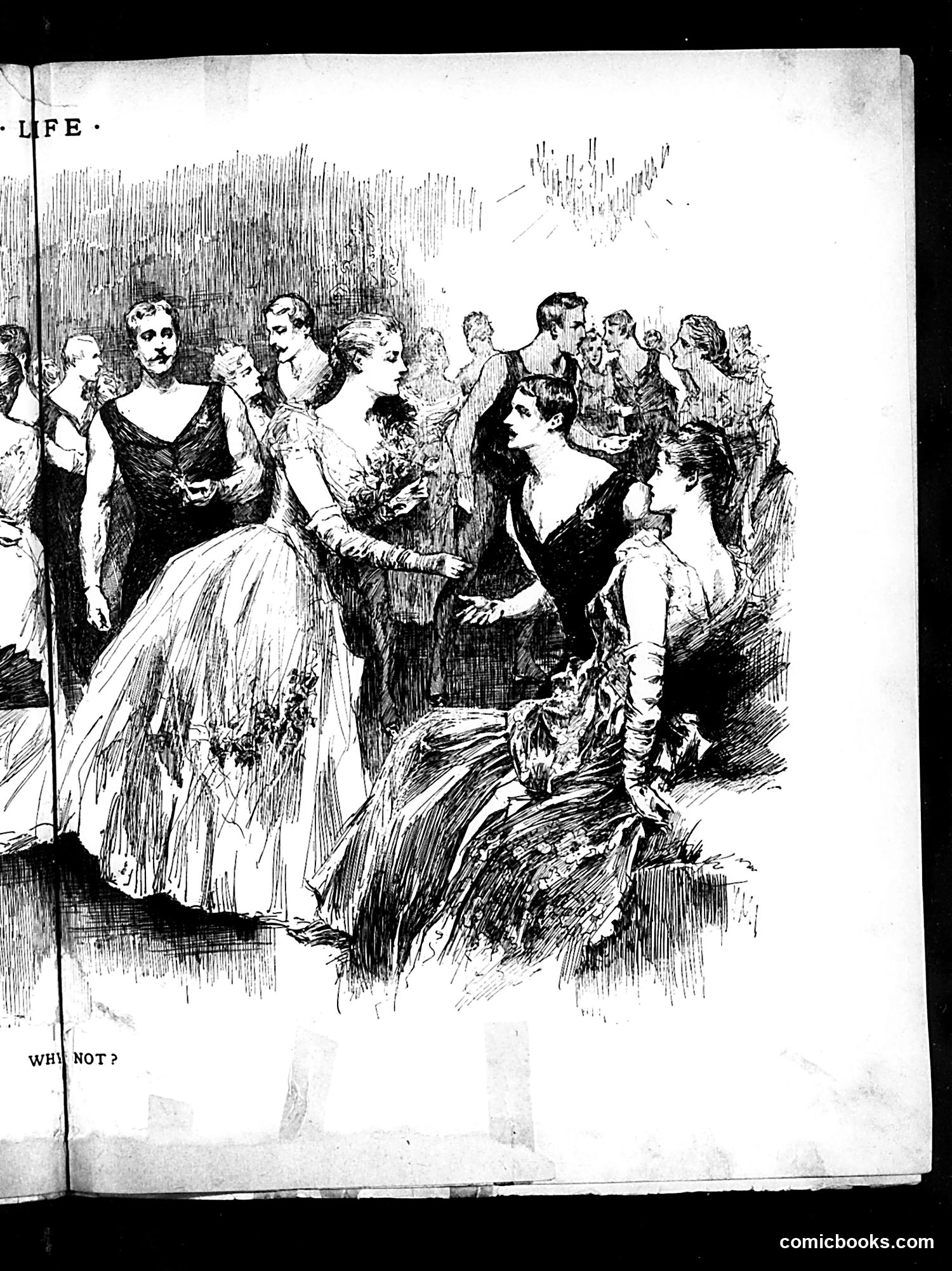
This page from *Life* magazine shows a social gathering, likely a formal reception or ball. The illustration depicts well-dressed men and women in evening wear, with some seated and others standing in conversation. The caption reads "WHY NOT?" — a rhetorical question suggesting social commentary. Without additional context or identifying captions in the OCR text, the specific satirical point remains unclear. The scene appears to critique social conventions or etiquette of the era, possibly commenting on formal dress codes, gender roles at social events, or acceptable behavior in high society. The questioning tone of "WHY NOT?" implies the artist is challenging some established social norm shown in the gathering, but the precise target of satire cannot be definitively determined from the image alone.
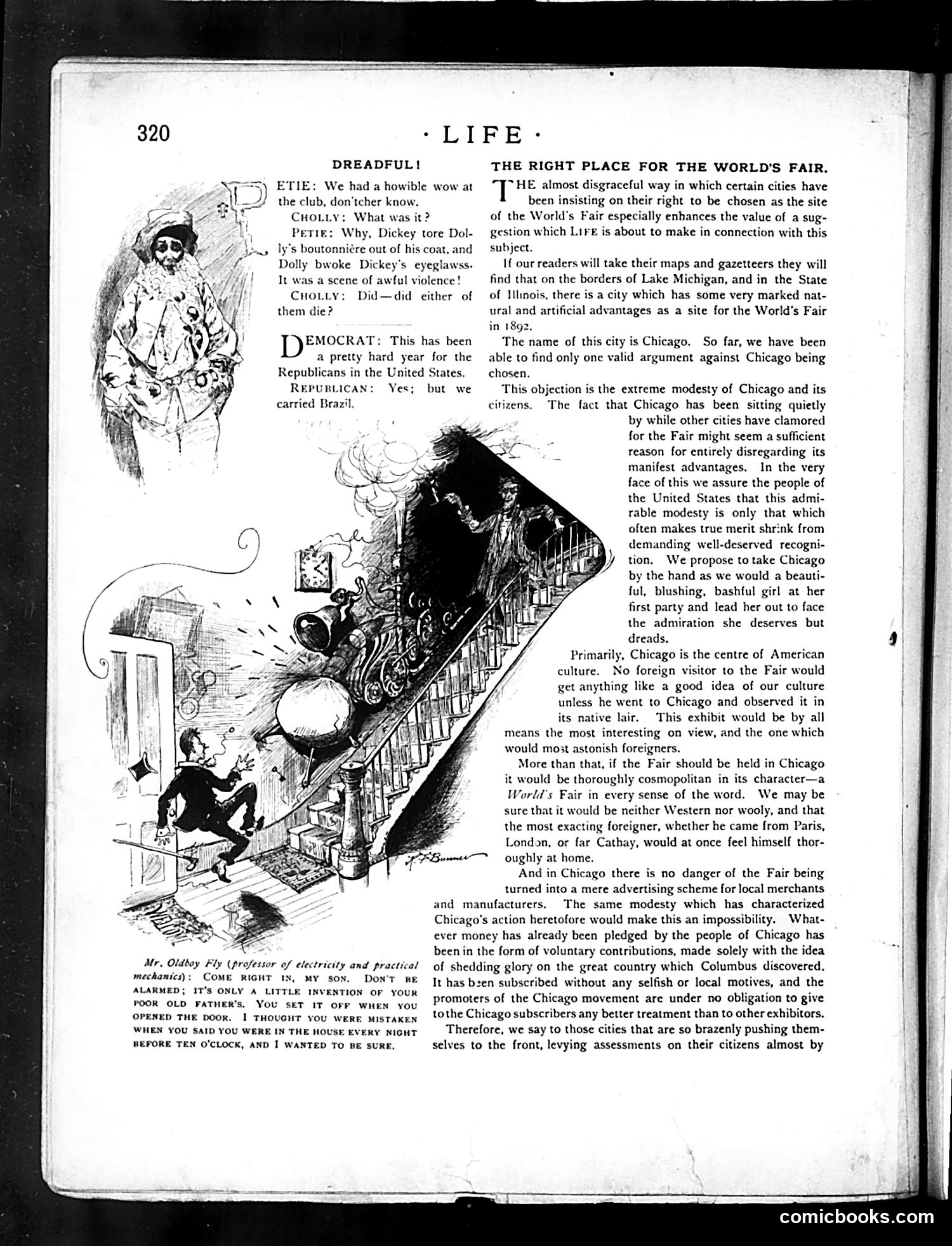
This page argues for Chicago as the 1892 World's Fair location. The satirical cartoon (lower half) depicts a disheveled man being forcibly ejected from a building by a stern woman—likely representing Chicago "taking by the hand" other competing cities and removing them from consideration. The text counters objections that Chicago is too modest to host the Fair, arguing instead that the city's modesty demonstrates its worthiness. It emphasizes Chicago as America's cultural center and claims the Fair would be thoroughly cosmopolitan there—not "Western nor woolly"—appealing to international visitors. The cartoon ridicules rival cities' presumption, suggesting they deserve ejection for their audacity to compete against Chicago's manifest advantages.
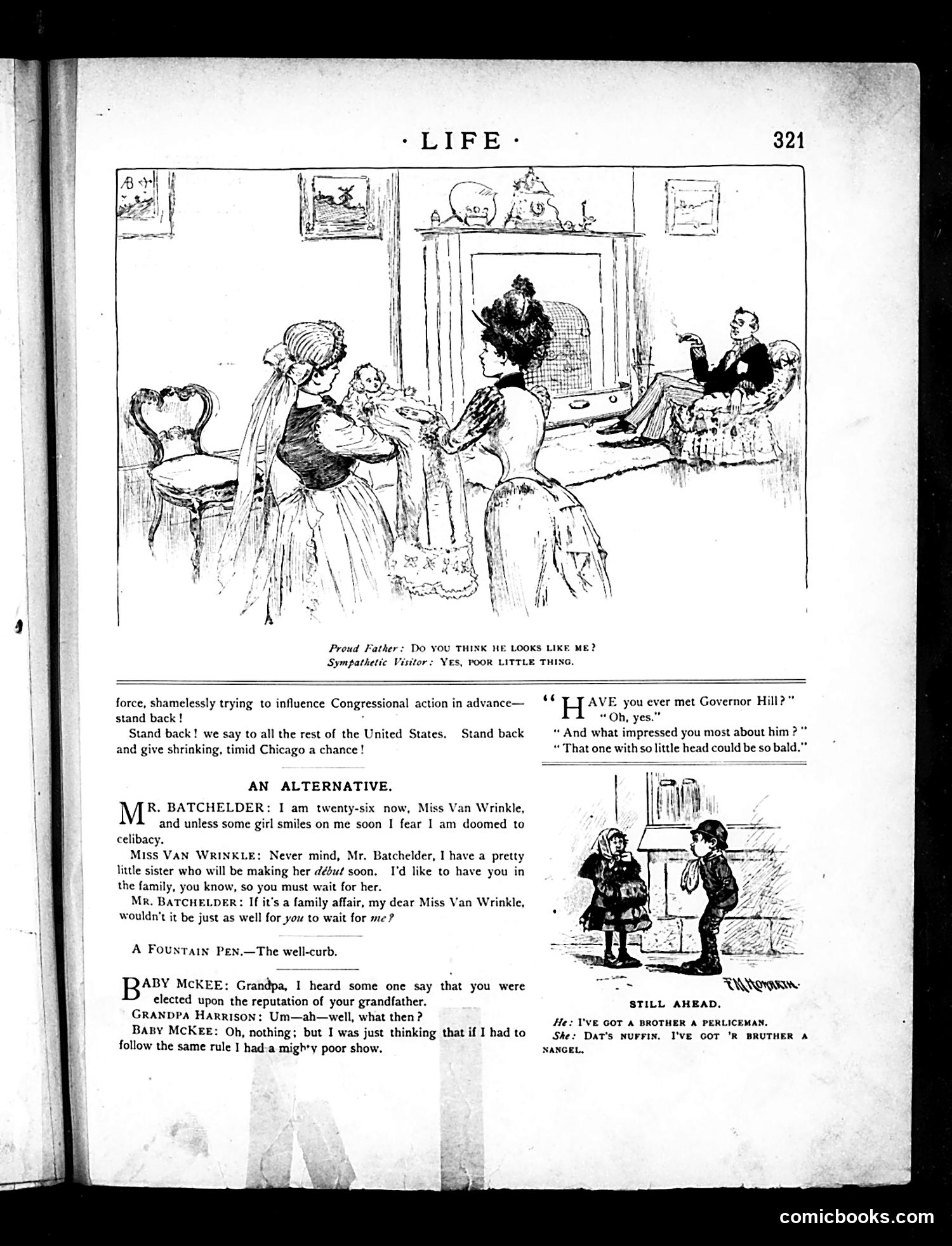
The page contains several distinct humor pieces: **Top cartoon**: Shows a proud father asking if his newborn resembles him, while a sympathetic visitor tactfully agrees the "poor little thing" looks like him—a classic joke about unflattering paternity. **"An Alternative" section**: Mr. Batchelder, a 26-year-old bachelor, fears bachelorhood while Miss Van Wrinkle mentions her sister making her "début" (high-society debut). Batchelder nervously asks if he could court the sister instead, turning the social ritual of debutante seasons into comedy about desperate matrimonial prospects. **Bottom pieces**: Include brief exchanges about political reputation and sibling relationships, using wordplay typical of early 20th-century magazine humor. The cartoons satirize marriage anxiety, social pretension, and changing family dynamics among the upper-middle class.
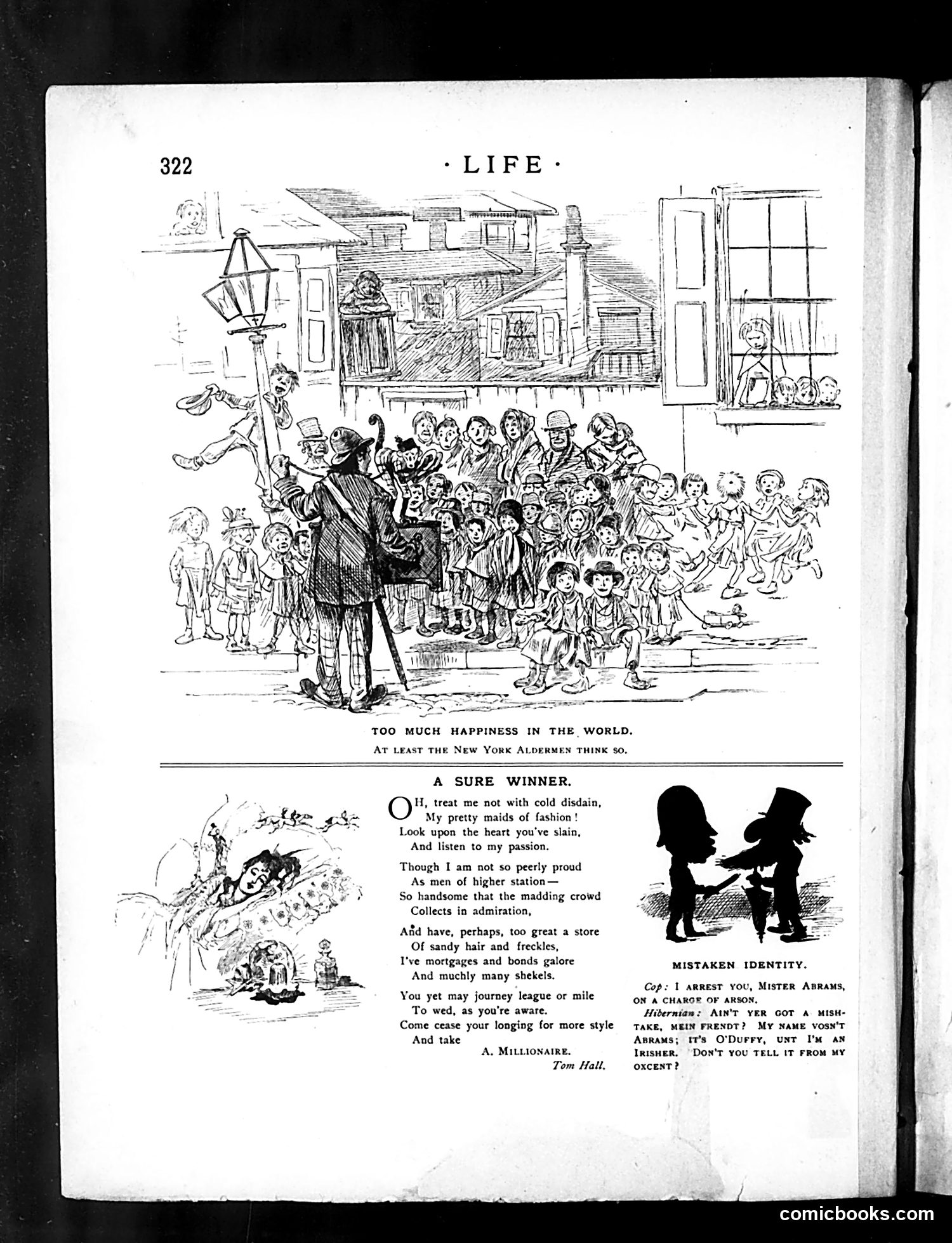
**Top Cartoon ("Too Much Happiness"):** This satirizes New York aldermen as killjoys. A street performer entertains a crowd of children and adults, but the cartoon's title suggests the aldermen believe there's excessive public happiness—implying they'd suppress such gatherings through regulation or prohibition. **Middle Poem ("A Sure Winner"):** A satirical love poem by Tom Hall mocking wealthy suitors. A millionaire with unflattering qualities (sandy hair, freckles) nonetheless courts women by boasting of his financial assets (mortgages, bonds, "shekels"). The joke: money supersedes appearance or breeding among the fashionable classes. **Bottom Comic ("Mistaken Identity"):** An Irish immigrant (indicated by accent and "Hibernian" label) is arrested for arson but corrects the officer—his name is O'Duffy, not "Abrams." The joke plays on ethnic stereotyping: his thick Irish brogue is so pronounced that even his name-correction seems absurd to the cop, who apparently expected an Irish-sounding name for the accused.
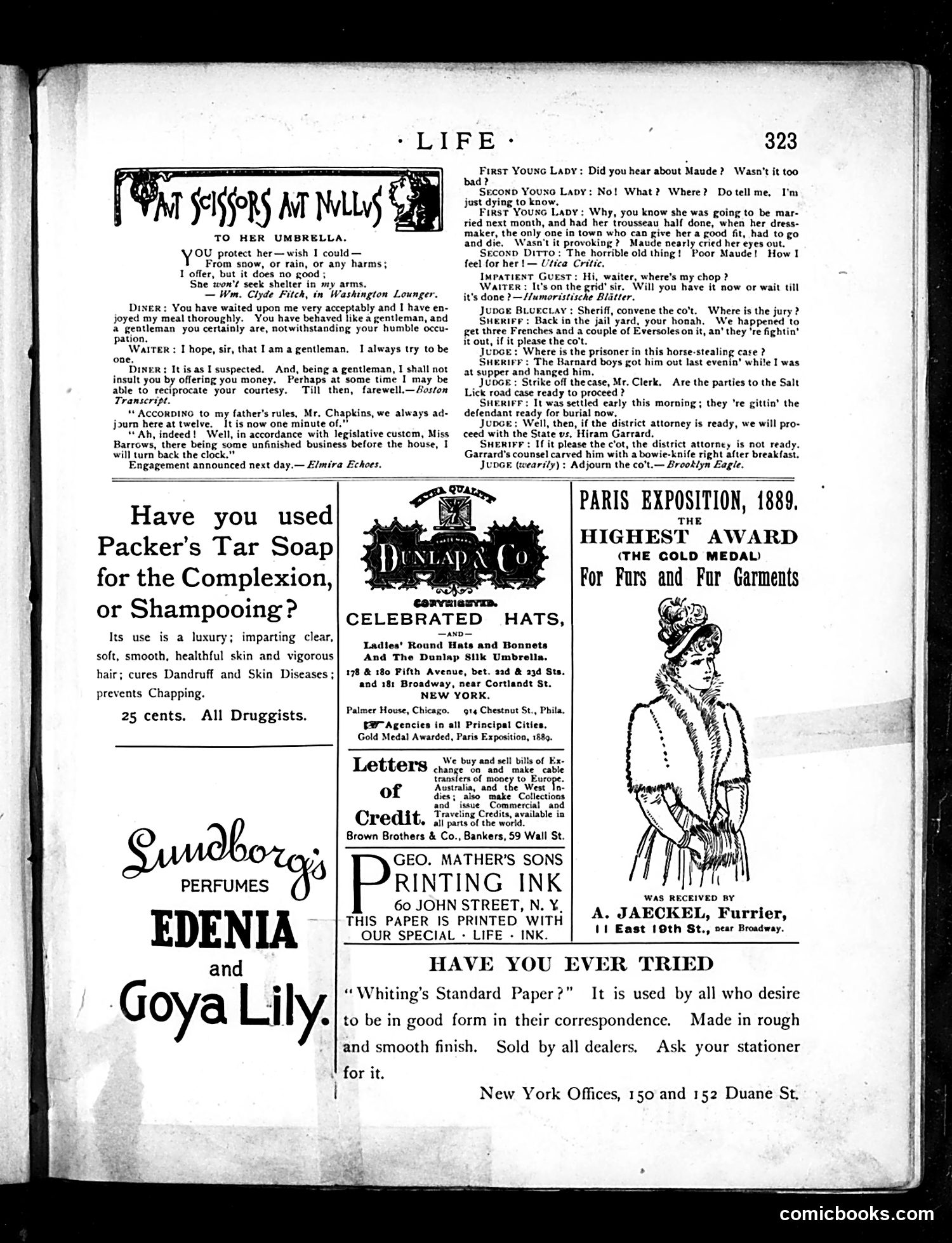
This page from *Life* magazine is primarily a **collection of short humorous anecdotes and advertisements**—not a political cartoon. The humor pieces satirize **social pretension and absurdity**. One sketch mocks an overly genteel diner who insults a waiter by *not* tipping him, claiming the waiter is too much of a gentleman for money. Another ridicules a legislator who literally turns back a clock to continue business past the adjournment deadline—a transparent mockery of procedural manipulation. Most darkly, a piece set in a frontier courtroom depicts a corrupt judge accepting that a prisoner was lynched, a prosecutor was murdered by the defendant's lawyer, and court business is "settled" by violent extra-judicial means. This appears to satirize **lawlessness in frontier towns** and judicial dysfunction. The remaining content is **period advertising**: soap, hats, printing ink, perfume, and paper—typical of *Life*'s revenue model. The "Paris Exposition 1889" award advertisement references that year's World's Fair. **This is not a coded political statement**, but rather satirical vignettes of everyday social comedy and hypocrisy.
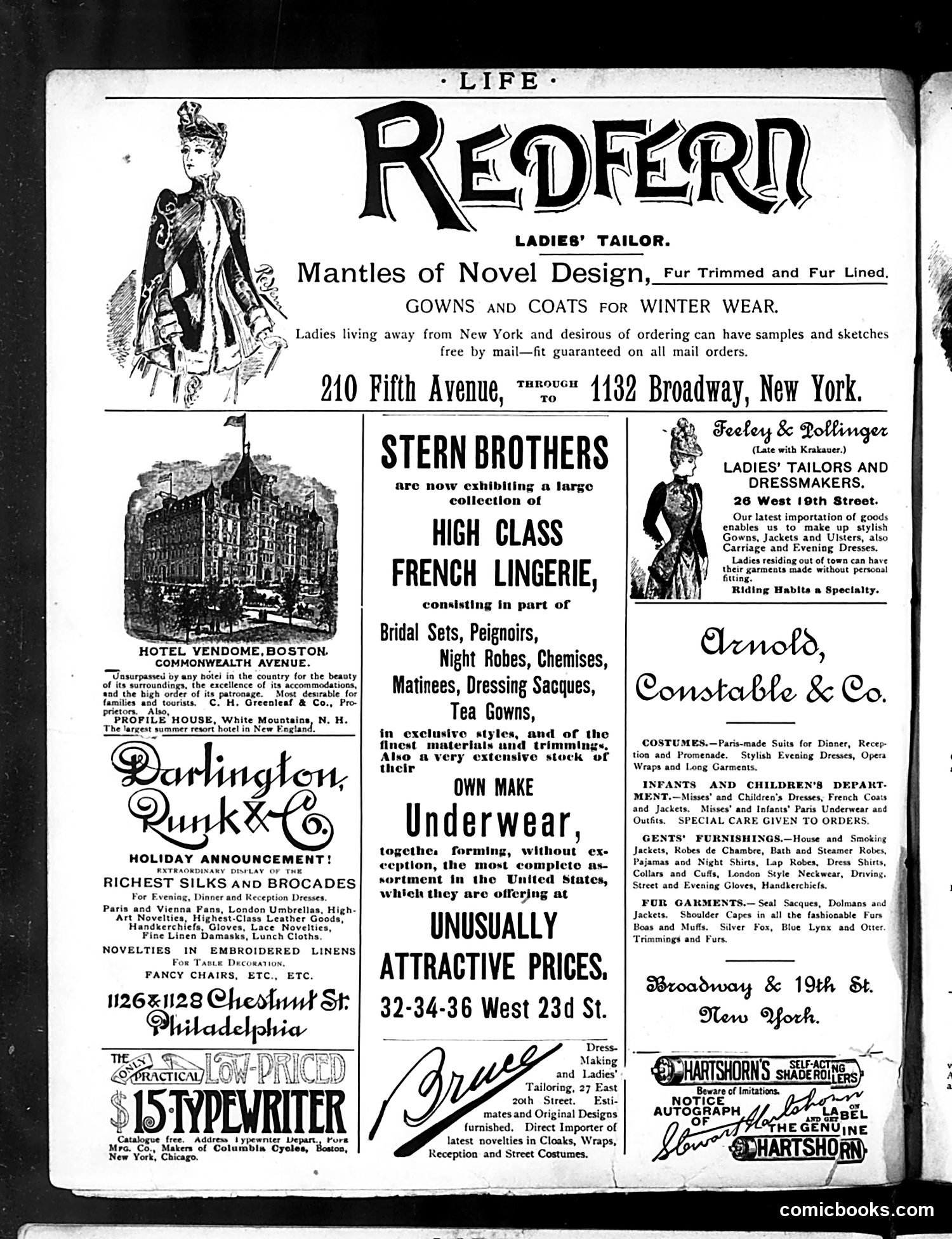
This is **not a satirical page**—it's primarily a **fashion and retail advertising section** from Life magazine, likely early 1900s. The page features ads for high-end women's clothing retailers and tailors in New York City (Redfern, Stern Brothers, Arnold Constable & Co., and others). Key offerings include: - **Winter wear**: fur-trimmed mantles, gowns, and coats - **French lingerie**: bridal sets, chemises, tea gowns - **Custom tailoring** for women living outside New York (samples sent by mail) - **Luxury goods**: Paris imports, embroidered linens, fine leather The small illustrations show fashionable women in elaborate period dress with corsets and detailed embellishments—typical high-fashion displays of the era. There are also ads for unrelated products (typewriters, hotels), which was standard for Life's mixed-content pages. **For modern readers**: This reflects the era's emphasis on conspicuous consumption, imported luxury goods, and the prominence of custom tailoring before ready-made fashion became standard.
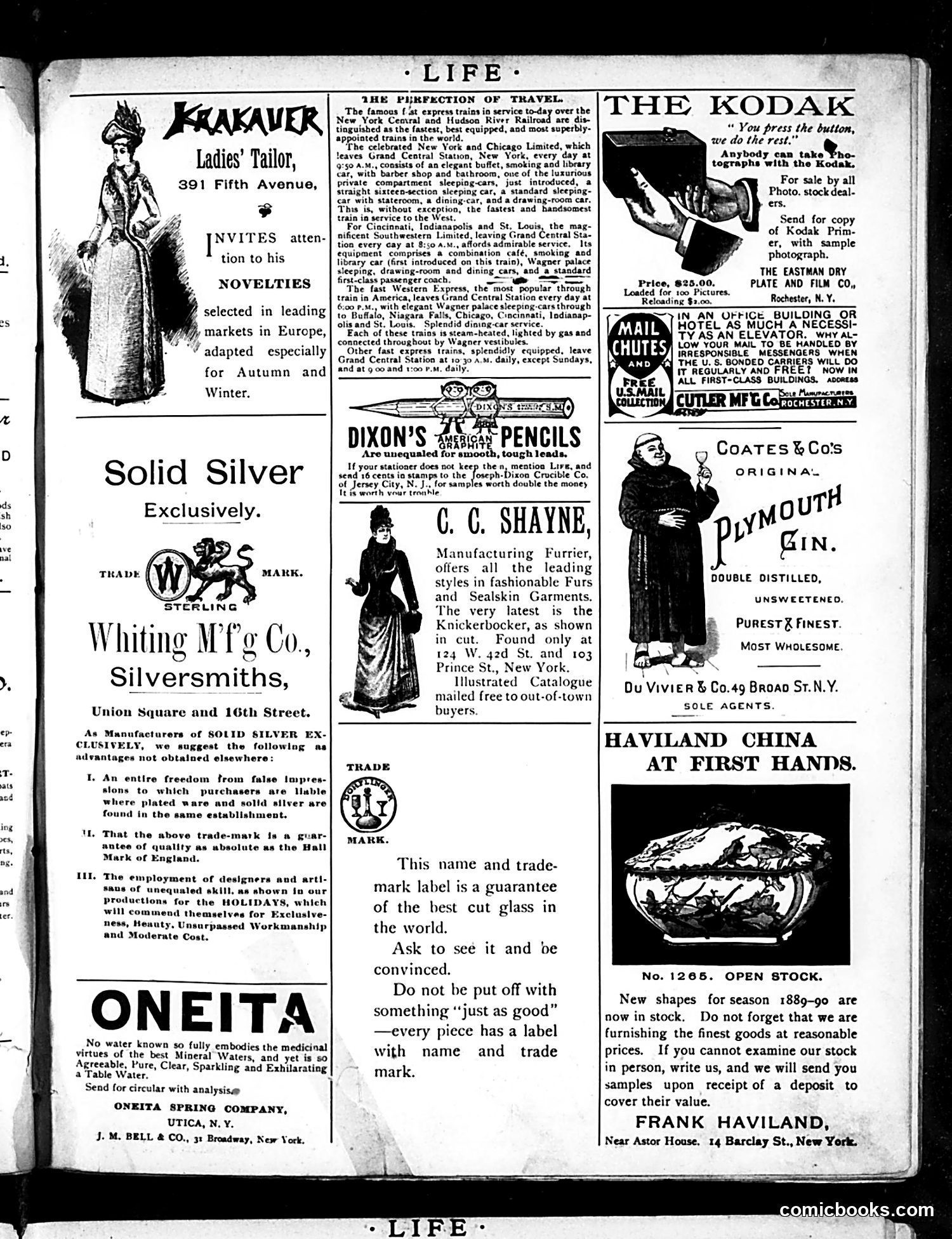
This is primarily an **advertising page** from Life magazine, not a political cartoon or satirical content page. The page features various luxury consumer product advertisements typical of the 1880s-90s era: solid silver tableware by Whiting Manufacturing, a ladies' tailor on Fifth Avenue, railroad services (New York Central's express trains), the Kodak camera, Plymouth Gin, Haviland china, Dixon's pencils, and Oneita mineral water. Each ad emphasizes quality, exclusivity, and modern convenience—hallmarks of affluent American consumer culture during the Gilded Age. The only illustration with satirical potential is the fashionable woman in the Krakauer Ladies' Tailor ad, though this appears promotional rather than satirical. There are no political figures, caricatures, or social commentary visible on this page.
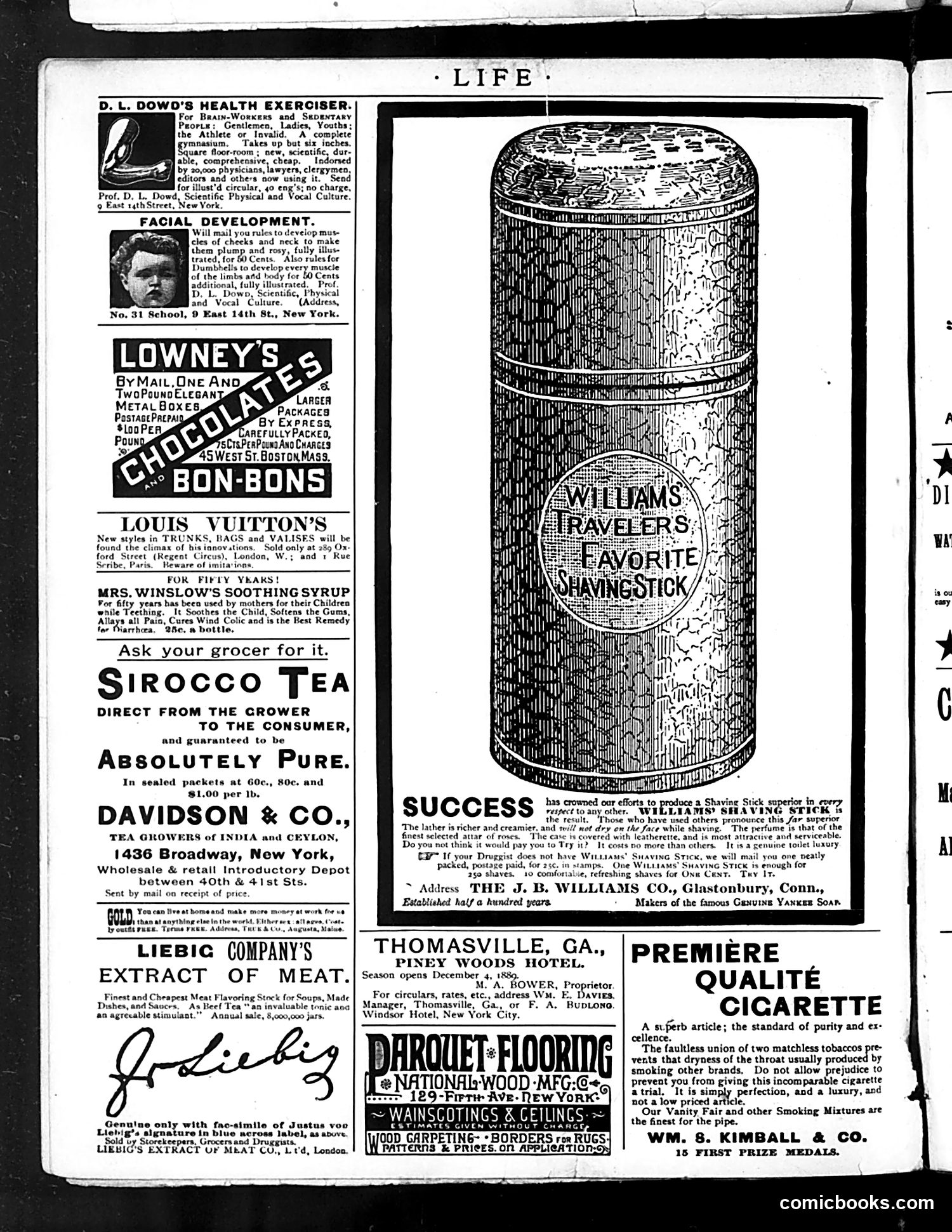
This page is **primarily advertising**, not satire or political commentary. It's a collection of Victorian-era product advertisements typical of early Life magazine. The ads promote various consumer goods and services: health exercisers (marketed to sedentary professionals), facial development courses, chocolates, trunks and bags, soothing syrup for teething infants, tea, meat extract, shaving cream, a Georgia hotel, flooring materials, and cigarettes. Notable to modern readers: several products appear harmful by today's standards—**Mrs. Winslow's Soothing Syrup** (likely opium-based), and aggressive marketing of cigarettes as a luxury item. The ads reflect Gilded Age consumer culture and period attitudes toward self-improvement through commercial products. The Williams Shaving Stick advertisement includes descriptive copy about its superiority, exemplifying the promotional style of the era. There is **no discernible political cartoon or satirical content** on this page.
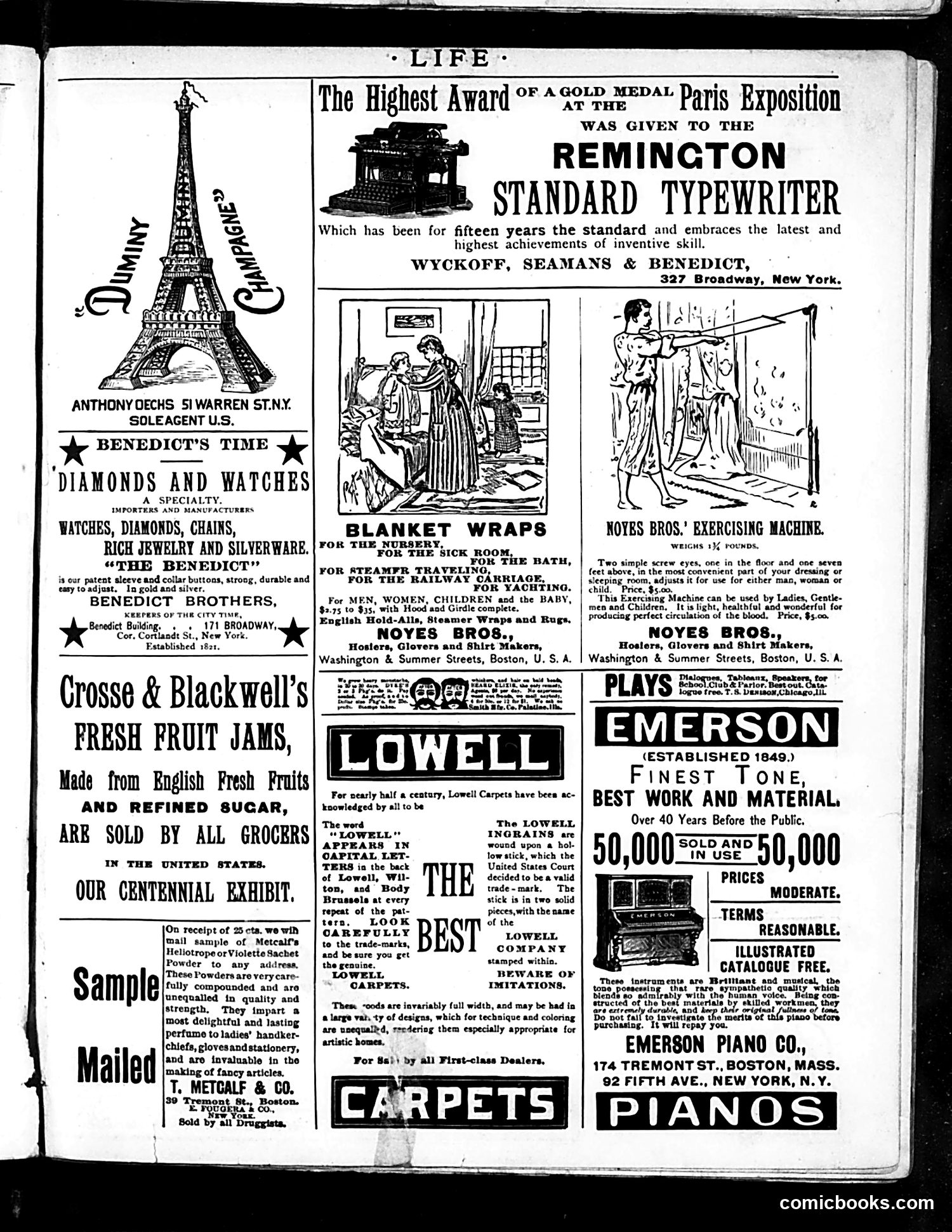
This page is primarily **advertising**, not satirical content. It showcases late-19th-century consumer goods and services, likely from the 1880s-1890s based on product references (typewriters, gas lamps era). The small illustrations accompanying ads show period domestic scenes: women in blanket wraps, children using exercise equipment, people using an exercising machine. These are straightforward product demonstrations, not political satire. The page includes a notable achievement: the **Remington Standard Typewriter** won the "highest award of a gold medal" at the Paris Exposition, competing against other typewriter manufacturers—a significant commercial milestone for office technology. The remaining content advertises luxury goods (watches, diamonds), European imports (Crosse & Blackwell jams), and home furnishings (Lowell carpets, Emerson pianos). The "Emerson Piano Co." advertisement emphasizes American manufacturing quality and durability. This is a commercial product page reflecting Gilded Age consumer culture and American industrial pride.
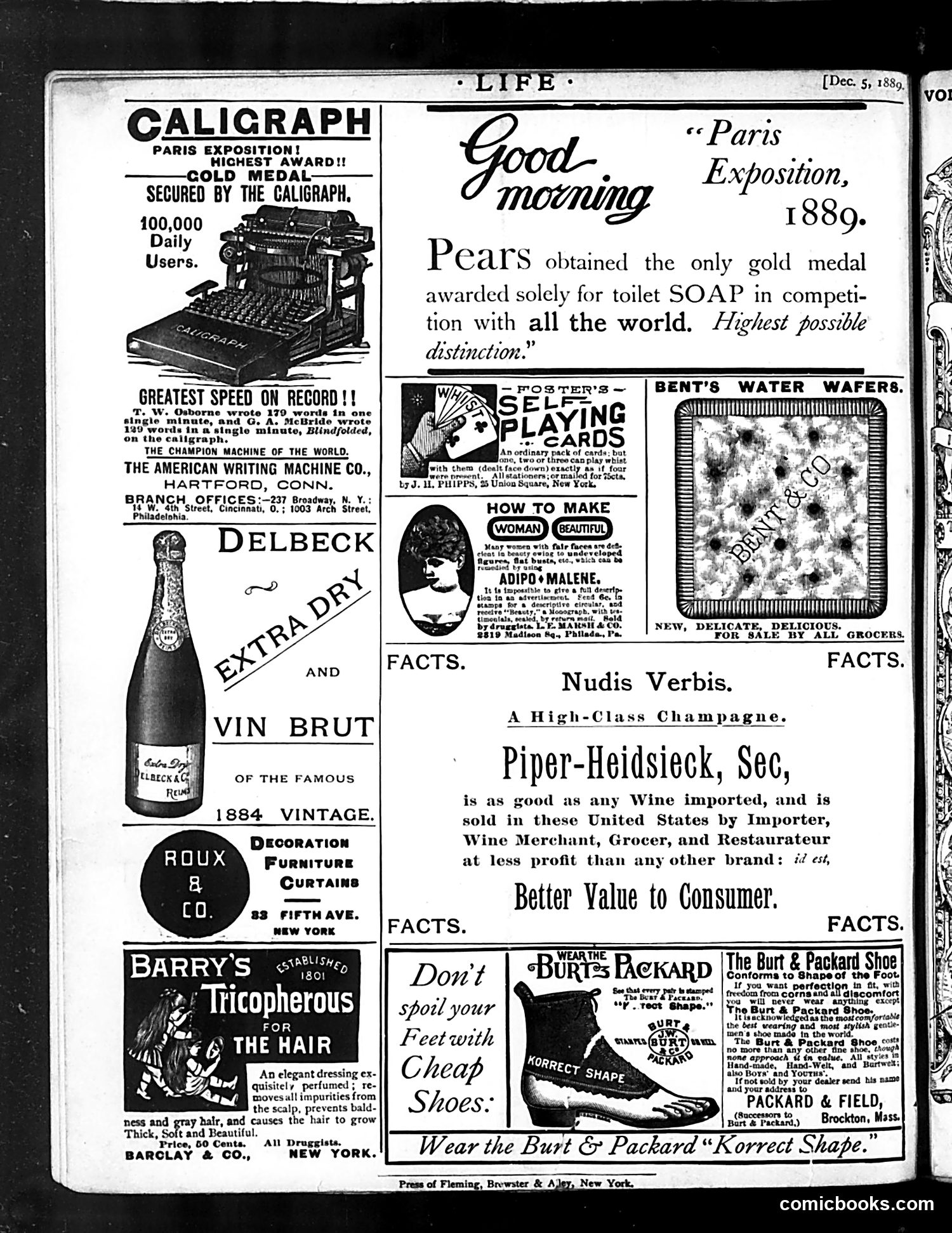
This is primarily an **advertisement page** with no political cartoons or satirical content. The page showcases various consumer products from the 1889 Paris Exposition period. The advertisements highlight products claiming international recognition and superiority: - **Caligraph typewriter**: boasts winning a gold medal at the Paris Exposition and speed records (179 words per minute) - **Pears soap**: claims the "only gold medal" awarded for toilet soap globally - **DelBeck champagne** (1884 vintage) and **Piper-Heidsieck** champagne: emphasize imported quality and value - **Burt & Packard shoes**: stress proper foot health and quality construction - **Barry's Tricopherous hair product**: promises to prevent baldness - Various minor products (playing cards, water wafers, etc.) The page reflects **Victorian-era marketing tactics**: products legitimized through international awards, medical/scientific claims, and appeals to middle-class aspirations for quality goods. There is no satire here—simply competitive advertising typical of the era's magazine culture.