
Life, 1889-12-05 · page 4 of 18
Life — December 5, 1889 — page 4: what you’re looking at
What you’re looking at
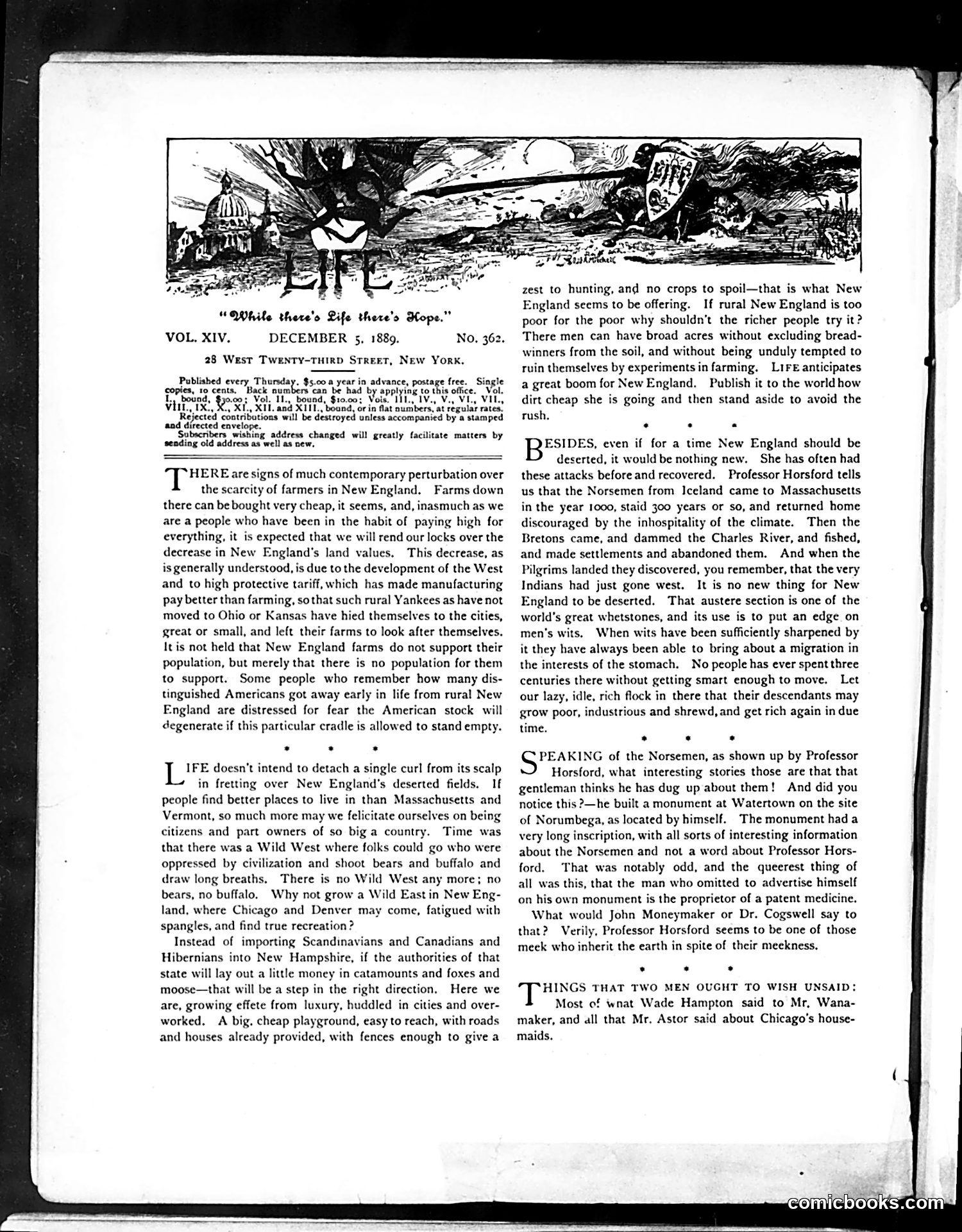
**The Cartoon:** The header illustration titled "While there's Life there's Skops" appears to show allegorical figures in a landscape—likely personifications of themes discussed in the article below. **The Content:** The main article discusses New England's agricultural decline and depopulation. It argues that rural New England farms are being abandoned as people migrate westward or to cities, causing property values to collapse. The author proposes solutions: instead of farming, New England should develop recreational hunting grounds and estates for wealthy buyers. **The Satire:** The piece critiques both rural decay and wealthy indifference. It sardonically suggests that rather than revitalize farming communities, the solution is to convert struggling farmland into playgrounds for the rich—essentially abandoning ordinary people's livelihoods.
📄 Transcribed text from this page (OCR, searchable)
Machine-transcribed from the original scan — historical spelling and the odd misread are preserved.
“OMhile there's Life there's Hope.” VOL. XIV. DECEMBER 65, 1889. No. 362. 28 West Twenty-THirp STREET, New York. Published every Thursday. $5.00 a year in advance, postage free. Sing! copies, 10 cents. Back numbers can be had by applying to this office. - Vol. 1, bound, $30.00; Vol $10.00; Voie, Hie IV. Vay Vier Vile, ViIL., 1X, XT, XIi. and XIIL., bound, or in flat numbers, at regular rates, Rejected contributions will be destroyed unless accompanied by a stamped and directed envelope. Subscribers wishing address changed will greatly facilitate matters by sending old address as well as new, 0 Ree are signs of much contemporary perturbation over the scarcity of farmers in New England. Farms down there can be bought very cheap, it seems, and, inasmuch as we are a people who have been in the habit of paying high for everything, it is expected that we will rend our locks over the decrease in New England's land values. This decrease, as is generally understood, is due to the development of the West and to high protective tariff, which has made manufacturing pay better than farming, sothat such rural Yankees as have not moved to Ohio or Kansas have hied themselves to the cities, great or small, and left their farms to look after themselves. It is not held that New England farms do not support their population, but merely that there is no population for them to support. Some people who remember how many dis- tinguished Americans got away early in life from rural New England are distressed for fear the American stock will degenerate if this particular cradle is allowed to stand empty. . . . IFE doesn’t intend to detach a single curl from its scalp in fretting over New England's deserted fields. If people find better places to live in than Massachusetts and Vermont, so much more may we felicitate ourselves on being citizens and part owners of so big a country. Time was that there was a Wild West where folks could go who were oppressed by civilization and shoot bears and buffalo and draw long breaths, There is no Wild West any more; no bears, no buffalo. Why not grow a Wild East in New Eng- land, where Chicago and Denver may come, fatigued with spangles, and find true recreation ? Instead of importing Scandinavians and Canadians and Hibernians into New Hampshire, if the authorities of that state will lay out a little money in catamounts and foxes and moose—that will be a step in the right direction, Here we are, growing effete from luxury, huddled in cities and over- worked. A big. cheap playground, easy to reach, with roads and houses already provided, with fences enough to give a zest to hunting, and no crops to spoil—that is what New England seems to be offering. If rural New England is too poor for the poor why shouldn't the richer people try it? There men can have broad acres without excluding bread- winners from the soil, and without being unduly tempted to ruin themselves by experiments in farming. LiF anticipates a great boom for New England. Publish it to the world how dirt cheap she is going and then stand aside to avoid the rush, : . . ESIDES, even if for a time New England should be deserted, it would be nothing new. She has often had these attacks before and recovered. Professor Horsford tells us that the Norsemen from Iceland came to Massachusetts in the year 1000, staid 300 years or so, and returned home discouraged by the inhospitality of the climate. Then the Bretons came, and dammed the Charles River, and fished, and made settlements and abandoned them. And when the Pilgrims landed they discovered, you remember, that the very Indians had just gone west. It is no new thing for New England to be deserted. That austere section is one of the world’s great whetstones, and its use is to put an edge on men’s wits. When wits have been sufficiently sharpened by it they have always been able to bring about a migration in the interests of the stomach. No people has ever spent three centuries there without getting smart enough to move. Let our lazy, idle, rich flock in there that their descendants may grow poor, industrious and shrewd, and get rich again in due time. * . * SPEAKING of the Norsemen, as shown up by Professor Horsford, what interesting stories those are that that gentleman thinks he has dug up about them! And did you notice this ?—he built a monument at Watertown on the site of Norumbega, as located by himself. The monument had a very long inscription, with all sorts of interesting information about the Norsemen and not a word about Professor Hors- ford. That was notably odd, and the queerest thing of all was this, that the man who omitted to advertise himself on his own monument is the proprietor of a patent medicine, What would John Moneymaker or Dr. Cogswell say to that? Verily, Professor Horsford seems to be one of those meek who inherit the earth in spite of their meckness. . . . HINGS THAT TWO MEN OUGHT TO WISH UNSAID: Most of wnat Wade Hampton said to Mr, Wana- maker, and all that Mr. Astor said about Chicago's house- maids.