
Life, 1889-12-05 · page 6 of 18
Life — December 5, 1889 — page 6: what you’re looking at
What you’re looking at
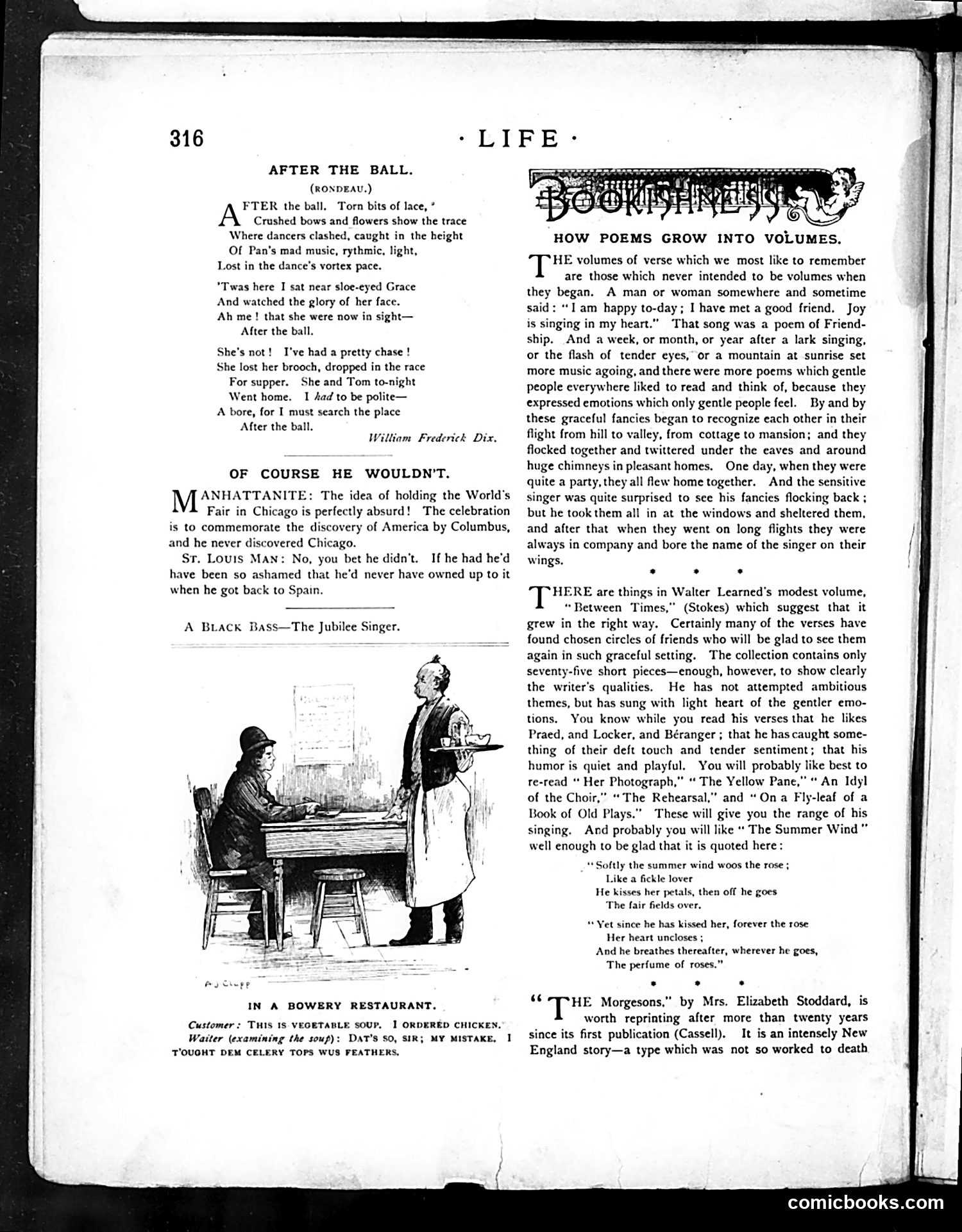
This page contains literary reviews and social humor rather than political cartoons. The main cartoon titled "A BLACK BASS—The Jubilee Singer" depicts a waiter serving a seated customer in what appears to be a restaurant setting. The accompanying caption reads: "Customer: This is vegetable soup. I ordered chicken. Waiter (examining the soup): Dat's so, sir; my mistake. I thought dem celery tops wus feathers." The joke relies on racial dialect humor common to the era, portraying the waiter as ignorant and clumsy—confusing vegetable matter for poultry feathers. This reflects period stereotypes about Black service workers. The page's other content focuses on book reviews, including discussions of Walter Learned's poetry volume "Between Times" and Elizabeth Stoddard's "The Morgessons."
📄 Transcribed text from this page (OCR, searchable)
Machine-transcribed from the original scan — historical spelling and the odd misread are preserved.
AFTER THE BALL. (RONDEAU.) FTER the ball. Torn bits of lace, * Crushed bows and flowers show the trace Where dancers clashed, caught in the height Of Pan's mad music, rythmic, light, Lost in the dance’s vortex pace. *Twas here I sat near sloe-eyed Grace And watched the glory of her face. Ah me! that she were now in sight— After the ball. She’s not! I've had a pretty chase ! She lost her brooch, dropped in the race For supper. She and Tom to-night Went home. I Aad to be polite— A bore, for I must search the place After the ball. William Frederick Dix, OF COURSE HE WOULDN'T. [VANES trae : The idea of holding the World's Fair in Chicago is perfectly absurd! The celebration is to commemorate the discovery of America by Columbus, and he never discovered Chicago. Sr. Louis MAN: No, you bet he didn't. If he had he'd have been so ashamed that he'd never have owned up to it when he got back to Spain. A Biack Bass—The Jubilee Singer. fy Chepe IN A BOWERY RESTAURANT. Customer: THIS 1S VEGETABLE soup, I ORDERED CHICKEN, Waiter (examining the soup): DAt’S $0, SIR; MY MISTAKE, I TOUGHT DEM CELERY TOPS WUS FEATHERS, HOW POEMS GROW INTO VOLUMES. HE volumes of verse which we most like to remember are those which never intended to be volumes when they began. A man or woman somewhere and sometime said: “1 am happy to-day; I have met a good friend. Joy is singing in my heart.” That song was a poem of Friend- ship. And a week, or month, or year after a lark singing, or the flash of tender eyes, or a mountain at sunrise set more music agoing, and there were more poems which gentle people everywhere liked to read and think of, because they expressed emotions which only gentle people feel. By and by these graceful fancies began to recognize each other in their flight from hill to valley, from cottage to mansion; and they flocked together and twittered under the eaves and around huge chimneys in pleasant homes. One day, when they were quite a party, they all flew home together. And the sensitive singer was quite surprised to see his fancies flocking back ; but he took them all in at the windows and sheltered them, and after that when they went on long flights they were always in company and bore the name of the singer on their wings. . . . HERE are things in Walter Learned’s modest volume, “Between Times,” (Stokes) which suggest that it grew in the right way. Certainly many of the verses have found chosen circles of friends who will be glad to sce them again in such graceful setting. The collection contains only seventy-five short pieces—enough, however, to show clearly the writer's qualities. He has not attempted ambitious themes, but has sung with light heart of the gentler emo- tions. You know while you read his verses that he likes Praed, and Locker, and Béranger ; that he has caught some- thing of their deft touch and tender sentiment; that his humor is quiet and playful. You will probably like best to te-read “ Her Photograph,” ‘* The Yellow Pane,” “ An Idyl of the Choir,” “The Rehearsal,” and “Ona Fly-leaf of a Book of Old Plays.” These will give you the range of his singing. And probably you will like * The Summer Wind" well enough to be glad that it is quoted here: “Softly the summer wind woos the rose ; Like a fickle lover He kisses her petals, then off he goes The fair fields over. * Yet since he has kissed her, forever the rose Her heart uncloses ; And he breathes thereafter, wherever he goes, The perfume of roses.” . . . a HE Morgesons,” by Mrs. Elizabeth Stoddard, is worth reprinting after more than twenty years since its first publication (Cassell), It is an intensely New England story—a type which was not so worked to death comicbooks.com