
A complete issue · 20 pages · 1889
Life — May 2, 1889
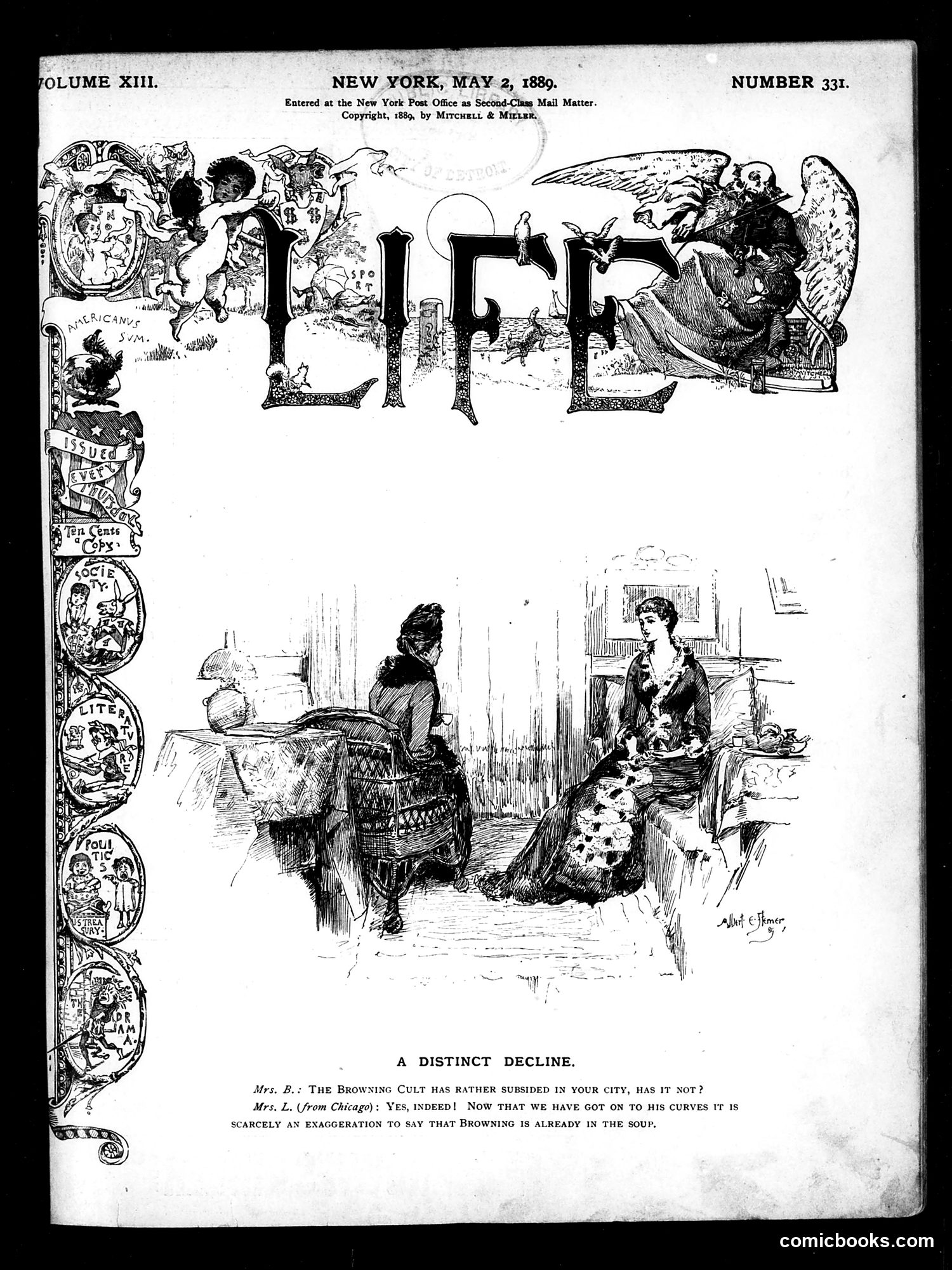
This cartoon satirizes the declining popularity of the Browning Cult—a late-nineteenth-century literary movement devoted to poet Robert Browning's work. The dialogue shows two women discussing how the cult "has rather subsided in your city." The joke targets Victorian intellectual pretension: the Browning Cult had been fashionable among educated women seeking cultural sophistication, but the fad was already waning by 1889. One woman admits the movement is "already in the soup"—meaning it's finished or ruined. The satirical thrust mocks both the cult's superficiality (treating serious literature as mere trend) and the fickle nature of fashionable enthusiasms among the wealthy. The ornate decorative border reinforces Life's sophisticated audience.
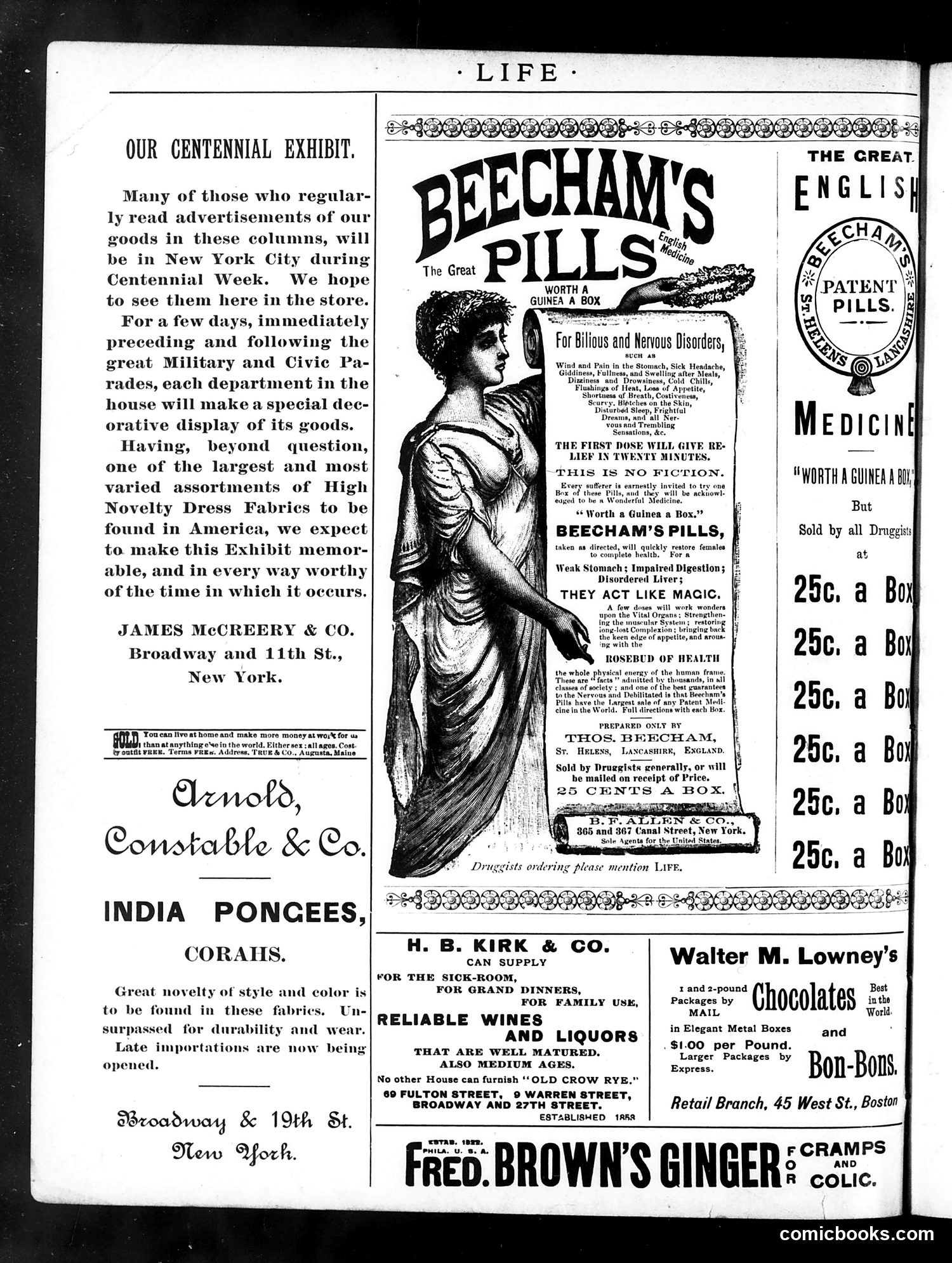
This page is primarily **advertising with minimal editorial content**. The dominant image is Beecham's Pills advertisement, featuring a classical female figure (likely representing health or wellness) alongside text promoting the patent medicine as a cure-all for "Billious and Nervous Disorders." The left side contains brief advertisements from James McCreery & Co. (dress fabrics) and Arnold, Constable & Co. (India poncees/fabrics), promoting their Centennial Week displays in New York City. Additional ads promote wines, liquors, chocolates, and Fred Brown's Ginger for cramps and colic. **There is no political satire on this page.** Life magazine here functions as a conventional advertising vehicle rather than as satirical commentary. The Beecham's Pills ad represents typical patent medicine marketing of the era—making broad curative claims without scientific evidence.
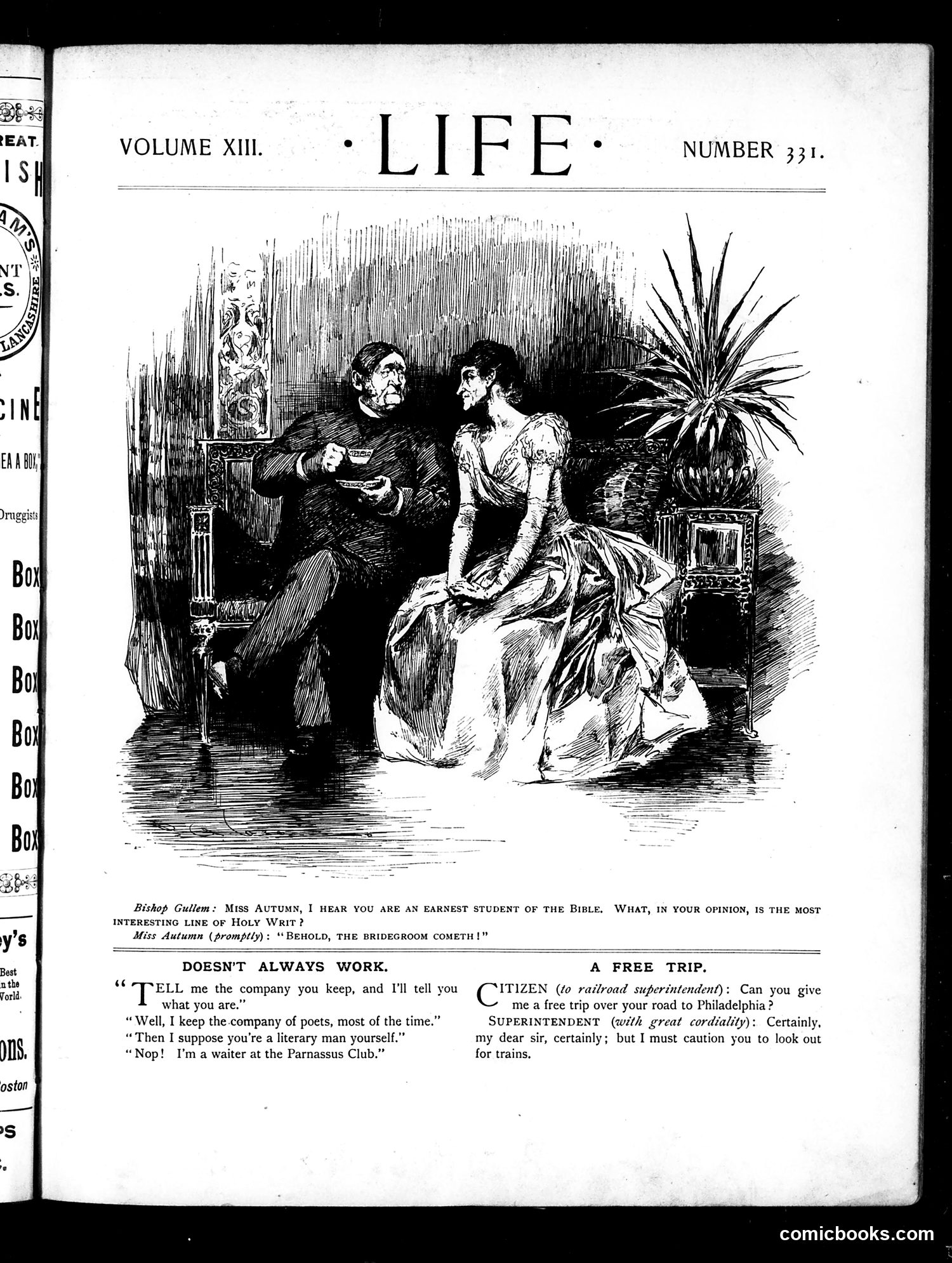
The main illustration depicts a social satire about class and courtship. A well-dressed woman in an elegant gown sits with a poorly-dressed man in dark, shabby clothing. The caption indicates Bishop Gullem is complimenting "Miss Autumn" as a Bible student, while she responds that "the bridegroom cometh"—a biblical reference suggesting marriage is imminent. The joke appears to mock either: (1) the absurdity of their mismatched social stations, or (2) a woman's eagerness to marry regardless of the man's circumstances. Below are two unrelated brief comedic dialogues: "Doesn't Always Work" about keeping literary company, and "A Free Trip," a railroad joke. The overall page represents *Life* magazine's typical mix of social commentary through humor, targeting Victorian-era courtship conventions and class pretensions.
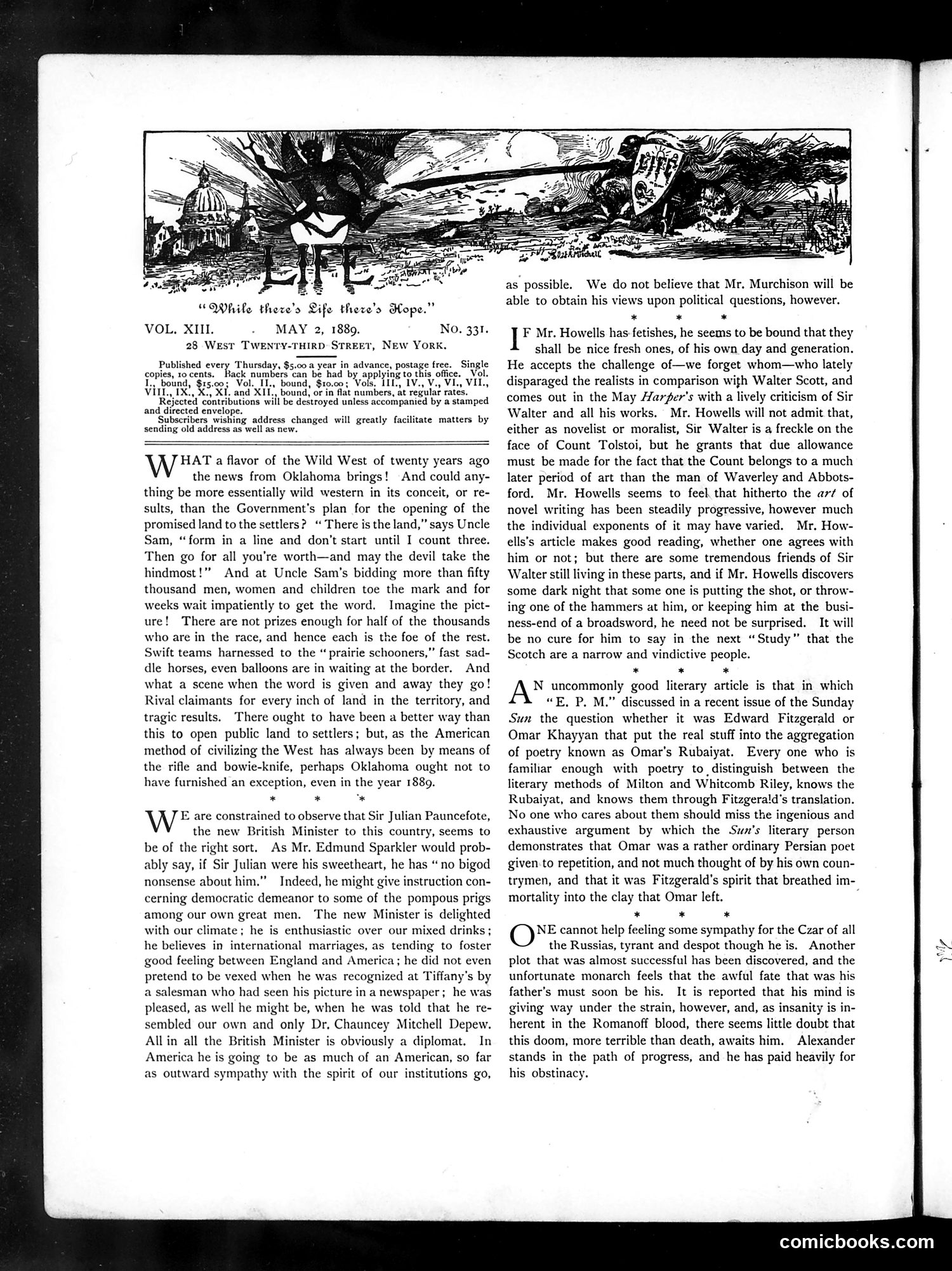
The illustrated masthead cartoon, titled "While there's Life there's Hope," depicts a chaotic Western scene with figures in conflict—likely satirizing the Oklahoma Land Rush (referenced in the accompanying editorial). The text describes the "Wild West of twenty years ago" and the government's opening of promised land to settlers, mocking the chaos and violence of land distribution where settlers rushed to claim territory. The editorial also discusses Sir Julian Paunceforte, Britain's new Minister to the U.S., expressing sympathy for his diplomatic position. There's commentary on literary matters, including discussion of Omar Khayyam's poetry translation and criticism of Sir Walter Scott. The cartoon satirizes frontier lawlessness and land-grab mentality as emblematic of American expansion.
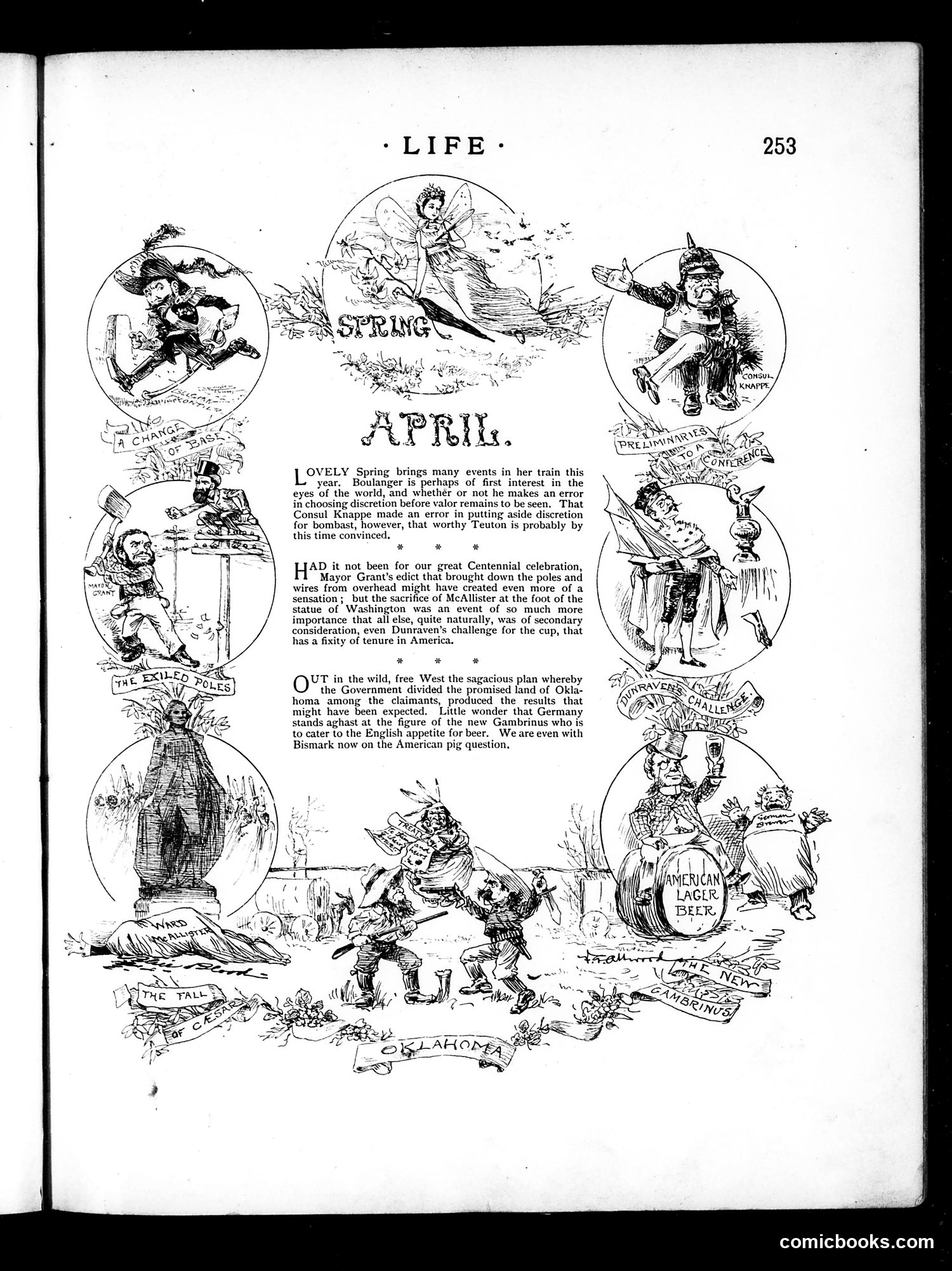
This page satirizes spring 1889 events through anthropomorphized seasonal figures. The circular vignettes arranged around "April" reference contemporary news: **"Spring"** features a fairy-like figure dispersing renewal. **"The Exiled Boers"** and **"The Fall of Sarajevo"** appear to reference colonial conflicts. **"Oklahoma"** discusses the Government's land division scheme for settlers—a significant 1889 event. The text mentions **Boulanger** (likely French General Boulanger's political movements), **McAllister's** memorial sacrifice, **Dunraven's cup challenge** (yacht racing), and German/English competition over beer and pigs. **"American Lager Beer"** represents contemporary commercial rivalry. The cartoons use whimsical characters and seasonal personification to comment on these disparate 1889 news stories—a typical Life magazine format combining political satire with humor.
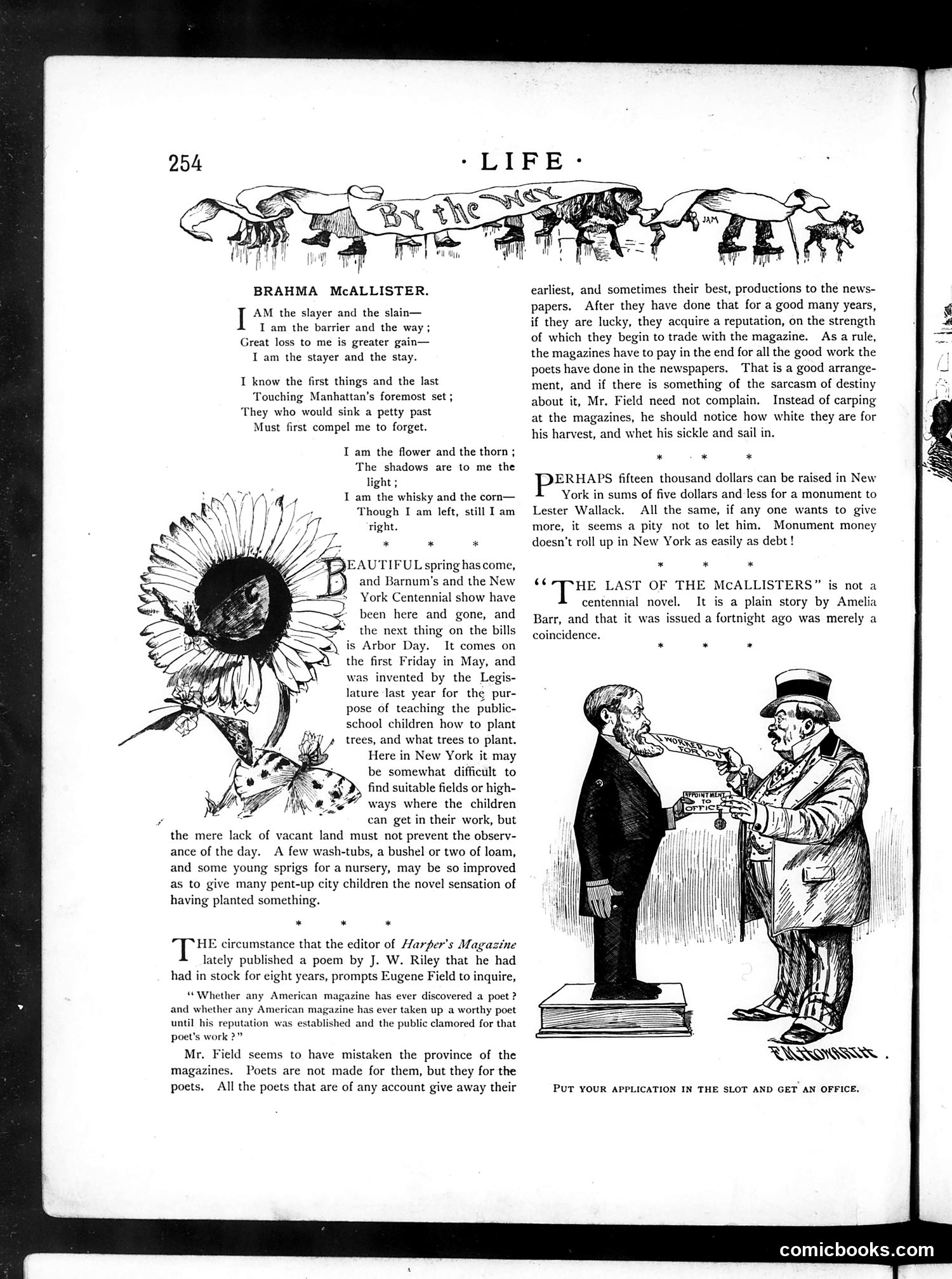
This page contains **Brahma McAllister**, a poem about loss and resilience, alongside commentary about American magazines and poets. The main **cartoon** (lower right) depicts two men in what appears to be a transaction or negotiation—one in formal dress, the other wearing a hat and casual clothing. The caption reads "PUT YOUR APPLICATION IN THE SLOT AND GET AN OFFICE," suggesting satire about bureaucratic job-seeking or political patronage systems. The text criticizes **Eugene Field** (a prominent poet) for questioning whether American magazines properly support poets. The author argues magazines don't exist to serve poets—poets serve magazines. This reflects **late 19th-century tensions** between literary merit and commercial publishing needs, with magazines prioritizing what sells over artistic quality.
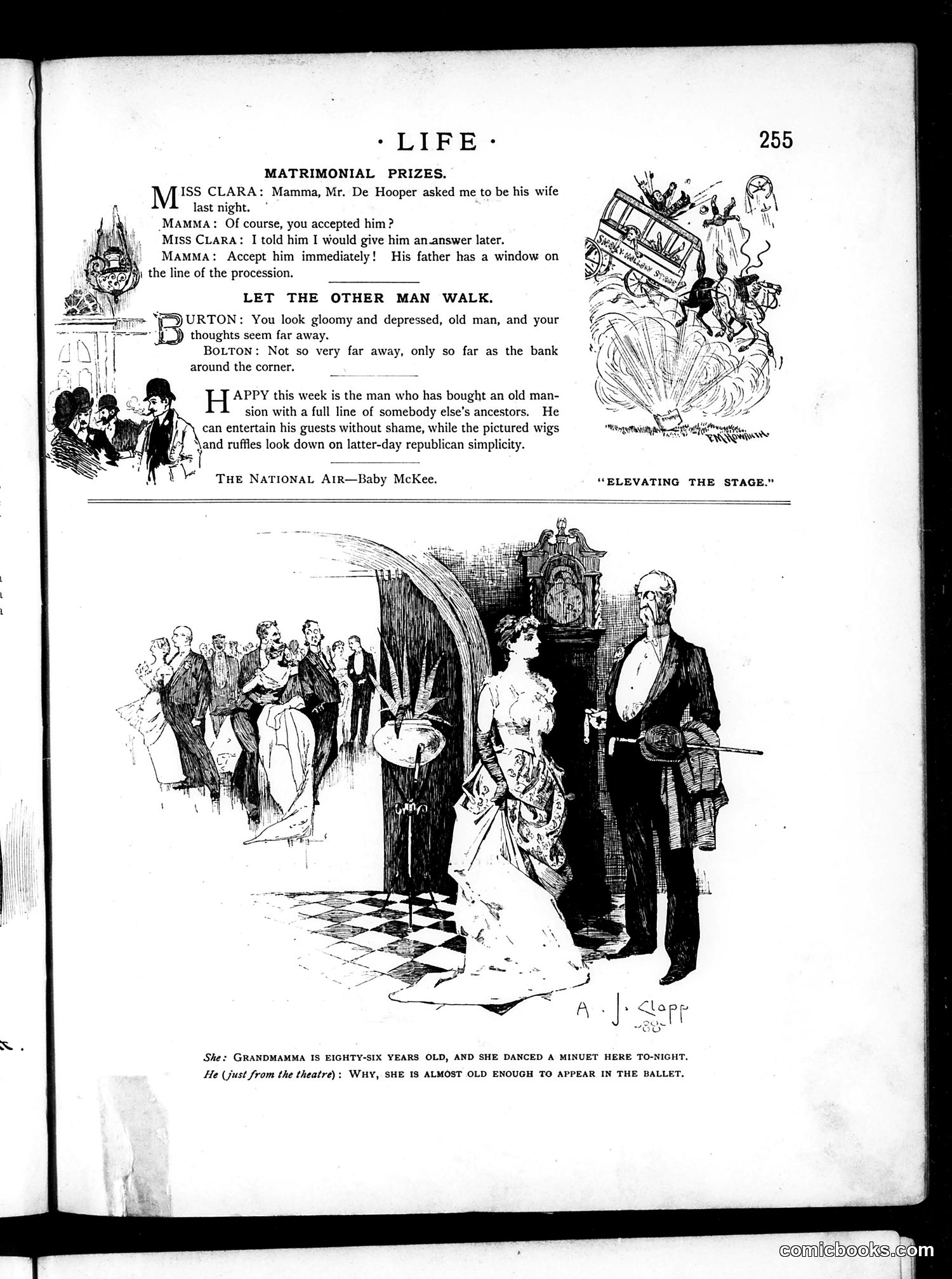
This page contains three distinct humor sections: **"Matrimonial Prizes"** presents a brief dialogue joke about a man (Mr. De Hooper) proposing marriage, with the humor deriving from the mother's mercenary focus on his father's wealth ("a widow on the line of the procession"). **"Let the Other Man Walk"** appears to be a short philosophical quip about melancholy, with accompanying illustration of figures in conversation. **"Elevating the Stage"** is the main cartoon by A.J. Capp, captioned with a joke about an eighty-six-year-old grandmother dancing a minuet at what appears to be a formal theatrical or social event. The humor relies on age-based comedy—the incongruity of an elderly woman participating in such refined entertainment. The content reflects early 20th-century American satirical humor emphasizing class, courtship, and age-based jokes typical of Life magazine's style.
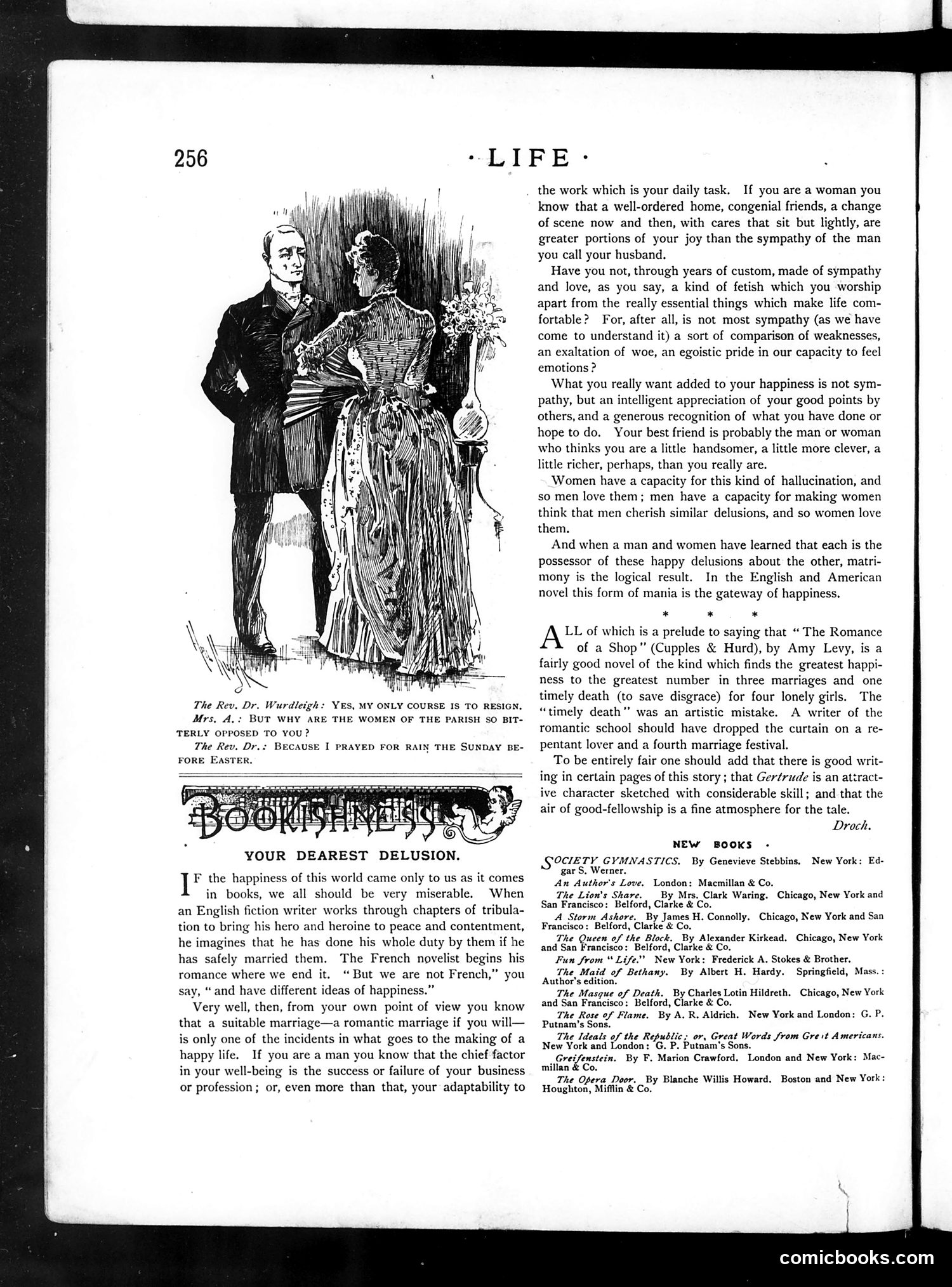
This page contains a satirical article titled "Your Dearest Delusion" rather than a political cartoon. The accompanying illustration shows a Victorian-era couple in conversation. The article critiques romantic ideals in marriage, arguing that happiness depends on mutual "delusions"—each partner thinking the other is better than they actually are. The text suggests this self-deception is essential to marital contentment, and notes it's a common theme in English and American novels. The article then reviews "The Romance of a Shop" by Amy Levy, praising its realistic portrayal of character and "good-fellowship," though noting the ending (involving marriage and death) follows conventional romantic formula rather than offering genuine novelty. The page functions as literary criticism examining how romantic fiction shapes expectations about love and marriage.
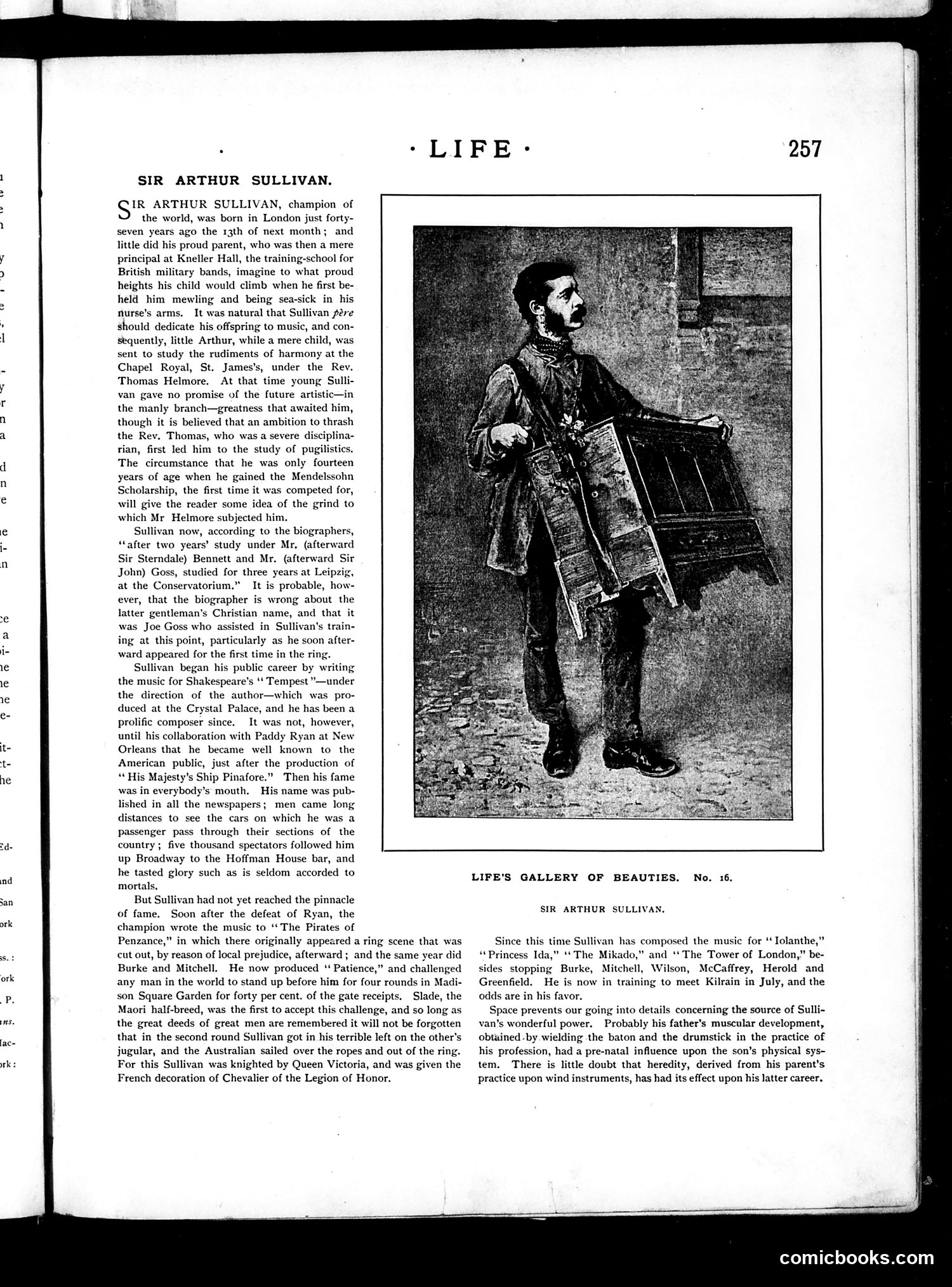
This is a biographical profile of Sir Arthur Sullivan, the famous composer, presented in Life magazine's "Gallery of Beauties" series. The page includes a portrait photograph of Sullivan in period costume. The text traces Sullivan's life from his birth in London through his early musical training at Chapel Royal under Rev. Thomas Helmore, his studies in Leipzig, and his emergence as a composer. It discusses his early works including music for Shakespeare's "The Tempest," his collaboration with Paddy Ryan, and his famous partnership producing comic operas like "The Pirates of Penzance" and "Princess Ida." The article notes Sullivan's celebrity status—his name appeared in newspapers, he drew crowds to Broadway, and he achieved recognition unusual for musicians of his era. It emphasizes his musical gifts and his path to becoming a celebrated figure in both American and British culture.
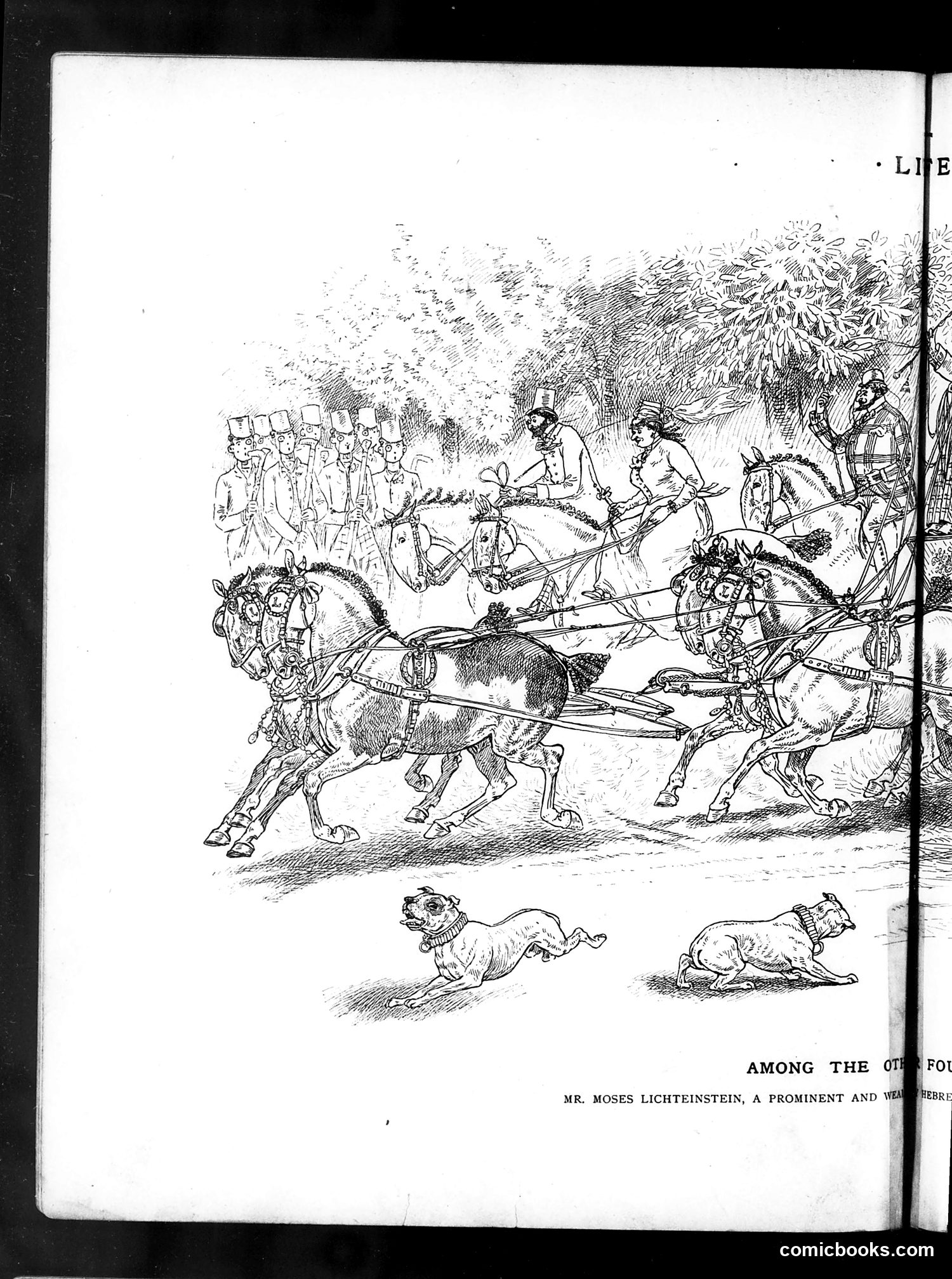
This satirical illustration depicts a formal procession or parade featuring elegantly dressed figures on horseback, with military or ceremonial guards marching behind them. Two small dogs wearing ornate collars frolic in the foreground. The caption references "Mr. Moses Lichtenstein, a prominent and well-[esteemed]" figure, though the text is partially cut off. The cartoon appears to satirize the ostentatious display and pretension of wealthy or prominent Jewish figures of the era, using the contrast between the elaborate formal ceremony and the undignified dogs to mock the subjects' self-importance. The style and subject matter suggest this reflects early 20th-century social satire, likely containing period-specific antisemitic caricature typical of some Life magazine content from that era.
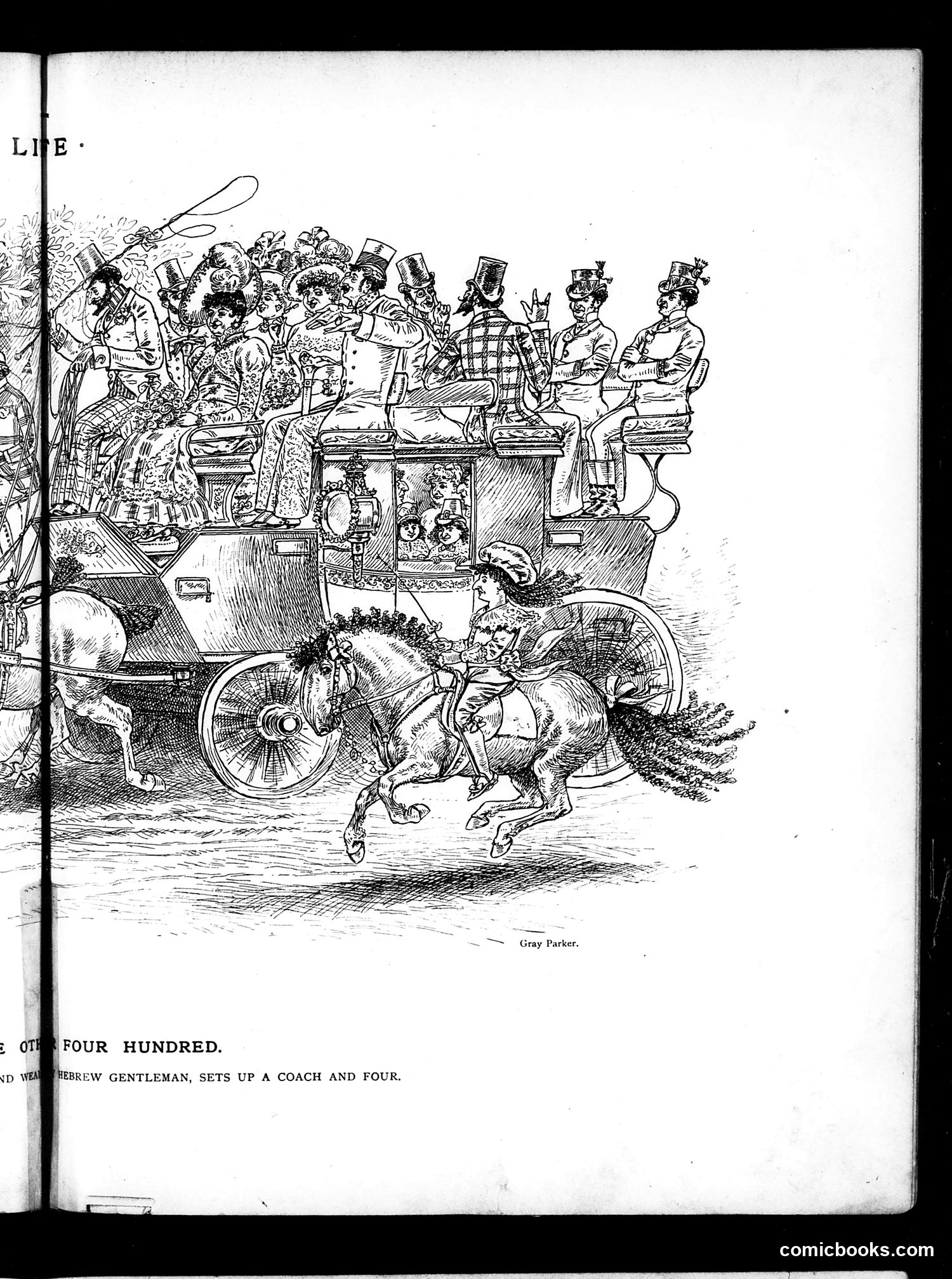
This illustration depicts a social satire titled "A WEALTHY HEBREW GENTLEMAN SETS UP A COACH AND FOUR" (visible at bottom). The cartoon shows an ostentatiously dressed Jewish gentleman arriving in an elaborate carriage pulled by horses, surrounded by fashionably dressed passengers wearing top hats. The scene mocks nouveau riche pretension—specifically, the stereotype of a wealthy Jewish businessman flaunting his newfound wealth through conspicuous consumption (an expensive coach-and-four was a status symbol). The credit reads "Gray Parker," identifying the artist. This reflects period antisemitic caricature common in 19th-century American satirical publications, targeting Jewish economic success and social aspiration through exaggeration and mockery of dress, manners, and ostentation.
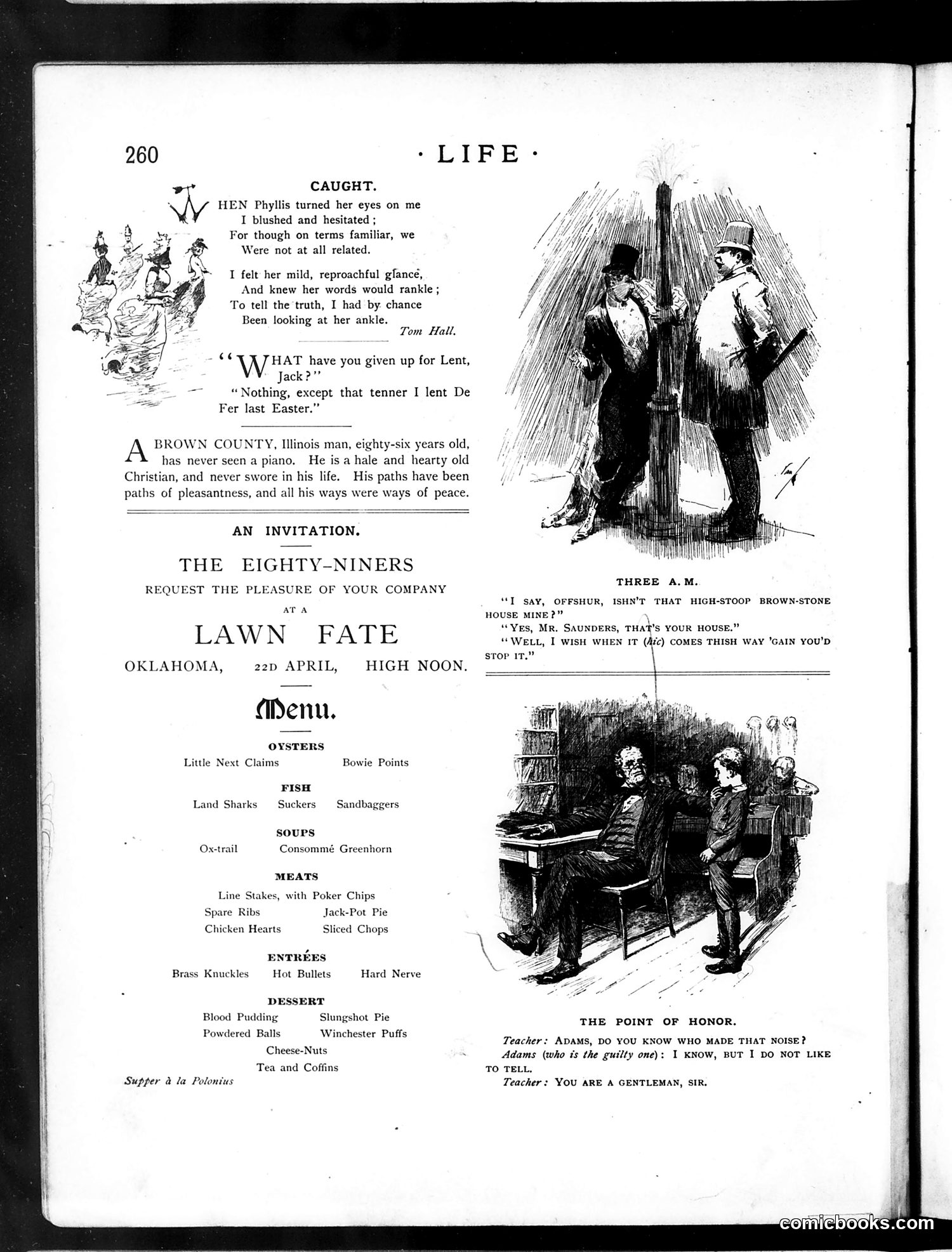
This *Life* magazine page contains several period humor pieces: **"Caught"** (top left): A poem about a man embarrassed when a woman (Phyllis) catches him looking at her ankle—a scandalous act in the era when women's ankles were hidden. The humor lies in the social transgression and his awkward explanation. **Lent joke**: Satirizes a man's reluctance to make genuine religious sacrifice; he only gave up repaying a debt. **"Lawn Fate" menu**: A satirical invitation from "The Eighty-Niners" (likely Oklahoma settlers from the 1889 land rush). The menu mockingly lists frontier violence as "dishes"—"Line Stakes with Poker Chips," "Brass Knuckles," "Winchester Puffs"—joking that Oklahoma was lawless and dangerous, populated by violent criminals and con artists ("Sandbaggers," "Suckers"). **Three A.M. cartoon**: A drunk man can't recognize his own house, suggesting urban displacement or intoxication's disorientation. **"Point of Honor"**: A boy refusing to tattle is called a "gentleman"—gentle satire on misguided honor codes.
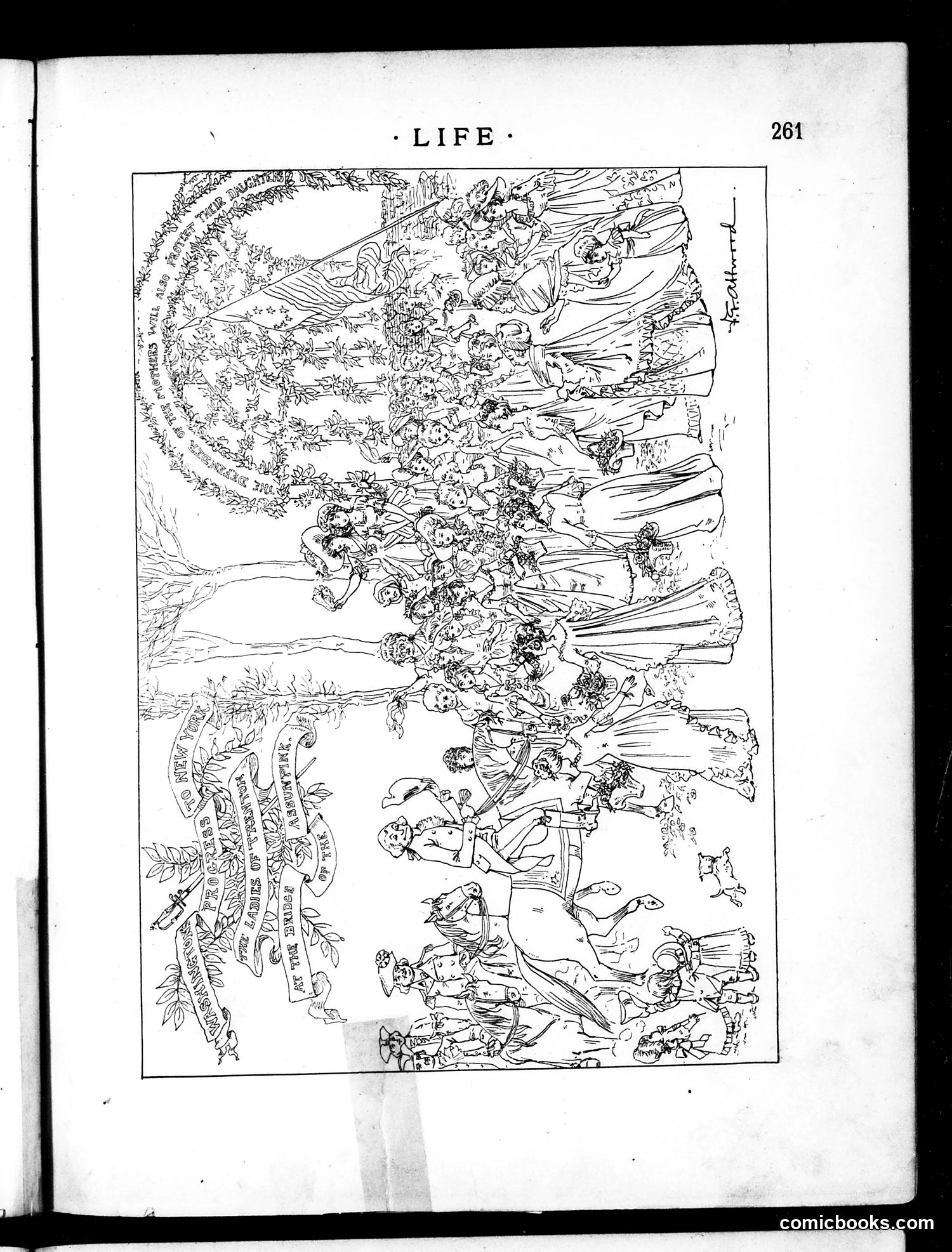
This page from *Life* magazine (page 261) contains a detailed satirical engraving depicting what appears to be a large formal gathering or procession. The image is rotated 90 degrees, showing numerous figures in period dress arranged in hierarchical groupings. The left side features decorative flourishes with scrolled text banners (though illegible in this reproduction). The composition suggests this is political or social satire commenting on institutional power structures or a specific historical event involving crowds and authority figures. However, **without legible text labels or OCR content identifying the specific figures, event, or date, I cannot definitively explain which political figures are caricatured or what particular event or policy this satirizes.** The artistic style suggests 19th-century publication, but the specific satirical target remains unclear from the image alone.
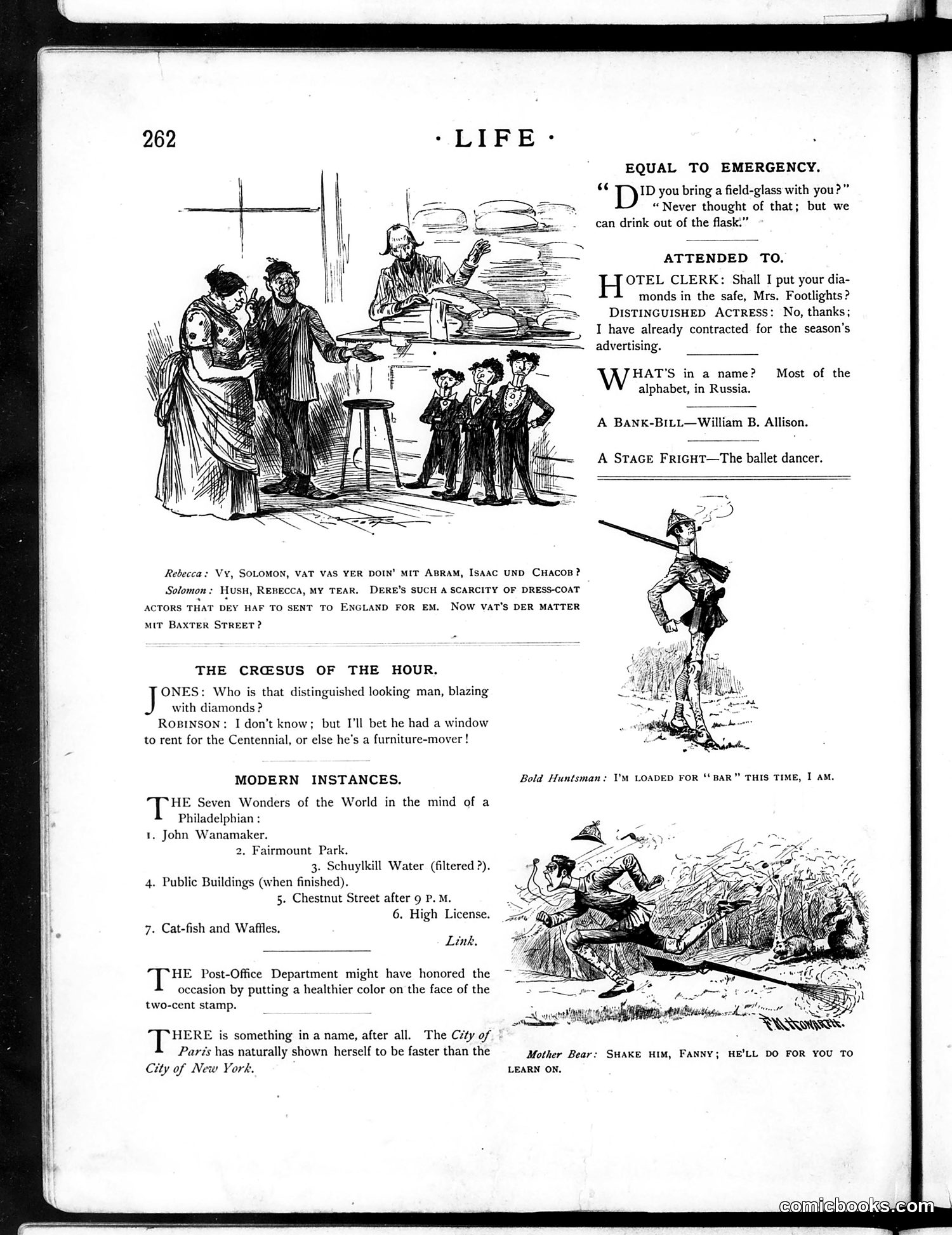
This page from *Life* magazine contains several short satirical jokes typical of 1870s-80s American humor: **The main cartoon** depicts a Jewish immigrant family (Rebecca and Solomon, speaking in Yiddish dialect) discussing a scarcity of actors with dress coats—a joke about struggling immigrant theater workers. **"The Cresus of the Hour"** mocks a wealthy, diamond-bedecked man; Robinson jokes he either rented property during the Centennial celebration or is a furniture mover—satirizing how wealth could be acquired through real estate speculation rather than "respectable" means. **"Modern Instances"** lists Philadelphia's "seven wonders," including John Wanamaker (a prominent merchant) and local features, poking fun at provincial pride. Other jokes reference contemporary issues: Post Office stamp quality, the steamship *City of Paris* being faster than *City of New York*, and banking/theater references. The humor relies on period stereotypes, local references, and assumptions now dated but historically revealing about late-19th-century American attitudes.
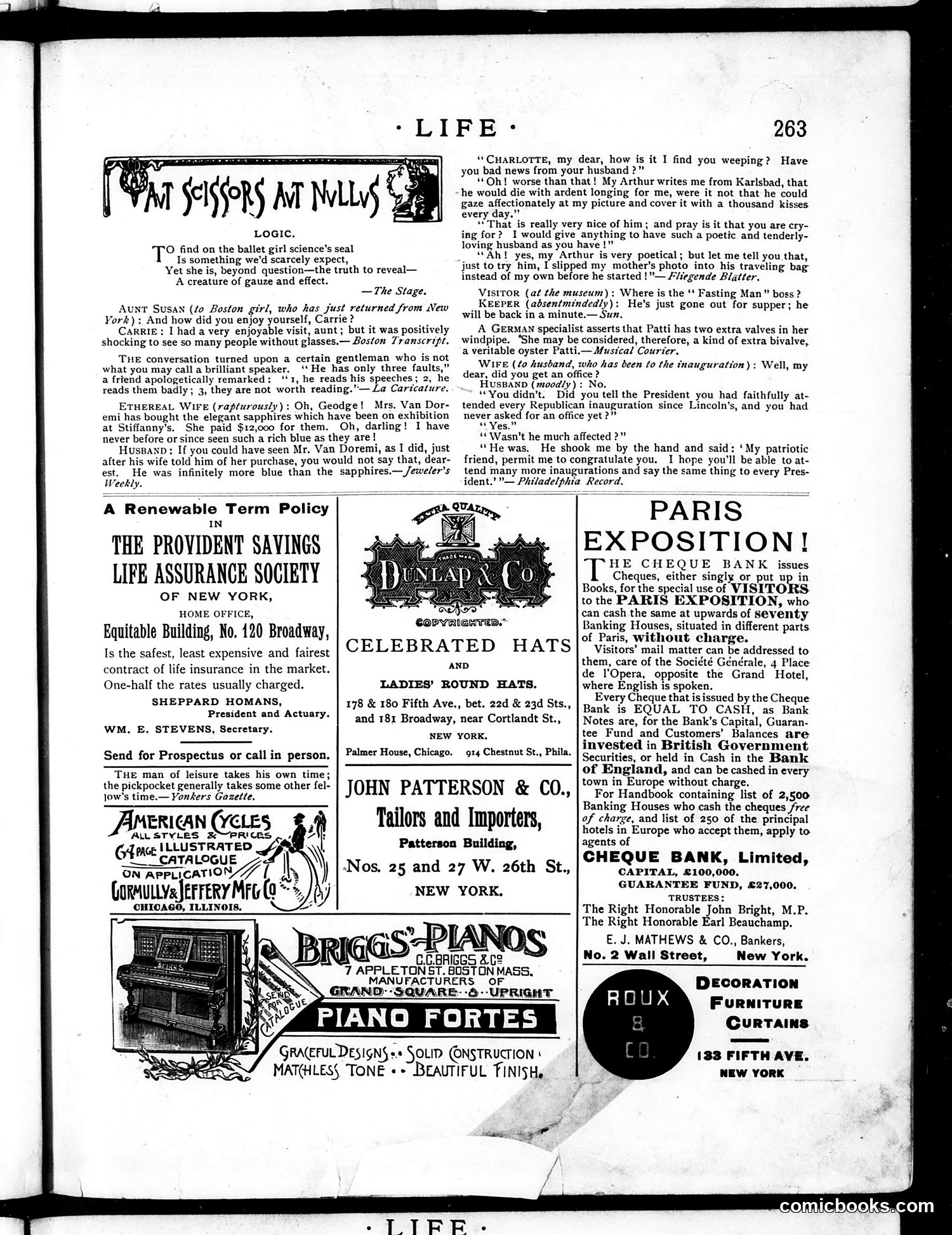
This is primarily an **advertising and humor page** from Life magazine's satirical humor section. The page contains several short joke submissions from readers that exemplify the magazine's light social commentary: The jokes mock various social types: a Boston woman shocked by people without glasses; a politician who reads bad speeches; a wealthy couple's vanity about sapphires; and a wife who tests her husband's affection by secretly replacing her photo with her mother's (implying he won't notice). One joke criticizes political jobseekers expecting office rewards for "patriotic" attendance at inaugurations—satirizing American patronage politics. The page is dominated by **period advertisements**: life insurance, pianos, bicycles, tailoring services, and travel services for the Paris Exposition. These ads reflect the era's commercial culture and consumer goods. The cartoon section "AT MILLS" (visible at top) appears to be decorative rather than politically substantive. Overall, this represents Life's **early satirical humor** targeting middle-class pretension and social absurdity rather than hard political satire.
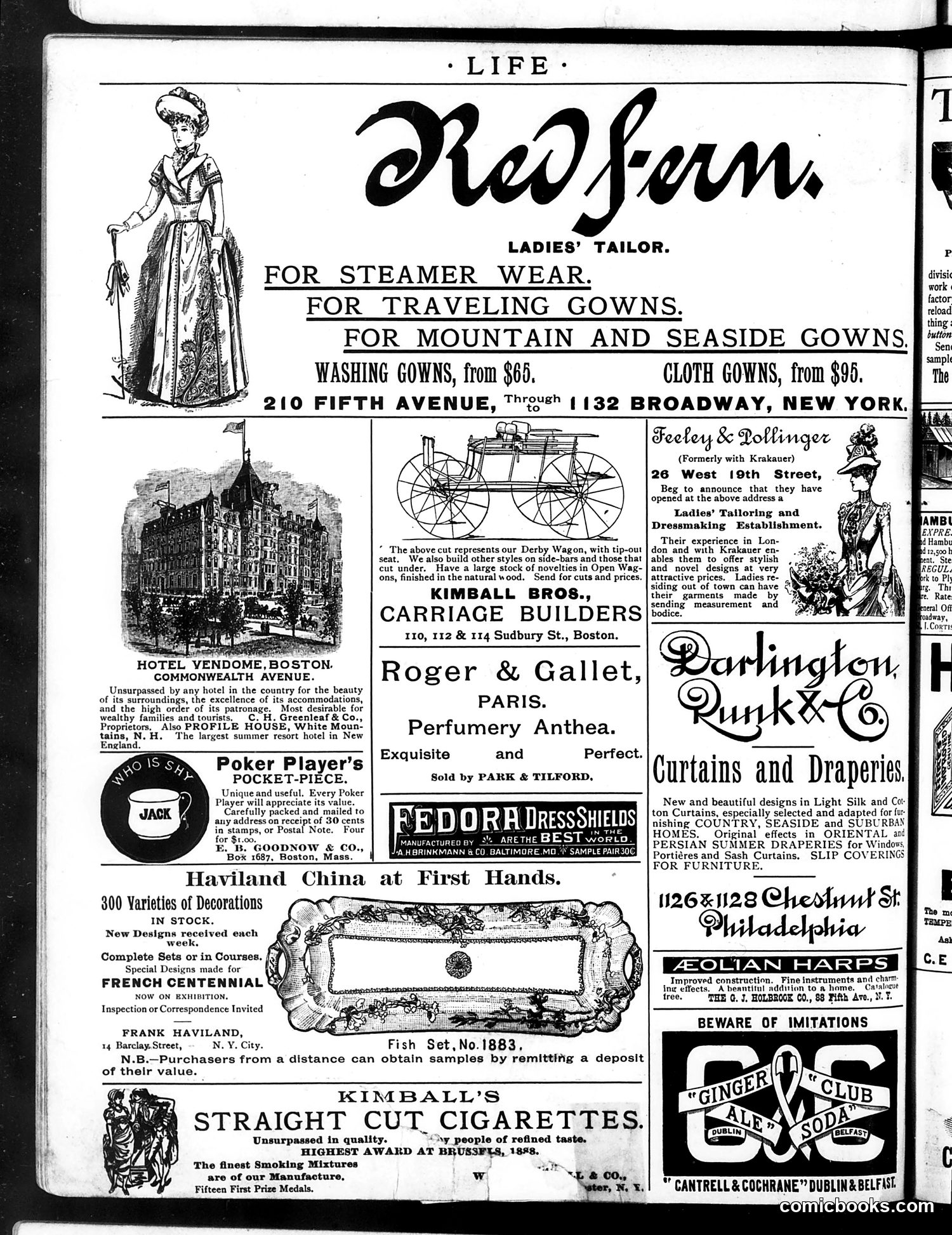
This is primarily an **advertising page** from Life magazine, not a satirical cartoon page. The layout contains roughly 20 commercial advertisements for luxury goods and services circa 1880s-1890s. **Key advertisers include:** - Red Fern, a ladies' tailor offering steamer wear and traveling gowns - Hotel Vendome in Boston - Kimball Bros. carriage builders - Haviland china - Roger & Gallet perfumery - Fedora dress shields (a practical undergarment accessory) - Aeolian harps and ginger ale The page reflects the **commercial culture of wealthy Americans** during the Gilded Age—targeting affluent consumers purchasing imported French perfumes, fine china, custom-tailored clothing, and luxury hotel stays. The emphasis on "refined taste" and European goods (Paris, London) indicates aspirational, class-conscious marketing. There are **no visible political cartoons or satirical commentary** on this particular page. It represents Life magazine's business model of combining editorial content with high-end advertising.
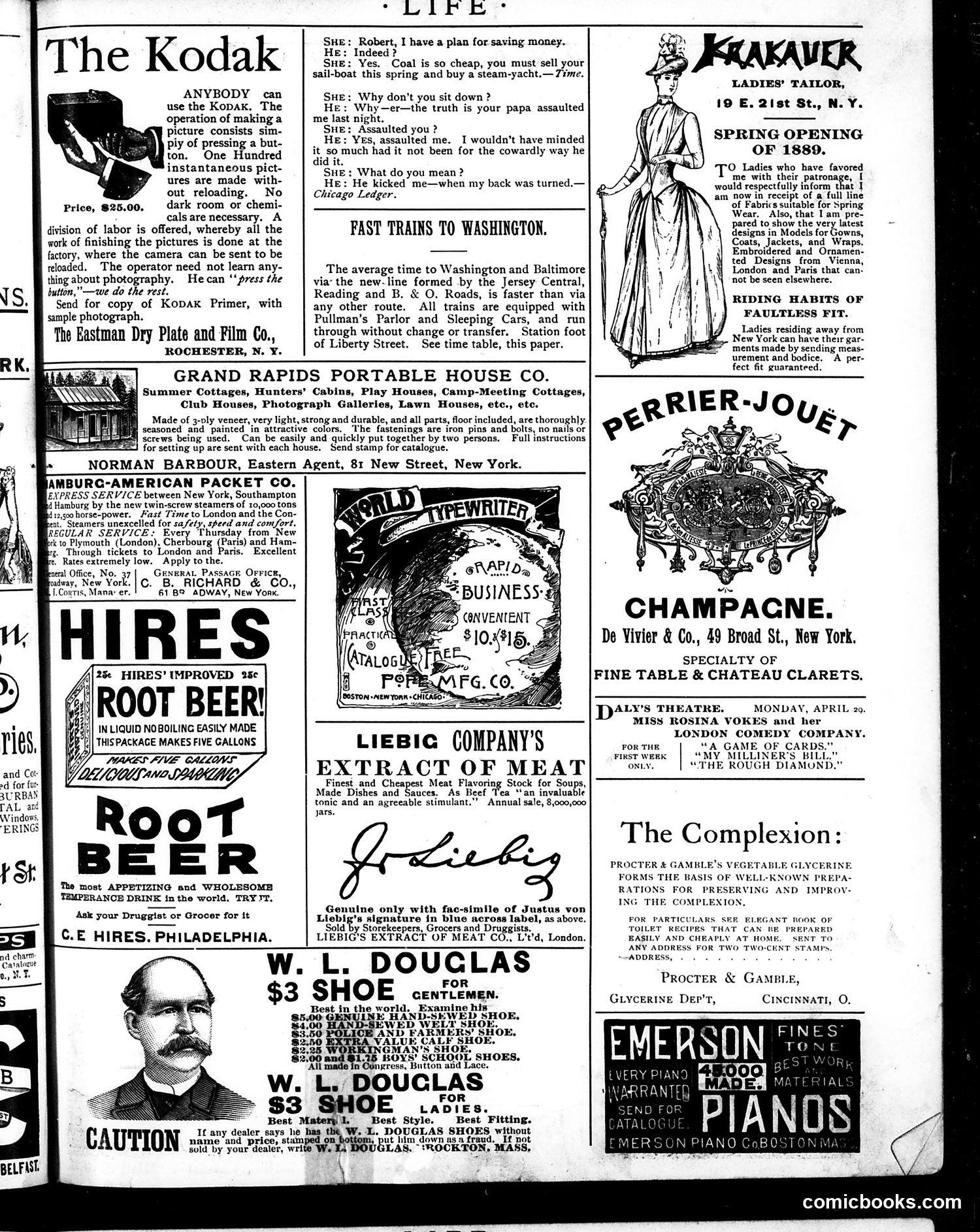
This page is primarily **advertising** from Life magazine (circa 1889), with one satirical cartoon at the top. ## The Cartoon The brief comic dialogue mocks upper-class logic: a wife proposes "saving money" by selling their sailboat and buying an expensive steam-yacht instead—clearly the opposite of economy. The husband, having been beaten by her father the night before, meekly accepts this illogical plan. The satire targets both **spousal dynamics** (the henpecked husband) and **wealthy absurdity** (the contradiction between stated frugality and luxury spending). ## The Advertisements The rest consists of period product ads: Kodak cameras (emphasizing ease of use), portable houses, steamship service, typewriters, root beer, shoes, champagne, and pianos. One notable ad features **W.L. Douglas shoes** with his photograph—a brand known for affordable quality footwear. These ads reflect 1880s consumer culture and emerging mass-market products like cameras and ready-made clothing. The page reflects how Life functioned: satirical humor paired with consumer advertising targeting middle and upper-class readers.
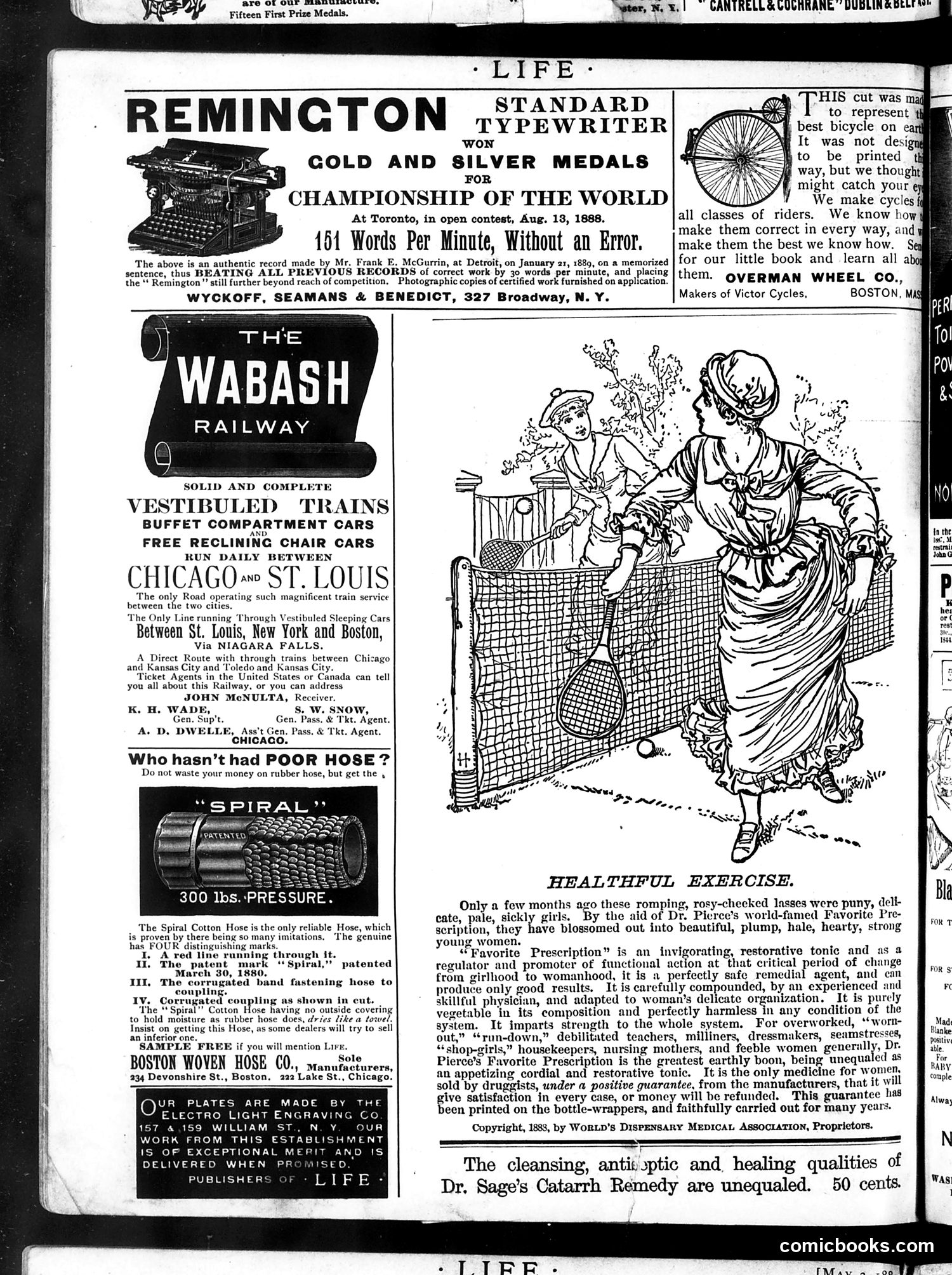
This page from *Life* magazine (dated 1889, based on visible context) is primarily a compendium of period advertisements, not political satire. The centerpiece is a genteel illustration labeled "Healthful Exercise," depicting two fashionably dressed women at a tennis net. This accompanies an advertisement for Dr. Pierce's "Favorite Prescription," a patent medicine marketed to "puny, delicate, pale, sickly girls" promising to transform them into "beautiful, plump, hale, hearty, strong young women." The ad explicitly targets "debilitated teachers, milliners, dressmakers, seamstresses" and other working women. The page surrounds this with period advertisements: Remington typewriters (boasting speed records), the Wabash Railway, bicycle makers, and hose manufacturers. The "Healthful Exercise" narrative—showing women made robust and strong by commercial products—reflects late-19th-century anxieties about female frailty and the emerging "New Woman" ideal. The satire, if present, likely resides in the ironic tension between marketed feminine delicacy and the active, athletic woman depicted.
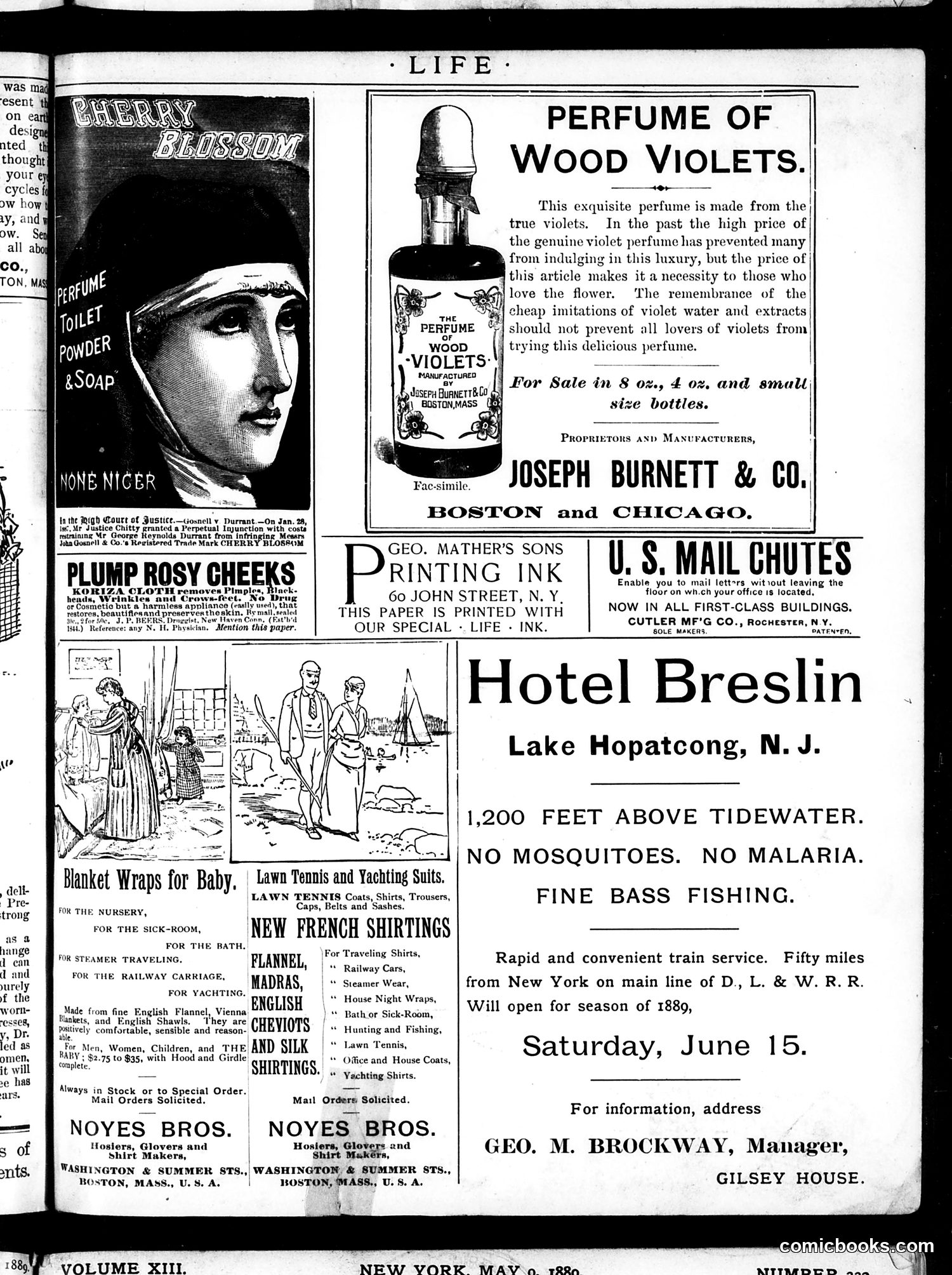
This page is primarily **advertising**, not satirical content. It's from Life's early period when the magazine relied heavily on paid advertisements to support publication. The notable items include: **"Plump Rosy Cheeks"** advertisement references a legal case (visible in fine print) involving a "Cherry Blossom" trademark dispute—likely advertising a cosmetic product claiming to enhance complexion. **Wood Violets Perfume** by Joseph Burnett & Co. promises affordable access to luxury: the text explicitly states the product "makes it a necessity to those who love the flower" by offering genuine violet perfume at lower prices than previously available, while warning against cheap imitations. **Clothing and textile ads** (Noyes Bros., New French Shirtings) target leisure activities—tennis, yachting, steamer travel—reflecting the recreational interests of Life's affluent readership. **Hotel Breslin** advertisement emphasizes health benefits (no malaria, no mosquitoes) at high altitude, appealing to late-19th-century anxieties about disease. The page reflects Gilded Age consumer culture and the magazine's affluent audience.
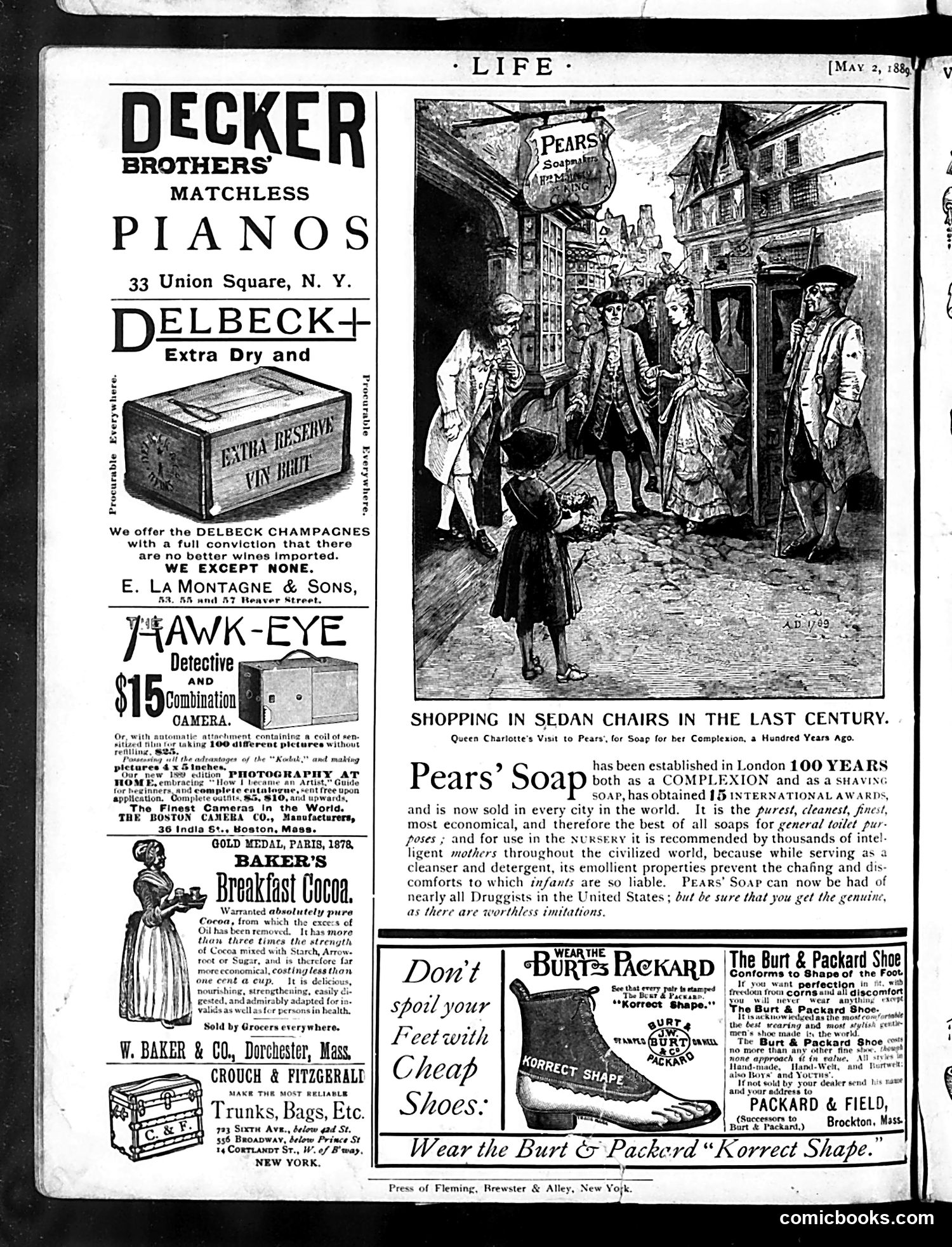
This page is primarily **advertisements** with one central illustrated article. The main cartoon depicts a historical scene titled "Queen Charlotte's Visit to Pears' for Soap for her Complexion, a Hundred Years Ago." The image shows elegantly dressed 18th-century figures in a cobblestone street, with a woman being carried in a sedan chair (a portable enclosed chair used for transportation). The joke/satire appears to be **nostalgia marketing**: Pears' Soap Company uses a fictionalized historical anecdote to suggest their product has royal endorsement dating back a century, emphasizing tradition and prestige. The accompanying text advertises Pears' Soap's "100 YEARS" of establishment, "15 INTERNATIONAL AWARDS," and claims it's "the purest, cleanest, finest" soap available—standard Victorian-era advertising hyperbole. The satire likely mocks both the product's exaggerated claims and consumers' susceptibility to heritage-based marketing.