
Life, 1889-05-02 · page 6 of 20
Life — May 2, 1889 — page 6: what you’re looking at
What you’re looking at
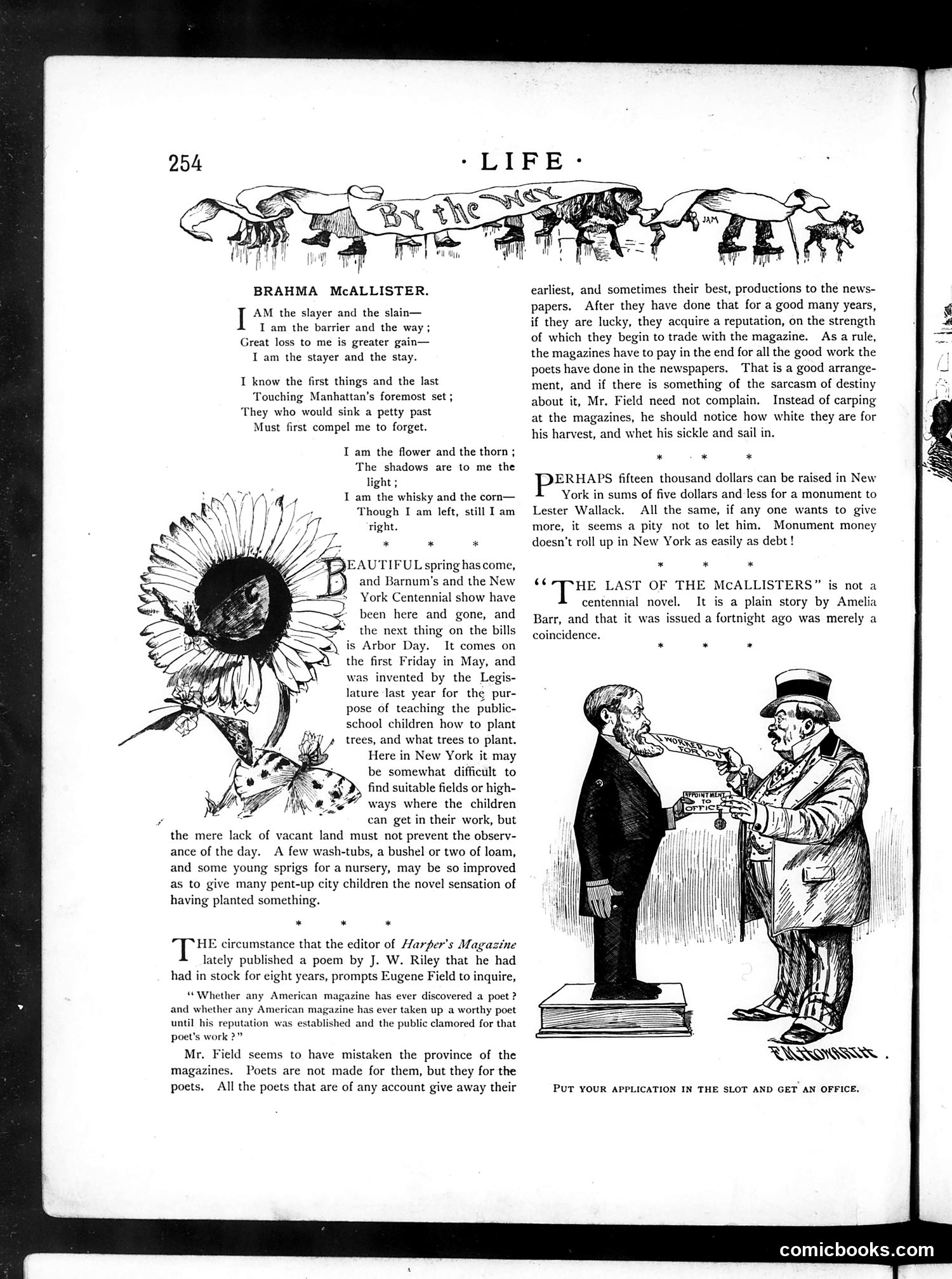
This page contains **Brahma McAllister**, a poem about loss and resilience, alongside commentary about American magazines and poets. The main **cartoon** (lower right) depicts two men in what appears to be a transaction or negotiation—one in formal dress, the other wearing a hat and casual clothing. The caption reads "PUT YOUR APPLICATION IN THE SLOT AND GET AN OFFICE," suggesting satire about bureaucratic job-seeking or political patronage systems. The text criticizes **Eugene Field** (a prominent poet) for questioning whether American magazines properly support poets. The author argues magazines don't exist to serve poets—poets serve magazines. This reflects **late 19th-century tensions** between literary merit and commercial publishing needs, with magazines prioritizing what sells over artistic quality.
📄 Transcribed text from this page (OCR, searchable)
Machine-transcribed from the original scan — historical spelling and the odd misread are preserved.
BRAHMA MCALLISTER. J AM the slayer and the slain— I am the barrier and the way; Great loss to me is greater gain— I am the stayer and the stay. I know the first things and the last Touching Manhattan’s foremost set ; They who would sink a petty past Must first compel me to forget. I am the flower and the thorn ; The shadows are to me the light ; I am the whisky and the corn— Though I am left, still I am * * * EAUTIFUL spring has come, and Barnum’s and the New York Centennial show have been here and gone, and the next thing on the bills is Arbor Day. It comes on the first Friday in May, and was invented by the Legis- lature last year for the pur- pose of teaching the public- school children how to plant / trees, and what trees to plant. 2) Here in New York it may ¥ be somewhat difficult to find suitable fields or high- ways where the children can get in their work, but the mere lack of vacant land must not prevent the observ- ance of the day. A few wash-tubs, a bushel or two of loam, and some young sprigs for a nursery, may be so improved as to give many pent-up city children the novel sensation of having planted something. * * * TH circumstance that the editor of Harper's Magazine lately published a poem by J. W. Riley that he had had in stock for eight years, prompts Eugene Field to inquire, “Whether any American magazine has ever discovered a poet ? and whether any Ameri ine has ever taken up a worthy poet until his reputation was established and the public clamored for that poet's work 2” Mr. Fi n ma; Id seems to have mistaken the province of the Poets are not made for them, but they for the poets. All the poets that are of any account give away their earliest, and sometimes their best, productions to the news- papers. After they have done that for a good many years, if they are lucky, they acquire a reputation, on the strength of which they begin to trade with the magazine. As a rule, the magazines have to pay in the end for all the good work the poets have done in the newspapers. That is a good arrange- ment, and if there is something of the sarcasm of destiny about it, Mr. Field need not complain. Instead of carping at the magazines, he should notice how white they are for his harvest, and whet his sickle and sail in. * * * ERHAPS fifteen thousand dollars can be raised in New York in sums of five dollars and less for a monument to Lester Wallack. All the same, if any one wants to give more, it seems a pity not to let him. Monument money doesn’t roll up in New York as easily as debt ! x * * $¢CHE LAST OF THE MCALLISTERS” is not a centennial novel. It is a plain story by Amelia Barr, and that it was issued a fortnight ago was merely a coincidence. PUT YOUR APPLICATION IN THE SLOT AND GET AN OFFICE. comicbooks.com