
Life, 1889-05-02 · page 9 of 20
Life — May 2, 1889 — page 9: what you’re looking at
What you’re looking at
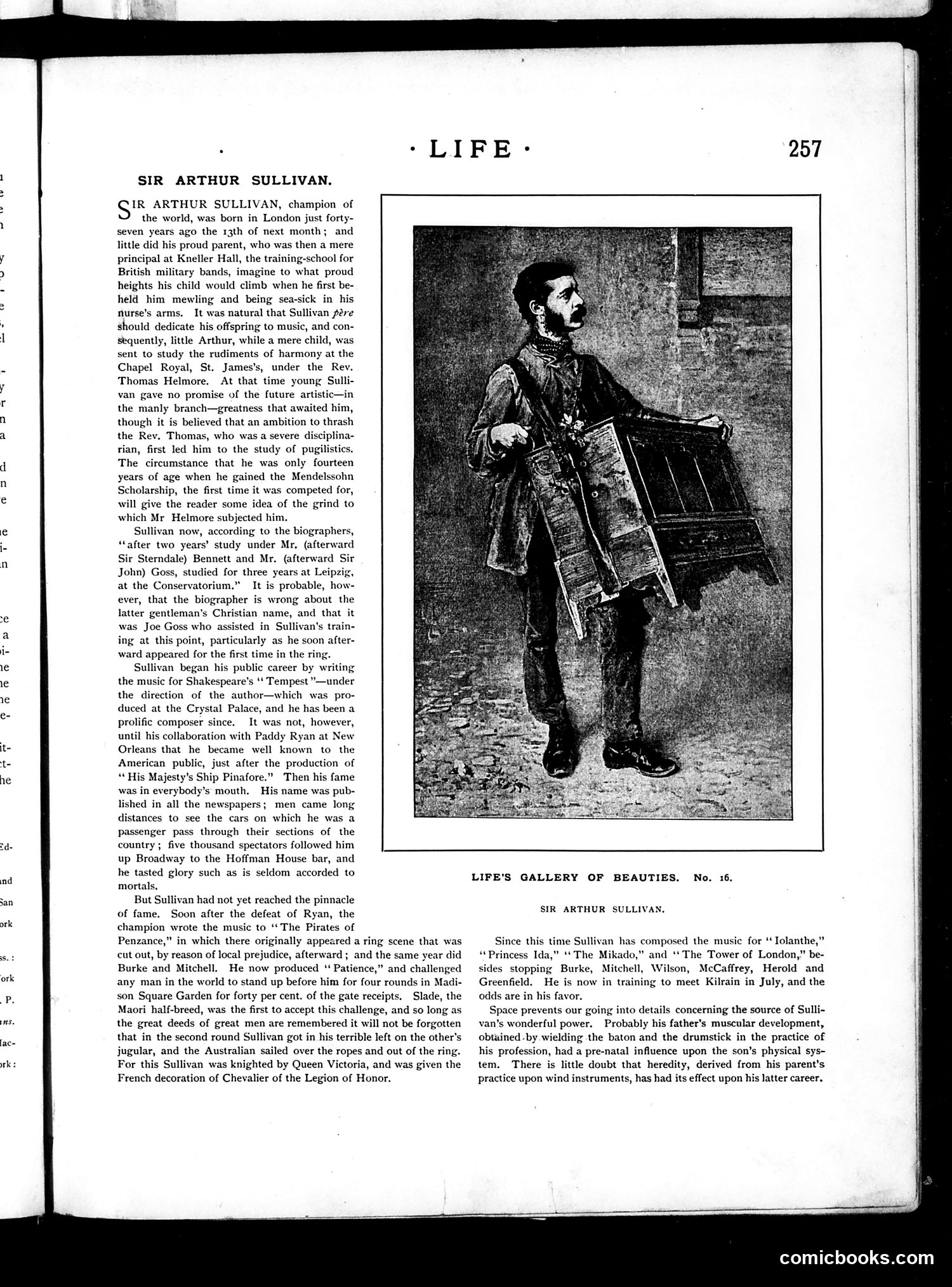
This is a biographical profile of Sir Arthur Sullivan, the famous composer, presented in Life magazine's "Gallery of Beauties" series. The page includes a portrait photograph of Sullivan in period costume. The text traces Sullivan's life from his birth in London through his early musical training at Chapel Royal under Rev. Thomas Helmore, his studies in Leipzig, and his emergence as a composer. It discusses his early works including music for Shakespeare's "The Tempest," his collaboration with Paddy Ryan, and his famous partnership producing comic operas like "The Pirates of Penzance" and "Princess Ida." The article notes Sullivan's celebrity status—his name appeared in newspapers, he drew crowds to Broadway, and he achieved recognition unusual for musicians of his era. It emphasizes his musical gifts and his path to becoming a celebrated figure in both American and British culture.
📄 Transcribed text from this page (OCR, searchable)
Machine-transcribed from the original scan — historical spelling and the odd misread are preserved.
SIR ARTHUR SULLIVAN. IR ARTHUR SULLIVAN, champion of the world, was born in London just forty- seven years ago the 13th of next month; and little did his proud parent, who was then a mere principal at Kneller Hall, the training-school for British military bands, imagine to what proud heights his child would climb when he first be- held him mewling and being sea-sick in his nurse's arms. It was natural that Sullivan pere should dedicate his offspring to music, and con- sequently, little Arthur, while a mere child, was sent to study the rudiments of harmony at the Chapel Royal, St. James's, under the Rev. Thomas Helmore. At that time young Sulli- van gave no promise of the future artistic—in the manly branch—greatness that awaited him, though it is believed that an ambition to thrash the Rev, Thomas, who was a severe disciplina- rian, first led him to the study of pugilistics. The circumstance that he was only fourteen years of age when he gained the Mendelssohn Scholarship, the first time it was competed for, will give the reader some idea of the grind to which Mr Helmore subjected him. Sullivan now, according to the biographers, “after two years’ study under Mr. (afterward Sir Sterndale) Bennett and Mr. (afterward Sir John) Goss, studied for three years at Leip at the Conservatorium,” It is probable, how- ever, that the biographer is wrong about the latter gentleman’s Christian name, and that it was Joe Goss who assisted in Sullivan's train- ing at this point, particularly as he soon after- ward appeared for the first time in the ring. Sullivan began his public career by writing the music for Shakespeare's ‘‘ Tempest "—under the direction of the author—which was pro- duced at the Crystal Palace, and he has been a prolific composer since. It was not, however, until his collaboration with Paddy Ryan at New Orleans that he became well known to the American public, just after the production of “ His Majesty’s Ship Pinafore.” Then his fame was in everybody’s mouth. His name was pub- lished in all the newspapers; men came long distances to see the cars on which he was a passenger pass through their sections of the country ; five thousand spectators followed him up Broadway to the Hoffman House bar, and he tasted glory such as is seldom accorded to mortals, But Sullivan had not yet reached the pinnacle of fame. Soon after the defeat of Ryan, the champion wrote the music to ‘‘ The Pirates of Penzance,” in which there originally appeared a ring scene that was cut out, by reason of local prejudice, afterward ; and the same year did Burke and Mitchell. He now produced ‘ Patience,” and challenged any man in the world to stand up before him for four rounds in Madi- son Square Garden for forty per cent. of the gate receipts, Slade, the Maori half-breed, was the first to accept this challenge, and so long as the great deeds of great men are remembered it will not be forgotten that in the second round Sullivan got in his terrible left on the other's jugular, and the Australian sailed over the ropes and out of the ring. For this Sullivan was knighted by Queen Victoria, and was given the French decoration of Chevalier of the Legion of Honor. LIFE'S GALLERY OF BEAUTIES. No. 16. SIR ARTHUR SULLIVAN, Since this time Sullivan has composed the music for ‘ Iolanthe,” “Princess Ida,” ‘* The M jo,” and ‘* The Tower of London,” be- sides stopping Burke, Mitchell, Wilson, McCaffrey, Herold and Greenfield. He is now in training to meet Kilrain in July, and the odds are in his favor. Space prevents our going into details concerning the source of Sulli- van’s wonderful power. Probably his father's muscular development, obtained. by wielding the baton and the drumstick in the practice of his profession, had a pre-natal influence upon the son’s physical sys- tem. There is little doubt that heredity, derived from his parent's practice upon wind instruments, has had its effect upon his latter career. comicbooks.com