
Life, 1889-05-02 · page 8 of 20
Life — May 2, 1889 — page 8: what you’re looking at
What you’re looking at
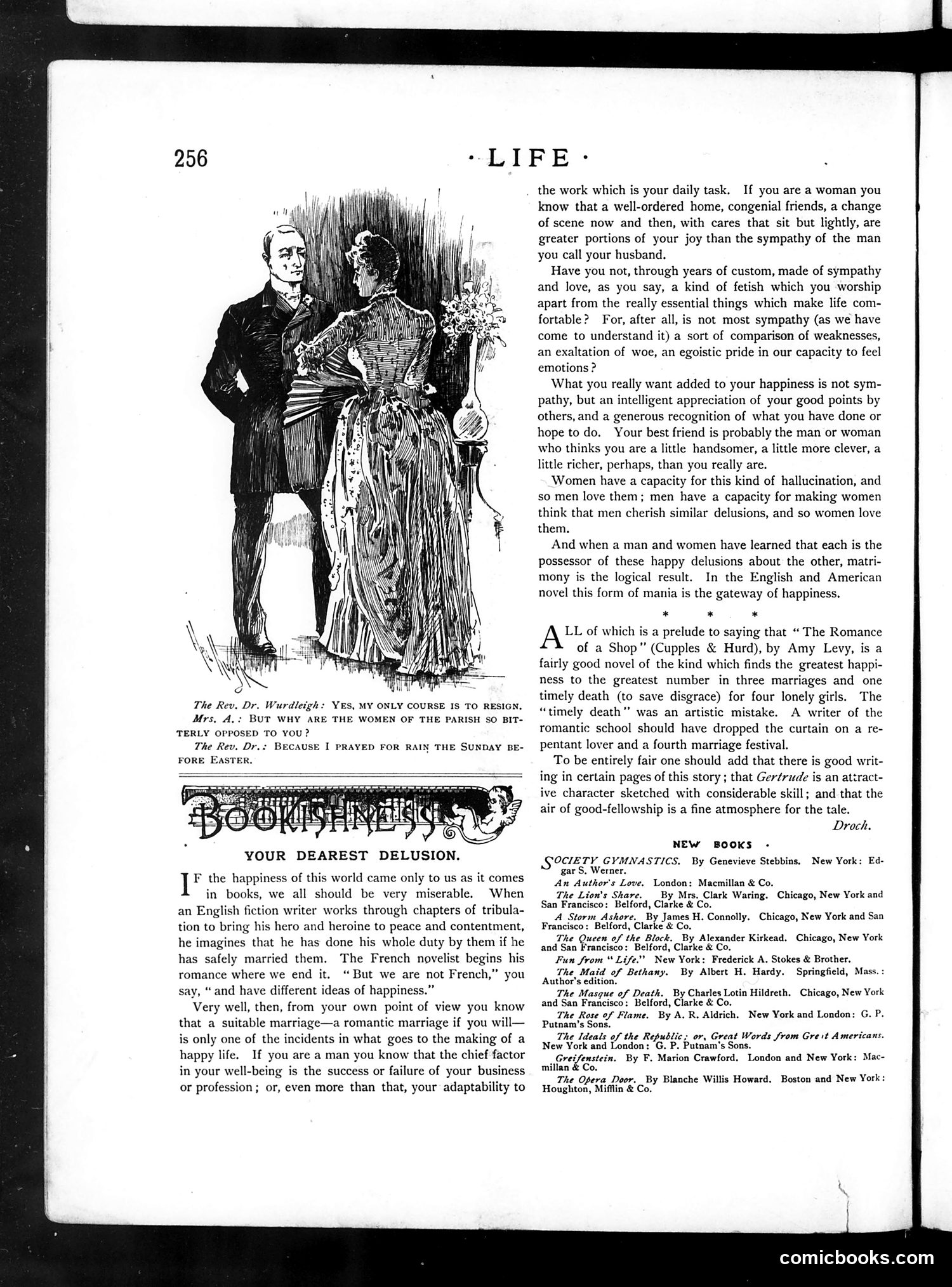
This page contains a satirical article titled "Your Dearest Delusion" rather than a political cartoon. The accompanying illustration shows a Victorian-era couple in conversation. The article critiques romantic ideals in marriage, arguing that happiness depends on mutual "delusions"—each partner thinking the other is better than they actually are. The text suggests this self-deception is essential to marital contentment, and notes it's a common theme in English and American novels. The article then reviews "The Romance of a Shop" by Amy Levy, praising its realistic portrayal of character and "good-fellowship," though noting the ending (involving marriage and death) follows conventional romantic formula rather than offering genuine novelty. The page functions as literary criticism examining how romantic fiction shapes expectations about love and marriage.
📄 Transcribed text from this page (OCR, searchable)
Machine-transcribed from the original scan — historical spelling and the odd misread are preserved.
-LIFE: . The Rev. Dr. Wurdleigh: Yes, MY ONLY COURSE IS TO RESIGN. Mrs, A,: BUT WHY ARE THE WOMEN OF THE PARISH SO BIT- TERLY OPPOSED TO YOU? The Rev. Dr.: BECAUSE I PRAYED FOR RAIN THE SUNDAY BE- FORE Easter. YOUR DEAREST DELUSION. [Ete bepress of this world came only to us as it comes in books, we all should be very miserable. When an English fiction writer works through chapters of tribula- tion to bring his hero and heroine to peace and contentment, he imagines that he has done his whole duty by them if he has safely married them. The French novelist begins his romance where we end it. ‘But we are not French,” you say, “and have different ideas of happiness.” Very well, then, from your own point of view you know that a suitable marriage—a romantic marriage if you will— is only one of the incidents in what goes to the making of a happy life. If you are a man you know that the chief factor in your well-being is the success or failure of your business or profession; or, even more than that, your adaptability to the work which is your daily task. If you are a woman you know that a well-ordered home, congenial friends, a change of scene now and then, with cares that sit but lightly, are greater portions of your joy than the sympathy of the man you call your husband. Have you not, through years of custom, made of sympathy and love, as you say, a kind of fetish which you worship apart from the really essential things which make life com- fortable? For, after all, is not most sympathy (as we have come to understand it) a sort of comparison of weaknesses, an exaltation of woe, an egoistic pride in our capacity to feel emotions ? What you really want added to your happiness is not sym- pathy, but an intelligent appreciation of your good points by others, and a generous recognition of what you have done or hope to do. Your best friend is probably the man or woman who thinks you are a little handsomer, a little more clever, a little richer, perhaps, than you really are. Women have a capacity for this kind of hallucination, and so men love them; men have a capacity for making women think that men cherish similar delusions, and so women love them. And when a man and women have learned that each is the possessor of these happy delusions about the other, matri- mony is the logical result. In the English and American novel this form of mania is the gateway of happiness. * * * At of which is a prelude to saying that “ The Romance of a Shop” (Cupples & Hurd), by Amy Levy, is a fairly good novel of the kind which finds the greatest happi- ness to the greatest number in three marriages and one timely death (to save disgrace) for four lonely girls. The “timely death” was an artistic mistake. A writer of the romantic school should have dropped the curtain on a re- pentant lover and a fourth marriage festival. To be entirely fair one should add that there is good writ- ing in certain pages of this story ; that Gertrude is an atiract- ive character sketched with considerable skill; and that the air of good-fellowship is a fine atmosphere for the tale. Droch. NEW BOOKS - SOCIETY GYMNASTICS. By Genevieve Stebbins. gar S, Werner, An Author's Love. London: Macmillan & Co. The Lion's Share. _ By Mrs. Clark Waring. Chicago, New York and San Francisco: Belford, Clarke & Co. A Storm Ashore. By James H. Connolly. Chicago, New York and San Francisco: Belford, Clarke & Co. The Queen of the Block. By Alexander Kirkead. Chicago, New York and San Francisco: Belford, Clarke & Co. Fun from “ Life.” New York: Frederick A. Stokes & Brother. The Maid of Bethany. By Albert H. Hardy. Springfield, Mass. : Author's edition. The Masque of Death. By Charles Lotin Hildreth. Chicago, New York and San Francisco: Belford, Clarke & Co. The Rose of Flame. By A. R. Aldrich. New York and London: G. P. Putnam's Sons. The Ideals of the Republic: or, Great Words from Greit Americans. New York and London: G. P. Putnam's Sons. Greifenstein. By F. Marion Crawford. London and New York: Mac- millan & Co, The Opera Door. By Blanche Willis Howard. Boston and New York: Houghton, Miflin & Co. New York: Ed- comicbooks.com