
Life, 1889-05-02 · page 4 of 20
Life — May 2, 1889 — page 4: what you’re looking at
What you’re looking at
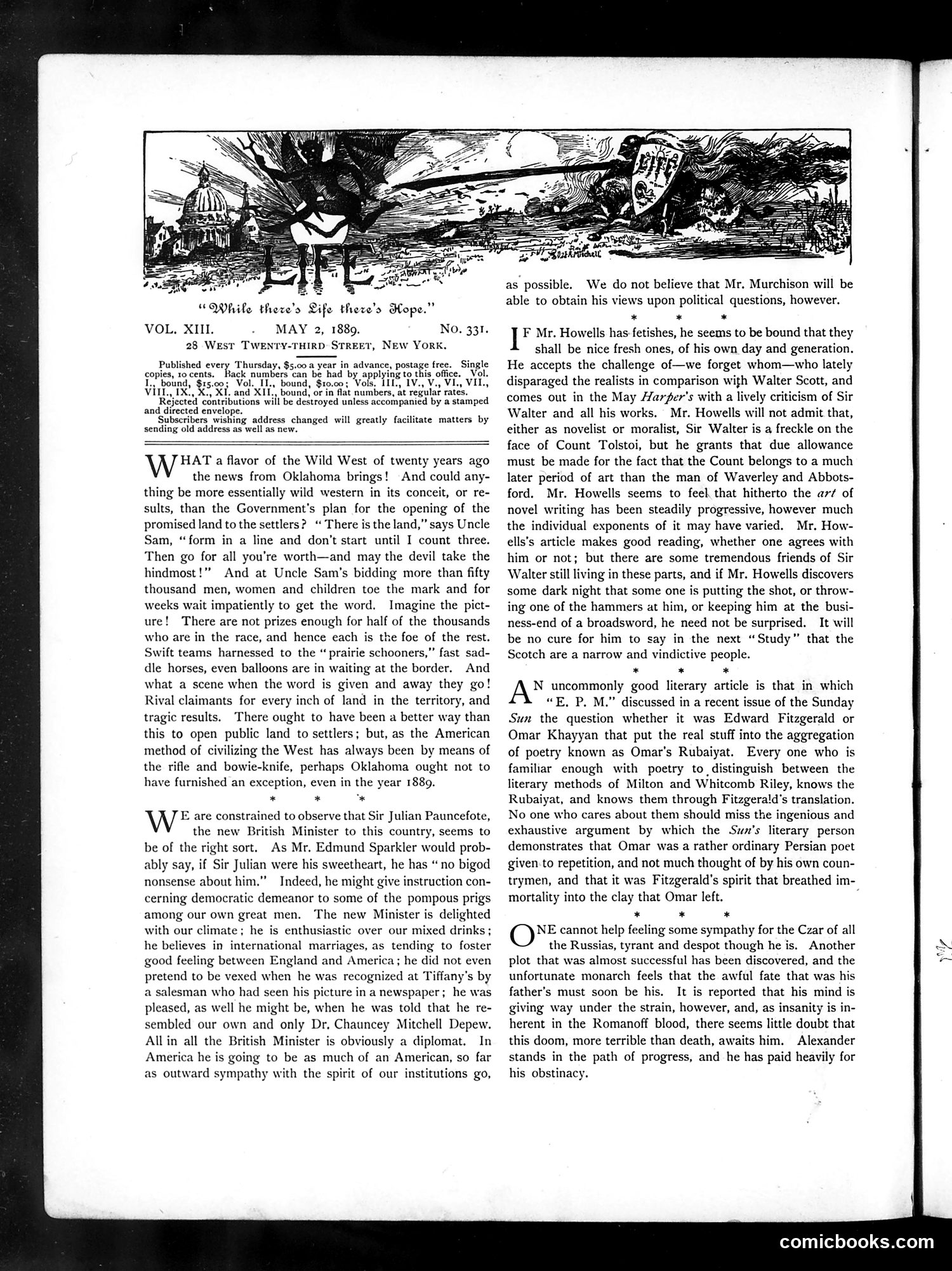
The illustrated masthead cartoon, titled "While there's Life there's Hope," depicts a chaotic Western scene with figures in conflict—likely satirizing the Oklahoma Land Rush (referenced in the accompanying editorial). The text describes the "Wild West of twenty years ago" and the government's opening of promised land to settlers, mocking the chaos and violence of land distribution where settlers rushed to claim territory. The editorial also discusses Sir Julian Paunceforte, Britain's new Minister to the U.S., expressing sympathy for his diplomatic position. There's commentary on literary matters, including discussion of Omar Khayyam's poetry translation and criticism of Sir Walter Scott. The cartoon satirizes frontier lawlessness and land-grab mentality as emblematic of American expansion.
📄 Transcribed text from this page (OCR, searchable)
Machine-transcribed from the original scan — historical spelling and the odd misread are preserved.
=a See Gos Ee “While there's Life theze’s Hope.” VOL. XIII. MAY 2, 1889. No. 331. 28 West TWENTY-THIRD STREET, NEw York, Published every ‘Thursday, $5.00 a year in advance, postage free. Single copies, 10 cents. Hack numbers can be had by applying to this office. Vol. 1, bound, $15.00; Vol. II., bound, $10.00; Vols. IIL., 1V., V., VI, VIL, Vill, IX’, X., XI, and XII, bound, or in flat numbers, at regular rates. Rejected contributions will be destroyed unless accompanied by a stamped and directed envelope. Subscribers wishing address changed will greatly facilitate matters by sending old address as well as new. HAT a flavor of the Wild West of twenty years ago the news from Oklahoma brings! And could any- thing be more essentially wild western in its conceit, or re- sults, than the Government's plan for the opening of the promised land to the settlers? “ There is the land,” says Uncle Sam, “form in a line and don't start until I count three. Then go for all you're worth—and may the devil take the hindmost!” And at Uncle Sam's bidding more than fifty thousand men, women and children toe the mark and for weeks wait impatiently to get the word. Imagine the pict- ure! There are not prizes enough for half of the thousands who are in the race, and hence each is the foe of the rest. Swift teams harnessed to the “ prairie schooners,” fast sad- dle horses, even balloons are in waiting at the border. And what a scene when the word is given and away they go! Rival claimants for every inch of land in the territory, and tragic results. There ought to have been a better way than this to open public land to settlers; but, as the American method of civilizing the West has always been by means of the rifle and bowie-knife, perhaps Oklahoma ought not to have furnished an exception, even in the year 1889. * * * WE are constrained to observe that Sir Julian Pauncefote, the new British Minister to this country, seems to be of the right sort. As Mr. Edmund Sparkler would prob- ably say, if Sir Julian were his sweetheart, he has “no bigod nonsense about him.” Indeed, he might give instruction con- cerning democratic demeanor to some of the pompous prigs among our own great men. The new Minister is delighted with our climate; he is enthusiastic over our mixed drinks ; he believes in international marriages, as tending to foster good feeling between England and America; he did not even pretend to be vexed when he was recognized at Tiffany's by a salesman who had seen his picture in a newspaper ; he was pleased, as well he might be, when he was told that he re- sembled our own and only Dr, Chauncey Mitchell Depew. Allin all the British Minister is obviously a diplomat. In America he is going to be as much of an American, so far as outward sympathy with the spirit of our institutions go, as possible. We do not believe that Mr. Murchison will be able to obtain his views upon political questions, however. * * * F Mr. Howells has: fetishes, he seems to be bound that they shall be nice fresh ones, of his own day and generation. He accepts the challenge of—we forget whom—who lately disparaged the realists in comparison with Walter Scott, and comes out in the May Harfer's with a lively criticism of Sir Walter and all his works. Mr. Howells will not admit that, either as novelist or moralist, Sir Walter is a freckle on the face of Count Tolstoi, but he grants that due allowance must be made for the fact that the Count belongs to a much later period of art than the man of Waverley and Abbots- ford. Mr. Howells seems to feel that hitherto the a7¢ of novel writing has been steadily progressive, however much the individual exponents of it may have varied. Mr. How- ells’s article makes good reading, whether one agrees with him or not; but there are some tremendous friends of Sir ‘Walter still living in these parts, and if Mr. Howells discovers some dark night that some one is putting the shot, or throw- ing one of the hammers at him, or keeping him at the busi- ness-end of a broadsword, he need not be surprised. It will be no cure for him to say in the next “Study” that the Scotch are a narrow and vindictive people. * * * N uncommonly good literary article is that in which “E, P. M.” discussed in a recent issue of the Sunday Sun the question whether it was Edward Fitzgerald or Omar Khayyan that put the real stuff into the aggregation of poetry known as Omar's Rubaiyat. Every one who is familiar enough with poetry to distinguish between the literary methods of Milton and Whitcomb Riley, knows the Rubaiyat, and knows them through Fitzgerald's translation. No one who cares about them should miss the ingenious and exhaustive argument by which the Swv’s literary person demonstrates that Omar was a rather ordinary Persian poet given. to repetition, and not much thought of by his own coun- trymen, and that it was Fitzgerald's spirit that breathed im- mortality into the clay that Omar left. * * * NE cannot help feeling some sympathy for the Czar of all the Russias, tyrant and despot though he is. Another plot that was almost successful has been discovered, and the unfortunate monarch feels that the awful fate that was his father’s must soon be his. It is reported that his mind is giving way under the strain, however, and, as insanity is in- herent in the Romanoff blood, there seems little doubt that this doom, more terrible than death, awaits him. Alexander stands in the path of progress, and he has paid heavily for his obstinacy. comicbooks.com