
A complete issue · 20 pages · 1889
Life — March 21, 1889
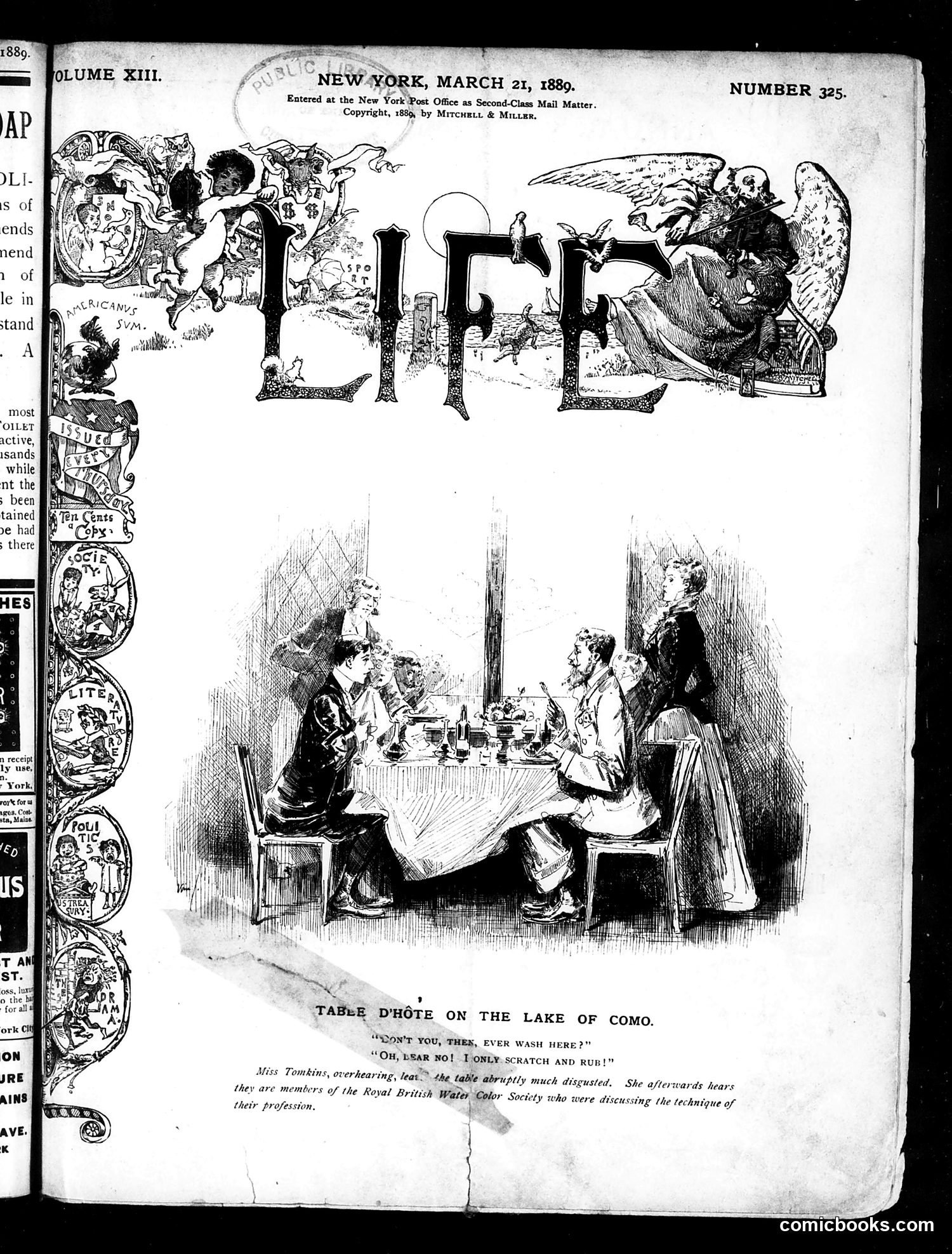
This page features two satirical illustrations. The masthead includes elaborate decorative vignettes typical of the era's design aesthetic. The main cartoon, titled "Table d'Hôte on the Lake of Como," depicts a dining scene with the caption "Don't you, Thee, ever wash here?" and "Oh, dear no! I only scratch and rub!" The scene appears to satirize members of the Royal British Water Color Society, whom Miss Tomkins overhears discussing their artistic technique. The joke critiques these artists' painting methods—specifically their light, tentative approach to watercolor work ("scratch and rub") rather than more decisive application. It's social satire mocking British artistic pretension and technical affectation among professional painters of the period.
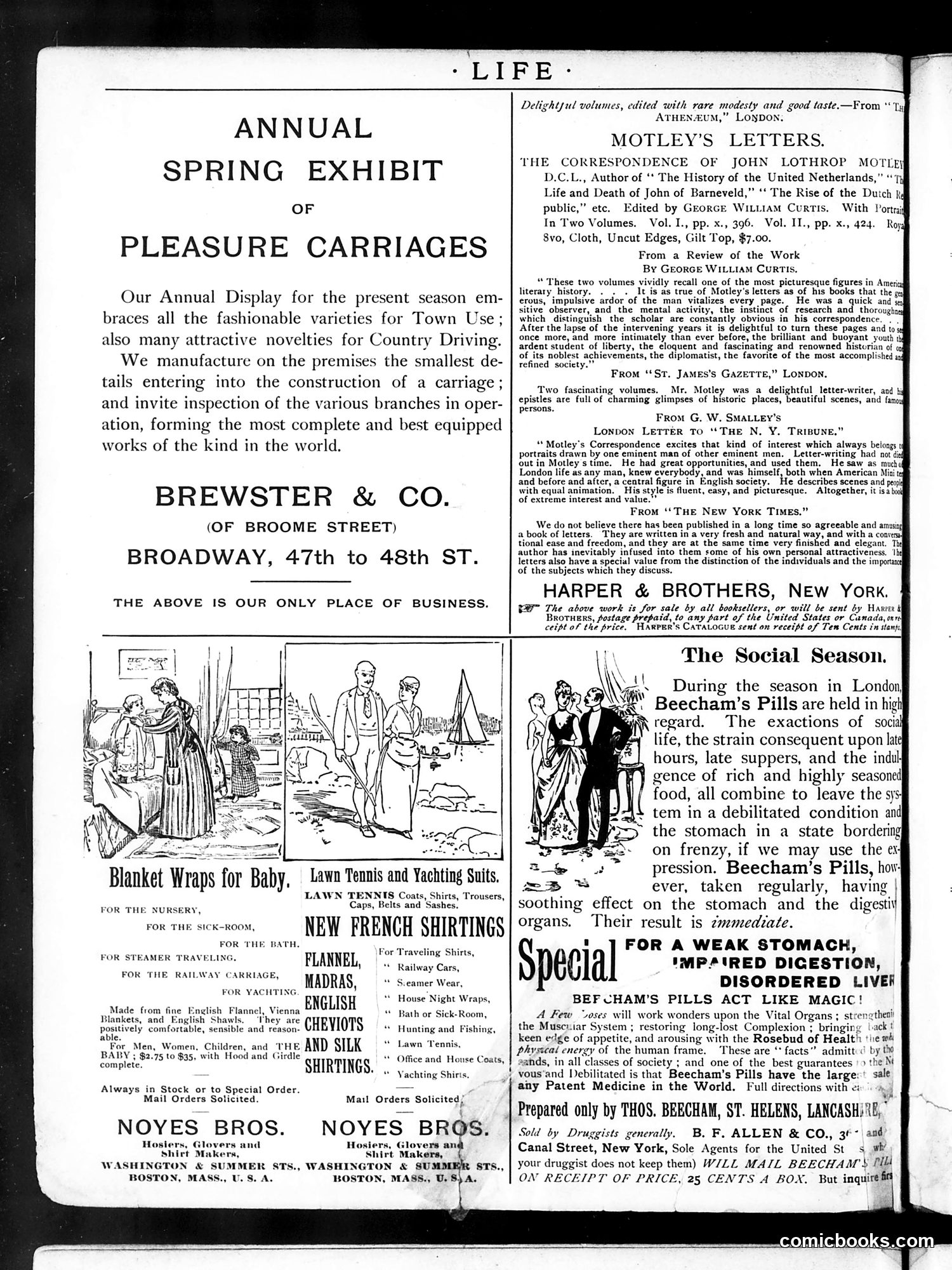
This page is **primarily advertising**, not political satire. The left side features ads for Brewster & Co. (pleasure carriages), Noyes Bros. (clothing and shirts), and clothing items like "New French Shirtings." The two small illustrations labeled "Blanket Wraps for Baby" and "Lawn Tennis and Yachting Suits" appear to be product showcases rather than satirical cartoons—they depict domestic and leisure scenes meant to sell merchandise. The right side contains book reviews and a Beecham's Pills advertisement with an illustration of well-dressed socialites. The pills ad is promotional, not satirical, though it humorously claims the pills provide "magic" relief for digestive issues. Overall, this is a **commercial page** typical of *Life* magazine's revenue model, mixing light entertainment with extensive advertising.
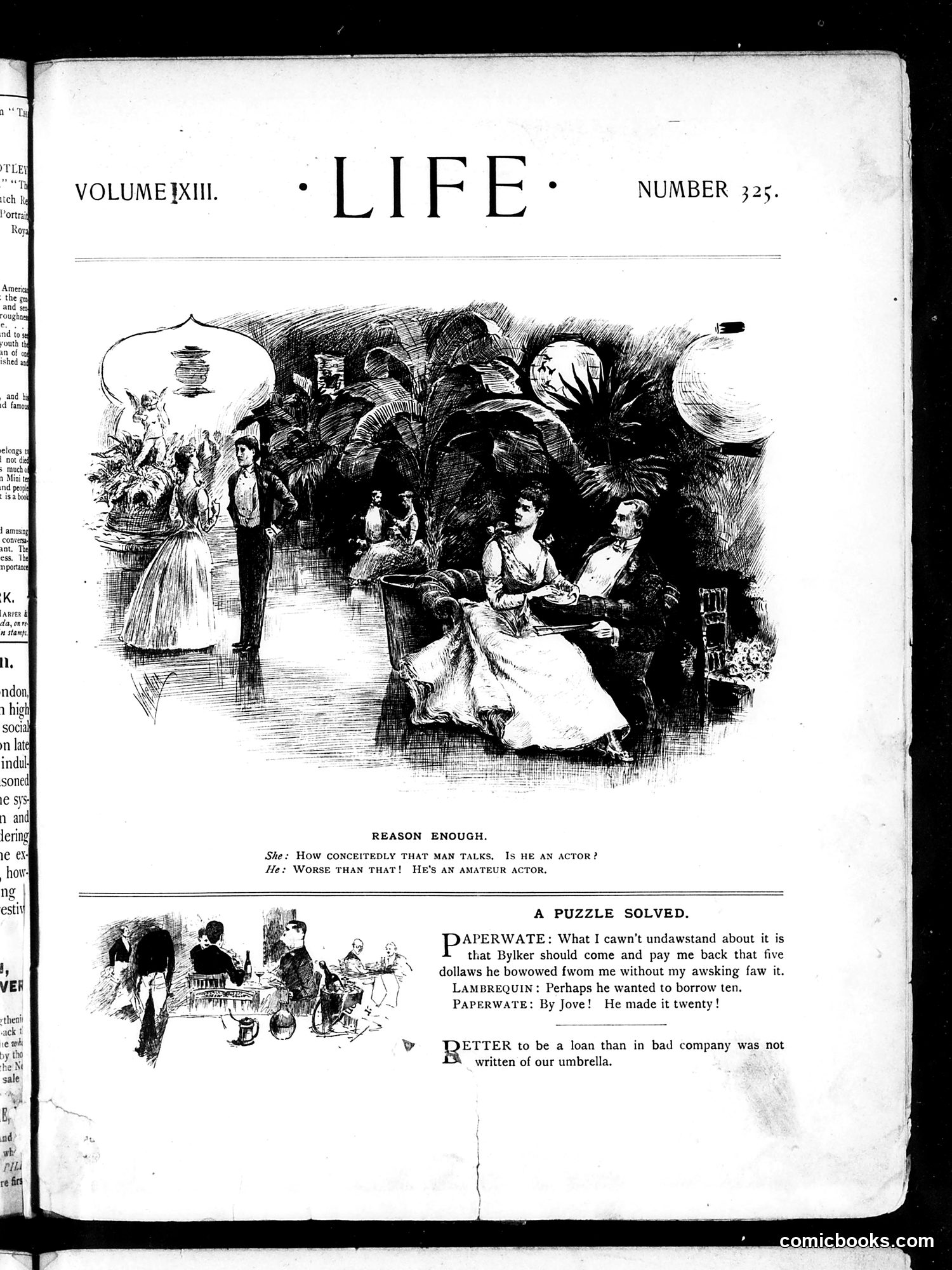
This page from *Life* magazine (Volume XIII, Number 325) contains two separate humorous pieces: **"Reason Enough"** (top): A sketch of an elegant social gathering where a woman remarks on a man's theatrical manner of speaking. The joke is straightforward: she asks if he's an actor; her companion replies he's worse—"an amateur actor." This satirizes social pretension, mocking people who affect exaggerated dramatic behavior in ordinary conversation. **"A Puzzle Solved"** (bottom): A brief dialogue between Paperwater and Lambrequin about an unpaid five-dollar loan that supposedly became twenty dollars. The humor relies on wordplay and confusion about debt accumulation, concluding with an unrelated quip about umbrellas. Both pieces represent typical *Life* magazine humor: gentle social satire targeting pretension and absurd domestic situations rather than political commentary.
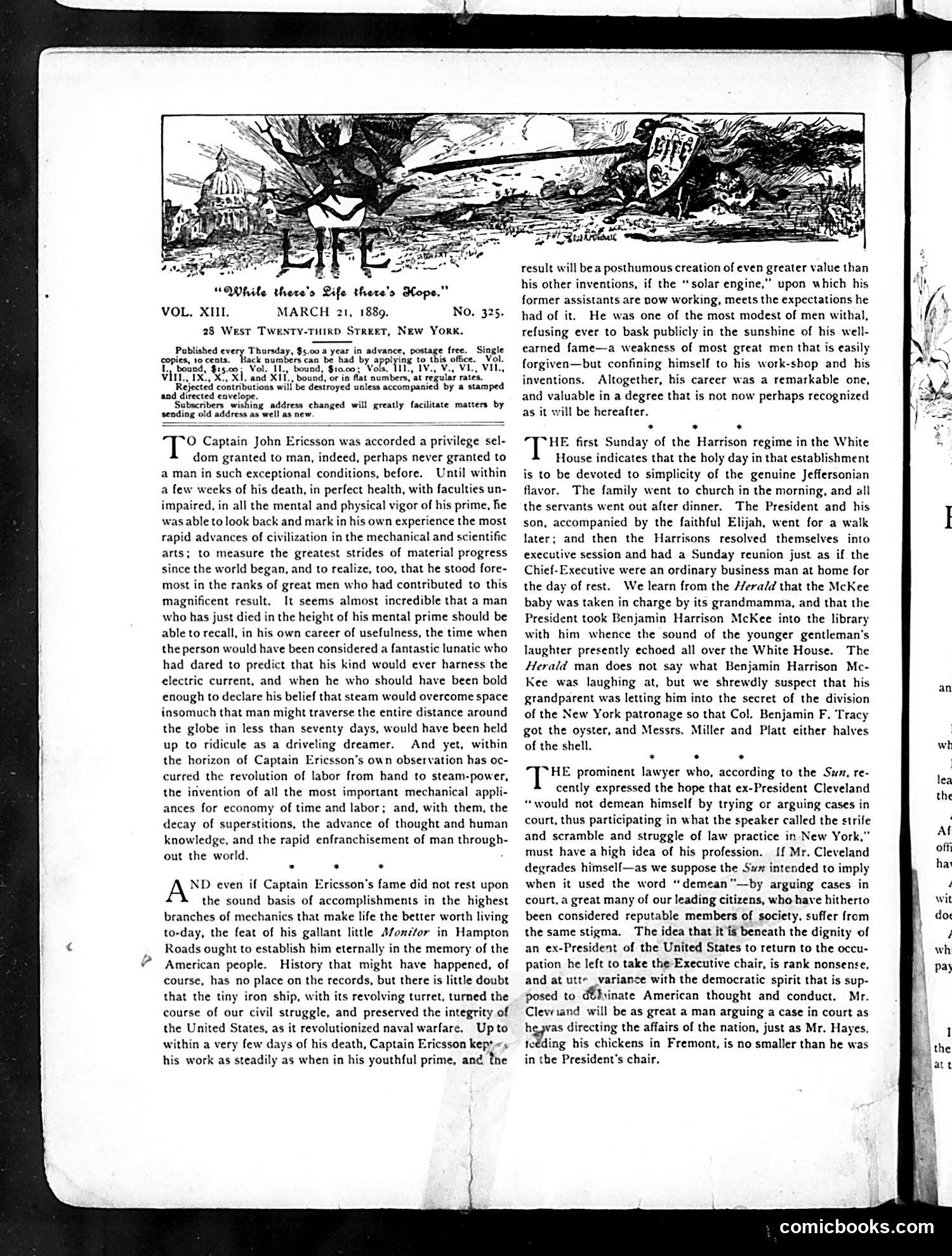
The masthead cartoon depicts a grim reaper figure labeled "LIFE" hovering over a desolate landscape with a distant dome (likely the Capitol). The caption reads "While there's Life there's Hope." The accompanying articles discuss Captain John Ericsson's death and praise his mechanical innovations. The text also satirizes President Benjamin Harrison's first Sunday at the White House, mocking the family's attempt at "genuine Jeffersonian flavor" and ridiculing young Benjamin McKee's antics in the library—suggesting the administration lacks dignity. A third piece criticizes ex-President Cleveland's potential legal involvement, questioning whether he should participate in court cases while maintaining presidential respectability. The overall tone blends obituary commemoration with satirical jabs at the current administration.
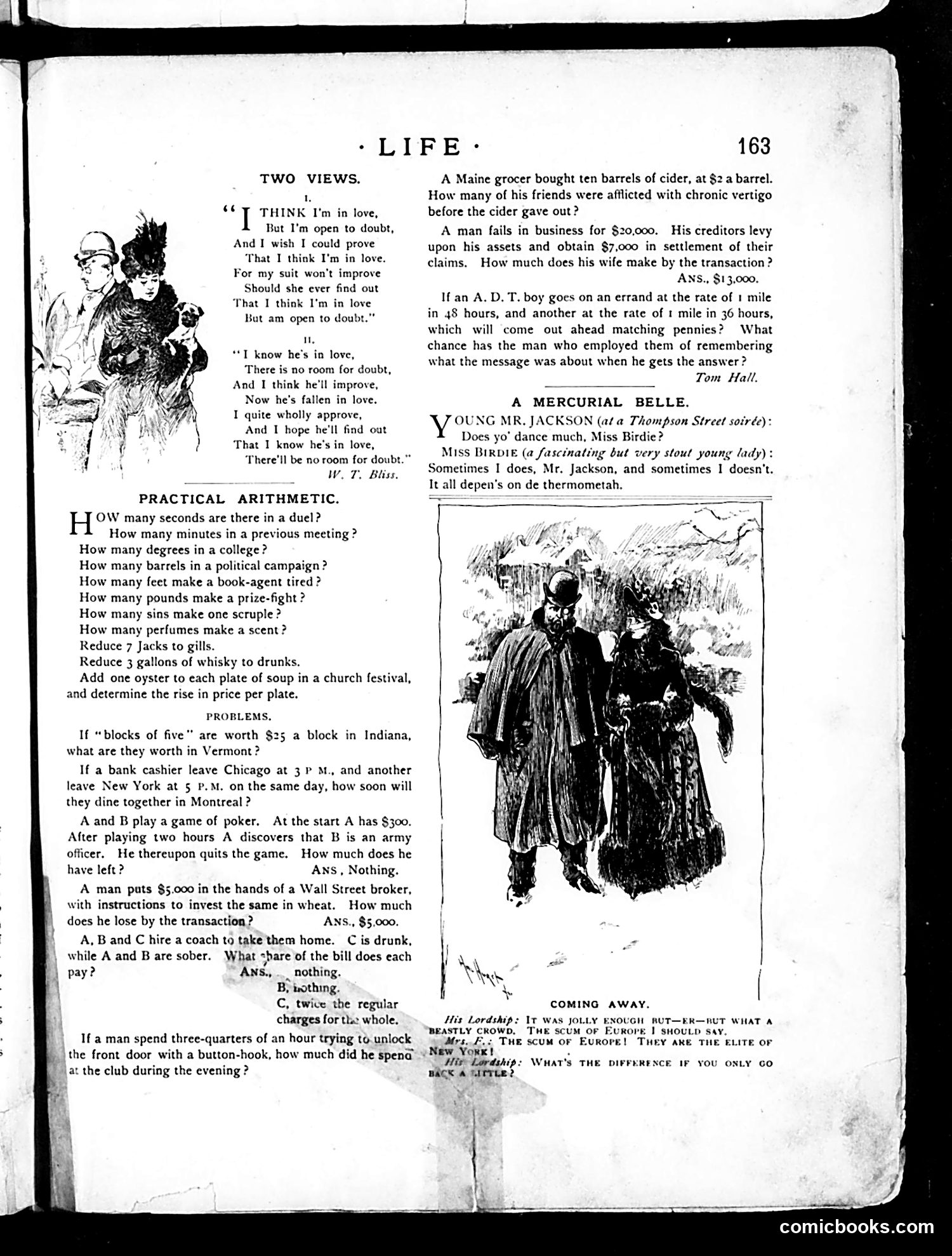
This page contains humorous practical problems and a social sketch titled "A Mercurial Belle." The main cartoon, "Coming Away," depicts two fashionably dressed figures—a man and woman—departing what appears to be a social event. The accompanying dialogue satirizes upper-class pretension and social climbing. His Lordship criticizes the "scum of Europe" and "elite of New York," while Mrs. F. dismisses such distinctions as mere social posturing. The joke mocks both aristocratic snobbery and American efforts to mimic European sophistication. The practical arithmetic problems above are lighthearted number puzzles with absurdist premises (converting "blocks of five" between states, calculating oyster-related costs), typical of Life's humor style. "A Mercurial Belle" is a brief comedic exchange about a young woman whose behavior depends on temperature—satirizing inconsistent or temperamental female personality tropes common to period humor.
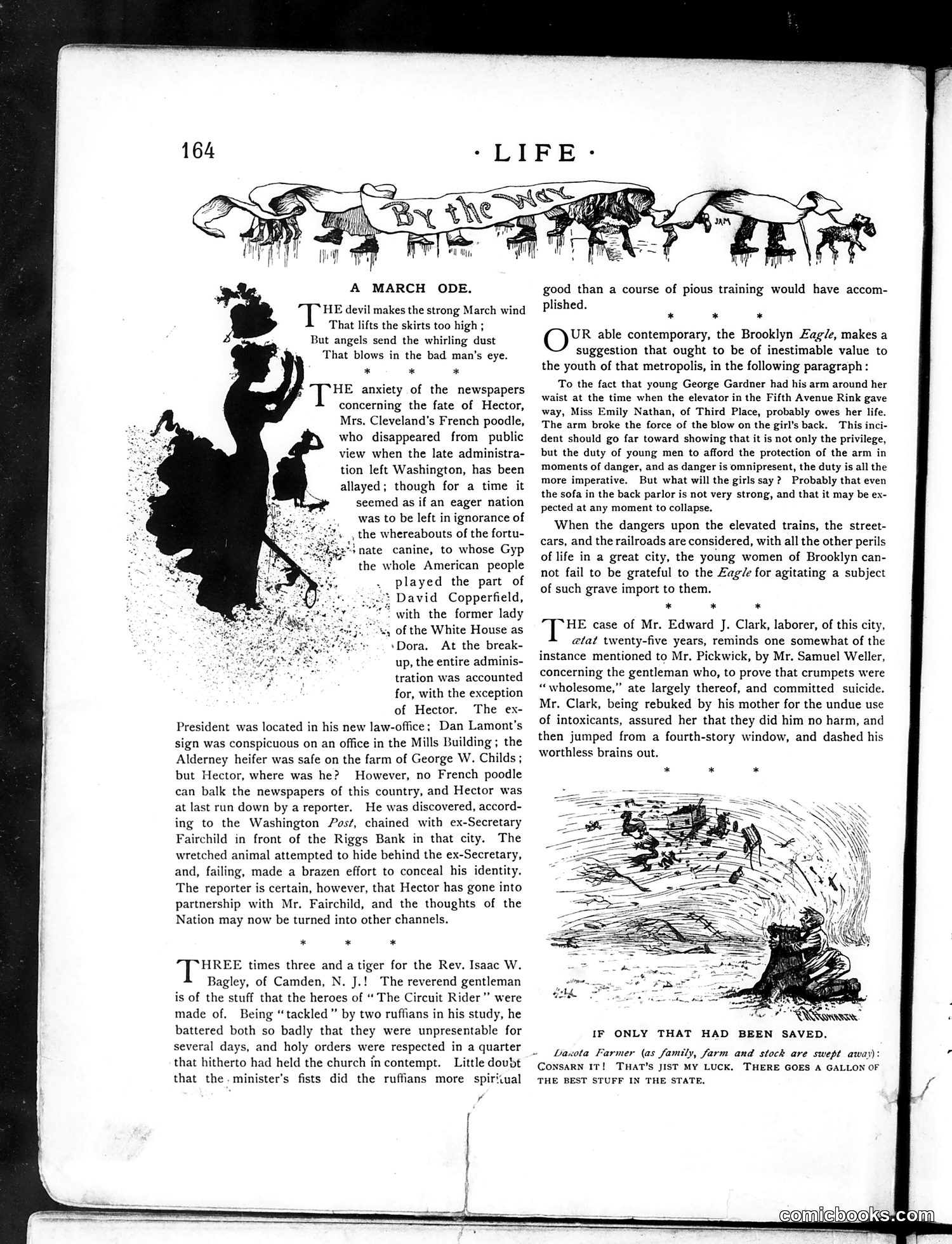
This page contains three satirical pieces critiquing American public figures and events: 1. **"A March Ode"** mocks newspaper anxiety over the fate of Hector (likely a French poodle), contrasting trivial concerns with serious political matters involving ex-Secretary Fairchild and other Washington officials. 2. **The Brooklyn Eagle anecdote** satirizes elevator safety dangers in modern cities, using a near-fatal incident involving a young woman to highlight urban industrial hazards. 3. **The Edward J. Clark case** ridicules a laborer's suicide attempt, apparently debunking claims about "wholesome" crumpets while commenting on desperation and social conditions. The tone throughout is caustic, targeting both sensationalist press coverage and broader social failures. Without clearer attribution, specific identities remain unclear, but the satire targets newspapers, urban dangers, and class-related tragedy.
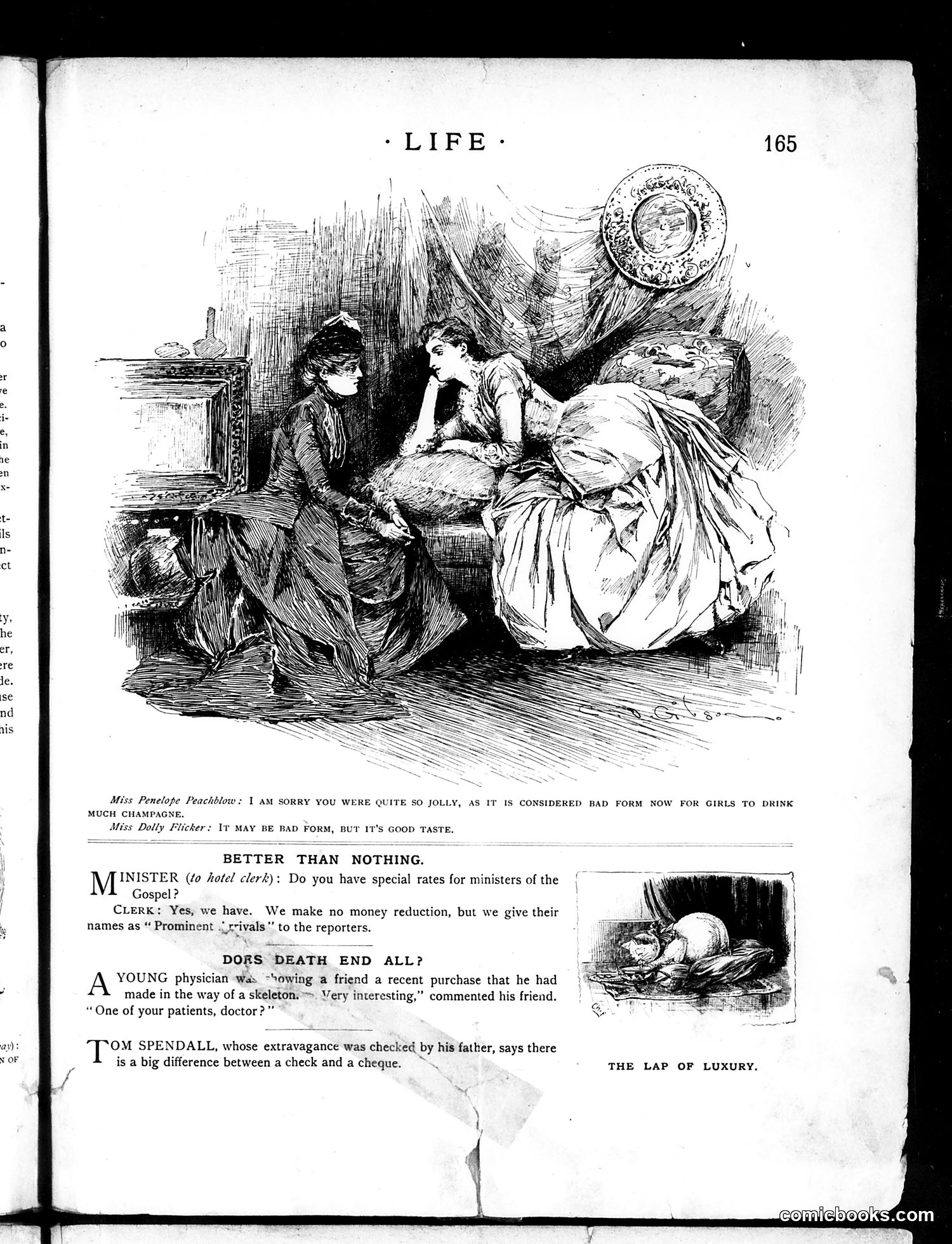
The main illustration depicts two young women in Victorian-era dress, with the caption about Miss Penelope Peckham scolding Miss Dolly Flicker for drinking champagne, which was considered improper behavior for unmarried girls at the time. Miss Flicker's defiant response—"It may be bad form, but it's good taste"—satirizes the tension between rigid social propriety and personal pleasure among the era's youth. Below are three brief satirical anecdotes: one mocking hotel clerks' euphemistic treatment of clergy ("prominent rivals"), another joking darkly about a physician's skeleton, and a final quip about Tom Spendall confusing checks with cheques—a play on words about financial irresponsibility. The overall theme concerns social hypocrisy and the gap between appearance and reality in Victorian society.
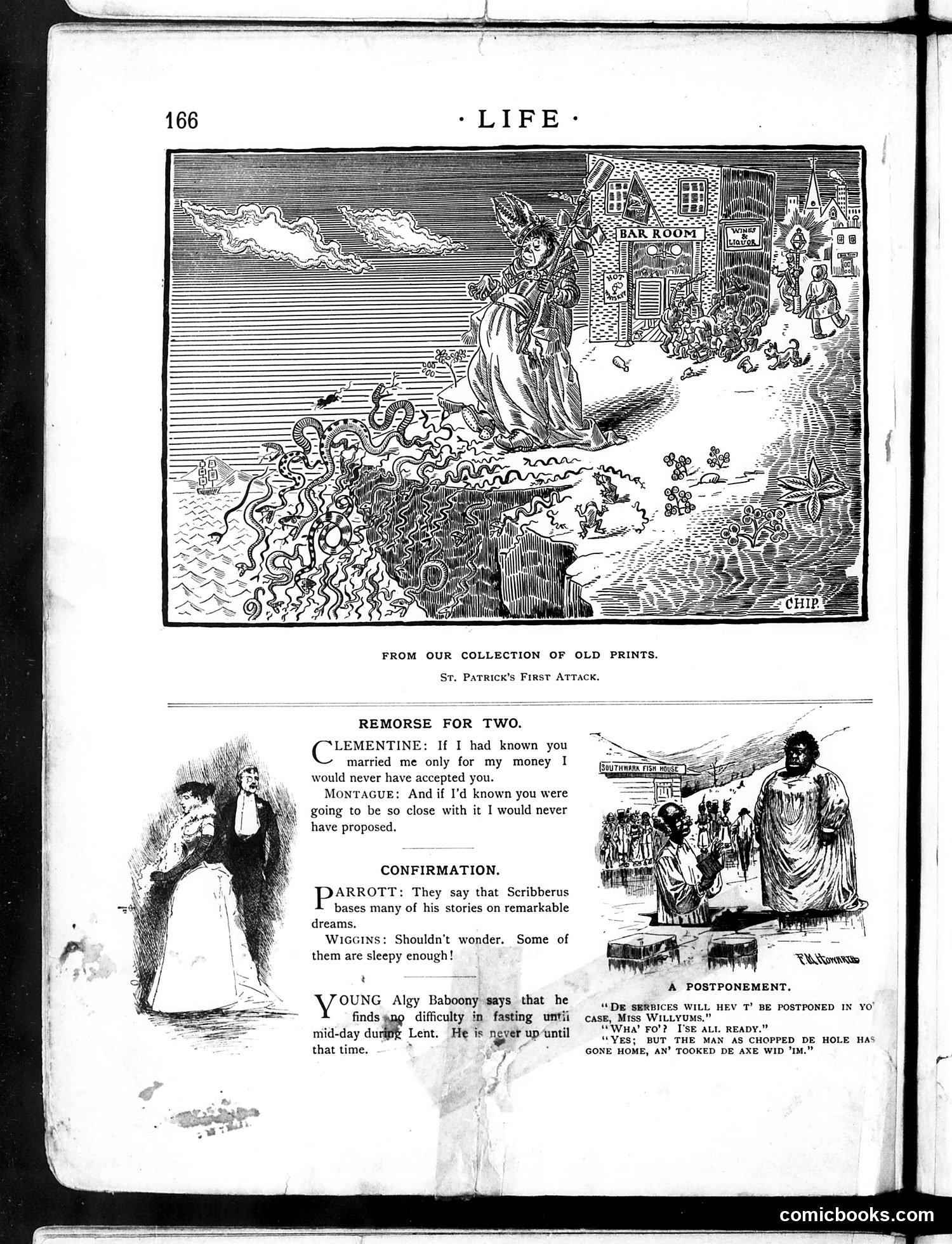
This page from *Life* magazine contains three separate satirical pieces: 1. **Top illustration** ("St. Patrick's First Attack"): A woodcut-style print showing Saint Patrick driving snakes from Ireland, but reimagined with demons and chaos. The satire appears to reference Irish immigration or religious conflict. 2. **"Remorse for Two"**: A dialogue between "Clementine" and "Montague" trading accusations about a mercenary marriage—she married for money, he proposed falsely. Standard marital satire. 3. **"Confirmation"** and **"A Postponement"**: Brief humorous anecdotes about Scribberus (appears fictional), someone named Algy Baboony fasting during Lent, and a postponed event involving "Miss Willyums." The exact historical context of these jokes remains unclear without additional dating information.
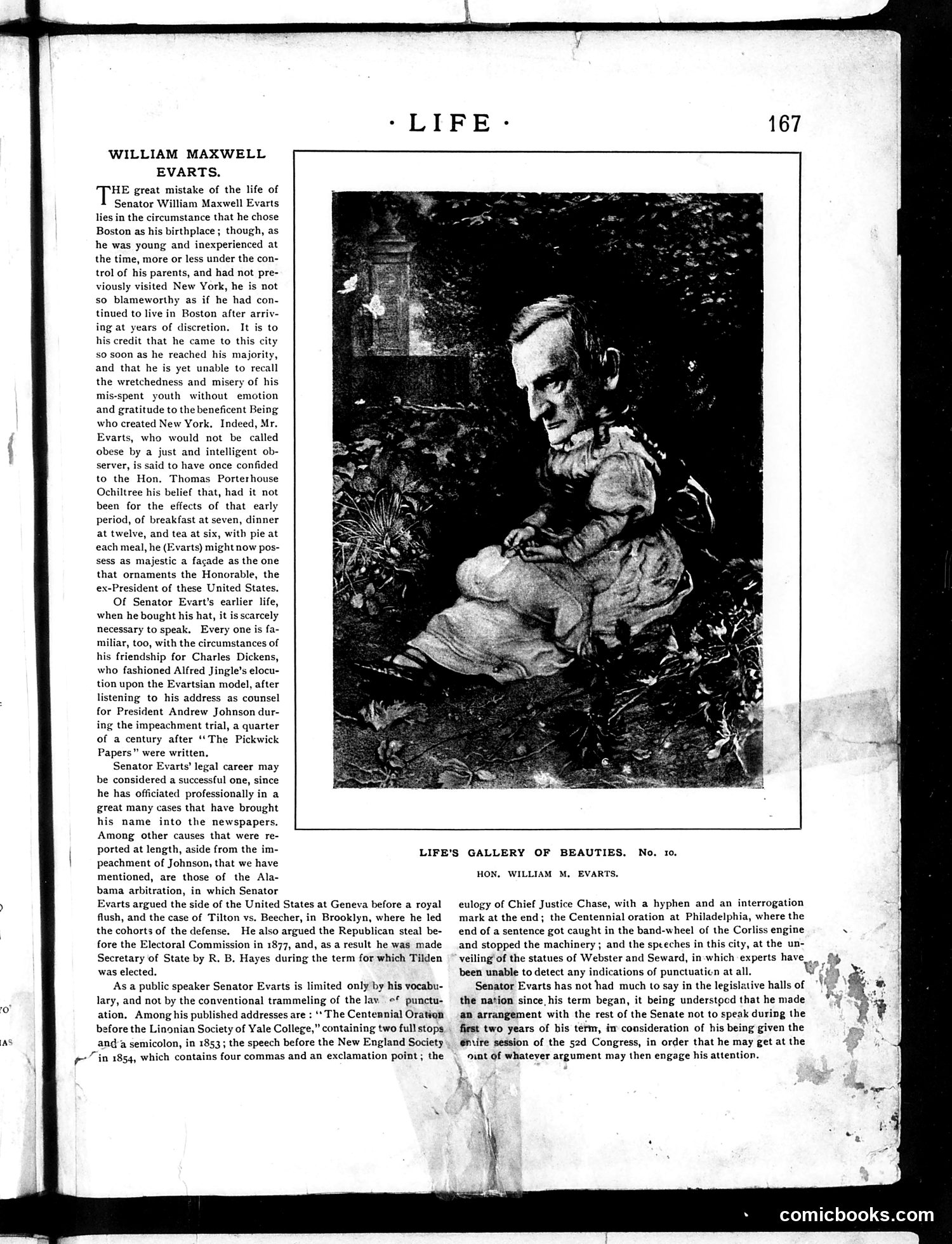
This page features a biographical article and portrait photograph of **Senator William Maxwell Evarts**, a prominent 19th-century political figure. The text describes his career achievements, including legal cases and oratorical skills. Key points the article highlights: - His mistake of choosing Boston (rather than New York) as his residence - His friendship with Charles Dickens - His role as counsel for President Andrew Johnson during impeachment proceedings - His legal career handling major cases brought before newspapers - The Alabama arbitration case argued before a royal institution in Geneva - His notable speeches, including "The Centennial Oration" and addresses to the Linnæan Society and New England Society The caption identifies this as "Life's Gallery of Beauties, No. 10," suggesting this was part of a recurring feature profiling notable Americans.
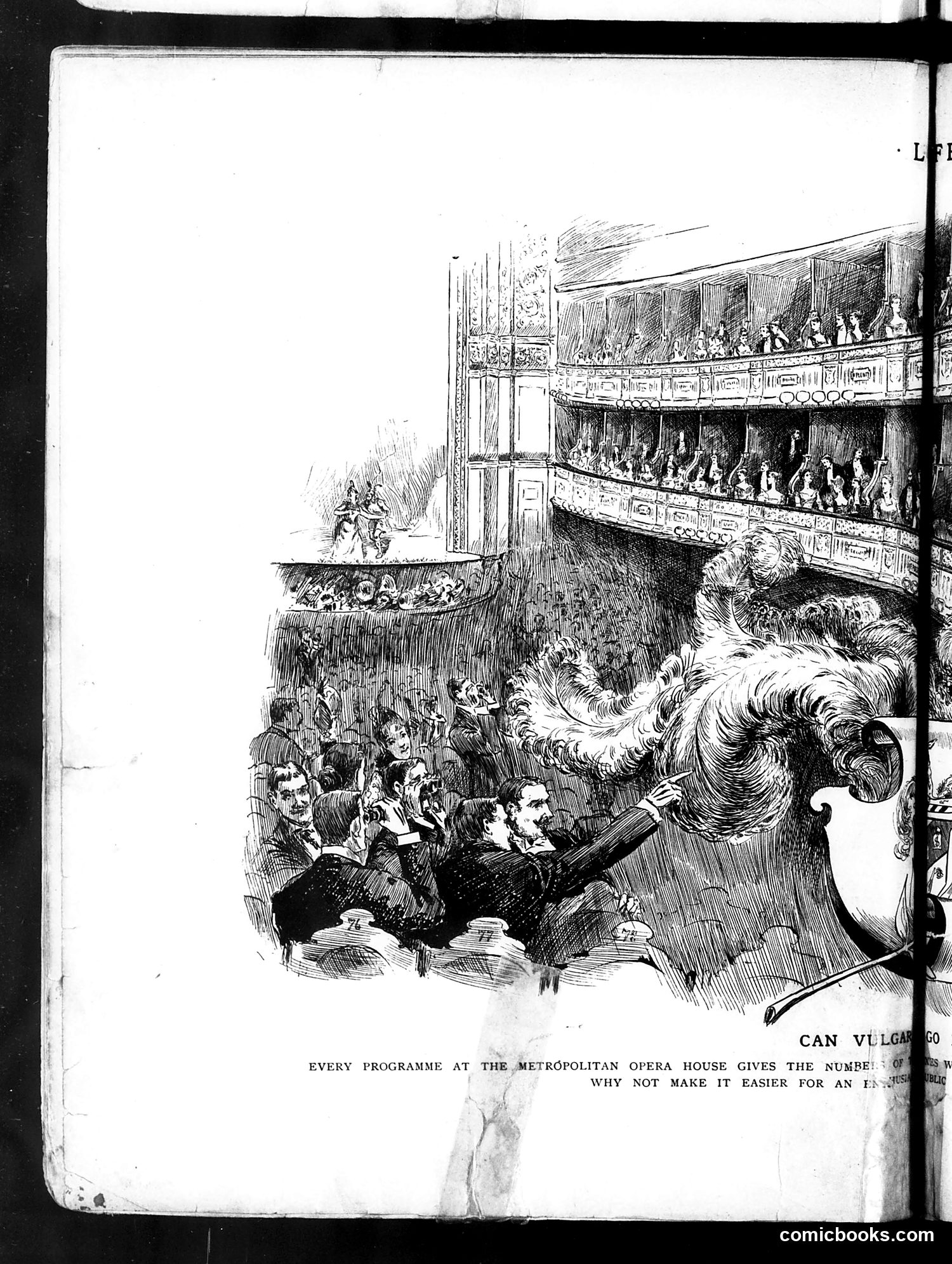
This is a satirical cartoon about opera attendance at the Metropolitan Opera House. The visible text reads: "EVERY PROGRAMME AT THE METROPOLITAN OPERA HOUSE GIVES THE NUMBER OF... WHY NOT MAKE IT EASIER FOR AN ENG..." (cut off). The cartoon depicts well-dressed opera patrons in the orchestra section pointing toward the stage, with elaborate multi-tiered boxes filled with spectators above. A large caricatured head on the right appears to represent an opera-goer or perhaps a prominent figure of the era. The satire appears to criticize the Metropolitan Opera's practice of listing something in their programs—likely musical selections or aria titles—that the cartoonist suggests should be made more accessible or clearer for English-speaking audiences. The joke likely concerns opera's reputation for being difficult or inaccessible to general audiences.
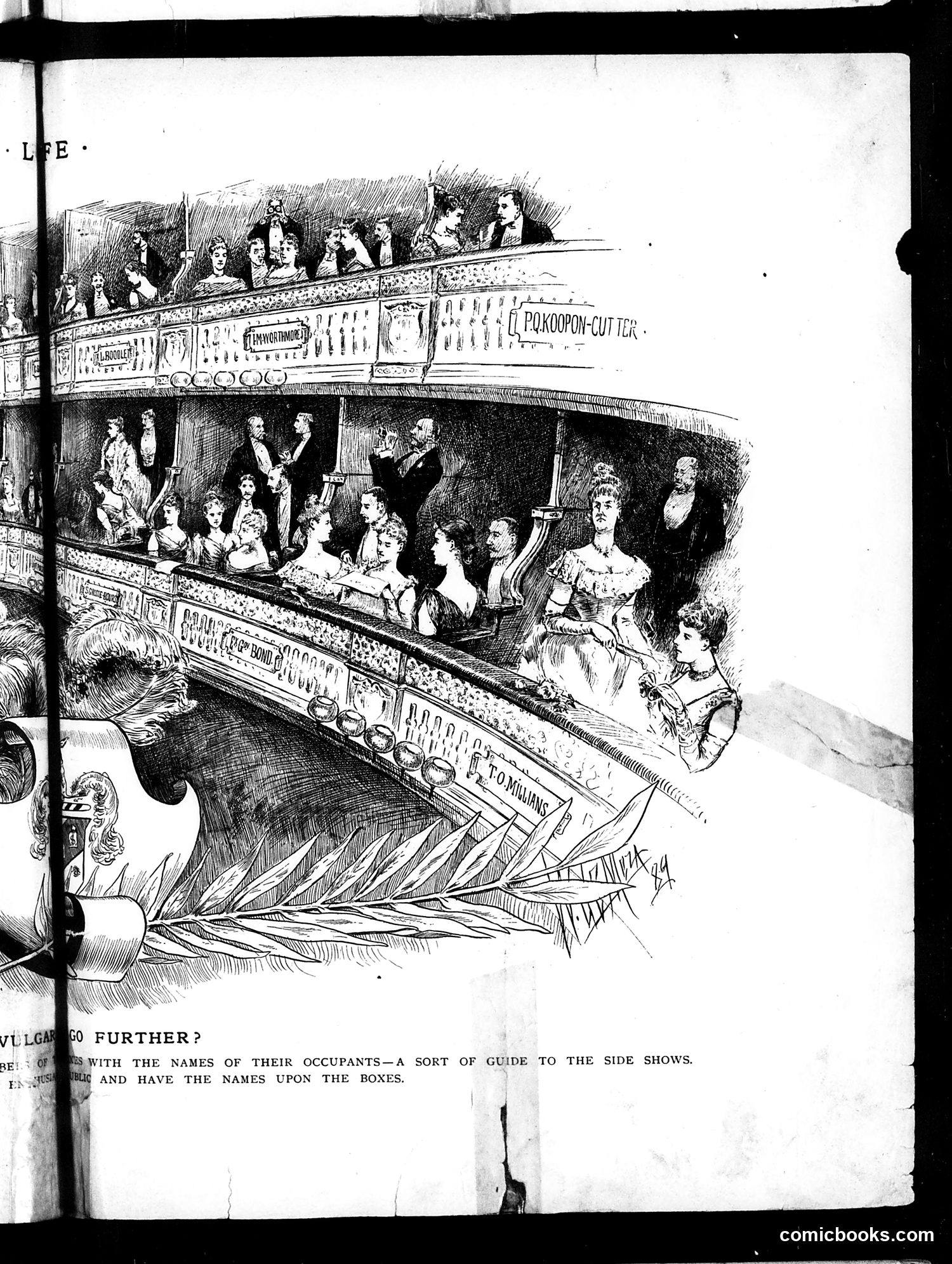
This satirical illustration depicts a theater or opera house with multiple tiers of boxes, labeled with names identifying wealthy patrons—"a sort of guide to the side shows." The cartoon satirizes high society's theatrical attendance as performative display. The heading "Shall We Go Further?" suggests expanding this social commentary. The joke appears to be that the "side shows" are not the stage entertainment, but rather the society figures themselves in the boxes—their fashions, interactions, and presence constitute the real spectacle for public observation and ridicule. The ornate boxes are explicitly named, mocking how New York's elite used theater attendance as public demonstration of wealth and social status. This reflects Gilded Age critique of conspicuous consumption, where being *seen* at prestigious venues mattered more than the actual performance. The illustration satirizes society's vanity and the theater as a venue for social positioning rather than art appreciation.
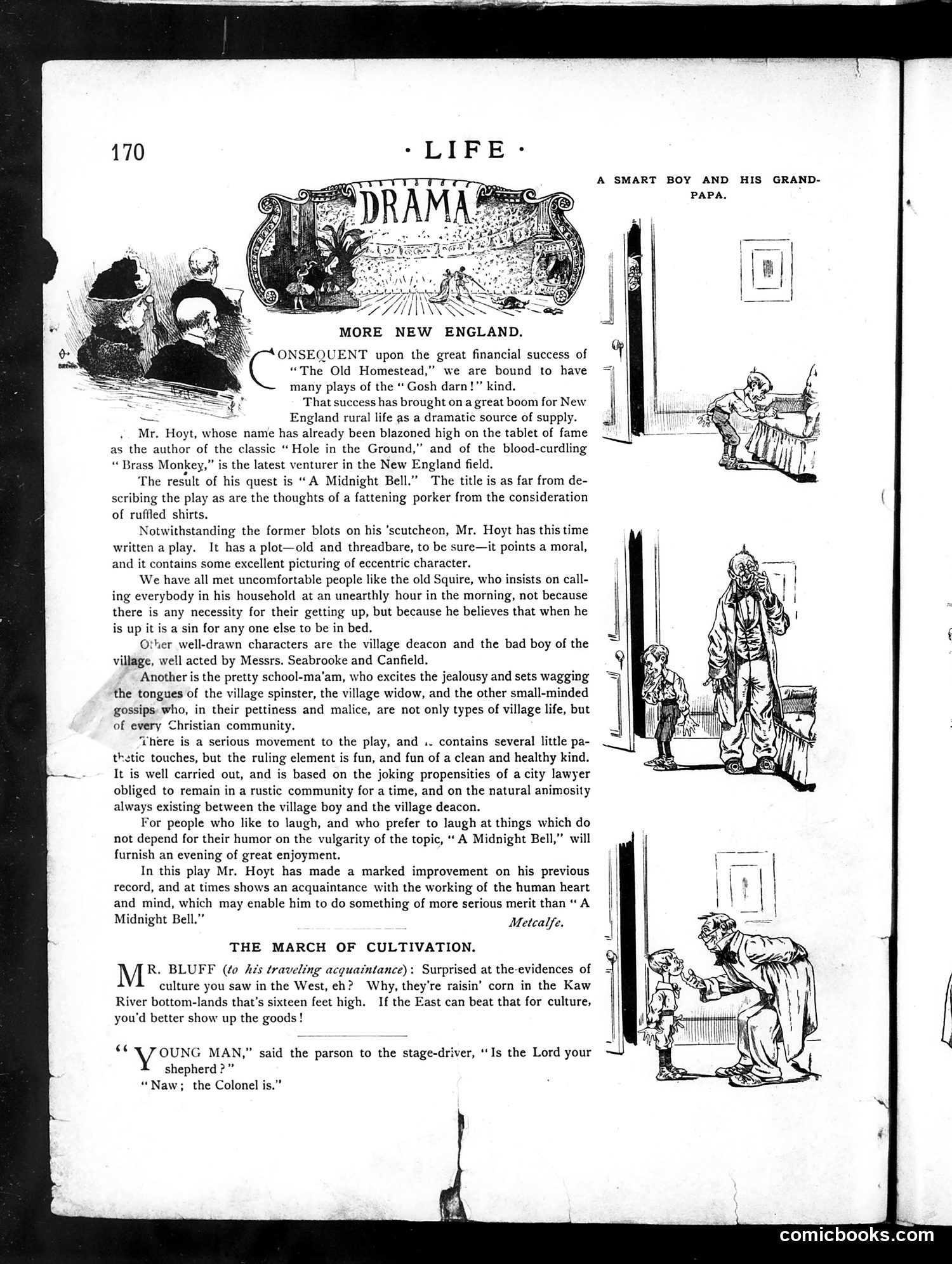
This page reviews theatrical productions, primarily Mr. Hoyt's play "A Midnight Bell," a New England rural comedy. The satire operates on multiple levels: **Main Review**: Hoyt had succeeded with "The Old Homestead," triggering a theatrical boom in rustic New England plays. Life notes the irony that despite Hoyt's previous mediocre work ("Hole in the Ground," "Brass Monkey"), "A Midnight Bell" actually succeeds—featuring stock characters like an obnoxious squire, village gossips, and a schoolteacher. The review praises it as wholesome humor for audiences preferring clean comedy over vulgar topics. **The Cartoons**: The illustrations on the right show domestic scenes with children and elderly figures, likely depicting scenarios from the play. **"The March of Cultivation"**: A brief satirical dialogue mocking Western "culture"—a man boasts that Kansas grows 16-foot-tall corn as proof of civilization, while another joke conflates a shepherd (religious figure) with "the Colonel" (secular authority), suggesting rural confusion of values. The overall tone gently mocks both rural life stereotypes and theater audiences' appetite for them.
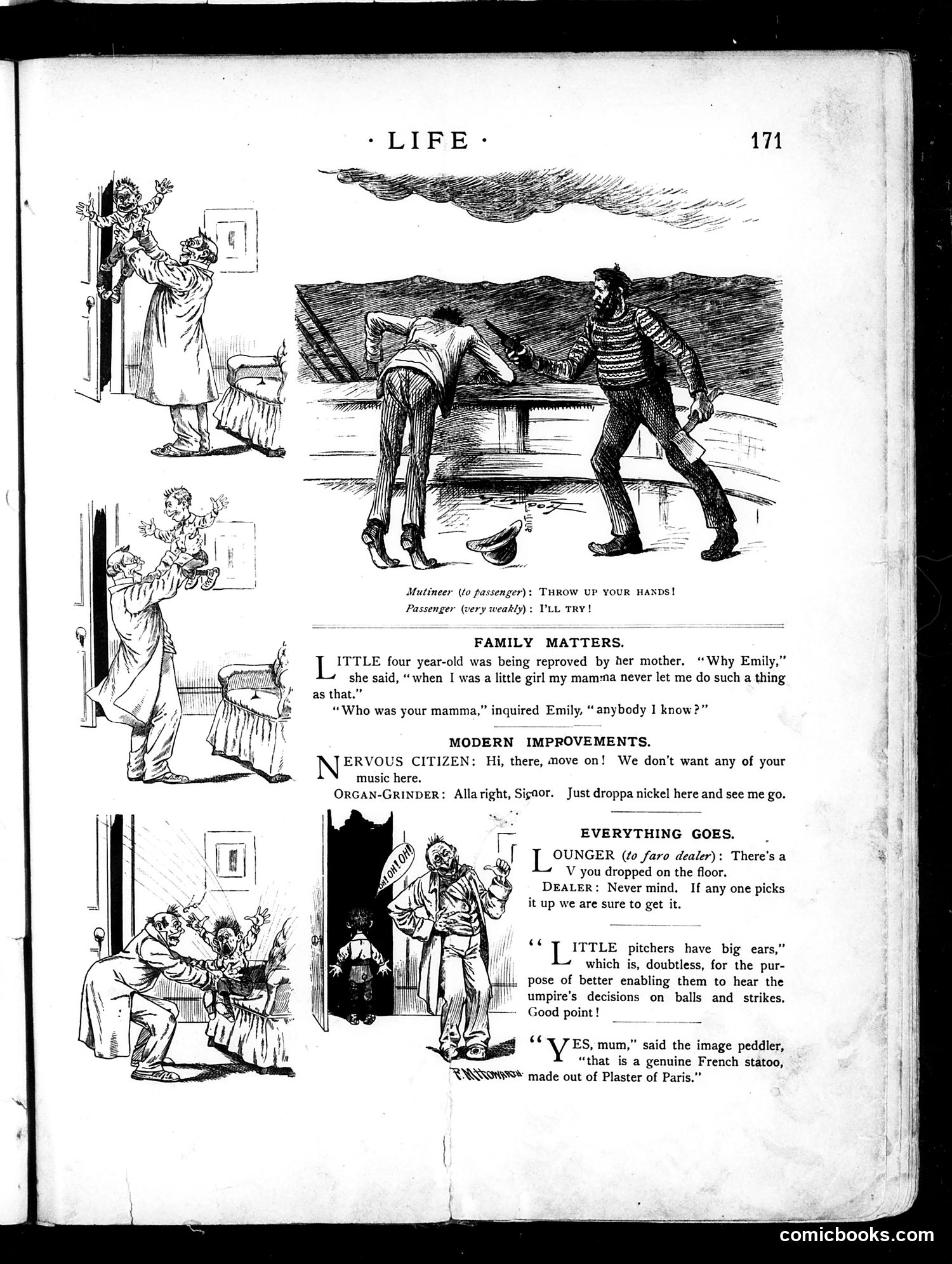
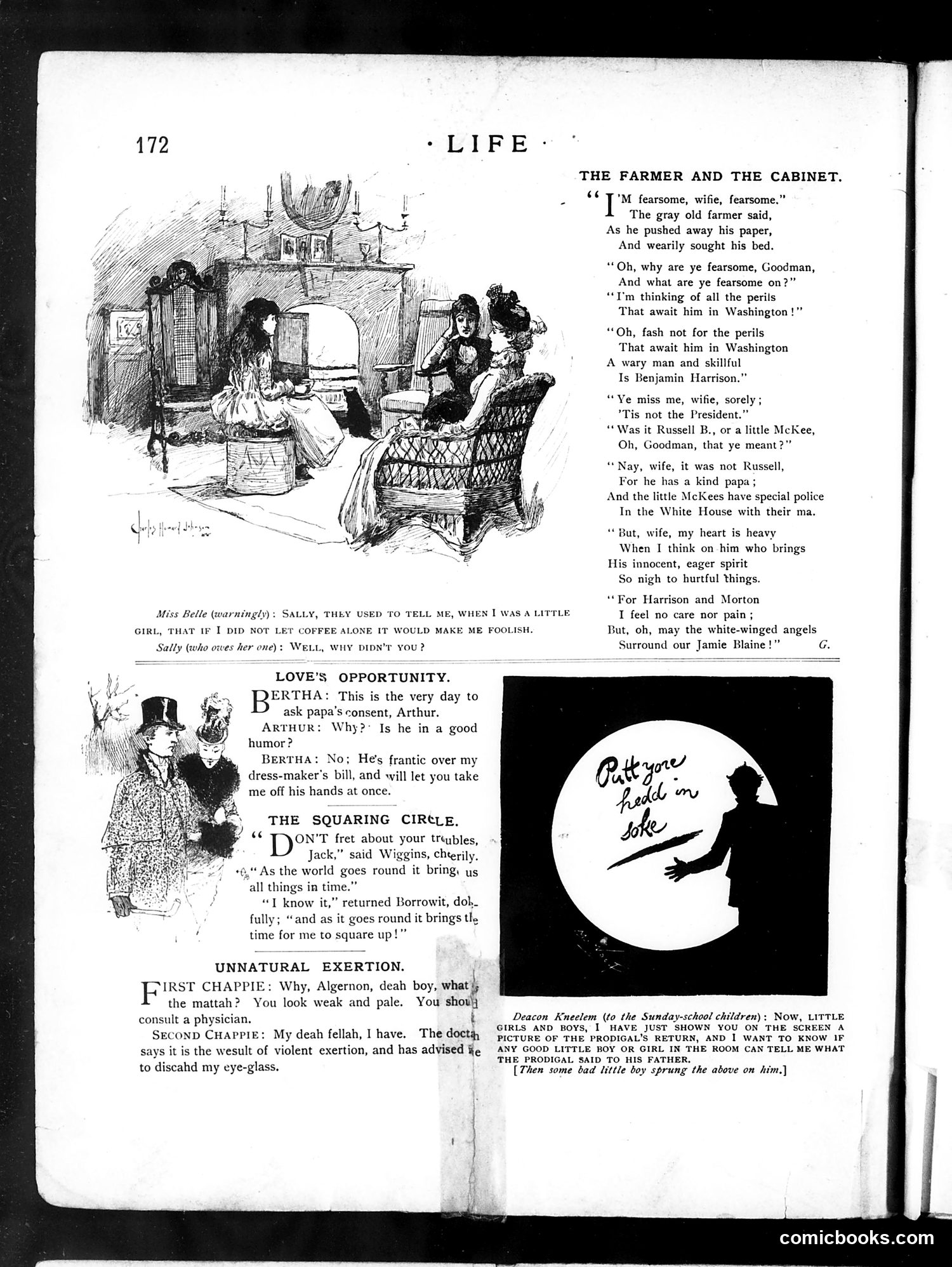
The main cartoon, "The Farmer and the Cabinet," satirizes anxieties about a young, inexperienced political appointee—likely James G. Blaine, who served as Secretary of State under Benjamin Harrison (referenced by name). The farmer's worry isn't about President Harrison himself, but about "Jamie Blaine," whose "innocent, eager spirit" faces corruption risks in Washington politics. The satire critiques how powerful politicians' children receive preferential treatment: Russell B. and the McKees enjoy protection through family connections and "special police in the White House." The cartoon suggests that without such patronage, Blaine is vulnerable to political harm. The remaining items are typical *Life* magazine humor—short comic dialogues on unrelated topics like coffee's effects, romantic timing, financial debt, and medical advice. These appear designed as filler rather than political commentary.
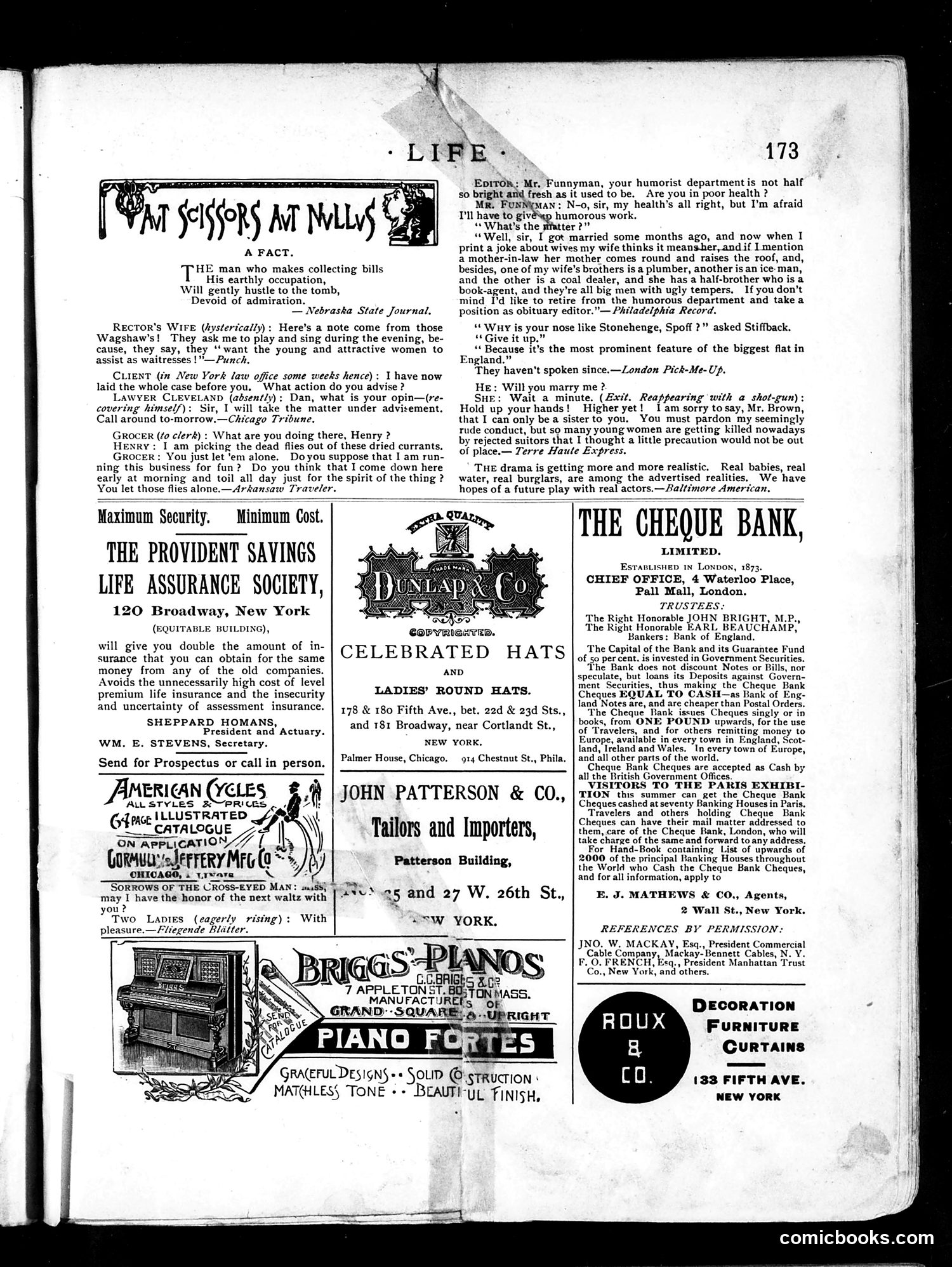
This page from *Life* magazine (a satirical publication, not a news magazine) contains multiple brief humorous cartoons and jokes typical of the era, alongside advertisements. The main satirical content includes: 1. **"Bigots at Mills"** - A poem mocking debt collectors as unappreciated drudges 2. **Several short comedic sketches** featuring common scenarios: a church rector's wife offended by a social request, a distracted lawyer mixing up clients' names, a grocer defending dead flies in fruit 3. **Reader complaints about humor** - An editor acknowledges that matrimonial jokes have become too personal since his marriage; his in-laws (plumber, ice-man, coal dealer brother) intimidate him into silence 4. **Romance humor** - A woman proposes to a suitor while brandishing a shotgun for self-defense against rejected-suitor violence 5. **Theater criticism** - Mocking the trend toward "realistic" stage productions The page is primarily filler content (jokes and ads), with no apparent political cartoons. The humor targets middle-class domestic anxieties, gender relations, and professional incompetence—standard satirical fare for the period.
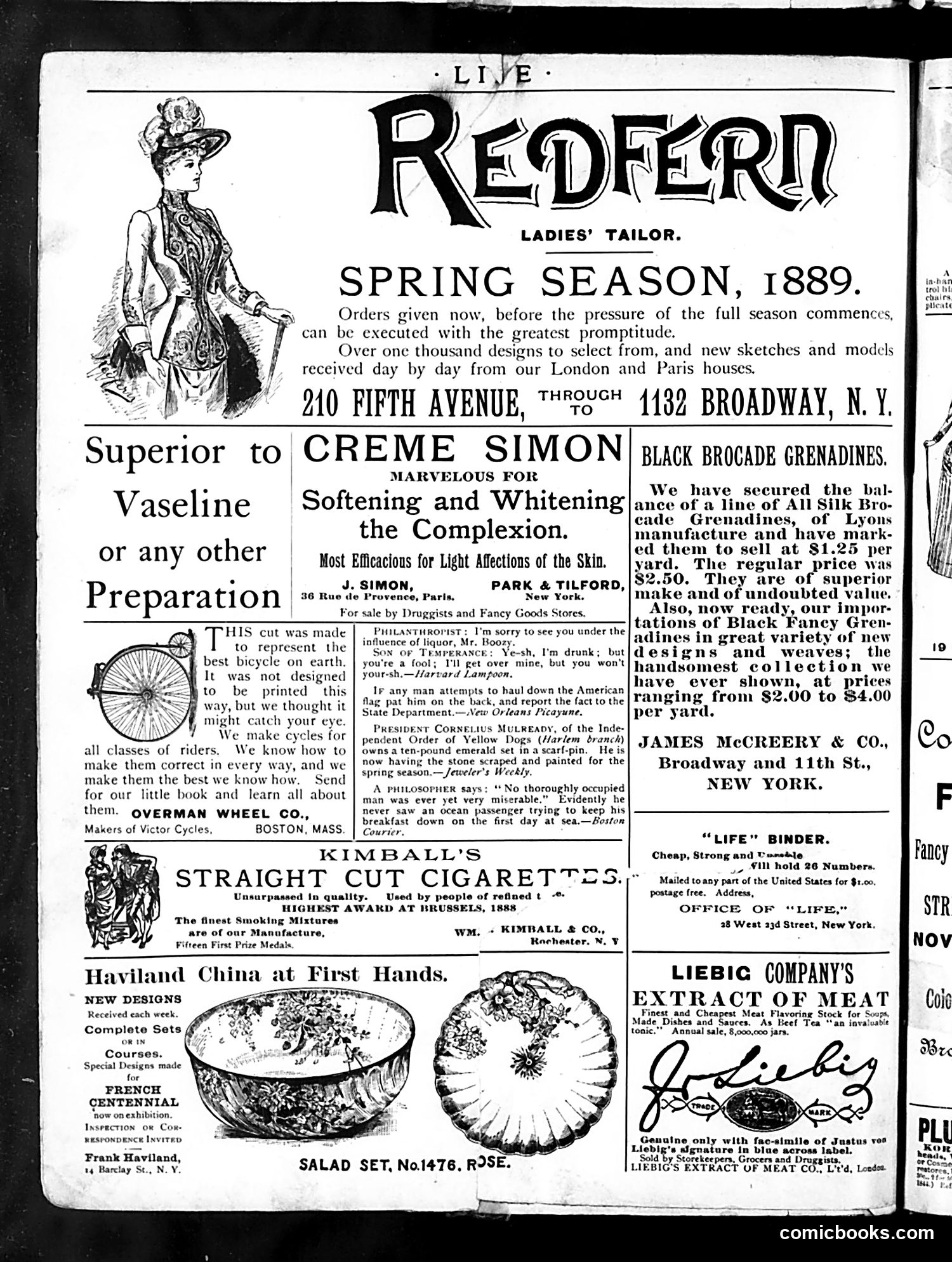
This is primarily an **advertisement page**, not a satirical cartoon page. It features various commercial promotions typical of the era, interspersed with brief humorous quips. The page advertises: - **Redfern Ladies' Tailor** (Fifth Avenue/Broadway) for spring fashions - **Vaseline** and **Crème Simon** (complexion products) - **Overman Wheel Company** bicycles - **Kimball's Straight Cut Cigarettes** - **Haviland China** - **Liebig Company's Extract of Meat** - A "Life" magazine binder The small comedic snippets scattered throughout satirize contemporary figures and situations—including a drunk Harvard student, President Cornelius Mulready of a fictional "Yellow Dogs" fraternity, and ocean sickness—but these are minor filler jokes, not the page's main content. The page reflects late-19th-century advertising conventions and consumer culture rather than political satire.
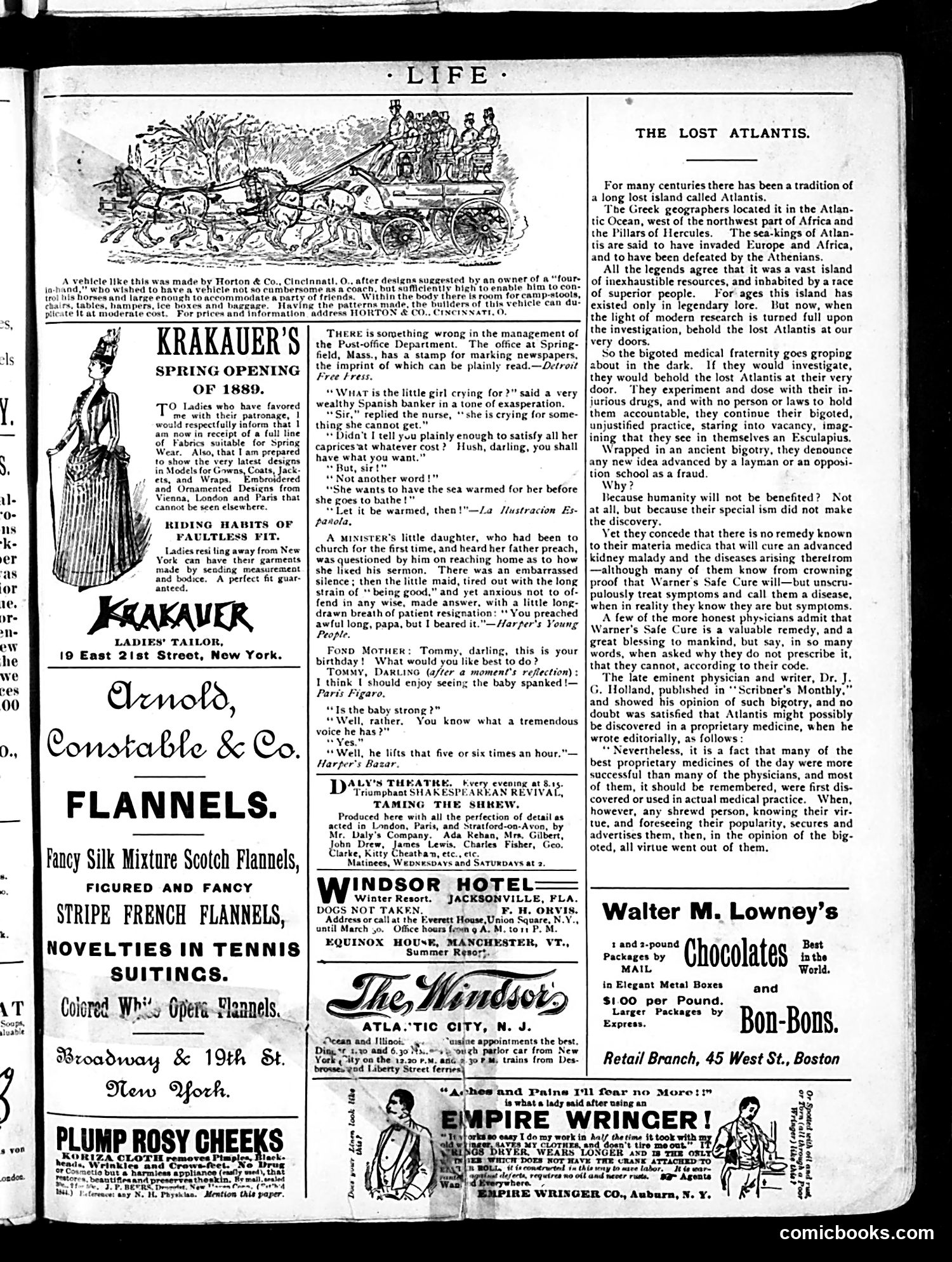
This page is primarily **advertising mixed with humor pieces**—typical of Life magazine's format combining commerce with satire. The illustrated cartoon at top shows a practical coach designed by Horton & Co., offering wealthy readers a middle option between unwieldy coaches and small carriages—relevant to 1880s leisure culture. The humor pieces are brief anecdotes satirizing **upper-class excess and absurdity**: A Spanish banker's daughter demands heated seawater for bathing (mocking extreme wealth-indulgence); a child finds her father's sermon boring but politely endures ("I beared it"); a boy's birthday wish is watching a baby spanked—dark humor about childhood cruelty. The **fashion advertisements** (Krakauer, Arnold Constable, flannel companies) target wealthy women, and the postal service joke critiques minor government inefficiency. The *Daly's Theatre* notice advertises a Shakespeare production, standard for the period. Overall, this reflects 1880s upper-middle-class concerns: fashion, leisure vehicles, humor mocking both wealth and working-class life, and period entertainment options. No specific political content.
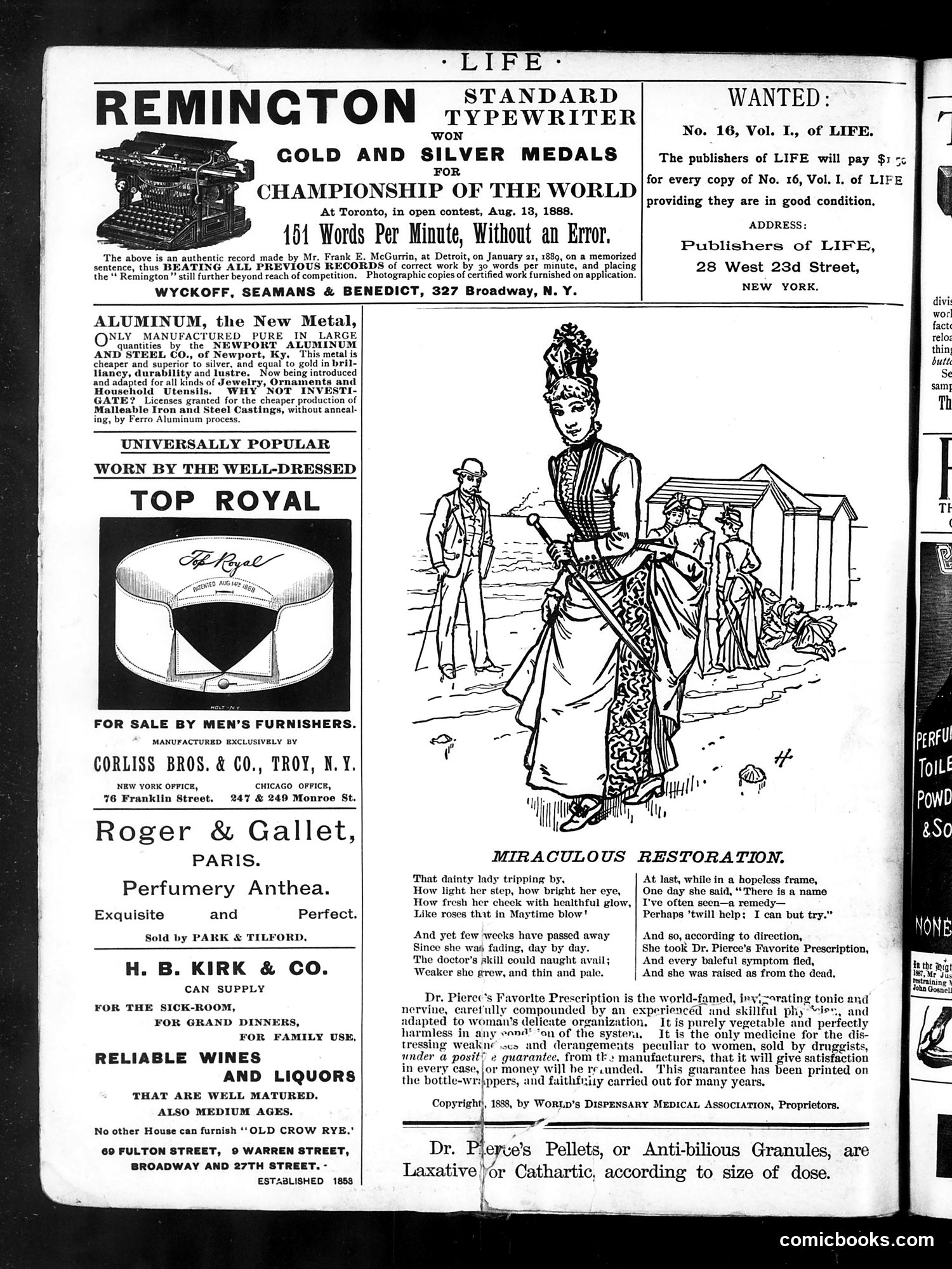
This page is primarily **advertising**, with one small illustrated narrative about miraculous medical restoration. The main cartoon, titled "Miraculous Restoration," tells a before-and-after story of a sickly woman restored to health. The illustration shows an elegantly dressed woman now robust and vibrant, surrounded by admirers and children, contrasting with her previous "hopeless frame" of illness. The accompanying verse explains she discovered "Dr. Pierce's Favorite Prescription"—a patent medicine advertised as a cure for women's ailments. This exemplifies **late-19th-century patent medicine marketing**: exaggerated claims of miraculous cures, vague descriptions of what the remedy treats (coded as "weaknesses peculiar to women"), and testimonial narratives. The advertisement includes a guarantee promising refunds if unsatisfied. The surrounding ads showcase typical 1888 products: typewriters, aluminum jewelry, perfume, hats, and wines—reflecting Gilded Age consumer culture and technological innovation.
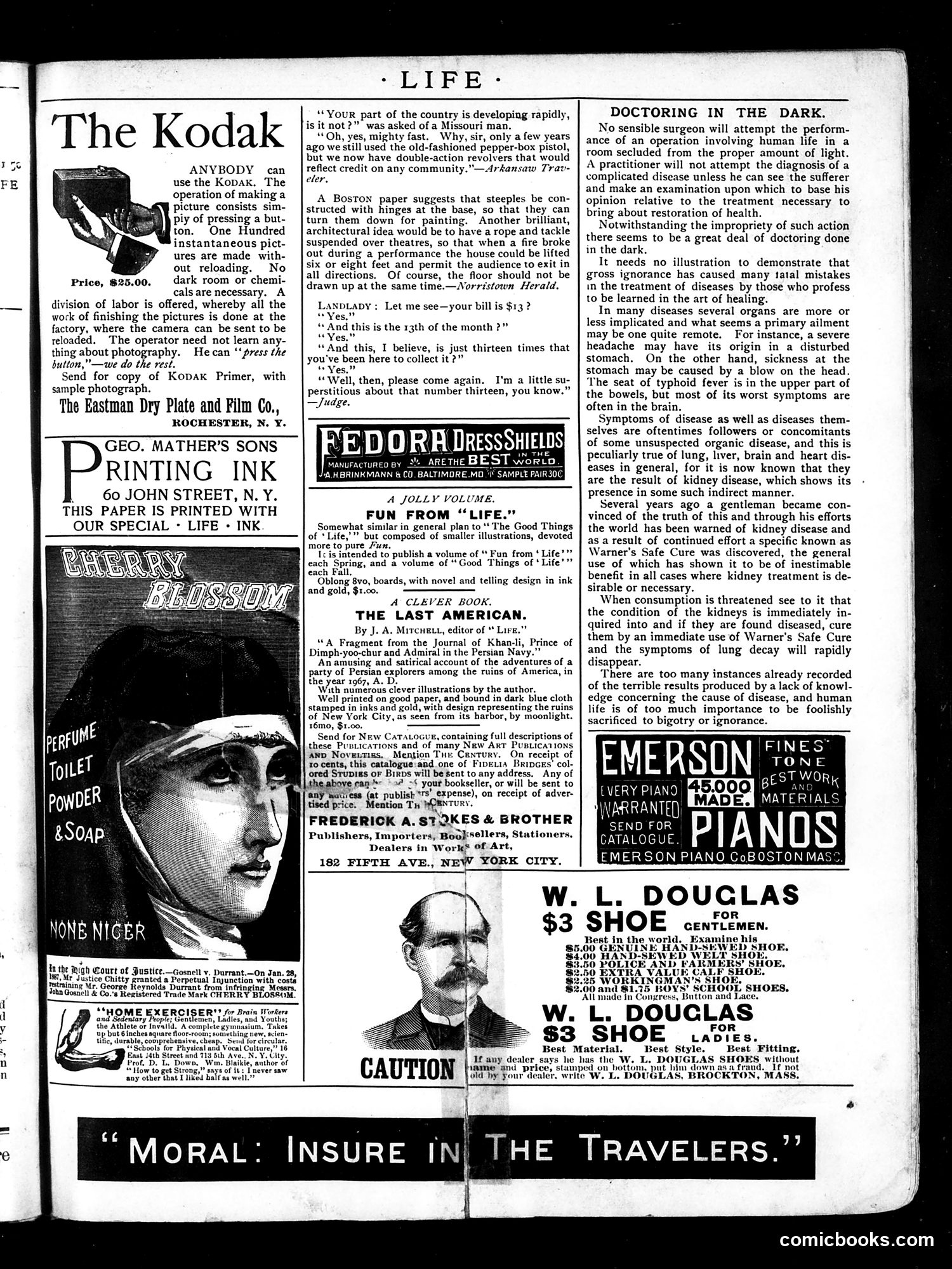
This page from *Life* magazine is primarily **advertisements and light humor pieces**, not political satire. The content includes: **Main Elements:** - **Kodak camera advertisement**: Emphasizes that anyone can use it by simply "pressing a button"—the earliest marketing of photography as democratized, user-friendly technology - **Printing ink and book advertisements** - **Three brief comic anecdotes** (from *Arkansaw Traveler*, *Norristown Herald*, and *Judge*) about American life, progress, and human nature—nothing explicitly political - **An article titled "Doctoring in the Dark"** warning about medical practitioners making diagnoses without proper examination, a consumer-safety concern rather than satire The page reflects late-1800s concerns: **industrial progress** (rapid development), **modernization** (revolvers improving), and **consumer skepticism** about unqualified professionals. The humor is gentle and domestic rather than satirical about politics or identifiable public figures.
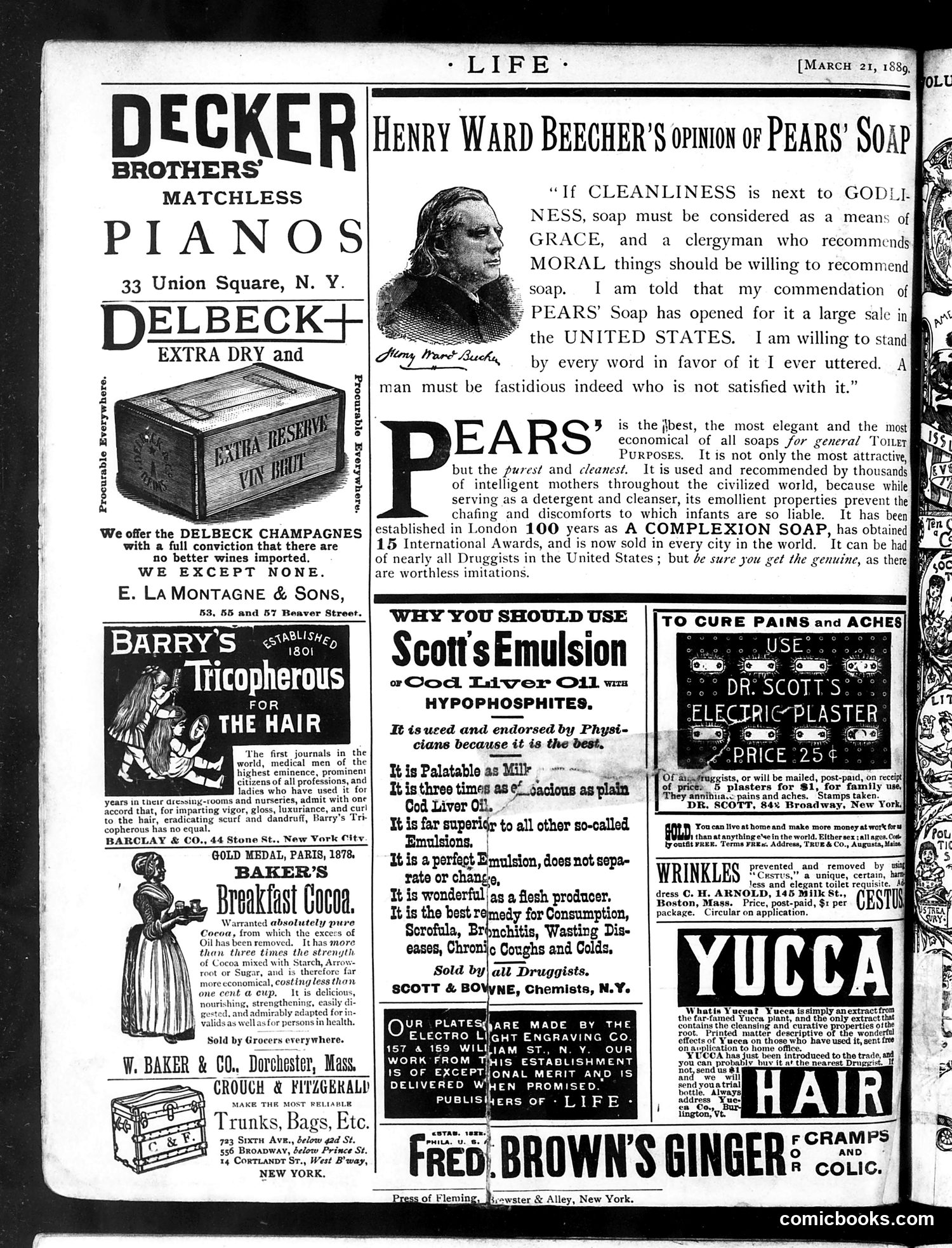
This is primarily an **advertising page** with minimal editorial content. The notable non-advertisement element is Henry Ward Beecher's endorsement of Pears' Soap. **The Beecher endorsement** is the page's main satirical point. Beecher was a famous Protestant clergyman whose moral authority was valued for product promotion. The quote—equating cleanliness with godliness and arguing that a moralist should recommend soap—is presented as genuine testimony. However, the placement among numerous other product ads (pianos, cocoa, hair treatments, trunks) suggests *Life* may be gently mocking celebrity endorsements and the commercialization of religious figures' moral authority. The page otherwise contains standard late-19th-century patent medicine and consumer goods advertisements, reflecting the magazine's business model. Without additional context, it's unclear whether *Life* intended satirical commentary on Beecher specifically or simply reproduced his popular endorsement.