
Life, 1889-03-21 · page 4 of 20
Life — March 21, 1889 — page 4: what you’re looking at
What you’re looking at
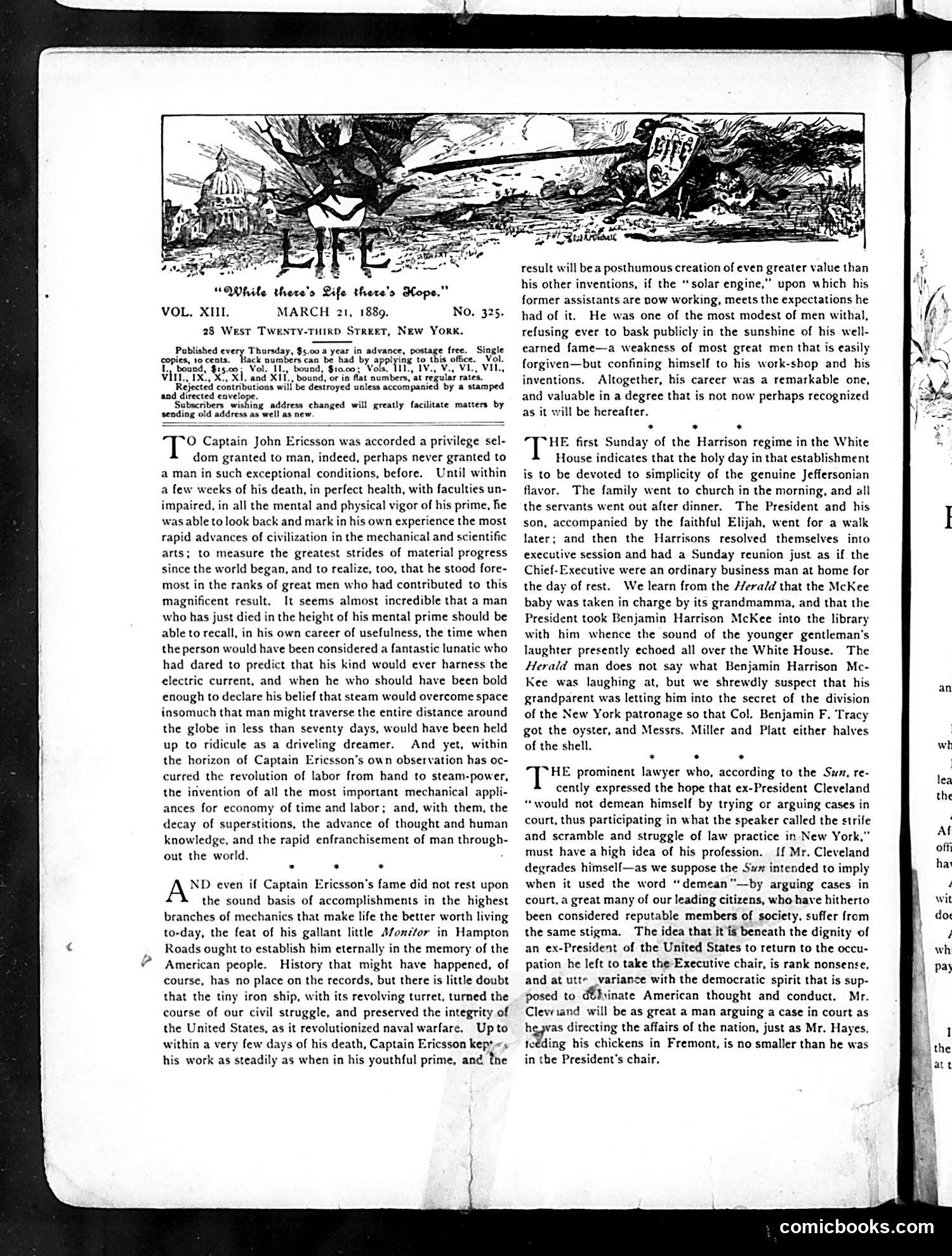
The masthead cartoon depicts a grim reaper figure labeled "LIFE" hovering over a desolate landscape with a distant dome (likely the Capitol). The caption reads "While there's Life there's Hope." The accompanying articles discuss Captain John Ericsson's death and praise his mechanical innovations. The text also satirizes President Benjamin Harrison's first Sunday at the White House, mocking the family's attempt at "genuine Jeffersonian flavor" and ridiculing young Benjamin McKee's antics in the library—suggesting the administration lacks dignity. A third piece criticizes ex-President Cleveland's potential legal involvement, questioning whether he should participate in court cases while maintaining presidential respectability. The overall tone blends obituary commemoration with satirical jabs at the current administration.
📄 Transcribed text from this page (OCR, searchable)
Machine-transcribed from the original scan — historical spelling and the odd misread are preserved.
B.S “While there's Life there's Hope.” VOL, XIII. MARCH 21, 1889, 28 West Twenty-1 NO, 325. kD STREET, New York. Poblished every Thursday, $3.00 a y advance, postage free, Single copies, 10 cents. Back numbers can be had by applying to this office, Vol. L., bound, $15.00; Vol. II., bound, $10.00; Vow. II., IV., V., VI. VIL, VIIT., 1X. X., XI. and XIT., bound, or in lat numbers, at regular rates. Rejected contributions will be destroyed unless accompanied by a stamped and directed envelope. Subscribers wishing address changed will greatly facilitate matters by old address as well as new sendii T°? Captain John Ericsson was accorded a privilege sel- dom granted to man, indeed, perhaps never granted to a man in such exceptional conditions, before. Until within a few weeks of his death, in perfect health, with faculties un- impaired, in all the mental and physical vigor of his prime, he was able to look back and mark in his own experience the most rapid advances of civilization in the mechanical and scientific arts; to measure the greatest strides of material progress since the world began, and to realize, too, that he stood fore- most in the ranks of great men who had contributed to this magnificent result. It seems almost incredible that a man who has just died in the height of his mental prime should be able to recall, in his own career of usefulness, the time when the person would have been considered a fantastic lunatic who had dared to predict that his kind would ever harness the electric current, and when he who should have been bold enough to declare his belief that steam would overcome space insomuch that man might traverse the entire distance around the globe in less than seventy days, would have been held up to ridicule as a driveling dreamer. And yet, within the horizon of Captain Ericsson’s own observation has oc- curred the revolution of labor from hand to steam-power, the invention of all the most important mechanical appli- ances for economy of time and labor; and, with them, the decay of superstitions, the advance of thought and human knowledge, and the rapid enfranchisement of man through- out the world. . . . ND even if Captain Ericsson's fame did not rest upon the sound basis of accomplishments in the highest branches of mechanics that make life the better worth living to-day, the feat of his gallant little Afonz/or in Hampton Roads ought to establish him eternally in the memory of the American people. History that might have happened, of course, has no place on the records, but there is little doubt that the tiny iron ship, with its revolving turret, turned the course of our civil struggle, and preserved the integrity of the United States, as it revolutionized naval warfare. Upto within a very few days of his death, Captain Ericsson kep? +s his work as steadily as when in his youthful prime, and the result will bea posthumous creation of even greater value than his other inventions, if the “solar engine,” upon which his former assistants are now working, meets the expectations he had of it. He was one of the most modest of men withal, refusing ever to bask publicly in the sunshine of his well- earned fame—a weakness of most great men that is easily forgiven—but confining himself to his work-shop and his inventions. Altogether, his career was a remarkable one, and valuable in a degree that is not now perhaps recognized as it will be hereafter. . . . THe first Sunday of the Harrison regime in the White House indicates that the holy day in that establishment is to be devoted to simplicity of the genuine Jeffersonian flavor. The family went to church in the morning, and all the servants went out after dinner. The President and his son, accompanied by the faithful Elijah, went for a walk later; and then the Harrisons resolved themselves into executive session and had a Sunday reunion just as if the Chief-Executive were an ordinary business man at home for the day of rest. We learn from the /Yera/d that the McKee baby was taken in charge by its grandmamma, and that the President took Benjamin Harrison McKee into the library with him whence the sound of the younger gentleman's laughter presently echoed all over the White House. The Herald man does not say what Benjamin Harrison Mc- Kee was laughing at, but we shrewdly suspect that his grandparent was letting him into the secret of the division of the New York patronage so that Col. Benjamin F. Tracy got the oyster, and Messrs. Miller and Platt either halves of the shell. . . . HE prominent lawyer who, according to the Sun, re- cently expressed the hope that ex-President Cleveland “would not demean himself by trying or arguing cases in court, thus participating in what the speaker called the strife and scramble and struggle of law practice in New York,” must have a high idea of his profession. If Mr. Cleveland degrades himself—as we suppose the Swz intended to imply when it used the word “demean"—by arguing cases in court, a great many of our leading citizens, who have hitherto been considered reputable members of society, suffer from the same stigma. The idea that it is beneath the dignity of an ex-President of the United States to return to the occu- pation he left to take the Executive chair, is rank nonsense, and at utte variance with the democratic spirit that is sup- posed to G€hyinate American thought and conduct. Mr. Cleveiand will be as great a man arguing a case in court as paras directing the affairs of the nation, just as Mr. Hayes, teéding his chickens in Fremont, is no smaller than he was in the President's chair. comicbooks.com