
Life, 1889-03-21 · page 6 of 20
Life — March 21, 1889 — page 6: what you’re looking at
What you’re looking at
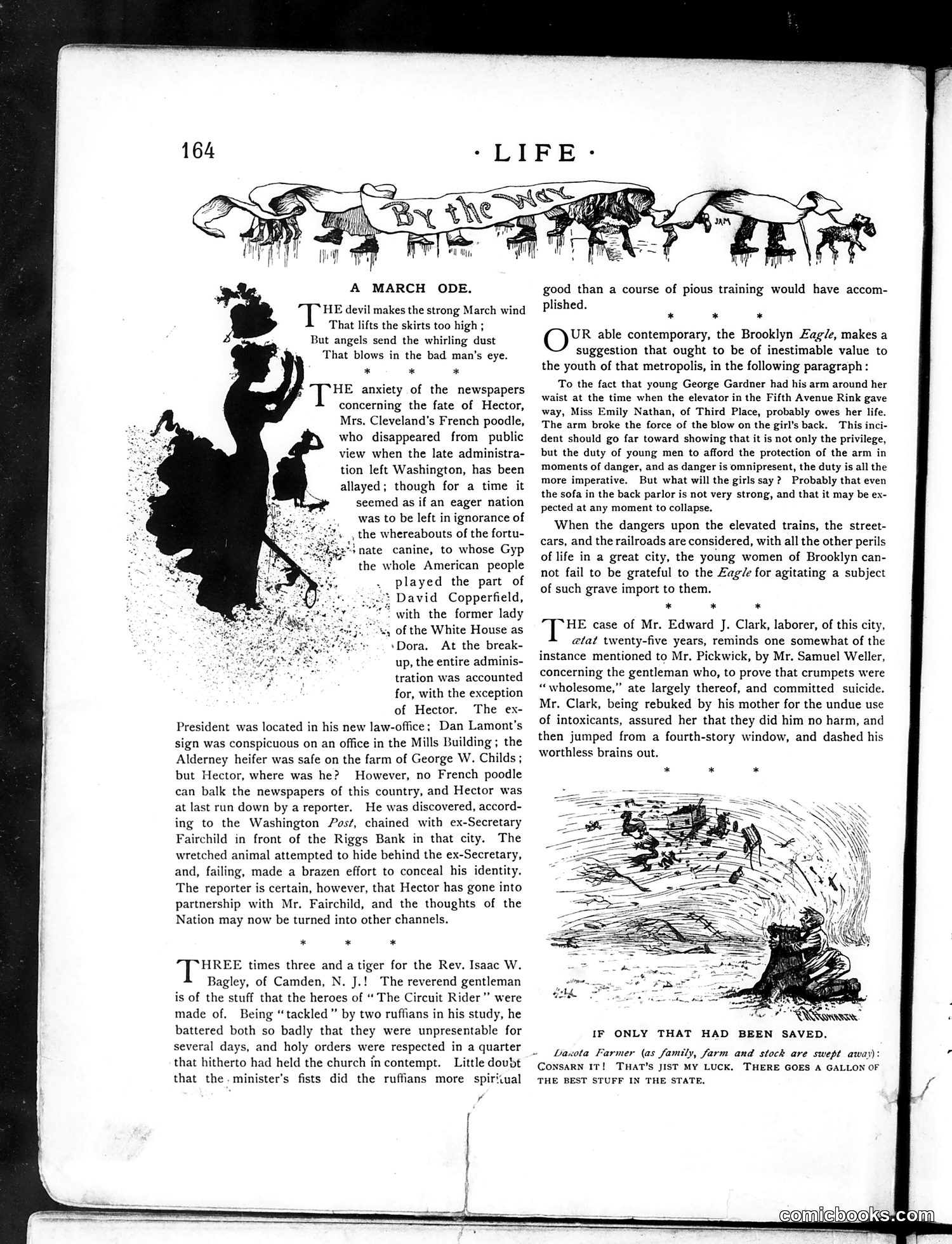
This page contains three satirical pieces critiquing American public figures and events: 1. **"A March Ode"** mocks newspaper anxiety over the fate of Hector (likely a French poodle), contrasting trivial concerns with serious political matters involving ex-Secretary Fairchild and other Washington officials. 2. **The Brooklyn Eagle anecdote** satirizes elevator safety dangers in modern cities, using a near-fatal incident involving a young woman to highlight urban industrial hazards. 3. **The Edward J. Clark case** ridicules a laborer's suicide attempt, apparently debunking claims about "wholesome" crumpets while commenting on desperation and social conditions. The tone throughout is caustic, targeting both sensationalist press coverage and broader social failures. Without clearer attribution, specific identities remain unclear, but the satire targets newspapers, urban dangers, and class-related tragedy.
📄 Transcribed text from this page (OCR, searchable)
Machine-transcribed from the original scan — historical spelling and the odd misread are preserved.
A MARCH ODE. HE devil makes the strong March wind That lifts the skirts too high ; But angels send the whirling dust That blows in the bad man’s eye. * * * “PoE anxiety of the newspapers concerning the fate of Hector, Mrs. Cleveland's French poodle, who disappeared from public view when the late administra- tion left Washington, has been allayed; though for a time it seemed as if an eager nation was to be left in ignorance of the whereabouts of the fortu- nate canine, to whose Gyp the whole American people . played the part of David Copperfield, - with the former lady -, of the White House as ‘Dora. At the break- up, the entire adminis- tration was accounted for, with the exception of Hector. The ex- President was located in his new law-office; Dan Lamont’s sign was conspicuous on an office in the Mills Building ; the Alderney heifer was safe on the farm of George W. Childs ; but Hector, where was he? However, no French poodle can balk the newspapers of this country, and Hector was at last run down by a reporter. He was discovered, accord- ing to the Washington Pos?, chained with ex-Secretary Fairchild in front of the Riggs Bank in that city. The wretched animal attempted to hide behind the ex-Secretary, and, failing, made a brazen effort to conceal his identity. The reporter is certain, however, that Hector has gone into partnership with Mr. Fairchild, and the thoughts of the Nation may now be turned into other channels. * * * HREE times three and a tiger for the Rev. Isaac W. Bagley, of Camden, N. J.! The reverend gentleman is of the stuff that the heroes of “ The Circuit Rider” were made of. Being “tackled” by two ruffians in his study, he battered both so badly that they were unpresentable for several days, and holy orders were respected in a quarter that hitherto had held the church in contempt. Little doubt that the. minister's fists did the ruffians more spir‘iual good than a course of pious training would have accom- plished. * * * UR able contemporary, the Brooklyn Zag/e, makes a suggestion that ought to be of inestimable value to the youth of that metropolis, in the following paragraph: To the fact that young George Gardner had his arm around her waist at the time when the elevator in the Fifth Avenue Rink gave way, Miss Emily Nathan, of Third Place, probably owes her life. The arm broke the force of the blow on the girl’s back. This inci- dent should go far toward showing that it is not only the privilege, but the duty of young men to afford the protection of the arm in moments of danger, and as danger is omnipresent, the duty is all the more imperative. But what will the girls say? Probably that even the sofa in the back parlor is not very strong, and that it may be ex- pected at any moment to collapse. When the dangers upon the elevated trains, the street- cars, and the railroads are considered, with all the other perils of life in a great city, the young women of Brooklyn can- not fail to be grateful to the Zag/e for agitating a subject of such grave import to them. * * * HE case of Mr. Edward J. Clark, laborer, of this city, @tat twenty-five years, reminds one somewhat of the instance mentioned to Mr. Pickwick, by Mr. Samuel Weller, concerning the gentleman who, to prove that crumpets were “wholesome,” ate largely thereof, and committed suicide. Mr. Clark, being rebuked by his mother for the undue use of intoxicants, assured her that they did him no harm, and then jumped from a fourth-story window, and dashed his worthless brains out. IF ONLY THAT HAD BEEN SAVED. ~ Laxota Farmer (as family, farm and stock are swept away): ConsaRn IT! THAT'S JIST MY LUCK, THERE GOES A GALLON OF THE BEST STUFF IN THE STATE.