
Life, 1889-03-21 · page 12 of 20
Life — March 21, 1889 — page 12: what you’re looking at
What you’re looking at
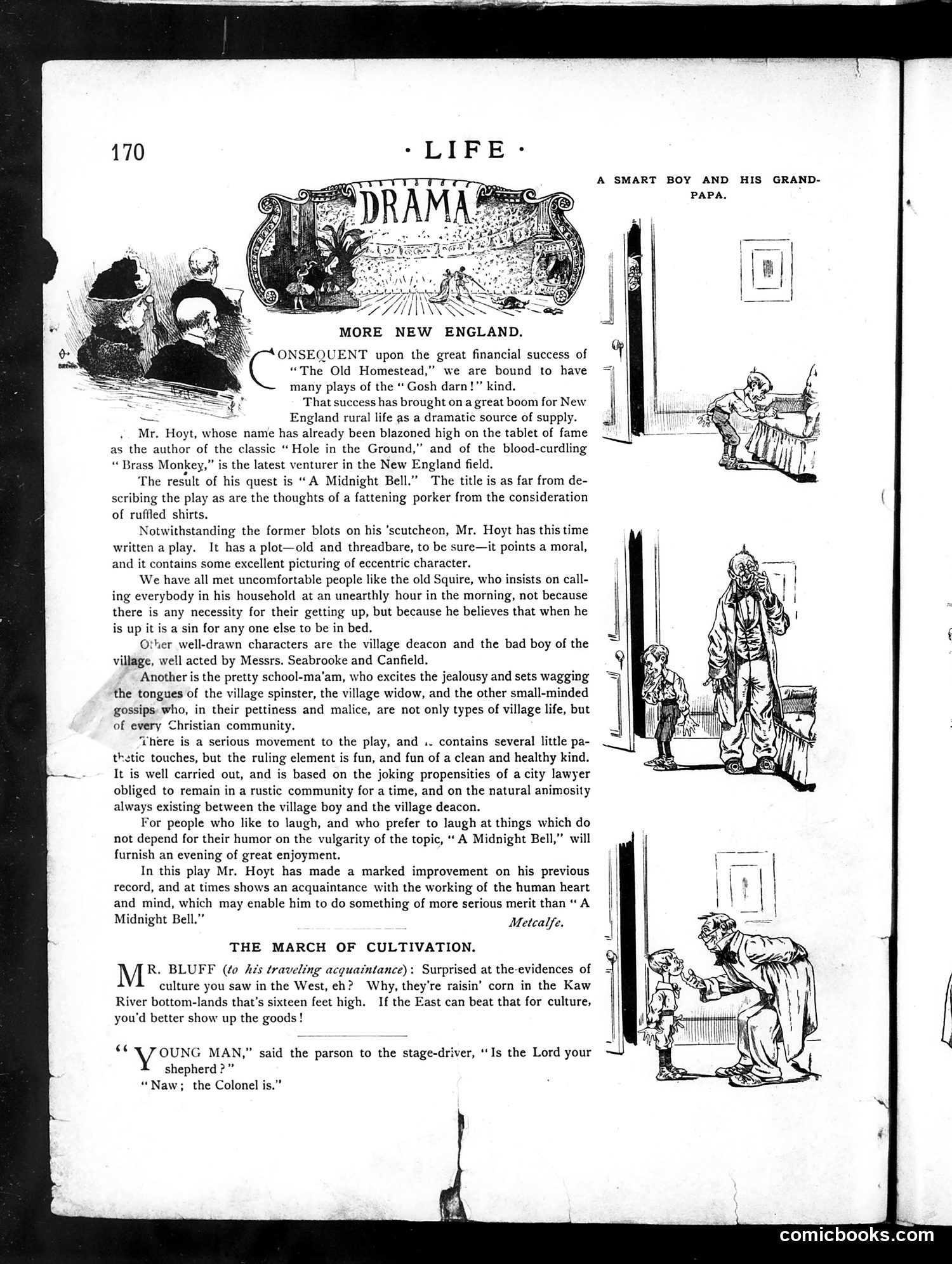
This page reviews theatrical productions, primarily Mr. Hoyt's play "A Midnight Bell," a New England rural comedy. The satire operates on multiple levels: **Main Review**: Hoyt had succeeded with "The Old Homestead," triggering a theatrical boom in rustic New England plays. Life notes the irony that despite Hoyt's previous mediocre work ("Hole in the Ground," "Brass Monkey"), "A Midnight Bell" actually succeeds—featuring stock characters like an obnoxious squire, village gossips, and a schoolteacher. The review praises it as wholesome humor for audiences preferring clean comedy over vulgar topics. **The Cartoons**: The illustrations on the right show domestic scenes with children and elderly figures, likely depicting scenarios from the play. **"The March of Cultivation"**: A brief satirical dialogue mocking Western "culture"—a man boasts that Kansas grows 16-foot-tall corn as proof of civilization, while another joke conflates a shepherd (religious figure) with "the Colonel" (secular authority), suggesting rural confusion of values. The overall tone gently mocks both rural life stereotypes and theater audiences' appetite for them.
📄 Transcribed text from this page (OCR, searchable)
Machine-transcribed from the original scan — historical spelling and the odd misread are preserved.
: ro VEZ | \\ RNB ek MORE NEW ENGLAND. ONSEQUENT upon the great financial success of “The Old Homestead,” we are bound to have many plays of the “Gosh darn!” kind. That success has brought on a great boom for New - England rural life as a dramatic source of supply. Mr. Hoyt, whose name has already been blazoned high on the tablet of fame as the author of the classic “ Hole in the Ground,” and of the blood-curdling “Brass Monkey,” is the latest venturer in the New England field. The result of his quest is “A Midnight Bell.” The title is as far from de- scribing the play as are the thoughts of a fattening porker from the consideration of ruffled shirts. Notwithstanding the former blots on his ’scutcheon, Mr. Hoyt has this time written a play. It has a plot—old and threadbare, to be sure—it points a moral, and it contains some excellent picturing of eccentric character. We have all met uncomfortable people like the old Squire, who insists on call- ing everybody in his household at an unearthly hour in the morning, not because there is any necessity for their getting up, but because he believes that when he is up it is a sin for any one else to be in bed. Other well-drawn characters are the village deacon and the bad boy of the village, well acted by Messrs. Seabrooke and Canfield. Another is the pretty school-ma’am, who excites the jealousy and sets wagging the tongues of the village spinster, the village widow, and the other small-minded gossips who, in their pettiness and malice, are not only types of village life, but of every Christian community. ‘There is a serious movement to the play, and .. contains several little pa- thetic touches, but the ruling element is fun, and fun of a clean and healthy kind. It is well carried out, and is based on the joking propensities of a city lawyer obliged to remain in a rustic community for a time, and on the natural animosity always existing between the village boy and the village deacon. For people who like to laugh, and who prefer to laugh at things which do not depend for their humor on the vulgarity of the topic, ‘A Midnight Bell,” will furnish an evening of great enjoyment. In this play Mr. Hoyt has made a marked improvement on his previous record, and at times shows an acquaintance with the working of the human heart and mind, which may enable him to do something of more serious merit than “ A Midnight Bell.” Metcalfe. THE MARCH OF CULTIVATION. R. BLUFF (¢o hés traveling acquaintance): Surprised at the-evidences of culture you saw in the West, eh? Why, they’re raisin’ corn in the Kaw River bottom-lands that’s sixteen feet high. If the East can beat that for culture, you'd better show up the goods! Oe OUNG MAN,” said the parson to the stage-driver, ‘Is the Lord your shepherd ?” “Naw; the Colonel is.” A SMART BOY AND HIS GRAND- PAPA. comicbooks.com