
A complete issue · 20 pages · 1889
Life — March 14, 1889
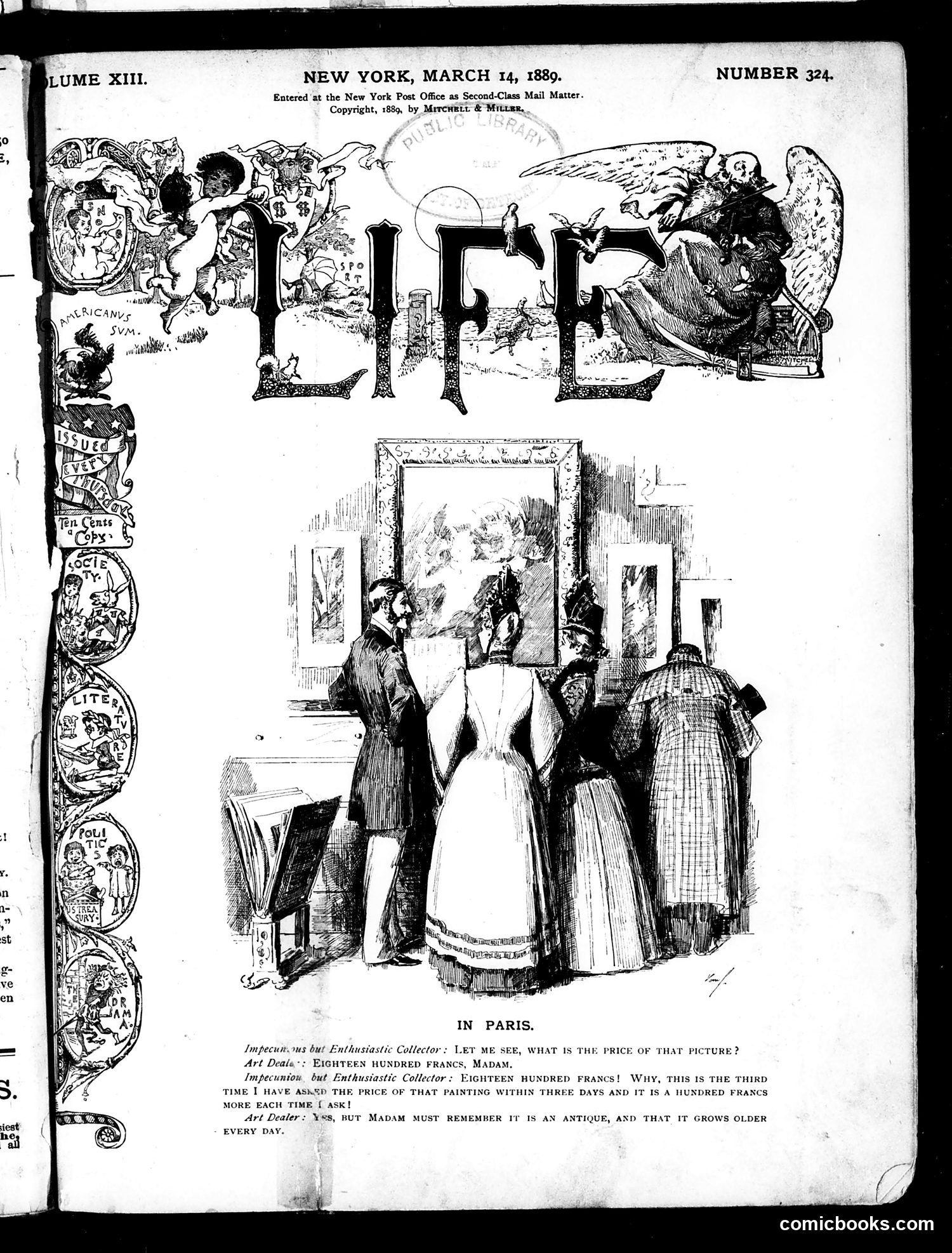
This cartoon satirizes the art market's absurdity. An "Enthusiastic Collector" negotiates with an "Art Dealer" over a painting's price. The collector notes the price has risen from 800 to 1,800 francs in just three days—a tripling in value. The dealer's response captures the satire: the painting's worth increases simply because it's now "antique" and "grows older every day." The joke mocks wealthy collectors' illogical reasoning about art valuation. Rather than basing value on artistic merit or craftsmanship, the dealer suggests mere age automatically creates value. This reflects late 19th-century concerns about speculative art markets and nouveau riche collectors willing to pay inflated prices based on artificial scarcity rather than genuine appreciation.
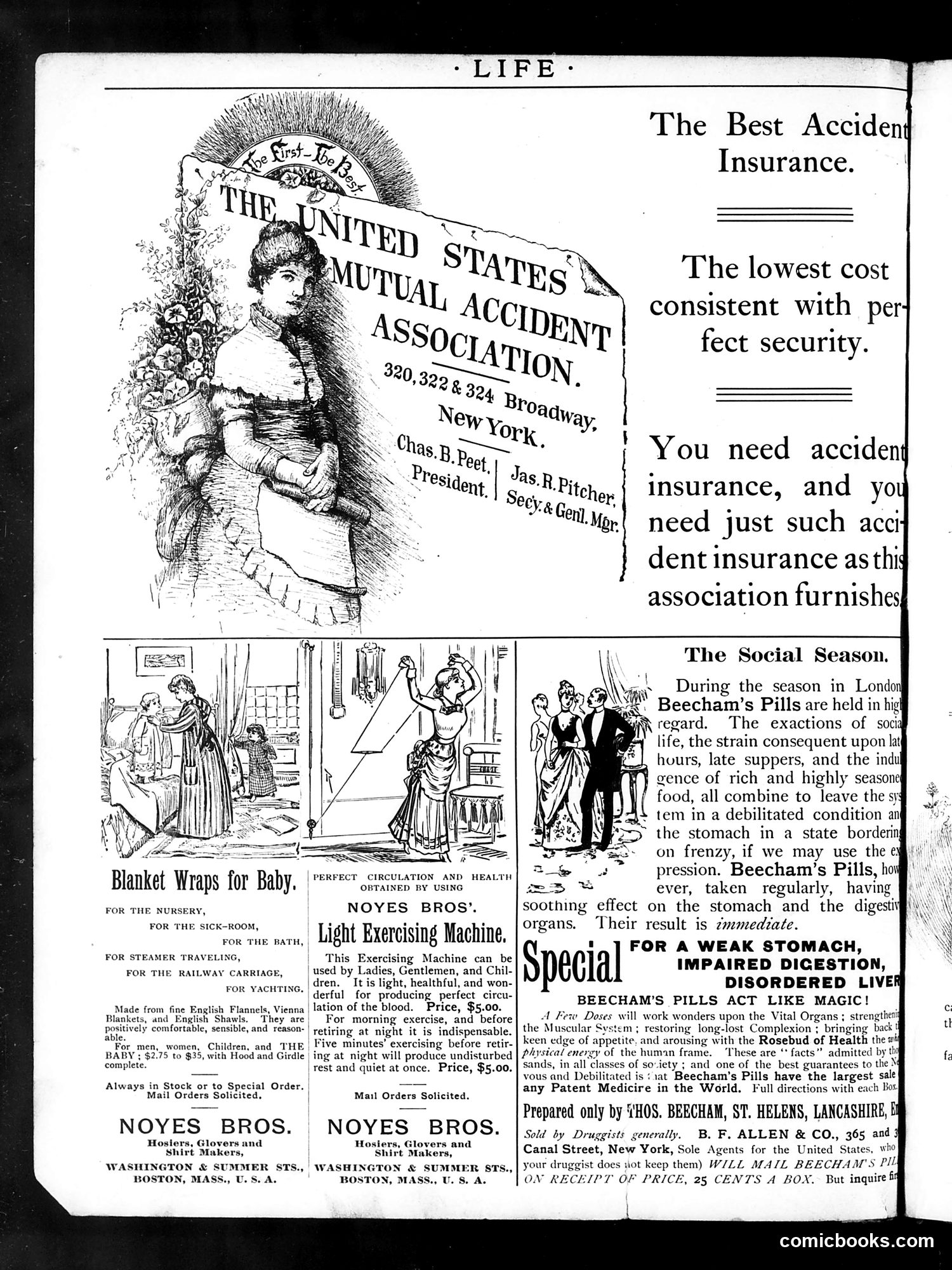
This page is primarily **advertising rather than satirical content**. The main elements are commercial ads: 1. **United States Mutual Accident Association** (top left): Features an illustrated woman promoting accident insurance, emphasizing low cost and security. 2. **Noyes Bros.' Blanket Wraps and Light Exercising Machine** (bottom left): Advertises domestic products for babies, invalids, and travelers. 3. **Beecham's Pills** (right side): A large patent medicine advertisement claiming the pills treat digestive issues and weak stomachs, promising "immediate" results. The ad includes testimonial-style copy suggesting the pills are essential for London's social season. The page reflects late 19th/early 20th-century advertising practices, combining illustrated vignettes with health claims now considered dubious.
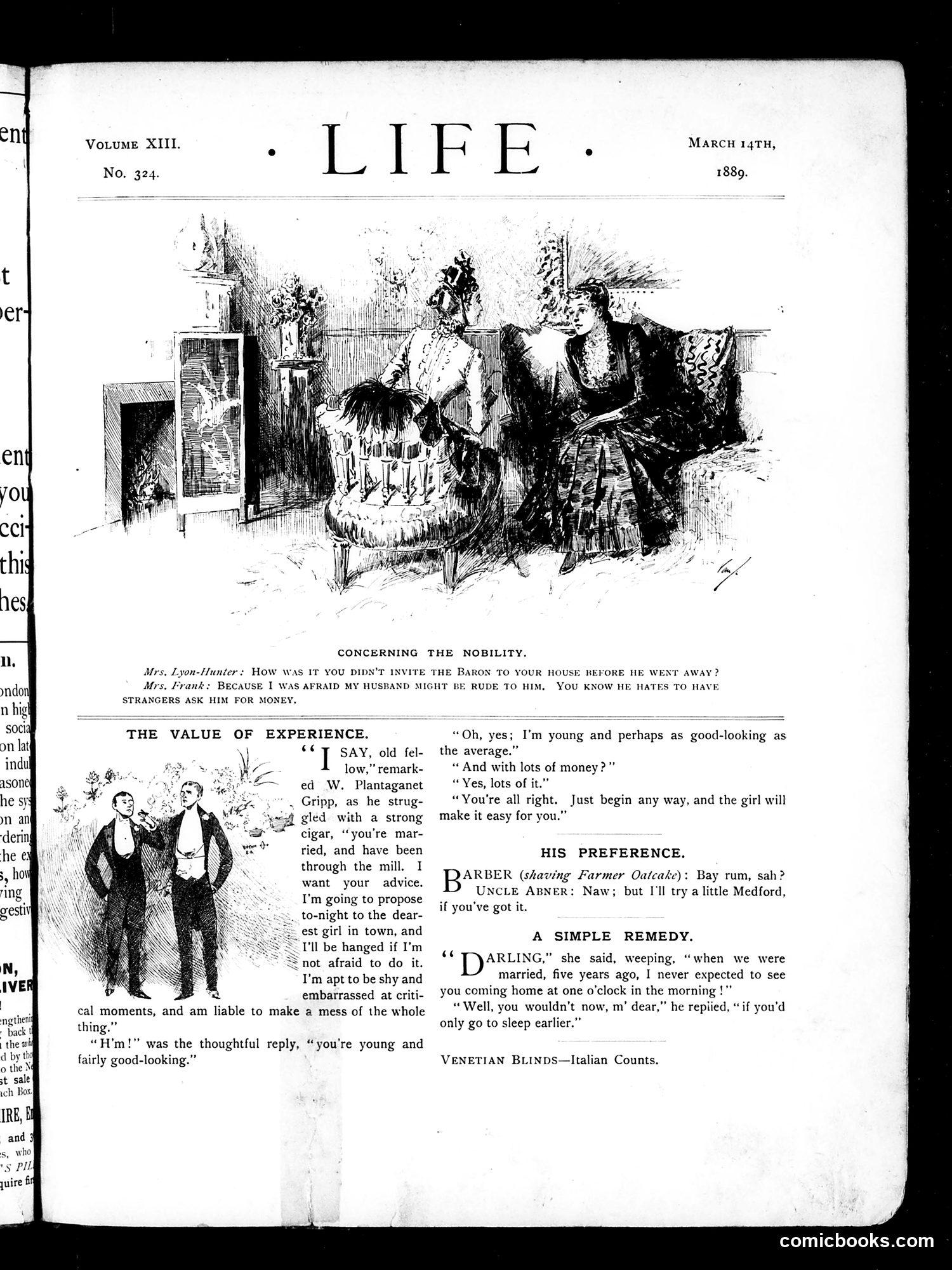
**The main illustration** depicts three fashionable women in an interior setting, accompanying a joke titled "CONCERNING THE NOBILITY." The humor concerns social snobbery: Mrs. Lyon-Hunter asks Mrs. Frank why she didn't invite the Baron before he left, and Mrs. Frank responds that she feared her husband would be rude to him because "You know he hates to have strangers ask him for money." This satirizes the pretentiousness of wealthy Americans who courted European nobility while being reluctant to provide financial support—mocking both the social climbing of the era and the assumption that foreigners expected American hospitality to include loans. The page's other brief comic items—"The Value of Experience," "His Preference," and "A Simple Remedy"—appear to be unrelated social humor typical of Life's format.
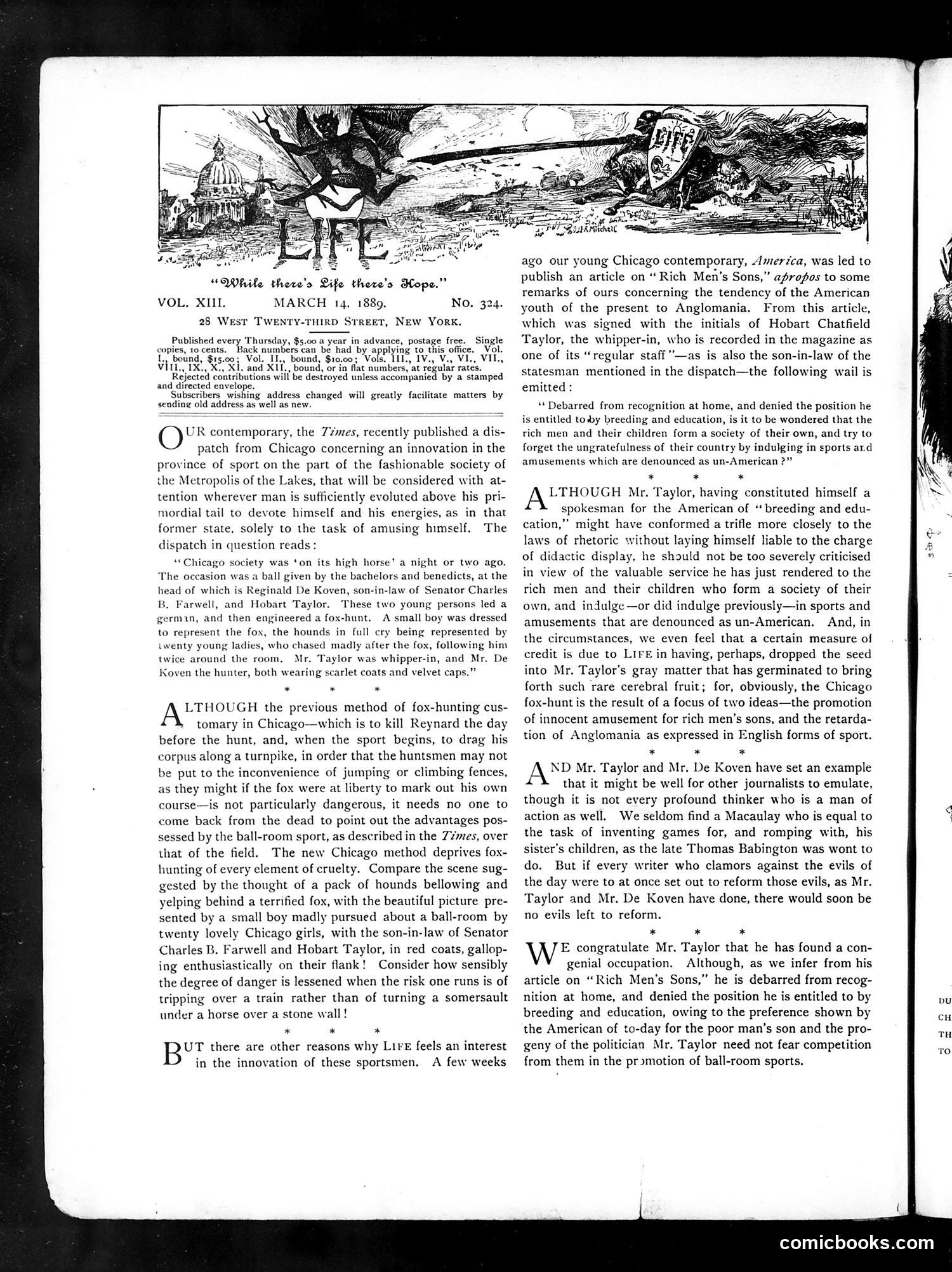
The masthead cartoon depicts "Life" as a classical female figure surveying a landscape, symbolizing the magazine's role as social commentator. The article discusses Chicago sportsmen—specifically Reginald de Koven and Hobart Taylor—who've innovated fox-hunting methods. The satire critiques their leisure pursuits: rather than traditional pre-hunt preparation, they've developed a method involving dragging a fox corpse along a turnpike so huntsmen needn't worry about fences or property damage. Life mocks this as removing "cruelty" while missing the point—it's still fundamentally cruel. The deeper satire targets wealthy men indulging in aristocratic pastimes while presenting themselves as reformers. The article suggests their innovations reveal their true priorities: convenience over ethics, and maintaining appearances of respectability while engaging in morally questionable amusements.
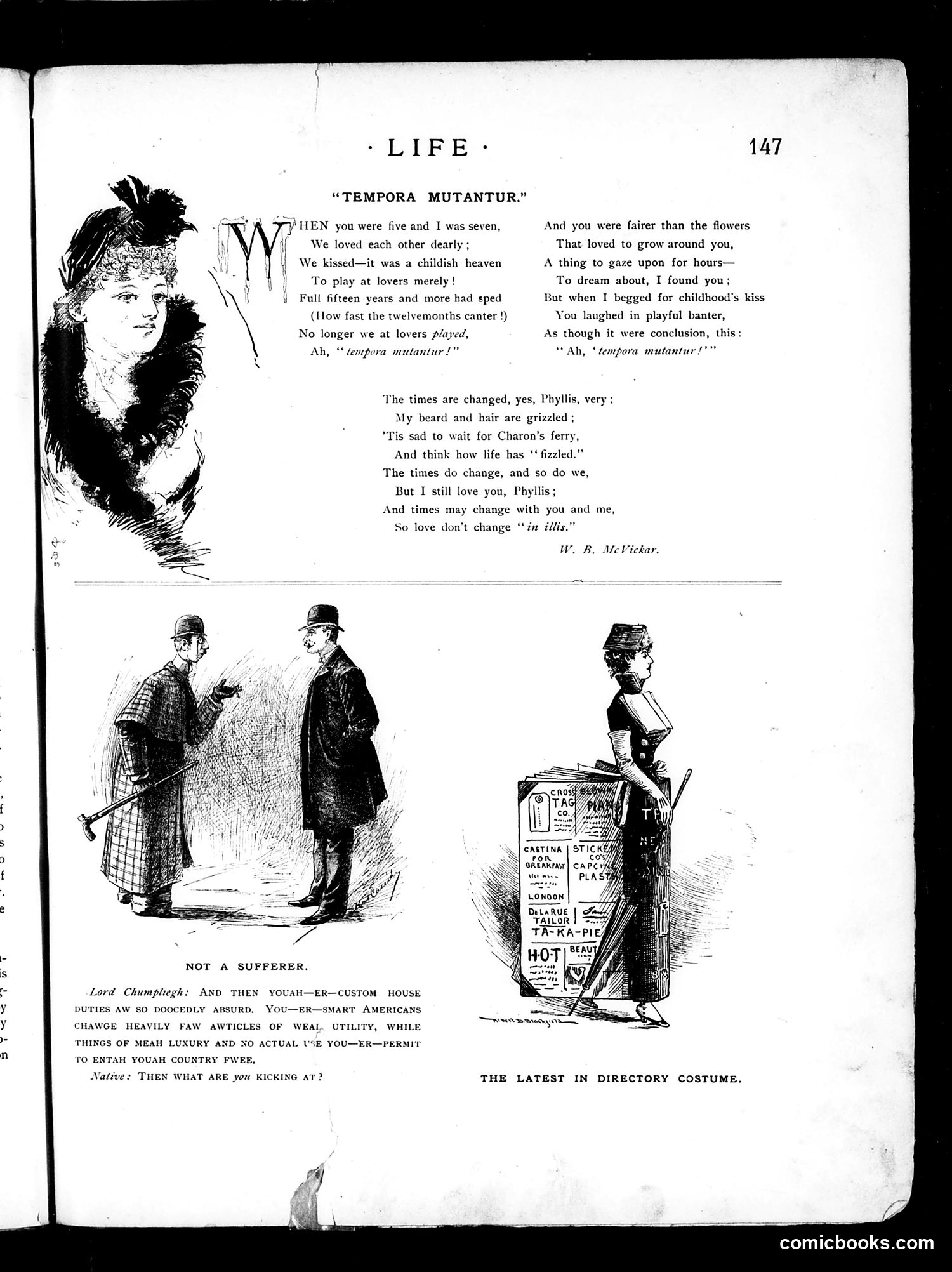
The page contains three distinct elements: 1. **"Tempora Mutantur"** - A romantic poem by W.B. McVickar addressed to "Phyllis," nostalgically contrasting youthful love with aging ("My beard and hair are grizzled"). The accompanying portrait shows a young woman in fashionable dress. 2. **"Not a Sufferer"** - A dialogue between two men (one in plaid, one in dark coat) mocking American customs duties. A Lord Champlain complains that Americans impose heavy tariffs on luxury goods while allowing practical items to enter freely. The "Native" responds sarcastically, questioning his complaint. 3. **"The Latest in Directory Costume"** - A cartoon showing a woman laden with advertising boxes and stickers, satirizing how directory advertisements have become so ubiquitous they resemble actual clothing or costume.
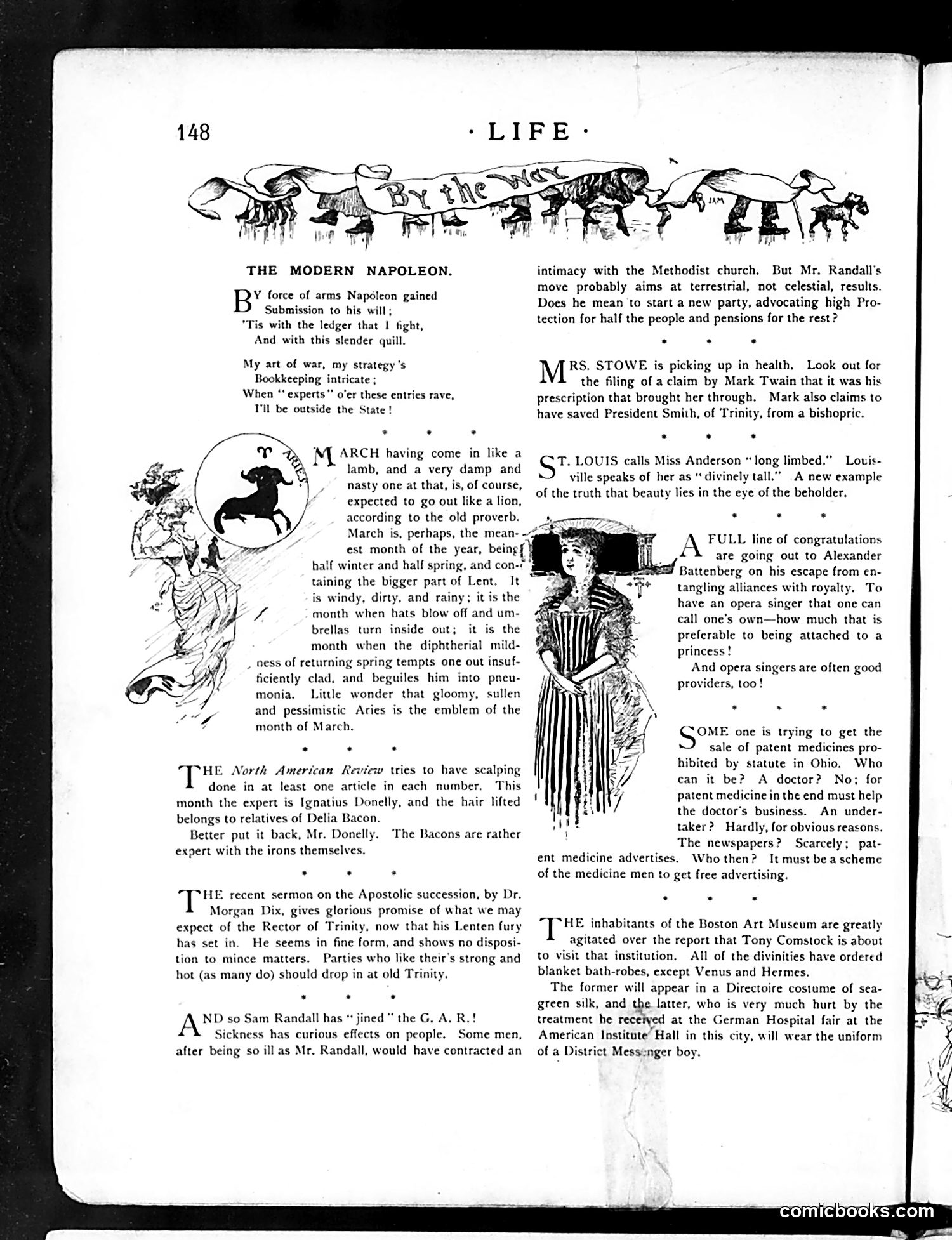
The page contains a section titled "The Modern Napoleon" with a satirical poem about someone (likely a political figure) who gained power through military force. The accompanying illustration shows a caricatured figure on a reclining chair or couch, possibly depicting this leader in a grandiose or compromised position. The remainder of the page consists of brief social commentary items typical of Life's satirical format, covering topics like weather (March), church politics, celebrity gossip (mentioning Mrs. Stowe and Miss Anderson), and administrative matters regarding patent medicines and the Boston Art Museum. The specific political figure referenced in "The Modern Napoleon" is unclear from context alone, though the military power-grab reference suggests commentary on contemporary political ambitions or leadership style.
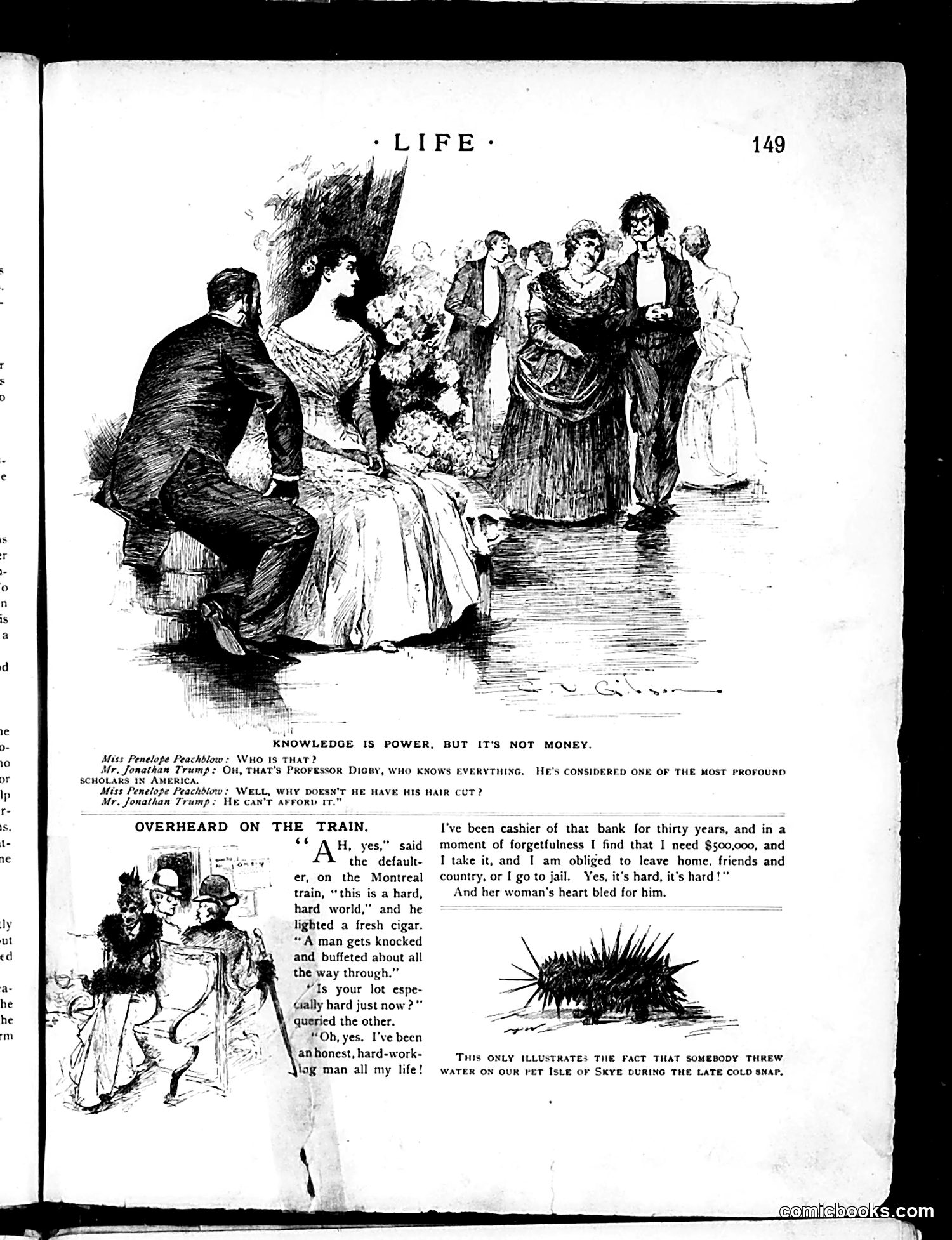
**Top Cartoon**: A satirical dialogue about Professor Diorby, presented as someone with vast knowledge but no money. The joke plays on the phrase "Knowledge is Power, But It's Not Money"—mocking the impracticality of intellectual expertise without financial resources. The well-dressed gentleman appears to be inquiring why such a learned man cannot afford a haircut, to which the response is essentially "he's broke." **"Overheard on the Train"**: A anecdote about a bank cashier facing financial desperation—needing $500 immediately or facing jail or exile to the country. This illustrates early 20th-century economic hardship and the precarious position of working-class professionals. **Bottom illustration**: An unrelated humorous note about water being thrown on Isle of Skye during cold weather.
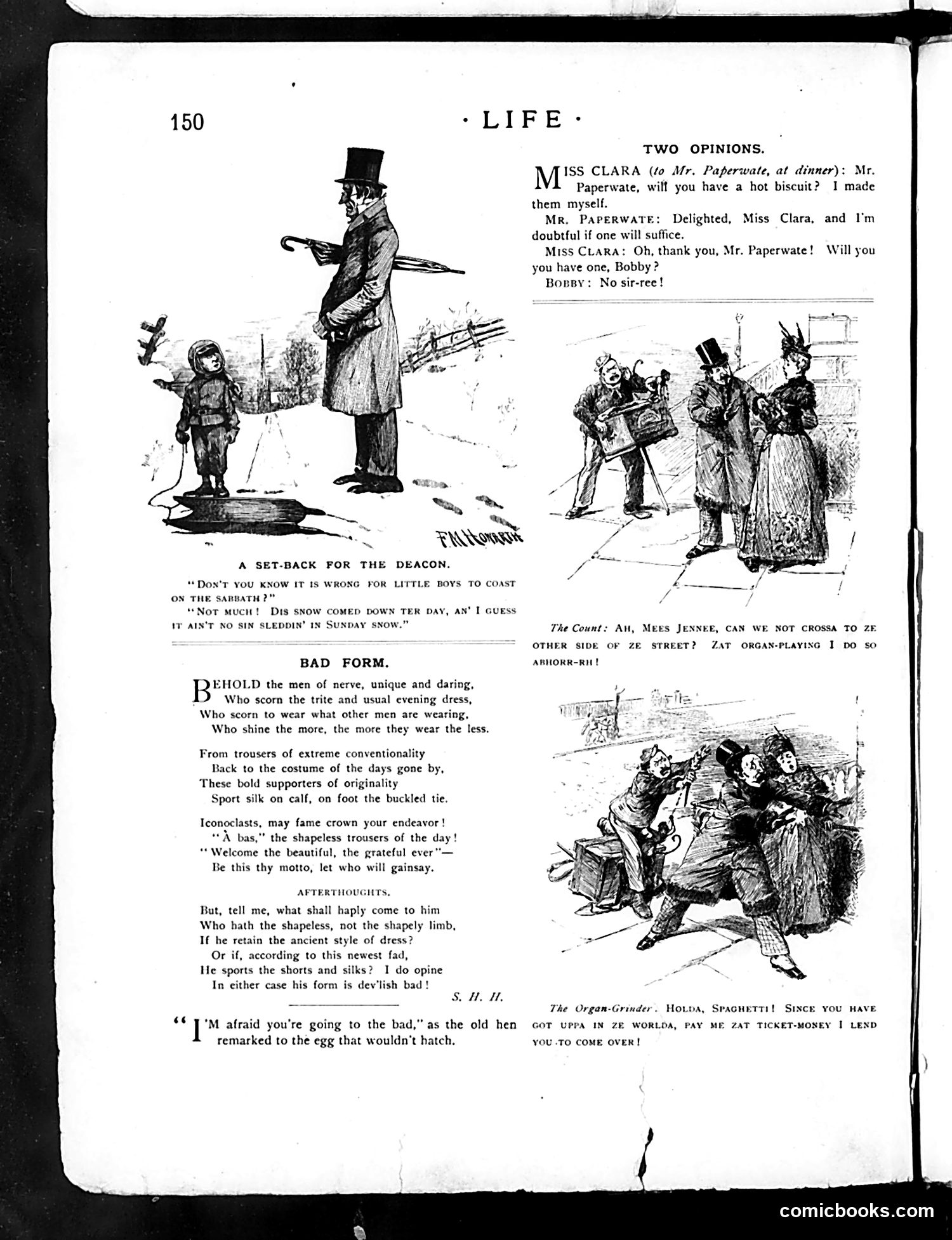
This page contains three distinct satirical pieces: **"Two Opinions"** (top): A dinner conversation between Miss Clara and Mr. Paperwate about hot biscuits, with young Bobby declining. The humor appears gentle domestic comedy rather than political. **"A Set-Back for the Deacon"** (left): A child asks an adult about whether it's "wrong for little boys to coast on the Sabbath," claiming snow prevents proper sledding on Sunday. This satirizes Victorian religious strictness about weekend observance. **"Bad Form"** (center): A poem mocking men who reject formal evening dress in favor of unconventional trousers. It ridicules those claiming originality through fashion nonconformity, suggesting their "shapeless" attire is actually in poor taste. The remaining sketches appear to be social humor about street encounters and organ-grinders, typical of the magazine's gentle satirical style.
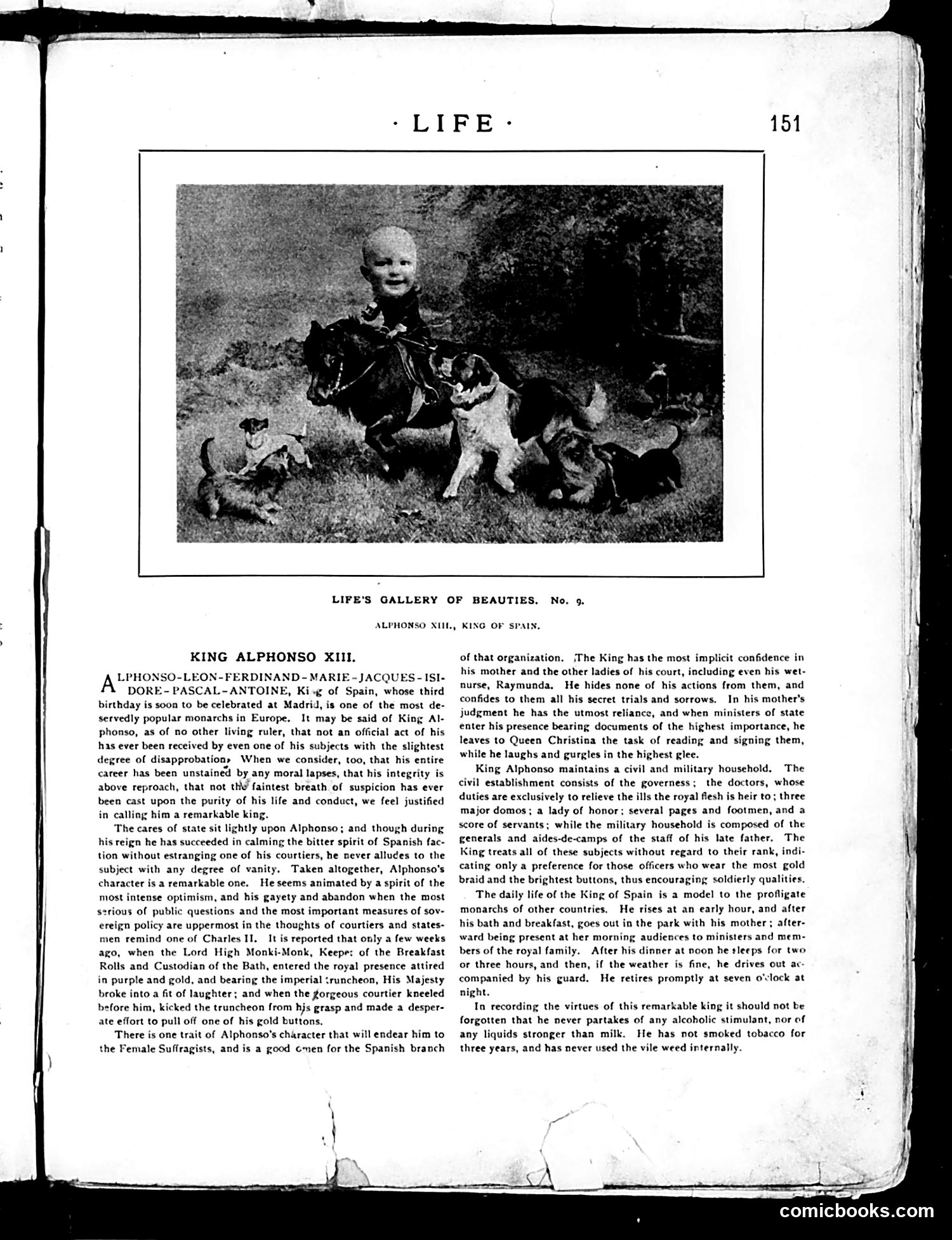
This page from *Life* magazine (page 151) features a photograph titled "Life's Gallery of Beauties, No. 9" depicting King Alfonso XIII of Spain as a young child, surrounded by several dogs while seated outdoors in formal attire. The accompanying article praises Alfonso as a remarkably virtuous monarch, emphasizing his moral character, temperance (never drinking alcohol or smoking), close relationship with his mother Queen Christina, and his meticulous attention to state duties. The piece presents him as an exemplary European royal—a model of propriety and dedication to governance. This appears to be straightforward monarchical flattery rather than satire, celebrating the Spanish king's reported virtues and character during his reign.
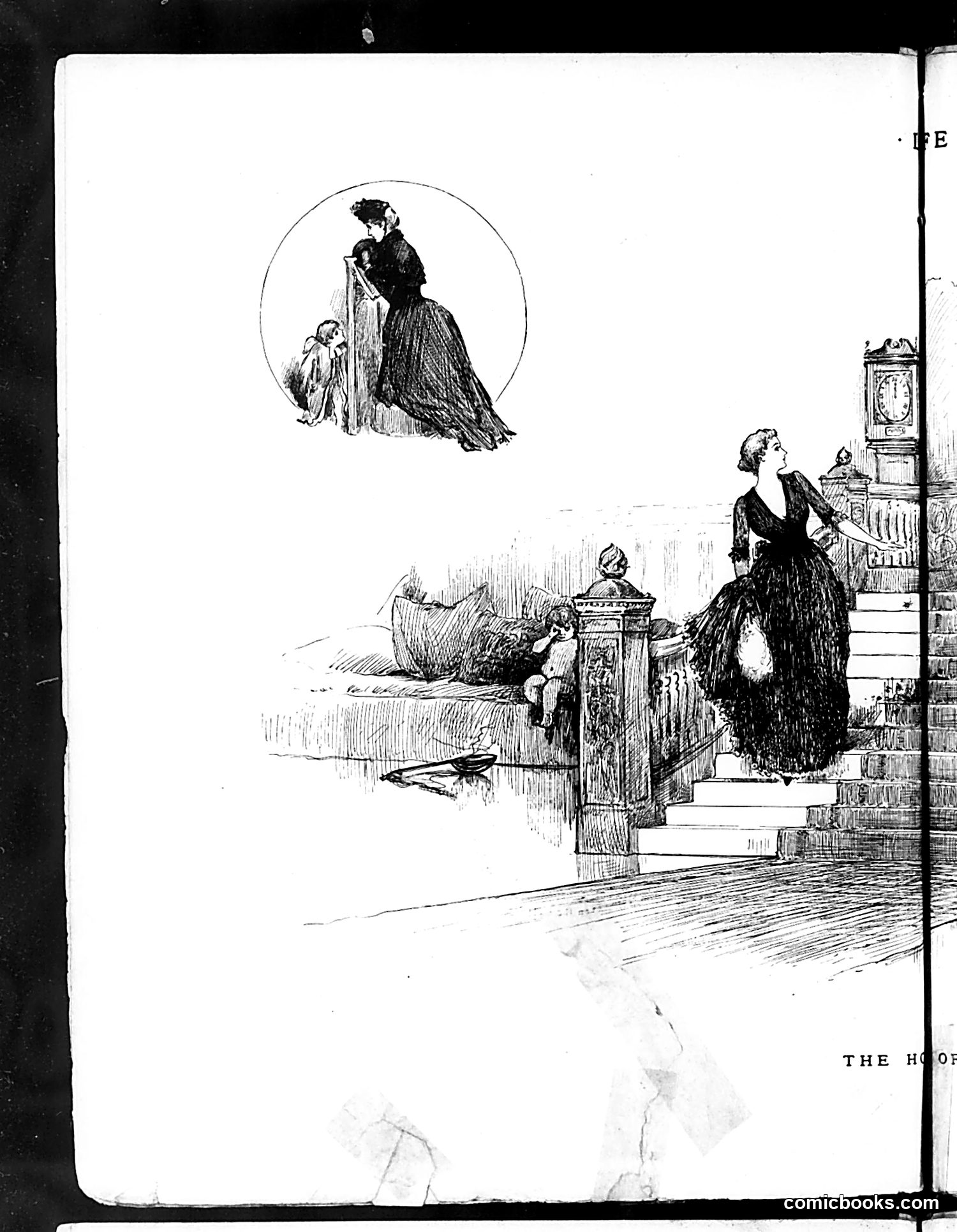
This page appears to be from an early *Life* magazine issue and shows a domestic scene with social commentary. The illustration depicts a woman on a porch or veranda watching children play near a decorative gate or fence post, with a clock visible on the building. A circular vignette at top shows an adult and child, possibly representing an idealized or contrasting domestic moment. The partial text "THE HO" (likely "THE HOME") at bottom suggests this addresses domestic or family life themes. Without the complete OCR text and publication date, the specific satirical point remains unclear—though the juxtaposition of figures and the formal composition suggest commentary on class, parenting, or domestic expectations typical of *Life*'s social satire.
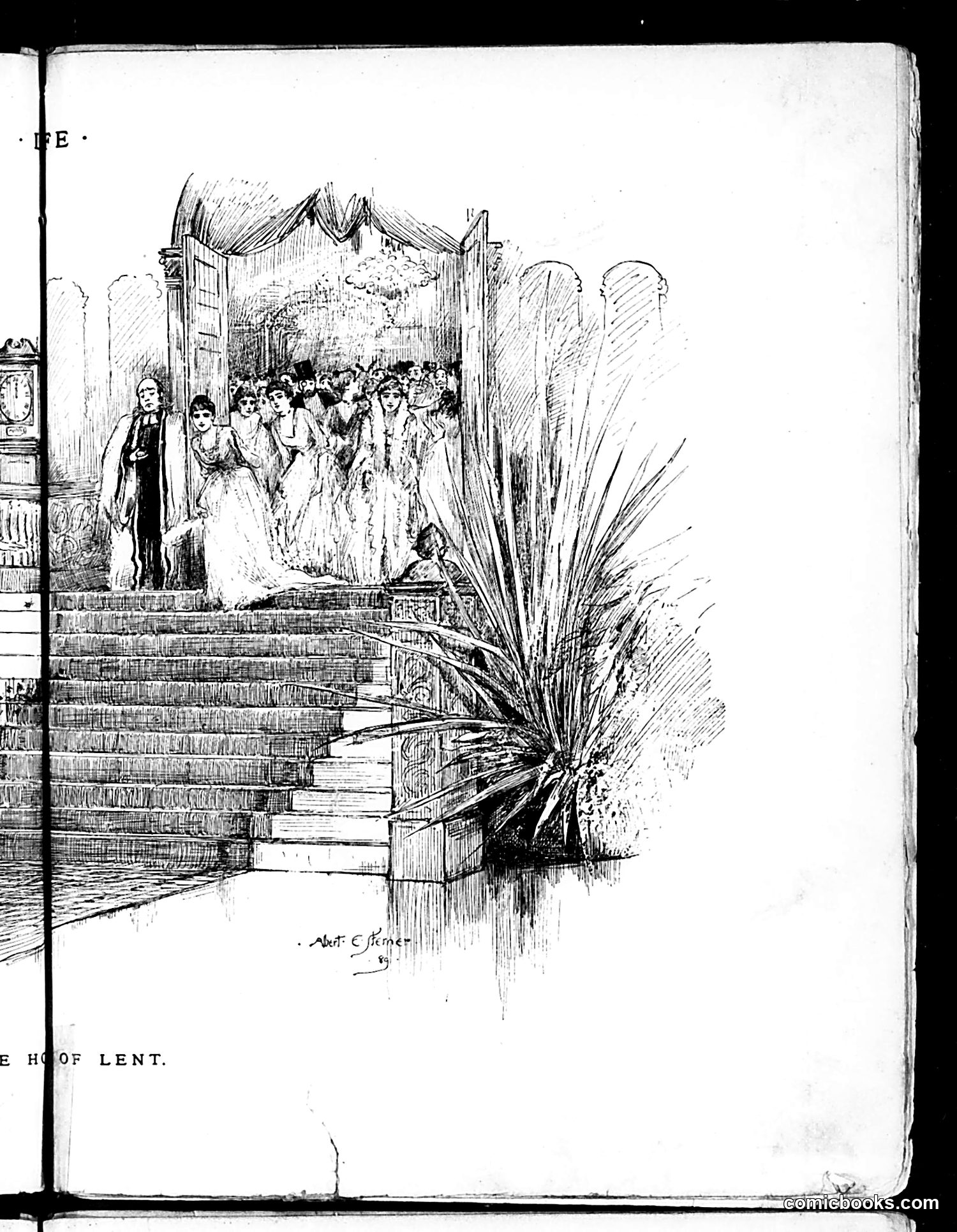
This is an illustration signed by Adolf Schmer depicting a formal social scene, likely from a satirical piece titled "The Hoof Lent" (visible at bottom). The drawing shows well-dressed women in elaborate Edwardian-era gowns ascending grand steps toward an ornate doorway, while a man in formal dress stands to the left. A potted plant with dramatic spiky leaves sits prominently in the foreground. The satirical point appears to concern high society's pretensions or social rituals, though the specific target remains unclear without additional context. The title's phrasing suggests wordplay or a pun. The artist's careful attention to the women's fashionable dress and the scene's theatrical staging suggests commentary on upper-class display and formality, typical of *Life* magazine's social satire from this era.
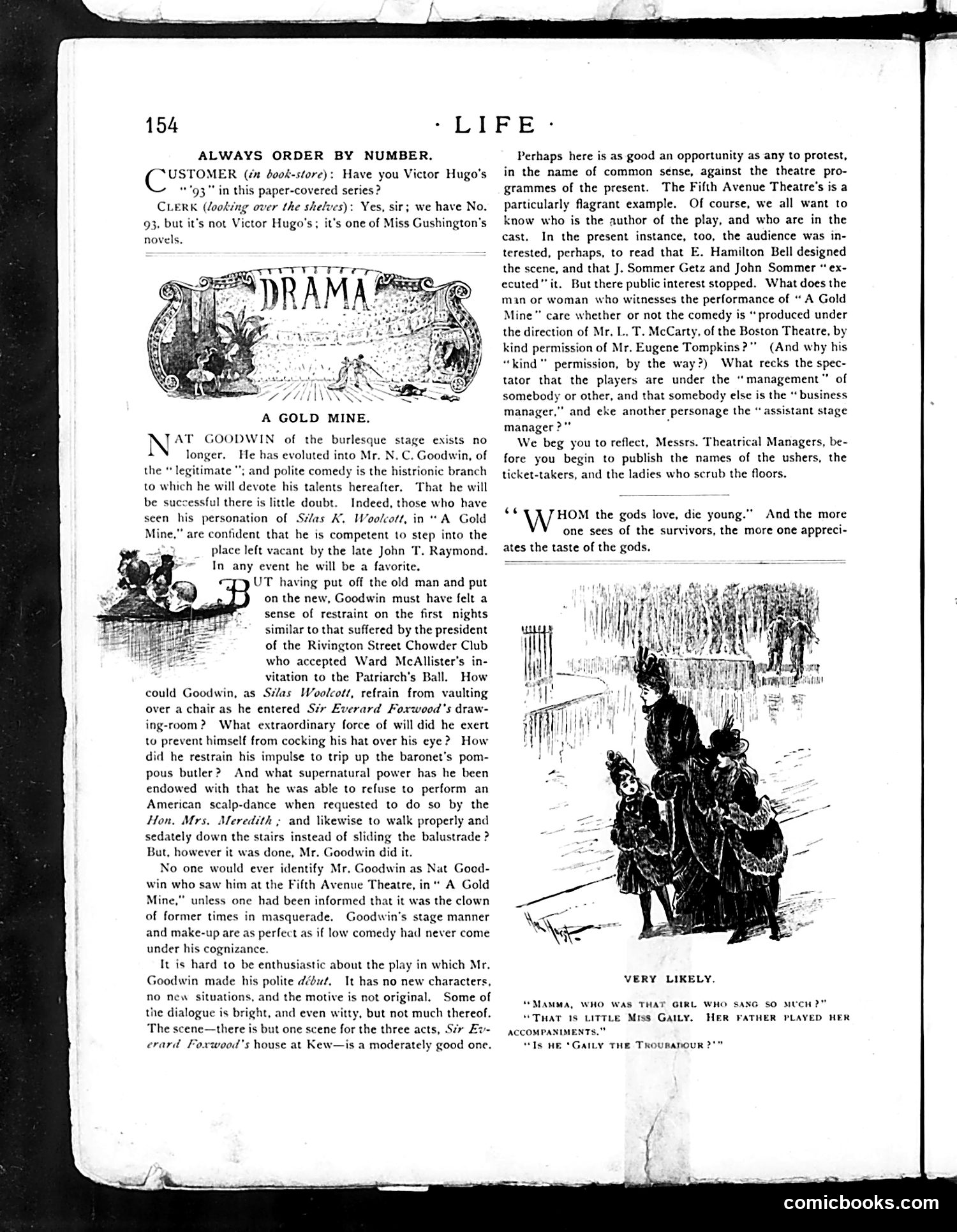
This *Life* magazine page contains two satirical pieces about theatre: **"Always Order by Number"** is a brief joke about a bookstore customer confusing a cheap paper-covered novel series with Victor Hugo's "93"—the clerk reveals the customer is actually looking at "Miss Gushington's novels," mocking mass-produced, low-quality fiction sold by catalog number. **"A Gold Mine"** discusses actor Nat Goodwin's transition from burlesque (lowbrow comedy with physical slapstick) to "legitimate" theatre (serious drama). The satire praises Goodwin for successfully restraining his old comedic habits—he resists vaulting over chairs, cocking his hat, and performing a "scalp-dance"—demonstrating genuine acting discipline. However, the piece critiques the play itself as unoriginal and unimportant, and launches into a broader complaint about theatre programs listing excessive credits (stage managers, ushers, cleaners) that audiences don't care about—a proto-critique of bloated production bureaucracy.
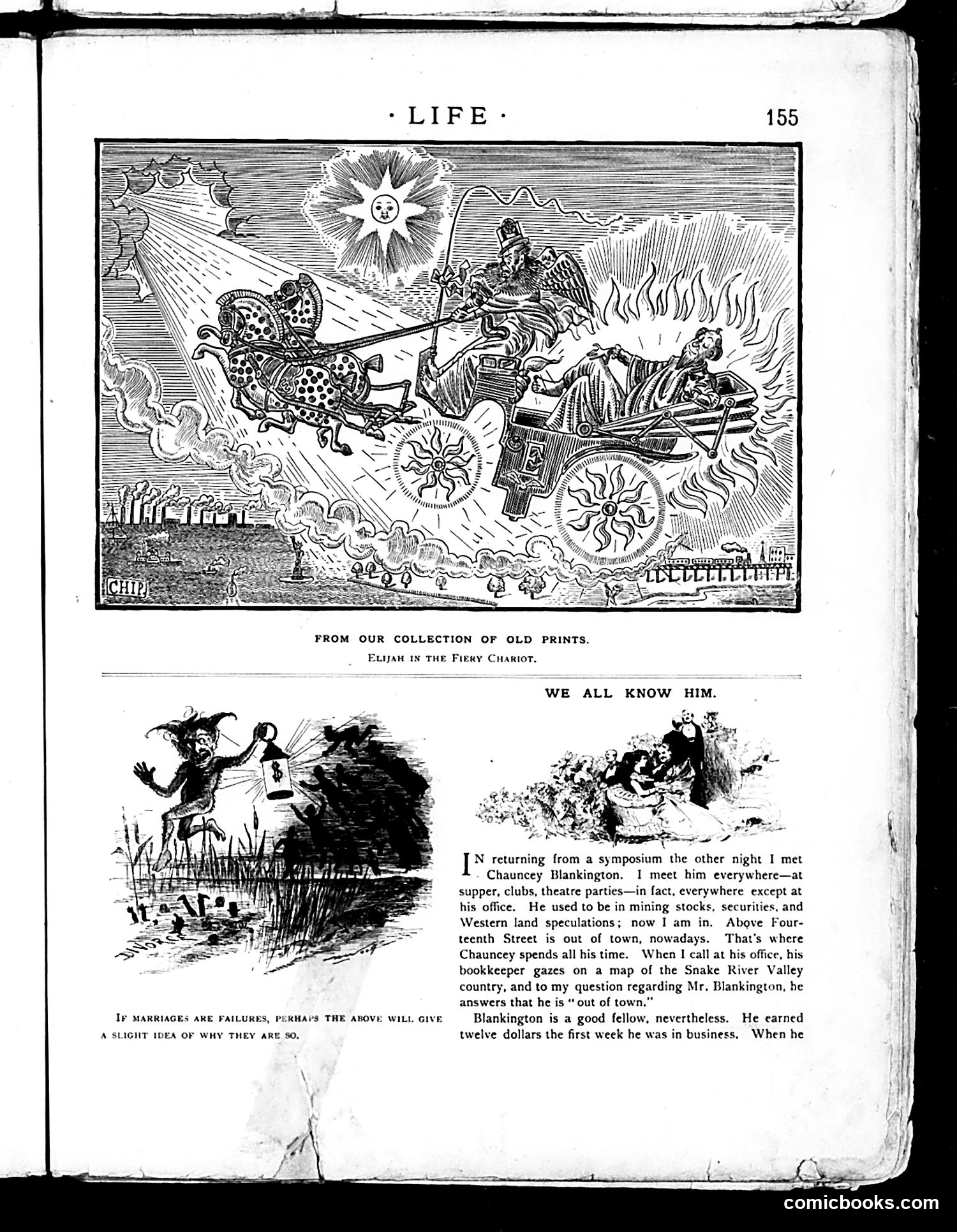
The page contains two distinct satirical pieces: **Top: "Elijah in the Fiery Chariot"** — A woodcut-style religious engraving showing Elijah's biblical ascension. The caption below suggests a crude joke equating divine transportation with marital discord: "If marriages are failures, perhaps the above will give a slight idea of why they are so" — implying husbands might wish for miraculous escape from their wives. **Bottom: "We All Know Him"** — A sketch and article about Chauncey Blankington, a wealthy speculator who dabbles in mining stocks and Western land speculation. The satire targets his perpetual absence from his office and his pretense of always being "out of town" on business above Fourteenth Street (uptown), while actually frequenting social venues (supper clubs, theater parties). The joke mocks how such men claim constant business activity while avoiding their actual offices and professional responsibilities. Both pieces satirize contemporary upper-class male behavior—either marital avoidance or business pretense.
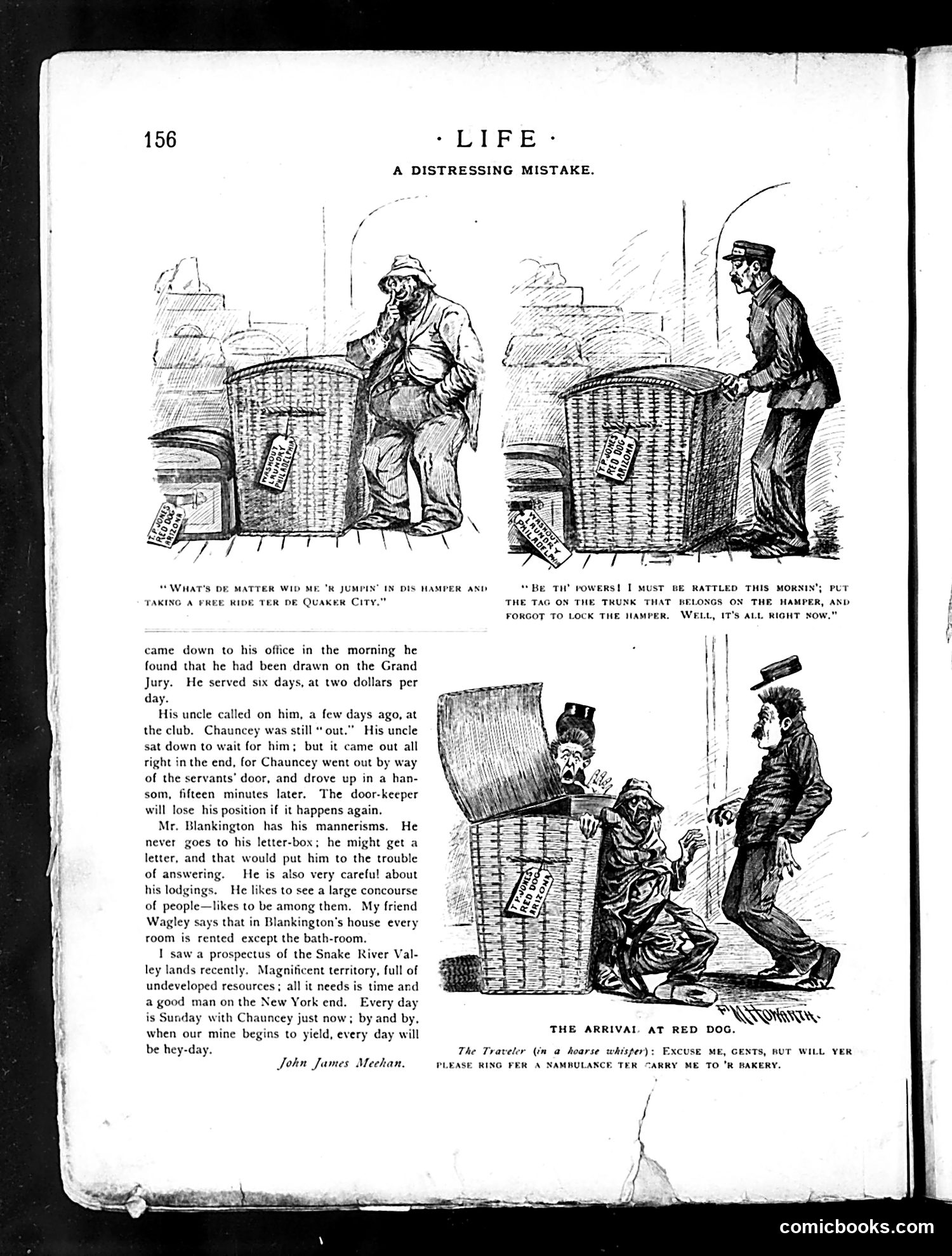
This page contains two separate satirical pieces mocking urban pretension and incompetence. **Top cartoon**: Shows a hobo mistakenly climbing into a wealthy man's travel hamper, thinking it's transportation to Philadelphia ("Quaker City"). The joke turns on class confusion—the hobo's dialect ("'R jumpin'") contrasts with the upper-class luggage he's entered. **Bottom cartoon & text**: Satirizes "Chauncey Blankington," a wealthy idler who avoids civic duty (escaping Grand Jury service via servants' door), never reads mail to avoid obligations, and rents his home rooms except the bathroom. The accompanying story mocks his lifestyle of leisure and a dubious investment scheme in "Snake River Valley lands"—likely referencing real speculative ventures that defrauded investors. **Bottom cartoon**: Shows a traveler arriving at "Red Dog" (a rough mining camp) requesting an ambulance to reach a bakery—absurdly fancy language in a frontier setting, mocking pretension. The satire targets wealthy idleness, investment fraud, and class-based avoidance of responsibility.
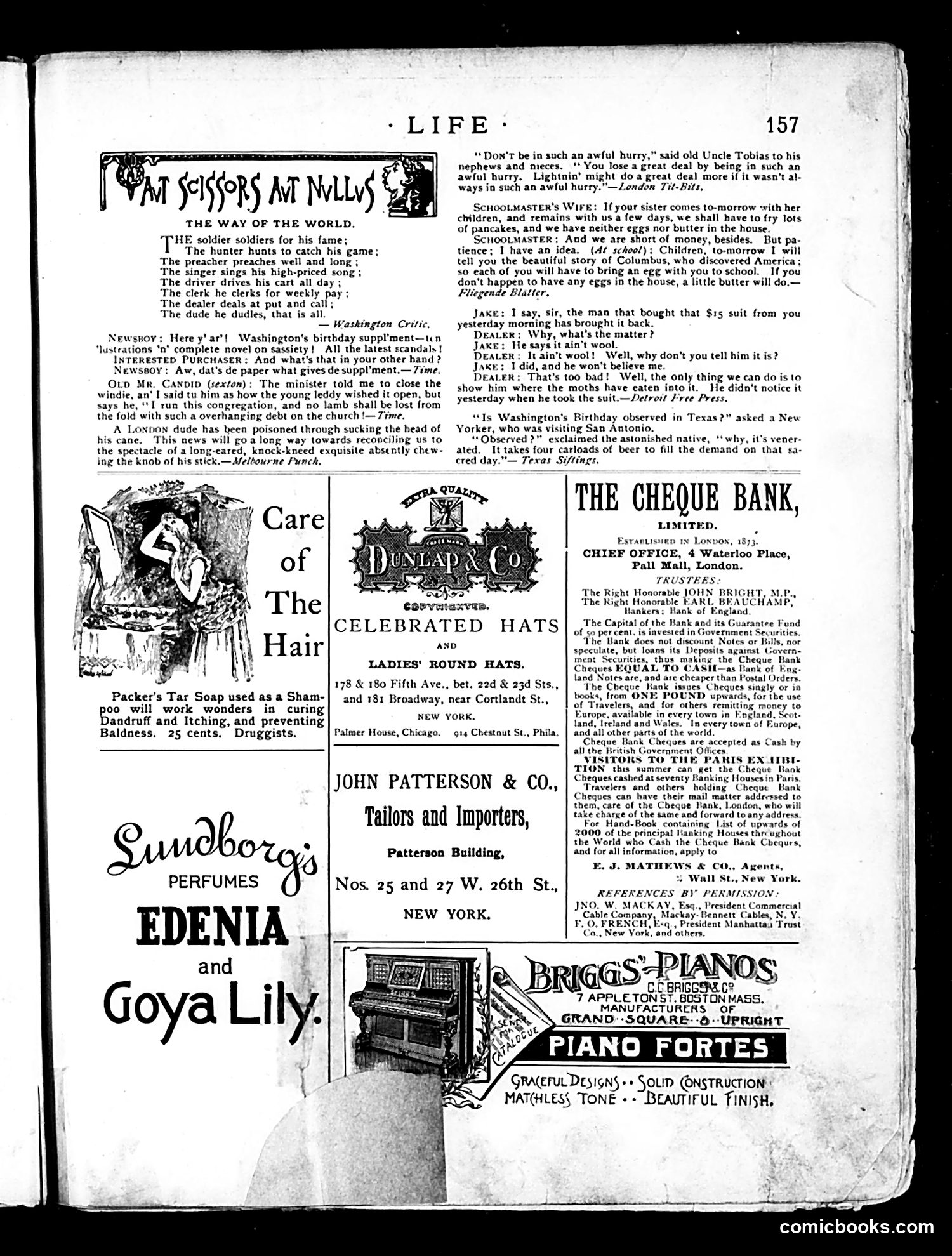
This page is primarily **advertising** interspersed with short humorous anecdotes. The satirical content consists of brief jokes and observations rather than political cartoons. The humor targets everyday absurdities: a newsboy hawking scandal sheets, a penny-pinching sexton prioritizing church finances over congregant comfort, and a London dandy poisoned by his own affectation (cane-chewing). A recurring theme mocks commercial dishonesty—a schoolmaster's scheme to trick parents into sending eggs by assigning Columbus essays, and a suit merchant suggesting moths in fabric are evidence of authenticity. One joke satirizes regional pride: when asked about Washington's Birthday observance in Texas, a local boasts it's "venerated"—evidenced by consuming four carloads of beer, implying Texas's reverence is more alcoholic excess than genuine patriotism. The page otherwise consists of period advertisements for hats, pianos, perfumes, tailoring, and banking services typical of late-19th-century American magazines.
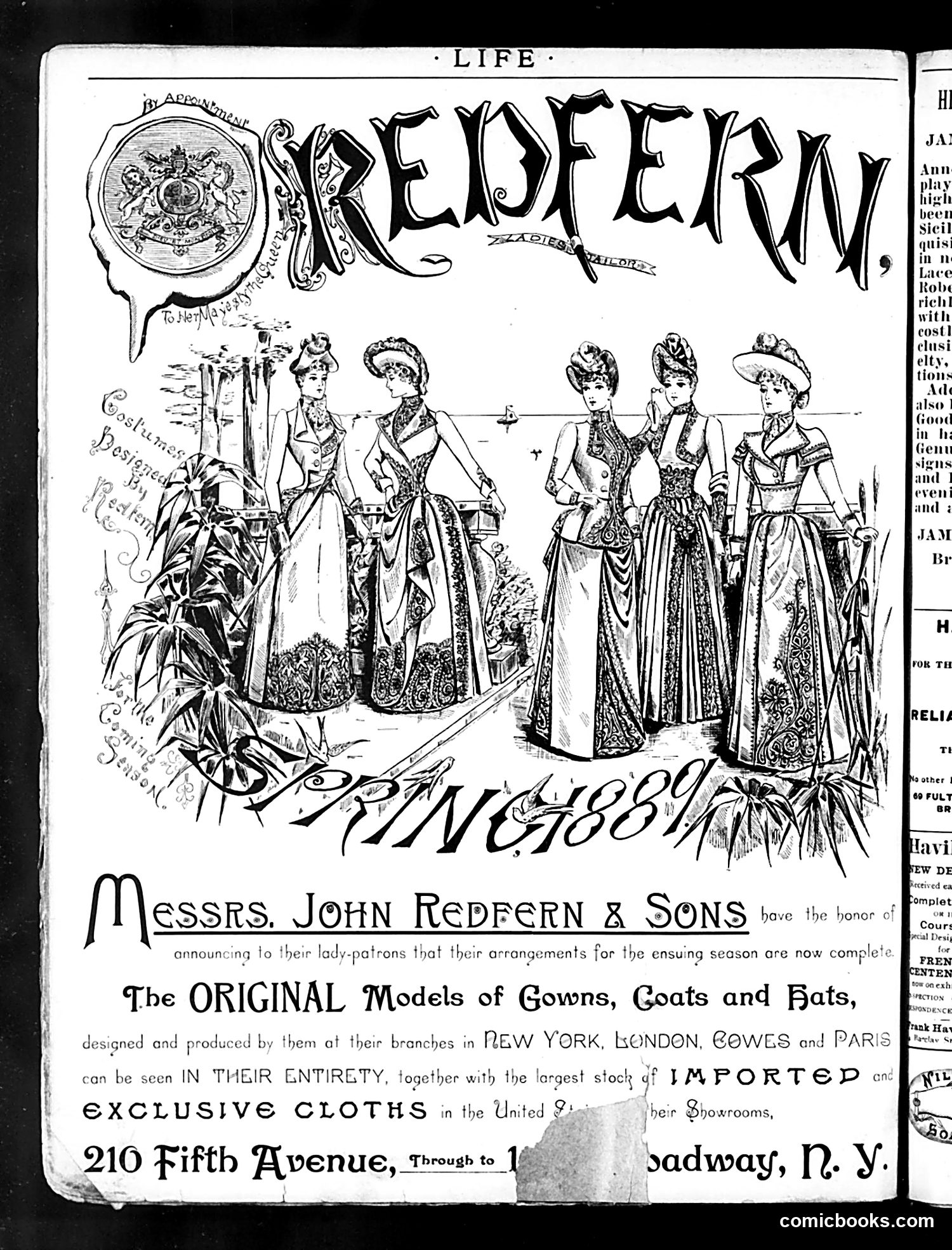
This page is primarily a **fashion advertisement**, not a political cartoon. It announces John Redfern & Sons, a high-end clothing manufacturer with branches in New York, London, Cowes, and Paris. The illustration depicts **six fashionably dressed women in 1889 clothing**—the "original models" of gowns, coats, and hats the company produced. The elaborate Victorian-era dresses, decorative hats, and refined styling showcase the luxury goods Redfern offered to wealthy female patrons. The ornate masthead reading "Redfern" and the date "1889" establish this as a seasonal announcement for the upcoming fashion season. The satirical magazine *Life* likely ran such ads to mock both high society's fashion obsessions and the extravagant spending habits of the wealthy elite—a common target of the publication's humor. This reflects no specific political content, but rather social satire about class and consumerism.
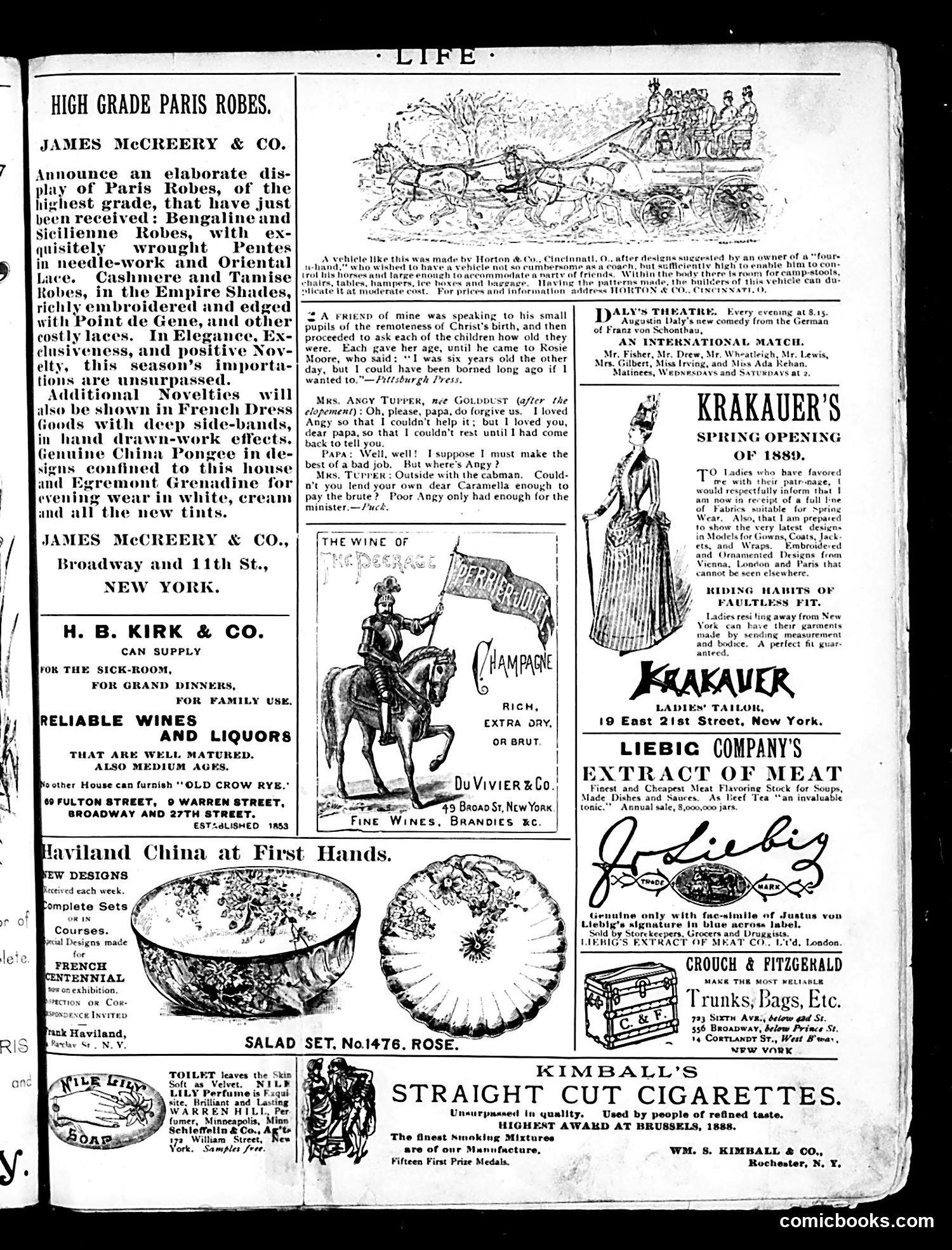
This page is primarily **advertising** for high-end merchants (Paris fashions, wines, cigars, furniture, tailoring) common to 1880s Life magazine's affluent readership. The only clear **satirical content** appears in two brief anecdotes: 1. A child's logical response about her birth age (suggesting precocious reasoning) 2. An elopement story where a young wife returns to her father seeking money to pay the cab driver home—the humor depends on the absurdity that she had enough funds for a secret marriage ceremony but not transportation, and that her father must subsidize her hasty mistake. The visual cartoons show conventional domestic/social scenes without clear political commentary. Overall, this is a commercial page with lightweight domestic humor aimed at middle-to-upper-class readers—no significant satire of public figures or social movements is evident.
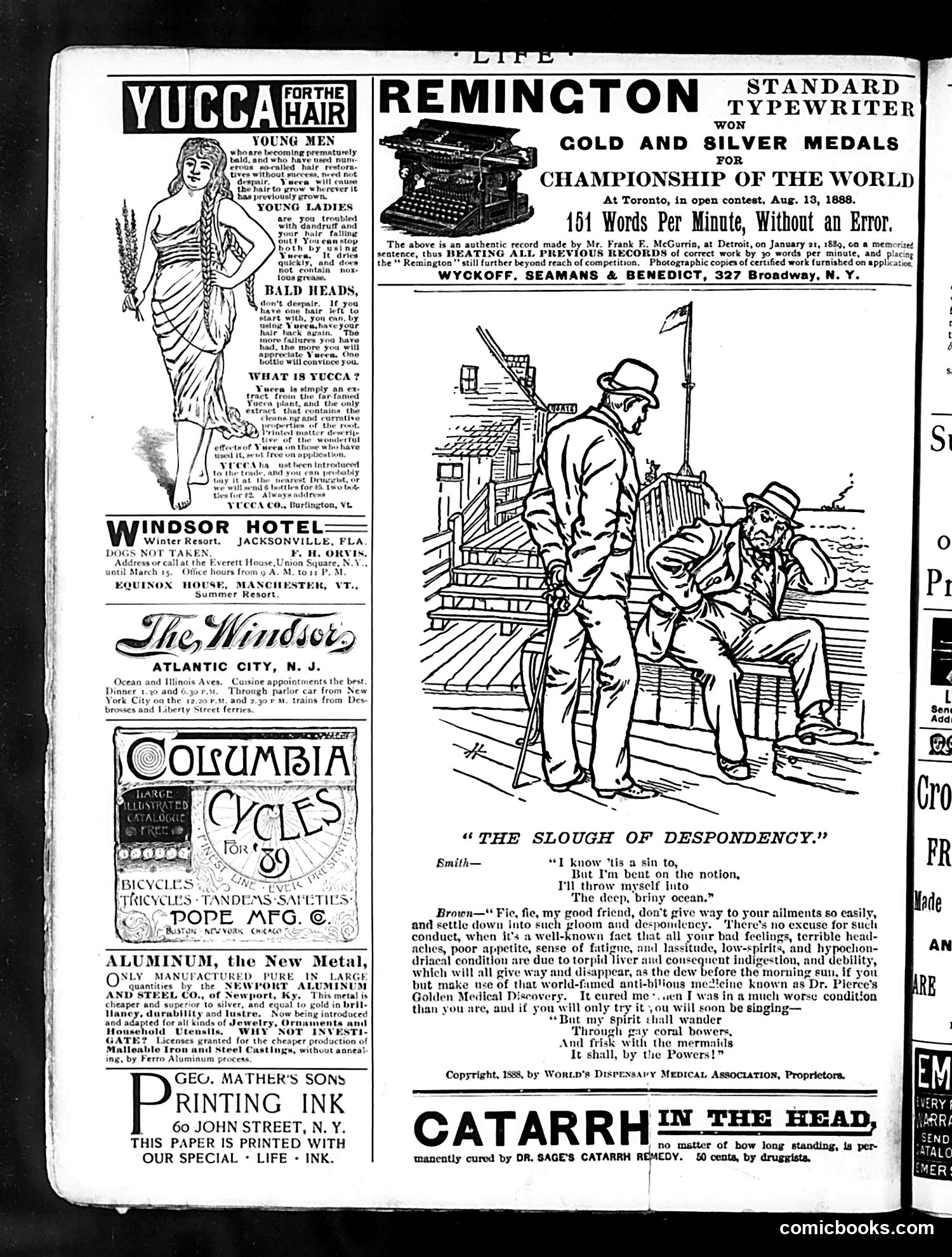
This page is primarily **advertising**, with one central cartoon satirizing medical quackery. The cartoon depicts two men: Smith contemplating suicide due to despair, and Brown offering a cure-all solution: Dr. Pierce's Golden Medical Discovery. Brown's speech is classic 19th-century patent medicine rhetoric—attributing all of Smith's ailments (headaches, fatigue, depression, poor appetite) to "torpid liver" and "indigestion," then promising miraculous cure through a single elixir. The satire mocks the era's ubiquitous **fraudulent medical advertisements** that claimed one product could cure nearly any ailment. The title references Bunyan's *Pilgrim's Progress*, elevating the humor by comparing Smith's depression to spiritual despair—only to be "solved" by dubious medicine. The page's other advertisements (Yucca hair treatment, Remington typewriter, aluminum products) further exemplify the period's aggressive patent-medicine and dubious-product marketing that Life magazine frequently ridiculed.
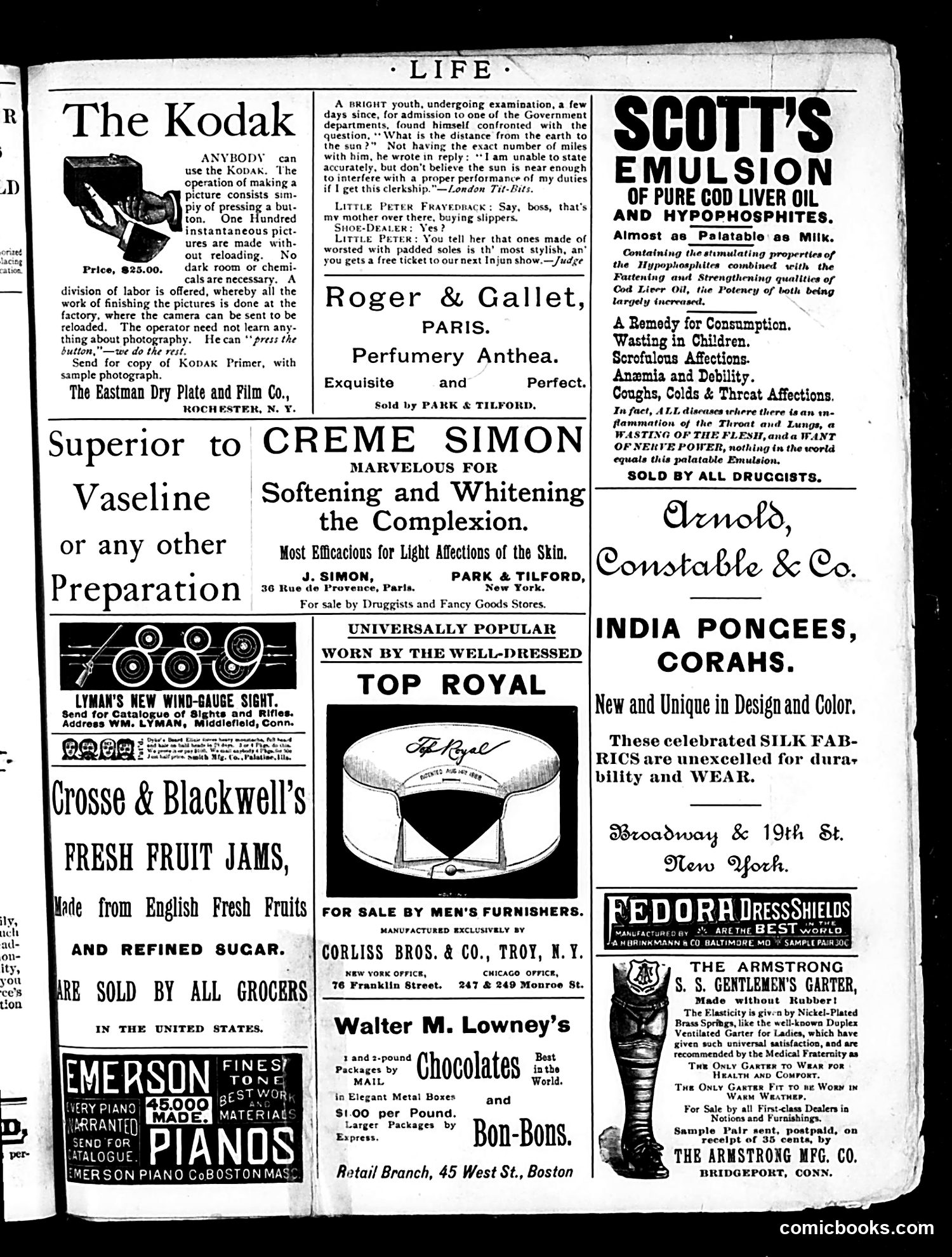
This page is **primarily advertising** with two brief satirical humor pieces at the top. ## The Jokes: **"Government Department Exam"**: A young man applying for a civil service job is asked "What is the distance from the earth to the sun?" He admits he doesn't know the exact mileage but claims it's irrelevant to job performance anyway. The satire mocks the absurdity of irrelevant test questions in government hiring—a criticism of bureaucratic inefficiency and the disconnect between exam content and actual job duties. **"Slippers Anecdote"**: A man tells a shoe-dealer that his mother is buying slippers. He recommends worsted with padded soles as "most stylish" and jokes she'll get "a free ticket to our next Injun show." This reflects period attitudes (offensive by today's standards) and advertises the retailer's goods. ## The Advertisements: The bulk of the page contains Victorian-era product ads: Kodak cameras, Scott's Emulsion (cod liver oil tonic), Vaseline, perfume, pianos, jams, chocolates, women's accessories, and patent medicines—typical of Life magazine's revenue model in this era.
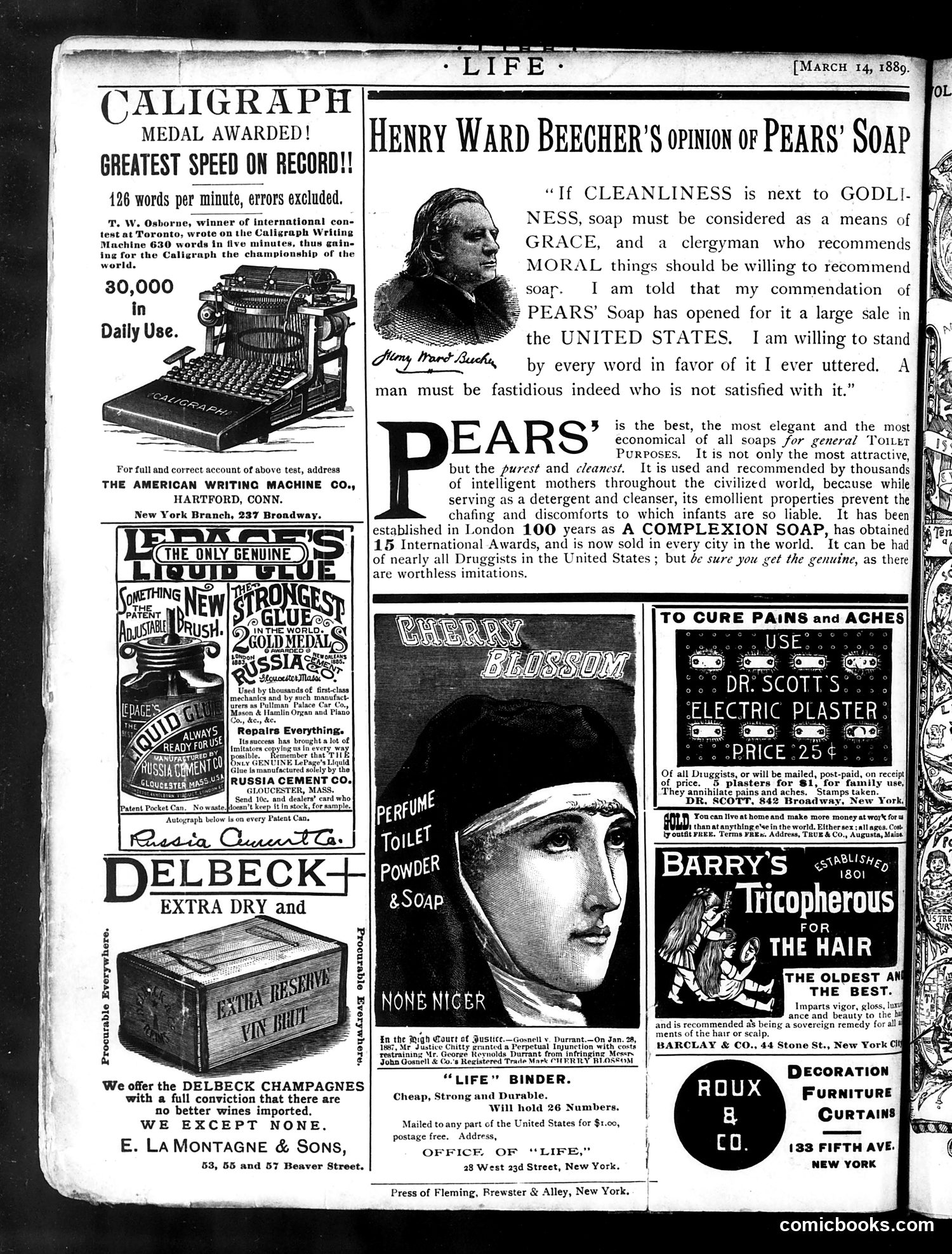
This page is primarily **advertising**, not satirical content. The dominant feature is an endorsement by Henry Ward Beecher, a prominent 19th-century clergyman, praising Pears' Soap. **The Key Content:** Beecher's testimonial uses religious language ("cleanliness is next to godliness," "means of grace") to legitimize soap as a moral product. This was common Victorian-era advertising strategy—equating consumer goods with virtue and proper living. **Why This Mattered:** Celebrity endorsements from respected figures like Beecher carried enormous weight. The ad boasts that his recommendation opened large U.S. sales, suggesting such endorsements directly drove commerce. The soap's "100 years" history and "15 International Awards" emphasized quality through tradition and validation. **The Satire (If Any):** Subtle irony exists in using a prominent moral authority to sell a commodity—commodifying piety itself. However, the page reads as earnest advertising rather than satirical critique. The remaining ads (typewriter, champagne, plaster, hair tonic) are straightforward commercial pitches typical of 1880s magazines.