
Life, 1889-03-14 · page 9 of 20
Life — March 14, 1889 — page 9: what you’re looking at
What you’re looking at
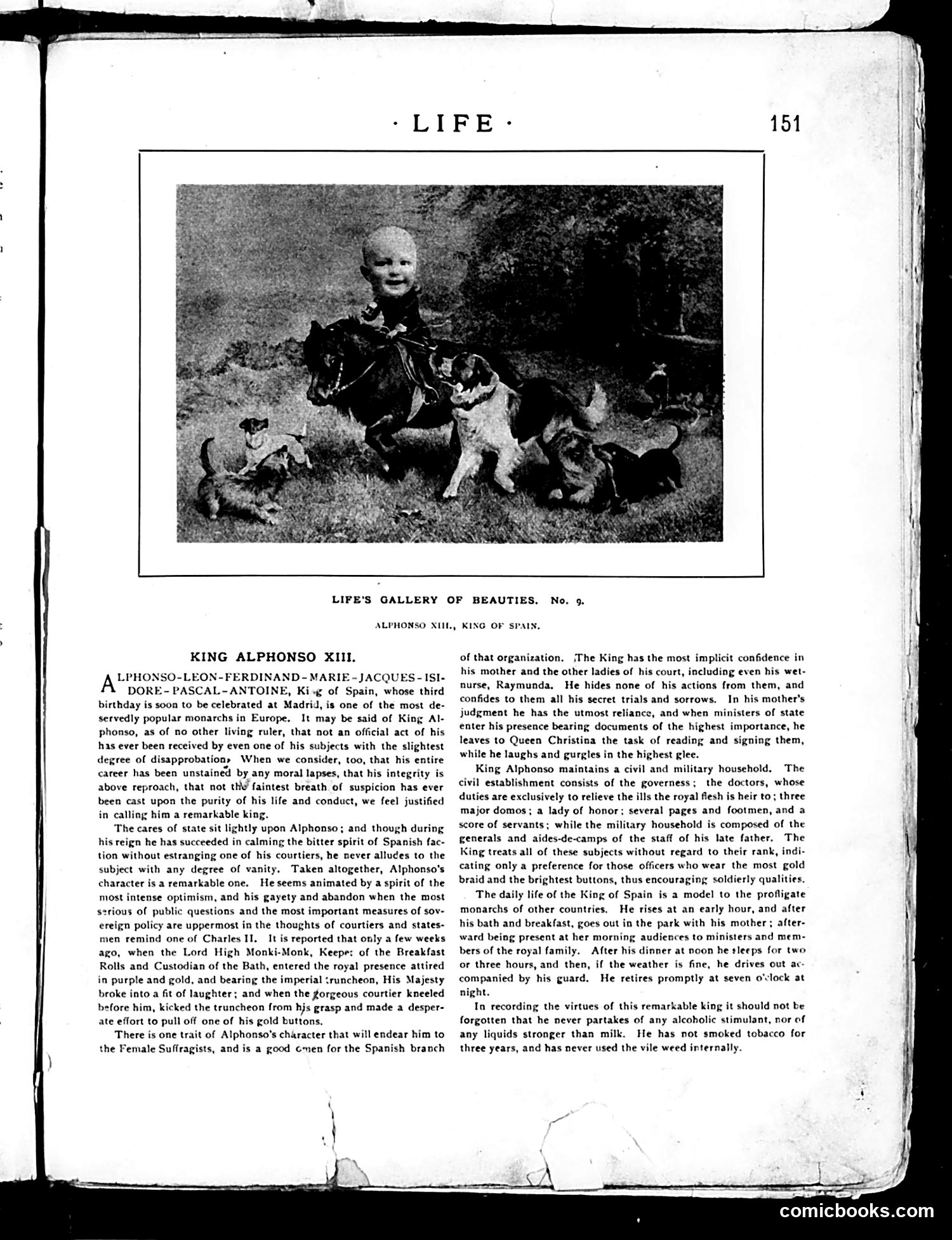
This page from *Life* magazine (page 151) features a photograph titled "Life's Gallery of Beauties, No. 9" depicting King Alfonso XIII of Spain as a young child, surrounded by several dogs while seated outdoors in formal attire. The accompanying article praises Alfonso as a remarkably virtuous monarch, emphasizing his moral character, temperance (never drinking alcohol or smoking), close relationship with his mother Queen Christina, and his meticulous attention to state duties. The piece presents him as an exemplary European royal—a model of propriety and dedication to governance. This appears to be straightforward monarchical flattery rather than satire, celebrating the Spanish king's reported virtues and character during his reign.
📄 Transcribed text from this page (OCR, searchable)
Machine-transcribed from the original scan — historical spelling and the odd misread are preserved.
LIFE’'S GALLERY OF BEAUTIES. No. 9. ALPHONSO XIII,, KING OF SPAIN. KING ALPHONSO XIII. LPHONSO-LEON-FERDINAND- MARIE - JACQUES - ISI- DORE- PASCAL-ANTOINE, Ki«g of Spain, whose third birthday is soon to be celebrated at Madrid, is one of the most de- servedly popular monarchs in Europe. It may be said of King Al- phonso, as of no other living ruler, that not an official act of his has ever been received by even one of his subjects with the slightest degree of disapprobationy When we consider, too, that his entire career has been unstained by any moral lapses, that his integrity is above reproach, that not the’ faintest breath of suspicion has ever been cast upon the purity of his life and conduct, we feel justified in calling him a remarkable king. The cares of state sit lightly upon Alphonso; and though during his reign he has succeeded in calming the bitter spirit of Spanish fac- tion without estranging one of his courtiers, he never alludes to the subject with any degree of vanity, Taken altogether, Alphonso's character is a remarkable one. He seems animated by a spirit of the most intense optimism, and his gayety and abandon when the most serious of public questions and the most important measures of sov- ereign policy are uppermost in the thoughts of courtiers and states- men remind one of Charles Il. It is reported that only a few weeks ago, when the Lord High Monki-Monk, Keepe: of the Breakfast Rolls and Custodian of the Bath, entered the royal presence attired in purple and gold, and bearing the imperial truncheon, His Majesty broke into a fit of laughter; and when the gorgeous courtier kneeled before him, kicked the truncheon from hjs grasp and made a desper- ate effort to pull off one of his gold buttons. There is one trait of Alphonso’s character that will endear him to the Female Suffragists, and is a good cmen for the Spanish branch of that organization. his mother and the other ladies of his court, including even his wet- ‘The King has the most implicit confidence in nurse, Raymunda, He hides none of his actions from them, and confides to them all his secret trials and sorrows. In his mother's judgment he has the utmost reliance, and when ministers of state enter his presence bearing documents of the highest importance, he leaves to Queen Christina the task of reading and signing them, while he laughs and gurgles in the highest glee. King Alphonso maintains a civil and military household. The civil establishment consists of the governess; the doctors, whose duties are exclusively to relieve the ills the royal flesh is heir to; three major domos; a lady of honor; several pages and footmen, and a score of servants; while the military household is composed of the generals and aides-de-camps of the staff of his late father, The King treats all of these subjects without regard to their rank, indi- cating only a preference for those officers who wear the most gold braid and the brightest buttons, thus encouraging soldierly qualities. The daily life of the King of Spain is a model to the profligate monarchs of other countries. He rises at an early hour, and after his bath and breakfast, goes out in the park with his mother ; after- ward being present at her morning audiences to ministers and mem- bers of the royal family. After his dinner at noon he sleeps for two or three hours, and then, if the weather is fine, he drives out ac- companied by his guard, He retires promptly at seven o'clock at night. In recording the virtues of this remarkable king it should not be forgotten that he never partakes of any alcoholic stimulant, nor of any liquids stronger than milk. He has not smoked tobacco for three years, and has never used the vile weed internally. comicbooks.com