
Life, 1889-03-14 · page 4 of 20
Life — March 14, 1889 — page 4: what you’re looking at
What you’re looking at
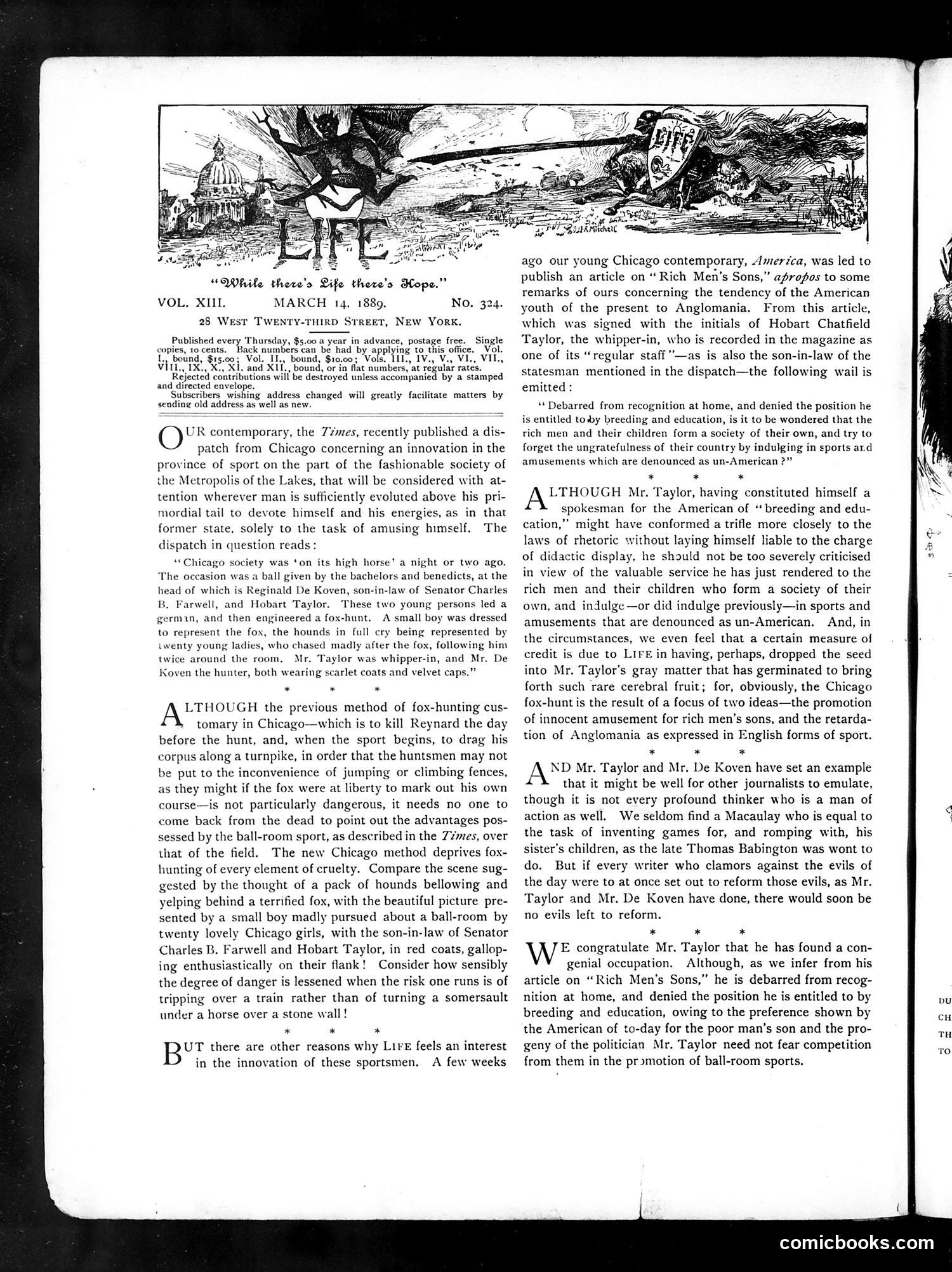
The masthead cartoon depicts "Life" as a classical female figure surveying a landscape, symbolizing the magazine's role as social commentator. The article discusses Chicago sportsmen—specifically Reginald de Koven and Hobart Taylor—who've innovated fox-hunting methods. The satire critiques their leisure pursuits: rather than traditional pre-hunt preparation, they've developed a method involving dragging a fox corpse along a turnpike so huntsmen needn't worry about fences or property damage. Life mocks this as removing "cruelty" while missing the point—it's still fundamentally cruel. The deeper satire targets wealthy men indulging in aristocratic pastimes while presenting themselves as reformers. The article suggests their innovations reveal their true priorities: convenience over ethics, and maintaining appearances of respectability while engaging in morally questionable amusements.
📄 Transcribed text from this page (OCR, searchable)
Machine-transcribed from the original scan — historical spelling and the odd misread are preserved.
# 3S “While there's Life there’s Hope.” VOL, XIII. MARCH 14, 1889. 28 West Twe No. 324. 'Y-THIRD New York. Published every. Thursday, $5.00 a year in advance, postage free. Single copies, 10 cents. Back numbers can be had by applying to this office. Vol. ts , Vol, Il., bound, $10.00; Vols. ils IV., Vy Vic, Vite, vith 1X, XX bound, or in flat numbers, at regular rates. Re be destroyed unless accompanied by a stamped and directed envelope. Subscribers wishing address changed will greatly facilitate matters by sending old address as well as new. UR contemporary, the 77es, recently published a dis- patch from Chicago concerning an innovation in the province of sport on the part of the fashionable society of the Metropolis of the Lakes, that will be considered with at- tention wherever man is sufficiently evoluted above his pri- mordial tail to devote himself and his energies, as in that former state, solely to the task of amusing himself. The dispatch in question reads: “Chicago so The occasion was a ball given by the bachelors and benedicts, at the head of which is Reginald De Koven, son-in-law of Senator Charles B, Farwell, and Hobart Taylor. These two young persons led a german, and then engineered a fox-hunt. A small boy was dressed to represent the fox, the hounds in full cry being represented by iwenty young ladies, who chased madly after the fox, following him twice around the room, Mr, Taylor was whipper-in, and Mr. De Koven the hunter, both wearing scarlet coats and velvet caps.” y was ‘on its high horse’ a night or two ago. * * * A LTHOUGH the previous method of fox-hunting cus- tomary in Chicago—which is to kill Reynard the day before the hunt, and, when the sport begins, to drag his corpus along a turnpike, in order that the huntsmen may not be put to the inconvenience of jumping or climbing fences, as they might if the fox were at liberty to mark out his own course—is not particularly dangerous, it needs no one to come back from the dead to point out the advantages pos- sessed by the ball-room sport, as described in the 7zmes, over that of the field. The new Chicago method deprives fox- hunting of every element of cruelty. Compare the scene sug- gested by the thought of a pack of hounds bellowing and yelping behind a terrified fox, with the beautiful picture pre- sented by a small boy madly pursued about a ball-room by twenty lovely Chicago girls, with the son-in-law of Senator Charles B. Farwell and Hobart Taylor, in red coats, gallop- ing enthusiastically on their flank! Consider how sensibly the degree of danger is lessened when the risk one runs is of tripping over a train rather than of turning a somersault under a horse over a stone wall! * * * UT there are other reasons why Lire feels an interest in the innovation of these sportsmen. A few weeks Eee ago our young Chicago contemporary, 4Amerzca, was led to publish an article on “Rich Men's Sons,” apropos to some remarks of ours concerning the tendency of the American youth of the present to Anglomania. From this article, which was signed with the initials of Hobart Chatfield Taylor, the whipper-in, who is recorded in the magazine as one of its “regular staff "—as is also the son-in-law of the statesman mentioned in the dispatch—the following wail is emitted : ‘*Debarred from recognition at home, and denied the position he is entitled toby breeding and education, is it to be wondered that the rich men and their children form a society of their own, and try to forget the ungratefulness of their country by indulging in sports ard amusements which are denounced as un-American ?” * * * LTHOUGH Mr. Taylor, having constituted himself a spokesman for the American of ‘ breeding and edu- cation,” might have conformed a trifle more closely to the laws of rhetoric without laying himself liable to the charge of didactic display, he should not be too severely criticised in view of the valuable service he has just rendered to the rich men and their children who form a society of their own, and indulge —or did indulge previously—in sports and amusements that are denounced as un-American. And, in the circumstances, we even feel that a certain measure of credit is due to Lire in having, perhaps, dropped the seed into Mr. Taylor's gray matter that has germinated to bring forth such rare cerebral fruit; for, obviously, the Chicago fox-hunt is the result of a focus of two ideas—the promotion of innocent amusement for rich men’s sons, and the retarda- tion of Anglomania as expressed in English forms of sport. * x * ND Mr. Taylor and Mr. De Koven have set an example that it might be well for other journalists to emulate, though it is not every profound thinker who is a man of action as well. We seldom find a Macaulay who is equal to the task of inventing games for, and romping with, his sister's children, as the late Thomas Babington was wont to do. But if every writer who clamors against the evils of the day were to at once set out to reform those evils, as Mr. Taylor and Mr. De Koven have done, there would soon be no evils left to reform. * * * E congratulate Mr. Taylor that he has found a con- genial occupation. Although, as we infer from his article on “Rich Men's Sons,” he is debarred from recog- nition at home, and denied the position he is entitled to by breeding and education, owing to the preference shown by the American of to-day for the poor man’s son and the pro- geny of the politician Mr. Taylor need not fear competition from them in the promotion of ball-room sports. comicbooks.com