
Life, 1889-03-14 · page 12 of 20
Life — March 14, 1889 — page 12: what you’re looking at
What you’re looking at
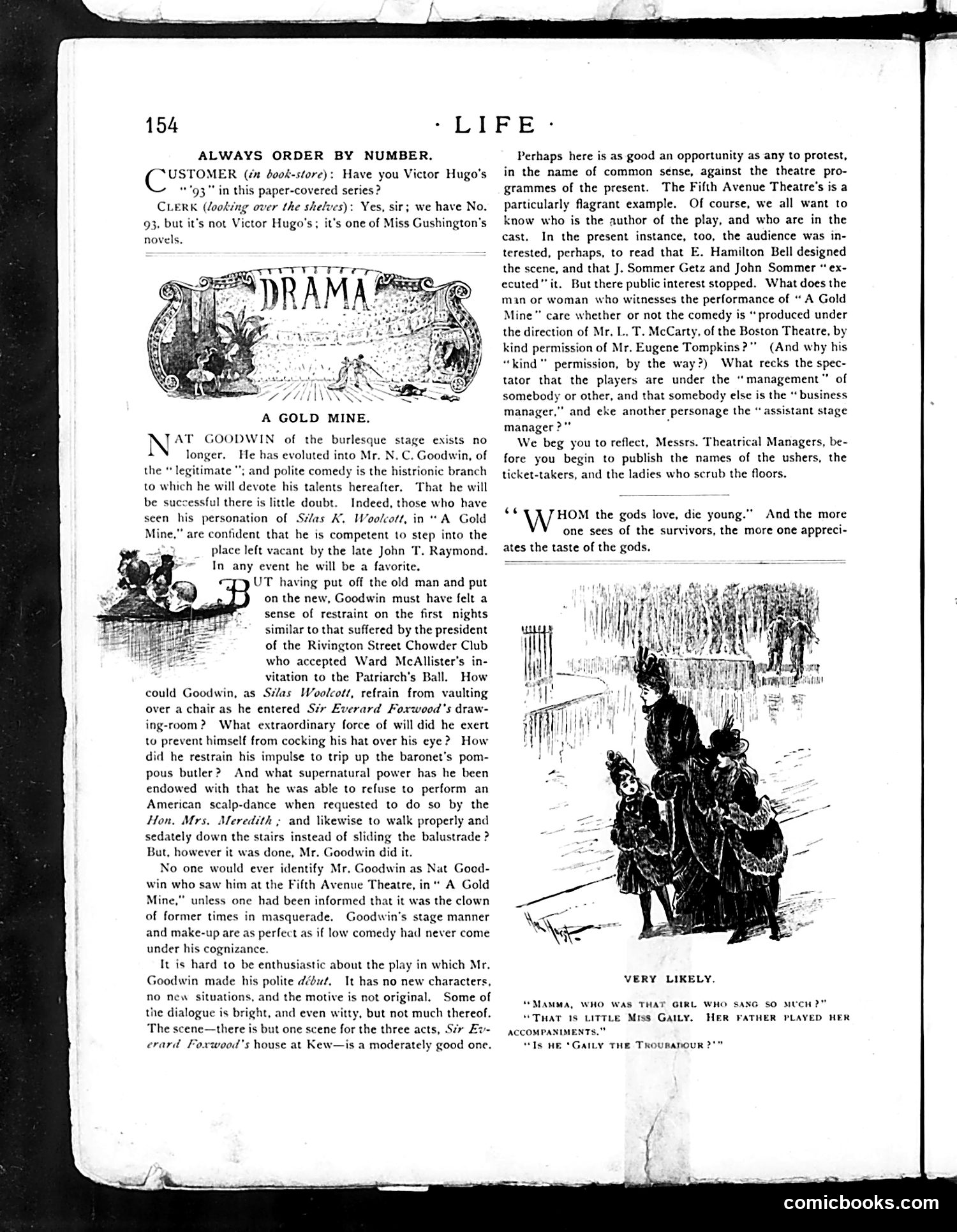
This *Life* magazine page contains two satirical pieces about theatre: **"Always Order by Number"** is a brief joke about a bookstore customer confusing a cheap paper-covered novel series with Victor Hugo's "93"—the clerk reveals the customer is actually looking at "Miss Gushington's novels," mocking mass-produced, low-quality fiction sold by catalog number. **"A Gold Mine"** discusses actor Nat Goodwin's transition from burlesque (lowbrow comedy with physical slapstick) to "legitimate" theatre (serious drama). The satire praises Goodwin for successfully restraining his old comedic habits—he resists vaulting over chairs, cocking his hat, and performing a "scalp-dance"—demonstrating genuine acting discipline. However, the piece critiques the play itself as unoriginal and unimportant, and launches into a broader complaint about theatre programs listing excessive credits (stage managers, ushers, cleaners) that audiences don't care about—a proto-critique of bloated production bureaucracy.
📄 Transcribed text from this page (OCR, searchable)
Machine-transcribed from the original scan — historical spelling and the odd misread are preserved.
-~LIFE: ALWAYS ORDER BY NUMBER. *USTOMER (¢” d00k-store): Have you Victor Hugo's "93" in this paper-covered series? CLERK (looking over the shelves): Yes, sir; we have No. 93. but it’s not Victor Hugo's; it’s one of Miss Gushington’s novels, A GOLD MINE. N*t GOODWIN of the burlesque stage exists no longer. He has evoluted into Mr. N. C. Goodwin, of the * legitimate "; and polite comedy is the histrionic branch to which he will devote his talents hereafter. That he will be successful there is little doubt. Indeed, those who have seen his personation of Silas K. Woolcott, in * A Gold Mine,” are confident that he is competent to step into the place left vacant by the late John T. Raymond. In any event he will be a favorite. UT having put off the old man and put on the new, Goodwin must have felt a sense of restraint on the first nights similar to that suffered by the president of the Rivington Street Chowder Club who accepted Ward McAllister’s in- vitation to the Patriarch's Ball. How could Goodwin, as Silas Woolcott, refrain from vaulting over achair as he entered Sir Everard Foxwood's draw- ing-room ? What extraordinary force of will did he exert to prevent himself from cocking his hat over his eye? How did he restrain his impulse to trip up the baronet’s pom- pous butler? And what supernatural power has he been endowed with that he was able to refuse to perform an American scalp-dance when requested to do so by the Hon. Mrs, Meredith ; and likewise to walk properly and sedately down the stairs instead of sliding the balustrade ? But, however it was done, Mr. Goodwin did it. No one would ever identify Mr. Goodwin as Nat Good- win who saw him at the Fifth Avenue Theatre, in“ A Gold Mine,” unless one had been informed that it was the clown of former times in masquerade. Goodwin's stage manner and make-up are as perfect as if low comedy had never come under his cognizance. It is hard to be enthusiastic about the play in which Mr. Goodwin made his polite déut, It has no new characters, no new situations, and the motive is not original. Some of the dialogue is bright, and even witty, but not much thereof. The scene—there is but one scene for the three acts, Sir Ev erard Foxwood's house at Kew—is a moderately good one. Perhaps here is as good an opportunity as any to protest, in the name of common sense, against the theatre pro- grammes of the present. The Fifth Avenue Theatre's is a particularly flagrant example. Of course, we all want to know who is the author of the play, and who are in the cast. In the present instance, too, the audience was in- terested, perhaps, to read that E. Hamilton Bell designed the scene, and that J. Sommer Getz and John Sommer “ ex- ecuted”’it. But there public interest stopped. What does the man or woman who witnesses the performance of “ A Gold Mine” care whether or not the comedy is “ produced under the direction of Mr. L. T. McCarty, of the Boston Theatre, by kind permission of Mr. Eugene Tompkins?” (And why his “kind permission, by the way?) What recks the spec- tator that the players are under the “management” of somebody or other, and that somebody else is the “ business manager,” and eke another personage the “assistant stage manager ?" . We beg you to reflect, Messrs. Theatrical Managers, be- fore you begin to publish the names of the ushers, the ticket-takers, and the ladies who scrub the floors. HOM the gods love, die young.’ And the more one sees of the survivors, the more one appreci- ates the taste of the gods, VERY LIKELY. “MAMMA, WHO WAS THAT GIRL WHO SANG SO MUCH?” “THAT 18 LITTLE Miss GaILy. HER FATHER PLAYED HER ACCOMPANIMEN “1s HE ‘GAILY THE TROURANOUR ?*” comicbooks.com