
A complete issue · 20 pages · 1889
Life — February 14, 1889
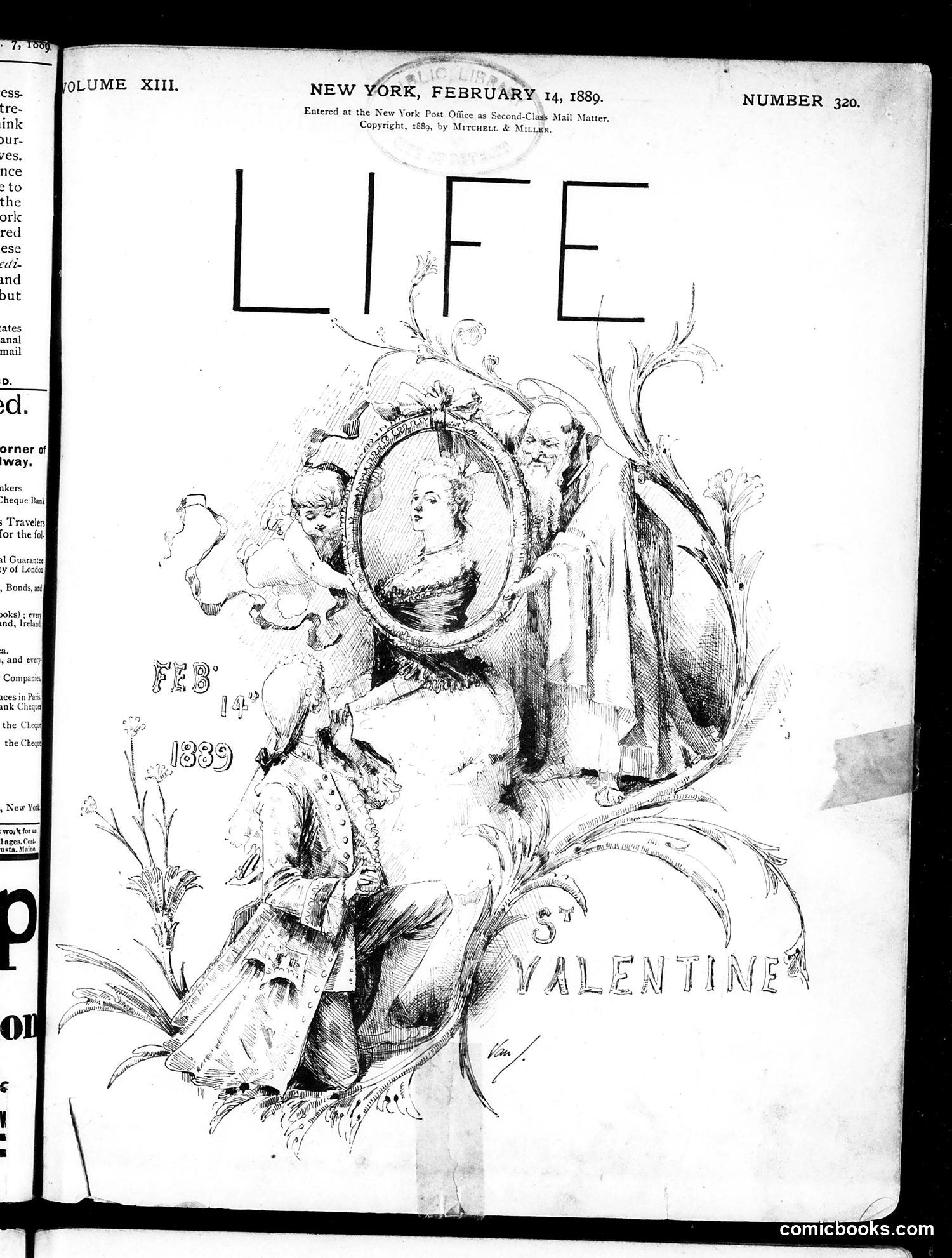
This is a Valentine's Day cover illustration for Life magazine's satirical "Life Valentine" feature. The central image shows a mirror or frame containing two profile portraits of figures from 1889, flanked by cherubs and decorative flourishes typical of Victorian valentine imagery. The cartoon appears to satirize prominent public figures of that era through the valentine format—a common way 19th-century satirical magazines mocked politicians and celebrities. The dates visible (1839, 1889) suggest commentary on 50-year retrospectives or generational comparisons. Without being able to definitively identify the specific individuals depicted, this represents Life magazine's practice of using sentimental holiday imagery to deliver political or social satire—transforming the traditionally romantic valentine into a vehicle for mockery.
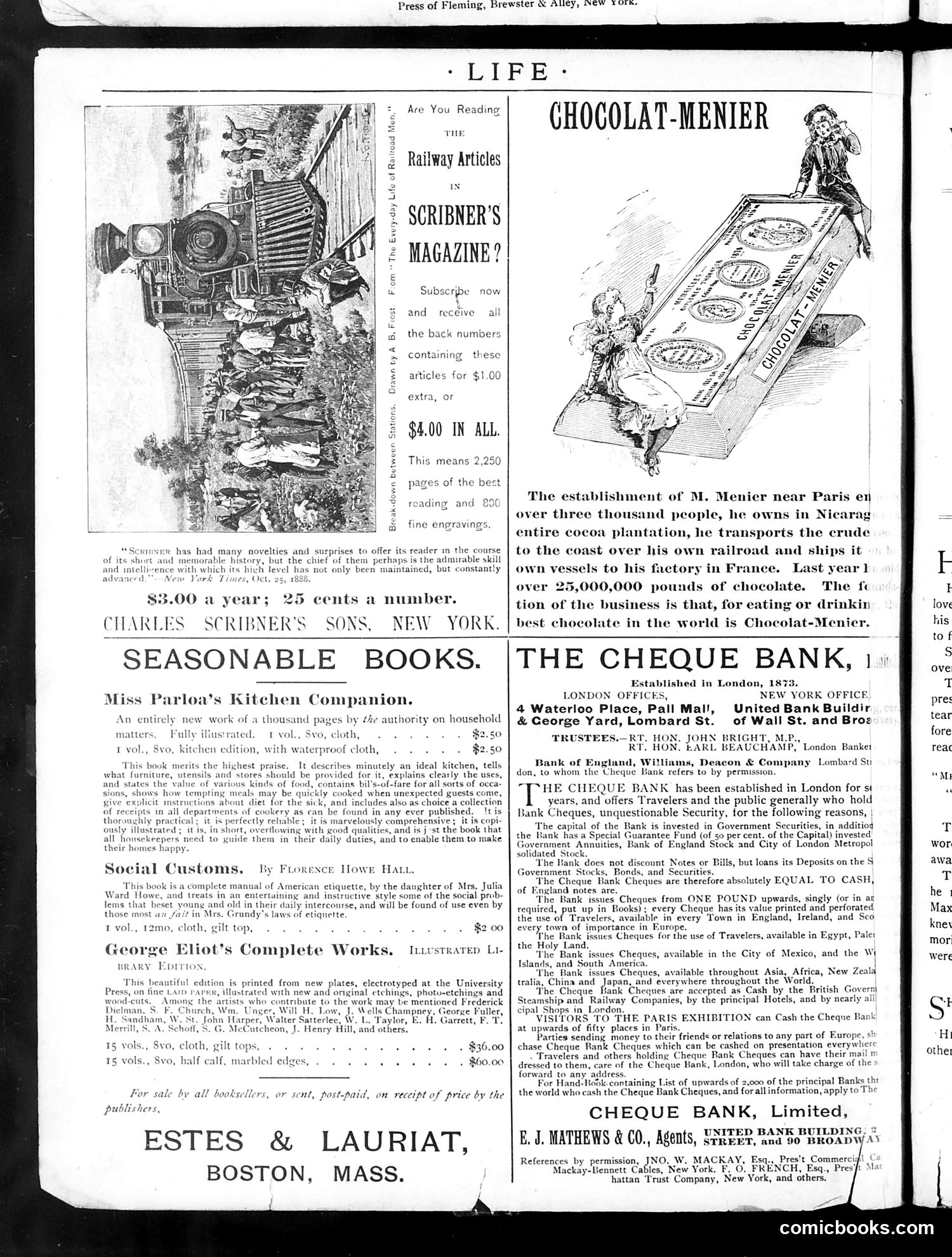
This page is **primarily advertising** rather than satirical content. The main elements are: 1. **Scribner's Magazine advertisement** (left): promoting railway articles and back issues at discounted rates—straightforward magazine marketing. 2. **Chocolat-Menier advertisement** (right): illustrating cherubs on a chocolate box, promoting a French chocolate manufacturer's factory output and superiority. This is product advertising. 3. **Book advertisements** (bottom): promoting Miss Parloa's Kitchen Companion, Social Customs by Florence Howe Hall, and George Eliot's Complete Works—standard publishing promotions. 4. **The Cheque Bank advertisement** (bottom right): describing banking services in London and New York. The page contains **no political satire or editorial cartoons**—it's a commercial page filled with period advertising for magazines, books, chocolate, and financial services.
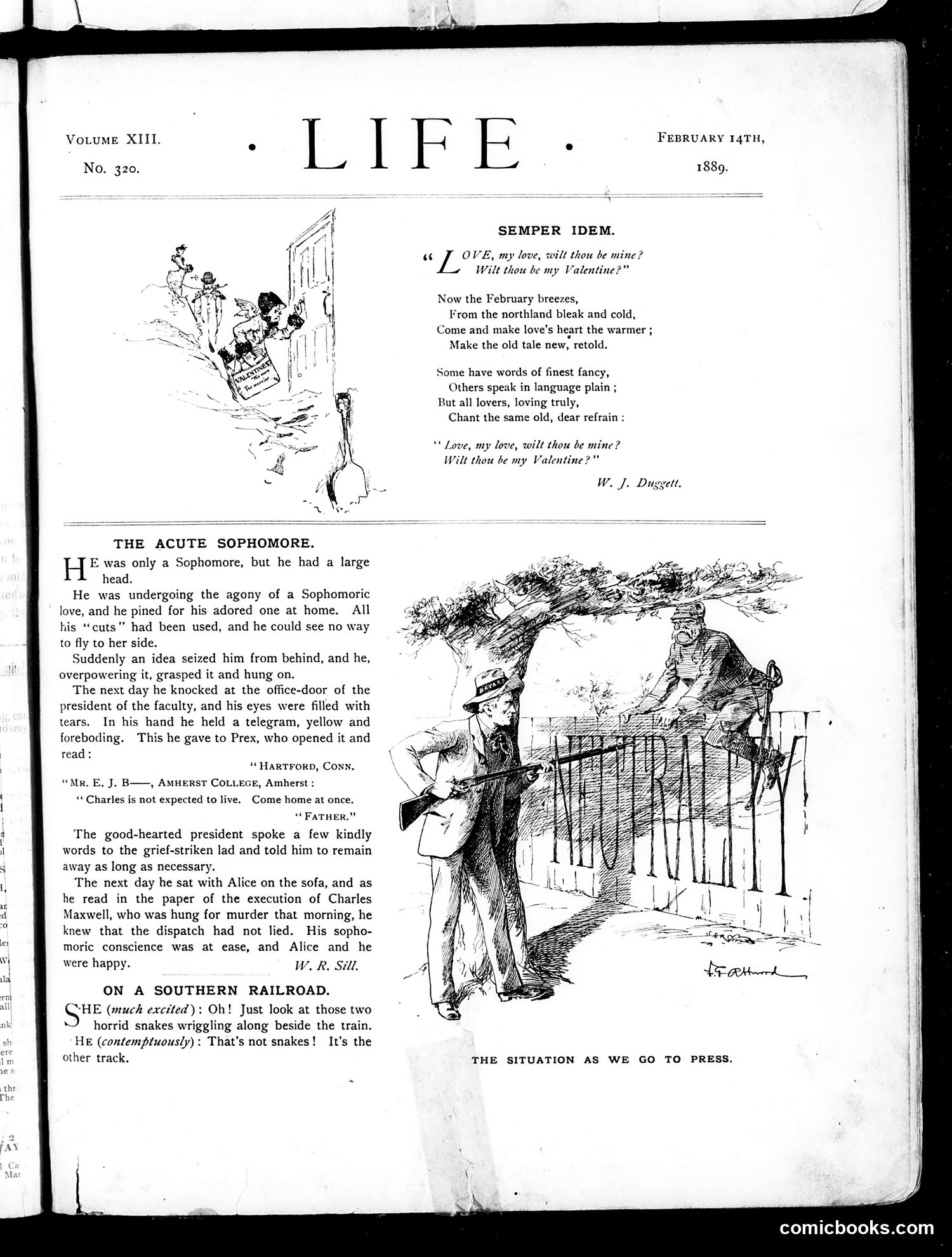
This page contains three separate pieces of satirical humor typical of the period: 1. **"Semper Idem"** (top): A Valentine's Day poem by W. J. Daggett about romantic constancy, illustrated with a whimsical sketch of figures in winter weather. 2. **"The Acute Sophomore"** (center): A joke about a lovelorn college student. A telegraph arrives with news that his beloved "Charles Maxwell" has been executed—he misinterprets it as bad news about his romance. The humor relies on the contrast between his emotional turmoil and the mundane reality (the name similarity is coincidental). The illustration shows the president consoling the distraught young man. 3. **"On a Southern Railroad"** (bottom): A brief dialogue joke where a woman mistakes railroad tracks for snakes—a simple sight-gag reflecting period attitudes about rural/Southern settings.
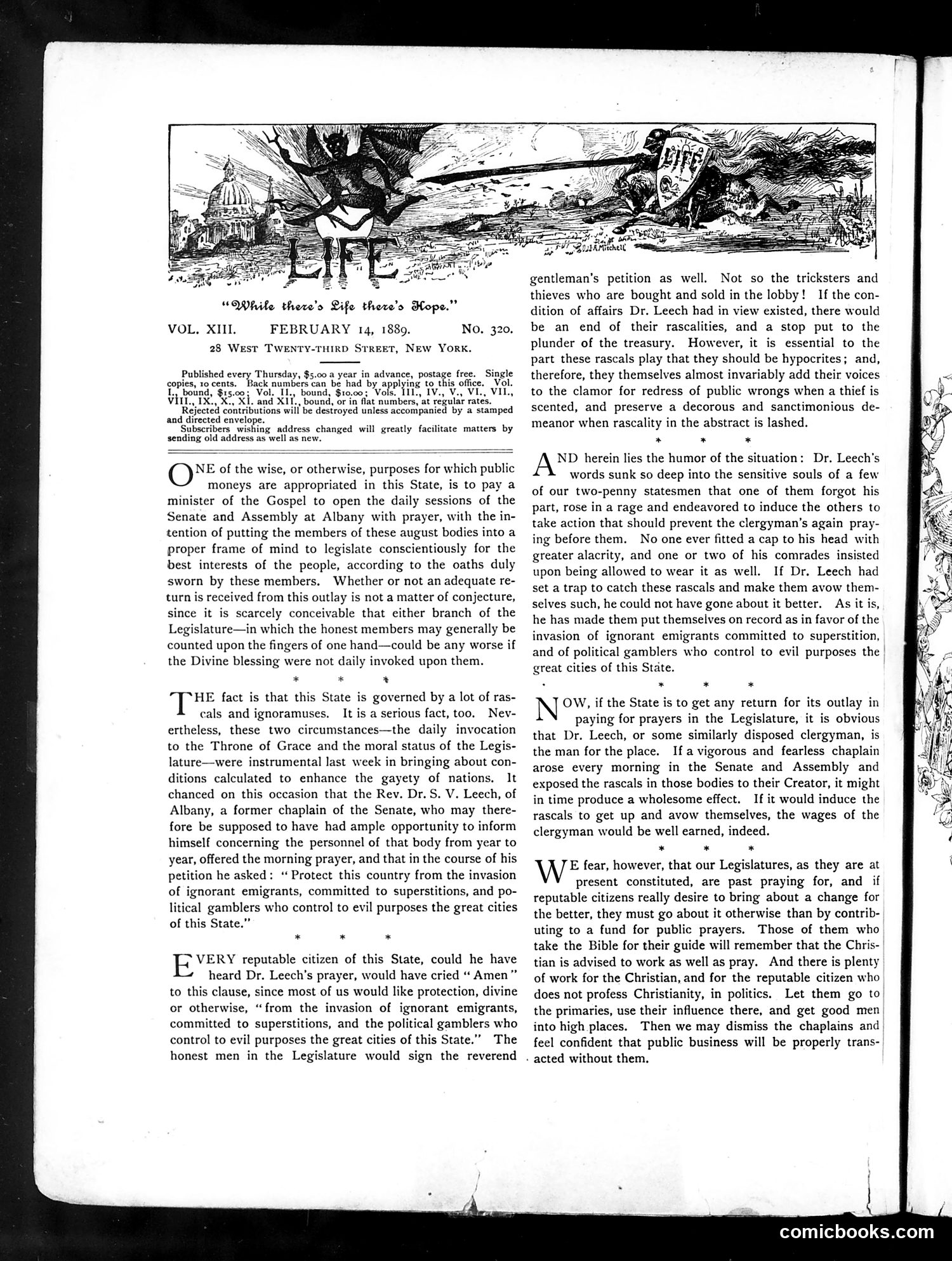
This page satirizes New York State's funding of legislative chaplains to conduct prayers in the Senate and Assembly. The article mocks Dr. S. V. Leech, a former Senate chaplain, who petitioned the state to prevent "ignorant emigrants" and "political gamblers" from corrupting the legislature. The satire's point: the irony is sharp. The author argues that if the State truly wanted protection from corruption, it should instead hire vigorous chaplains to expose rascals daily—making them "put themselves on record" as corrupt. The piece sardonically suggests that while respectable citizens waste resources on prayers, actual legislative fraud goes unchecked. It's a critique of misplaced moral priorities and ineffective remedies for genuine political corruption.
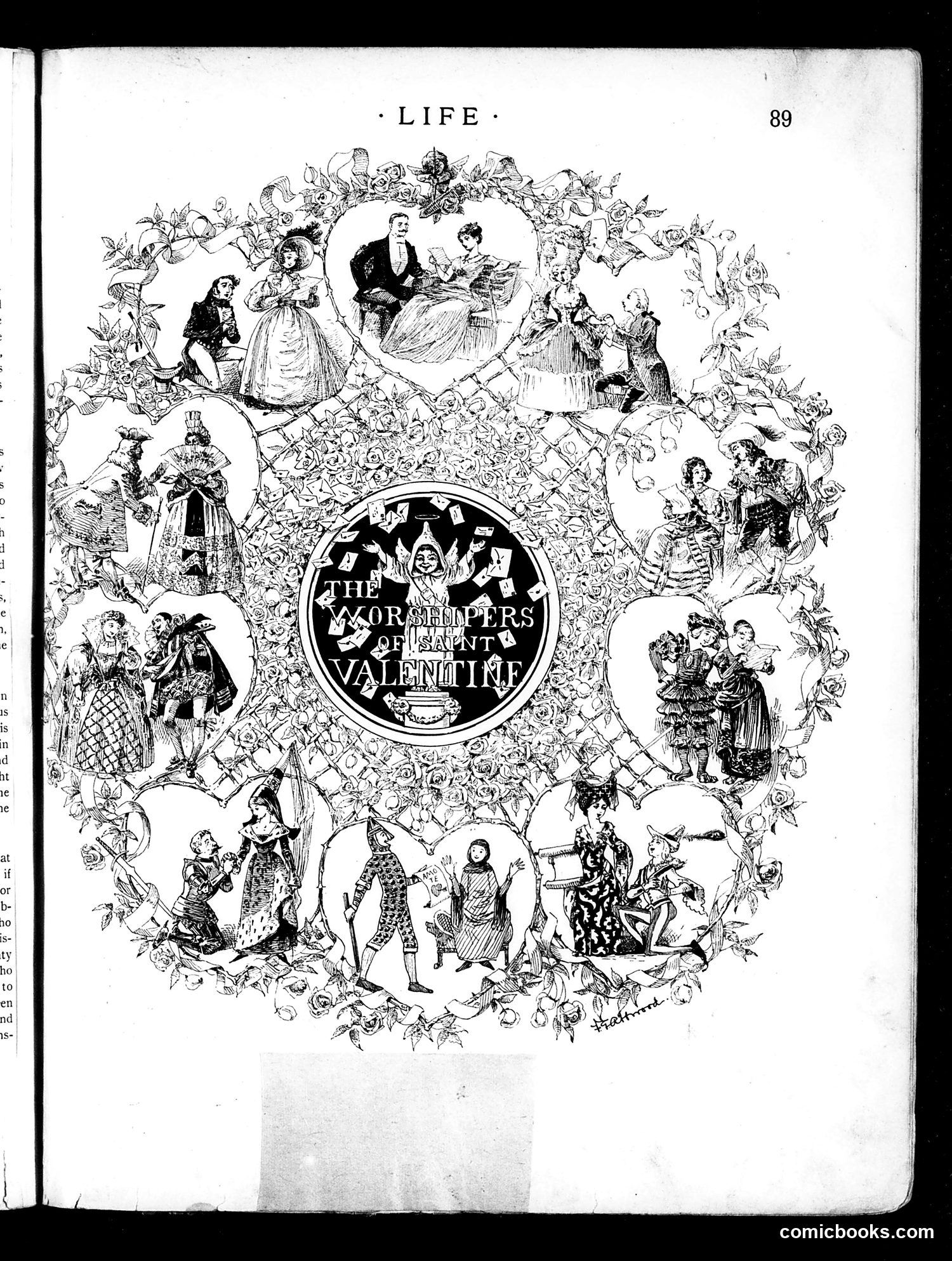
This is a decorative illustration for Valentine's Day content, page 89 of Life magazine. The central circle contains the title "The Worshippers of Saint Valentine" surrounding a cherub figure. The surrounding border consists of multiple vignettes depicting various romantic and social scenes from the Victorian/Edwardian era—couples courting, women in fashionable dress, men in formal attire, and what appear to be scenes of courtship and romance. These are framed within an ornamental wreath of roses and floral designs. Rather than political satire, this appears to be gentle social commentary on courtship customs and romantic pursuits of the era. The "worshippers" are everyday people engaged in the rituals of romance and courtship that the magazine's readers would recognize. It's an affectionate, decorative celebration of Valentine's Day traditions.
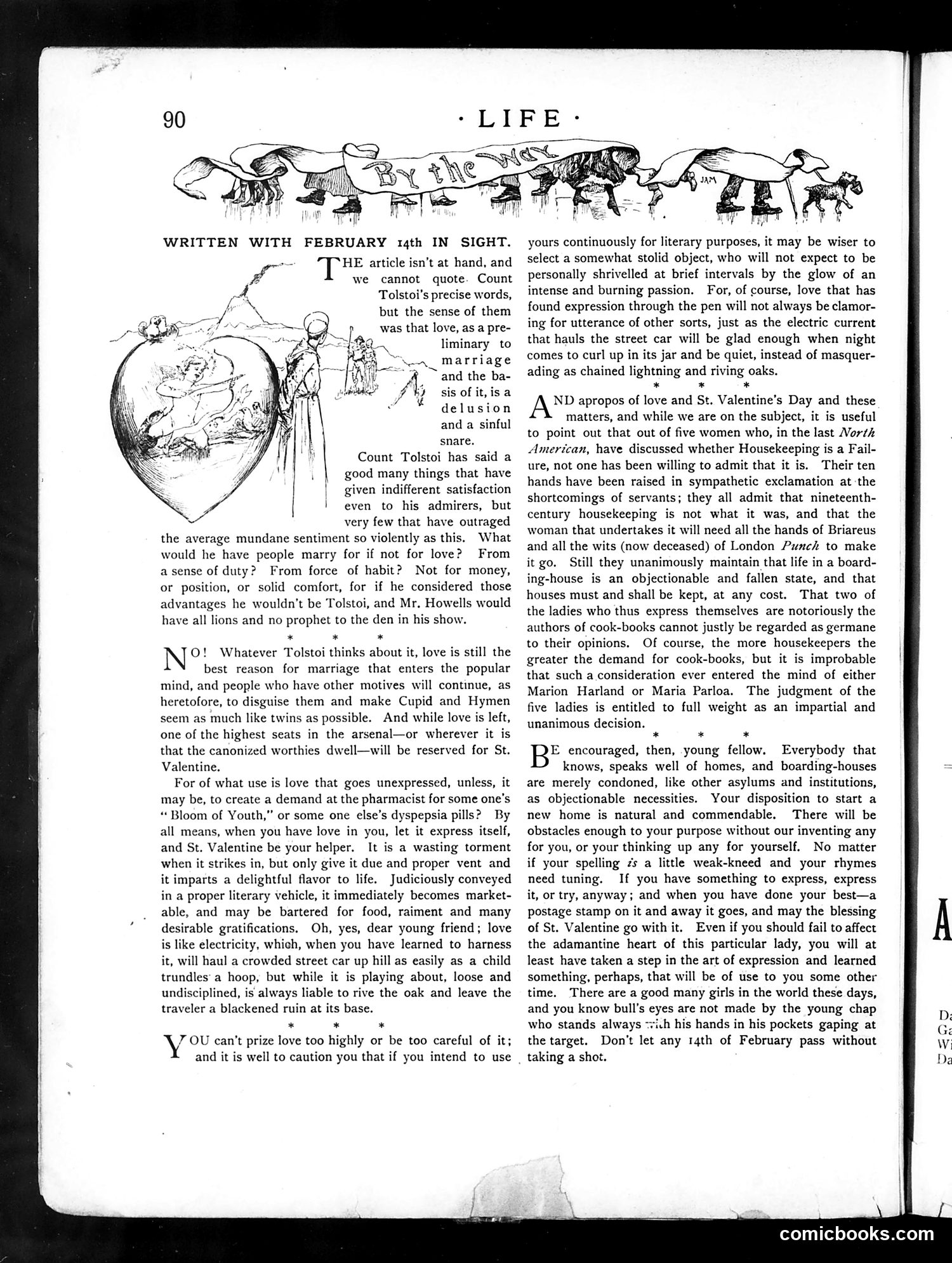
This page is a satirical essay about love and marriage written around Valentine's Day. The illustrations show a large heart with figures inside, and various couples in romantic situations. The text mocks the tension between idealized romantic love and practical married life. It references Count Tolstoy's views on love as preliminary to marriage, then argues that while love is important, it shouldn't blind people to reality. The article notably discusses five women from *North American* magazine who debated whether housekeeping is a "failure"—suggesting this reflects a contemporary women's rights discussion about domestic labor's value. The closing section encourages young men to express their feelings on Valentine's Day, warning against hesitation. The overall tone balances romantic sentiment with practical advice about marriage and self-expression.
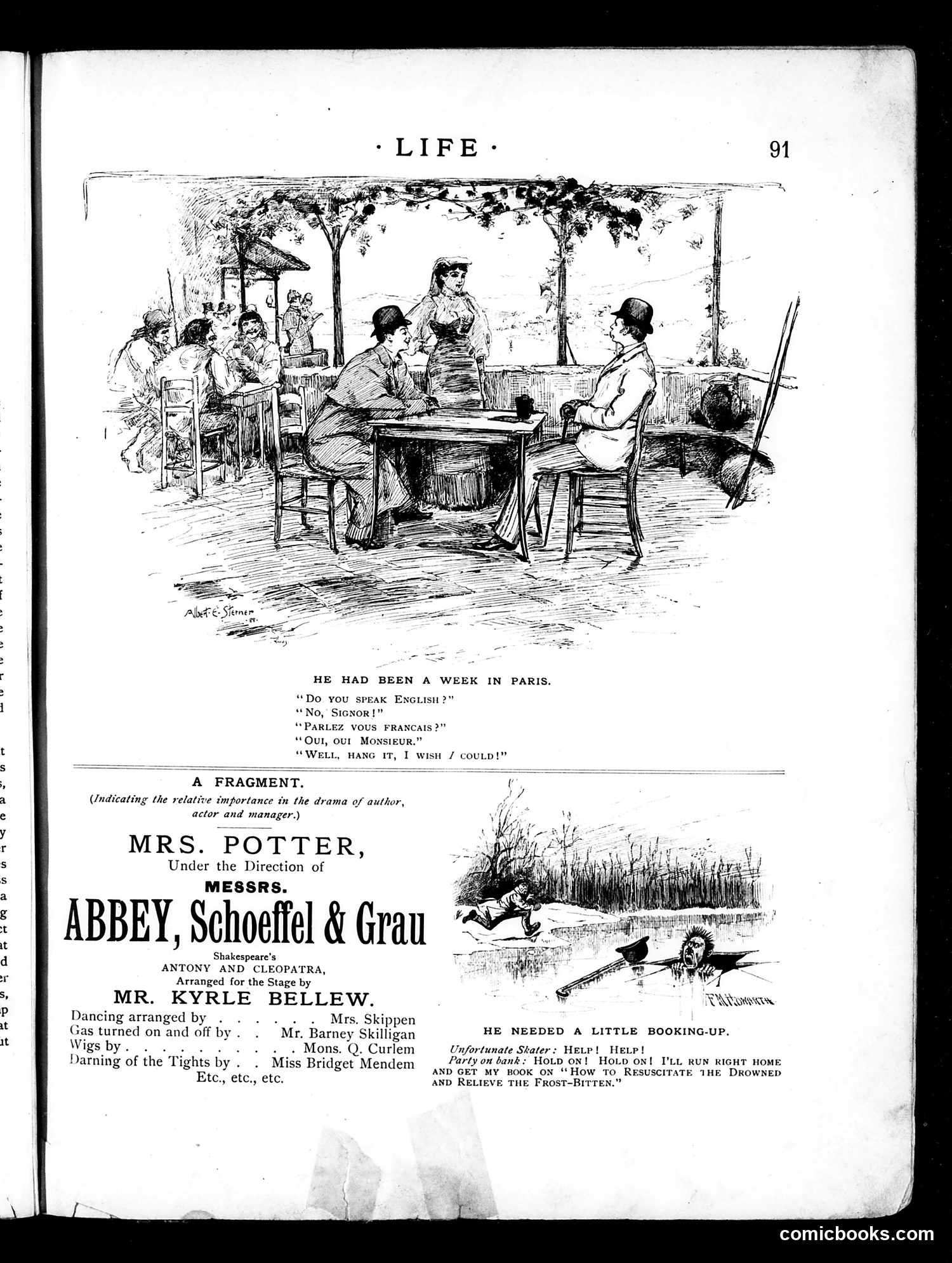
The top illustration depicts a social scene in Paris—a café or outdoor gathering where someone who has spent a week there is being quizzed about language skills. The dialogue humorously captures the pretensions of American tourists: "Do you speak English?" "No, Signor!" "Parlez vous francais?" "Oui, oui Monsieur." "Well, hang it, I wish I could!" The satire mocks Americans abroad who encounter language barriers and the absurdity of communication attempts across cultures. Below is theatrical advertising for Mrs. Potter's production of Shakespeare's "Antony and Cleopatra," arranged by the firm Abbey, Schoeffel & Grau, with credits for various production roles. The bottom illustration shows a drowning figure, captioned "He Needed a Little Booking-Up," satirizing someone unfamiliar with water rescue techniques.
This page is primarily a **book review**, not a political cartoon. The main text discusses George Meredith's novel *Beauchamp's Career*, analyzing its protagonist Nevil Beauchamp as a character type: idealistic, impulsive, and intellectually honest but inflexible. The reviewer argues that Beauchamp represents a "fanatic" whose radical theories, while well-intentioned, make him difficult and ultimately tragic. The review praises the novel's final hundred pages as among Meredith's finest work. At the bottom is a brief **humorous dialogue** between characters Jack and Gus about cigarettes—a minor comedic interlude. The page includes a "New Books" section listing recent publications. No significant political satire or caricature is present on this page.
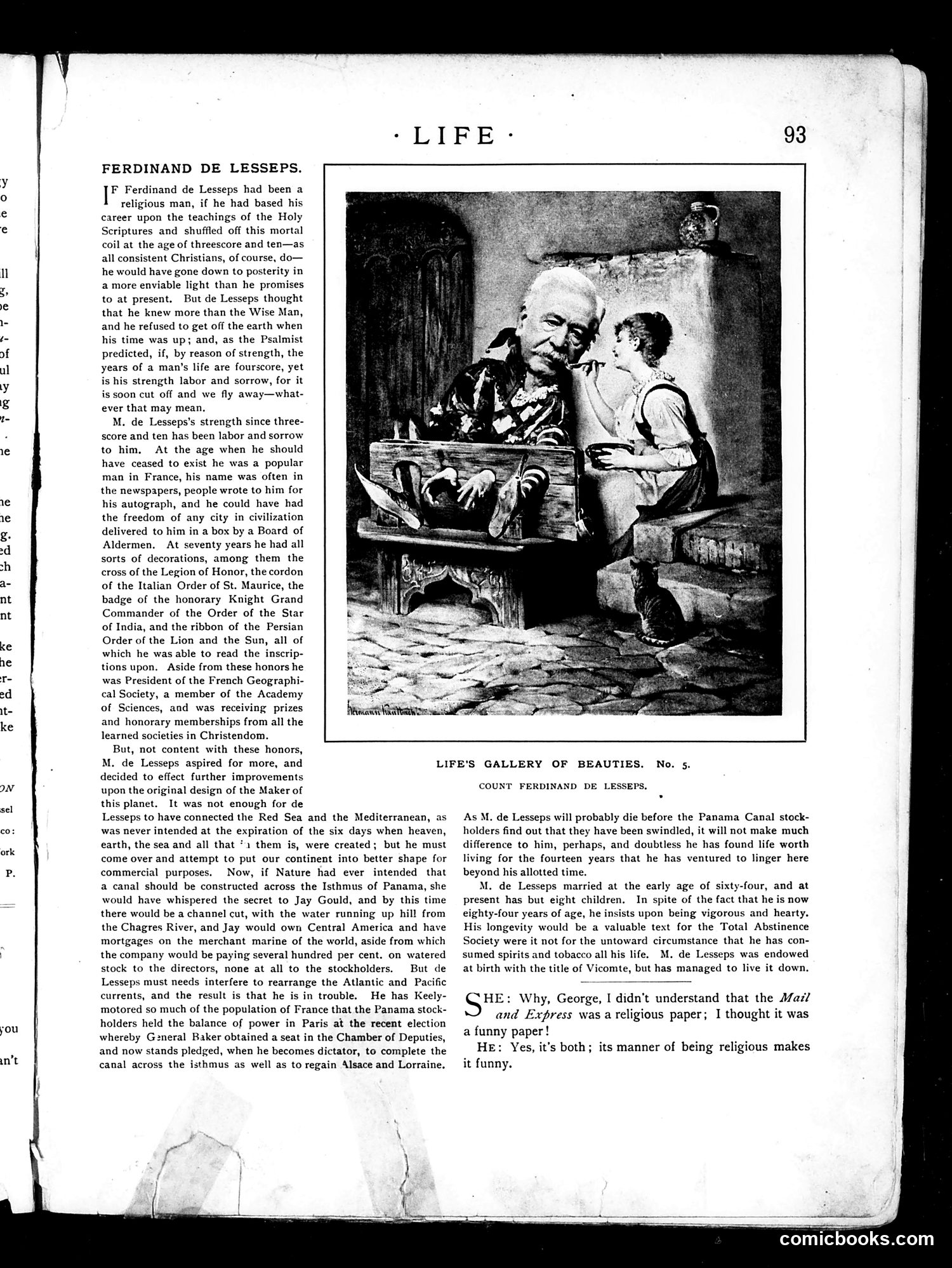
This page features "Life's Gallery of Beauties, No. 5," depicting **Count Ferdinand de Lesseps**, the French engineer famous for designing the Suez Canal. The accompanying article discusses Lesseps' accomplishments and honors, but pivots to satirize his ambitions to construct a Panama Canal. The text suggests Lesseps wanted to reshape geography for commercial purposes, connecting the Red Sea and Mediterranean—implying grandiose, impractical engineering schemes. The satire culminates in a brief dialogue where a character expresses surprise that the *Mail and Express* is a "religious paper," finding it funny that a serious publication discusses such matters. This suggests the page mocks Lesseps' projects and contemporary debates about canal construction as simultaneously serious and absurd.
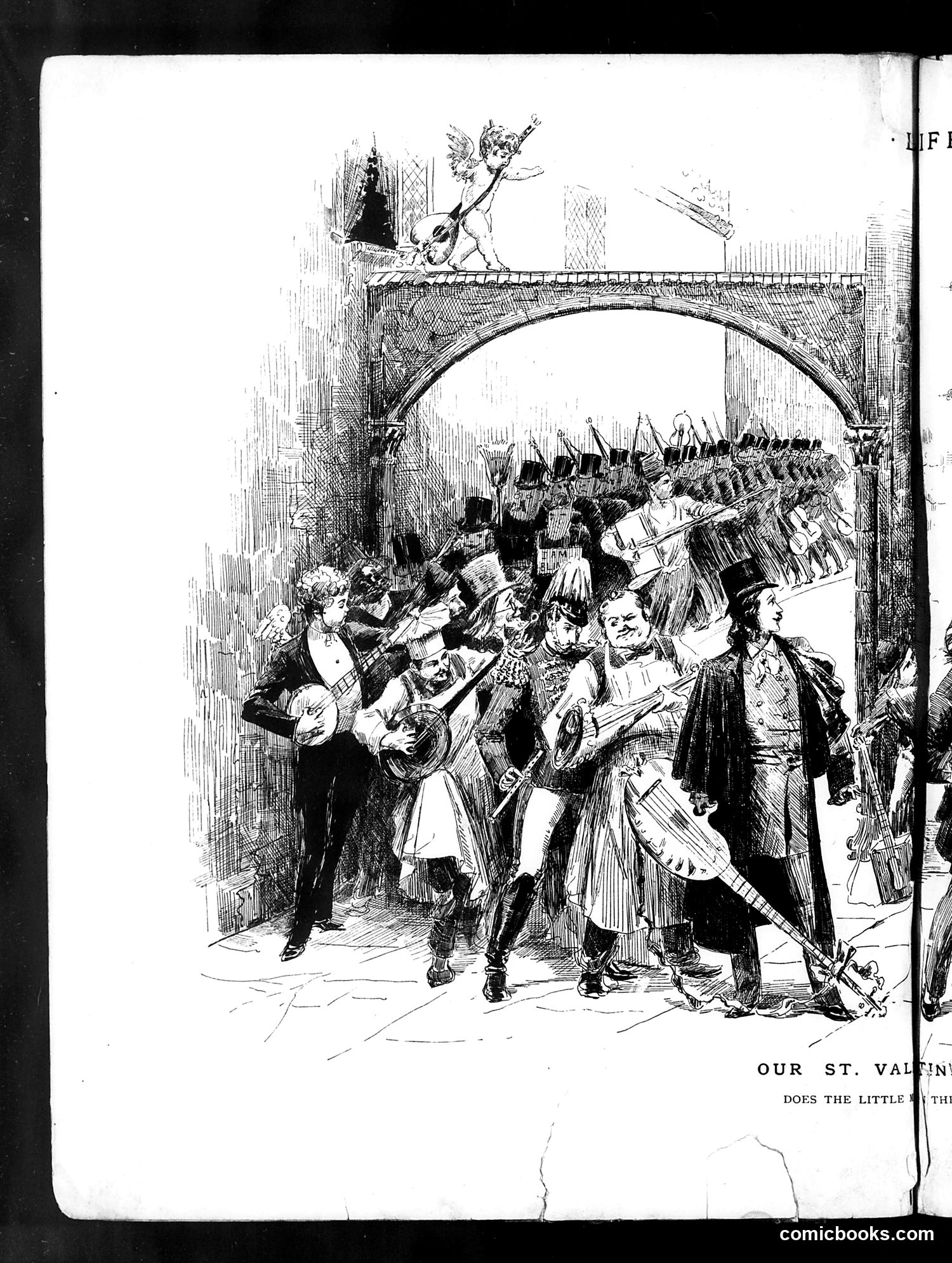
This is a satirical illustration titled "OUR ST. VALENTINE / DOES THE LITTLE..." (text is cut off). The image depicts a military band or procession passing under an arch, with soldiers playing various instruments marching in formation. A cherub or cupid figure sits atop the arch above them. The satire appears to be a Valentine's Day joke that subverts romantic expectations by replacing typical sentimental imagery with militaristic pageantry. Instead of traditional romantic symbols, we see uniformed soldiers with instruments—transforming the holiday associated with love into one of martial display. The reference to "St. Valentine" combined with military imagery suggests commentary on how institutions or authority figures co-opt or reframe romantic ideals, though the specific historical context remains unclear from the visible text alone.
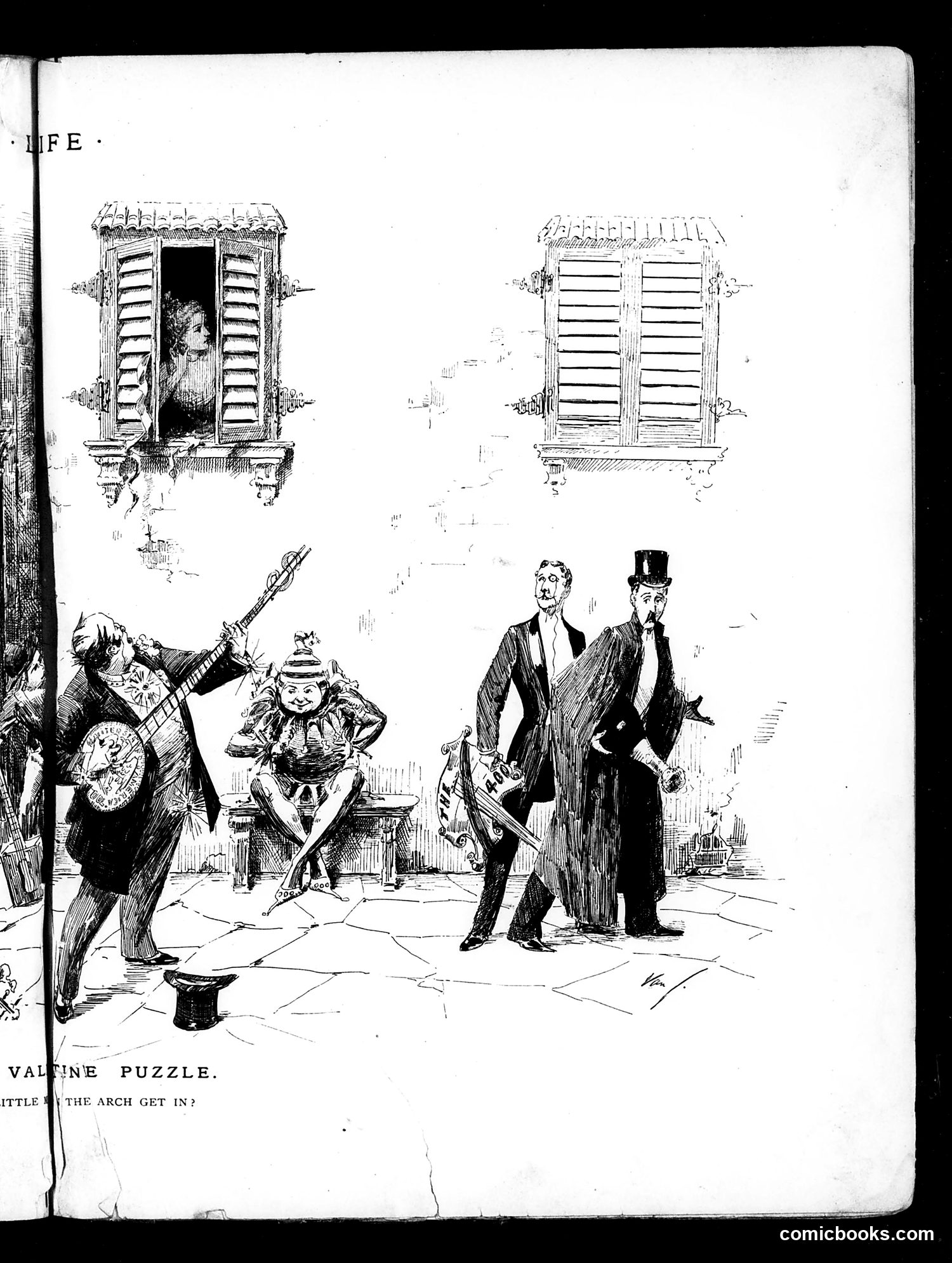
This is a satirical Valentine's Day puzzle cartoon from *Life* magazine. The scene depicts four figures in front of Parisian architecture (the arch and shuttered windows suggest the Arc de Triomphe area). The "puzzle" appears to be a visual gag about whether a rotund, elaborately dressed military or political figure (left, with musical instrument) can fit through the architectural arch—a joke about his considerable girth. The other figures—including what appears to be a fashionable woman and two gentlemen in formal dress—observe the predicament. Without knowing the specific historical moment, the cartoon likely mocks a particular public figure's physical appearance or political pretensions. The Valentine's Day framing adds romantic/social commentary to the satire, though the exact reference remains unclear without additional context.
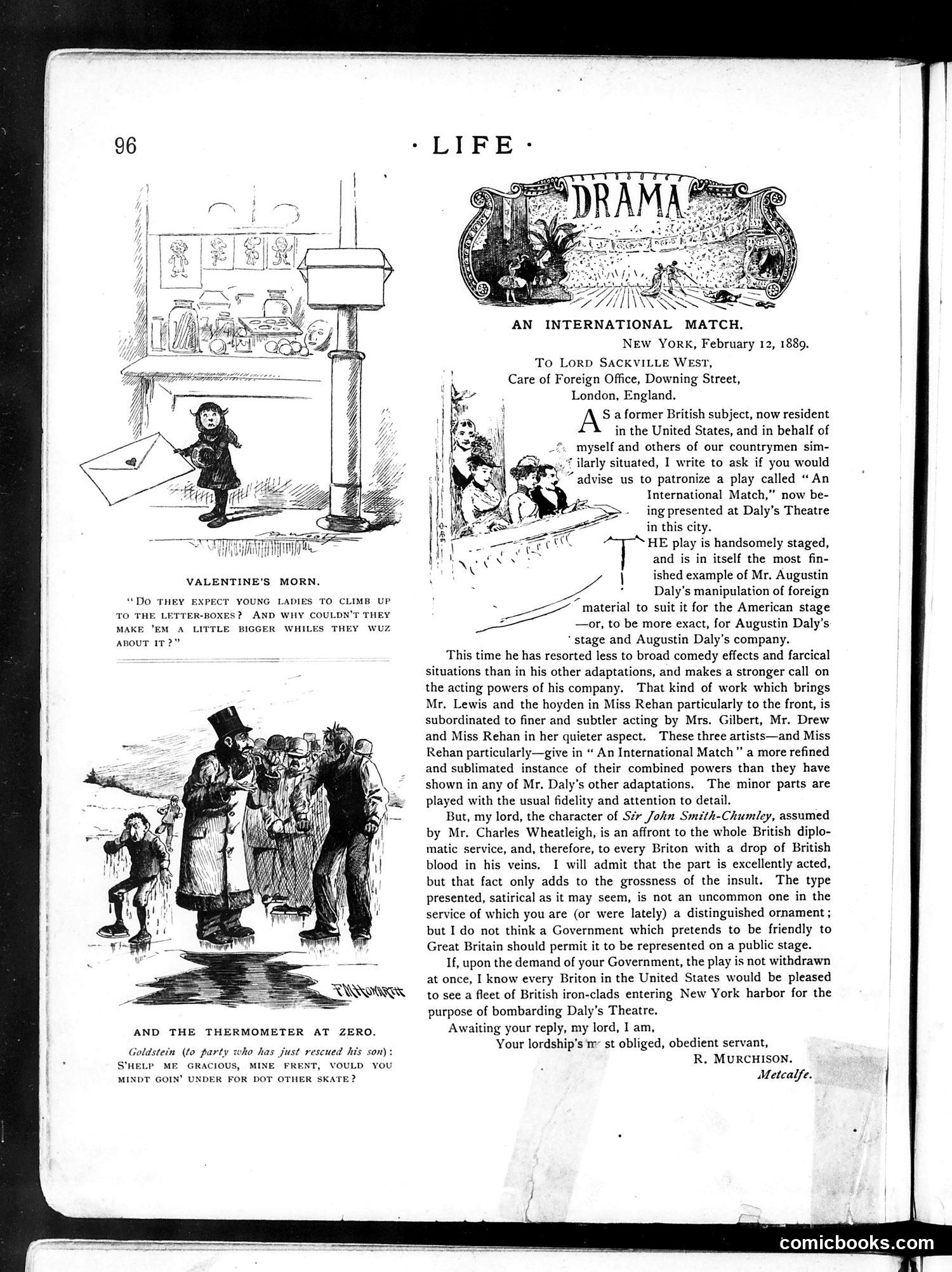
This page contains satirical commentary on a theatrical production. The main feature is a mock-formal letter to Lord Sackville West (Britain's diplomat in the U.S.) protesting a play called "An International Match" at Daly's Theatre. The satire targets a character named Sir John Smith-Chumley, played by Charles Wheatleigh, which the letter claims offensively stereotypes British diplomats. The writer humorously threatens that if the play isn't withdrawn, British warships should bombard the theatre—obviously absurd hyperbole mocking overprotective national pride. The three small cartoons on the left are unrelated comic sketches: "Valentine's Morn" jokes about letter-boxes, "And the Thermometer at Zero" shows Goldstein making a pun about ice-skating, and the top shows children near toys. The satire aims at both theatrical adaptation practices and stuffy diplomatic sensibilities—poking fun at how seriously nations treated theatrical representations.
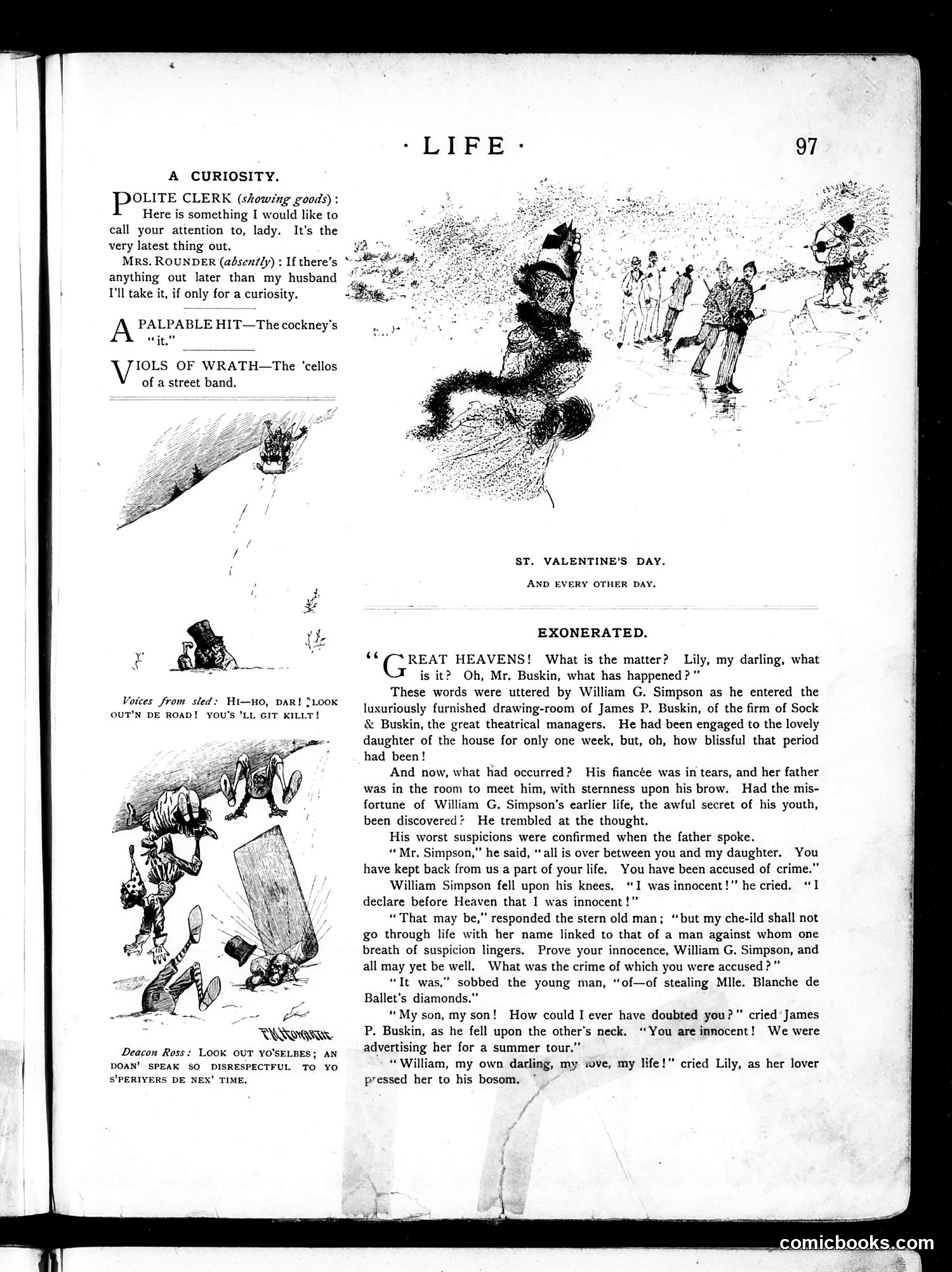
This page contains three brief satirical items and one longer comedic story. **Top cartoons:** Quick jokes about social awkwardness. "A Curiosity" mocks a married woman so neglectful of her husband she'd collect him as a curiosity if he actually stayed out. "A Palpable Hit" and "Viols of Wrath" are wordplay-based visual gags (cockney speech, street musicians). **Main story "Exonerated":** A melodramatic parody of theatrical romance plots. William Simpson's fiancée's father discovers he was *accused* of stealing diamonds from a dancer (Mlle. Blanche de Ballet). The "crime" is immediately forgiven when the father realizes she was merely an advertising attraction for a summer tour—implying the dancer was a promotional gimmick, not a real person of importance. The satire mocks both theatrical melodrama and the disposability of performers in entertainment marketing.
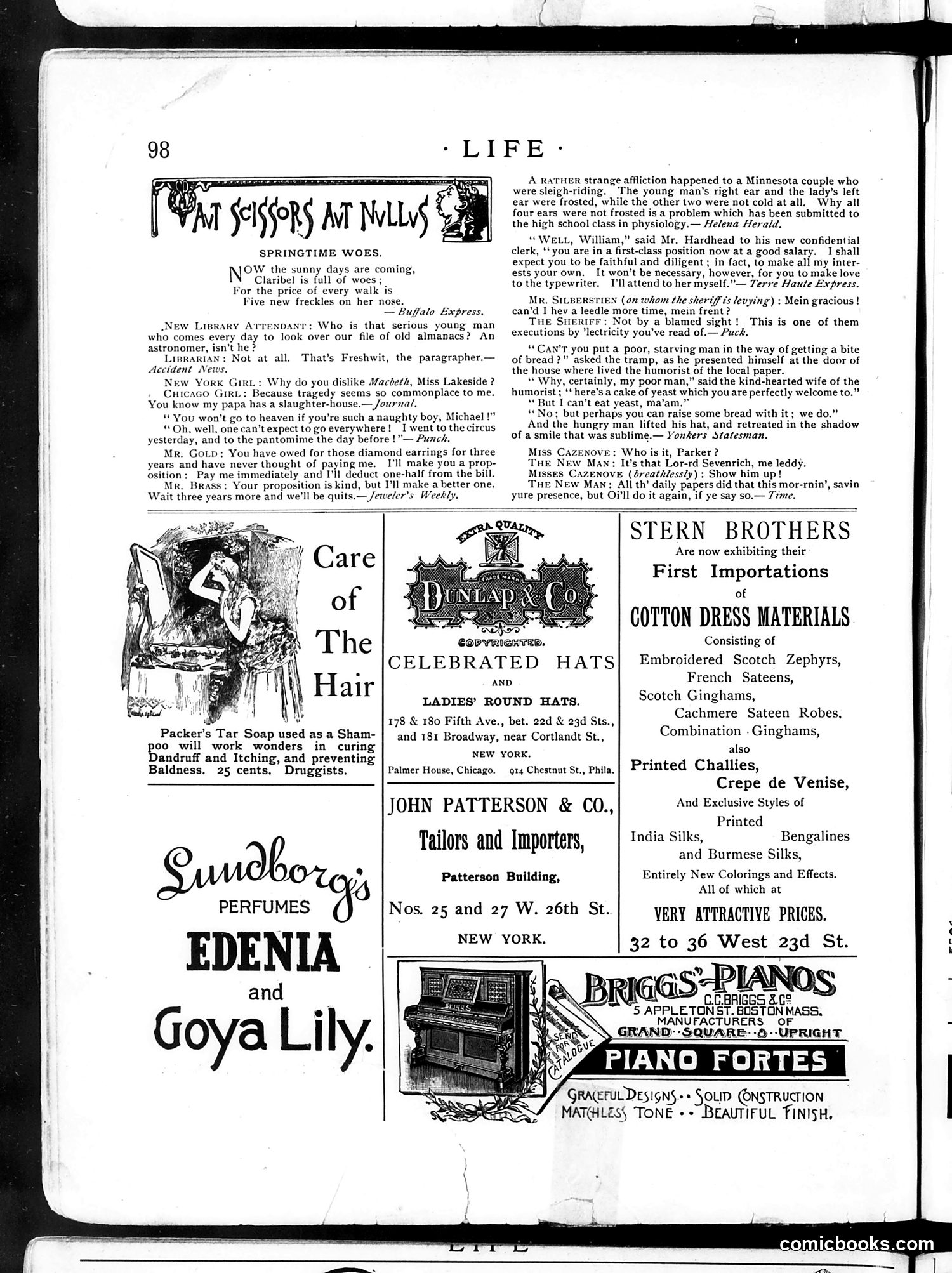
This page from *Life* magazine contains a collection of brief satirical jokes rather than a single cartoon. The humor relies on wordplay and social observation typical of late 19th-century American magazines. Key jokes include: - **"Springtime Woes"**: A girl named Claribel gets freckles from outdoor walks—mocking vanity and the era's beauty standards. - **The Library Attendant joke**: A young man consults old almanacs daily; the punchline suggests he's checking horoscopes or seeking astrological guidance—satire on pseudoscience. - **The Chicago Girl's comment**: Her father owns a slaughterhouse, so witnessing theatrical tragedy seems mundane—dark humor about desensitization to violence. - **The Jeweler exchange**: A debtor proposes waiting longer for payment; the creditor counters by suggesting he wait even longer—mocking both procrastination and deadbeat behavior. - **The yeast cake**: A humorist's wife "helpfully" gives a starving tramp yeast instead of food, then quips about "raising" bread—cruel wordplay at poverty's expense. The page is primarily **advertisements** for clothing, pianos, and toiletries.
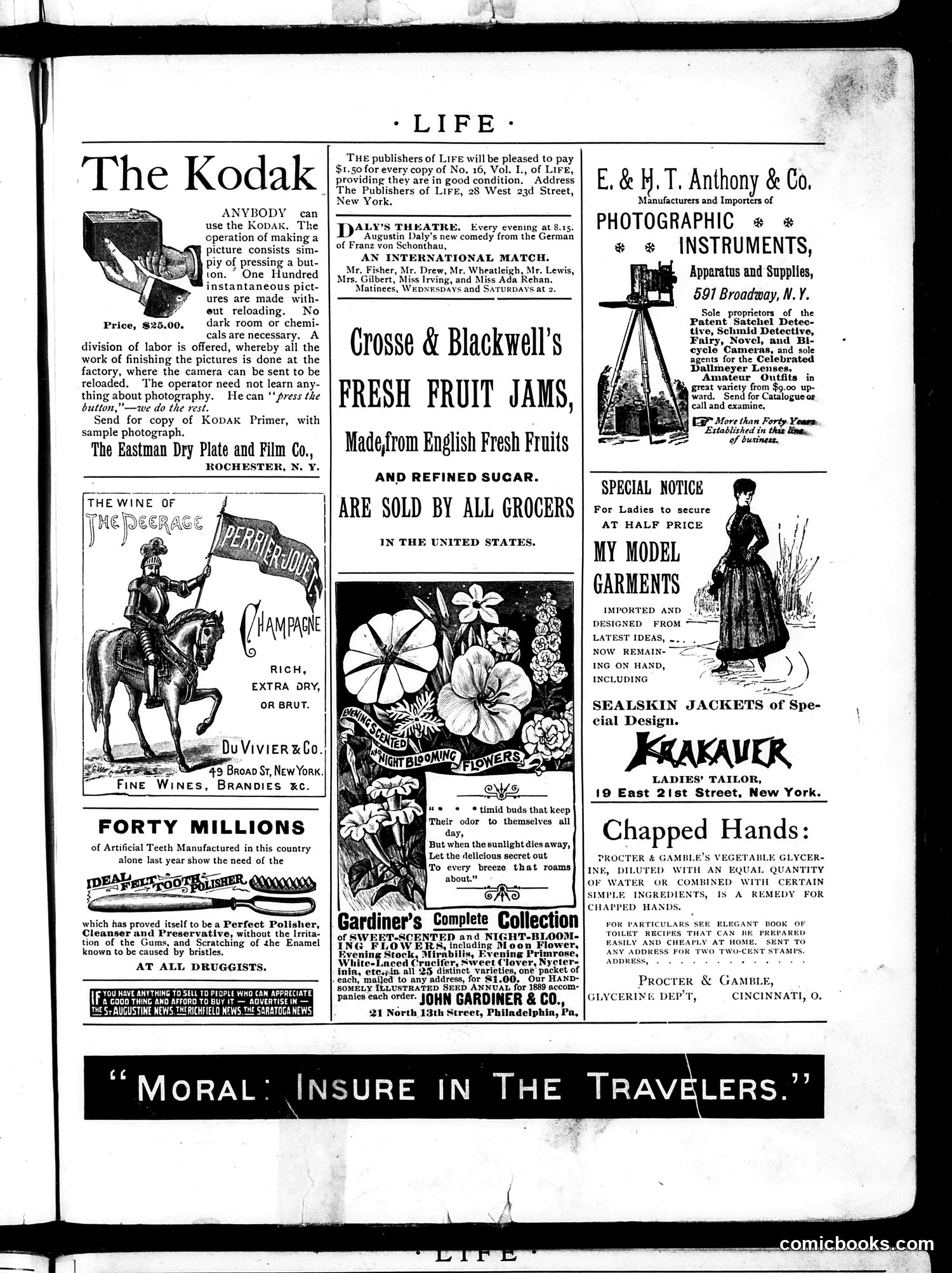
This is primarily a **late 19th-century advertisement page** with no apparent political satire or editorial cartoons. The dominant image is a **floral still life** (likely decorative rather than satirical) promoting Gardiner's seed collection. The actual content is commercial advertising for products including Kodak cameras, champagne, tooth polish, jam, photographic equipment, women's garments, and glycerine hand cream. The one exception appears at the bottom: a tagline stating "MORAL: INSURE IN THE TRAVELERS," which is itself an advertisement for insurance, presented in the style of a moral or lesson—making light mockery of the "moral" format while promoting their product. **For modern readers:** This page reflects an era when satirical magazines like *Life* mixed editorial content with substantial advertising revenue. The only hint of satire is the tongue-in-cheek "moral" framing of a commercial message—a mild joke about extracting lessons from everyday commerce.
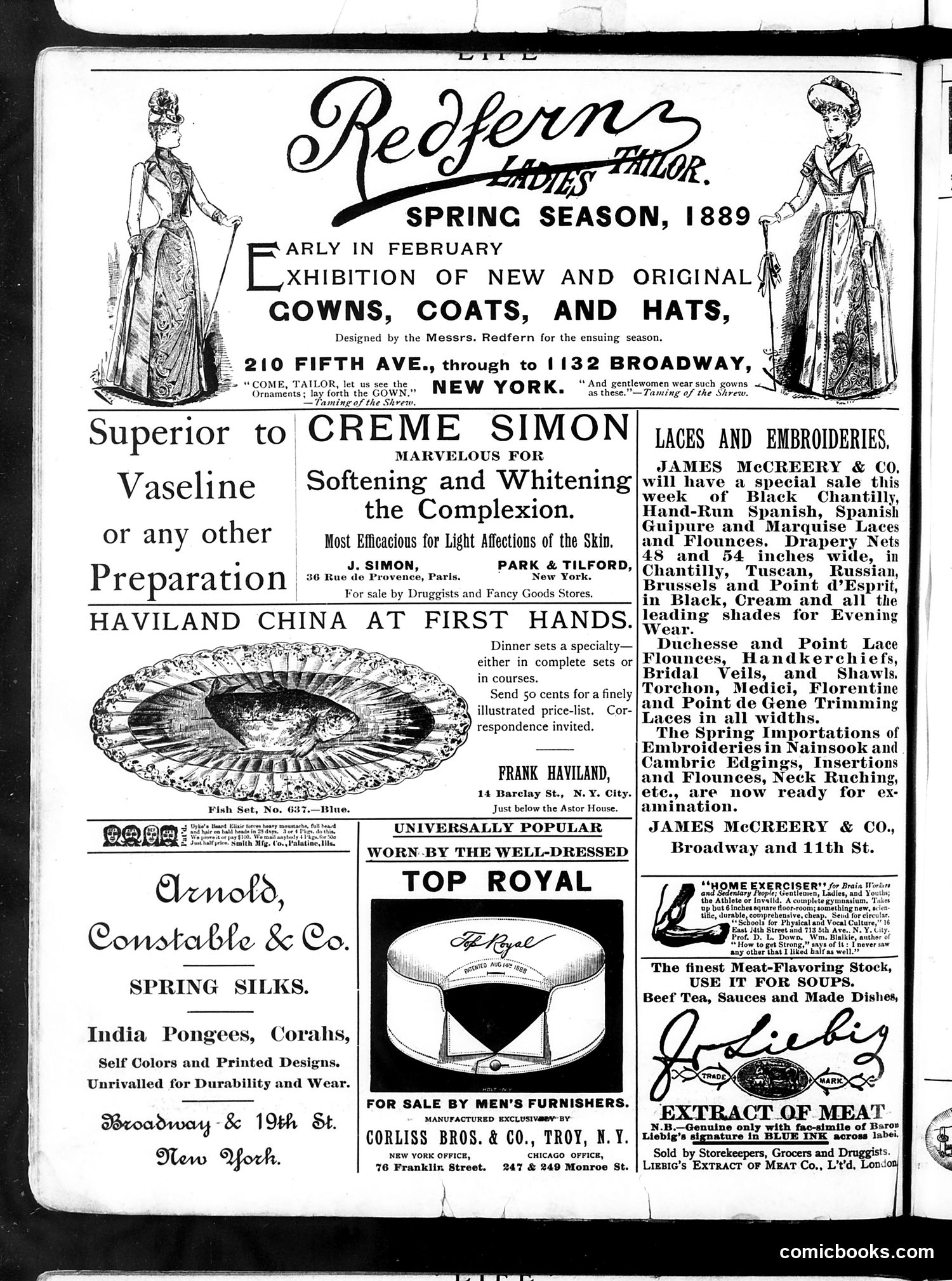
This is primarily a **advertisements page**, not a satirical cartoon. It showcases luxury goods for the 1889 spring season, targeting affluent readers. The page opens with **Redfern's fashion house** announcing new gowns, coats, and hats (with a Shakespeare quote about fine garments). Below are ads for beauty products (Crème Simon for skin whitening—reflecting period beauty standards), **Haviland china**, **spring silks**, and **lace imports**. The "Top Royal" ad features a men's hat, while **Liebig's Extract of Meat** (a popular meat-flavoring product) and **James McCreery & Co.** department store ads round out the page. **No political satire is present**—this is commercial content typical of *Life* magazine's revenue model, mixing editorial content with advertisements for goods targeting wealthy consumers in 1880s New York.
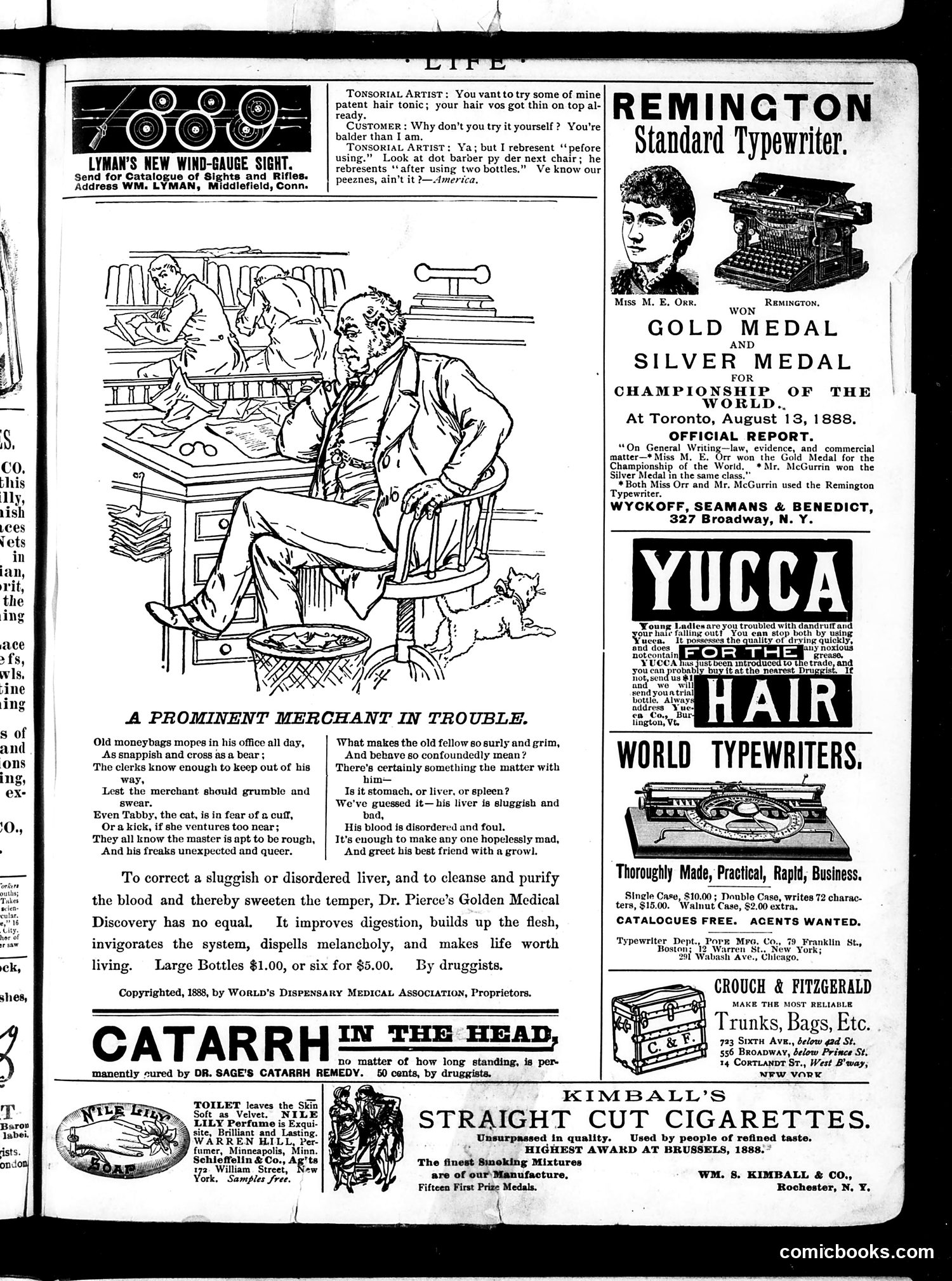
This cartoon satirizes the folk medical belief that bad temperament stems from physical illness rather than character. The wealthy merchant is depicted as perpetually angry and abusive—snapping at clerks, even kicking the cat. The accompanying verse suggests his irritability isn't moral failing but rather a liver disorder or "sluggish blood." The joke targets both the merchant's behavior and the era's medical pseudoscience: his grumpiness is "explained away" as a physical ailment. The caption then pivots to advertising Dr. Pierce's Golden Medical Discovery as the cure, suggesting that Victorian-era patent medicines promised to reform moral character through bodily correction. The satire cuts both ways—mocking the merchant's boorishness while also gently ribbing the quack-medicine industry's tendency to pathologize personality flaws as treatable diseases.
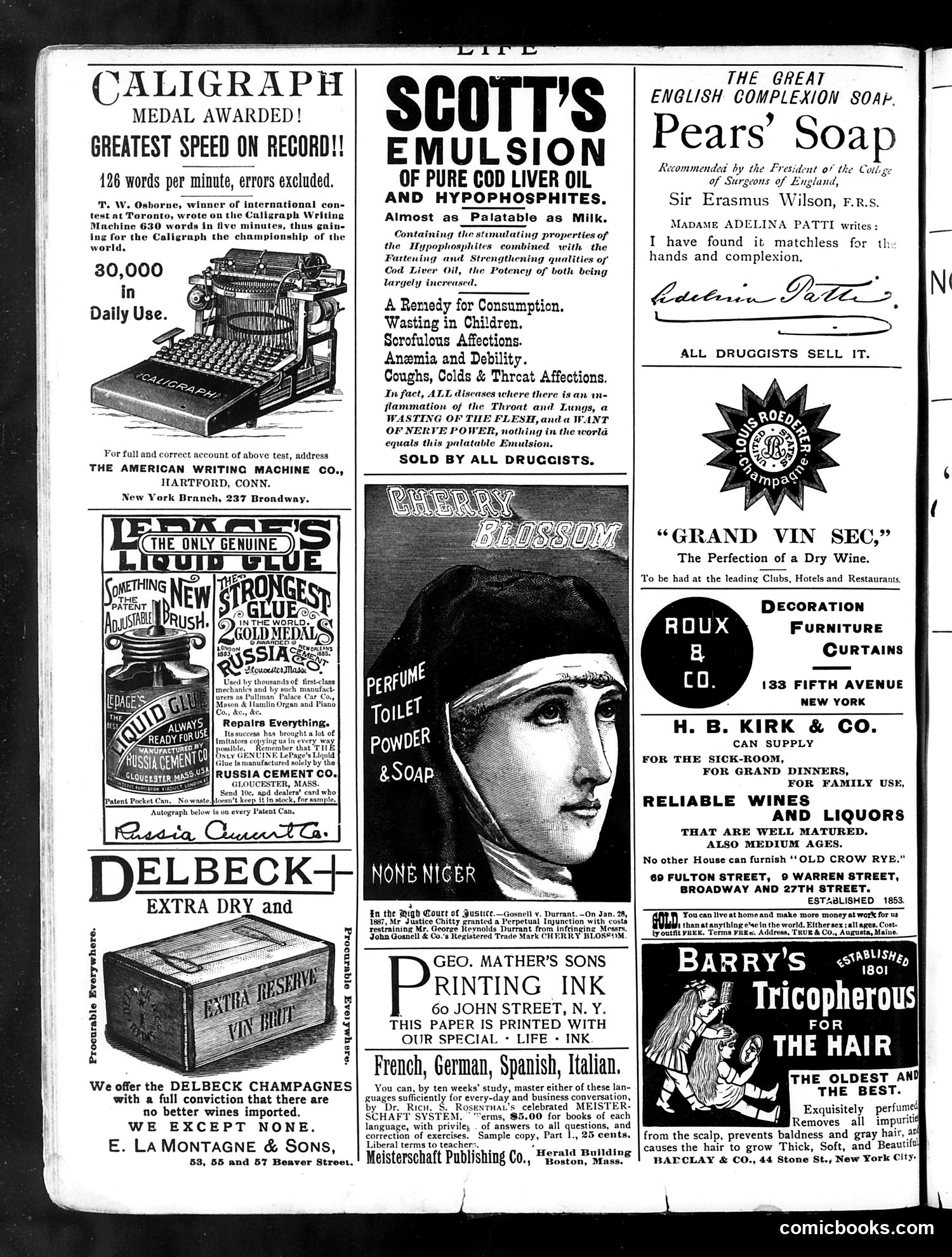
This is primarily an **advertisement page**, not a political cartoon. It contains vintage product ads from approximately the 1880s-1890s, with no satire or political commentary. Notable advertisements include: - **Caligraph typewriter**: Claims speed record of 126 words per minute - **Scott's Emulsion**: Cod liver oil remedy marketed for consumption, wasting, and various ailments - **Pears' Soap**: "Great English Complexion Soap" endorsed by Sir Erasmus Wilson and opera singer Adelina Patti - **Delbeck Champagne**: Wine merchant advertisement - **Barry's Tricophorous**: Hair treatment product - Various other products (printing ink, furniture, wines, language instruction) The page reflects **Victorian-era medicine and consumer culture**—note the dubious health claims for Scott's Emulsion treating serious diseases. The celebrity endorsements (Patti, Wilson) were typical marketing of the period. There is no cartoon content or satirical intent visible on this page.
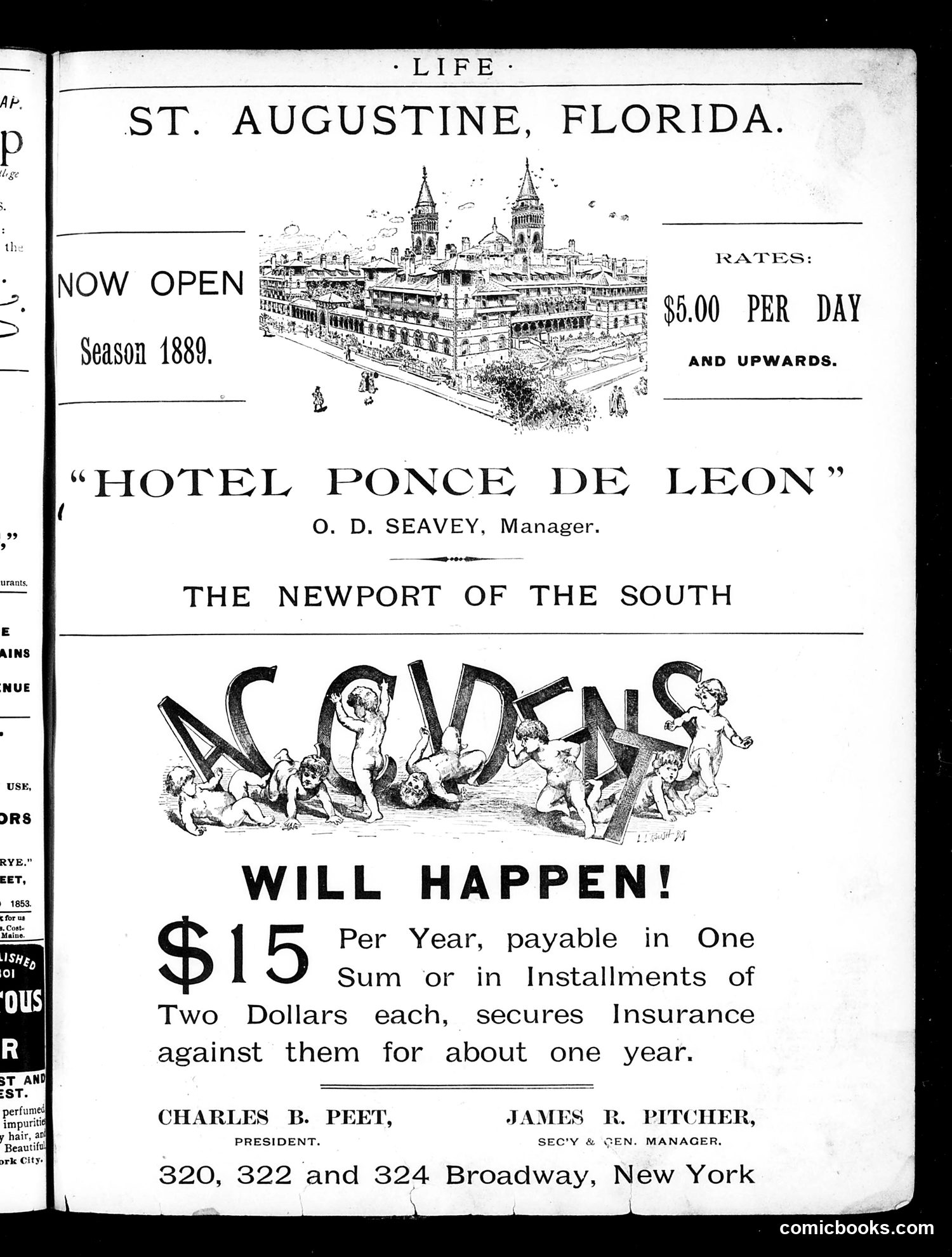
This page contains two distinct advertisements rather than political satire. **Top section:** A hotel advertisement for the Hotel Ponce de Leon in St. Augustine, Florida, promoting its opening for "Season 1889" at $5+ per day, marketed as "The Newport of the South"—positioning it as an upscale Southern resort rival to Newport, Rhode Island's wealthy establishment. **Bottom section:** An insurance advertisement featuring cherubs playing among large letters spelling "ACCIDENTS WILL HAPPEN!" The ad offers accident insurance for $15 yearly (or $2 installments), protecting against "accidents for about one year." The cherub imagery appears designed to make a serious topic (accidental death/injury) whimsical and palatable for Victorian audiences. The advertiser's offices were located in New York, suggesting national distribution of this insurance product during an era before widespread safety regulations.
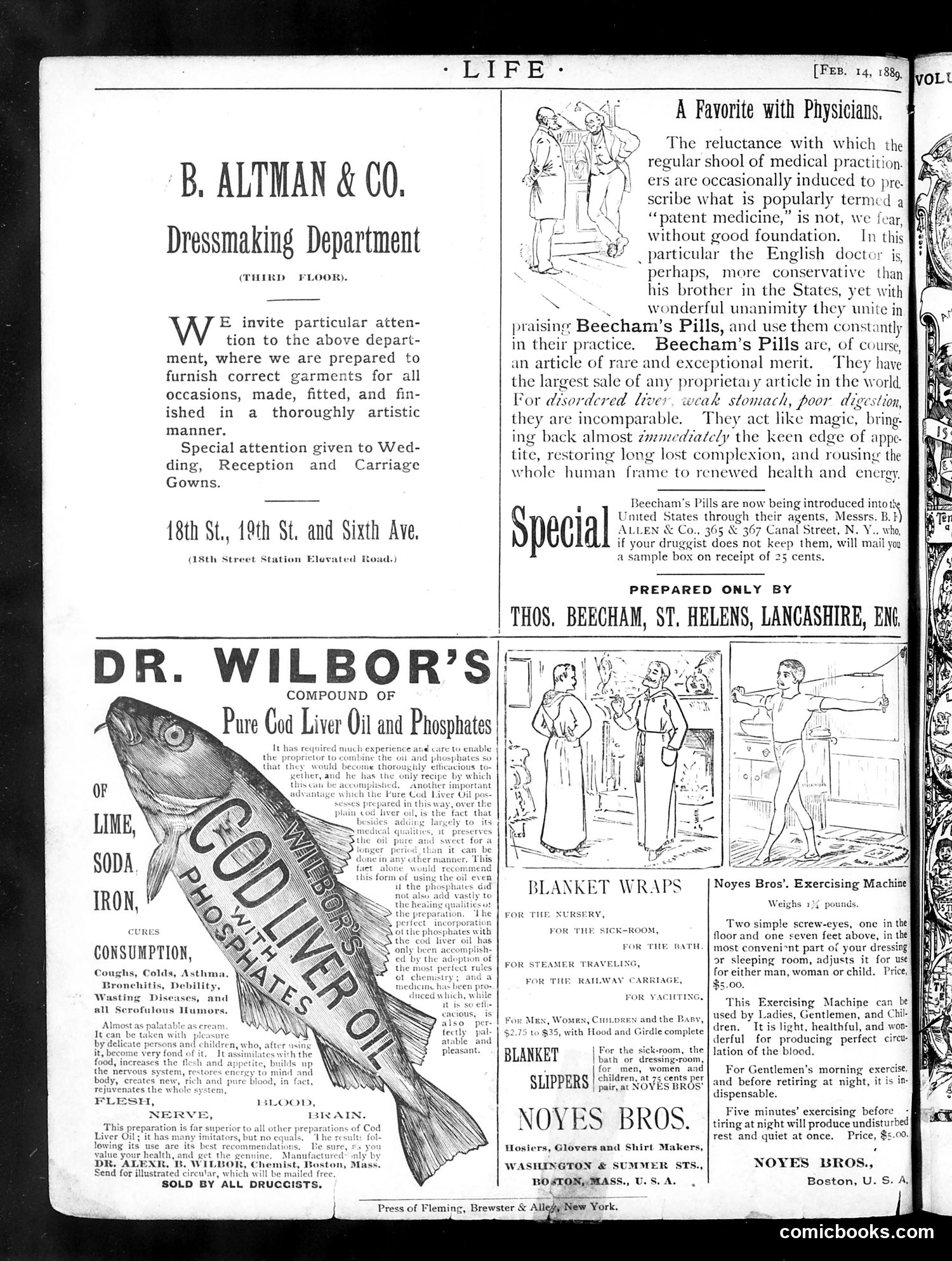
This page is primarily **advertising**, not satirical content. It contains four commercial advertisements typical of late-19th-century American magazines: 1. **B. Altman & Co.** (dressmaking) — a New York department store soliciting business for custom garments 2. **Beecham's Pills** — a British patent medicine claiming to cure digestive disorders and liver problems, marketed as endorsed by physicians despite the medical establishment's general skepticism of "patent medicines" 3. **Dr. Wilbor's Compound** — a cod liver oil supplement marketed for consumption and various ailments 4. **Noyes Bros.' Exercising Machine** — a home exercise device using rope and pulleys, promoted for health and circulation The page reflects the era's widespread marketing of patent medicines and health products with extravagant health claims, before modern FDA regulations. The ironic note about doctors reluctantly endorsing patent medicines (Beecham's Pills section) subtly acknowledges contemporary skepticism about such products' efficacy.