
Life, 1889-02-14 · page 13 of 20
Life — February 14, 1889 — page 13: what you’re looking at
What you’re looking at
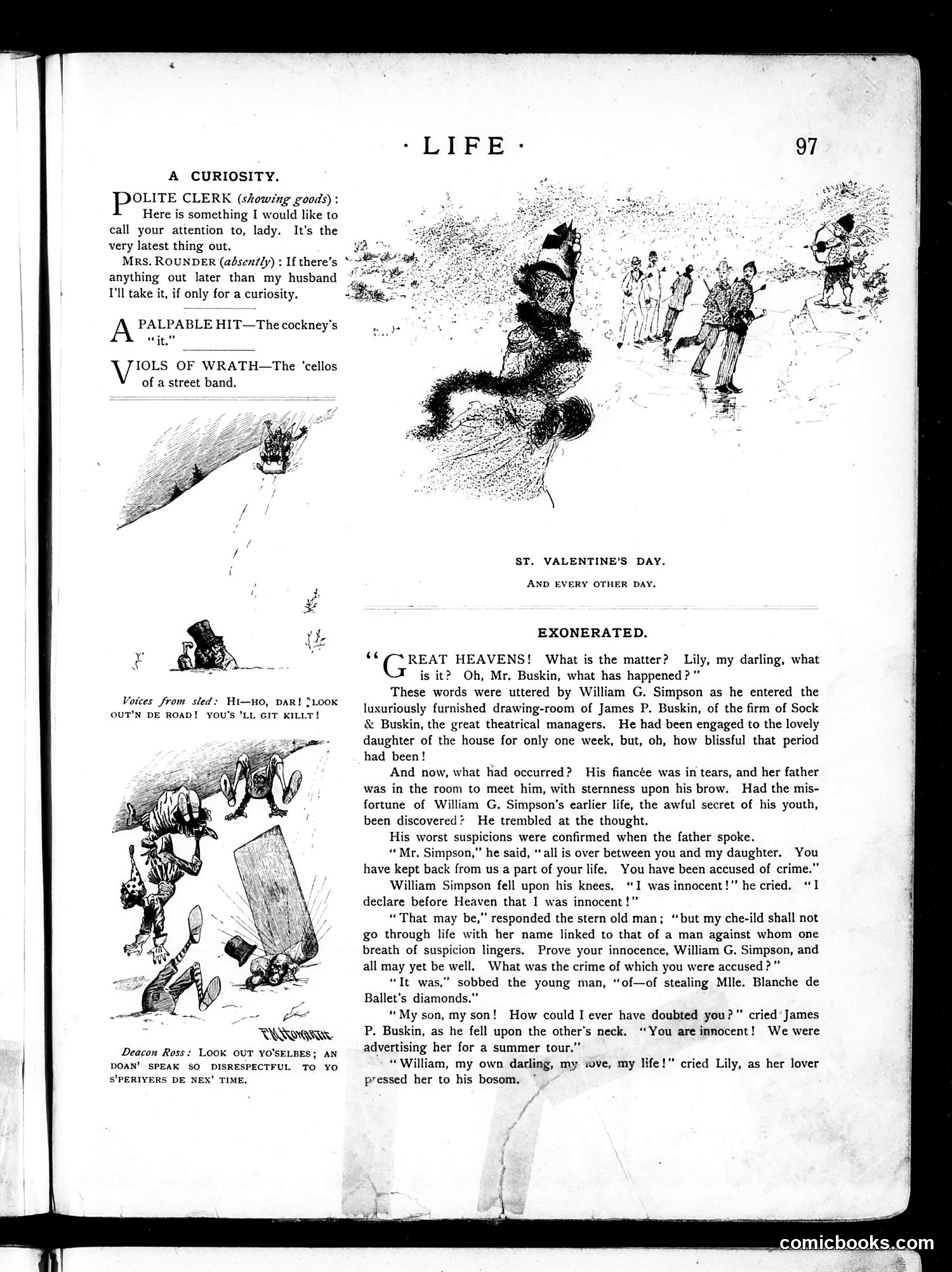
This page contains three brief satirical items and one longer comedic story. **Top cartoons:** Quick jokes about social awkwardness. "A Curiosity" mocks a married woman so neglectful of her husband she'd collect him as a curiosity if he actually stayed out. "A Palpable Hit" and "Viols of Wrath" are wordplay-based visual gags (cockney speech, street musicians). **Main story "Exonerated":** A melodramatic parody of theatrical romance plots. William Simpson's fiancée's father discovers he was *accused* of stealing diamonds from a dancer (Mlle. Blanche de Ballet). The "crime" is immediately forgiven when the father realizes she was merely an advertising attraction for a summer tour—implying the dancer was a promotional gimmick, not a real person of importance. The satire mocks both theatrical melodrama and the disposability of performers in entertainment marketing.
📄 Transcribed text from this page (OCR, searchable)
Machine-transcribed from the original scan — historical spelling and the odd misread are preserved.
A CURIOSITY. OLITE CLERK (showing goods) : Here is something I would like to call your attention to, lady. It’s the very latest thing out. Mrs. ROUNDER (adsently) : If there’s * anything out later than my husband I'll take it, if only for a curiosity. PALPABLE HIT—The cockney's cs (le IOLS OF WRATH—The ‘cellos of a street band. Voices from sled: Hi—H0, DAR! [LOOK OUT'N DE ROAD! YOU'S 'LL GIT KILLT! NAGE. Deacon Ross: LOOK OUT YO'SELBES; AN DOAN’ SPEAK SO DISRESPECTFUL TO YO S'PERIYERS DE NEX’ TIME. ST. VALENTINE’S DAY. AND EVERY OTHER DAY. EXONERATED. REAT HEAVENS! What is the matter? Lily, my darling, what is it? Oh, Mr. Buskin, what has happened?” These words were uttered by William G. Simpson as he entered the luxuriously furnished drawing-room of James P. Buskin, of the firm of Sock & Buskin, the great theatrical managers. He had been engaged to the lovely daughter of the house for only one week, but, oh, how blissful that period had been! And now, what had occurred? His fiancée was in tears, and her father was in the room to meet him, with sternness upon his brow. Had the mis- fortune of William G. Simpson's earlier life, the awful secret of his youth, been discovered? He trembled at the thought. His worst suspicions were confirmed when the father spoke. “Mr. Simpson,” he said, “all is over between you and my daughter. You have kept back from us a part of your life. You have been accused of crime.” William Simpson fell upon his knees. “I was innocent!” he cried. “I declare before Heaven that I was innocent!” “That may be,” responded the stern old man; “but my che-ild shall not go through life with her name linked to that of a man against whom one breath of suspicion lingers. Prove your innocence, William G. Simpson, and all may yet be well. What was the crime of which you were accused?” “It was,” sobbed the young man, “of—of stealing Mlle. Blanche de Ballet’s diamonds.” “My son, my son! How could I ever have doubted you?” cried’ James P. Buskin, as he fell upon the other's neck. ‘You are innocent! We were advertising her for a summer tour.” “William, my own darling, my sve, my life!” cried Lily, as her lover pressed her to his bosom,